
In this article
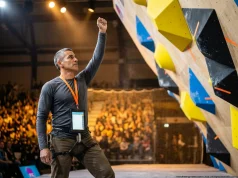
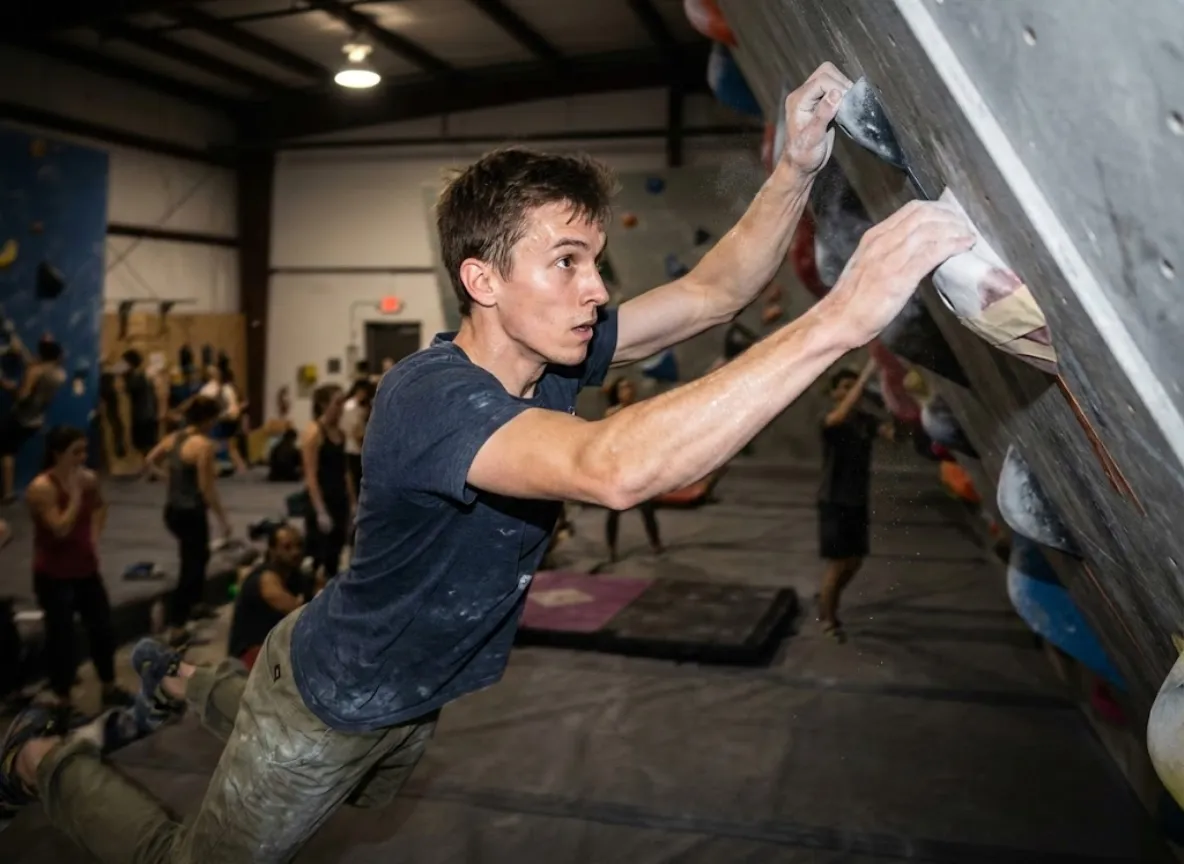
The ISO judge nods, the buzzer screams, and your four-minute window begins. At this precise moment, there is no time to build fitness, only to express it. A successful bouldering competition peak is not accidental; it is an architectural feat where muscular strength, neural recruitment, and metabolic buffering are stacked precisely to culminate on a single Saturday.
As a climbing coach, I often see athletes trying to train everything at once, resulting in a plateau rather than a peak. This holistic competitor’s blueprint transforms the chaos of general fitness into a focused physiological arrow, aiming squarely at your highest potential performance.
This 12-week bouldering competition peaking plan utilizes block periodization strategies. We will move from building tissue to teaching that tissue to fire explosively, finally sharpening your ability to recover between attempts on comp-style boulders.
The Physiology of Performance: Why We Separate Energy Systems?

How do specific energy systems dictate competition success?
Competition success dictates that we isolate energy systems because training them simultaneously creates an “interference effect,” diluting your body’s ability to adapt to either stimulus.
To understand why we prioritize block training, we must understand the three energy systems running under your hood:
- The Alactic Engine (ATP-PCr): This fuels the first 0-12 seconds of max effort. It powers the explosive dyno, the limit bouldering crux move, and the initial pull off the mat.
- The Lactic Reality (Glycolytic): Bouldering competition rotations last 4 to 5 minutes. Repeated attempts without full recovery force the body to rely on glycolysis. This produces metabolites that cause the “pump” and failure.
- The Aerobic Foundation: While rarely the power source for the move itself, the aerobic base is the recovery engine. It clears lactate and replenishes ATP during the 4-minute rest intervals between boulders.

Attempting to train limit bouldering (Alactic) and 4x4s (Lactic) in the same training session sends mixed signals to your physiological conditioning. Effective peaking requires isolating these systems into distinct mesocycles. Research on energy system contributions in indoor rock climbing confirms that while the alactic system powers the move, the aerobic system dictates how many times you can try it.
Our goal is to build a climber with the power to flash hard moves and the capacity to recover for a second attempt. This requires a smart rock climbing training program that respects biological timing and workout methodologies.
The 12-Week Architecture: Phases 1 & 2 (Structural to Neural)

How do we transition from structural integrity to maximal recruitment?
We transition by first increasing muscle cross-sectional area through volume (Phase 1) and then teaching the nervous system to recruit those fibers rapidly through high intensity (Phase 2).
Phase 1 (Weeks 1-4): Structural Hypertrophy
The objective of this strength phase is to increase the physical size and capacity of the finger flexors and pulling muscles. We utilize higher volume at moderate intensity (70-80%). The primary protocol involves “Repeaters” (7 seconds on, 3 seconds off) on a 20mm edge hangboard.
This phase conditions the tendons and builds the work capacity required for harder training blocks. Because the volume is high, we must place a heavy emphasis on antagonist muscles (push muscles) and posterior chain engagement. This prevents the structural imbalances that lead to injury when the intensity ramps up later.
Pro-Tip: Do not skip the “Prehab.” During Phase 1, finish every session with 15 minutes of wrist extension and shoulder stability work. Your elbows will thank you in Week 8.
Phase 2 (Weeks 5-8): Neural Recruitment
Now, the focus shifts entirely to increasing the Rate of Force Development (RFD). We want to recruit high-threshold motor units that were built in Phase 1. Volume drops significantly, but the intensity spikes.
We switch protocols to 10-second Max Hangs at 90% effort and 1-3 move limit bouldering sequences with full rest. A systematic review on determinants for success in climbing highlights the direct correlation between these finger strength metrics and performance levels.
You should implement specific rock climbing finger training techniques like strict half-crimp max hangs to ensure safety at these loads.
Crucially, Week 4 and Week 8 serve as active recovery or “deload” periods. Reduce volume by 50% during these weeks to allow for supercompensation and tissue repair before the next training block duration.
Phase 3: Specificity & Modern Comp Fluency (Weeks 9-11)

How do we integrate coordination dynamics with metabolic capacity?
We integrate these elements by performing high-skill coordination drills while fresh, followed immediately by metabolic intervals to simulate decision-making under fatigue.
Power Endurance Transmutation
Having built the engine in Phases 1 and 2, we must now tune it for the track. Raw strength is useless if you pump out reaching for the finish hold. We transmute that strength into usable competition power endurance using 4×4 intervals. This involves climbing four moderate boulders back-to-back without rest, resting 4 minutes, and repeating for four sets.
To simulate the urgency of the final minute of a heat, we use “Every Minute on the Minute” (EMOM) drills. These force you to execute moderately hard moves with incomplete alactic recovery, mimicking the time limit pressure.
The Modern Skill Gap
Modern comp fluency demands more than just pulling power; it requires complex proprioception. We must integrate “paddle dynos,” “double-dynos,” and parkour style coordination moves into warm-ups and limit sessions.
If your local gym lacks comp-style boulders, use a spray board, woody, or Tension Board to create awkward, contorted beta. Biomechanics research on dynamic movement indicates that this coordination requires distinct neural firing patterns compared to static loading.
If you struggle with aerial body awareness, dedicate time to learning how to dyno climbing specifically for volume-style problems.
Pro-Tip: Adopt the “Flash Mindset” during this phase. Stop projecting. Allow yourself only one attempt on a new boulder to train immediate beta execution. If you fall, move on.
Phase 4: The Taper & Tactical Execution (Week 12)

What is the 60/40 rule for peaking and tactical readiness?
The 60/40 rule states that in the final week, training volume should decrease by 60%, while intensity remains at 90-100% to maintain neurological priming.
The Taper Protocol
Many climbers mistake tapering for resting. If you stop climbing completely, you will feel “flat” on competition day. In Week 12, we reduce the total number of moves significantly (dropping volume by 60%). However, the moves you do execute must be quality over quantity and high intensity.
This reduction allows systemic fatigue to dissipate. According to the NSCA, a pre-comp taper period is optimal for maximizing strength-power performance. You are shedding fatigue to reveal your fitness.
Tactical Considerations
Competition climbing is as much about strategy as it is about strength. You must understand the isolation rules and the guide to ifsc formats scoring rules rounds to make smart decisions. For example, prioritizing a Zone hold (or bonus hold) is often better than wasting energy on a low-percentage Top move.
During the 2-minute observation period, focus on route reading and deciphering beta from the Top down. Look for hidden volumes or dual-tex holds that aren’t obvious from the mat.
Gear, Skin, and Logistics

How do equipment choices and logistics impact the scorecard?
Equipment and logistics impact the scorecard by optimizing friction and energy levels; the wrong shoes or a blood sugar crash can cause a fall regardless of physical strength.
Shoe Strategy
With the physical plan set, we must address the variables outside your body. Do not rely on a single pair of climbing shoes. I recommend rotating between soft shoes for volume-heavy qualifiers where smearing is key, and stiffer shoes for crimpy finals or slab walls. Understanding the nuances of friction is vital, so consult a definitive climbing shoe rubber guide to build your quiver.
Skin and Nutrition
Skin maintenance is a daily ritual. Use sandpaper to file down calluses flush with the skin to prevent “flappers” on sharp holds. If you are prone to sweating, apply antihydral agents cautiously in the weeks leading up to the bouldering challenge.
Regarding fuel, the International Society of Sports Nutrition validates caffeine’s effect on anaerobic performance. A protocol of 3-6mg/kg taken 45 minutes prior to the isolation window can peak alertness during your performance window. Combine this with simple sugars (gels or gummies) immediately after a rotation to replenish glycogen for the next boulder.
Conclusion
A competition peak is a temporary state of physiological brilliance. By following this 12-week architecture, you move from the general construction of muscle tissue to the specific sharpening of neural drive and metabolic efficiency.
Remember the phases:
- Build structural capacity (Strength Phase).
- Recruit that capacity (Max Effort).
- Transmute it into specific movement (Power Endurance).
- Taper to reveal the peak (Rest & Priming).
The training is logged. The taper week is complete. Your bag is packed. Now, the only variable left to control is your execution.
FAQ – Frequently Asked Questions
How long before a bouldering competition should I stop training?
You should not stop completely, as this leads to flatness and loss of recruitment. Instead, taper your volume by 60% in the final week while maintaining high intensity in short bursts (e.g., a few hard flash attempts) to keep your nervous system primed.
What is the best workout for bouldering power endurance?
The 4×4 protocol is the gold standard for climbing-specific workouts. Select four moderate boulders (slightly below your flash level). Climb them back-to-back without rest. Rest 4 minutes. Repeat this cycle for 4 total sets. This specifically targets the anaerobic lactic system used in bouldering competitions.
Should I do cardio for bouldering competitions?
Low-intensity aerobic work (like ARC traversing) aids recovery between attempts by flushing lactate. However, long-distance running is generally counterproductive as it generates fatigue that competes with the leg power recovery needed for explosive moves.
How do I prevent flash pump during a comp?
Flash pump is often caused by event psychology issues like anxiety and skipping a warm-up. Ensure a thorough 45-minute progressive warm-up routine in isolation to dilate capillaries. Use breathwork to regulate adrenaline before stepping onto the mat to keep your heart rate managed.
Safety Notice: Rock climbing and mountaineering are inherently high-risk
activities that can involve physical trauma or fatal incidents. The information on Rock Climbing Realms is for
educational and informational purposes only. Techniques and advice presented here are not a substitute
for professional, hands-on instruction. Conditions and risks vary by location. Always seek guidance
from a qualified instructor before attempting new techniques. By using this website, you agree that you
are solely responsible for your own safety. Any reliance you place on this information is strictly
at your own risk, and you assume all liability for your actions. Rock Climbing Realms and its authors
will not be held liable for any harm, damage, or loss sustained in connection with the use of this information.
Affiliate Disclosure: We are a participant in the Amazon Services LLC Associates Program, an
affiliate advertising program designed to provide a means for us to earn advertising fees by advertising and linking
to Amazon.com. As an Amazon Associate, we earn from qualifying purchases. We are also an official affiliate partner
of Black Diamond Equipment via the AvantLink network. If you click on a Black Diamond affiliate link and make a
purchase, we may earn a commission at no additional cost to you. We also participate in other affiliate programs.
Additional terms are found in the terms of service.