

In this article
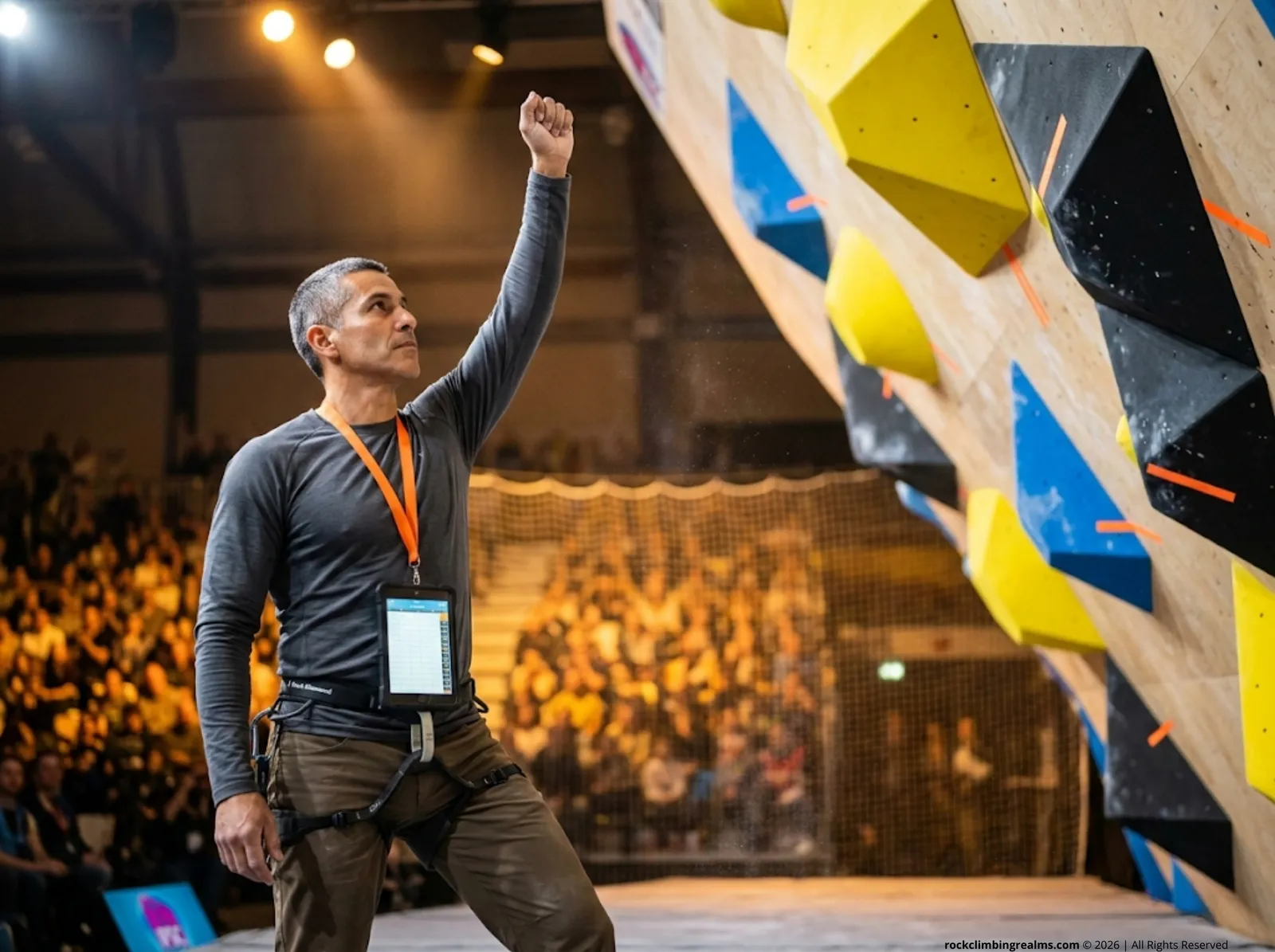
The heavy bass of the arena speakers is burying the crowd noise, the clock is at ten seconds, and the climber throws a desperate dyno to the final volume. They slap the edge with one hand, violently swing out, tap it momentarily with their trailing hand, and then plummet to the pads. The crowd screams for the finish. The climber looks at you, waiting for the raised hand. You have exactly two seconds to make the call: was that a controlled 25-point Top, or another -0.1 point fall?
After volunteering on the mats for over a dozen IFSC-sanctioned events and countless local citizens’ comps, I can tell you the hardest move in the gym is never on the wall. It is the split-second read you make from the ground while 200 people scream for a ruling you cannot reverse. The 2025 IFSC point-based system rewrote the playbook this season — the old hierarchy of Tops before Zones before attempts is gone. In its place is a continuous number line where every fall shaves exactly 0.1 points off your maximum.
This is your field manual for assigning points, managing technical incidents, and surviving your rotation as a competition judge — whether you are tracking a bouldering final on a tablet, calling lead hold numbers, or monitoring the stopwatch on a speed wall.
⚡ Quick Answer: Under the 2025 IFSC rules, bouldering awards 25 points for a Top and 10 for a Zone, with a -0.1 deduction per unsuccessful attempt. Lead climbing distributes 100 points across the top 40 holds, and a “+” adds 0.1 bonus for deliberate movement toward the next hold before a fall. Judges verify “control” by looking for stable, two-handed matching on finish holds, and must enforce start protocols, manage technical incidents, and coordinate brush breaks.
The 2025 Paradigm Shift: From Ordinal Ranks to Cardinal Math

The Baseline Arithmetic of 25 and 10
For decades, bouldering was judged by a simple hierarchy. Did the climber get the Top? If yes, how many attempts did it take? If not, did they reach the Zone? Tops always beat Zones, regardless of how messy the send was. That era is over.
The official 2025 IFSC Bouldering rules replaced that ordinal ranking with a 100-point scale per round. Each boulder in a final is worth 25 points. A perfect round across four problems maxes out at 100. The Zone hold is worth 10 points. Every time a climber peels off the wall and hits the pads, they lose 0.1 points from whichever scoring hold they eventually reach. Flash the Top on your first attempt and you walk away with 25.0. Fall five times before topping and you score 24.5. If you are understanding how these new numbers influence the overarching IFSC formats, you will see the entire tournament structure now hinges on this single formula.
Why the -0.1 Deduction Rewards Persistence
The IFSC spent two years stress-testing this number. A 1.0-point deduction per fall placed too much weight on flashes and not enough on reaching higher. By choosing 0.1, the governing organization guaranteed that reaching the Top will always outscore reaching the Zone, no matter how many attempts it takes. A climber who finally nails the Top on attempt 99 still earns 15.1 points — which outruns a competitor who flashed the Zone for 10.0.
One detail that trips up new officials: the -0.1 point deduction only applies if the climber eventually reaches a scoring hold. Five falls with no Zone means 0.0, not -0.5. The system never produces a negative score.
Pro tip: When the leaderboard gets tight, remind your volunteer team that the 0.1 system was built so they would not have to guess. Trust the universal competition scorecard app — whether you are using Climb Along, JudgeMate, or S.C.O.R.E. — to handle the countback logic when ties hit the qualifiers.
Resolving Ties with the “Countback” System
In the old days, tie-breaking was a four-dimensional headache: compare Tops, then Zones, then attempts to Top, then attempts to Zone. The 2025 system collapses that into a single continuous score. If two athletes remain tied after the round total, the countback protocol compares their individual boulder scores from best to worst. The climber with the higher single-boulder score wins. Your job is clean data entry — the software does the rest.
Bouldering Logistics: Managing the Four-Point Start
Verifying Tape Marks and Volume Bounds
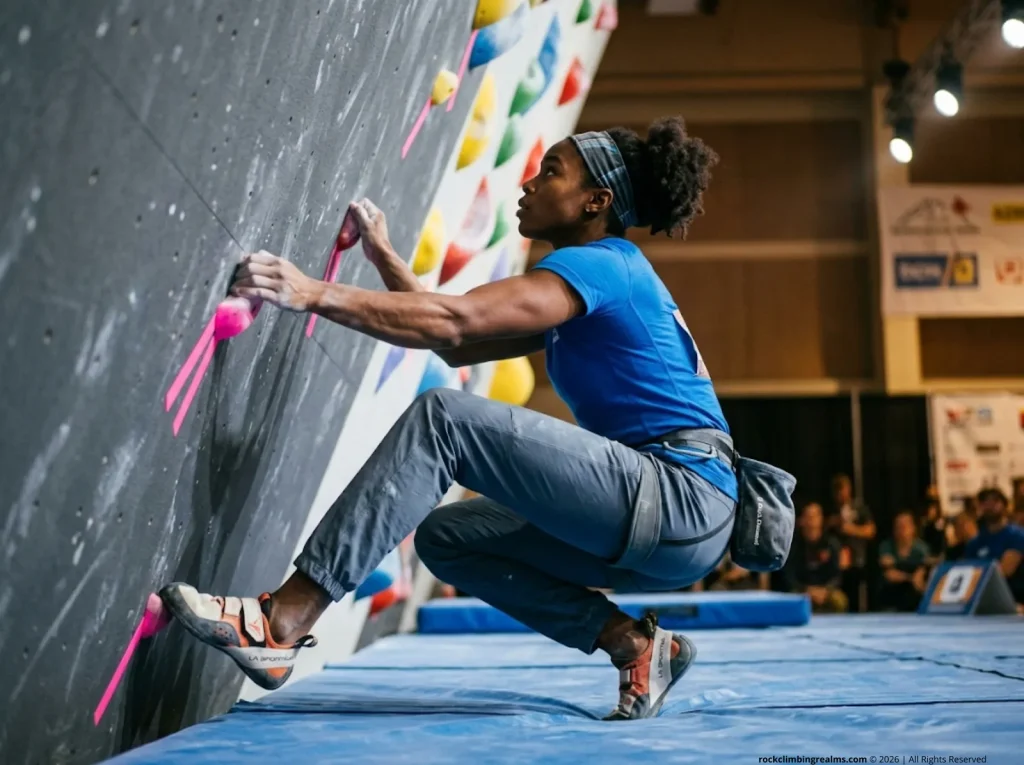
A valid bouldering attempt does not begin until the athlete has established a four-point start: both hands placed on marked start holds, both feet on designated footholds, and all weight off the crash pad. Modern comp problems mark these positions with colored tape, and the routesetters design them to force a precise position from the bottom. Understanding how setters approach competition bouldering setting logic will sharpen your eye for what constitutes legal positioning.
If a climber touches a non-start hold while establishing, uses a volume not designated in-bounds, or lets a foot drag on the pad after initiating, you must immediately terminate the attempt and record a fall. No grace period. The attempt counter goes up by one.
Catching the “Dab” Rule on Start Pads
One of the most commonly missed violations is the subtle foot dab. A climber establishes both hands, lifts off, but their heel brushes the crash pad as they set their feet. That is an invalid attempt. Wave the horizontal slashing signal and log the fall. Climbers will argue, especially during youth rounds, but the rule is clear: once you call the start, no limb or torso can touch the pad or the floor.
Pro tip: Watch the climber’s knees, not their hands. A frequent hard-to-catch violation is an athlete resting a kneecap on an unmarked volume. If skin touches unmarked plastic, that is an out-of-bounds contact and the attempt is over.
Establishing Control vs. “Slapping” the Start
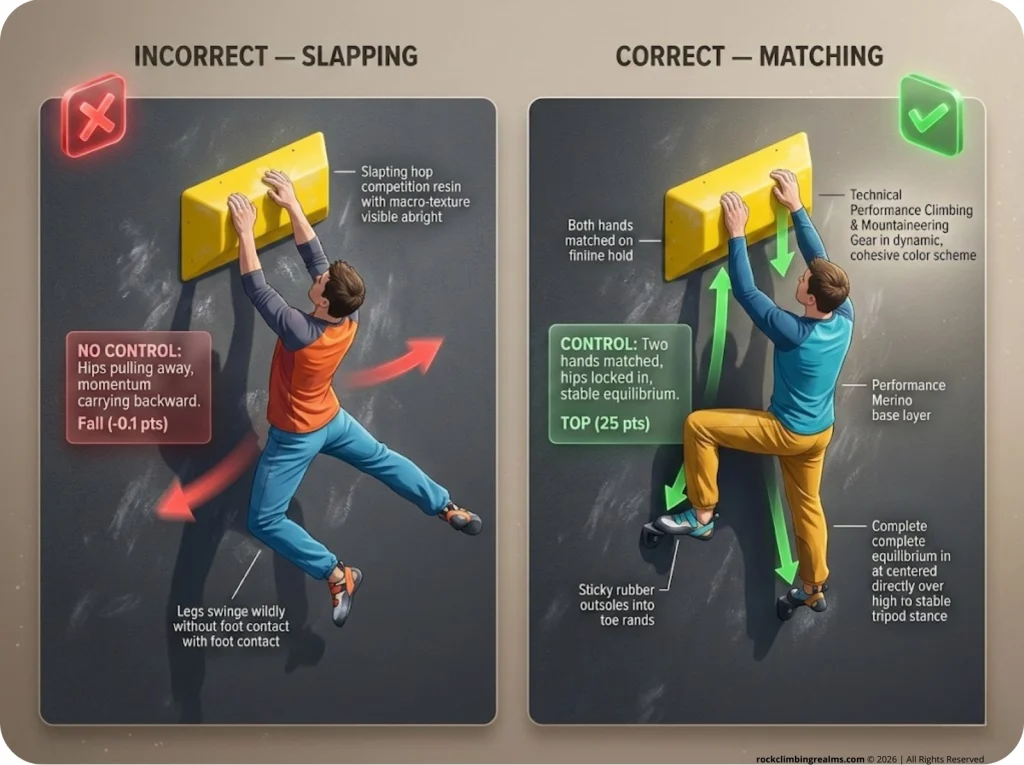
There is a critical difference between establishing a position and generating momentum. A climber who slaps the start holds one hand at a time while swinging to build a dynamic launch is not establishing a four-point start — they are just bouncing off the bottom of the wall. All four limbs must be stable and simultaneously in place before upward progress counts.
The Anatomy of the Finish: Defining “Control” Under Pressure
The Two-Second Stability Benchmark
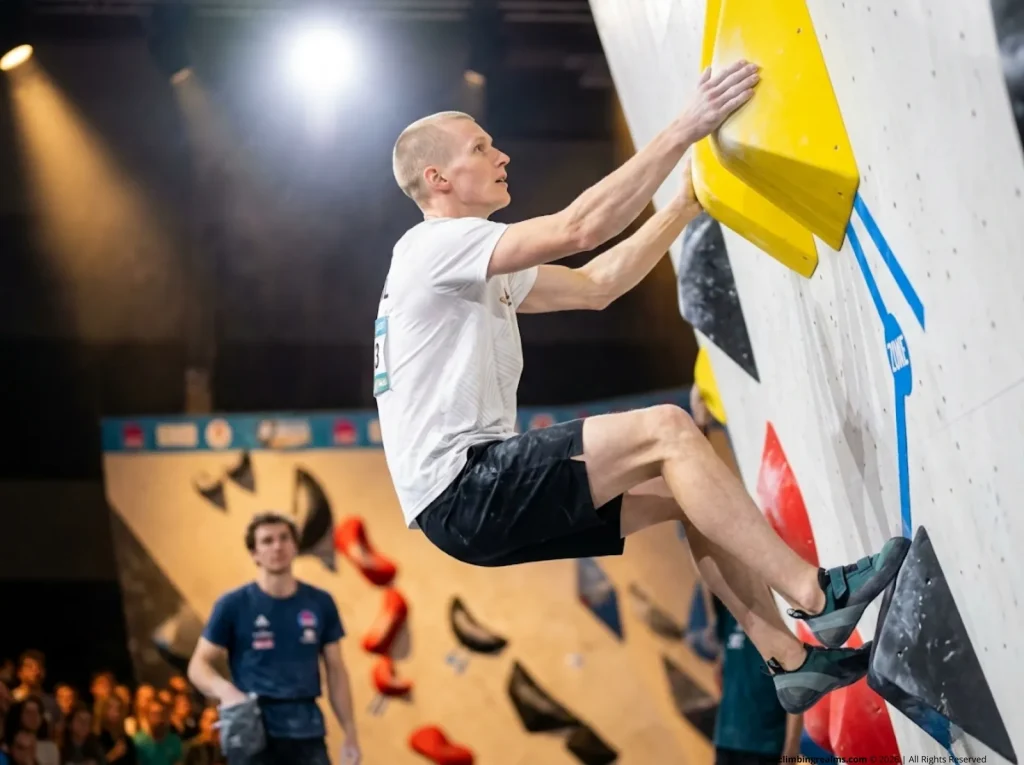
This is the call that makes or breaks your credibility as a judge. For a Top to count, the climber must match both hands on the final hold and demonstrate control — a stable position where they are not sliding or swinging off. There is no written “two-second rule” in the IFSC regulations, but experienced officials track it mentally as a benchmark. If the climber matches both hands and you can count “one-one-thousand, two-one-thousand” without them peeling away, that is a Top.
If the athlete slaps the hold with one hand while tapping it with the other during a fall, that is not control. If they latch dynamically but their center of gravity is already pulling them off the wall, that is not control. The crowd may erupt — it does not matter. You call what you see.
Distinguishing a Matching Tap from True Sequence Mastery
The Zone hold carries its own version of this debate. To earn 10 points, the climber must use the Zone hold to progress or stabilize — not just brush it with their fingertips during a fall. Athletes focused on reading modern competition boulder problems know the Zone sits at the crux transition. Your job is to confirm they genuinely engaged with it, not just passed through its airspace.
Pro tip: Beginners look at the hands. Veteran judges look at the hips. If a climber’s center of gravity is actively peeling away from the wall, they do not have control of the finish jug, no matter how hard they are squeezing. Train your eye to read the hip angle, not the white knuckles.
Utilizing Hand Signals in High-Decibel Environments
In an arena where crowd noise can hit 90 decibels, verbal calls are useless. Competition judges use standardized hand signals to communicate. A successful Top or Zone is confirmed by raising one hand vertically — the classic hand raise — and announcing “OK.” A terminated attempt gets a horizontal slashing motion across the chest. A thumbs-up before the start signals that the position is legal and the climber is cleared.
Lead Climbing Mathematics: Calculating the Physics of the “Plus”
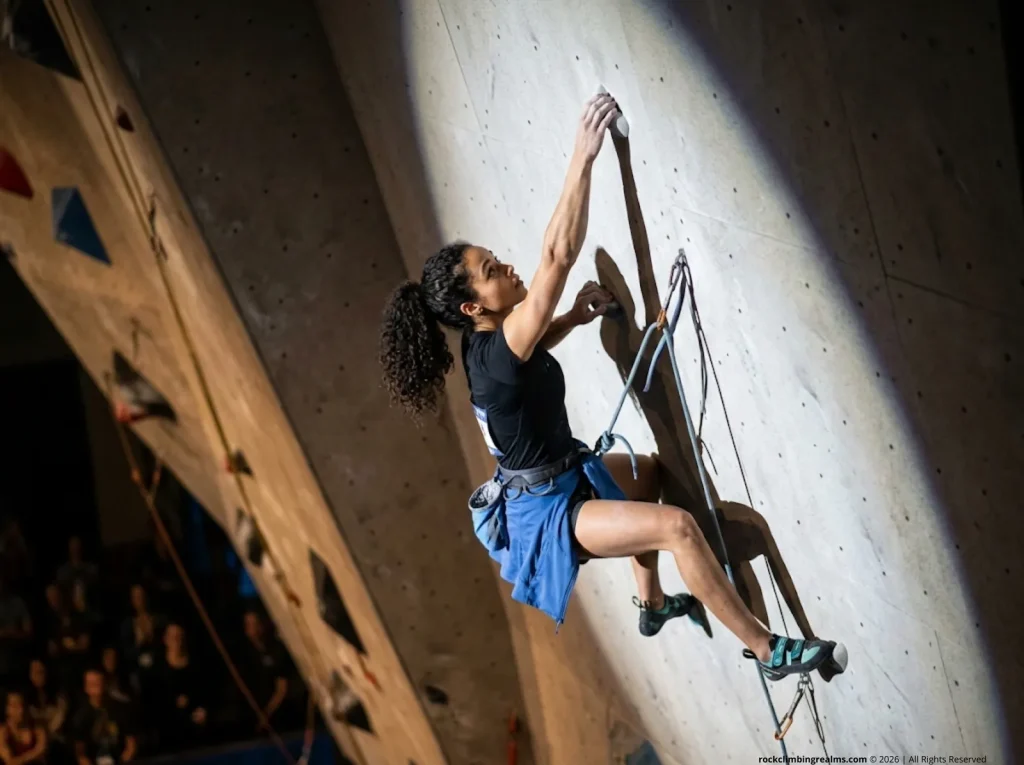
The 40-Hold Headwall Premium Distribution
Lead scoring operates on a fundamentally different logic than bouldering. Since climbing recognized the official criteria of climbing as a sport on the Olympic stage, the need for precise progressive scoring has intensified. In elite finals, only the top 40 hold numbers on the route carry point values, distributed on a steep curve.
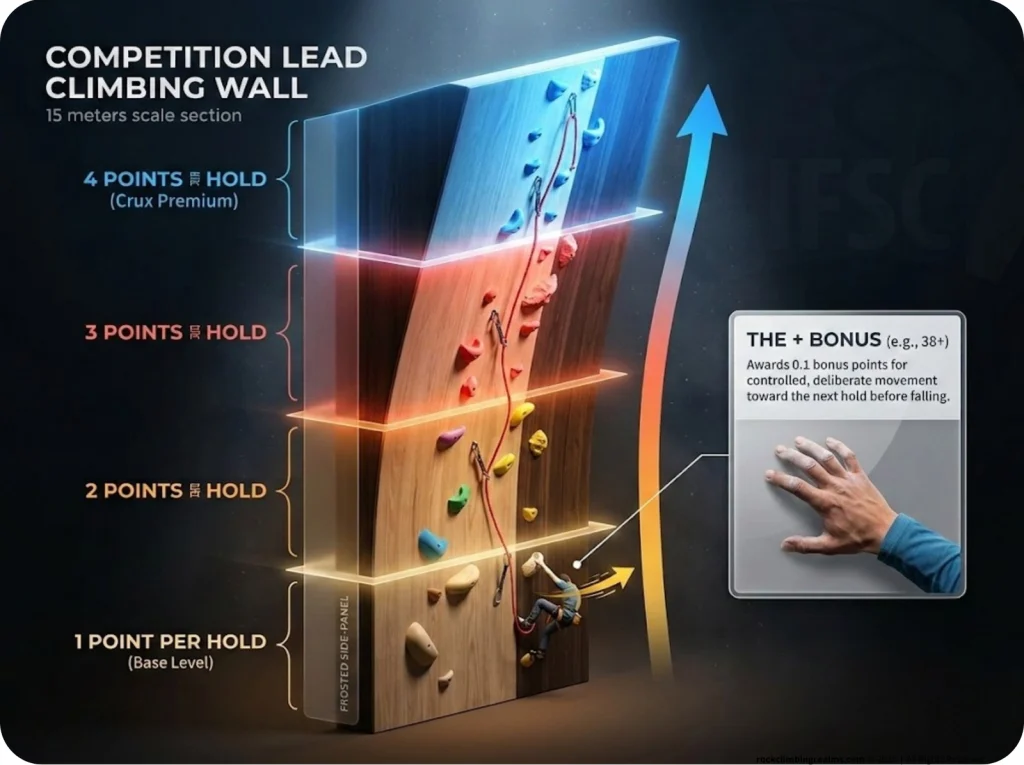
Holds 1 through 10 — counted from the top down — are each worth 4 points, totaling 40. Holds 11 through 20 are worth 3 points each. Holds 21 through 30 carry 2 apiece, and holds 31 through 40 are worth just 1 point each. Anything below hold 40 earns nothing. Missing hold 5 versus hold 11 — a gap of six grips — can swing the score by 24 points and flip an entire podium.
Defining “Use” vs. “Control” for the +0.1 Bonus
The “+” symbol on a lead scorecard is the most misunderstood mark in competitive sports climbing. It does not mean “almost.” It means the climber controlled a hold and then deliberately launched toward the next one before falling. That intentional movement earns 0.1 bonus plus scores — so 38+ equals 38.1 points, which beats a flat 38 from a climber who pumped off without trying to progress.
As a judge, you must differentiate between a climber who is pumping out — forearms locked, static, slowly losing grip — and a climber who is actively driving upward through the quickdraws with clear intent. Competition rules award the first climber 38.0 and the second 38.1. That tenth of a point has decided IFSC World Cup podiums.
The USA Climbing competition rulebook defines this distinction clearly: “Use” means the hold helped the climber make a controlled movement toward the next sequence. “Control” means the climber achieved a stable position on that hold. The “+” requires both — control first, then visible progression.
Navigating Duoholds and Unexpected Sequence Deflections
Lead routesetters sometimes create Duoholds — single large volumes that carry two separate hold numbers. If the setter expects both hands to match on a big jug, the first hand earns number 22 and the second earns 23. If the expected sequence differs from what the athlete actually does, the judge must follow the pre-briefed Topo — a printed photo map of the route — to assign each hold number correctly.
Pro tip: During lead qualifiers, the routesetters will brief you on the Topo before the round. Memorize where the Duoholds live. When an athlete hits one out of expected sequence, you need to know the numbering rule cold — because you will not have time to look it up while the climber is moving above you.
The Jury President Duties: Managing Technical Incidents

Addressing Spinning Holds and Broken Volumes
A technical incident happens when the wall fails the climber. The most common case is a spinning hold — a polyurethane grip whose bolt has vibrated loose after repeated use. When the climber pulls hard and the hold rotates, that is no longer a fair attempt. If the athlete flags the incident immediately, the Jury President halts the clock, consults the Chief Routesetter, and typically grants a fresh attempt after a 20-minute recovery window. If the climber “plays through” the incident and falls higher, the JP can rule that they accepted the condition and deny the re-climb.
The climbing lingo and official terms used in these rulings follow strict procedures, and judges must vocalize them word-for-word to the scoring table.
The Video Appeal Process and “Official Video” Rulings
After scores go up, teams have a narrow window to appeal. At USA Climbing National Team Trials, a verbal objection must land immediately, with a written appeal and a $100 fee filed within five minutes. At youth regionals, the window opens to 10 or 20 minutes. The key rule: only Official Video — footage from the dedicated judge’s camera or production crew — is admissible. A parent’s phone clip from the bleachers does not count. The JP reviews official angles, and the ruling stands or gets reversed.
Enforcing the Brush Rule for Friction Equity
Between attempts, chalk and rubber residue build up on holds, changing the friction surface. The brush rule requires judges to coordinate with volunteer brushers at scheduled intervals. This is not a courtesy — it is a fairness protocol. The climber going out 40th deserves the same conditions as the climber who went first.
Pro tip: Enforce the brush rule aggressively. Scheduling brush breaks every four to five climbers guarantees friction equity across the entire field and prevents the argument from the last competitor that holds were greased by the time they climbed.
Local Format Variations: The Redpoint and Bump Protocols

Navigating Roving Judges in Redpoint Scenarios
Most local gym comps run a redpoint format rather than the onsight isolation model used at elite events. In redpoint, athletes get a multi-hour open window — sometimes with posted time limits — to attempt as many problems as they can, and only their top five scores count. Instead of stationing one official per boulder, you become a roving judge walking the floor, verifying sends as athletes hand over scorecards.
The USA Climbing youth format relies heavily on this model. Roving judges must track scorecards because the sheer volume of concurrent climbing makes it easy to miss a send or double-count an attempt. Digital apps like Climb Along and S.C.O.R.E. have streamlined the workflow, but the bottleneck remains: a judge must witness the send live to sign off.
Defeating Sandbagging with the Institutional “Bump Rule”
If you have judged a local citizens’ comp, you have seen it: a strong intermediate climber enters the beginner division and dominates. The bump rule exists to prevent this. When a climber’s total score exceeds the division average by a significant margin — scoring 4,500 points in a Beginner bracket where the next highest is 2,000 — they get automatically bumped into the next division.
This connects directly to how subjective bouldering grades across the gym can be — a V4 at one gym might feel like a V6 at another, so the bump rule acts as a safety net against grade sandbagging.

Isolation (ISO) Management and Beta Prevention
In contrast to the open-floor redpoint format, elite finals use strict Isolation zones. Athletes surrender their phones, cannot watch other competitors climb, and receive zero beta about the problems until they step onto the mats. A judge assigned to ISO duty must enforce zero communication — no hand signals from coaches, no whispered advice, no peeking at the livestream. Any violation can result in disqualification.
Conclusion
Judging a climbing competition demands split-second reads stacked on top of the 2025 IFSC point-based system. Three things will keep you clean on the mats. First, trust the numbers: 25 for a Top, 10 for a Zone, -0.1 per fall, and the app handles the countback. Second, watch the hips, not the hands — control is about stability, not grip strength. Third, enforce the brush rule and the four-point start with zero flexibility, because fairness is not a suggestion.
Run these mechanics at your next local citizens’ comp, and you will discover that the hardest job in the gym is not on the wall. It is down on the pads, holding the scorecard, making the call before the crowd finishes screaming.
Now go send something.
FAQ
How does the new 2025 IFSC bouldering scoring system work?
Athletes earn a maximum of 25 points for a Top and 10 for a Zone. Every unsuccessful attempt results in a -0.1 point deduction, so a flash scores 25.0 while five falls before topping scores 24.5. The round maximum across four problems is 100 points.
What does the + symbol mean on a lead climbing scorecard?
The + indicates a climber controlled a hold and then initiated deliberate movement toward the next sequence before falling. This awards 0.1 plus scores bonus over a competitor who pumped out from the same hold without progressing.
How do judges define control for a Top hold?
A judge awards control when an athlete places both hands on the final hold and establishes total physical stability, tracked mentally as roughly a two-second benchmark. Slapping a volume mid-fall or touching it while swinging does not qualify.
What is a technical incident in climbing competitions?
A technical incident occurs when facility issues — such as a spinning hold or broken tape — unfairly obstruct a climber’s attempt. The Jury President can pause the clock and determine whether the climber is entitled to a fresh attempt after a mandatory rest period.
Safety Notice: Rock climbing and mountaineering are inherently high-risk
activities that can involve physical trauma or fatal incidents. The information on Rock Climbing Realms is for
educational and informational purposes only. Techniques and advice presented here are not a substitute
for professional, hands-on instruction. Conditions and risks vary by location. Always seek guidance
from a qualified instructor before attempting new techniques. By using this website, you agree that you
are solely responsible for your own safety. Any reliance you place on this information is strictly
at your own risk, and you assume all liability for your actions. Rock Climbing Realms and its authors
will not be held liable for any harm, damage, or loss sustained in connection with the use of this information.
Affiliate Disclosure: We are a participant in the Amazon Services LLC Associates Program, an
affiliate advertising program designed to provide a means for us to earn advertising fees by advertising and linking
to Amazon.com. As an Amazon Associate, we earn from qualifying purchases. We are also an official affiliate partner
of Black Diamond Equipment via the AvantLink network. If you click on a Black Diamond affiliate link and make a
purchase, we may earn a commission at no additional cost to you. We also participate in other affiliate programs.
Additional terms are found in the terms of service.