
In this article
My hands are shaking so badly I can barely grip the quickdraw. I’m six bolts up a 5.10a I’ve sent indoors twenty times, and my legs are jackhammering against the wall so hard I can hear my heels chattering on the granite. The rational part of my brain knows the system is solid — I checked the knot, the belayer is locked, the bolts are bomber. But anxiety doesn’t negotiate with rational thought. It hijacks your motor system and tells you the worst is about to happen.
After fifteen years of climbing 5.12 while managing clinical anxiety, I’ve built a field-tested system for negotiating with that hijack. It’s not about conquering fear or pretending it doesn’t exist. It’s about building a systematic nervous system management plan that lets you climb at your potential instead of your panic threshold.
This guide covers everything: the biology behind the freeze, the breathing techniques that actually work, the gear that takes the edge off, and the honest conversation nobody is having about hormones, life stress, and the shame-free approach to using every tool available.
⚡ Quick Answer: Fear on the wall is a neurological response, not a character flaw. Managing it requires a three-phase system: pre-climb preparation (breathing resets, visualization, gear audits), on-wall tactics (somatic flushing, cognitive reframing, stick clips), and post-climb processing (fear logs, redefined progress metrics). Gear like stick clips and assisted braking devices are mental health management tools, not cheating.
Why Your Nervous System Hijacks Your Climbing
The Yerkes-Dodson Sweet Spot — Why Some Fear Helps
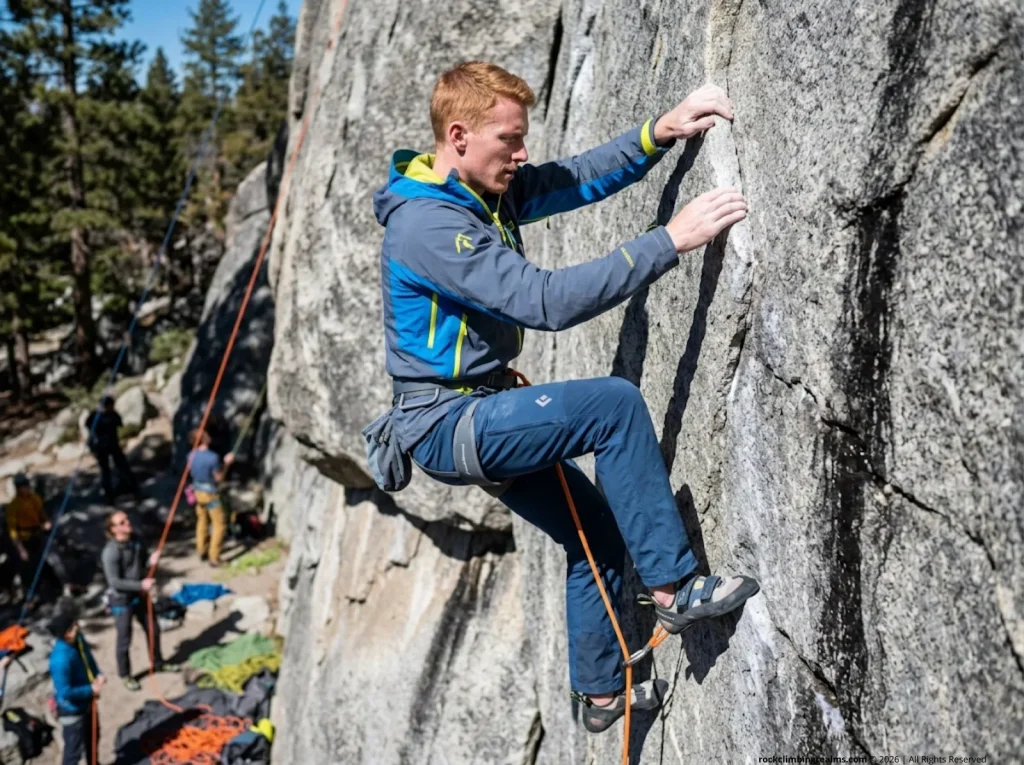
Here’s the thing most climbing fear articles get wrong: they treat all fear as the enemy. It’s not. The Yerkes-Dodson Law describes the relationship between physiological arousal and motor performance as a bell curve. Too little activation, and your footwork gets sloppy, your route-reading goes lazy. Too much, and you freeze mid-crux with tunnel vision and hands locked in a white-knuckle grip.
The sweet spot sits at roughly 40-60% perceived arousal. In that zone, your movements sharpen. Your feet find holds with precision. You read the next three moves before you need them. Beyond that zone, the wheels fall off — Elvis leg kicks in, breathing locks up, and you can’t process the sequence two feet above your head.
The problem is that most climbers have no idea where they sit on that curve until they’re already past the tipping point.
Pro tip: Before leaving the ground, rate your arousal on a 1-10 scale. If you’re above a 7, step off and run the breathing reset below before pulling on. This 30-second pause saves you from burning an entire attempt in panic mode.
Somatic vs. Cognitive Anxiety — Two Different Battles
Not all anxiety shows up the same way, and the fix depends on which type has you.
Somatic anxiety lives in the body. It’s the shaking legs, the sweating palms, the sewing-machine calf, the chest that won’t expand. Cognitive anxiety lives in the mind. It’s the catastrophic “what if” loops, the inability to read the next sequence, the conviction that everything is about to go wrong despite all evidence to the contrary.
Most fear management advice throws a generic “just breathe” at you and calls it done. That’s lazy. Somatic anxiety responds to physical interventions — shake-outs, deliberate muscle release, controlled breathing. Cognitive anxiety responds to reframing, visualization, and task-specific verbal self-coaching. Lattice Training structures their sessions around this distinction, training each type separately. We’ll do the same.
The Invisible Threshold — Life Stress and Fear on the Wall
Your nervous system does not compartmentalize. A terrible day at work, financial stress, a fight with your partner — all of it lowers the activation threshold at which fear takes over on the wall.
If you walked into the gym already sitting at a 6 out of 10 from outside life stress, you only have a 1-2 point margin before hitting panic territory. On those days, deliberately choose routes 2-3 grades below your max and treat the session as nervous system maintenance, not performance. According to the ADAA, regular physical activity can reduce anxiety symptoms and improve stress resilience — but only when the intensity matches your current capacity.
TrainingBeta is one of the few sources that discusses how hormones and menstrual cycles affect climbing fear — progesterone spikes during the luteal phase are associated with heightened fear threshold sensitivity. If you’re tracking cycles alongside climbing logs, the “unexplainable bad days” suddenly have a pattern.
For climbers who want to go deeper on the neuroscience side, we’ve built a structured 4-week mental training protocol that targets fear extinction through progressive training.
The Pre-Climb Fear Reset Protocol
The 3-Breath Reset at the Base
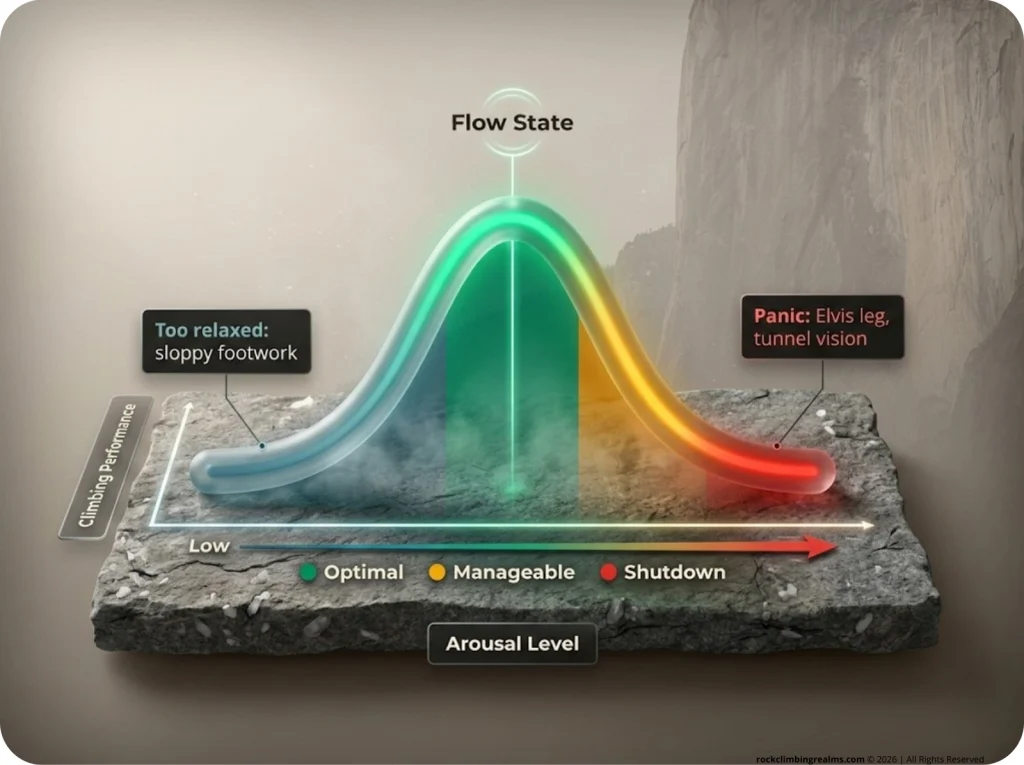
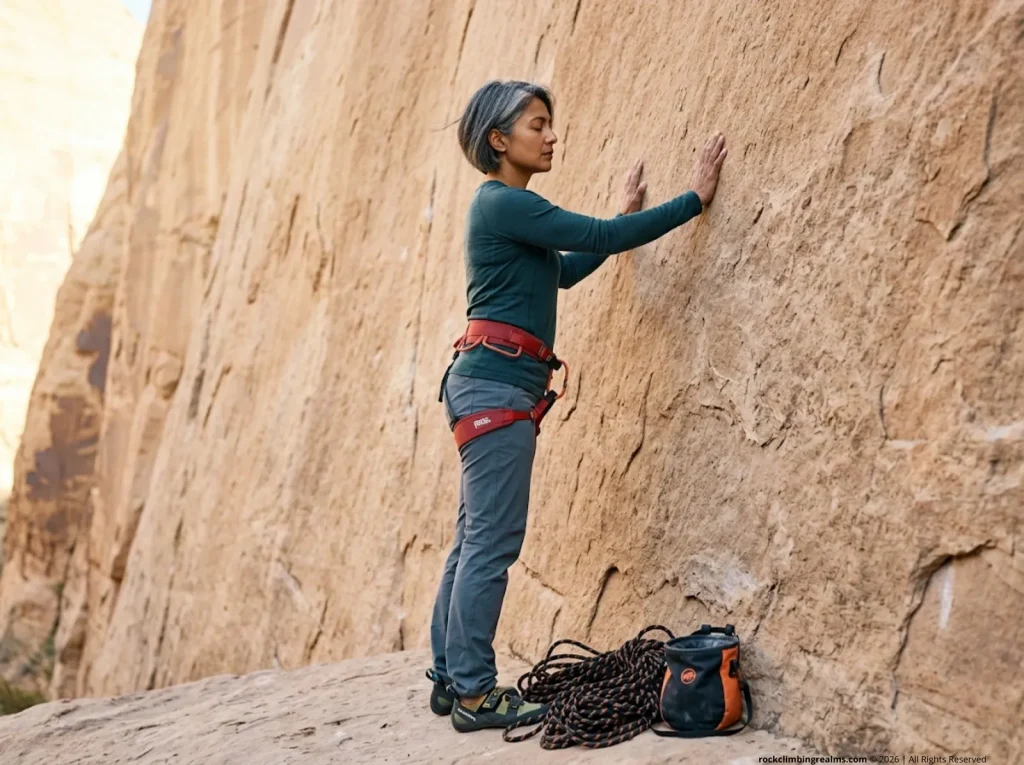
Stand at the base of the route with both hands on the rock. Inhale for 4 counts through the nose. Hold for 4. Exhale through the mouth for 6-8 counts. Repeat three times.
That’s it. The 3-breath reset works because the extended exhale activates the calming branch of your nervous system, which drops your heart rate within about 60 seconds. Every climbing fear article tells you to “breathe.” We’re giving you the exact on-wall breathing routine.
Do this before every route where fear is a factor. On high-anxiety leads, repeat it at every bolt. The mechanism doesn’t wear out — your system responds to extended exhales the same way on bolt 8 as it does at the base.
Ground-Level Visualization — Climbing the Route With Your Eyes
Before pulling on, trace the entire route visually from the ground. Identify every bolt, every rest stance, every crux section. Mentally rehearse the specific clip at each bolt — left hand or right hand, the body position, the hold you’ll be clipping from.
Arno Ilgner calls this “accepting the challenge” in The Rock Warrior’s Way — a deliberate, conscious decision to engage rather than a passive drift into commitment. Visualization reduces cognitive anxiety by converting unknown sequences into known ones. Your brain treats rehearsed sequences with dramatically less threat response than novel ones.
The Gear Trust Audit
Run a full physical check before you leave the ground: harness doubled back, knot dressed and tightened, belay device loaded correctly, stopper knot tied. This serves a dual purpose — actual safety verification AND psychological anchoring.
Completing a physical checklist gives your brain concrete evidence that the system is solid. If you’re using an assisted braking device like a GriGri, verbally confirm the device is loaded correctly with your belayer. Miscommunication here is one of the top causes of severe accidents.
For the complete protocol, including the steps most experienced climbers skip out of routine complacency, see the six pre-climb safety checks most climbers skip.
On-Wall Tactics — Managing Fear While You Climb
The Somatic Reset — Physically Flushing the Panic
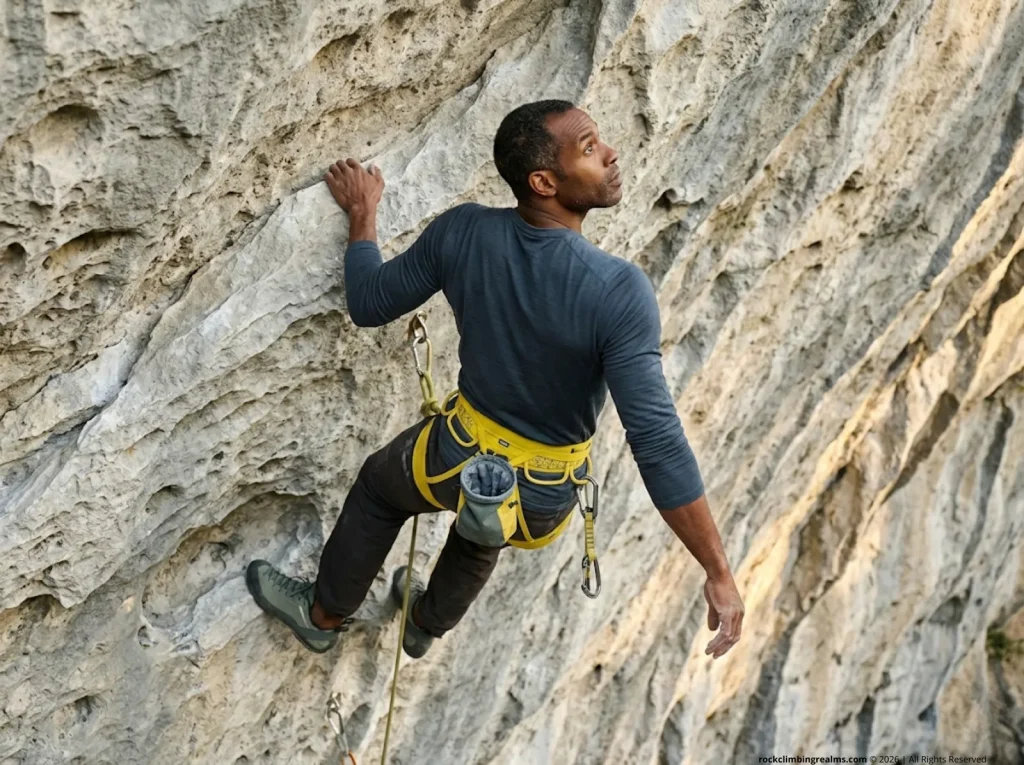
When the panic hits mid-route, you need a physical intervention before a mental one. At the next bolt, clip in, then deliberately shake out each arm for a full 10 seconds. Open and close your hands five times.
Drop your heels flat onto the foothold — not tiptoe-perching, which keeps your calves loaded and feeds the shaking cycle. Then run the 3-breath reset at the bolt with the exhale extended to 8 counts because your heart rate will be elevated.
Consciously soften your grip. Anxious climbers white-knuckle holds with far more force than needed, which accelerates pump and creates a self-fulfilling cycle of fatigue, more fear, more over-gripping. Breaking this loop at the bolt is the single highest-value mid-route tactic.
Pro tip: Say the word “soft” out loud every time you place your hand on a new hold. This vocal cue disrupts the automatic panic-grip pattern. It sounds strange, but the verbal interruption is faster than any internal self-talk.
Cognitive Reframing — Changing the Story Mid-Route
Replace catastrophic internal narratives with process-focused cues. Instead of “I’m going to fall,” force the thought to: “Left foot on the crystal. Push. Reach right.” Arno Ilgner’s framework is simple: you cannot hold the consequence (falling) and the process (the next move) in your mind simultaneously. Choose the process.
The Climbing Doctor applies the Inhibitory Learning model directly to climbing — testing the feared outcome in a controlled way. Clip in at a bolt, let go of one hand, hang on the rope for five seconds. Your brain predicted the worst. The outcome was a gentle hang. That prediction error, repeated across sessions, rewires the fear circuit. This is what therapists call expectancy violation, and it works on the wall exactly like it works in a clinical office.
Positive self-talk is NOT “You’ve got this, bro!” That’s cheerleading, and your nervous system isn’t buying it. Effective self-talk is specific and task-focused: “My feet are good. The bolt is three feet away. I will match and clip.”
The Stick Clip — A Shame-Free Safety Tool
A stick clip eliminates the highest-consequence fall in sport climbing — the unprotected ground fall below bolt 1. Understanding why the 15-foot rule is your best defense against hitting the deck makes this a straightforward safety decision, not a style debate.
TrainingBeta and experienced coaches explicitly validate using stick clips as mental health management tools for climbers with anxiety. Long-stiffy draws — extended quickdraws that let you pre-clip sketchy sections — serve the same function.
There is a gatekeeping culture in climbing that shames stick-clip users as “not real climbers.” Let’s put that to rest: a stick clip costs $25. A ground fall costs a broken ankle and an ambulance bill. If the tool allows you to climb and manage your anxiety, it is the correct tool. Full stop. This is the shame-free approach — no apologies for using legitimate safety strategies.
Building Gear Trust and Belayer Communication
The Graded Exposure Falling Ladder
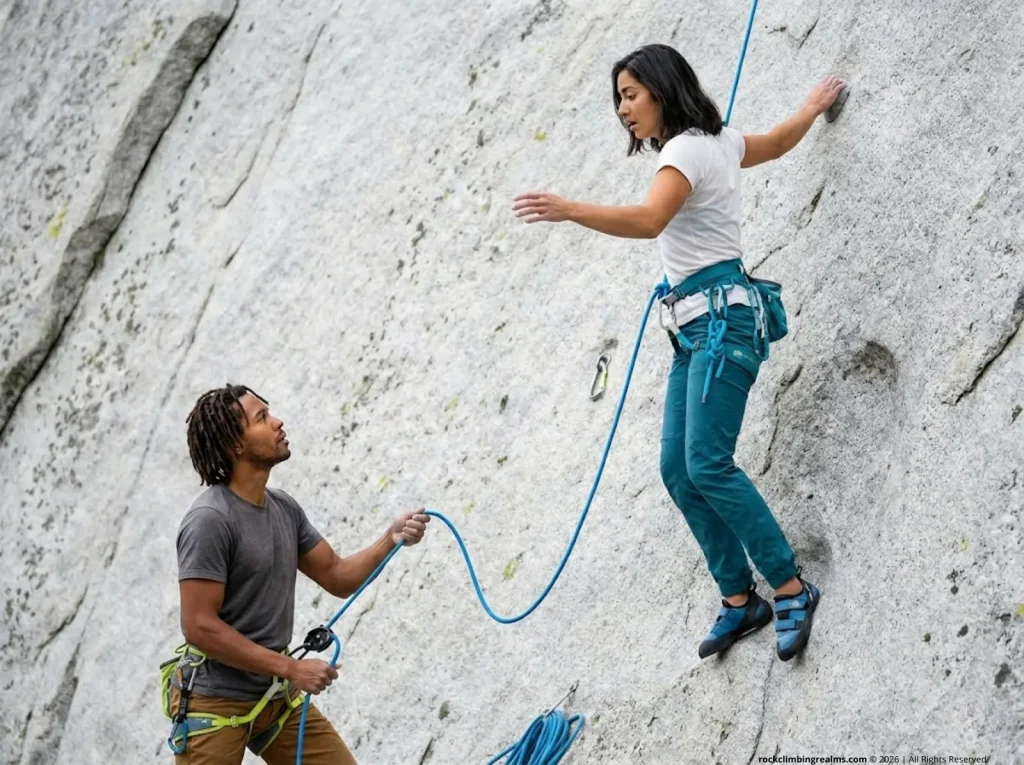
Graded exposure is the gold standard for treating specific phobias — and fear of falling is exactly that. The protocol works because each completed fall is an expectancy violation: the brain predicted catastrophe, and the outcome was a controlled catch.
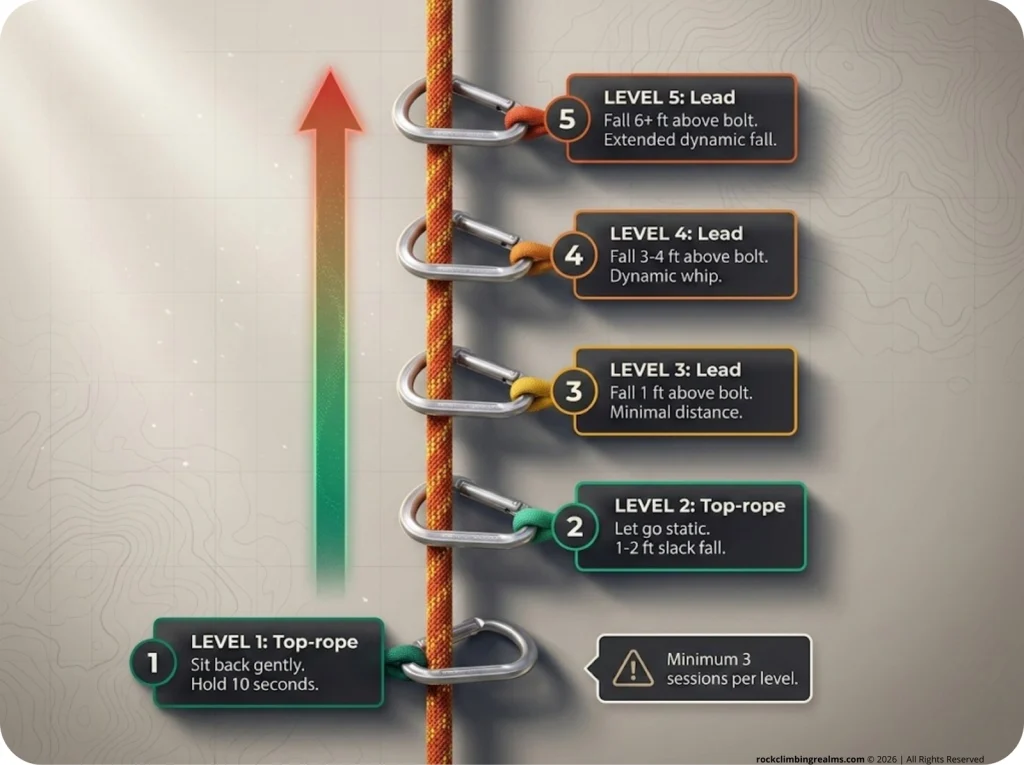
Here’s the five-level falling practice ladder:
- Level 1: Top-rope. Sit back gently into the system. Hold for 10 seconds. Feel the harness take your weight.
- Level 2: Top-rope. Let go from a static position. Fall 1-2 feet of slack.
- Level 3: Lead. Deliberately fall from 1 foot above the bolt. Minimal fall distance.
- Level 4: Lead. Fall from 3-4 feet above the bolt. A real, dynamic whip.
- Level 5: Lead. Fall from 6+ feet above the bolt. Extended dynamic fall.
Spend a minimum of three sessions at each level before advancing. Rushing this progression is counterproductive — you need the repetitions to build genuine belayer trust and system confidence, not just check a box.
Pro tip: After every practice fall, close your eyes and consciously notice your heart rate dropping back down. Registering the return to safety accelerates the inhibitory learning process. The brain needs to encode the “after” — you going calm — just as much as it needs to encode the fall itself.
The Belayer Communication Script
Anxious climbers need to pre-negotiate communication with their belayer before leaving the ground. This is not optional.
The belayer communication script is simple: “Watch me” (belayer confirms: “Watching”). “Tension” (belayer takes slack and locks). “Falling” (belayer prepares the catch). Discuss catch style before the first move — does the climber want a hard lock (short fall, wall impact) or a soft catch (longer fall, softer deceleration)? Most anxious climbers prefer tight initially.
Understanding the soft catch technique most belayers get wrong helps both partners make informed decisions about catch dynamics.
Build a system of verbal reassurance at rest points. The belayer says “You look solid” or “Good placement” — not “You’re fine!” which dismisses the anxiety rather than acknowledging it.
The Intersectional Factors Nobody Talks About
Climbing With Clinical Anxiety
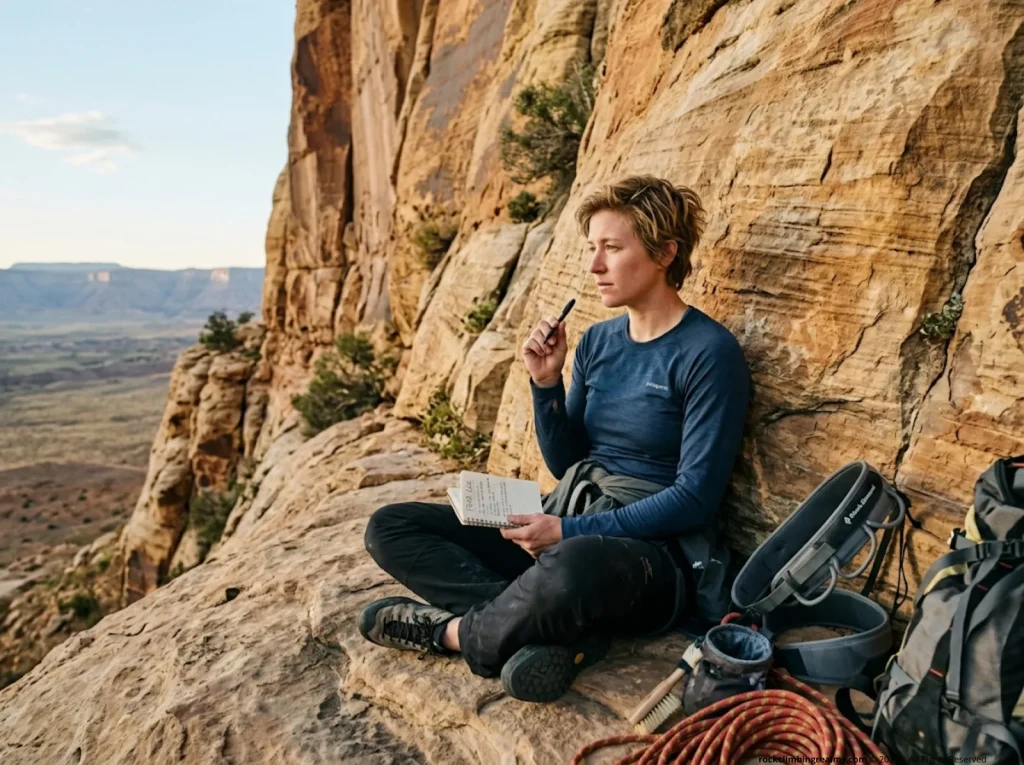
If you have a diagnosed anxiety disorder — generalized anxiety, panic disorder, PTSD — climbing fear is amplified by a nervous system that’s already running at elevated baseline. You’re starting closer to the panic threshold before you even touch the rock.
Here’s the good news: Cognitive Behavioral Therapy techniques translate directly to the wall. Thought logs become fear logs. Behavioral experiments become falling practice drills. Cognitive restructuring becomes route-level reframing. If you’re already working with a therapist, your climbing practice and your therapy can reinforce each other.
Content for anxious high-performers — people sending 5.12 or harder while managing clinical anxiety — barely exists. If that’s you, your experience is valid. You’re not weak for being anxious and strong simultaneously.
⚠️ Safety note: This article provides practical climbing strategies, not medical advice. If anxiety significantly impacts your daily life, work with a qualified mental health professional. Climbing can complement therapy, but it’s not a substitute.
Hormones, Cycles, and the Fear Threshold
Progesterone spikes during the luteal phase are associated with increased amygdala sensitivity and a heightened anxiety response. Climbers who menstruate frequently report unexplainable “bad fear days” that correlate with cycle timing — not fitness regression.
Tracking menstrual cycles alongside climbing logs reveals patterns that enable strategic session planning. Harder sends during the follicular phase. Nervous system maintenance during the luteal phase. This information is almost completely absent from mainstream climbing performance content, and it should be standard.
When to Step Off — Knowing the Difference Between Growth and Harm
There is a line between productive discomfort and destructive overwhelm. If you’re crying on the wall, hyperventilating, or experiencing a sense of unreality — that’s not training. That’s harm. Lower off.
“Taking” on lead and lowering off are NOT failure. They are professional-grade nervous system management decisions. Hazel Findlay, one of the world’s strongest trad climbers, openly normalizes stepping off routes to manage fear. If it’s good enough for her, the shame narrative has no place in your climbing.
After stepping off, the work isn’t finished. Process the experience by running a post-mortem on every climbing mistake — including the ones that feel like personal failure but are actually smart calls.
Post-Climb Processing and Long-Term Progress
The Fear Log — Tracking Your Nervous System Over Time
After every session, record five things: route name, grade, maximum fear rating (1-10), what triggered the peak fear, and what tactic you used to manage it.
Over 4-6 weeks, patterns surface. Specific heights. Specific move types. Specific times of day. The fear log transforms an ambiguous “I’m scared” into actionable data: “I consistently spike above a 7 when clipping the 4th bolt on routes steeper than 15 degrees overhanging.”
That data lets you train with precision. If bolt 4 is your crux, practice deliberate falls from that exact height. If overhanging routes spike your fear more than vertical ones, run your somatic resets specifically on steep terrain. You can expand the fear log into a data-backed framework for identifying exactly what’s holding you back across your entire climbing performance.
Redefining “Sending” — Progress Is Not Just Grades
For anxious climbers, sending the route is not the only valid metric of progress. Did you manage your breathing at the crux bolt? Did you stick-clip without shame? Did you take a deliberate practice fall? Did you lower off calmly instead of panicking?
These are sends. Nervous system sends. Confidence boosters that compound over time just like strength gains do.
Framing progress around nervous system management instead of grades prevents the destructive cycle of “I didn’t send → I’m weak → I’m more anxious next session.” If you managed your fear better than last week, you got stronger in the only way that matters at this stage.
Conclusion
Three things to carry out of this article:
Fear is biology, not weakness. The Yerkes-Dodson curve and the somatic vs. cognitive anxiety distinction give you precision tools instead of vague hope. When you understand why your nervous system does what it does, you stop blaming yourself and start working with it.
Managing anxiety on the wall is a three-phase system. Pre-climb preparation — breathing resets, visualization, gear audits. On-wall tactics — somatic flushing, cognitive reframing, stick clips without shame. Post-climb processing — fear logs and redefining progress beyond the grade.
Outside factors set your fear threshold. Work stress, hormonal cycles, and clinical conditions are not excuses. They’re variables that directly affect your nervous system’s activation point. Planning sessions around them is strategic, not soft.
Next session, bring a pen and a small notebook. Climb one route at your limit and one route two grades below. Record your fear peaks. In four weeks, you’ll have a nervous system map that shows you exactly where to aim your work.
Now go send something.
FAQ
Is it normal to be scared of heights when climbing?
Yes. Fear of heights is a survival instinct hardwired into the human nervous system — it is not a flaw. The vast majority of climbers, including professionals, experience it in some form. The difference between a scared beginner and a calm expert is not fearlessness. It is a trained nervous system response shaped through graded exposure and deliberate practice over hundreds of sessions.
How do I stop my legs from shaking (Elvis leg) when climbing?
Elvis leg is a somatic anxiety symptom driven by adrenaline-fueled muscle fiber recruitment. Drop your heels flat onto the foothold to stretch the calf and reduce tension. Run the 3-breath reset — 4-count inhale, 4-count hold, 6-8-count exhale. The shaking typically settles within 15-30 seconds once the calming response kicks in.
Can I climb well if I have clinical anxiety?
Yes. Many climbers perform at 5.12 and above while managing diagnosed anxiety disorders. Climbing can serve as a form of behavioral therapy when approached systematically. However, clinical anxiety raises your baseline arousal, putting you closer to the panic threshold from the start. Adjust by choosing slightly lower grades on high-anxiety days, using graded exposure falling drills, and coordinating your climbing program with your mental health professional.
Is using a stick clip cheating?
Absolutely not. A stick clip eliminates the single most hazardous moment in sport climbing — the unprotected ground fall below the first bolt. AMGA-certified guides use and recommend them. The gatekeeping culture around stick clips actively harms anxious climbers by denying them a legitimate safety tool.
What is the best book for climbing fear management?
The Rock Warrior’s Way by Arno Ilgner is the most widely recommended book on climbing psychology. It provides a framework for shifting attention from consequence (falling) to process (the next move), and treats fear as a negotiation partner rather than an enemy to defeat.
Safety Notice: Rock climbing and mountaineering are inherently high-risk
activities that can involve physical trauma or fatal incidents. The information on Rock Climbing Realms is for
educational and informational purposes only. Techniques and advice presented here are not a substitute
for professional, hands-on instruction. Conditions and risks vary by location. Always seek guidance
from a qualified instructor before attempting new techniques. By using this website, you agree that you
are solely responsible for your own safety. Any reliance you place on this information is strictly
at your own risk, and you assume all liability for your actions. Rock Climbing Realms and its authors
will not be held liable for any harm, damage, or loss sustained in connection with the use of this information.
Affiliate Disclosure: We are a participant in the Amazon Services LLC Associates Program, an
affiliate advertising program designed to provide a means for us to earn advertising fees by advertising and linking
to Amazon.com. As an Amazon Associate, we earn from qualifying purchases. We are also an official affiliate partner
of Black Diamond Equipment via the AvantLink network. If you click on a Black Diamond affiliate link and make a
purchase, we may earn a commission at no additional cost to you. We also participate in other affiliate programs.
Additional terms are found in the terms of service.