

In this article
The lactic acid burn is searing through your forearms. You are 15 feet off the deck, staring at the exact same quartzite crimp that spit you off last Tuesday, feeling your fingers uncurl against your will. You have been hitting the indoor walls four days a week, buying more aggressive shoes, and obsessing over the V-scale. Yet you are stuck in the exact same grade plateau you were six months ago.
The truth is, grade chasing fails the test of time. After twenty years of projecting on granite and building anchors in the dark, I have watched this cycle wreck climbers who were genuinely talented. True progression requires abandoning arbitrary numbers and adopting a data-backed framework grounded in how bodies actually adapt, how movement actually works, and what professional safety mastery actually looks like. Stop guessing. Here is exactly how to build a climbing goal architecture that produces measurable progress without destroying your pulleys.
⚡ Quick Answer: Setting a realistic climbing goal means separating the physical adaptation of your tendons from the strength gains of your biceps. Stop focusing on the end grade and start measuring objective metrics like your finger strength percentages and your technical execution on the wall. A systemic blueprint focuses on process goals in climbing — like hitting a 7-second max hang benchmark or mastering safety systems — which you control entirely.
The Biology of the Plateau: Why Grade Chasing Fails
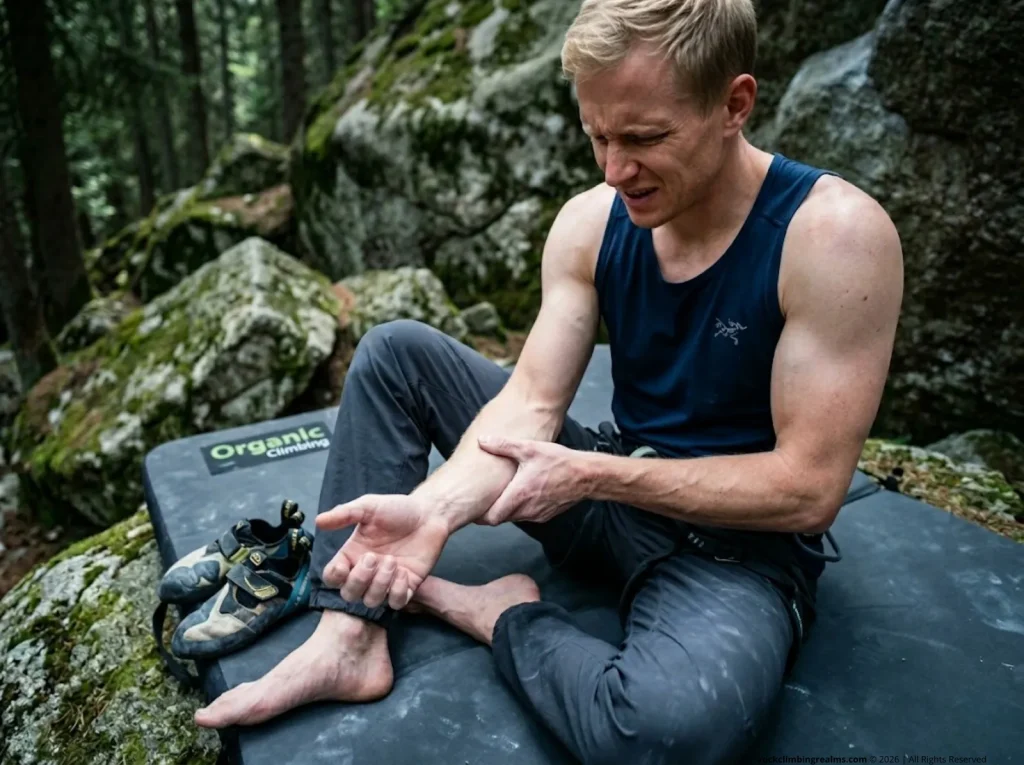
The grade you want assumes your body adapts uniformly to stress. It does not.
The primary bottleneck for climbing advancement is that tendon density and collagen remodeling lag far behind muscle growth. You can build the back strength to pull through a V7 roof in a few weeks, but the connective tissue in your fingers requires seasons of consistent load to catch up. Your biceps and lats are highly vascularized — they receive massive blood flow and respond to stimulus in a matter of days. Tendons and ligaments rely on a much slower diffusion process. They need three to twelve months to safely transmit that new muscular force.
This mismatch is why climbers slam into the legendary V4 or V5 wall. At these difficulties, the demands shift from large, muscle-dependent jugs to tiny, tendon-busting edges. You feel strong enough to pull, so you force the send. Your flexor muscles contract with immense power against an A2 pulley that has not had a full adaptation cycle to stiffen. That snap you hear is not bad luck. It is the predictable result of pushing tendons on a muscular timeline. The Time course of muscular, neural and tendinous adaptations research confirms exactly this — the distinct adaptation timelines of muscle versus tendon tissue make grade-chasing on a short calendar biologically unsustainable.
The Tendon-Muscle Discrepancy
When you set an outdoor project planning timeline based on how fresh your muscles feel, you are ignoring silent micro-tears accumulating in your pulleys. Let the rapid early gains you experience in your first year of climbing run their course. Do not let them dictate the pace of your five-year plan.
Plans that demand a grade increase every month require collagen remodeling that biology simply does not allow on that schedule. A 12-week minimum is needed before significant changes in the extracellular matrix of finger collagen will even register. Most grade-chasers ignore this completely.
The “Overtraining” Trap vs. Real Progression
Chronic mechanical strain on unconditioned tissue creates silent damage. The climber logs hours on the hangboard, pushes through the familiar dull ache in their knuckles, and wonders why they keep falling off the same 5.11 crux. They assume they need more volume. They are wrong.
Veteran climbers watch this happen constantly. A climber is forced off the wall for a week due to a vacation or mild illness, and upon returning they absolutely crush their project. They were never weak. They were trapped in chronic fatigue. Learning the active recovery and rest day science and mandating scheduled deload weeks is non-negotiable. Rest is not lost training time. It is the literal mechanism of your progression.
Pro tip: Plan a full week of zero climbing every six weeks. Your muscles will feel soft, but your pulleys will finally heal the micro-trauma you have been ignoring. You will return lighter on the wall and noticeably stronger.
The Architecture of Intention: Moving Beyond the Number

Modern rock climbing culture worships the send. Gyms color-code success, and social media rewards the hardest grades. This creates extrinsic motivation, which crumbles the moment you face a six-month weather delay or a tweak in your ring finger.
The fix is a Life Blueprint — a personal framework that forces your goals to stem from core intentions rather than ego. Instead of saying you want to climb El Capitan, you define what kind of climber you are willing to become. The physical risks we take out here have to align with deeply held personal values. If you skip this internal architecture, the existential dread of “what now?” will hit you the day after you clip the chains of your dream route. By incorporating a mental training protocol, you build the psychological resilience to handle the inevitable failures of pushing your limits. The literature on Psychological Skills by Risk Sport Athletes confirms that tying athletic ambition to core values drastically reduces performance anxiety.
The “Life Blueprint” Methodology
Start with your intention. Ask yourself why you tolerate bleeding cuticles and freezing belays. The answer might be “I am willing to master complex physical puzzles” or “I am willing to trust myself in high-consequence environments.”
From that intention flows your area of focus — developing multi-pitch trad efficiency in Yosemite, for example. Finally, you establish smart goals for climbing that serve the larger intention. The goal serves the intention. Never the other way around.
Categorizing Outcome, Performance, and Process Goals
Outcome goals rely on luck. Sending a specific route requires good weather, low humidity, a capable partner, and zero skin issues. If you build your identity around an outcome, a rainy weekend ruins your season.
You need a portfolio. Performance goals measure internal capability regardless of the final send. If you stick the crux move five times in a row, you succeed regardless of conditions. Process goals are 100% controllable — focusing on maintaining a steady exhalation on every deadpoint, for instance. A goal hierarchy like this protects your motivation from bad days and bad weather.
Linguistic Precision and Fear Naming
Stop saying “I want to lead 5.12.” Start saying “I am willing to take lead falls to learn 5.12.” Linguistic precision shifts you from passive desire into active commitment. Before pulling onto a route, explicitly name the fear: “I am afraid of blowing the clip at the third bolt and taking a ten-foot whip.” Owning it de-fangs it. Then use visualization to pre-program your exact sequence. You lower the cognitive load during the redpoint because your brain has already solved the problem.
Pro tip: Write out your process goals in a notebook before you tie in. When you pull the crux, your brain only has bandwidth to remember one or two cues. Make them count. The diary method works. Shauna Coxsey built her training diaries into a core part of her process — tracking her mental state with the same rigor as her hangboard loads.
Data-Backed Benchmarks: Objective Measurement Framework
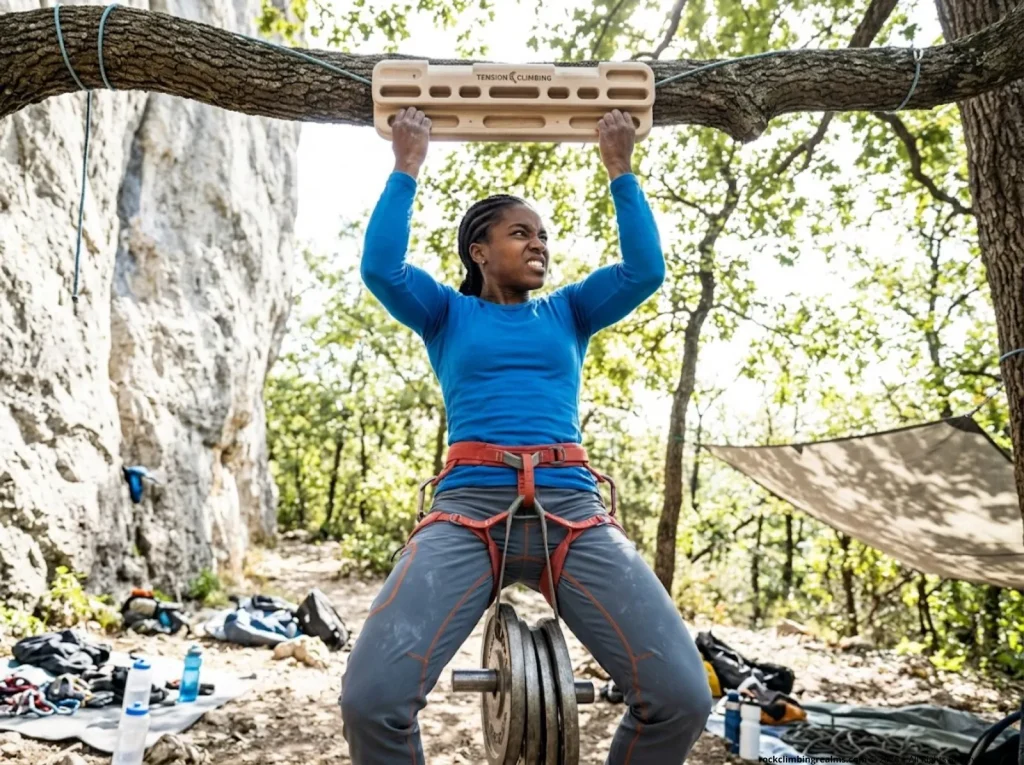
Stop trusting gym grades as progress markers. Plastic routes are notoriously inconsistent, heavily reliant on big muscular pulls and high-friction colored holds. To gauge real progression, strip away the ambiguity and measure raw force production.
The industry standard comes from Lattice Training, which documents a direct correlation between max finger strength and climbing ability. Moving from subjective feelings to objective %BW metrics tells you exactly what to train next. Your plateau is not a mystery. You are either strong but climb poorly, or you climb efficiently but lack the pulling power. You find the answer on the testing block.
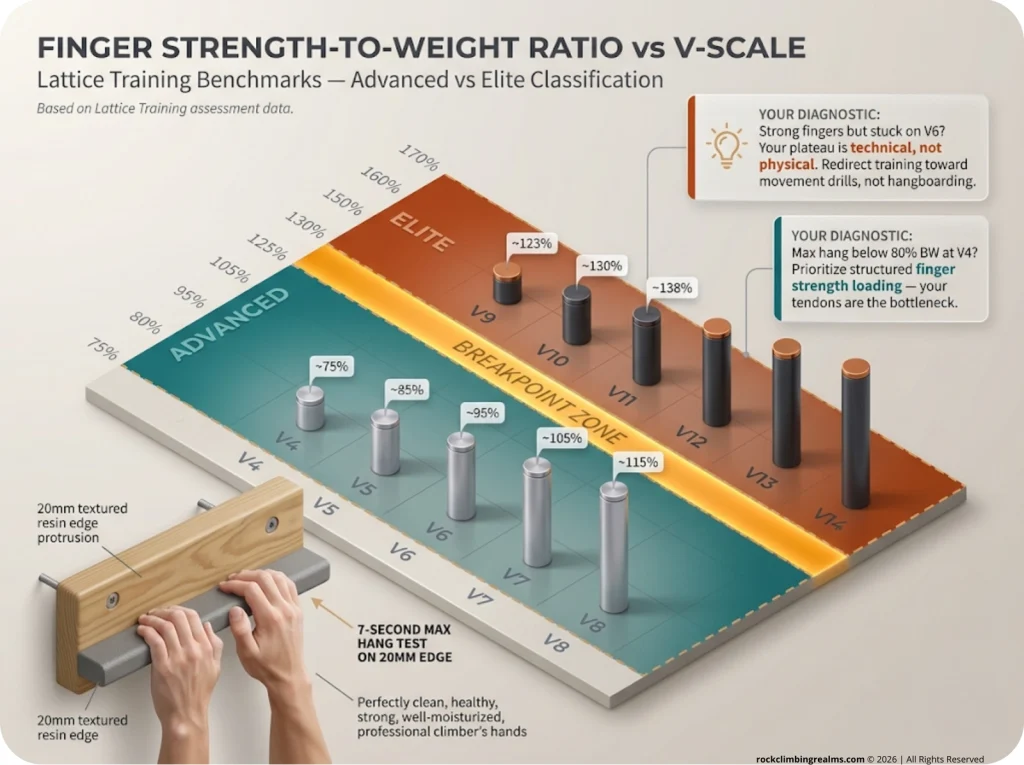
The 7-Second Max Hang Benchmark
The baseline test is the 7-second max hang on a 20mm edge. Test your maximum added weight and calculate the percentage of your body weight (%BW). The data is clear: climbing V8 typically requires holding 123% to 150% of your body weight.
Testing with reliable finger strength testing protocols prevents you from guessing your physical capacity. If your edge strength sits at 160% BW but you cannot flash a V6, your fingers are not weak. Your footwork is trash. Do not waste another cycle hangboarding when you need technical drills. The Effects of Different Loading Programs on Finger Strength research outlines how specific loading targets specific tissue changes — and the data shows that climbers at V13+ derive only 4.2% of their performance gains from raw strength. Movement library takes over.
Critical Force and Anaerobic Capacity
Bouldering demands peak power. Sport climbing demands endurance. Critical Force (CF) measures the maximum load you can sustain aerobically over time. If a route forces you above your CF threshold, you start the clock toward complete pump.
Sport climbers must track their aerobic forearm capacity using a 7/3 repeater protocol — 7 seconds on, 3 seconds off. Identifying the gap between your maximum voluntary contraction and your sustainable CF reveals exactly why you are resting on the rope three bolts from the chains. Stop doing heavy max hangs if your aerobic engine is stalling out halfway up the wall.
The V-Grade Myth: Technical Execution vs Raw Power
Grades are salt, not the meal itself. A V6 on smooth granite at the Hudson Boulders feels drastically different than a V6 on an indoor Moonboard. When you hit advanced levels — V13 and beyond — raw strength offers severely diminishing returns. Technical efficiency and tactical execution take over.
Measure technical consistency. Track the number of clean sends you execute at 80% of your maximum grade. A climber who can reliably dispatch a dozen 5.11s in a day has better movement mastery than a climber who flails their way up a single 5.12 after forty attempts. Using climbing apps for route tracking to log these sessions gives you the feedback loops you actually need.
Pro tip: Do not test your max hang on a day you plan to climb hard. You will ruin the session and get inaccurate data. Dedicate a specific, fresh day to baseline testing.
Tactical Systems: Periodization and the “One Month Project”
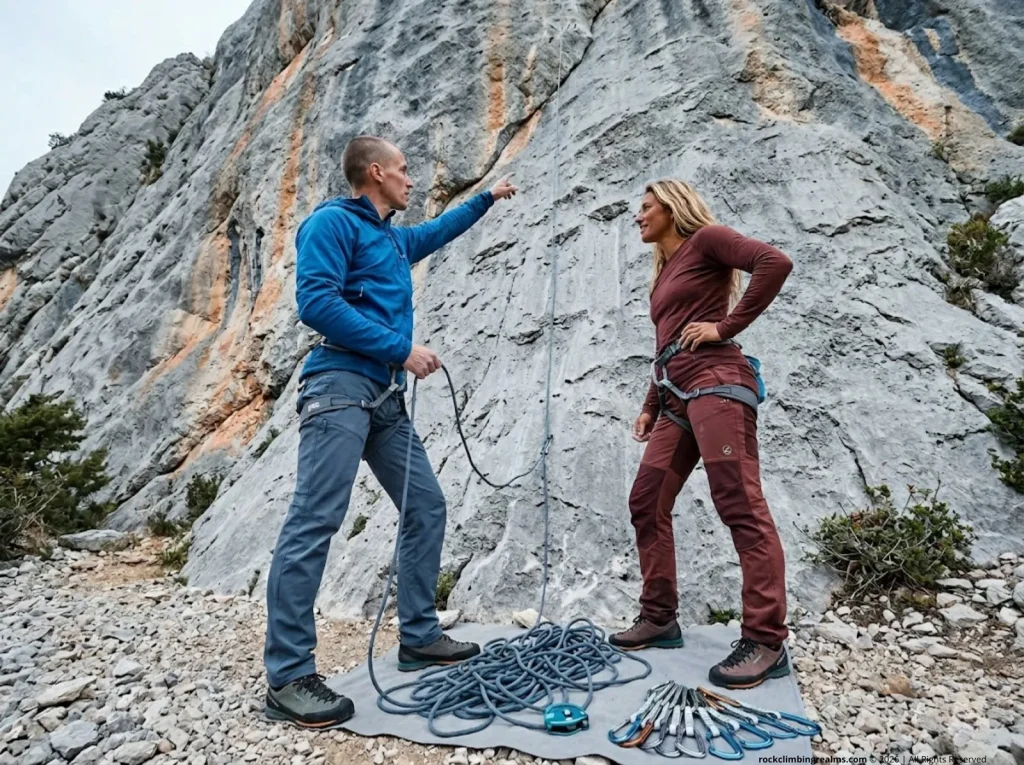
Training indiscriminately for “general fitness” is the fastest way to stay weak. If you go to the gym and randomly mix bouldering, endurance laps, and campusing in the same two-hour window, your central nervous system receives conflicting signals and adapts to nothing.
You must implement athletic periodization. Focus your energy sequentially, taking your body through deliberate phases to peak for a specific outdoor season. The Monitoring Muscle-Tendon Adaptation Over Several Years research confirms that linear loading prevents chronic injuries. This structural timeline maps daily sweat into long-term peak performance.
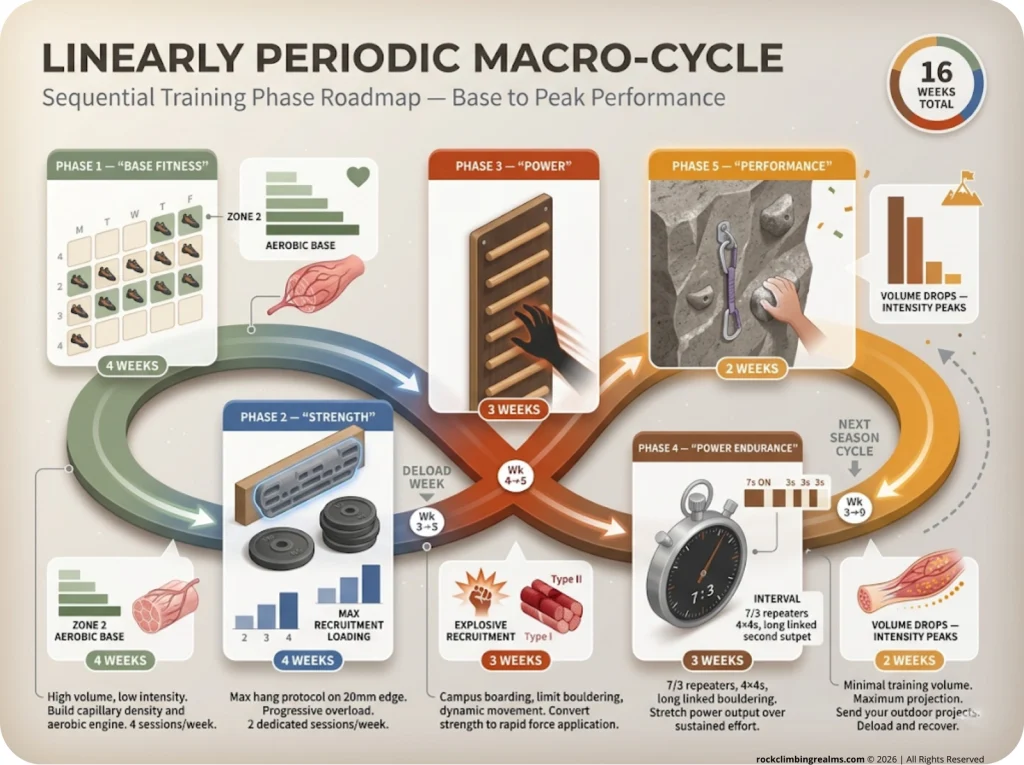
The Linearly Periodic Macro-Cycle
A structured periodization framework shifts your physiological focus over months. You start with high-volume, low-intensity base fitness to build capillary density. You move to a strength phase focused on max recruitment. That strength converts into rapid application during a power phase. You stretch that power out during power endurance. Finally, drop your training volume entirely during the performance phase to send your projects. Planned recovery blocks separate each phase.
The One Month Project (OMP) Protocol
The One Month Project (OMP) is the tactical bridge between the gym and long-term goals. Choose a route slightly above your current redpoint limit and commit exactly four weeks to it.
The OMP reveals specific skill gaps. If you fail to stick the crux lock-off, you know exactly what the next training block must address. The strict time limit prevents the psychological burnout of year-long mega-projects. You test your new strength, collect the data, and walk away regardless of the outcome.
Short-Term Projects (STPs) and the Senders’ Pyramid
You must remember how to finish climbs. Spending six months falling off the same three moves ruins your climbing psychology. You forget the sensation of success.
Short-Term Projects (STPs) require 10 to 20 attempts to complete. They build your senders’ pyramid. The rule is simple: for every limit-level attempt you make, bank three successful sends at a lower grade. This maintains central nervous system confidence and ensures you are still actually rock climbing, not just practicing falling. Work crag-specific replicas on the home wall as STP tools to dial sequence memory.
Pro tip: Climbing with partners who are stronger than you provides a live movement mapping library. Watching them execute a drop-knee perfectly alters your own spatial awareness faster than reading any textbook. Cultivate strong partner management.
Biomechanics and Force Vectors: Measuring Movement Mastery
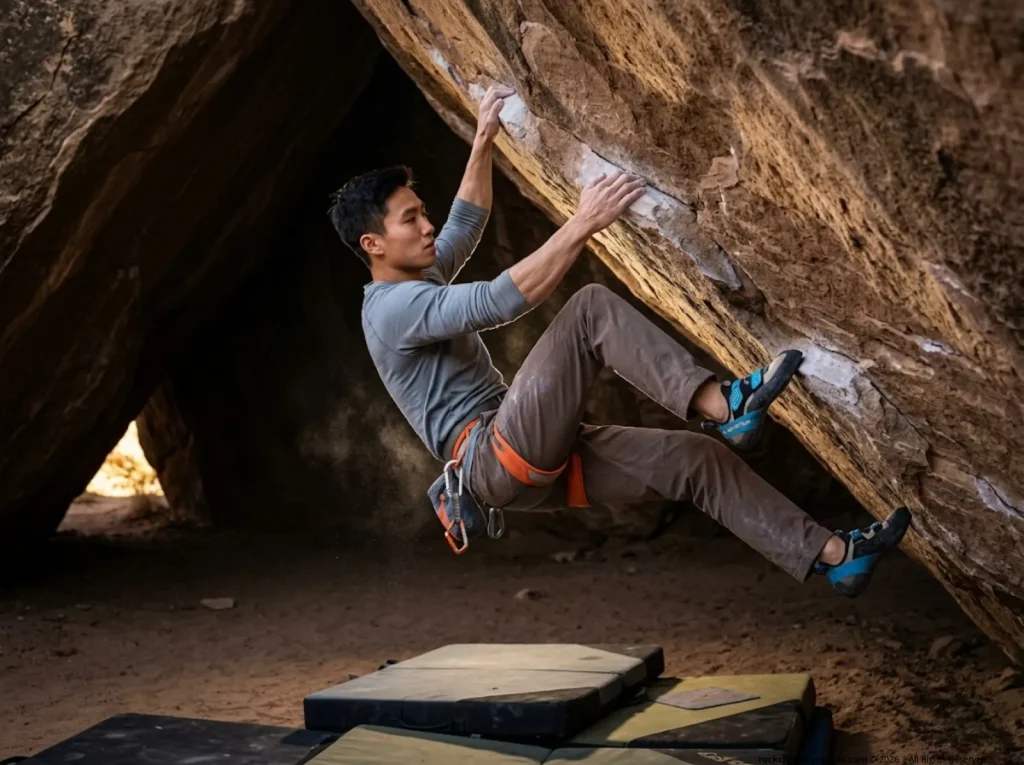
Athletic power is irrelevant if you leak it into empty space. Most climbers think strength is about pulling harder. Real process mastery is pulling smoother. You learn to direct all mechanical energy directly into the rock rather than bleeding it sideways.
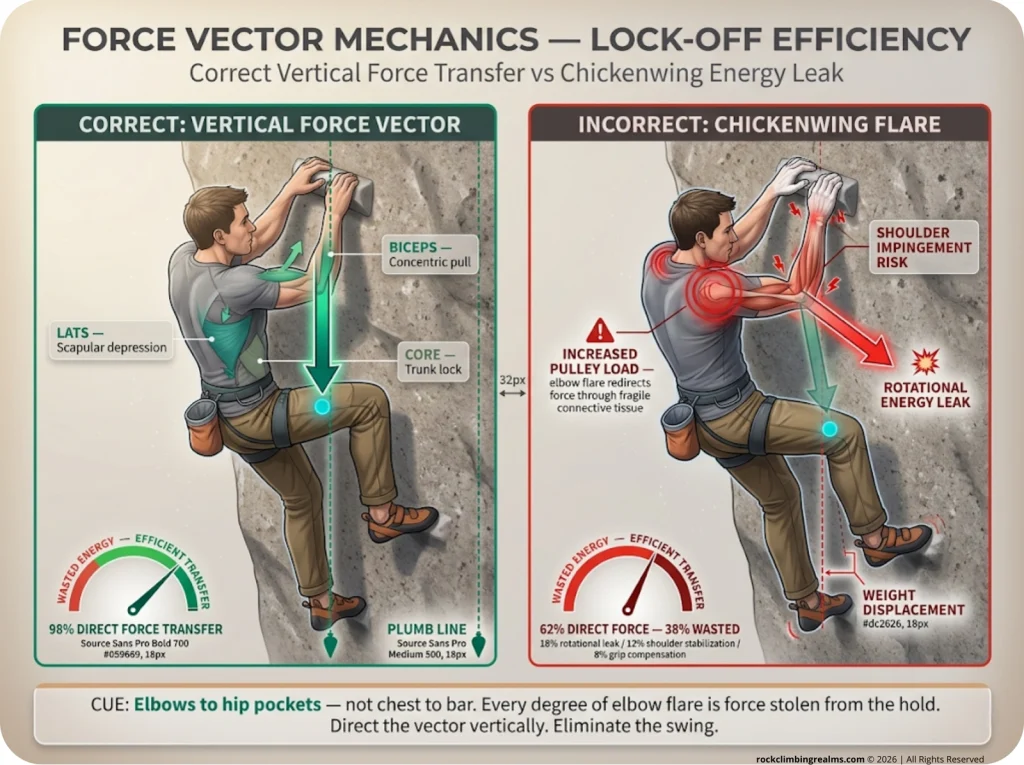
The Physics of Directional Force and Stillness
Perfecting your force vectors requires eliminating all swing. When you initiate a pull, think “elbows to hip pockets” — not “chest to bar.” This maintains a strict vertical arc through the shoulder complex. If your elbows flare out sideways into a chickenwing, you dump the load directly onto the fragile connective tissue of your shoulders and fingers.
Elite climbers exhibit lower movement complexity than novices — their hips glide, their transitions are smooth, and their holds do not pop unexpectedly. Novice climbers stutter, adjust, and bounce, burning massive amounts of energy correcting sloppy positioning. Your practical goal is reducing the stutter. One deliberate movement is worth three panicked ones.
Top-Out Mechanics and Plumb Lines
Countless redpoint attempts die on the top-out slab. The climber panics, throws their body onto their belly, and loses sight of their footholds. By doing this, they shift their center of gravity dangerously outward — away from the wall.
Your hands will pop off holds that felt bomber thirty seconds ago if your weight drifts backward. You must understand the mechanics of edging and smearing and how surface contact relates to friction, as documented in Climbers’ Perception of Hold Surface Properties. Use the “Knee to Sky” rule on mantles. Keep the force directed viciously downward into the foothold, staying tight against the plumb line of the lip.
Pro tip: Have your belayer film your top-outs from the side profile. If your hips breach the vertical plane of the rock lip, you are wasting energy pushing yourself horizontally away from the wall. Pull down, not out.
Professional Safety Benchmarks: The Ultimate Process Goal
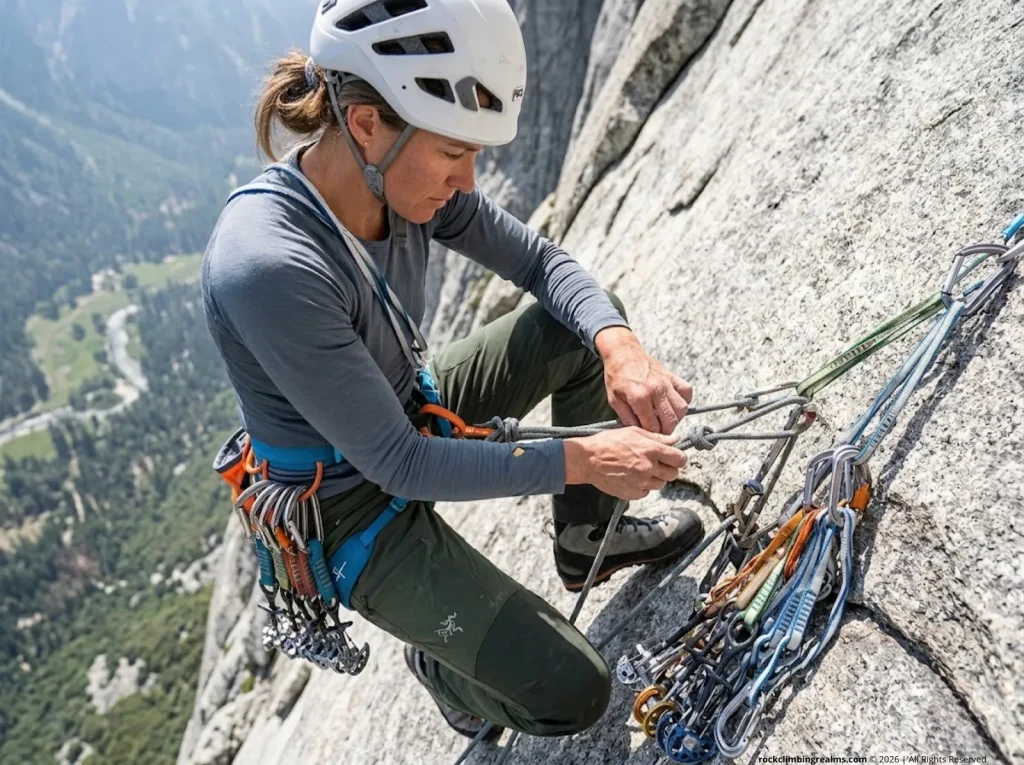
The leap from pulling plastic during indoor climbing to leading trad out on real rock requires a terrifying reckoning with gravity. Out here, a technical failure does not mean missing the send. It means someone gets hauled out by a helicopter. Integrating safety proficiencies into your progression tracking changes the nature of your climbing entirely.
Setting a definitive tactical goals framework around professional safety benchmarks forces you to prioritize survival over subjective achievement. You are not a competent leader because you can crank a 5.12. You are a competent leader when your systems are dialled to the point of unconscious competence. A $150 cam is a useless piece of metal if you do not understand the rock feature you are placing it into.
Mastering the AMGA SPI Anchor Benchmarks
Forget “learning to build an anchor.” That is a vague, unmeasurable wish. Make it a timed, strict capability. Your goal is to reliably construct a SERENE/ERNEST trad anchor system, hit three redundant points, and equalize it in under 120 seconds.
The AMGA Single Pitch Instructor prerequisites demand dark and blind knot tying. You must rip a Figure-8, Munter, and Clove hitch in under 15 seconds without looking. If a storm rolls in and the temperature drops thirty degrees, fine motor skills vanish. Escaping the belay and executing counterbalance rescues go from optional tricks to baseline survival benchmarks.
The Physics of Fall Factors and Limit Testing
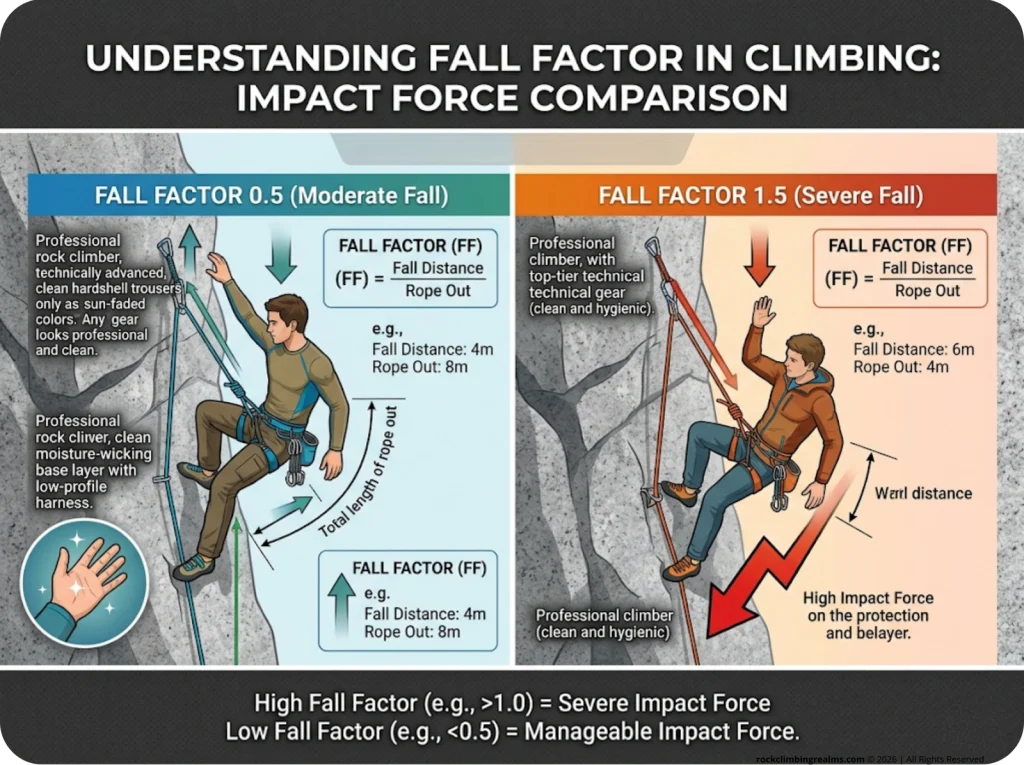
Most recreational climbers do not understand the physics of the UIAA drop tests. A Fall Factor is the ratio of the fall length to the rope absorbing the impact. A short factor 1.7 fall right off the belay generates up to 12 kN of force — approaching the absolute failure limit of modern carabiners and tearing aging gear apart.
You must calculate the “Pulley Effect” on your top piece. The trad anchor catches the impact of your mass plus the force of the belayer arresting the fall, multiplying the load on the top piece by nearly 2.0x. Read the How Far Can You Trust Your Belay Device? data from the Mountain Rescue Association. A 10-foot fall low on the route is vastly more violent to your spine and your gear than a 30-foot winger with a hundred feet of dynamic rope out.
The “Anti-Sell”: Skills Over Gear
The outdoor industry wants you to believe you can buy your way out of a plateau. You cannot. Buying lighter quickdraws will not fix a fundamentally flawed understanding of rope drag management.
Audit your gear aggressively. Sun-faded Dyneema slings lose over 50% of their rated strength from UV exposure — dropping from 22 kN to 10.5 kN, a load easily seen in a high-factor fall. Reject the consumer reflex and commit to relentless technical practice. Your identity out here depends entirely on your competence and self-reliance.
Pro tip: Before you step off the ground, calculate your worst-case fall factor for the first three bolts. If the math looks ugly, you stick-clip the first piece. Ego has zero place in the physics of a ground fall.
Conclusion
True progression is the deliberate orchestration of your physiological timelines, movement efficiency, and professional safety standards. You cannot force a tendon to heal faster by wanting it more. You cannot defy the physics of a severe fall factor by wearing better shoes.
Three things to take with you: First, your tendons set the real timeline — build your training calendar around them, not around your ego. Second, a diversified portfolio of process and performance goals will outlast any single send. Third, your safety benchmarks are climbing goals, full stop — treat them with the same rigor you give your hangboard sessions.
Go draft your blueprint this week, drop the participant mindset, and become a tactician. Now go send something.
FAQ
What is a realistic timeframe to increase my bouldering grade?
Going from V3 to V5 demands three to twelve months, tied strictly to the speed of collagen remodeling in your tendons. Your lats and biceps adapt and feel stronger in a few weeks. Your pulleys require seasons of systematic loading to withstand the smaller, harsher edge demands of advanced grades. Ignore the muscle pump and listen to the joints.
How often should I train my finger strength to see progress?
One to two dedicated, fresh hangboard sessions per week during a targeted strength macro-cycle is the standard protocol. Exceeding this frequency rarely speeds up recruitment and drastically spikes the risk of rupturing an A2 pulley in intermediate climbers. More is not always better. More is often injury.
What are process goals in rock climbing?
Process goals ignore the outcome of the climb and focus entirely on executing a specific movement. Choosing to maintain rhythmic breathing on the crux, point the knee to the sky on the top-out, or stick a flawless 3-second lock-off keeps the definition of success entirely within your direct control, insulating you from failure caused by bad weather or slick rock.
Why do I climb well in the gym but struggle outdoors at the same grade?
Indoor climbing relies heavily on gross muscular power and aggressively textured resin holds, while outdoor climbing demands complex force vector management and incredibly subtle micro-beta. Tracking progression strictly through indoor grades creates a dangerous illusion of capability that shatters against the low-friction nuance of outdoor stone.
How do I incorporate safety into my climbing goals?
Set hard, measurable, professional-level milestones taken straight from AMGA curriculum prerequisites. Shifting a vague ambition from lead harder trad to reliably construct a 3-point redundant anchor in under 120 seconds creates a foundation of survivability that protects your life while you chase the physical limits.
Safety Notice: Rock climbing and mountaineering are inherently high-risk
activities that can involve physical trauma or fatal incidents. The information on Rock Climbing Realms is for
educational and informational purposes only. Techniques and advice presented here are not a substitute
for professional, hands-on instruction. Conditions and risks vary by location. Always seek guidance
from a qualified instructor before attempting new techniques. By using this website, you agree that you
are solely responsible for your own safety. Any reliance you place on this information is strictly
at your own risk, and you assume all liability for your actions. Rock Climbing Realms and its authors
will not be held liable for any harm, damage, or loss sustained in connection with the use of this information.
Affiliate Disclosure: We are a participant in the Amazon Services LLC Associates Program, an
affiliate advertising program designed to provide a means for us to earn advertising fees by advertising and linking
to Amazon.com. As an Amazon Associate, we earn from qualifying purchases. We are also an official affiliate partner
of Black Diamond Equipment via the AvantLink network. If you click on a Black Diamond affiliate link and make a
purchase, we may earn a commission at no additional cost to you. We also participate in other affiliate programs.
Additional terms are found in the terms of service.