

In this article
Pitch 4. The clouds that were “just weather” an hour ago are now a single grey wall pressing down on the ridge. Your partner’s hands are shaking — not from cold, but from that 45-minute runout above the last sketchy nut placement. You’ve been here before. You know this feeling. And yet the summit is right there.
This is where most climbers get hurt. Not from a catastrophic equipment failure. From refusing to trust a system they never fully built.
I’ve watched this play out more times than I care to count. The rope team that keeps moving when every signal says stop. The climber who knows — and keeps climbing anyway. The decision to bail is the highest-order technical skill in this sport, and almost nobody trains for it deliberately. This article is that training.
By the end, you’ll have a repeatable, emotion-resistant framework that integrates cognitive psychology, real-time hazard assessment, and the physics of a safe retreat anchor — built so that when the mountain forces the call, the answer is already loaded.
⚡ Quick Answer: When any three red flags from the Environmental, Human/Physical, or Technical categories are triggered simultaneously, that is a mandatory retreat — no team debate required. The system works because it strips the decision of ego and sunk cost before you leave the car. Supporting mechanics: keep bail anchor angles under 60 degrees, carry rated leaver gear, and name your turnaround time before the first pitch. The mountain will always be there. Your job is to make sure you are too.
The Architecture of a Bad Decision — Why Climbers Don’t Bail When They Should
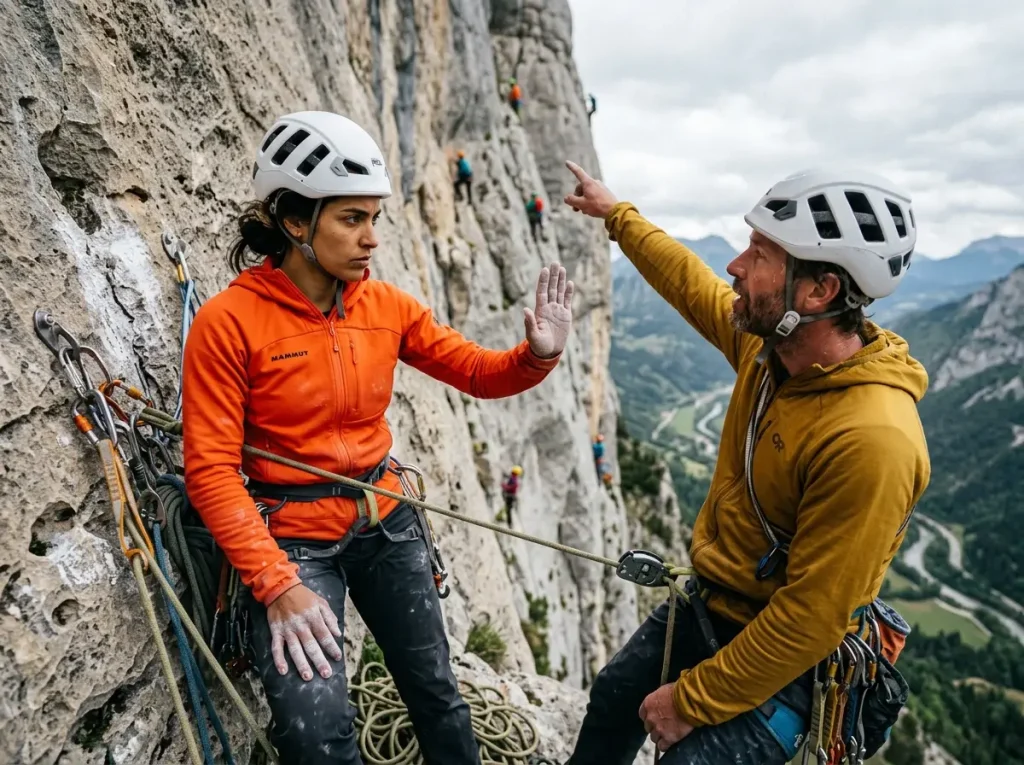
The FACETS model — Familiarity, Acceptance, Consistency, Expert Halo, Tracks/Scarcity, Social Facilitation — was originally developed by Ian McCammon for avalanche terrain, but it maps onto rock and alpine climbing with uncomfortable precision. Each heuristic is a mental shortcut that bypasses real risk assessment and replaces it with something more emotionally satisfying.
Familiarity is how experienced climbers get hurt on routes they know. The brain interprets past success as a safety guarantee. It isn’t. Objective hazards don’t care how many times you’ve been there before. The rockfall that cleaned out a new line last week doesn’t know your tick list.
Consistency — the sunk cost fallacy in climbing clothes — is the most powerful anti-bail force you’ll ever fight. After months of planning and thousands of dollars in travel, the psychological cost of “failing” can completely override statistically obvious retreat signals. Out-of-state climbers on Mt. Rainier summit at a 36.2% success rate compared to 47.5% for Washington residents. That 11-point gap isn’t fitness or skill — it’s the Consistency trap forcing people to attempt in weather windows they can’t afford to skip.
Social Facilitation is quieter and more hazardous. Seeing another party move upward through worsening conditions doesn’t mean the conditions are acceptable. It means another team made the same bad calculation you’re about to make. Group polarization makes this worse: teams consistently make more extreme decisions than individuals because diffused responsibility weakens individual accountability. The “risky shift” is real, and it gets people hurt on what should have been manageable days.
The pre-built antidote to all of it is the “two yes, one no” rule — every member of the rope team holds absolute veto power, no explanation required. But here’s the catch: it only works if you establish it before the climb. Partners who’ve never discussed veto power rarely exercise it. For a structured look at how heuristics interact with objective hazard data, the risk assessment matrix for climbing routes gives you a working framework to think through both layers systematically.
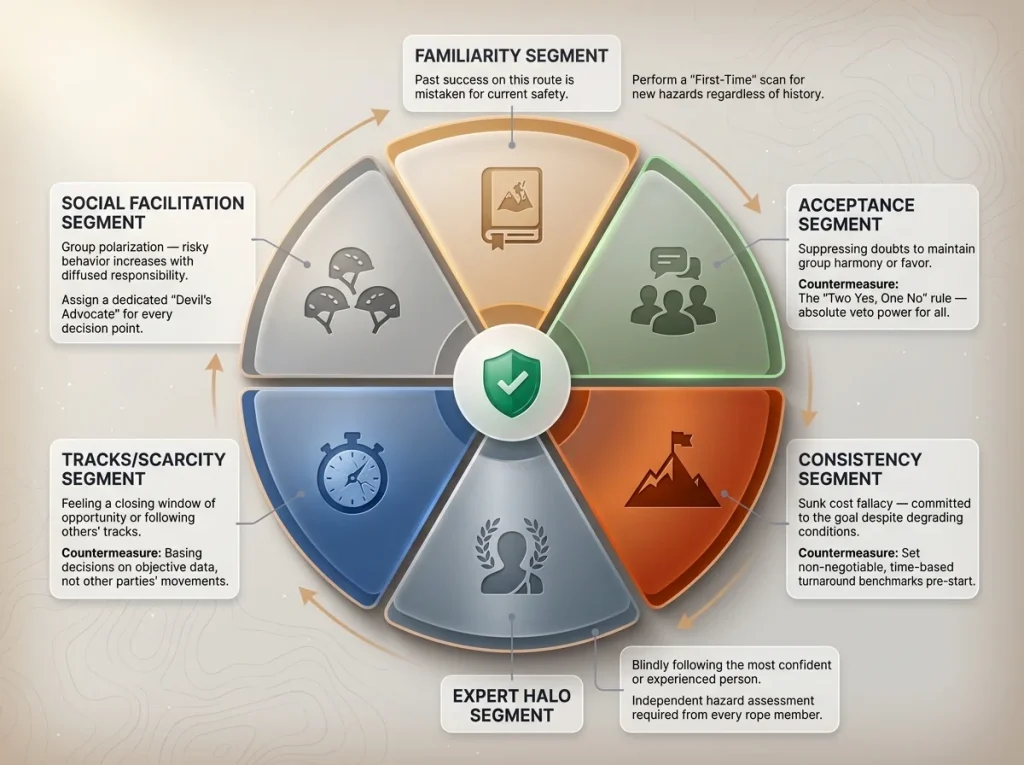
Familiarity, Consistency, and the sunk cost trap
“Normalization of deviance” is what happens when Familiarity runs long enough. The route felt safe before, so the brain quietly discounts new hazard signals. It’s not conscious — that’s what makes it lethal.
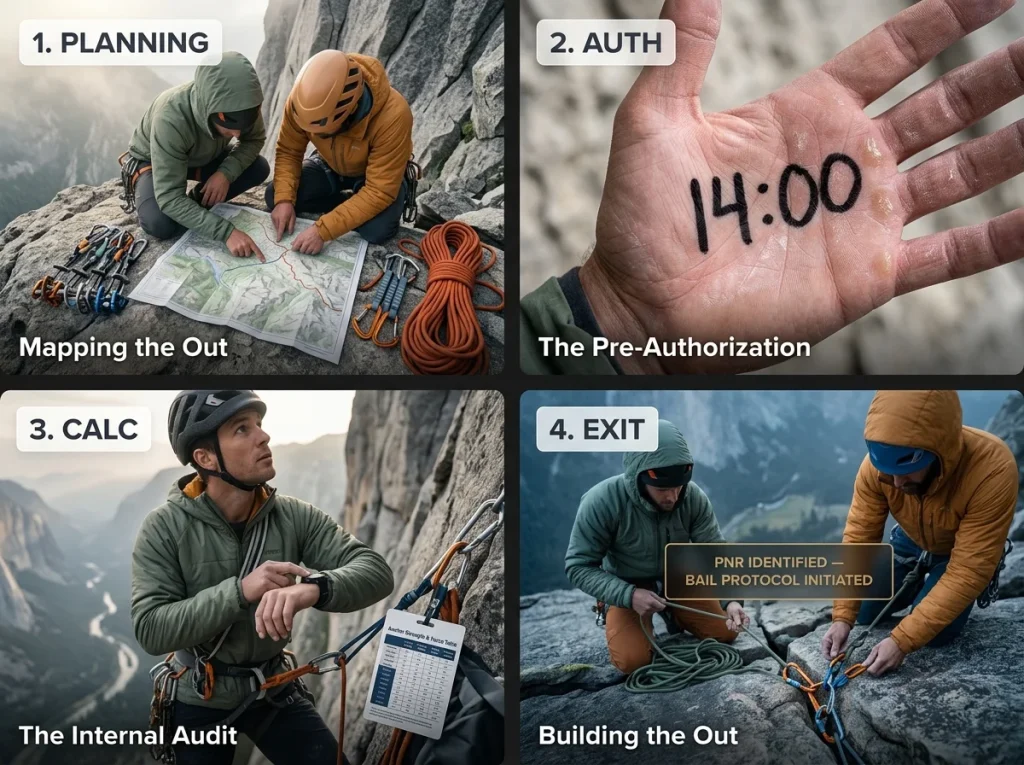
The countermeasure is pre-authorization. Set non-negotiable, objective benchmarks before you leave the trailhead. “We turn around at 2 PM regardless of where we are on the route.” The turnaround time needs to be set before sunk costs accumulate, because once you’re 1,000 feet up with summit fever running, the math always comes out in favor of continuing.
Pro tip: Write your turnaround time on your palm with a Sharpie before you leave the car. It sounds excessive. It works because it makes the commitment concrete and public before the emotional pressure builds.
The expert halo and social facilitation — when group dynamics kill
The Expert Halo operates on perceived authority, not actual competence. Age, confidence, and assertiveness are the proxy signals the brain uses when it doesn’t have real data to assess technical skill. If the most assertive person on the rope is running their own heuristic traps, everyone follows — and nobody has exercised independent judgment.
A professional guide cue worth memorizing: watch for “voices lowering and eyes moving.” That behavioral pattern signals team discord before anyone has named a problem out loud. It’s an early warning system for heuristic trap activation. Pay attention to it.
The Tracks/Scarcity trap compounds Social Facilitation in ways that don’t always register until later. Seeing another party move through an objective hazard zone reads to your brain as a rare conditions window closing — which drives urgency and rushed decisions. Both signals are wrong. Don’t use other people’s bad decisions as data on conditions.
When you’re scouting a new partner: ask directly whether they’ve ever bailed, and why. That answer tells you more about their judgment than any tick list.
Environmental Thresholds — The hard data for objective hazard recognition
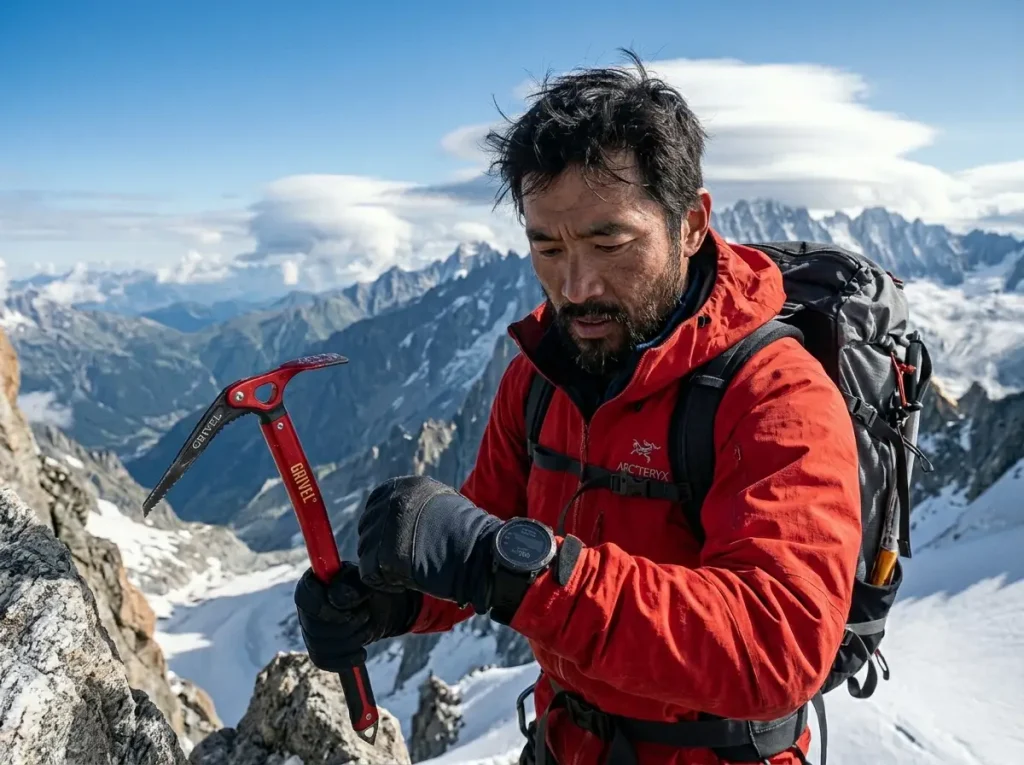
Objective hazards exist independent of the climber. Weather comes for you whether you’ve checked the forecast or not. The goal here isn’t fear management — it’s building a concrete, measurable threshold system so that “the weather looks sketchy” becomes “lenticular cloud formation confirmed above the summit ridge, we’re descending.”
Lenticular clouds indicate high-altitude winds likely above 50 mph. If your team cannot identify them on sight, you are not equipped for high-alpine objectives. That’s not an opinion — it’s an operational fact.
Anvil-headed cumulus (cumulonimbus buildup) signals impending severe convective activity. NOLS lightning protocols mandate descent when these are within 10–15 miles. The 2 PM rule for alpine starts exists for exactly this: if your team cannot summit and begin descent before 2 PM, the afternoon convective weather window has already closed the objective — regardless of how close the summit looks.
Rapid warming in alpine terrain triggers wet-snow avalanches, rockfall, and ice collapse. Couloirs act as natural funnels for this discharge. Once temps spike in a couloir environment, the question isn’t whether debris will come down — it’s when.
For weather reading in real time: apps like Mountain Forecast and Windy are useful, but their satellite data lags convective storm development by 30–90 minutes. Observational skill built before the trip matters more than app access on the day. A practical guide to mountain meteorology for climbers covers the visual literacy you need before committing to alpine terrain.
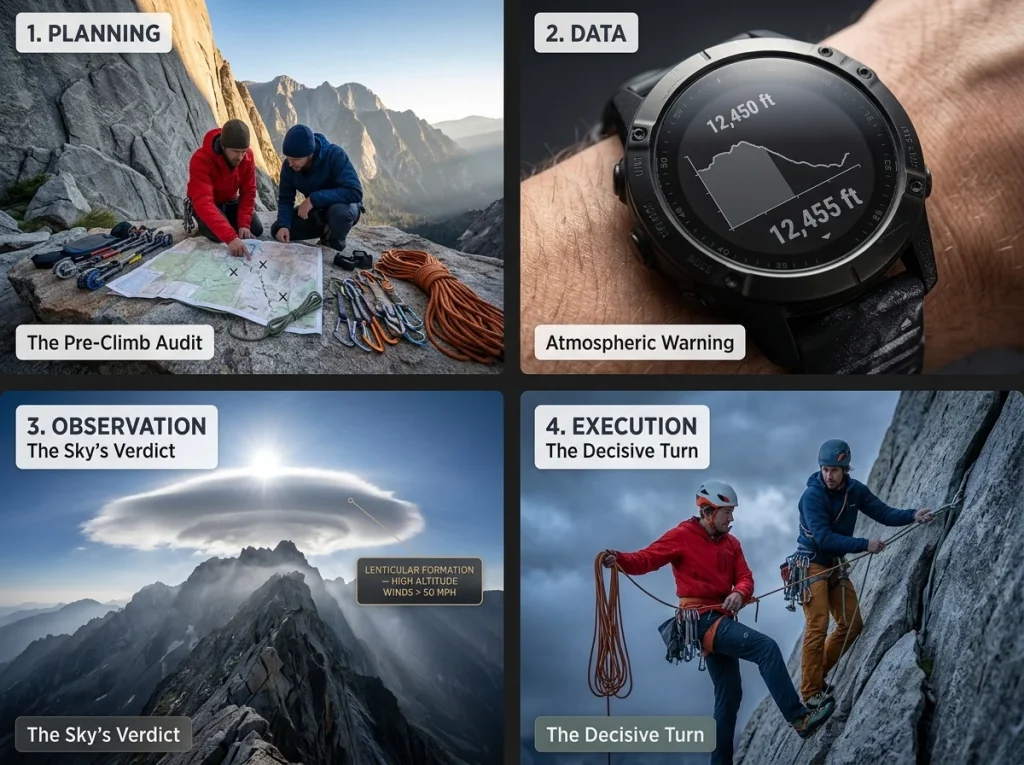
Weather pattern recognition — the 3 visual cues that mandate immediate descent
Three cues, no ambiguity:
- Lenticular cloud forming above the summit — winds above 50 mph likely at elevation
- Rapid barometric drop measurable with a wrist altimeter (more than 100 ft/hr altitude reading shift without actual elevation change)
- Cumulus edges darkening from white to grey-yellow — hail or electrical activity imminent
None of these require a meteorology degree. All of them require you to know what you’re looking at before you leave the parking lot.
Pro tip: Brief the specific weather abort criteria — cloud type, altimeter shift, time limit — with everyone on the rope team at the trailhead. Unnamed hazards don’t get called. If your partner doesn’t know what a lenticular looks like, show them the night before on a laptop, not at the base of the route.
Terrain traps and the route-finding red flag
Glacial retreat has altered the actual terrain on dozens of “standard” routes. When the route description in your guidebook diverges from what you’re actually seeing, that discrepancy is a mandatory situation assessment pause — not something to work around.
The soundness of holds test is its own data point: if you are testing holds before committing on a route you expected to be solid, you are already in terrain that warrants heightened retreat readiness. Holds that require testing are holds that might fail.
Terrain traps to flag specifically: narrow couloirs as rockfall funnels, traverses that move you away from viable rappel lines, north- and west-facing routes in early season with recently-exposed ice beneath a thin snow veneer.
The Three Red Flags Protocol — An objective decision framework
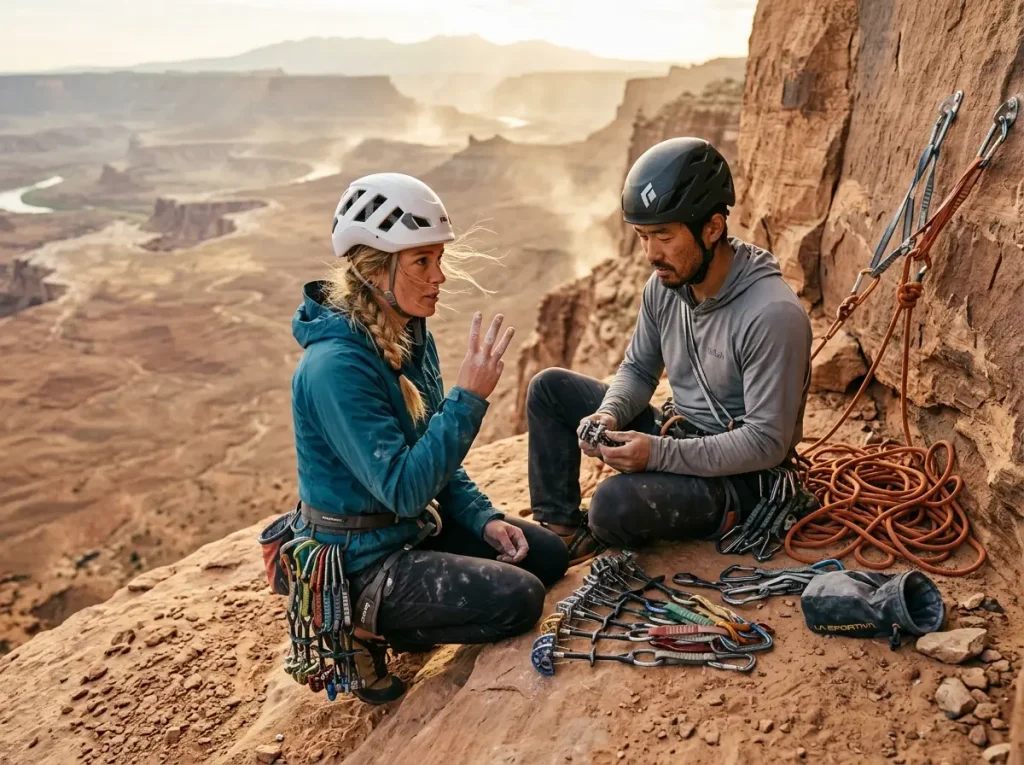
Most competitors cover “signs you should bail” as a checklist. This is different. The 3-red-flag rule is a pre-authorized tripwire system built to interrupt the accident cascade before it compounds — and it’s drawn directly from the AAC accident database, which has documented mountaineering incidents since 1943.
The data is clear: the majority of climbing accidents result from compounding contributing causes, not a single catastrophic failure. The Three Red Flags system is designed to intercept the pattern at the second flag — before the third one becomes the accident.
The three categories:
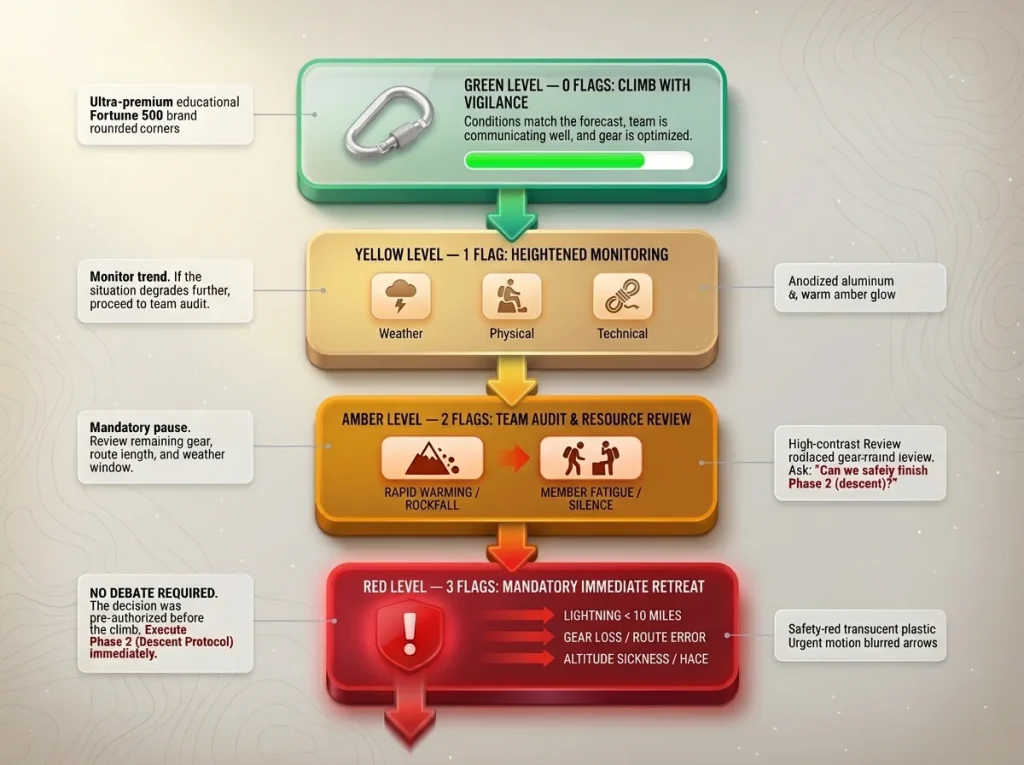
- Environmental Flags — unexpected lightning within 10 miles, falling ice above your position, temperature increase of more than 5°C in under an hour
- Human/Physical Flags — a partner “not feeling it,” visible signs of altitude sickness (headache, nausea, ataxia), creeping fatigue degrading fine motor control
- Technical Flags — gear loss, missed turnaround time by more than 20 minutes, significant route-finding error that consumed 30+ minutes or generated increased topographic commitment
Protocol: one red flag = increased vigilance. Two red flags = formal team discussion and resource audit. Three red flags = mandatory, non-negotiable retreat. The system’s power is its pre-authorization. When teams agree to the protocol before leaving the car, the third flag doesn’t require a debate. The decision was already made.
For the statistical framework behind accident causation patterns, why climbers should read AAC accident reports is worth reading before your next alpine objective. The Swiss Cheese Model of accident causation in climbing explains why these flags compound into events rather than remaining isolated near-misses.
Environmental red flags — the hard limits
“Unexpected” is the operative word. Phenomena you were not briefed on and did not plan for consume psychological bandwidth and degrade technical execution. A storm you knew was coming is a planning failure. A storm that wasn’t on the forecast is a flag — and it immediately counts.
Photograph the sky at the trailhead and at each pitch. Reviewing the visual sequence reveals trend data that memory will distort under summit fever pressure. The brain edits. Photos don’t.
Human and physical red flags — the internal audit
Altitude sickness symptoms — headache, nausea, loss of coordination — are physiological red flags that demand immediate consideration of descent, regardless of summit proximity. There is no version of this situation where the answer is “push through.”
A partner who falls quiet and stops communicating is emitting red flag behavior. It’s one of the most reliable early signs of both physical degradation and cognitive withdrawal. Pay attention to silence on a rope team.
Mid-climb Safety Audit: a deliberate pause to reassess team condition, remaining gear, time, and weather. If two or more of these factors have degraded since the last anchor, trigger the flag count. This is exactly the protocol that professional guides use — “the talk test” (can your client maintain conversation at current pace?) as a real-time fatigue monitor. Apply it to your partner on every pitch.
Technical red flags — when the system is failing
A “significant route-finding error” isn’t measured in time lost — it’s measured in commitment generated. If your detour has placed you in terrain that is harder to reverse than to continue, you are in a fundamentally different risk category than you planned for. That shift in commitment is the red flag, not the minutes spent finding your way back.
Any single piece of protection that fails under load — not testing, actual failure — is an immediate flag. That piece told you something about the wall you’re on.
Pro tip: Run a gear count at every belay. If you’re burning gear faster than planned — more pieces per pitch than the rack allows for a full retreat — that’s a technical flag. Catch it at anchor two, not anchor six.
The Point of No Return — How to calculate commitment before you cross it
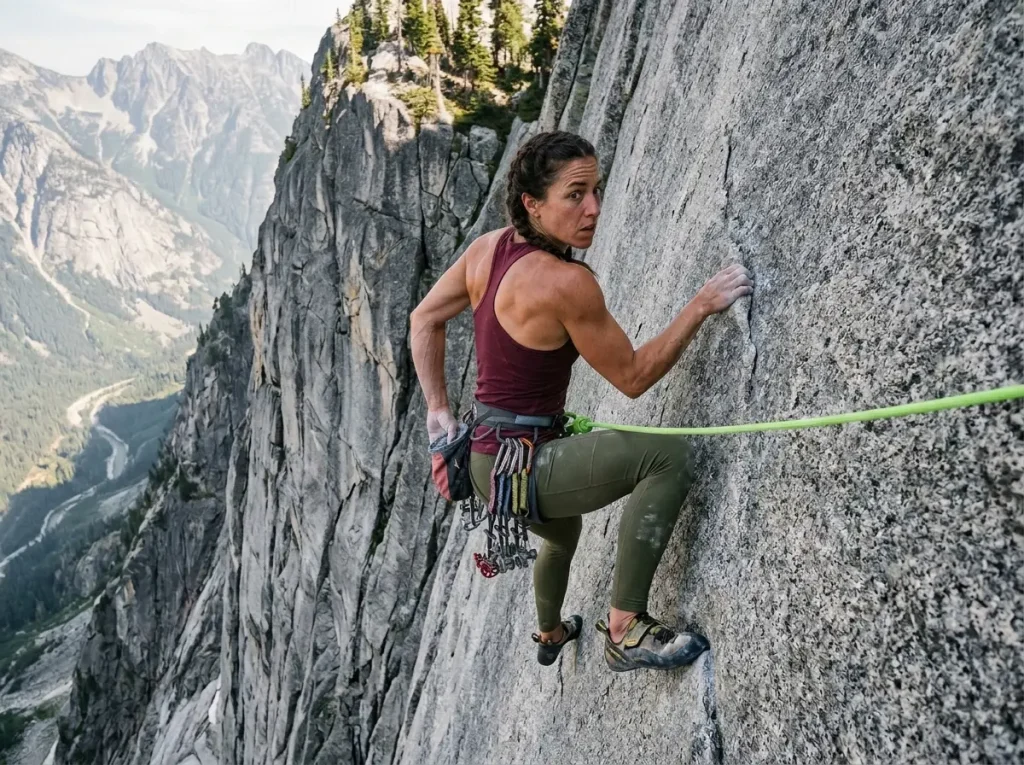
Three types of point of no return in climbing:
- Technical PNR — a move that cannot be reversed without a fall
- Logistical PNR — insufficient rope or daylight to reach the ground or next rappel station
- Environmental PNR — entering a couloir or avalanche path during a storm
The math of a rappel descent is worth knowing cold: total rappel distance divided by (rope length ÷ 2) equals the number of rappel stations you need. If those stations don’t exist on the wall, the math is already against you before you unclip.
On committing traverses, the topographical trap is most hazardous: horizontal movement puts you in terrain where the rope can descend but you can no longer reach the anchors to set up the next station. Most climbers cross this threshold without registering it consciously. Build the habit of mapping the rappel descent line explicitly, before climbing anything with significant horizontal movement.
IFMGA guiding standards treat IFMGA mountain guide commitment and retreat competency standards as assessed core skills — because the PNR is not a theoretical concept in professional terrain. For the practical mechanics of multi-pitch retreat systems, multi-pitch systems, safety, and retreat planning covers the anchor management and rope-length math in depth.
Identifying the technical point of no return before you hit it
Before committing to any irreversible move sequence, ask: “Can I safely reverse this?” If the answer is no, the PNR is that move — and you need to pre-place protection and confirm rope length with your belayer before attempting it. Down-climbing a trial sequence is not beginner behavior. It is the protocol used by professional guides in high-consequence terrain.
The PNR is often not a single move — it’s a sequence of three to five moves with no adequate rest position. The full sequence is the PNR block. Treat it as one unit.
Pro tip: If you find yourself mid-move and suddenly aware you cannot reverse — stop moving entirely. That moment of recognition is the PNR notification. Build your bail anchor right there if necessary. The hold you’re on is better than the hold you’re going to.
Traverses, couloirs, and topographical traps that prevent rappelling
On the Grand Teton’s Owen-Spalding route, the descent involves specific rappel stations that are not directly above the climb — and climbers who summit without knowing the descent beta are already past a logistical PNR. This is not an edge case. It’s a well-documented pattern on dozens of popular moderate routes. The Grand Teton Owen-Spalding route guide walks through the full descent sequence so you’re not figuring it out on a rocky ledge at dusk.
On any route with significant horizontal movement, map the rappel descent line separately from the ascent line before you start climbing. If those lines diverge by more than one pitch, you have two separate technical problems requiring separate planning.
The Physics of the Retreat — Building a bail anchor under pressure
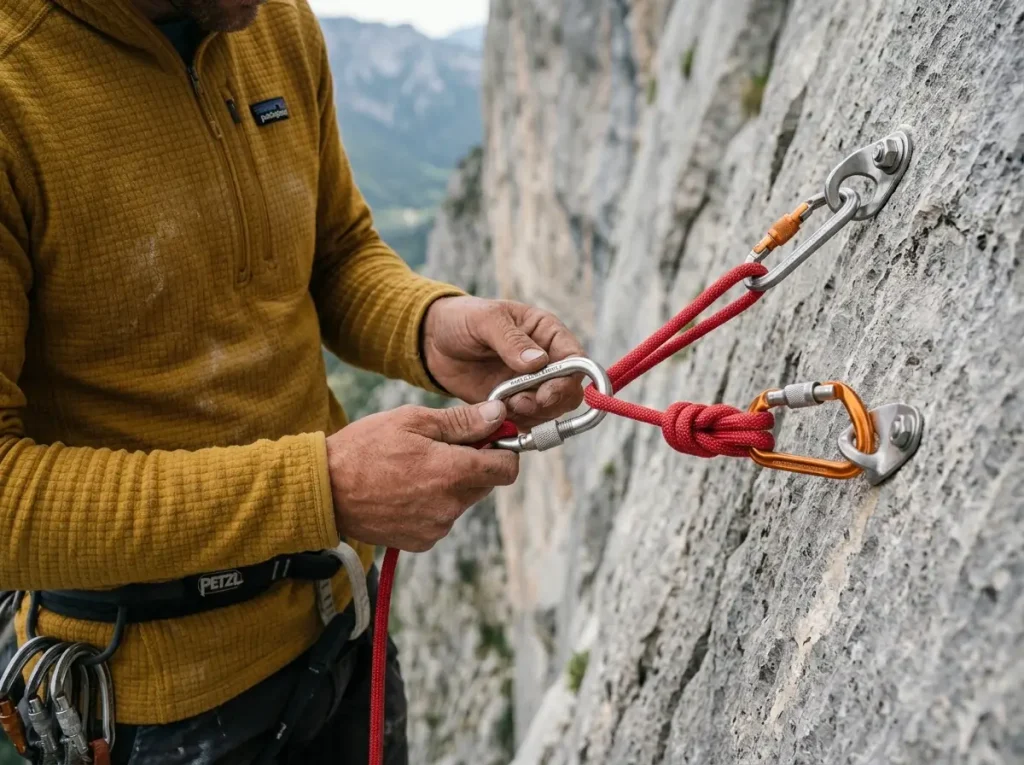
Once the bail decision is made, the technical work begins. This is where rushing gets people hurt — not the conditions that triggered the retreat.
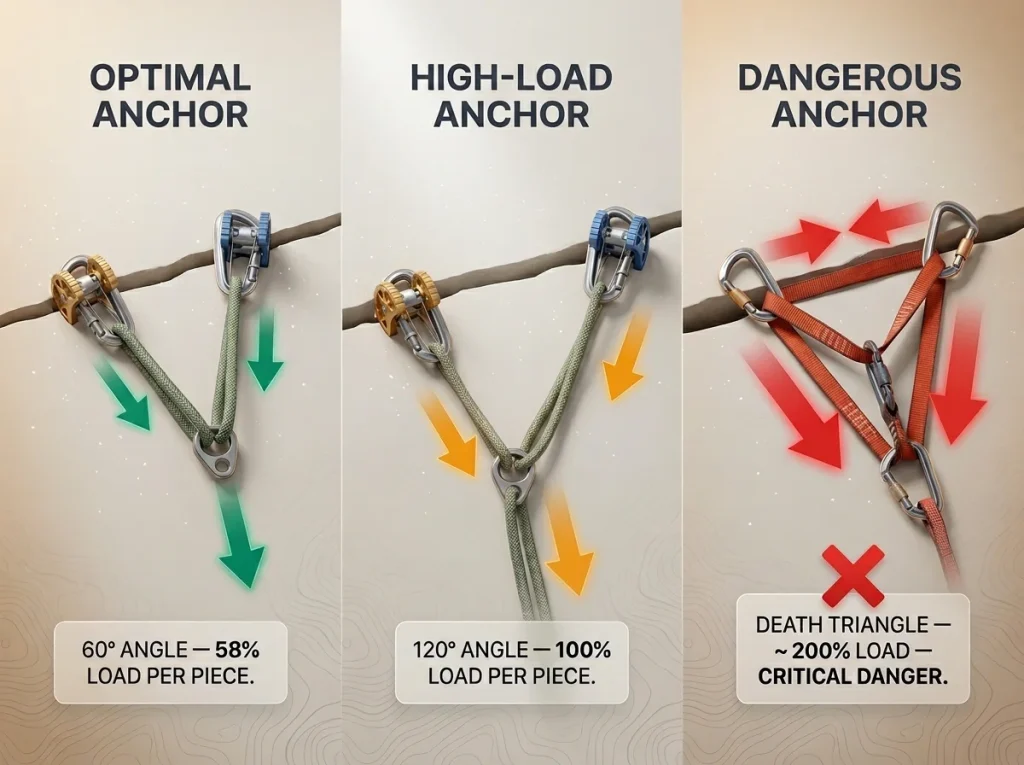
Anchor angle determines load distribution. At 60 degrees between anchor points, each piece takes 58% of the total load. At 90 degrees, 71%. At 120 degrees, each piece takes 100% — as if the other piece weren’t there. At 150 degrees, you’ve applied 193% of the load to each individual piece. You have literally made things worse than a single-point anchor.
The target is 60 degrees or under. If your anchor points are far apart, lengthen the material using a longer sling or cordelette to narrow the V-shape. This is not a suggestion — it’s the geometry of your survival. For the underlying force tables, vector force distribution in climbing anchor systems covers the full angle breakdown. For real-world consequences of anchor errors, climbing anchor failure case studies is worth reading before you’re in a situation where it matters.
The American Death Triangle — threading anchor material through two points and connecting the load to a strand between them — dramatically increases horizontal tension on each bolt. At 90 degrees it applies roughly 1.3 times the load to each piece. At 120 degrees it nearly doubles the force on each anchor. It is categorically unsafe and there is no field context in which it is acceptable.
SRENE (Solid, Redundant, Equalized, No Extension) must hold even in an emergency bail. Compromise on any of those four in a rush scenario and the anchor fails from bad rigging, not bad rock.
Leaver gear — what to leave, what never to trust
The professional standard for bail-gear is a rated steel quicklink (Maillon Rapide) threaded through a fresh rated cordelette or 6mm accessory cord. Bail biners — standard locking carabiners — are acceptable for short descents, but the quicklink is the cleaner, more reliable option because it closes completely and provides a smooth rappel surface.
Found tat (weathered webbing already on the wall) must be treated as failed until proven otherwise. Retirement criteria: discoloration, UV fading, stiffness, fraying at thread points. If any of those are present, you reinforce it with your own cord before weighting it. You don’t guess.
Pro tip: Carry a 4–6 meter length of 6mm rated accessory cord on any multi-pitch objective, dedicated exclusively to bail scenarios. It costs under $10, has a rated load, and weighs almost nothing. The day you need it, it’s worth more than everything else on your rack.
SRENE under pressure — the non-negotiables when you’re building fast
The temptation under stress is to skip Redundancy (single-point anchor) or rush past verifying Solid placement. The rule is simple: if you would not be comfortable hanging your full body weight from each placement individually, the anchor does not meet SRENE. The standard doesn’t change because you’re scared.
The No Extension criterion becomes critical in a bail scenario. If one piece fails and the master point drops significantly, the remaining piece gets shock-loaded — potentially above its rated limit even if it was conservatively placed. Build the system with Extension failure in mind before you weight it.
The bounce test — applying sharp body-weight pressure downward — is the field standard for both No Extension verification and placement solidity. Do it. Every time. There is no time pressure worth skipping it.
The short-rope problem — retreat when your math doesn’t work
When rope length is insufficient for a full rappel to the ground, the options in order of safety:
- Lower your partner to the next station — the belayer can monitor rope remaining
- Pendulum to a better-positioned anchor
- Downclimb with protection to a feasible rappel point
When linking two ropes for extended rappels, use the flat-overhand (European Overhand Knot) — the asymmetrical tail catches on edges less aggressively than a symmetric knot.
Stopper knots on both rope ends are mandatory whenever the bottom is not visually confirmed. A rappeler sliding off the end of a rope is the most preventable fatality in climbing, and it keeps happening.
Managing the psychology of the retreat — executing without ego
The bail decision once made needs to be stated clearly and without drama. Professional guide training emphasizes this because emotionally charged announcements destabilize rope teams and produce error cascades at exactly the moment you need clean execution.
Fear is a data point, not a verdict. Once the decision is made, fear’s job is finished. The team is no longer retreating — they are executing a technical operation with defined steps. Ascent was Phase 1. Descent is Phase 2. Both require equal precision. Rushing Phase 2 because of embarrassment or frustration is how rappel fatalities happen on what should be clean retreats.
For more on operating under fear without degrading execution, managing fear and anxiety while climbing covers the mental framework that separates managed responses from panic.
Post-retreat judgment window: after the bail decision, there is a 15–30 minute period where degraded judgment persists even after the call is made. This is when another heuristic trap — rushing the descent, skipping anchor checks — can enter. Name this window explicitly. Slow down specifically because you know it exists.
The communication protocol for declaring a bail
State the bail decision in three components:
- Name the specific red flag that triggered the call
- Name the immediate action (build anchor here / downclimb to X / retreat to the ledge)
- Assign who does what first
Remove ambiguity from all three. Unnamed decisions become contested decisions under stress. If team dissent occurs after a three-red-flag trigger, the “two yes, one no” protocol overrides it. This was agreed to before the climb. It is not a democracy at three red flags.
Use the same verbal cue every time. Something like “Red flag three, we’re retreating.” Standard language is faster under stress than improvised language. Your partner’s nervous system needs to recognize the phrase in a fraction of a second, not parse it.
Descent mindset — executing the retreat as a technical operation
The BRAKES checklist, run out loud before every rappel:
- Backup in place
- Rappel device correctly rigged
- Anchor checked — SRENE confirmed
- Knots locked, all gates closed
- End of rope confirmed (and knotted if bottom not visible)
- Stopper knot on both tails
Professional guides run this verbally, every single rappel. The most common rappelling accidents and how to prevent them traces the majority of rappelling fatalities directly to one skipped step on a familiar setup. The familiar setup is when people get hurt.
Conclusion
Three things to take off this wall with you.
First: build the system before you need it. The FACETS model, the Three Red Flags protocol, and your turnaround time must be established — verbally, with your partner — before the first pitch. Heuristics only ambush climbers who haven’t pre-loaded a countermeasure.
Second: the physics of a bail anchor are not optional. Sixty degrees or under. SRENE. Rated leaver gear. A 150-degree anchor angle nearly doubles the force on each piece. The mountain doesn’t grade on a curve.
Third: bailing is not a failure state. It is the highest-order technical skill in climbing — the integration of cognitive psychology, real-time hazard assessment, and the humility to acknowledge that superior judgment means knowing when not to climb. As Ed Viesturs put it: “Getting to the top is optional. Getting down is mandatory.”
Next time you’re at the base of a route, do this: name your three red flags before you start. Write your turnaround time on your palm. Brief your partner on the “two yes, one no” rule. Then climb. You’ve just built the system that keeps you in the game for the next 40 years.
FAQ
What are the signs you should stop climbing?
Three red flags in any combination of Environmental, Human or Physical, and Technical categories mandate an immediate retreat — no debate needed. One flag warrants heightened vigilance; two require a formal team discussion and resource audit; three require descent. Specific triggers include unexpected lightning, a partner showing altitude sickness or severe fatigue, and a missed turnaround time or gear loss. The value of the system is that the threshold is pre-agreed before the climb, so the third flag isn’t a conversation — it’s an execution.
How do you bail on a multi-pitch climb safely?
Identify the nearest suitable anchor — existing bolts, a solid crack placement, or a two-piece trad anchor built to SRENE standards — and keep the angle between anchor points below 60 degrees. Verify your leaver gear is rated and properly threaded. Run the BRAKES checklist (Backup, Rappel device, Anchor check, Knots locked, End of rope confirmed, Stopper knot) verbally before every rappel station. Calculate whether your rope length reaches the next anchor before unweighting.
What gear do you leave when bailing?
The minimum safe leaver setup is a rated steel quicklink (Maillon Rapide) or a locking carabiner threaded through a rated cordelette or fresh 6mm accessory cord. Never rappel off found webbing alone — reinforce any existing tat with your own rated cord. Budget to leave one 6mm cord section and one quicklink per bail anchor. That’s roughly a $25–40 investment to get off the wall.
How do you calculate whether your rope is long enough to bail?
Divide the total distance to the ground or next rappel station by your rope length divided by 2. If the result isn’t a whole number with a known intermediate anchor, you don’t have a clean rappel. In that case: lower your partner to the next station so you can monitor rope remaining, or pendulum to better-positioned anchors. Stopper knots on both ends — always — when the bottom isn’t visually confirmed.
How do you manage the psychology of bailing when your partner wants to continue?
Apply the two yes, one no rule agreed to before the climb. State the bail trigger clearly and without drama — name the specific red flag, the required action, and who does what first. Summit-fever arguments and emotional appeals don’t override a third red flag. The system you agreed to before the climb is not subject to renegotiation when sunk costs are high. That’s exactly why you agree to it before the sunk costs accumulate.
Safety Notice: Rock climbing and mountaineering are inherently high-risk
activities that can involve physical trauma or fatal incidents. The information on Rock Climbing Realms is for
educational and informational purposes only. Techniques and advice presented here are not a substitute
for professional, hands-on instruction. Conditions and risks vary by location. Always seek guidance
from a qualified instructor before attempting new techniques. By using this website, you agree that you
are solely responsible for your own safety. Any reliance you place on this information is strictly
at your own risk, and you assume all liability for your actions. Rock Climbing Realms and its authors
will not be held liable for any harm, damage, or loss sustained in connection with the use of this information.
Affiliate Disclosure: We are a participant in the Amazon Services LLC Associates Program, an
affiliate advertising program designed to provide a means for us to earn advertising fees by advertising and linking
to Amazon.com. As an Amazon Associate, we earn from qualifying purchases. We are also an official affiliate partner
of Black Diamond Equipment via the AvantLink network. If you click on a Black Diamond affiliate link and make a
purchase, we may earn a commission at no additional cost to you. We also participate in other affiliate programs.
Additional terms are found in the terms of service.