
In this article
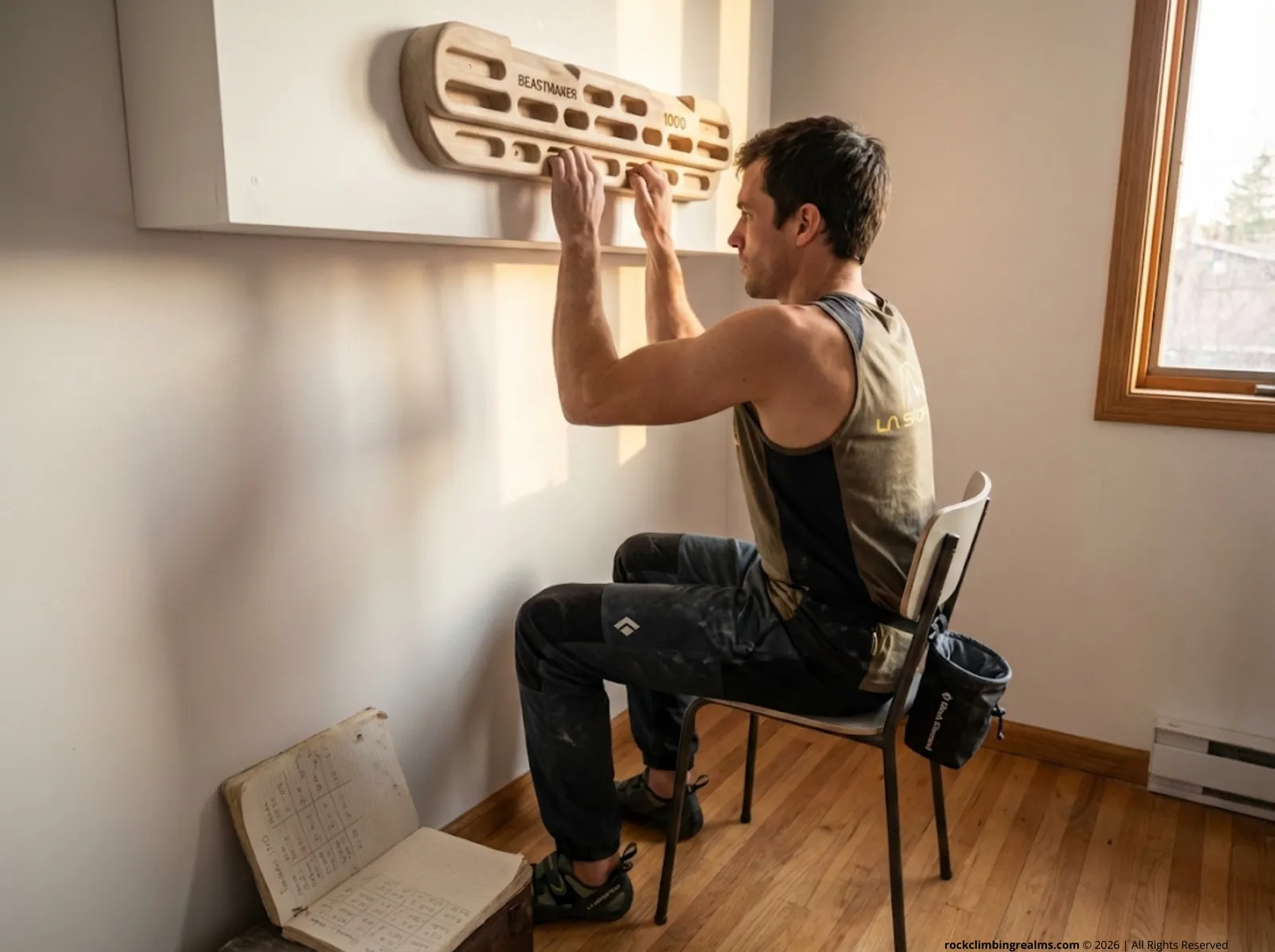
Last month I watched a climber on Reddit post his “max hang” number with genuine pride. Added 30 kg on a 20 mm edge, standing free-hang, single attempt. Elite-level stuff, right? Then someone suggested he try the same test seated with his elbows bent at 90 degrees. His number dropped 12%. Not because he got weaker between attempts. Because his first number was never real.
I’ve seen this happen dozens of times. Climbers tracking finger strength for months, making training decisions based on data that’s contaminated by body sway, inconsistent elbow angles, and trunk compensation they can’t even feel happening. They’re measuring a whole-body pull, not their fingers. And their training suffers for it.
Here’s exactly why the most common testing methods produce unreliable data, and how to set up a repeatable system backed by 2025 peer-reviewed research that actually tracks what matters. No guesswork. No inflated numbers. Just data you can trust.
⚡ Quick Answer: The most reliable finger strength test for climbers is the Sit-90 position (seated, elbows at 90° flexion), pulling on a 20–23 mm edge in half-crimp grip, averaging three maximal 5–7 second efforts with 2–3 minutes rest between each. This setup eliminates trunk sway and delivers test-retest reliability above 0.98, with the strongest correlation to actual climbing grades.
Why Most Finger Strength Tests Produce Garbage Data
The Body Sway Problem Nobody Talks About
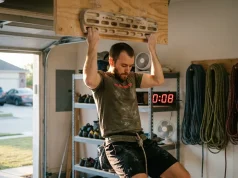
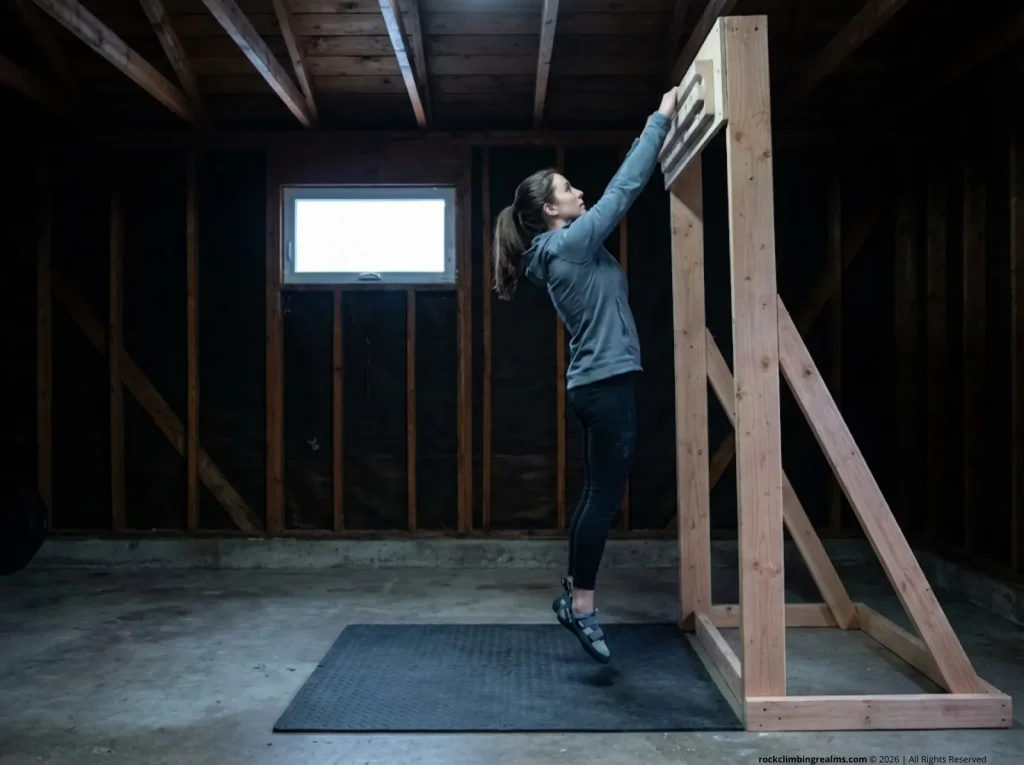
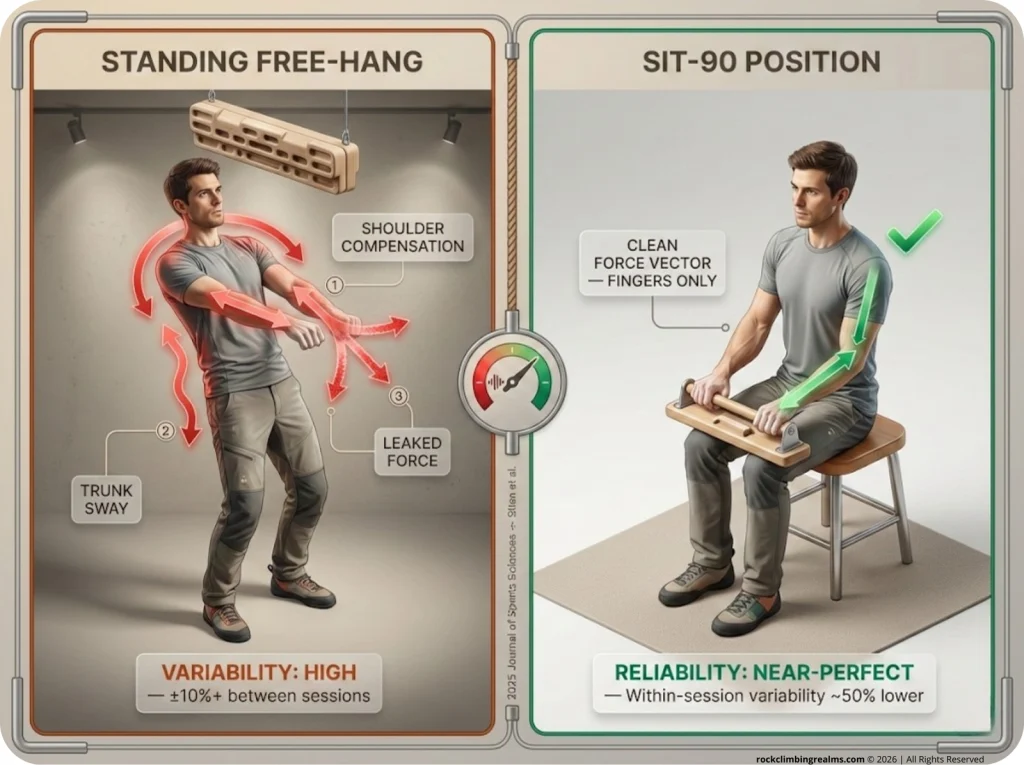
Here’s what happens when you stand and hang from a board: your lats fire, your traps engage, your core braces, and your shoulders compensate. You’re measuring a whole-body pull, not your finger flexors. And the amount of compensation changes with how tired you are, how you slept, and where your feet happen to be.
The 2025 Journal of Sports Sciences study on finger strength testing positions by Stien and colleagues tested four distinct positions and found what most of us suspected but never proved. Standing free-hang introduced the most trunk sway and shoulder compensation. Seated positions showed lower within-session variability — roughly half the bounce compared to standing.
The Sit-90 position specifically delivered near-perfect repeatability. Test yourself today, test yourself next week with the same setup, and you’ll get virtually the same number. That’s what separates useful data from noise.
The difference isn’t subtle. I tested my training group using standing vs. Sit-90 back-to-back. Every single climber got different numbers. Some differed by more than 10%. That’s an entire training block prescribed on wrong data.
Pro tip: If you’ve been tracking max hangs while standing, your historical data is probably noisy enough to be useless for trend analysis. Start fresh with Sit-90 and treat it as your new baseline. Don’t compare it to old standing numbers.
Absolute vs. Relative Strength
Raw kilogram numbers mean nothing without bodyweight context. A 75 kg climber hanging with +25 kg and a 60 kg climber hanging with +15 kg look similar on paper, but their relative finger strength tells a completely different story.
The Stien 2025 data showed that relative strength — your force divided by your bodyweight — predicts climbing ability better than raw force alone. The correlation with bouldering grade was strong for the Sit-90 position. Sport climbing correlation was slightly lower because routes layer endurance and tactics on top of raw contact strength.
If you only track “I added X kg,” you miss the signal when body composition shifts. A 2 kg bodyweight change can shift your relative number enough to matter. Start tracking your strength-to-weight ratio alongside raw load.
The Grip Position Variable
Half-crimp — fingers flexed at the middle knuckles, thumb relaxed and not locked over the index finger — is the finger strength testing standard across every major protocol. Lattice Training, Eric Hörst, Stien 2025, StrengthClimbing. They all use it. Full crimp generates 10–20% more force but carries significantly higher pulley injury risk and is not recommended for maximal testing.
Edge depth matters too. A 2025 systematic review in Frontiers by Pérez-Cordero and colleagues found that 20–23 mm fixed-depth edges consistently demonstrated the highest reliability across 12 studies.
If you want a data-backed climbing assessment framework that goes beyond finger strength into technique and tactics, we built one. But finger testing is where the data foundation starts.
The Sit-90 Protocol Step by Step
Equipment and Setup
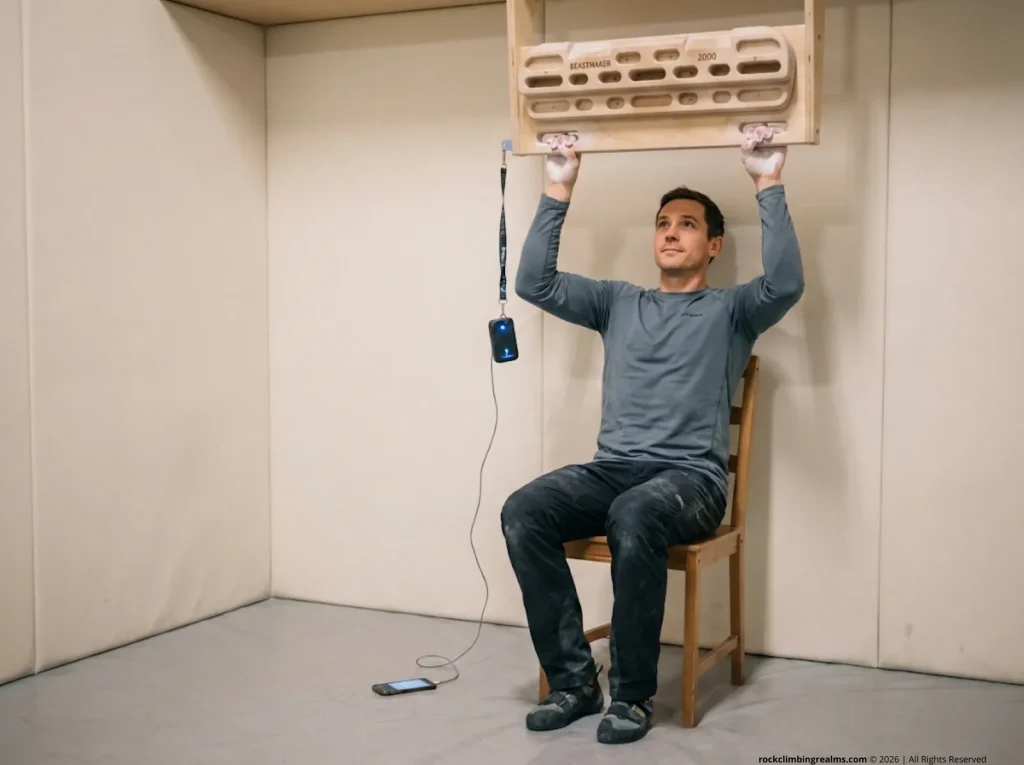
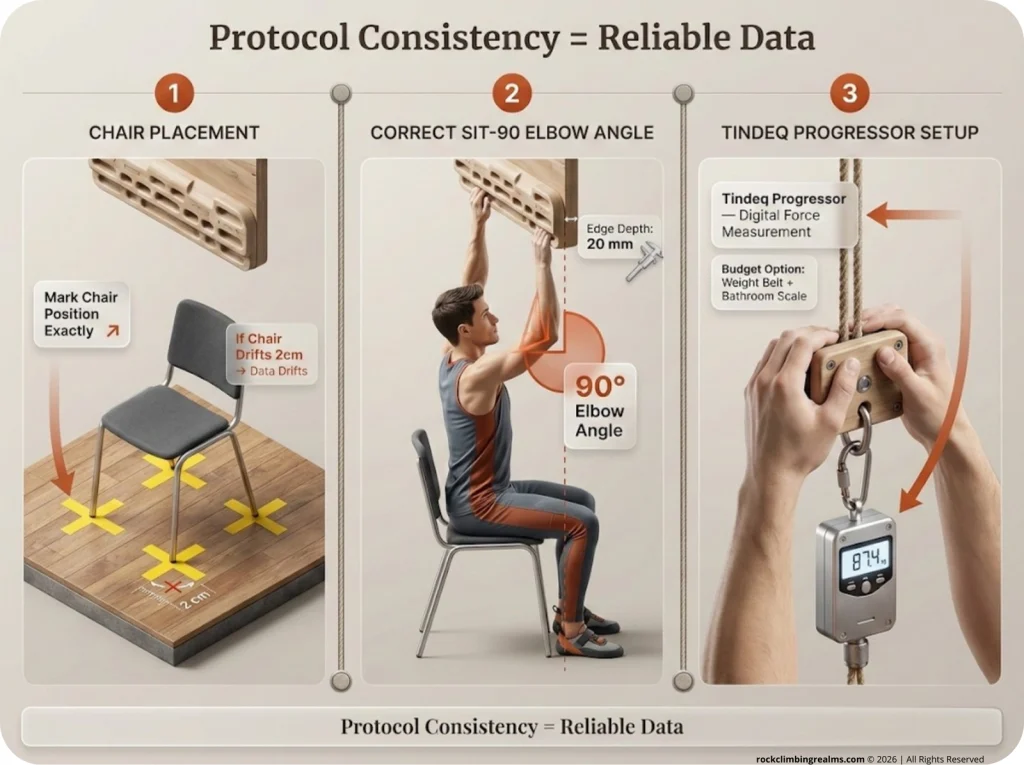
You need three things: a hangboard with a 20–23 mm edge (a Beastmaker 1000 or Lattice Training rung works), a way to pull down from a seated position (pulley rig or fixed mount), and a way to measure force. The Tindeq Progressor (~$135) is the budget-friendly digital option. For the analog approach, a weight belt and a bathroom scale will get the job done.
Sit directly below the edge. Position your chair so your elbows hit exactly 90° when pulling maximally. Mark the chair legs with tape on the floor. If the chair drifts even 2 cm by session three, your elbow angle changes and your data drifts with it.
If you’re working with limited space, figuring out choosing the right hangboard for your space is worth the time before you commit to a testing rig.
Warm-Up and Execution
Never test cold. Cold tendons produce artificially low scores and increase injury risk. This is the single most common testing mistake climbers admit to on r/climbharder.
Start with 5 minutes of light aerobic work and arm circles, then progress through easy hangs on large holds, gradually shrinking the edge. Include 3–4 sub-maximal hangs at roughly 50%, 70%, and 85% effort on your test edge before going all-out.
For the test itself, pull maximally for 7 seconds. This is called the MVC-7 — a maximum voluntary contraction held for exactly 7 seconds. Complete three maximal efforts and average them for your score. Averaging gives slightly more consistent results than just taking the single best attempt.
Rest 2–3 minutes between each attempt. Your fingers need full recovery between pulls; cutting the rest short biases attempts two and three downward.
Record everything: date, bodyweight, added weight (or peak force), edge depth, grip type, and any notes about form. Every variable matters for tracking progress over time.
Pro tip: Film your first few test sessions from the side. You’ll catch elbow angle drift, trunk lean, and grip shifts you can’t feel while pulling maximally. I caught myself flaring my elbows wider on attempt three every single time until video showed me.
No-Hang Dynamometry: The Clinical Alternative
Fixated vs. Non-Fixated Testing
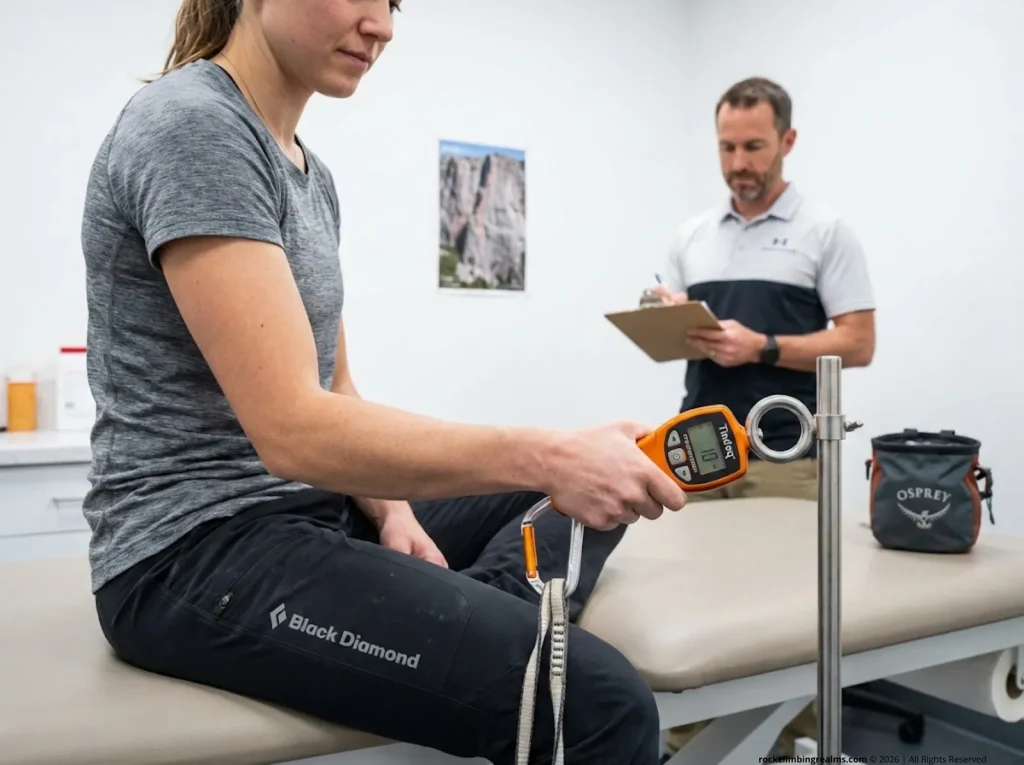
Not everyone needs a hangboard to test finger strength. Fixated-arm dynamometry — using a Tindeq Progressor or K-Force Link on a tension block while your elbow and shoulder are strapped or braced — isolates your finger flexors by eliminating upper-body compensation entirely.
The trade-off is straightforward. Fixated testing yields higher reliability for tracking pure finger flexor strength over time. Non-fixated testing (holding a device while standing freely) correlates slightly better with actual climbing ability because climbing is a whole-body activity. For most climbers tracking progress, the fixated method wins. For injury rehab monitoring and return-to-climb decisions, it’s the only sensible option.
The Tindeq Progressor runs about $135. The K-Force Link is the clinical-grade option at around $1,000. Unless you’re a physiotherapist running a practice, the Tindeq does the job. If you’re coming back from a finger injury, recovering from a finger pulley injury the right way means having objective data, not just “it doesn’t hurt when I crimp.”
The Single-Finger Diagnostic Test
This is where testing becomes genuinely powerful, and where every other article on this topic falls short.
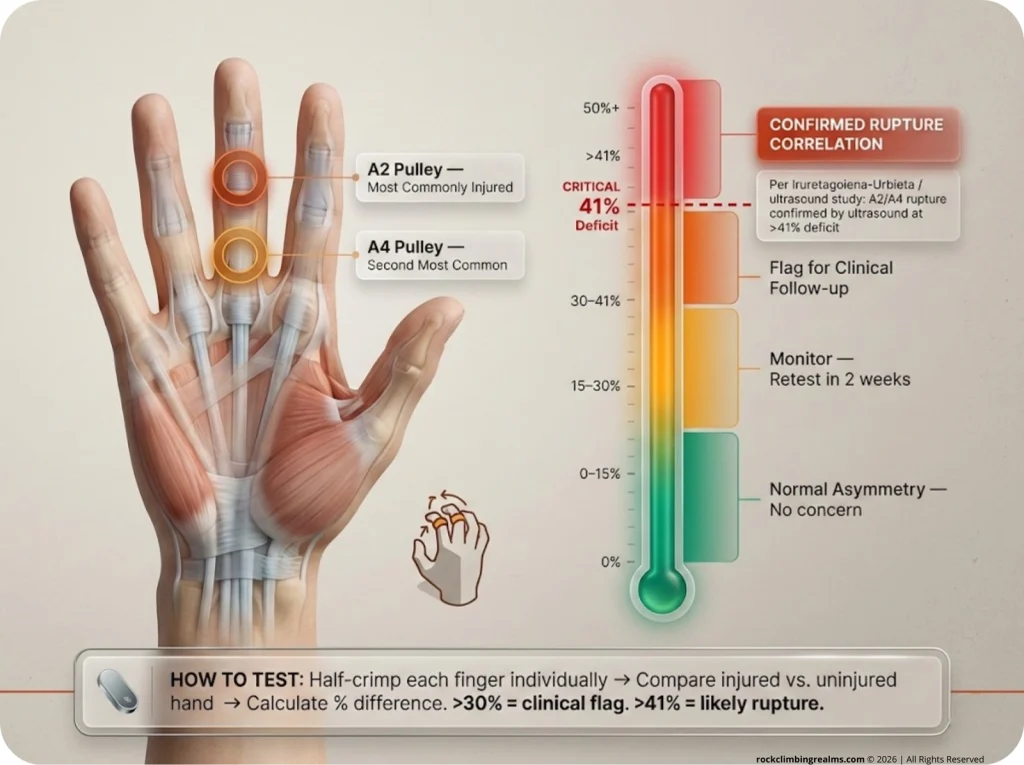
Research by Iruretagoiena-Urbieta (cited by The Climbing Doctor) found that a greater than 41% deficit in single-finger crimp strength compared to the uninjured hand correlates with confirmed A2/A4 pulley rupture on ultrasound. That turns your testing device from a training tool into a diagnostic instrument.
The protocol is simple: test each finger individually in half-crimp on a narrow edge or Tindeq block. Compare side to side. Anything above 30% asymmetry gets flagged for clinical follow-up. You can catch pulley injuries before they become full ruptures — before the “pop” that sidelines you for months.
Making Your Numbers Mean Something
Rohmert’s Curve and MVC-7 Standardization
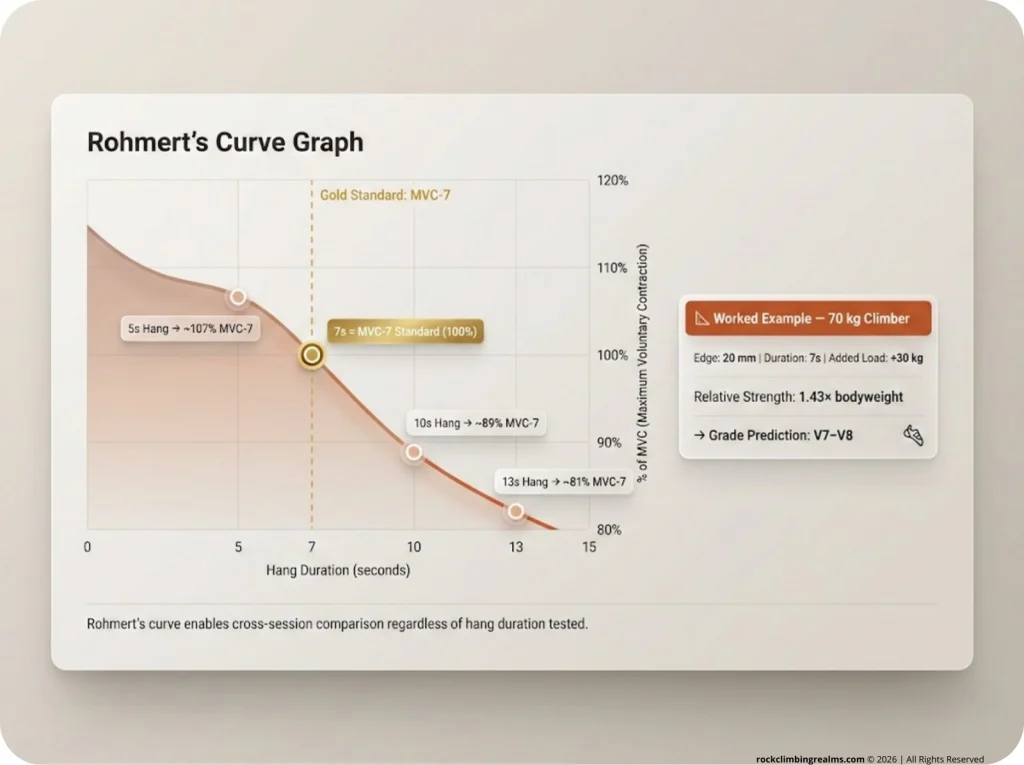
You tested at 5 seconds last month and 10 seconds this month. Can you compare the two? Not directly. Different hang durations test different things. That’s where Rohmert’s curve comes in.
Rohmert’s curve is a well-established relationship that converts any hang duration to an equivalent 7-second MVC value. It’s what makes MVC-7 the gold standard for hangboard protocol comparison: it gives you a common language across sessions, edge depths, and even different testing setups.
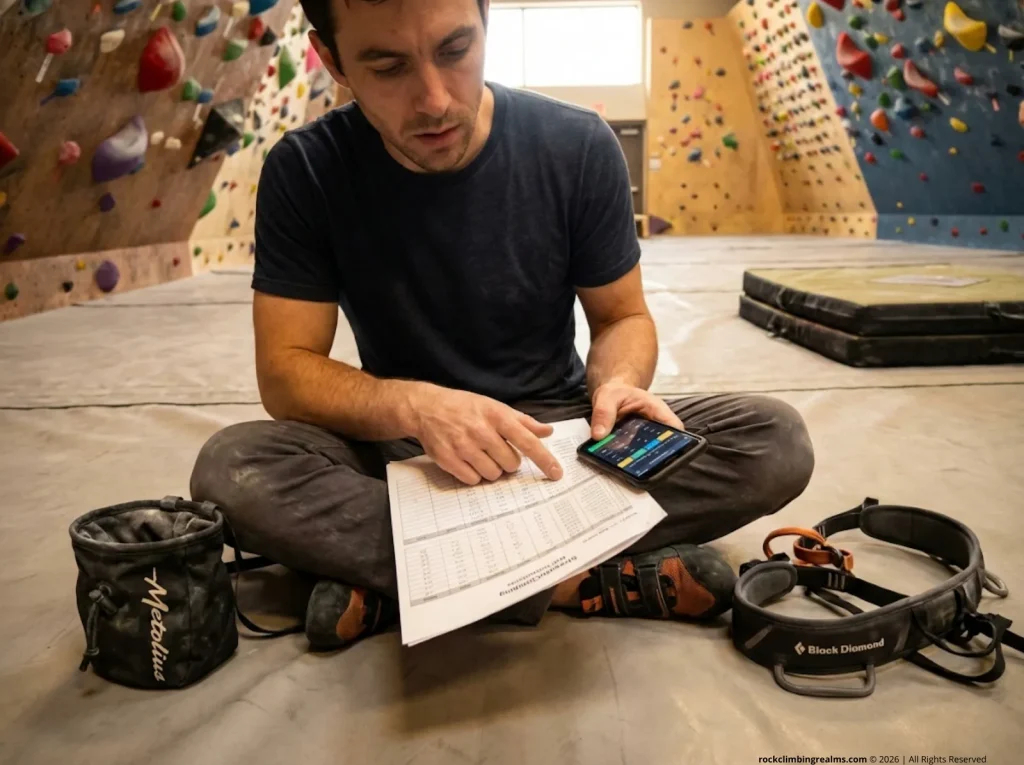
StrengthClimbing built a calculator around this. Plug in your edge depth (baseline 20 mm), hang duration, load, bodyweight, ape index, and height. It spits out a bouldering grade prediction. For example: +30 kg on a 20 mm edge for 7 seconds at 70 kg bodyweight puts your relative strength at 1.43x bodyweight. That places you roughly in V7–V8 territory.
Benchmarks That Actually Mean Something
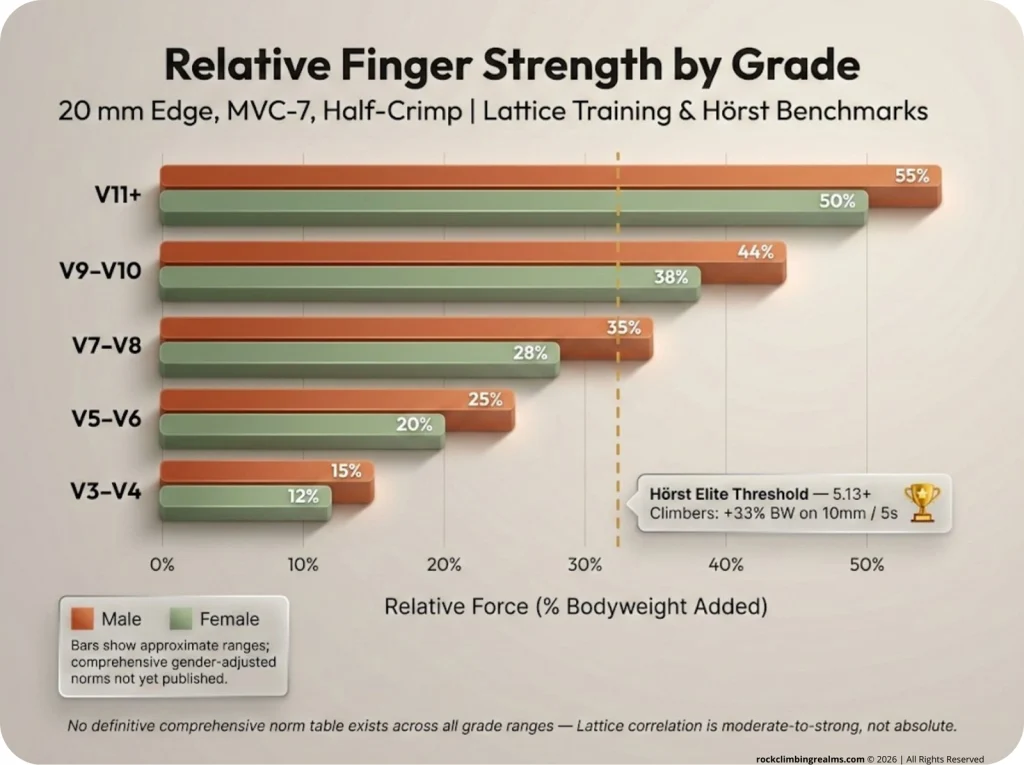
Hörst’s benchmark is clean and memorable: elite climbers (5.13+) can typically add one-third of their bodyweight for a 5-second max hang on a 10 mm edge in half-crimp. For a 70 kg climber, that’s about 23 kg added on a tiny edge.
Lattice Training uses MVC-7 on an 18–22 mm edge as their primary benchmark. Their data shows a moderate-to-strong correlation with best sport route grade. The correlation is real, but it’s not destiny. Finger strength is one variable among many.
The honest gap in the current data: no single source provides a comprehensive grade-by-grade, gender-adjusted, seasonal norm table. That table doesn’t exist yet, and anyone claiming definitive benchmarks across every grade range is oversimplifying.
The 4–8 Ramping Sets Protocol
Why One All-Out Attempt Lies to You
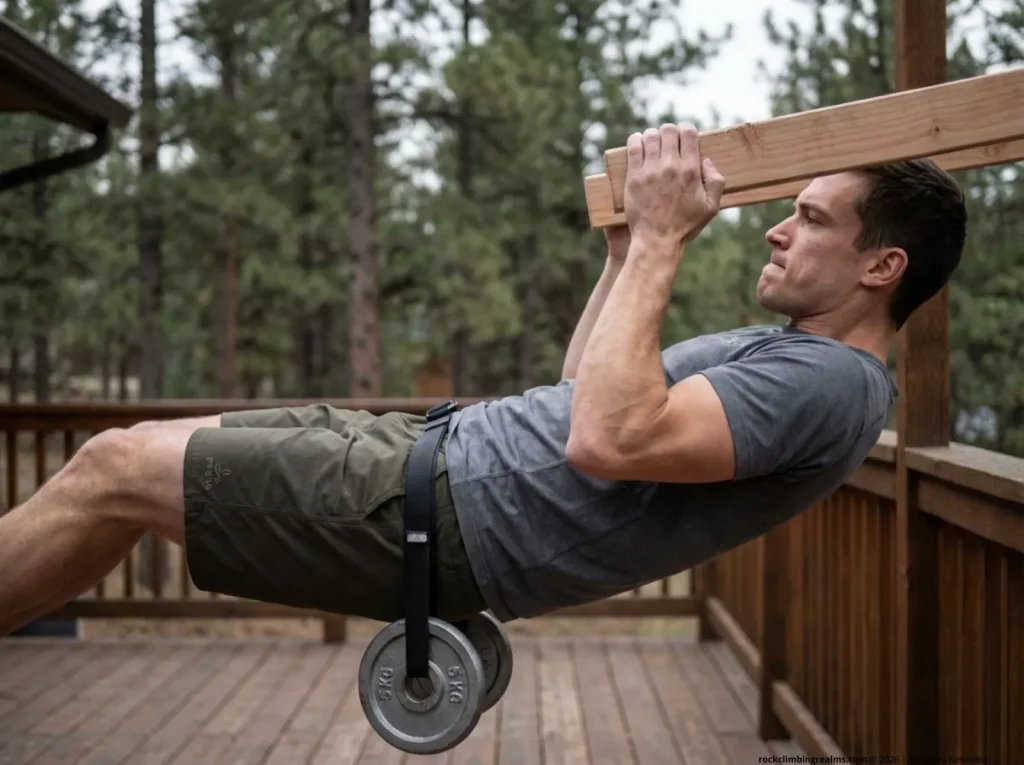
Nobody walks into a gym and pulls their 1RM deadlift cold. But climbers do exactly that with finger strength tests. One all-out attempt with minimal warm-up, then they write the number down and call it their max.
Lattice Training’s protocol uses 4–8 progressively heavier sets before the true max attempt. Your nervous system needs to ramp up. Skipping that process consistently underreports your actual strength.
A ramping sequence on a 20 mm edge looks like this: Set 1 at 50% estimated max. Set 2 at 65%. Set 3 at 80%. Set 4 at 90%. Set 5 at 95%. Set 6 at 100%. If Set 6 felt manageable, go to 102–105% on Set 7. Rest 2–3 minutes between each ramp. The whole session takes 20–30 minutes including warm-up.
I tracked ramping vs. cold single-attempt testing for six months. Ramping consistently produced 8–15% higher max hang scores. Not because I got stronger between protocols, but because my nervous system was actually primed for max effort.
Pro tip: Always convert everything to MVC-7 equivalent so you can compare sessions where you used different durations. StrengthClimbing’s calculator handles this automatically. Without standardization, you’re comparing apples to oranges across a training cycle.
Tracking and Seasonal Retesting
Retest every 6–12 weeks within a training cycle. More frequent testing overloads connective tissue and produces noise rather than signal. A 5% session-to-session fluctuation is completely normal and not a sign of lost fitness.
Track in a spreadsheet: date, bodyweight, added weight, peak force, relative force, edge depth, grip type, session notes, and overall training load that week. Seasonal patterns are real. Expect slight dips after high-volume climbing phases and peaks after dedicated progressive overload blocks.
If recovery between testing blocks matters to you (and it should), the science-backed climbing rest day protocol covers recovery timing and tendon health in detail. As climbing-specific finger strength research on PMC confirms, finger strength remains the strongest single predictor of male bouldering performance, so getting this tracking right has downstream effects on everything.
From Test Results to Training Prescription
Reading Your Baseline
If your relative force sits below the benchmark for your target grade, finger strength is your limiter. Prioritize hangboard strength blocks: 6–8 weeks, heavy loads, low volume. If you’re new to structured hanging, hangboard workout fundamentals for beginners lays out the progression.
If your relative force already matches or exceeds your target grade but you still can’t send there, your limiter is technique, endurance, or tactics. Not contact strength. The StrengthClimbing grade predictor is a rough compass, not gospel. A V8 finger score with V5 footwork still equals V5 climbing.
One climber I coach switched to Sit-90 and discovered his previous standing tests had been overestimating by 8–12%. His training had been calibrated wrong for two years. He wasn’t undertrained. He was training the wrong thing.
And don’t forget the other side of the equation. Heavy finger work without building antagonist strength for injury-free climbing is how you develop chronic elbow tendinitis. Balance pulling with pushing.
Red Flags and When to Stop
Never test through pain. Sharp discomfort in fingers, forearm, or elbow during testing means stop immediately. If you notice asymmetry over 20% between hands, or a sudden drop greater than 15% from your previous baseline without an obvious cause (deload week, illness, poor sleep), get it checked by a climbing-specific physiotherapist.
The single-finger diagnostic test from earlier is your early warning system. Catching a pulley deficit at 35% is far better than waiting for the pop at 50%.
Post-injury finger strength testing protocols look different: wait until pain-free in daily activities. Start at 50% estimated max. Ramp up over 3–4 sessions before attempting true maximal efforts again. Connective tissue earns trust slowly.
Pro tip: Keep a “testing readiness” checklist: slept 7+ hours, no finger soreness, at least 48 hours since last max session, full warm-up completed. If you can’t check all four boxes, postpone the test. Bad data is worse than no data.
Conclusion
Position matters more than you think. Sit-90 doesn’t just tweak your number; it eliminates the trunk sway that makes standing tests effectively random. Switch once, and you’ll finally have numbers worth tracking across seasons.
Standardize everything or measure nothing. Same edge. Same grip. Same rest. Same warm-up. The MVC-7 conversion via Rohmert’s curve lets you compare across sessions even when minor variables drift.
Test to train, not to brag. A reliable baseline tells you whether finger strength is actually your limiter or whether you’re solving the wrong problem. That distinction saves months of wasted training.
Set up a Sit-90 station this week. Run one honest test. Write the number down. In 8 weeks, test again with the exact same protocol. That delta is what tells you whether your training is working. Now go send something.
FAQ
How often should climbers test finger strength?
Every 6–12 weeks within a structured training cycle. More frequent maximal testing overloads connective tissue without producing meaningful data. A 5% fluctuation between sessions is normal noise, not a training signal.
MVC-7 vs MVC-10 finger strength — which is better?
MVC-7 is the current gold standard. Both Lattice Training and StrengthClimbing use it as their primary benchmark because it balances maximal recruitment with practical reliability. MVC-10 skews results toward endurance rather than peak contact strength.
How much weight should I add for a finger strength test?
Start at 50% of your estimated max and ramp up through 4–8 progressively heavier sets with 2–3 minutes rest between each. Your final set should be the heaviest load you can hold for a full 7 seconds in half-crimp on a 20 mm edge. There is no universal right amount. The test finds your max.
Can you test finger strength without a hangboard?
Yes. Fixated-arm dynamometry using a Tindeq Progressor on a tension block isolates finger flexors without a mounted board. This is also the preferred method for injury rehab monitoring and return-to-climb decisions.
What grip position should I use for finger strength testing?
Half-crimp. Fingers flexed at the middle knuckles, thumb not locked over the index. This is the standard across every major protocol. Full crimp produces higher numbers but carries significantly higher pulley injury risk during maximal effort.
Safety Notice: Rock climbing and mountaineering are inherently high-risk
activities that can involve physical trauma or fatal incidents. The information on Rock Climbing Realms is for
educational and informational purposes only. Techniques and advice presented here are not a substitute
for professional, hands-on instruction. Conditions and risks vary by location. Always seek guidance
from a qualified instructor before attempting new techniques. By using this website, you agree that you
are solely responsible for your own safety. Any reliance you place on this information is strictly
at your own risk, and you assume all liability for your actions. Rock Climbing Realms and its authors
will not be held liable for any harm, damage, or loss sustained in connection with the use of this information.
Affiliate Disclosure: We are a participant in the Amazon Services LLC Associates Program, an
affiliate advertising program designed to provide a means for us to earn advertising fees by advertising and linking
to Amazon.com. As an Amazon Associate, we earn from qualifying purchases. We are also an official affiliate partner
of Black Diamond Equipment via the AvantLink network. If you click on a Black Diamond affiliate link and make a
purchase, we may earn a commission at no additional cost to you. We also participate in other affiliate programs.
Additional terms are found in the terms of service.