
In this article
I watched a V7 climber struggle to dead-hang a 20mm edge for ten seconds. Same guy floated through a volumes-only comp problem like the holds didn’t matter. He looked confused when I told him his fingers were his weakest link. “But I climb hard,” he said. He did. Just not in the way that transfers to real rock.
Years of alternating between hangboard sessions and volume problems taught me something most training articles skip: these two tools build completely different climbers. Here’s what training boards and volume holds actually do to your body, where they overlap, and why cutting either one out of your routine is a mistake.
Here’s how the two compare at a glance:
| Training Boards vs. Volume Holds | ||
|---|---|---|
| Feature | Training Boards | Volume Holds |
| Primary focus | Finger strength and pulling power | Body tension and technique |
| Grip type | Crimps, edges, pockets (standardized) | Compression, smearing, open palm (irregular) |
| Key muscles | Finger flexors, forearms, lats | Core, shoulders, hips, full kinetic chain |
| Injury risk | A2 pulley, shoulder impingement | Shoulder strain, wrist hyperextension |
| Best for | Measurable strength gains | Movement quality and problem-reading |
| When to start | After 1+ year consistent climbing | Day one — volumes appear in regular problems |
Training Boards and Volumes Do Two Different Jobs
What a Training Board Actually Trains
Your fingers are the weakest link on hard routes. You might not believe that yet — most climbers don’t until they stall at a grade ceiling and can’t figure out why. A training board exists to fix that specific bottleneck.
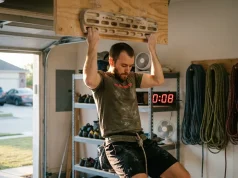
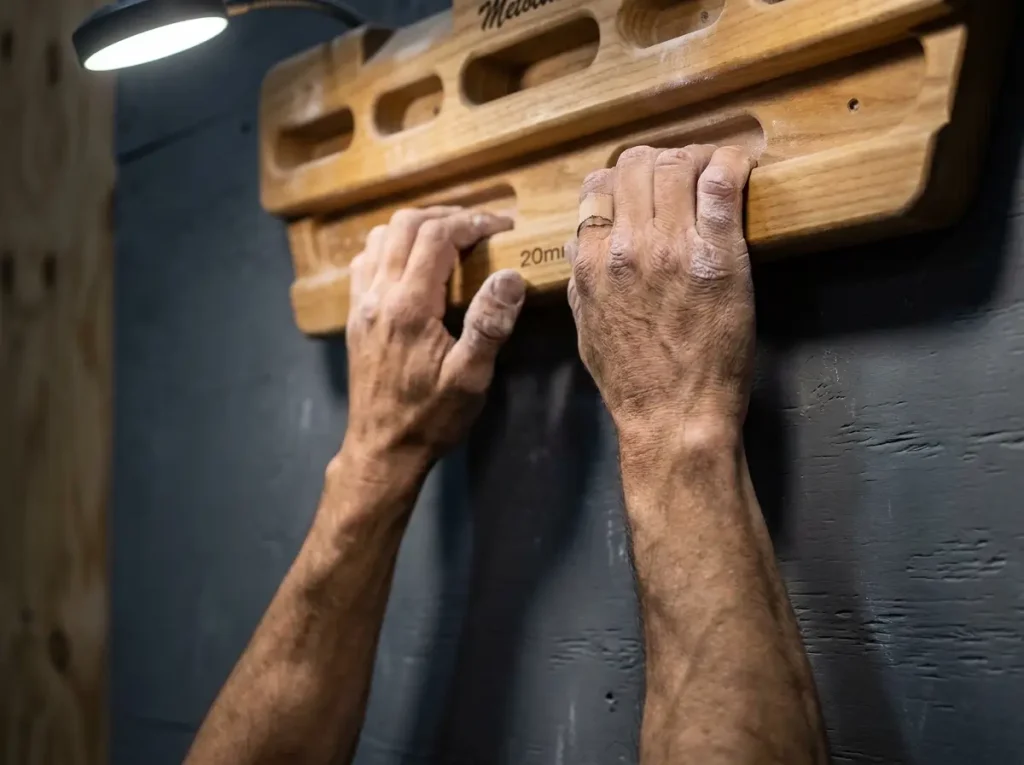
Hangboards isolate your finger flexor strength through standardized edges. The 20mm edge is the baseline everyone tests on, and for good reason — it’s small enough to be challenging but large enough to measure progress without wrecking your pulleys. A 10-week hangboard training study published in Frontiers in Sports and Active Living found that supplemental hangboard work significantly improved finger strength beyond what regular climbing alone could produce. That’s not a marginal gain. That’s the difference between hanging on and peeling off the crux.
Campus boards develop explosive pulling power and rate of force development — the ability to generate force fast, which matters when you’re catching a dyno or latching a distant hold mid-flight. These are not beginner tools. They load your tendons aggressively and demand baseline strength before they’re safe to use.
Modern LED boards like the MoonBoard, Kilter Board, and Tension Board combine finger strength with movement on standardized problems. The MoonBoard sits at a fixed 40° overhang with textured holds that mimic outdoor rock. The Kilter Board lets you adjust the angle. The Tension Board uses wooden holds that emphasize friction and body position. Each one trains differently, but they all share the same principle: measurable, repeatable problems that let you track progression.
Pro tip: Most strong climbers you see at the gym warm up on a hangboard before they touch the wall. Not because they love it — because ten minutes of light hangs on big edges wakes up the finger tendons and shoulder stabilizers without the impact of jumping straight into hard problems.
What Volume Holds Actually Train
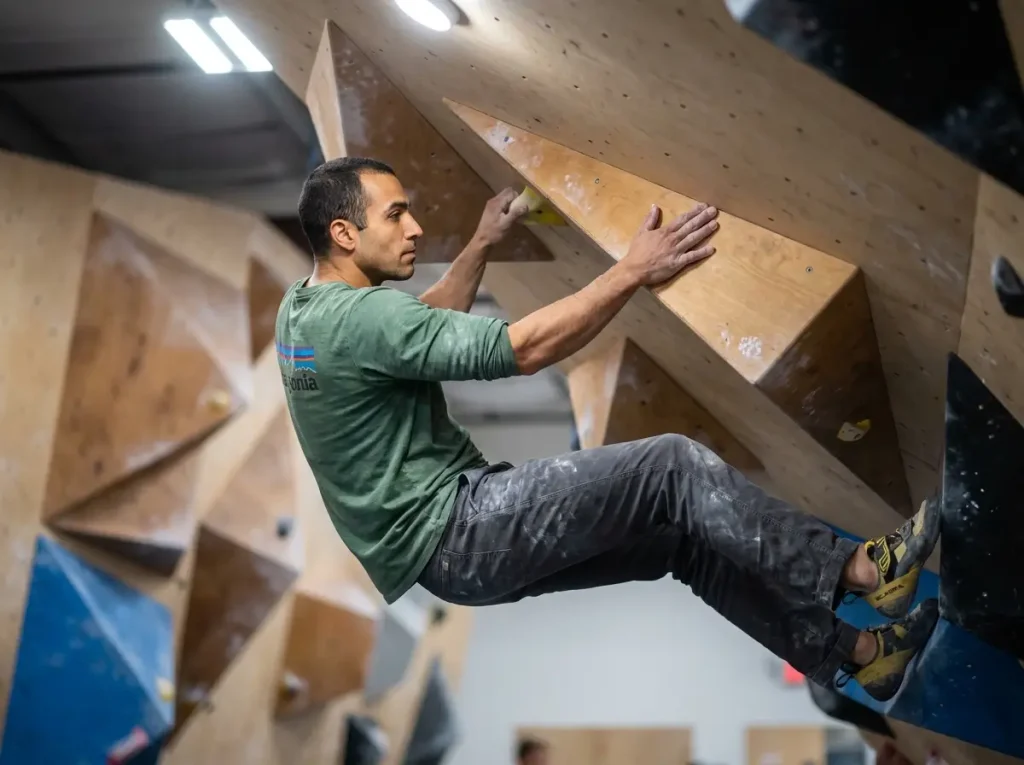
The first time you climb a volumes-only problem, it feels like someone removed all the holds and told you to figure it out. Your hands press flat against angled plywood surfaces. Your feet smear on smooth faces. Nothing feels secure because nothing is — not in the way an edge or a jug is secure.
Volumes are 3D plywood or fiberglass shapes covered in t-nuts, bolted to the wall like massive geometric features. Route setters attach holds to them or leave them bare. When a gym marks volumes as “always on,” they become extensions of the wall itself — terrain, not holds. That distinction changes how you climb.
What volumes train is fundamentally different from what a board trains. Compression — squeezing inward from both sides with opposing hands. Smearing — trusting your shoe rubber and body position when there’s no edge to stand on. Palming and pressing — open-hand contact with maximum surface area and zero finger flexion. These grip patterns and their biomechanics recruit entirely different muscle chains than edge-based climbing.
Body tension on volumes comes from technique more than raw strength. Your rectus abdominis and erector spinae contract isometrically to keep your torso rigid while your limbs press against surfaces that want to spit you off. That’s a skill. You learn it by doing it wrong fifty times and then suddenly doing it right.
Competition climbing relies heavily on volumes because they’re harder to read from the ground. You can’t look at a volume and know the beta the way you can with a row of crimps. That uncertainty forces you to think on the wall — which is a trainable skill that regular hold climbing doesn’t demand at the same intensity.
Pro tip: All sides of a volume are usable. When you’re stuck, try heel hooks on the back edge, underclings on the bottom lip, wraps around corners, and false grips on angles you’d normally ignore. The volume doesn’t care what you do with it. Your creativity determines whether it’s a blank wall or a ladder.
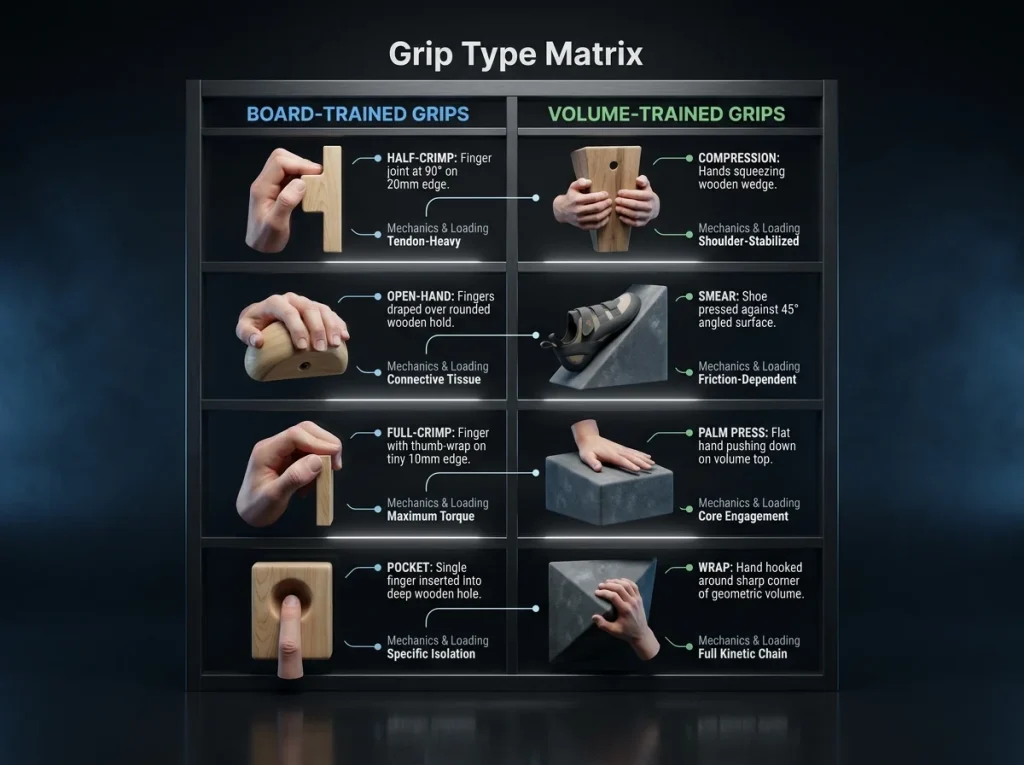
The Grip Type Matrix Nobody Talks About
Board Grips: Edges, Pockets, and Crimps
A hangboard turns your fingers into specialists. That’s the point — and also the limitation.
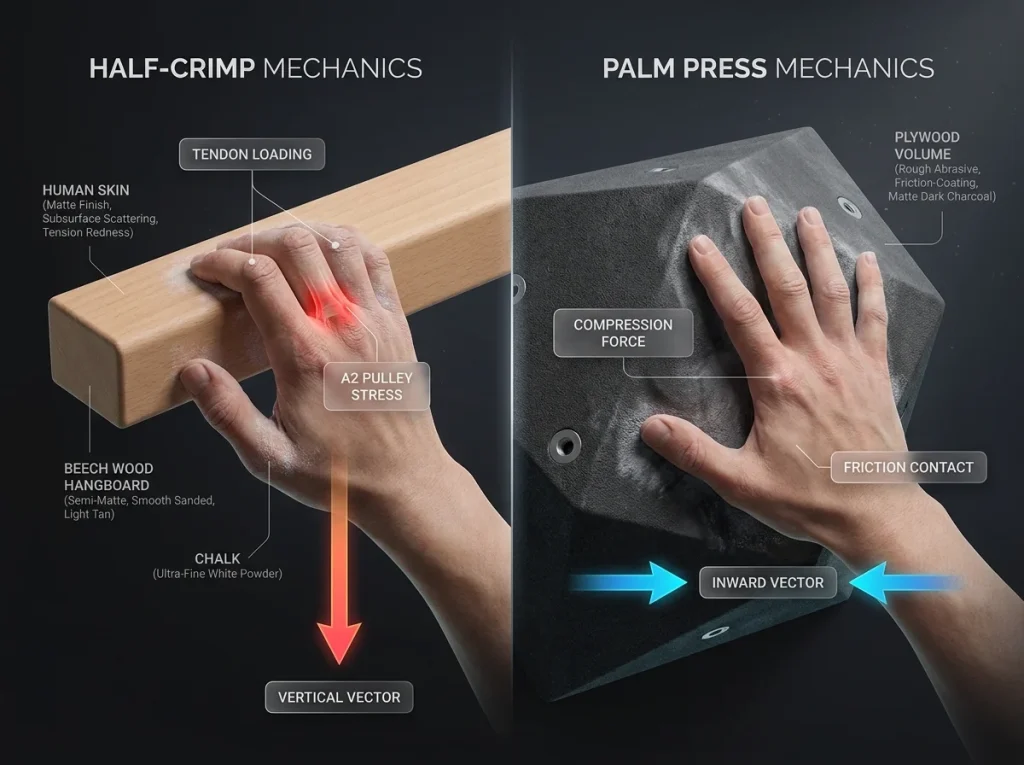
The three primary hangboard grip positions are half-crimp, open-hand, and full-crimp. Half-crimp is the workhorse: fingers curled over the edge at about 90 degrees, thumb not engaged. Open-hand drapes the fingers over the edge with less curl, loading the tendons differently and building a foundation of connective tissue strength. Full-crimp locks the thumb over the index finger for maximum holding power on tiny edges.
Here’s the part that matters for injury awareness: crimping puts approximately 31.5 times the force on your A2 pulley compared to an open-hand grip. That’s not a typo. The PIP joint bends sharply in a crimp, redirecting force directly through the A2 — and the smaller the edge, the sharper the angle, the higher the stress. This is why experienced climbers default to half-crimp on the hangboard. It builds nearly identical strength with significantly less risk of the injury that sidelines you for months.
Campus boards add another dimension: explosive recruitment. The movements are dynamic — no feet, just hands latching rungs in sequence. This trains neurological power, the speed at which your muscles fire, not just how hard they can hold. It’s the difference between hanging on a hold and catching one mid-flight.
If you’re curious whether your finger strength is where it should be, testing it with a standardized protocol tells you more than guessing based on what grade you climb.
Volume Grips: Compression, Smearing, and Open Contact
Volumes don’t care about your crimp strength.
Compression means pressing inward from both sides — your hands and feet creating opposing forces that pin you to a feature. There’s no edge to grab. The force comes from your entire body squeezing, not from your fingertips pulling. Think of hugging a giant wooden prism while trying to move upward. That’s compression.
Smearing on volumes puts your shoe rubber and body position in charge. You press the ball of your foot against a smooth angled surface and trust that the friction holds. It does — if your weight is over your foot and your hips are in the right place. Move your center of gravity two inches wrong and you’re on the crash pad.
Palming and pressing involve maximum surface-area contact with open hands. Zero finger flexion. Your palm pushes down or inward while your body maintains tension elsewhere to keep you on the wall. These movements recruit the shoulder girdle, hip flexors, and deep core stabilizers in ways that dual-texture holds and friction dynamics make even more complex.
The neurological patterns are different too. Edge climbing recruits finger flexors in a sustained isometric contraction. Volume climbing recruits chains of muscles firing in sequence — core stabilizing, then shoulder pressing, then hip adjusting — in a coordination pattern that looks more like gymnastics than traditional climbing.
Why Both Matter for Your Grade
Outdoor routes don’t separate these skills the way a gym does. A single pitch might have a thin crimp crux followed by a compression bulge followed by a smeary slab section. A climber who only hangboards has strong fingers but weak compression instincts — they’ll power through the crux and then fumble the bulge. A climber who only does volumes can flow beautifully but stalls when the route demands sustained finger strength through a crimpy sequence.
The climbers who break through grade ceilings are the ones who train both grip families deliberately. Your fingers need the hangboard. Your body needs the volumes. Cutting one out doesn’t save training time — it just moves your plateau to a different spot.
Body Tension: Where Boards and Volumes Cross-Train Each Other
How Volumes Build the Core Stiffness Boards Need
The strongest hangboard numbers in the gym mean nothing if your feet cut on the first steep move.
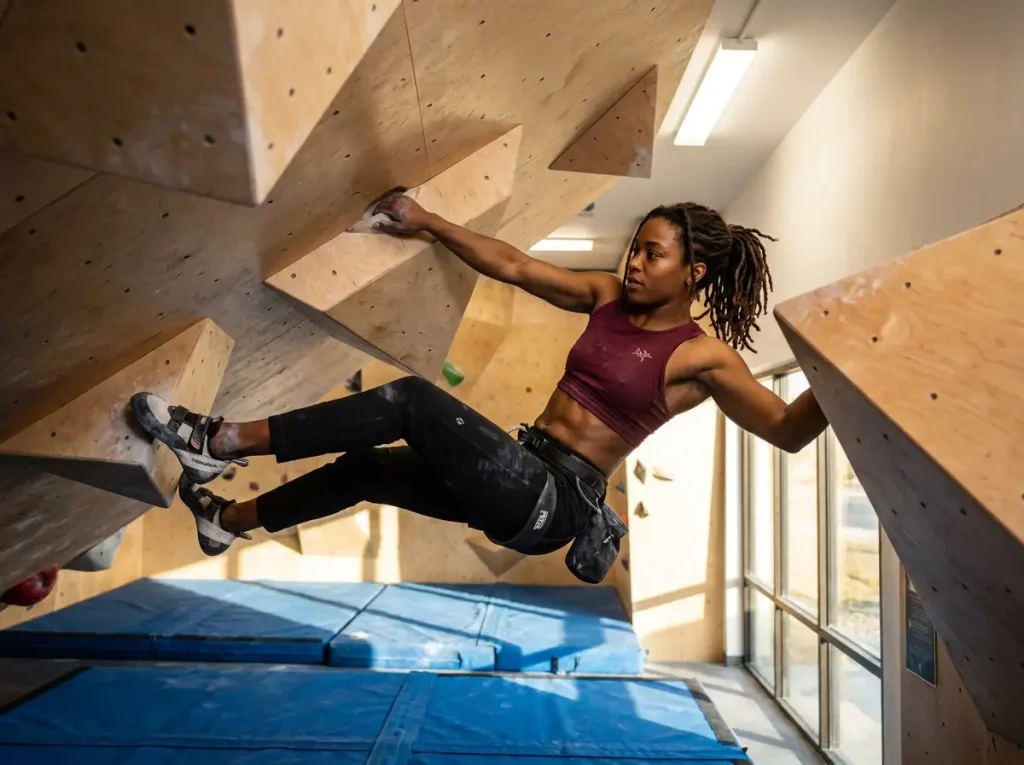
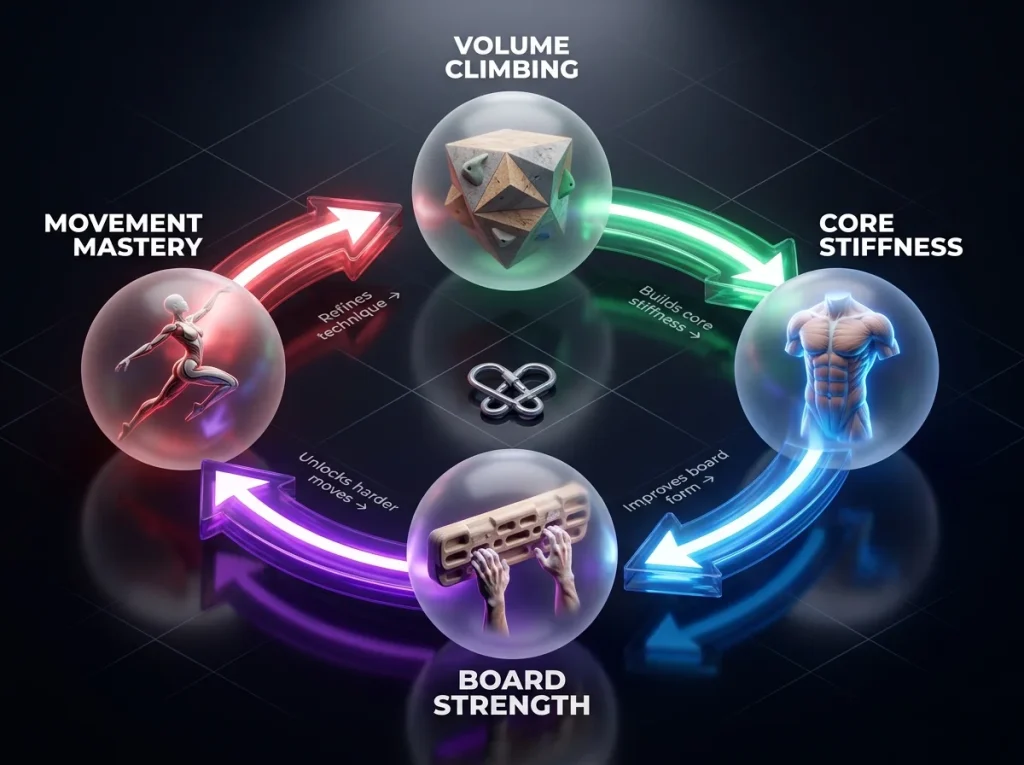
Volume climbing forces a specific kind of core engagement that planks and crunches don’t replicate. When you’re pressing into an angled surface with no real handhold, your rectus abdominis and erector spinae contract isometrically — equal force on both sides of the spine — to keep your torso rigid while your limbs work independently. That “quiet core” is what keeps your feet glued to the wall during steep board climbing.
Most climbers who plateau on boards aren’t failing because their fingers are weak. They’re failing because their body peels away from the wall before their fingers even reach maximum load. The feet cut, the hips sag, and suddenly a move that should be about finger strength becomes about swinging back onto the wall. Volumes teach you to maintain that rigid body line without thinking about it — the same way a swimmer learns to keep their body flat in the water.
Common mistake worth flagging: climbers add hangboard sessions to build finger strength but skip the movement work that lets them use those fingers effectively. Strong fingers attached to a floppy core is like a sports car with bald tires. The engine runs fine. The connection to the road is the problem.
Pro tip: Spend one session per week on volumes-only problems or comp-style boulders. Not as a warm-up — as a dedicated effort. Pay attention to where your body wants to sag or swing. That’s the weakness your body positioning techniques need to address.
How Board Strength Unlocks Harder Volume Problems
The reverse transfer is just as real. You can’t compress a volume if your fingers give out before your core does.
Stronger fingers let you hold worse positions longer. When your hand is pressing into an awkward angle on a volume and your body needs an extra half-second to find the next position, finger strength buys that half-second. Without it, you peel off while your brain is still solving the problem.
Board-trained pulling power also helps recovery. When you clip a bad position on a volume — body swinging, feet skating — the ability to pull yourself back into a stable position depends on raw strength. That’s what hangboard and campus work provide: the physical reserve that lets technique recover from errors.
Lock-off strength from board work transfers directly to volume climbing. When you need to press down on top of a volume or mantle over a feature, the same one-arm lock-off power you build on a board is what holds you in place while the other hand reaches. It’s the same movement pattern applied to a different surface.
When to Use Each in Your Training Cycle
Strength Phase: Boards Take Priority
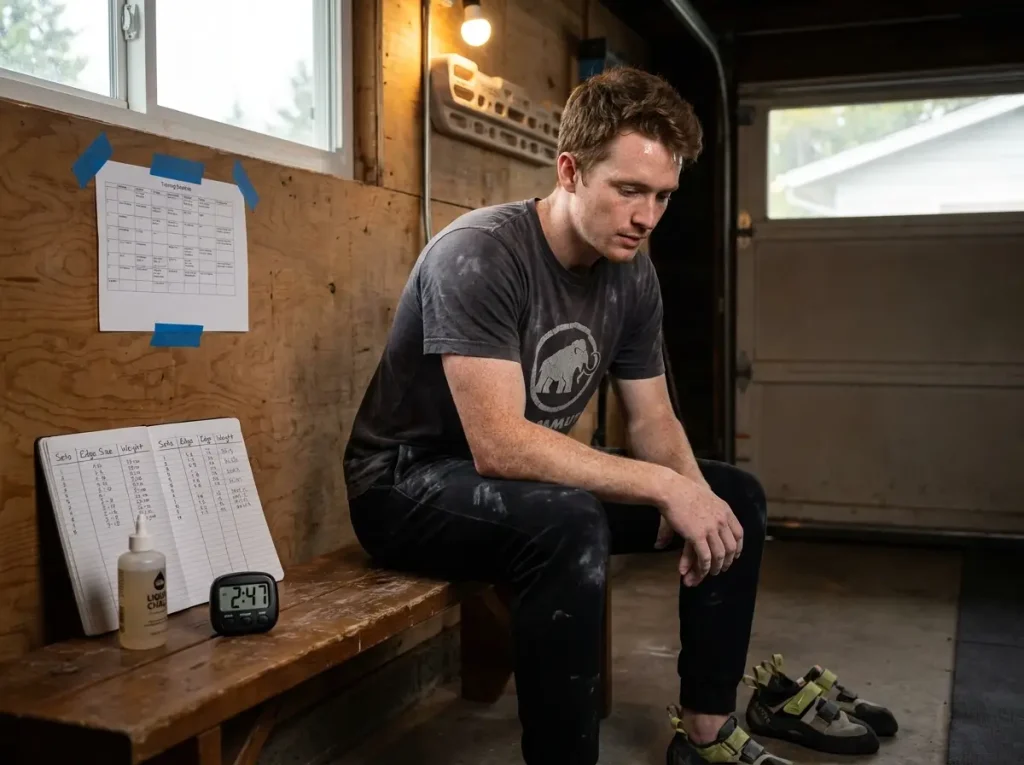
During a dedicated strength phase — typically 3 to 4 weeks — the hangboard runs the show. Max hangs and repeater protocols dominate your sessions. The goal is simple: increase the maximum load your finger tendons can handle.
Schedule 2 to 3 hangboard sessions per week on non-consecutive days with 48 to 72 hours of recovery between them. Your tendons adapt slower than your muscles, and the research backs this window. Pushing sessions closer together doesn’t accelerate gains — it accelerates injury.
Volume climbing still happens during this phase, but it drops to maintenance mode. Light volume problems as warm-ups or cool-downs. No projecting on comp-style volumes that drain your nervous system before finger work. The strength phase is about building a foundation, and a structured periodization framework keeps you on track.
Eva López’s research supports rotating between density hangs, max hangs, and repeaters across your macrocycle — starting with high-volume low-intensity work earlier in the season and progressing toward single heavy hangs as your performance window approaches.
Power and Power-Endurance Phase: Volumes Earn Their Spot
This is where volumes move from background to foreground.
Power endurance circuits on volumes build the capacity to recover mid-problem — the ability to shake out on a bad hold, breathe, and keep going. This matters because hard outdoor routes and comp problems aren’t over after one crux. They stack difficulty, and the climber who can recover between hard moves wins.
LED board climbing bridges the gap here. MoonBoard, Kilter, and Tension problems combine standardized difficulty with movement complexity — you’re training power and technique simultaneously on problems you can track and repeat. These boards sit right between pure hangboard strength work and pure volume technique work.
4×4 circuits that mix volume problems and board problems are a powerful tool in this phase. Four problems, four times through, minimal rest. If two of those problems are comp-style volume boulders and two are board problems, you’re training both systems under fatigue. That’s where 4×4 circuits built for real endurance earn their reputation.
Performance Phase: Put It Together
The performance phase is about expressing what you’ve built — not building more.
Reduce hangboard volume but keep the intensity. One or two short, sharp sessions per week to stay sharp without accumulating fatigue. This is “maintenance mode” for finger strength — the gains are banked, and now you’re spending them.
Volume problems take a bigger role here because they simulate the reading, creativity, and movement quality that sends require. Competition climbers spend the majority of this phase on volumes and comp-style problems. Route climbers use this phase to project on outdoor rock, where the variety of holds and movement styles is what you’ve been training for all along.
This is where the cross-training payoff becomes obvious. Strong fingers from the strength phase. Core tension from volume work. Problem-reading skills from months of diverse climbing. The climbers who periodize both tools deliberately don’t just send harder — they send faster, because less effort goes to figuring out the movement.
Injury Profiles: What Each Tool Risks
Training Board Risks: Fingers and Tendons
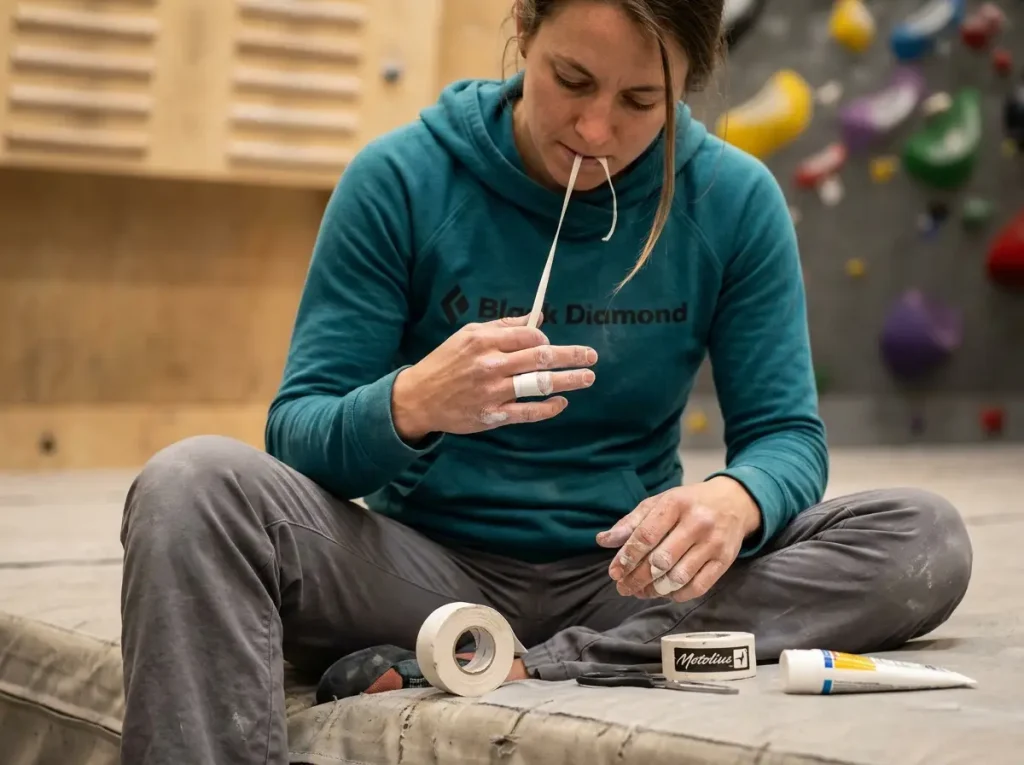
Every climber who’s been around long enough knows someone who popped an A2 pulley on a hangboard. It’s the signature injury of board training — and it’s almost always preventable.
The A2 pulley sits at the base of your finger and keeps the flexor tendon pressed against the bone. In a full-crimp position, the PIP joint bends sharply, concentrating force directly on that pulley. Combine a small edge, high added weight, and a cold warm-up, and you have the recipe for the pop that takes you off climbing for months. Peer-reviewed finger strength loading research confirms that grip position is the primary variable in pulley stress — not total load.
Shoulder impingement is the other board injury that sneaks up on people. Hanging with locked elbows and disengaged scapulae lets your shoulder joint take the load instead of your muscles. Over time, that impingement builds until reaching overhead becomes painful even off the wall.
Risk mitigation is straightforward: half-crimp over full-crimp for most training. Warm up for 8 to 12 minutes before touching the board — light cardio, then active hangs on big holds. Don’t start hangboard training until you have at least one year of consistent climbing behind you, twice a week minimum. If you do injure a pulley, a structured week-by-week recovery protocol makes the difference between a full comeback and a chronic problem.
Volume Risks: Shoulders and Core
Volumes break people differently.
Shoulder strain from compression moves hits the rotator cuff under angles it doesn’t normally experience. When you’re pressing inward on two volumes with your arms wide, the shoulder joint is loaded in rotation — not the straight pull-down of a hang, but a twisting force that stresses smaller stabilizer muscles. Mantling on top of a volume adds hyperextension to the mix.
Wrist hyperextension is common when palming. Pressing your open hand flat on an angled surface loads the wrist in a position that most daily activities — and most climbing holds — don’t require. Climbers with pre-existing wrist issues feel this one fast.
The fall profile is different too. On a hangboard, you release and drop straight down — predictable. On volumes, your feet slip off a smeared surface without warning, and the resulting swing is harder to control. The crashes are less predictable than edge-based falls, which is why thick, continuous padding matters.
Pro tip: Warm up with light volume problems before attempting aggressive comp-style sets. Start with large, low-angle volumes and build to smaller, steeper ones. Your shoulders need the same progressive loading ramp that your fingers do on a hangboard. A proper warm-up routine applies whether you’re training boards or volumes.
Where to Start Based on Your Current Grade
Beginner (V0–V2): Climb Everything, Train Nothing Specific
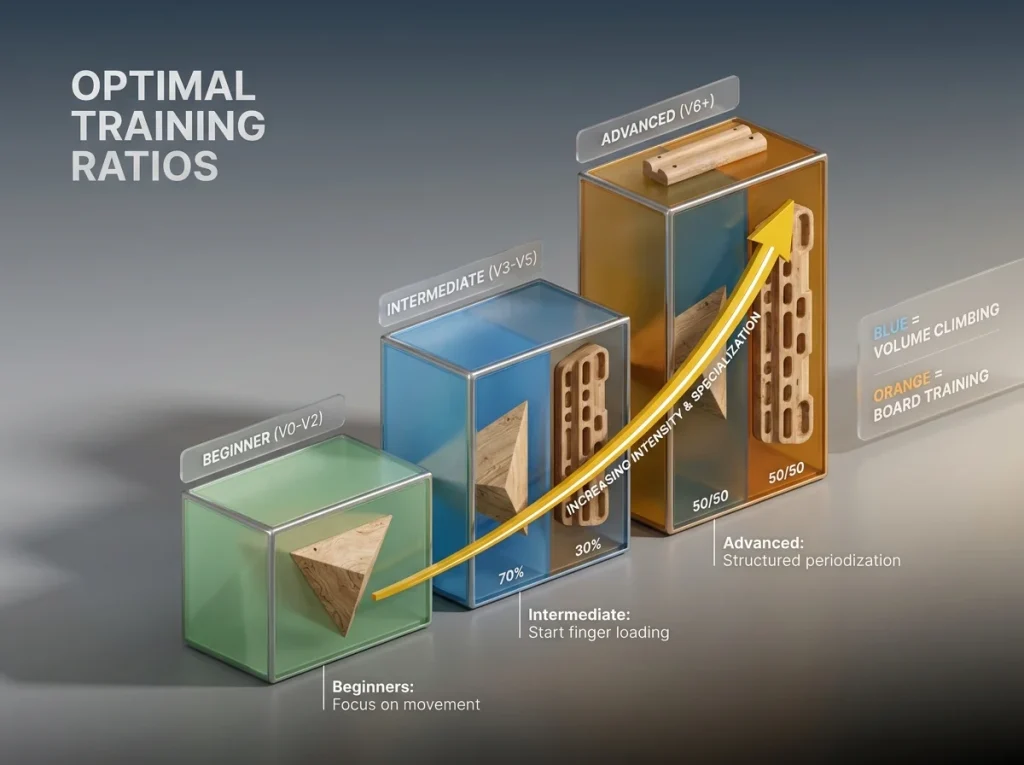
Your tendons are not ready for a hangboard. Full stop. Finger tendons need a minimum of 12 months of progressive loading through regular climbing before hangboard stress becomes safe — let alone productive. Jumping on a fingerboard at V1 is how people develop chronic injuries before they even understand what they’re training.
The good news: volumes are already training you. Every gym problem that includes a volume teaches body awareness, balance, and friction trust without you needing to seek it out. Climb widely. Climb varied. Try every style on the wall. Your body is building the movement library that will make specific training useful later.
Intermediate (V3–V5): Introduce Boards, Keep Climbing Volumes
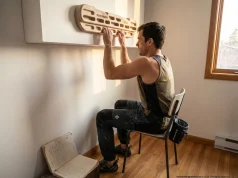
This is when a hangboard starts paying off. Two sessions per week with half-crimp and open-hand grips on a 20mm edge — 7-second hangs, 3-second rest, 6 sets. That’s it. Nothing fancy, nothing extreme. Your tendons are adapting, and consistency matters more than intensity at this stage.
If you’re looking at hangboard options for a small living space, the Metolius Project and Trango RPTC fit above a door frame and provide enough hold variety for a year of progression.
LED boards start earning their place here. The Kilter Board and Tension Board offer problems in your grade range with holds that emphasize friction and body position — a natural bridge between pure hangboard training and the volume-style movement you encounter on regular gym walls.
Keep climbing volume problems in your regular sessions. Don’t treat them as something separate from “training.” Volume climbing IS training — for body tension, for movement reading, for the compression and smearing skills that boards won’t teach you.
Advanced (V6+): Periodize Both Deliberately
At this level, the question isn’t whether to use boards or volumes. It’s when and how much of each.
Follow the periodization structure: strength phase with board priority, power phase with LED boards, power endurance phase with volumes and mixed circuits. Track finger strength with standardized protocols — the MVC-7 or Sit-90 tests give you numbers, not feelings.
The common trap at this level is over-indexing on board climbing. You send a new benchmark on the MoonBoard, so you keep grinding. Meanwhile, your movement quality degrades because you haven’t touched a comp-style volume problem in weeks. That’s how advanced climbers plateau — not from weak fingers, but from a training imbalance that narrows their climbing. The strongest climbers on the planet train both. Deliberately.
Conclusion
Training boards build the finger strength and pulling power that volumes can never replicate. They’re the foundation for harder climbing — measurable, progressive, and specific. Without them, your fingers become the ceiling on every route.
Volumes develop the body tension, compression technique, and movement intelligence that boards never touch. They teach you to read problems, trust your body position, and climb with your whole kinetic chain — not just your fingertips. Without them, you’re a strong climber who can’t move.
The climbers who progress fastest use both deliberately, shifting emphasis based on their training phase, their current grade, and what their weakest link actually is. That last part is the key — most people train what they’re already good at.
Next session, spend 15 minutes on whichever tool you usually skip. If you’re a board junkie, try a volumes-only problem. If you live on the comp wall, hang on a 20mm edge for 10 seconds. Notice what feels weak. That’s your next priority.
Q1 Are volumes harder to climb than regular holds?
Volumes feel harder because you can’t grab them like a traditional hold. Your grip depends on body position, friction, and compression rather than finger strength. They demand different skills, not necessarily more strength. Once you learn to trust smearing and pressing, volumes become another tool in your movement vocabulary.
Q2 Should beginners use training boards?
Not until you’ve climbed consistently for at least a year, twice a week minimum. Your finger tendons need 12 or more months of progressive loading before hangboard stress becomes safe. Starting too early risks A2 pulley injuries that could sideline you for months.
Q3 How often should you train on a hangboard?
Two to three sessions per week on non-consecutive days, with 48 to 72 hours between sessions. Tendons recover slower than muscles, and compressing that recovery window leads to overuse injuries. Quality of each hang matters more than total session count.
Q4 Can I build finger strength by just climbing on volumes?
Volumes build body tension and compression skills, but they don’t load your finger flexors the way a standardized edge does. For measurable finger strength gains, you need a hangboard with consistent holds that let you track progress and increase load over time.
Q5 What is a spray wall and how is it different from a training board?
A spray wall is a wall densely packed with varied holds at multiple angles — think of it as a freeform home training setup where you create your own problems. It bridges structured boards like the MoonBoard and pure volume climbing, training both strength and movement creativity without the standardization of LED-lit benchmark problems.
Safety Notice: Rock climbing and mountaineering are inherently high-risk
activities that can involve physical trauma or fatal incidents. The information on Rock Climbing Realms is for
educational and informational purposes only. Techniques and advice presented here are not a substitute
for professional, hands-on instruction. Conditions and risks vary by location. Always seek guidance
from a qualified instructor before attempting new techniques. By using this website, you agree that you
are solely responsible for your own safety. Any reliance you place on this information is strictly
at your own risk, and you assume all liability for your actions. Rock Climbing Realms and its authors
will not be held liable for any harm, damage, or loss sustained in connection with the use of this information.
Affiliate Disclosure: We are a participant in the Amazon Services LLC Associates Program, an
affiliate advertising program designed to provide a means for us to earn advertising fees by advertising and linking
to Amazon.com. As an Amazon Associate, we earn from qualifying purchases. We are also an official affiliate partner
of Black Diamond Equipment via the AvantLink network. If you click on a Black Diamond affiliate link and make a
purchase, we may earn a commission at no additional cost to you. We also participate in other affiliate programs.
Additional terms are found in the terms of service.