
In this article
You’re two moves from the lip. Arms still straight, hips glued to the wall — and then your feet pop. Not a slip. Not a missed hold. A full system failure: the moment your body becomes a pendulum and your fingers start losing the argument with gravity. You’ve felt it. The heinous forearm pump floods in, the rope goes taut, and the problem spits you back to the mat.
I’ve watched this happen hundreds of times. And the diagnosis is almost always the same. It’s not your fingers. It’s never your fingers.
This piece isn’t about pulling harder. It’s about why your mechanical system broke down — and exactly how to rebuild it from the toe up.
⚡ Quick Answer: Feet cutting on roofs is not a grip strength problem — it’s a torque management failure. When your hips drift away from the wall, the lever arm between your feet and your center of gravity multiplies the load on your fingers exponentially. The fix is keeping your hips close, prioritizing form-fit connections (heel hooks, toe hooks, bicycles, knee bars) over friction-dependent holds, and training your kinetic chain from toe to finger. Shoe choice matters too: soft rubber compounds (Shore A 70–74) are correct for steep terrain, not just a preference.
The Physics of Falling Off Overhangs (Why Feet Cut)
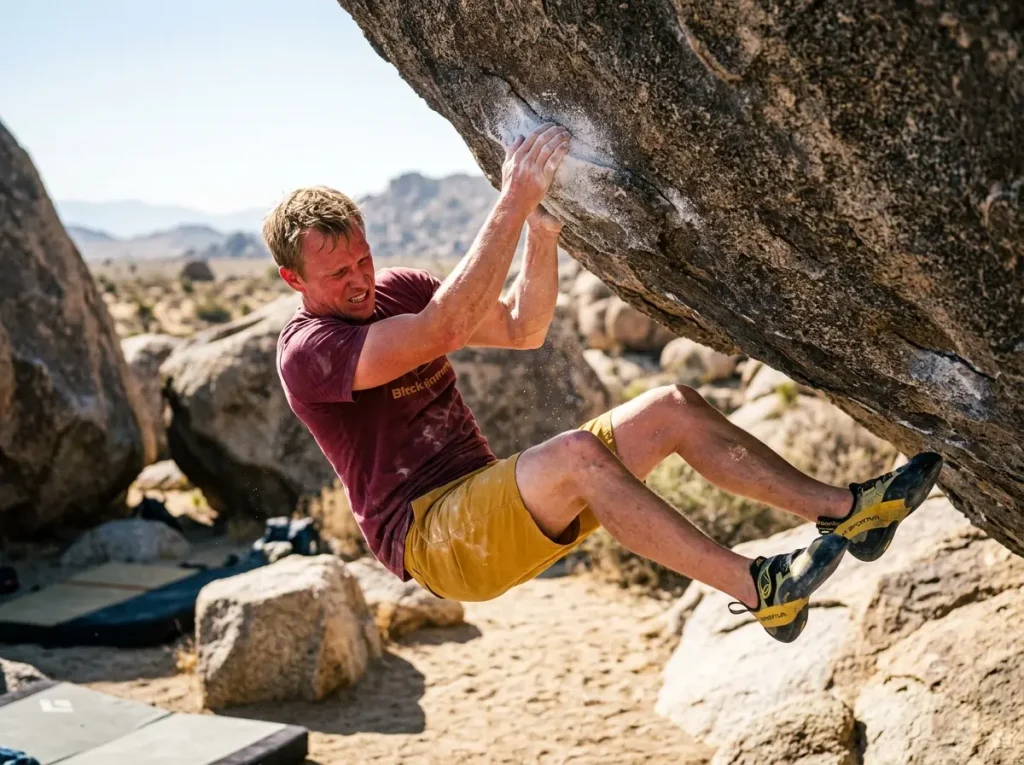
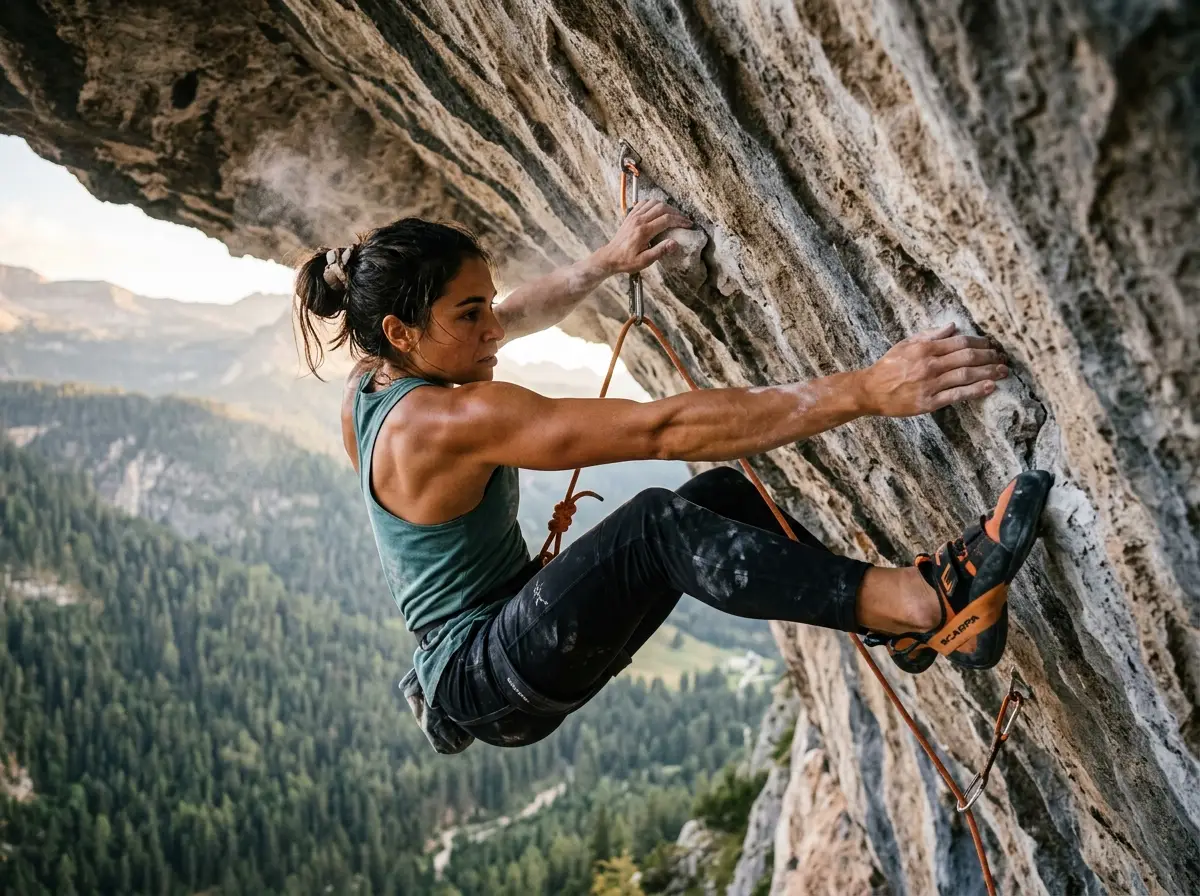
On a vertical wall, gravity pulls you into the rock. Your feet handle most of your body weight just by standing on them. Transition to a 90° roof, and that vector rotates completely — gravity now pulls you straight into space, perpendicular to the surface. Any failure in your contact points is immediate. There’s no margin.
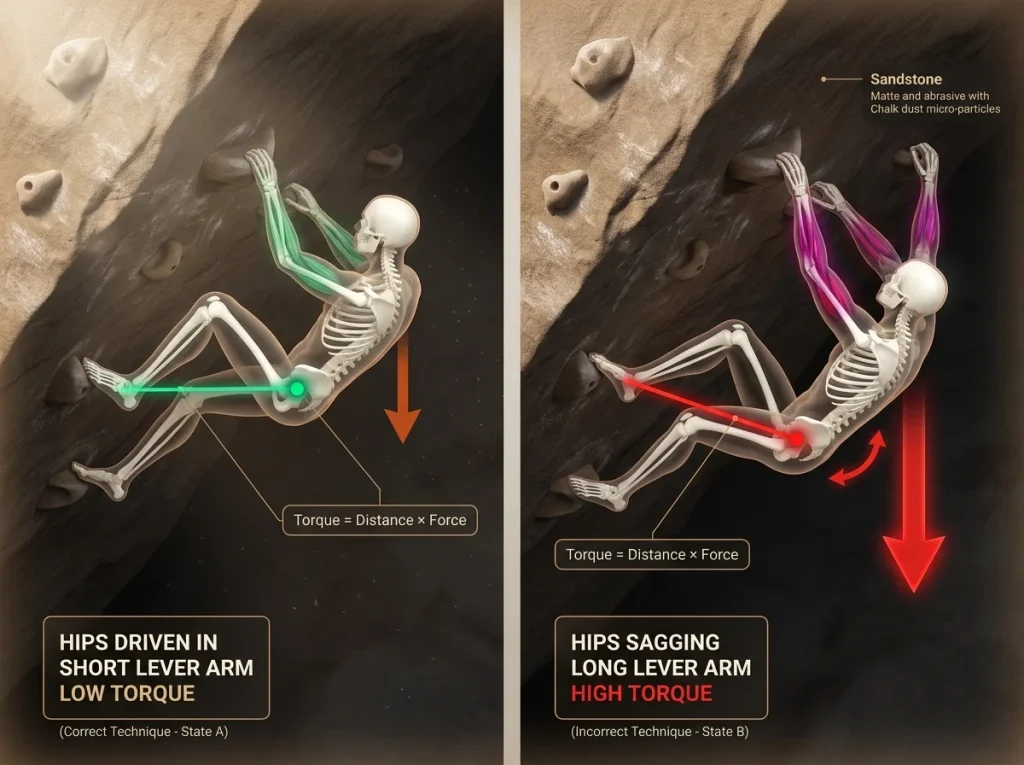
The root cause of feet cutting on roofs isn’t weak abs or bad grip. It’s torque overload. Torque depends on two things: your body weight, and the horizontal distance between your foot pivot and your center of gravity. Your CoG sits roughly at your lower abdomen. Every centimeter your hips sag away from the wall increases that distance — and the finger force required to compensate skyrockets. As validated by research on the resistive force on the body during a climb, weight distribution shifts dramatically to the upper extremities as wall angle increases.
Here’s where it gets irreversible. Once grip pressure exceeds 20% of your Maximum Voluntary Contraction (MVC), ischemia begins. Blood flow to the forearm shuts off, lactate accumulates, and the pump becomes terminal — not recoverable in seconds, sometimes not for minutes. This is physiology, not willpower. Understanding the 20% MVC ischemia threshold that ends a climb is the difference between knowing when to rest and when to fight on.
Elite climbers differentiate themselves with one thing: consistent CoG velocity. Their center of mass barely moves relative to the wall. Weekend climbers’ CoG oscillates wildly, creating repeated torque spikes that drain the forearms in eight to twelve seconds of pump-inducing chaos.
Pro tip: Next time you’re on a roof problem, stop before each move and ask: are my hips driving toward the wall, or drifting away? If you can’t answer quickly, your hips are drifting.
The Lever Arm Problem — Why Your Hips Are the Enemy
Picture a seesaw. Your foot is the fulcrum. Your body weight is on one side. The farther your hips sag from the wall, the longer that lever arm gets — and the harder your fingers have to pull to compensate.
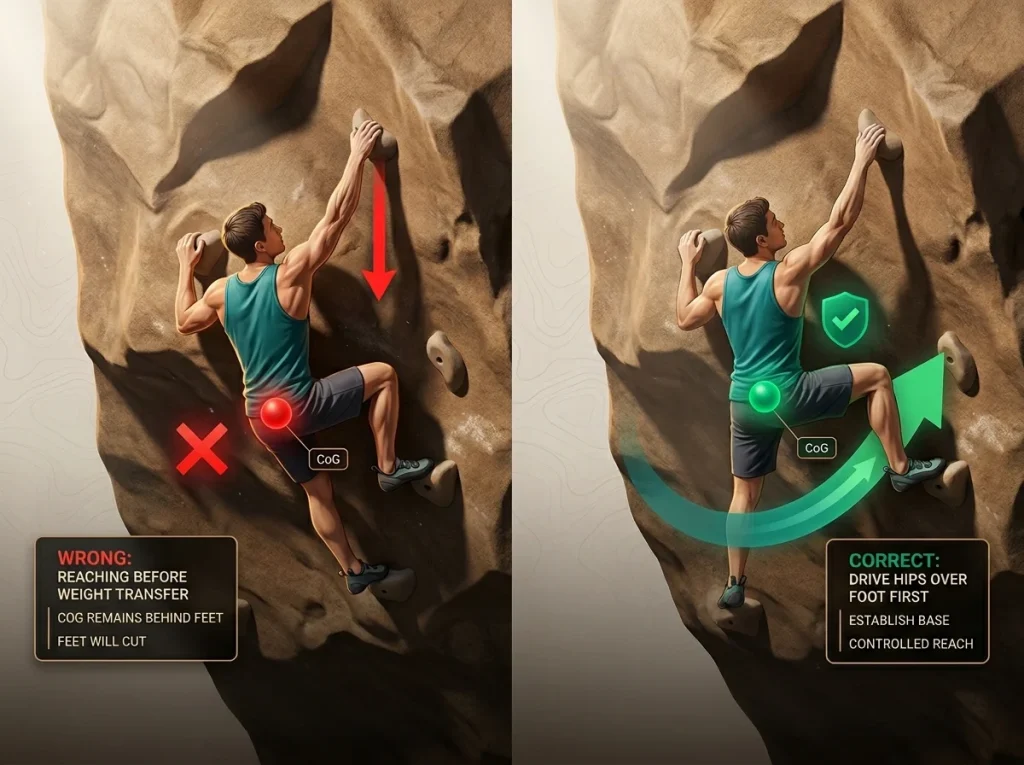
Straight arms are mandatory here, not optional. Bending your elbows shifts the load from your skeleton — radius and ulna — to your biceps, which burns through your MVC budget at the worst possible moment. The fix isn’t to squeeze harder. It’s to drive your hips toward the wall before you reach for the next hold. That sequence change alone — hips first, then reach — is what separates floaters from fighters on sustained roofs.
A 70kg climber with hips 40cm from the wall experiences roughly the same rotational load as an 80kg climber whose hips are only 35cm out. Weight matters far less than hip position. Most people spend months training grip when they should be training where their hips live.
Form-Fit vs. Force-Fit — The Two Laws of Roof Contact
This distinction is the most important thing in roof climbing, and almost nobody explains it clearly. Form-fit connections — heel-toe cams, knee bars — use your skeletal structure as a geometric lock. Near-zero muscular effort. Your bones carry the load while your muscles rest.
Force-fit connections — smears, slopers, friction-dependent holds — require continuous muscle activation just to maintain contact. On a sustained roof sequence, relying exclusively on force-fit burns through MVC in eight to twelve seconds. You don’t run out of grip. You run out of blood flow.
The strategy is simple: prioritize form-fit opportunities at every rest and transition. Use force-fit only to bridge between them. The bicycle, heel hooks, and knee bars are your power-save mode. Everything else is burning charge.
Barn-Dooring — When Angular Momentum Takes Over
Barn-dooring happens when you lose one contact point and your body rotates uncontrolled around the remaining two. It’s not random — it’s physics. Remove one anchor, and the body swings with the full arc of angular momentum, mass times velocity times radius.
Primary prevention is simple to say and hard to wire in: never move two contact points simultaneously. Keep a tripedal stance — three points locked before releasing the fourth. When that’s not possible, flagging counters the swing directly. Extend the non-contact leg as a counterweight and you cancel the rotational force before it builds. For the full breakdown, the guide on flagging and drop-knee mechanics that prevent barn-dooring covers the drill-level correction.
The Kinetic Chain — Power Runs From Toe to Finger
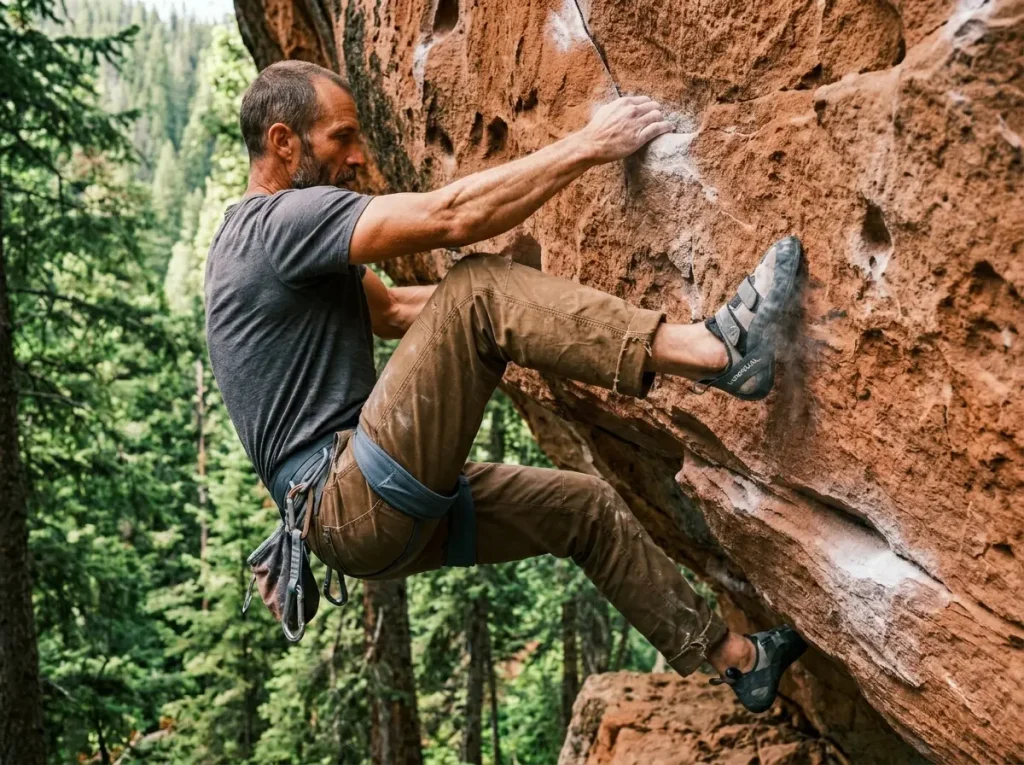
Here’s what most climbers get completely backward: roof climbing power does not come from your arms. It starts at your feet and runs up. Your calf muscles press rubber into the hold. That force travels through the posterior chain — hamstrings, glutes, Erector Spinae — which pull your hips toward the wall. Your core acts as the transmission, passing that force up to your fingers without losing energy. The arms finish the movement. They don’t start it.
Pull with your toes like they’re fingers. You should feel your lower back fire. If you don’t feel it, your chain is broken somewhere between the calf and the spine, and your fingers are compensating with interest. Research confirms that dynamic core training improves climbing-specific strength tests by up to 14.9% — but only when it targets the full chain, not just abs in isolation.
After you get the chain concept wired, understanding how foot technique initiates the kinetic chain gives you the ground-up foundation the chain requires.
The Posterior Chain — Why Back Muscles Send Feet Cutting
Most climbers train their pull muscles obsessively — lats, biceps, forearms. The Erector Spinae and multifidus, the spinal extensors that hold the chain rigid under load, get ignored. When they disengage or fatigue, the visual result is body sag: a rounded back, dropped hips, and feet popping off holds that you had ten seconds ago.
The Transversus Abdominis — the deepest abdominal layer — is the key piece most training programs skip. In elite athletes, the TVA fires before any limb movement. It’s pre-activation. On roofs, that split-second pre-tension is the difference between a stable platform and a collapsing lever that pops your feet off mid-reach.
The Pelvic Floor and Diaphragm — The Hidden IAP Generators
Nobody in climbing content talks about this. Intra-abdominal pressure (IAP) is what actually stiffens your lumbar spine on a roof. It’s created by a coordinated compression: diaphragm on top, pelvic floor on the bottom, TVA at the front, multifidus at the back. That 360° pressure system creates a rigid cylinder your limbs can push against.
When IAP fails — not when your core tires, but when that pressure collapses — you get the sudden, total body cave-in that sends feet flying. The correct cue is “brace like you’re about to take a punch.” Not “suck in your belly.” Belly-sucking destroys IAP. A punch-brace creates it.
Silent Feet — Proprioceptive Calibration for Roofs
Here’s a drill that tells you exactly how good your kinetic chain is right now. Climb an easy roof problem with one constraint: your feet cannot make a sound when they touch the wall. Any noise — any click, thud, or scrape — means you threw the foot with momentum instead of placing it with proprioceptive precision.
Sound is the feedback loop. A quiet foot means the core fired before the limb moved. A loud foot means the limb moved and the core scrambled to catch up. Progression is honest: once you can string a full horizontal sequence silently on easy terrain, the chain is coordinating correctly. Then bump the grade and repeat.
Advanced Hook Mechanics — The Form-Fit Toolbox
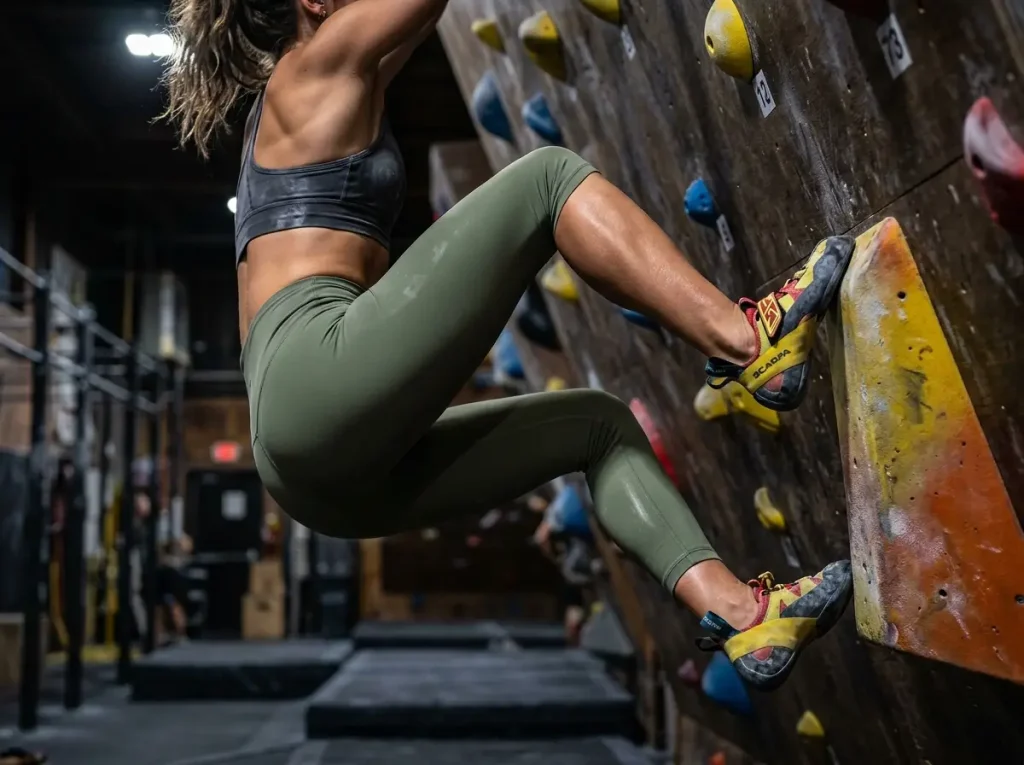
Four techniques dominate roof climbing. Know all four, and you have a toolkit that covers every terrain variation. Miss one, and there are whole categories of movement that will always feel desperate.
The heel hook engages your hamstrings to pull the body toward the wall. It’s the only roof movement that actively reduces upper-body load rather than just redistributing it. Efficiency here is tied to your anatomy — specifically the distance from your hip center of rotation to your ischium (the sit bone, which is the hamstring origin point). Research on the mechanical advantage for the hamstring muscles confirms that a longer moment arm from the ischium means more pulling force per unit of muscle tension. Taller climbers often have a slight anatomical edge on heel hooks. The mistake most people make is pressing with the calf (plantarflexion) instead of pulling with the hamstring (knee flexion). Completely different muscle group, completely different force direction.
For the detailed mechanics of heel hooks vs. toe hooks, the dedicated comparison breaks down technique, injury risk, and rubber selection for each.
The toe hook pulls with the top of the shoe. This one is almost entirely dependent on your rubber compound — soft rubber conforms to hold texture and grips. Hard rubber compounds at 84A feel glassy on volumes or plastic without significant pressing force. If your toe hooks keep slipping, check the rubber before blaming your technique.
The Heel Hook and Ischial Moment Arm
The common heel hook mistake is easy to identify if you know what to look for: the climber plants their heel and tries to push through the calf. Their lower leg drives down. That’s plantarflexion — the soleus and gastrocnemius, not the hamstrings. To actually use a heel hook, the heel must load the hold at a height that puts tension on the hamstrings through knee flexion. Heel height matters. Too low, and you’re pressing. Too high, and you’re just hanging it there.
Engage the entire hamstring group — biceps femoris plus the medial heads — rather than relying only on the lateral. That means slightly rotating the heel inward at the moment of loading.
Pro tip: On steep roof problems, practice heel hooks on the ground by placing your heel on a chest-height hold and consciously pulling your hips toward it using only your hamstring. If you feel your calf working, the mechanics are wrong.
The Bicycle — Gravity-Independent Clamping
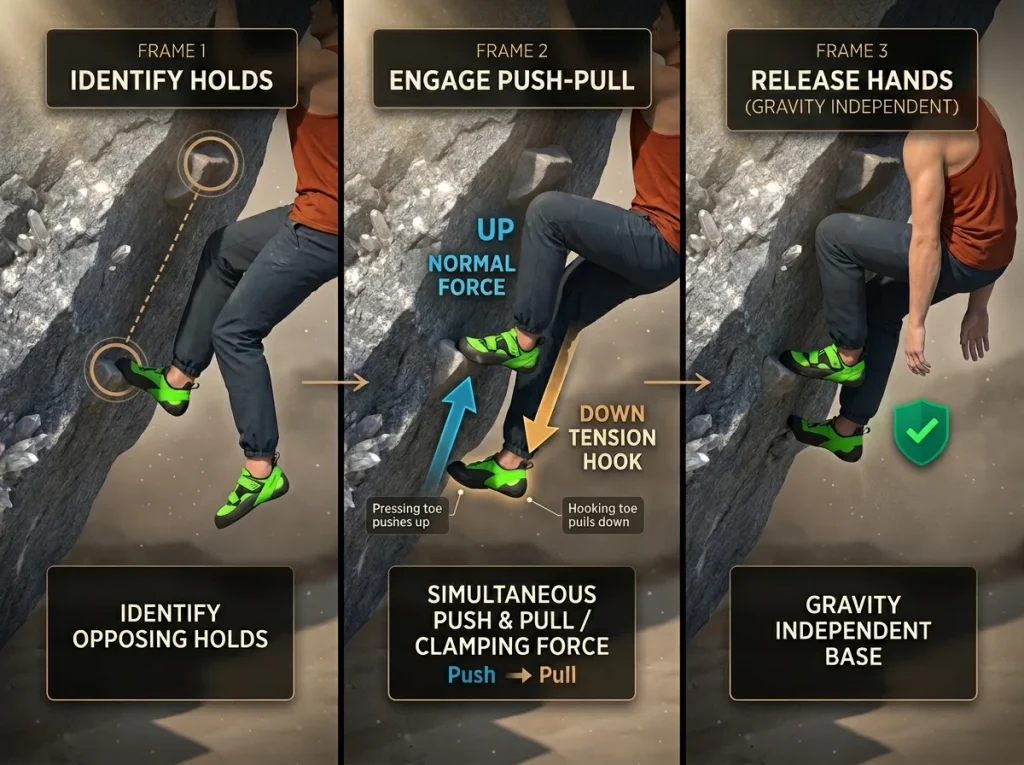
The bicycle is the most powerful form-fit position on a roof. One foot pushes up on a hold, the other pulls down on a different hold. The result is a closed-loop force system between two footholds — gravity loads the system but can’t destabilize it, because the clamping force is independent of where down is.
Most effective when the two footholds are at different heights — one foot presses, the other hooks. Downturned aggressive downturn shoes enhance bicycle mechanics because the pre-curved toe box naturally positions the rubber to hook without the climber having to actively flex the toe.
Knee Bars — The Zero-Effort Rest
A knee bar is when your femur and shin wedge between two structural points under compression. When it’s set correctly, your MVC requirement drops to effectively zero. Your skeleton carries the load. Your muscles recover. It is the only true rest position available on a severe roof.
In cold conditions below 10°C, leg muscles lose compliance and the rubber may stiffen — factor this in when deciding whether a knee bar pad is worth the added weight. Pack a spare if you’re projecting below that threshold.
Shoe Rubber Science for Roofs — Shore A Explained
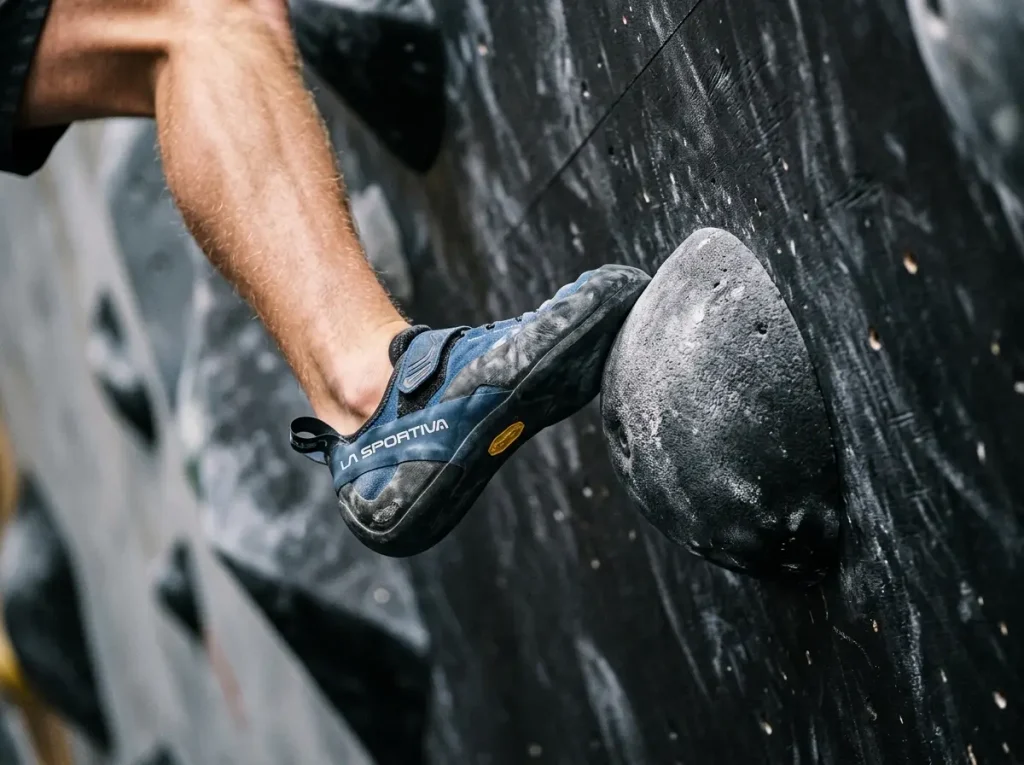
Climbers buy aggressive downturned shoes — the right shape — with hard rubber compounds. Then wonder why their toe hooks feel greasy. This is perhaps the most common gear mistake on steep terrain.
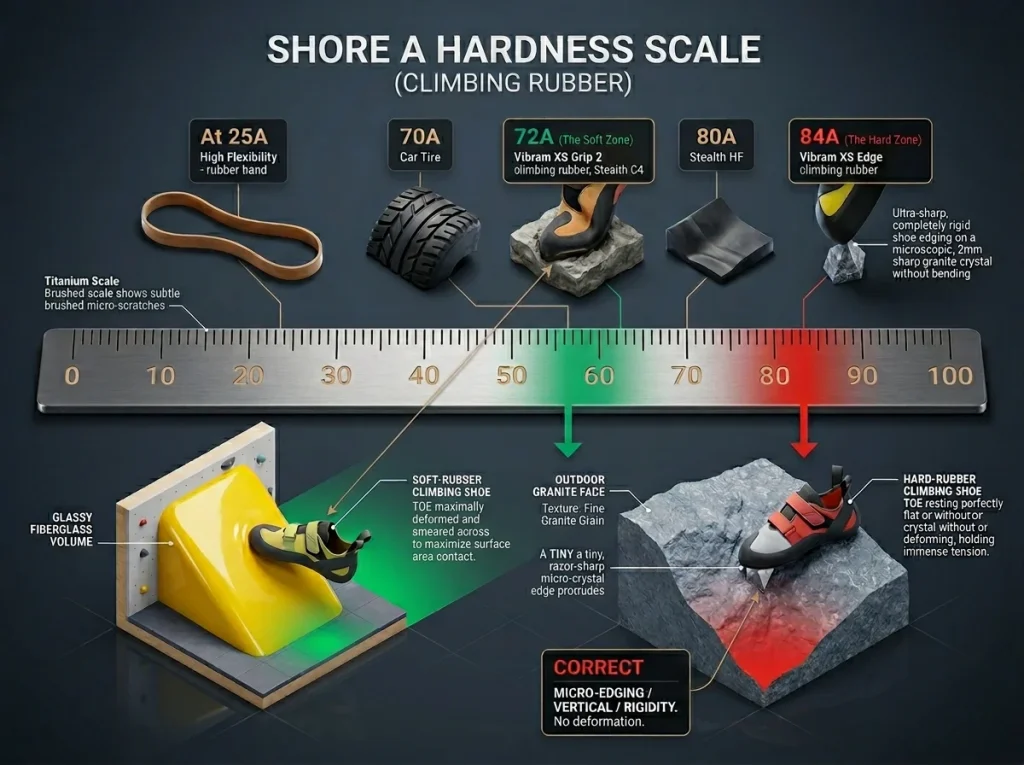
“Stickiness” is not a rubber quality — it’s a physical result of deformation energy. How much does the compound conform to the micro-texture of the rock before it slides? Soft rubber at 70–74A, like Vibram XS Grip 2 or Five Ten Stealth C4, conforms to micro-texture and maximizes surface area contact. That contact area is your friction. On glassy volumes and steep plastic, it’s the only mechanism generating grip.
Hard rubber at 84A, like Vibram XS Edge, resists deformation. Superior for precise edging on micro-crystals on vertical walls. On roofs without positive holds, it planes over texture — effectively frictionless without high pressing force, which you often can’t generate when you’re horizontal and pumped.
For a full data-backed breakdown of every major compound, the complete data-backed guide to climbing shoe rubber compounds covers Shore A ratings, temperature behavior, and terrain-specific selection.
Soft vs. Hard Rubber — Decision Matrix for Roofs
Soft (70–74A) is correct for: volumes, steep plastic, friction-dependent hooks on limestone tufas, any terrain where deformation matters more than precision. Names to know: XS Grip 2 (~72A), Stealth C4 (~72A).
Hard (84A) is for: micro-crystal vertical edges, granite faces, anywhere the hold is positive and you need a rigid platform. Names: XS Edge (~84A), Stealth HF (~80A).
The failure pattern is always the same. Climbers buy aggressive shoes (correct shape) with hard rubber (wrong compound) and spend months blaming their technique on problems where the material science was working against them from the start.
Viscoelasticity and Temperature — Why the Same Shoe Feels Different
Viscoelasticity is why the same shoe can feel totally different on a cool March morning versus a hot August afternoon. Rubber is both viscous and elastic. In cold conditions below 10°C, the elastic component dominates — the shoe feels stiff and almost pings off soft holds. Above 27°C, the viscous component takes over — too pliable, no structure, rolls off edges.
Most compounds perform in their optimal window between 10–22°C. The shoe that felt perfect on your project in spring may feel wrong in summer heat. This is material science, not your imagination.
Safety on Roofs — The Upside-Down Whipper
Competitors don’t cover this. That’s a problem, because this hazard causes real head and neck injuries.
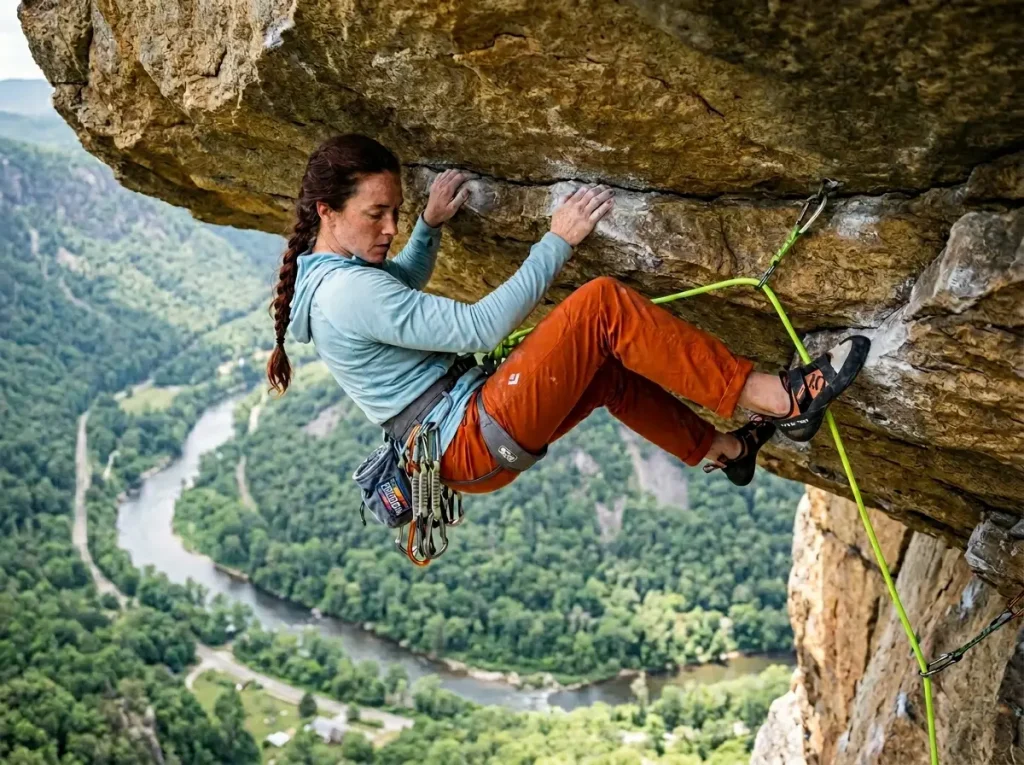
On roofs, your rope frequently passes between your body and the wall because you’re horizontal. This creates a persistent leg-behind-rope exposure that doesn’t exist on vertical terrain. If you place a foot or ankle between the rope and the rock and fall, the rope acts as a fulcrum. You flip upside down. Violent impact with the wall. Potential whiplash. This is one of the primary causes of head and neck injuries in sport climbing falls, per determinants of sport climbing performance and safety.
After learning the Rock-Rope-Leg procedure, reading about understanding fall dynamics and ground fall prevention gives you the complete fall management framework for steep terrain.
The Rock-Rope-Leg Procedure
The rock-rope-leg principle is simple: the rope must always stay on the shoelace side of your foot. On any traverse component of a roof, evaluate the foothold position relative to your last bolt before you place your foot.
If the hold is past the bolt: step over and around the rope. The rope stays on the shoelace side. If the hold is this side of the bolt: push the rope aside with the inside edge of your shoe before stepping.
Practice this consciously on easy roof traverses until it’s automatic. It must be a habit before it matters on high-consequence routes. Brief your belayer every time: “I’m moving right across the bolt — watch my rope position.” That communication should be routine conversation, not a special announcement.
Pro tip: On any roof problem with traverse movement, track your rope at every foot placement. Not just clipping moves. Every. Foot. Placement. One missed check is all it takes.
Clipping Positions on Roofs — The Z-Clip Trap
Roofs create unusual clipping angles — often sideways or upside down. The rule: only clip from a stable form-fit position. Heel hook locked, knee bar placed. Never clip while a force-fit connection is already consuming your MVC budget.
Z-clipping is grabbing rope from below the last clip. On a roof, your rope hangs behind and above you. Under pump, it’s easy to grab the wrong section. Prevention: always pull a big loop from the harness side, not from the trailing rope going to the belayer. The harness-side rope is always the correct section to clip.
Training to Stop Cutting Feet — The Physics-Based Protocol
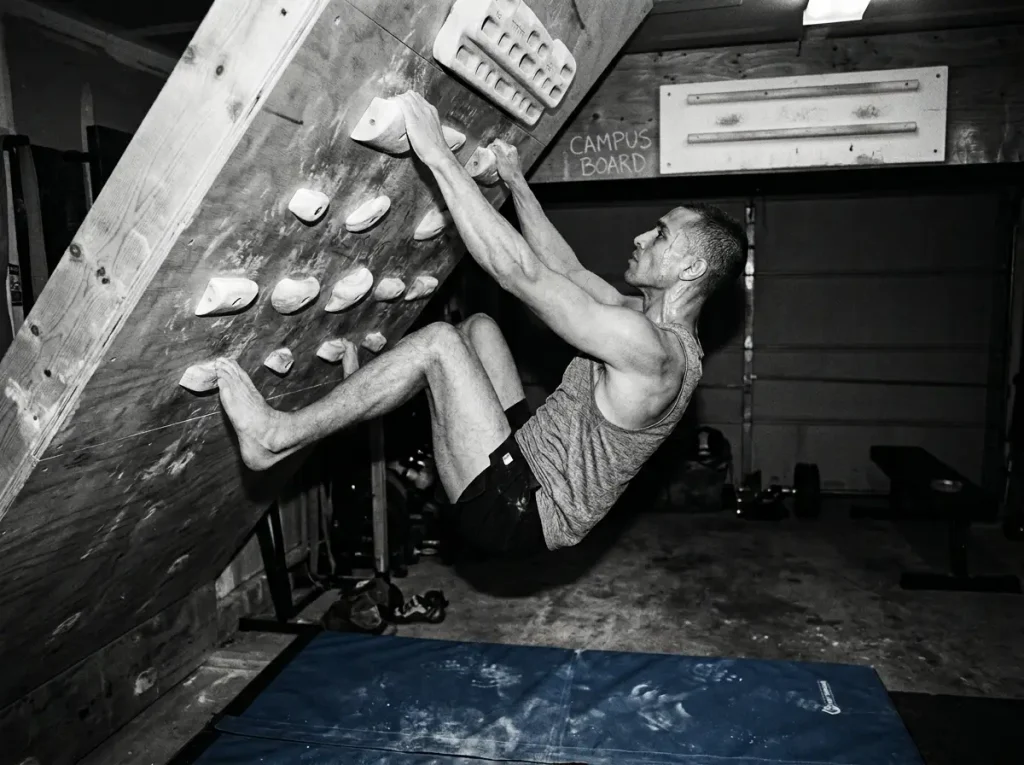
The mistake most people make in their training is targeting the symptom — weak grip — instead of the cause. Grip isn’t what fails first on a roof. The chain fails, or the IAP collapses, and then grip compensates until it can’t.
Body tension training needs to target the full kinetic chain. The silent feet drill — climbing easy roof problems without sound — forces proprioceptive precision alongside core pre-activation. It exposes exactly where the chain is breaking down, because the noise tells you. No noise means the chain fired before the limb moved.
Pro tip: Try the Ninja Feet drill on a V0–V2 roof circuit: three to four laps, full rest between, complete silence as the only success metric. When you can do the circuit clean, bump one grade. The drill degrades honestly at harder terrain, showing you your current threshold.
The Rock-Over Drill retrains the movement sequence directly. Step 1: place feet on the next holds. Step 2: drive your hips (CoG) directly over that new foundation. Step 3: then release a hand and reach. Most cut-feet happen because climbers reach in step one before completing steps two and three. The feet pop because the CoG never moved.
The Silent Feet Drill — Proprioceptive Recalibration
Select a V0–V2 roof problem. Climb it without any foot-contact noise. That’s the entire drill. The difficulty scales automatically: soundless execution on hard terrain means the chain is genuinely coordinating under load. Sound at any grade means it isn’t.
Three to four laps on two or three problems. Full rest between. The goal is focus, not fatigue.
The Rock-Over Drill — CoG Sequencing
Have a partner call “hips?” before each move. Answer “set” only when your CoG is genuinely over the new foot position — not when you think it’s close enough. If you can’t answer quickly, you aren’t tracking your own weight distribution. That inability is exactly what causes cuts.
After a few sessions, foot placements get dramatically quieter on their own. Each one becomes a controlled weight transfer, not a stabilization scramble.
G-Tox Recovery on Roofs
Most climbers shake out on roofs by dangling one arm. That gets you 5–8% of grip strength back. The G-Tox hemodynamic recovery protocol does better: alternate 5–10 seconds of arm hanging below your waist (drives oxygenated blood in) with 5–10 seconds of arm raised above your head (gravity drains deoxygenated blood and lactate out). Research shows this outperforms a standard shakeout by 18.4% in strength recovery.
On a knee bar or bicycle rest, you have both hands free. Run G-Tox on both arms simultaneously. You’ll add moves to your sustainable range that no amount of additional training replicates. The full recovery system for roof sequences is covered in the G-Tox hemodynamic recovery protocol.
Building a Roof-Specific Training Block
Two roof-focused bouldering sessions per week plus one hangboard session targeting open-hand grip (roof holds are rarely crimps). Supplement with posterior chain work outside climbing — Romanian deadlifts, Nordic curls — to train the hamstrings and Erector Spinae when you’re not on the wall.
Hip flexor and thoracic spine mobility are required, not optional. Restricted hip flexors prevent pelvic frontal plane control on overhangs. Restricted thoracic spine limits reach efficiency. The mobility program that unlocks high-steps and heel hooks provides a structured approach for both.
Measurable improvement on sustained V4–V5 roof problems takes six to eight weeks of consistent work. That timeline is honest.
Conclusion
Three things that actually matter:
Feet cutting is a torque failure, not a strength gap. The moment your hips drift, the lever arm multiplies — and no grip strength compensates for bad geometry. Fix the position first, every time.
Power on roofs flows from toe to finger. The kinetic chain is one system. If the posterior chain or TVA disengages at any link, the whole system collapses and your feet pay the price first.
Shoe rubber is a material science decision. Soft compound (70–74A) on a roof isn’t a personal preference — it’s the physically correct choice for deformation-based friction on steep terrain. Match the compound to the physics, not the logo.
Take your current project problem and climb it with one constraint: feet must be silent every time they touch the wall. Count how many moves you string before you make sound. That number tells you exactly where your kinetic chain is failing. Now fix the weakest link.
FAQ
How do you keep your feet on a roof?
Keep your hips as close to the wall as possible — that’s the core-tension and hip-proximity issue behind most feet cutting. Prioritize form-fit connections: heel hooks, toe hooks, and bicycles use skeletal structure rather than muscle tension to maintain contact. Force-fit connections drain your MVC in seconds on sustained terrain.
What muscles are used for roof climbing?
The primary drivers are the posterior chain — hamstrings, glutes, and Erector Spinae — which hold the hips in and generate pulling force through heel hooks. The Rectus Abdominis, obliques, and Transversus Abdominis act as the core cylinder transmitting force without losing rigidity. The forearms are the last link in a chain that starts at the toes.
How do I transition over a roof lip?
The lip is where the gravitational vector shifts most dramatically. The sequence: secure both feet on or near the lip edge, drive your hips aggressively up and over — not just pull with arms — and establish a foothold on the vertical face before releasing your top hand. Pausing at the lip with hips still horizontal maximizes finger load at the most pumped moment. Move through it, don’t stop.
Does shoe rubber matter for roof climbing?
Yes — it’s a material science decision. Soft rubber compounds (Shore A durometer 70–74, like Vibram XS Grip 2) deform into micro-texture and maximize contact area friction without requiring high pressing force. Hard rubber (84A, like Vibram XS Edge) planes over texture on steep terrain unless you can generate substantial pressing force — which is often not available on a sustained roof.
How do specific core muscle fiber types affect time-to-failure on 90-degree roofs?
Slow-twitch (Type I) fibers provide sustained low-force contractions — ideal for Erector Spinae and TVA stabilization roles during rest positions. Fast-twitch (Type II) fibers generate the explosive brace needed for dynamic moves. Roofs demand both: slow-twitch for maintaining core tension during knee bars, fast-twitch for the sudden tensioning required when reaching for a far hold. Training both modes — static planks plus explosive body-lifts — addresses the full demand profile that sustained roof bouldering creates.
Safety Notice: Rock climbing and mountaineering are inherently high-risk
activities that can involve physical trauma or fatal incidents. The information on Rock Climbing Realms is for
educational and informational purposes only. Techniques and advice presented here are not a substitute
for professional, hands-on instruction. Conditions and risks vary by location. Always seek guidance
from a qualified instructor before attempting new techniques. By using this website, you agree that you
are solely responsible for your own safety. Any reliance you place on this information is strictly
at your own risk, and you assume all liability for your actions. Rock Climbing Realms and its authors
will not be held liable for any harm, damage, or loss sustained in connection with the use of this information.
Affiliate Disclosure: We are a participant in the Amazon Services LLC Associates Program, an
affiliate advertising program designed to provide a means for us to earn advertising fees by advertising and linking
to Amazon.com. As an Amazon Associate, we earn from qualifying purchases. We are also an official affiliate partner
of Black Diamond Equipment via the AvantLink network. If you click on a Black Diamond affiliate link and make a
purchase, we may earn a commission at no additional cost to you. We also participate in other affiliate programs.
Additional terms are found in the terms of service.