
In this article
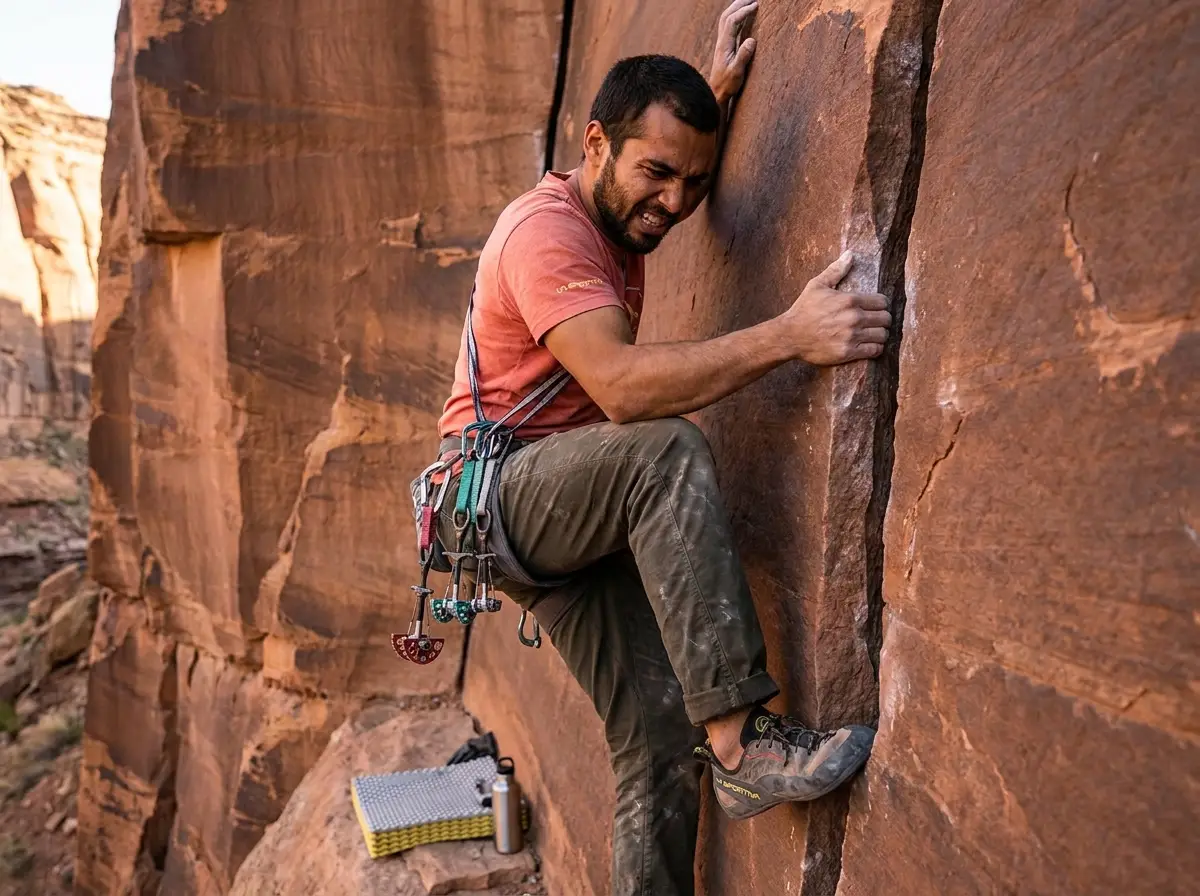
The first time I stuck my hand into a crack and trusted it to hold my weight, nothing happened. My feet skated, my shoulder screamed, and I peeled off in a way that suggested I had fundamentally misunderstood physics. The second time, I didn’t trust it enough and peeled off earlier. By the fifteenth attempt, something clicked — and that click is what I want to explain here, because it doesn’t happen automatically, and most beginner guides don’t tell you what actually blocks it.
Crack climbing is its own discipline inside rock climbing. The technique is unintuitive, the learning curve is steeper than it looks, and the payoff is access to entire categories of rock that sport and face climbers never see. I’ve logged enough time on splitters to know what beginners get wrong, and more importantly, what gets them right faster.
Quick Answer: Here’s how to crack climb for beginners:
- Learn crack sizes — finger, hand, fist, off-width — before your first route
- Start on hand cracks, not finger cracks (hand jams are more forgiving)
- Insert your hand, cup your palm, tuck your thumb, and hang — don’t pull outward
- Set foot jams by turning your foot sideways, inserting the toes, and weighting down
- Tape your hands before every session until your skin toughens up
- Find a single hand crack route at your gym or a beginner crag — climb it until the jam feels obvious
What Makes Crack Climbing Different
Face Holds vs. Jams — A Different Kind of Contact
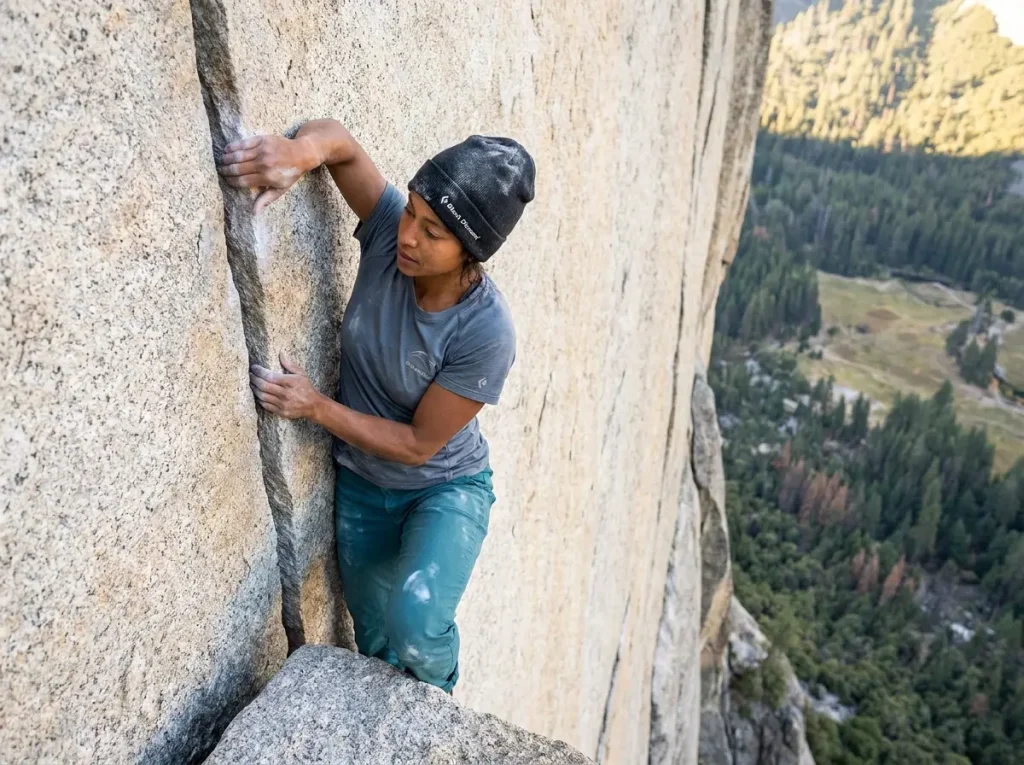
Face climbing is intuitive because you interact with the rock the same way you interact with most objects in life: you grab things and pull on them. The holds stick out. The contact is obvious. You can see exactly what you’re doing.
Crack climbing inverts that logic. The holds don’t stick out — they’re voids. You insert your body into the rock and create friction through expansion, torque, and body weight. A well-set hand jam produces no visible grip on the outside of the crack. The holding power is internal, generated by the geometry of your hand pressing outward against two walls simultaneously. The first time you weight it fully, it feels like holding onto nothing — and that feeling is exactly why beginners fail to commit.
This is also why crack climbing technique requires an entirely different type of reading than face routes: you’re not looking for holds, you’re reading the crack itself — its width variations, its constrictions, and where your anatomy fits best.
Why Crack Climbing Unlocks Entire Rock Faces
Rock climbing evolved through cracks. Before bolted sport routes appeared in the 1980s, if you couldn’t protect a route naturally, you couldn’t climb it. The entire Yosemite big wall tradition — El Capitan, Half Dome, the North America Wall — runs on cracks. Areas like Indian Creek in Utah, the Gunks in New York, and Squamish in British Columbia are almost entirely crack systems. Learning to jam opens access to routes that sport-only climbers never experience.
The practical reality: if you climb outdoors regularly and never learn to crack climb, you’re skipping roughly half the climbing available to you at most natural crags.
The Honest Truth About the Learning Curve
Crack climbing feels terrible before it feels good. Your skin will get scraped up. Jams that feel bomber will feel sketchy. You will pump out on routes that look casual. This is normal, and it has an end point — most climbers report a distinct session where the technique suddenly integrates, around session eight to fifteen depending on how they’re practicing. Before that session, it’s mostly uncomfortable. After it, the efficiency gap between jamming and pulling on holds starts to feel obvious.
Pro tip: Don’t judge crack climbing after your first two sessions. Judge it after your tenth. The technique needs time to integrate into your movement patterns, and the first few sessions are mostly just calibrating your brain to trust holds that feel invisible.
Crack Sizes — The Map You Need Before Your First Route
The Taxonomy You’ll Actually Use
Cracks are categorized by width, and width determines which part of your anatomy you jam. The basic categories from narrowest to widest:
Finger cracks accept one to four fingers, typically inserted to the first or second knuckle. They demand the most technique and cause the most discomfort for beginners.
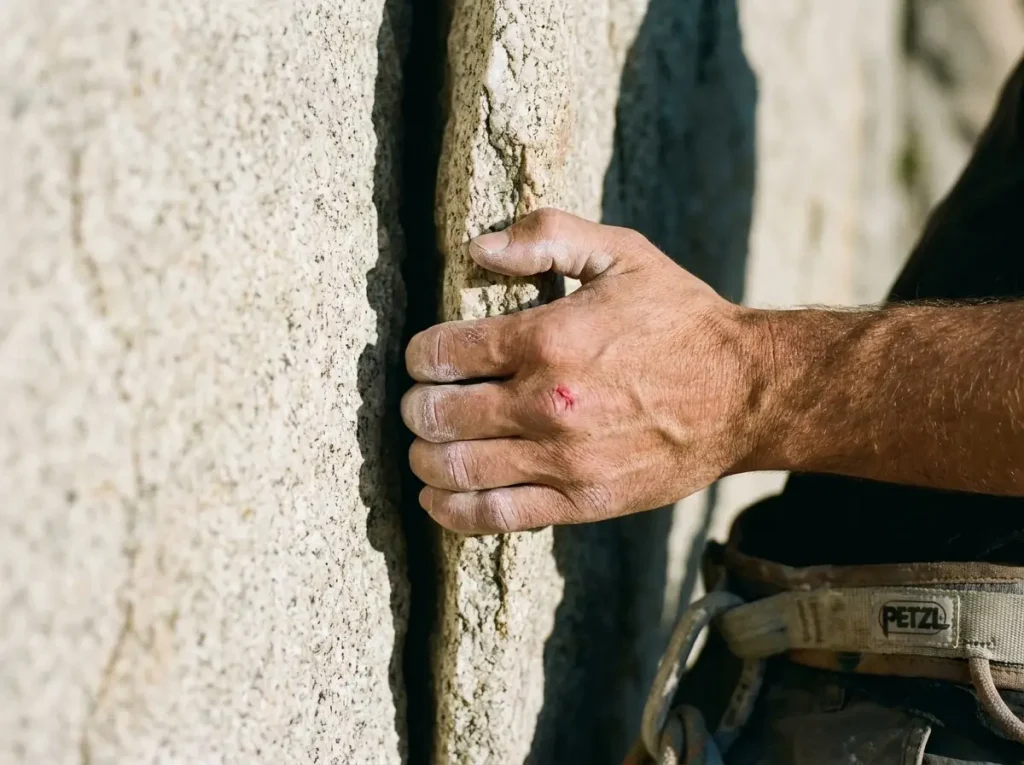
Hand cracks are sized for a full hand — roughly 1.5 to 3 inches wide, depending on your hand size. A perfect hand crack accepts your hand with light camming pressure; a thin hand crack requires your thumb tucked more aggressively into your palm. This is the best size for beginners to start on.
Fist cracks require your closed fist inserted horizontally. They’re wider than hand cracks and often feel either bomber or completely insecure depending on the exact width — there’s less forgiveness in the size variation.
Off-width cracks are too wide for a fist but too narrow for your whole body — the awkward zone between a fist crack and a chimney. Off-widths require arm bars, knee bars, and technique most beginners don’t need for years.
Chimneys accept your whole body, and you move by bridging and pressing between the two walls. They look dramatic but are often easier than they appear.
How to Size a Crack Before You Climb It
Before you climb anything, put your hand flat against the crack opening at eye level and look at what fits. If your fingers enter past the second knuckle and your palm doesn’t: finger crack. If your whole hand enters but not your fist: hand crack. If your fist fits: fist crack or wider.
Sizing matters because attempting the wrong jam type for a crack width wastes energy and causes unnecessary skin damage.
Why Crack Size Is Personal
A crack that’s a perfect hand jam for someone with small hands might be a tight hand or off-fingers for someone with large hands. The 5.10 sandbagged “hand crack” classic at every crag is frequently a brutal off-fingers battle for people with big hands. Check a guidebook’s description, but verify it against your own anatomy before committing to a specific jam type.
Hand Jams — The Foundation of Everything
The Mechanics of a Hand Jam
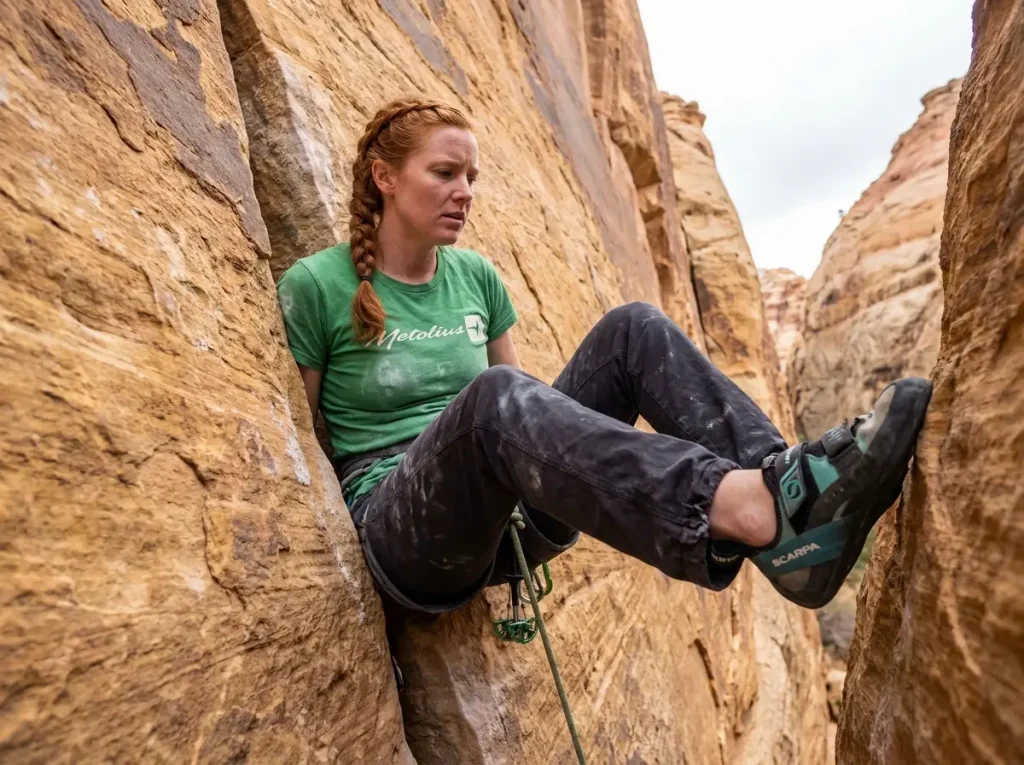
A hand jam works through expansion and torque. When you insert your hand into the crack and cup your palm, you’re creating three simultaneous contact points: the back of your knuckles and fingers on one wall, the fleshy pad on the thumb-side of your palm on the opposite wall, and your fingertips applying light pressure to direct the torque. The thumb tucked into the palm is what creates the expansion — it pushes the meaty heel of your palm outward, locking the hand in place without requiring active grip strength.
Step by step:
- Insert your hand into the crack, thumb up or thumb down depending on the crack orientation
- Cup your palm slightly — not a flat hand, not a fist
- Tuck your thumb firmly across your palm
- Let the expansion do the work — you should feel resistance before you apply any downward force
- Load the jam by hanging your body weight straight down, not pulling outward
For most hand cracks, thumb-up position puts you in a stronger, more natural position to move. Thumb-down is used when reaching above your head and the crack orientation requires it, or on certain diagonal crack systems.
Finding Constrictions and Placing the Jam Above Your Chest
The most common beginner mistake is weighting a jam below the chest, which creates outward pulling force that jams don’t handle well. Weight the jam from above: reach up, set the jam above your sternum, and let gravity pull you down into the constriction. The difference between a well-placed and a badly-placed trad protection piece mirrors this exactly — slot into the constriction, load from above.
Look for a slight narrowing in the crack above your entry point. Slide your hand up until the wrist rests in the constriction — that’s your anchor point. Constrictions dramatically improve jam security without requiring more hand strength.
Watch the video below for a clear visual demonstration of hand jam mechanics in action on a real crack route.
The “Trust the Jam” Problem — Why Beginners Fail to Commit
Here’s what nobody says plainly: most beginners can physically execute a passable hand jam within the first session. What they can’t do is weight it fully. The psychological barrier is real and specific: the jam produces no visible grip, creates no obvious feedback about whether it’s “on,” and failing to commit to it produces a characteristic face-scraping fall that reinforces the fear.
The fix is commitment, which only comes from practice on low-consequence terrain. Traverse a hand crack low to the ground without a top rope. Set jams, weight them fully, traverse sideways. Feel the jam lock as you load it. Do this for 20-30 minutes before you ever clip into a rope on a crack. By the time you’re on a vertical route with real stakes, your nervous system already has a reference for what a weighted jam feels like.
This is also why the mental game of trad climbing includes crack climbing specifically — learning to trust protection and jams uses the same neural pathway.
Foot Jams, Body Position, and Crack Stance
How to Set a Foot Jam That Actually Holds
A foot jam works on the same principle as a hand jam: expansion and torque. Turn your foot sideways so the sole is perpendicular to the crack walls, insert your foot to about the ball of the foot (not further), then bring your knee back in line with your body. The straightening of the knee cams the foot into the crack.
The key: don’t insert your foot horizontally like you’re pushing a key into a lock. That’s how feet get stuck. Turn the foot before insertion, insert, then align the knee.
For a crack sized for hand jams, your foot will fit perfectly. A crack that’s too small for a foot jam can still be used with the outside edge of your shoe smeared against the crack lip, or with toes inserted and body weight pressuring down.
Body Positioning — Hip Square, Hips In, Crack Center
The most important body position rule in crack climbing: keep your hips close to the wall. Beginners instinctively hang their hips out from the crack, which torques the jams and makes them feel insecure. When your hips are in — nearly touching the wall — your jams lock more efficiently and your feet carry more of your weight.
The classic crack stance positions the crack between your feet, with your body centered over it. Don’t climb to one side of a crack like you would a face route. Center on it.
Liebacking — When to Use It and When It Costs You
Liebacking (pulling on the crack edge with your hands while pressing your feet against the wall in opposition) is a useful technique for corner cracks and is tempting because it feels more like face climbing. It’s also significantly more pumpy than jamming, especially on sustained terrain.
Use liebacking tactically: for a few moves to bypass a section where you can’t establish a good jam, or on crack angles where it’s genuinely more efficient. Don’t lieback an entire route because jamming feels scary — you’ll be pumped in 10 moves and the falls won’t be fun.
Pro tip: If you find yourself liebacking to avoid learning to jam, you’re making the eventual jam-learning harder. The arm strength you build liebacking doesn’t transfer to jamming efficiency. They’re different movement patterns.
Tape Gloves, Shoes, and Protecting Your Skin
Making Your Own Tape Gloves
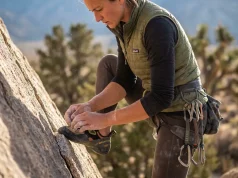
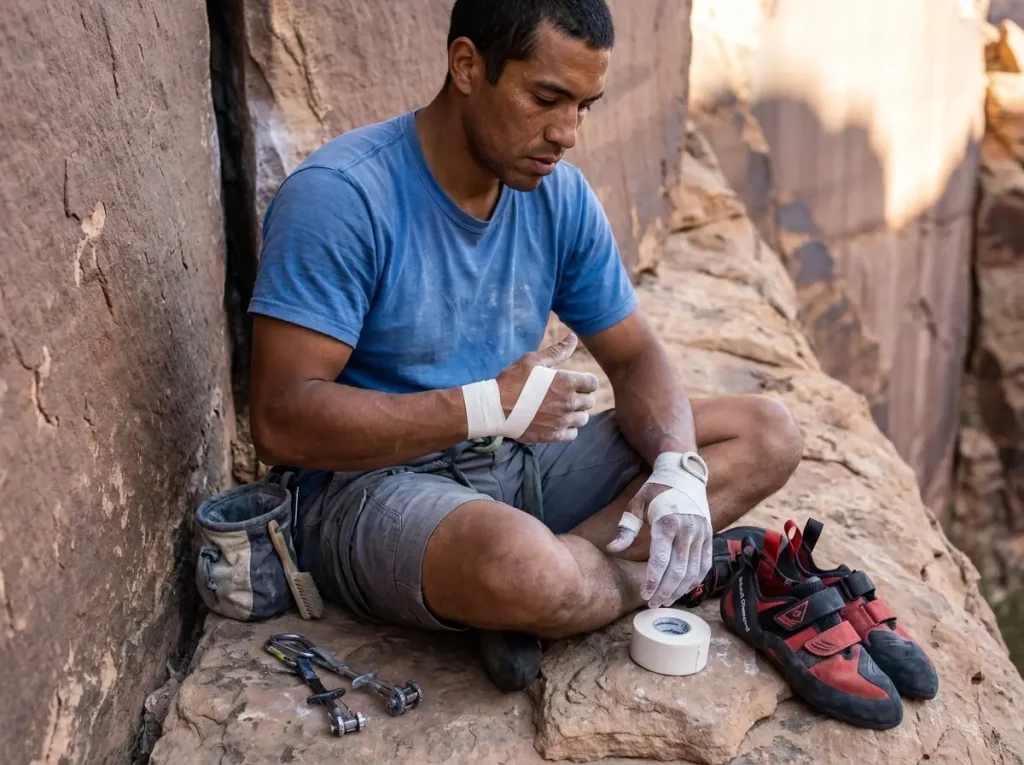
Tape gloves are non-negotiable for beginner crack climbers. Cracks abrade the back of your hands on granite and sandstone, and without tape you’ll end the session early due to skin before you’ve gotten enough practice to make progress.
Materials: a roll of 1.5-inch white athletic tape. The construction:
- Wrap a strip across the back of your hand, over the knuckles, and around to anchor on the palm
- Add a horseshoe loop around the thumb to prevent the wrap from sliding
- Wrap strips across individual knuckle zones as needed
- Keep the tape smooth and not too tight — circulation matters
The tape should protect the top of the hand and the knuckle area, where contact with the crack wall is heaviest. Leave your fingertips free. More detailed tape glove instructions are available in this guide to crack climbing gear.
What Crack Climbing Shoes Actually Need
Crack climbing shoes have different requirements than sport or face climbing shoes. The most important characteristic: a comfortable, non-painful fit with toes in a relatively flat, straight position. The torquing of foot jams on tight bouldering shoes causes significant pain and limits how long you can climb.
The La Sportiva TC Pro and Mythos are the most referenced crack climbing shoes for a reason — they’re stiff enough in the right places to protect the foot during jams while remaining comfortable enough to wear for hours on a multi-pitch route. High-top designs protect ankle skin on wider cracks.
If you’re starting out, use the most comfortable climbing shoe you own that has reasonable rubber. You don’t need specialty crack shoes for your first 20 sessions — you need to focus on the jam mechanics, and pain in your feet will disrupt that focus.
Managing the Skin Game
Even with good technique, crack climbing eats skin. The first three or four sessions on granite will leave the back of your hands pink, scabbed at the knuckles, and tender at the knuckle creases. This is normal and temporary — skin toughens with repeated use and becomes significantly more resistant within a few weeks of regular crack sessions.
Between sessions: let the skin dry naturally, apply a climbing balm to keep the skin supple, and don’t climb on fresh, weeping abrasions. Rock geology affects how quickly skin gets damaged — granite is rougher than sandstone, and some limestone cracks are almost kind to beginners.
Your First Crack Progression — Where to Actually Start
Start on Hand Cracks, Not Finger Cracks
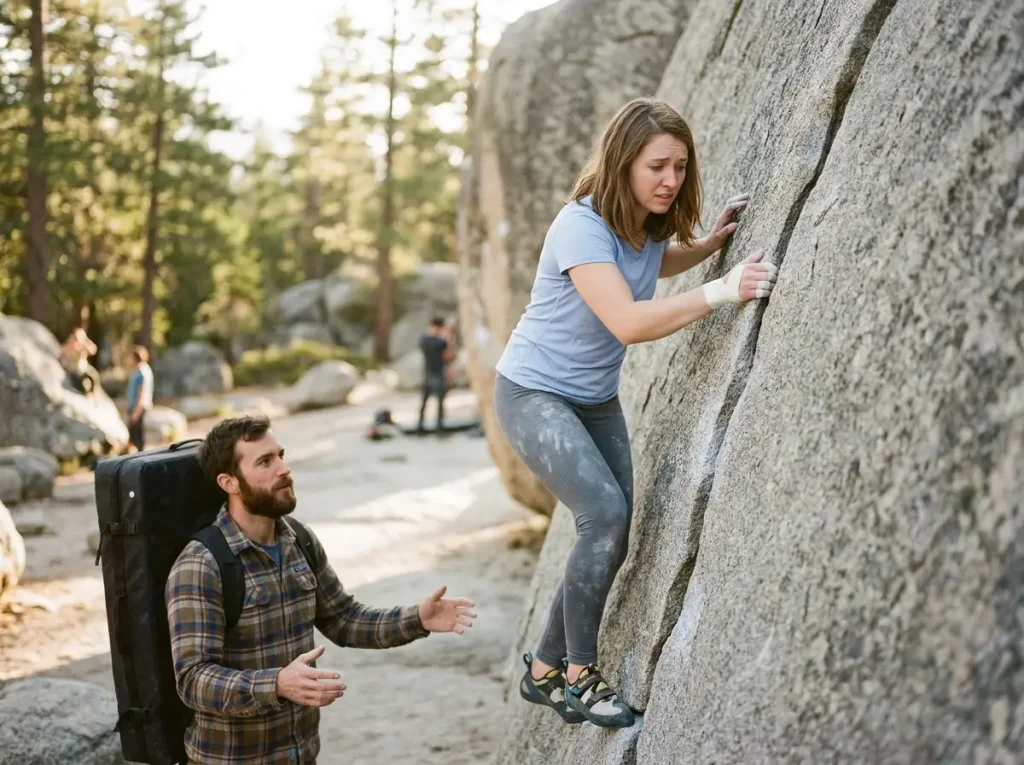
This is the single most important advice for a crack climbing beginner: start on hand cracks, not finger cracks, and definitely not fist cracks or off-widths.
Hand cracks are the most forgiving size for learning because the expansion mechanics are easiest to feel, the foot jam size matches perfectly, and the route protection on hand crack terrain is typically excellent. The Mountaineers’ five rules of crack climbing make this recommendation clearly, and it holds up in practice: every experienced trad climber I know learned to trust the system on hand cracks first.
Finger cracks demand more precise torque, cause more discomfort, and provide less security until technique is dialed. Starting on finger cracks is the fastest way to decide crack climbing is terrible and walk away from a skill that would have rewarded patience.
Building a Crack School Session
A structured beginner session looks like this:
First 20 minutes: traverse a low hand crack horizontally close to the ground. Set jams, weight them fully, move sideways without using the top of the crack as a handhold. This is the “crack school” drill — it isolates the jamming motion from the commitment of height.
Next 30 minutes: climb a single top-roped hand crack route, focusing on efficiency. Fall intentionally on weighted jams to feel what it’s like. Rest often. Don’t let yourself pump out — rest when your forearms start to fill, shake out, try again.
Final 20 minutes: free traverse and experiment. Try thumb-up vs. thumb-down positions. Try the lieback version of one section and compare how tired your arms feel. This is where technical intuition develops.
Repeat this structure for 8-10 sessions before introducing harder crack sizes or leading. The gains are front-loaded — your tenth session will feel dramatically more controlled than your first.
Where to Take Your First Crack Climbing Steps
Indoors: many gyms now have crack walls — vertical crack features with adjustable width. If your gym has one, use it every visit for two months before going outside. The controlled environment accelerates the learning.
Outdoors: Indian Creek in Utah is the classic crack climbing destination, but it’s intermediate terrain — the easiest routes there are 5.10 and require comfort with trad leading. For true beginners on outdoor terrain, seek out bolted crack routes at sport climbing crags, or visit areas like Red River Gorge in Kentucky that have accessible beginner trad routes. Before any outdoor trad climbing, get comfortable with your first trad rack and gear placement separately from the crack climbing skill.
Pro tip: Find a mentor, not just a guidebook. The specific correction — “your hand is too deep, your thumb needs to go here” — that an experienced crack climber can give you in 10 seconds would take you three frustrated sessions to figure out alone. Crack school in a gym or at the crag with someone who climbs 5.11 crack will cut your learning time in half.
Conclusion
Crack climbing is a technical discipline with an honest learning curve. The basics — crack size taxonomy, hand jam mechanics, foot positioning, tape gloves, and starting on hand cracks — give you the framework. What actually builds the skill is repeated practice on low-consequence terrain, enough sessions for your nervous system to trust an invisible hold, and starting on the right crack size before you try anything harder.
Three things that will make the difference in your first season: commit fully to hand jams when you’re low to the ground, protect your skin so sessions end when you choose to stop, and find one person who climbs cracks well and watch how they move. The technique clicks faster when you’ve seen it done right.
Get on a hand crack. Not a guidebook. A crack.
Q1 Is crack climbing hard for beginners?
Crack climbing has a steeper initial learning curve than face or sport climbing because the technique is counterintuitive — you create holds through expansion rather than grip. Most beginners feel genuine progress around session eight to fifteen. Starting on hand cracks rather than finger cracks significantly reduces early frustration, and the technique integrates much faster with deliberate practice than with casual repetition.
Q2 What size crack is easiest to learn on?
Hand cracks are the easiest starting point for most climbers. A hand crack accepts your full hand with light camming pressure — roughly 1.5 to 3 inches wide, depending on your hand size. The jamming mechanics are more forgiving, the foot jam size matches, and protection placement on hand crack terrain is typically reliable. Start here before attempting finger cracks, fist cracks, or off-widths.
Q3 Do I need trad gear to start crack climbing?
Not immediately. You can learn crack climbing technique on top-roped bolted crack routes, indoor crack walls, or by traversing low cracks without protection. However, most natural crack climbing areas require trad gear to lead. Before your first outdoor trad crack lead, practice gear placement separately — getting comfortable with cams and nuts as an independent skill, before combining it with crack technique under stress.
Q4 How do I protect my hands from crack climbing?
Make tape gloves using 1.5-inch white athletic tape, wrapping across the knuckles and the back of the hand with a thumb loop to keep the wrap in place. Apply tape before every session until your skin toughens, which takes three to five weeks of regular climbing. Between sessions, keep skin supple with climbing balm and avoid picking at scabs. Even experienced crack climbers tape for sustained granite crack routes.
Q5 What shoes should I wear for crack climbing?
Start with the most comfortable climbing shoe you own — tight bouldering shoes cause significant pain during foot jams and distract from learning technique. As you progress, look for shoes with a straighter toe box and a stiffer sole that protects the foot during crack torque. The La Sportiva TC Pro and La Sportiva Mythos are the most recommended dedicated crack shoes, with the TC Pro’s high-top design offering extra ankle protection on wider cracks.
Safety Notice: Rock climbing and mountaineering are inherently high-risk
activities that can involve physical trauma or fatal incidents. The information on Rock Climbing Realms is for
educational and informational purposes only. Techniques and advice presented here are not a substitute
for professional, hands-on instruction. Conditions and risks vary by location. Always seek guidance
from a qualified instructor before attempting new techniques. By using this website, you agree that you
are solely responsible for your own safety. Any reliance you place on this information is strictly
at your own risk, and you assume all liability for your actions. Rock Climbing Realms and its authors
will not be held liable for any harm, damage, or loss sustained in connection with the use of this information.
Affiliate Disclosure: We are a participant in the Amazon Services LLC Associates Program, an
affiliate advertising program designed to provide a means for us to earn advertising fees by advertising and linking
to Amazon.com. As an Amazon Associate, we earn from qualifying purchases. We are also an official affiliate partner
of Black Diamond Equipment via the AvantLink network. If you click on a Black Diamond affiliate link and make a
purchase, we may earn a commission at no additional cost to you. We also participate in other affiliate programs.
Additional terms are found in the terms of service.