
In this article
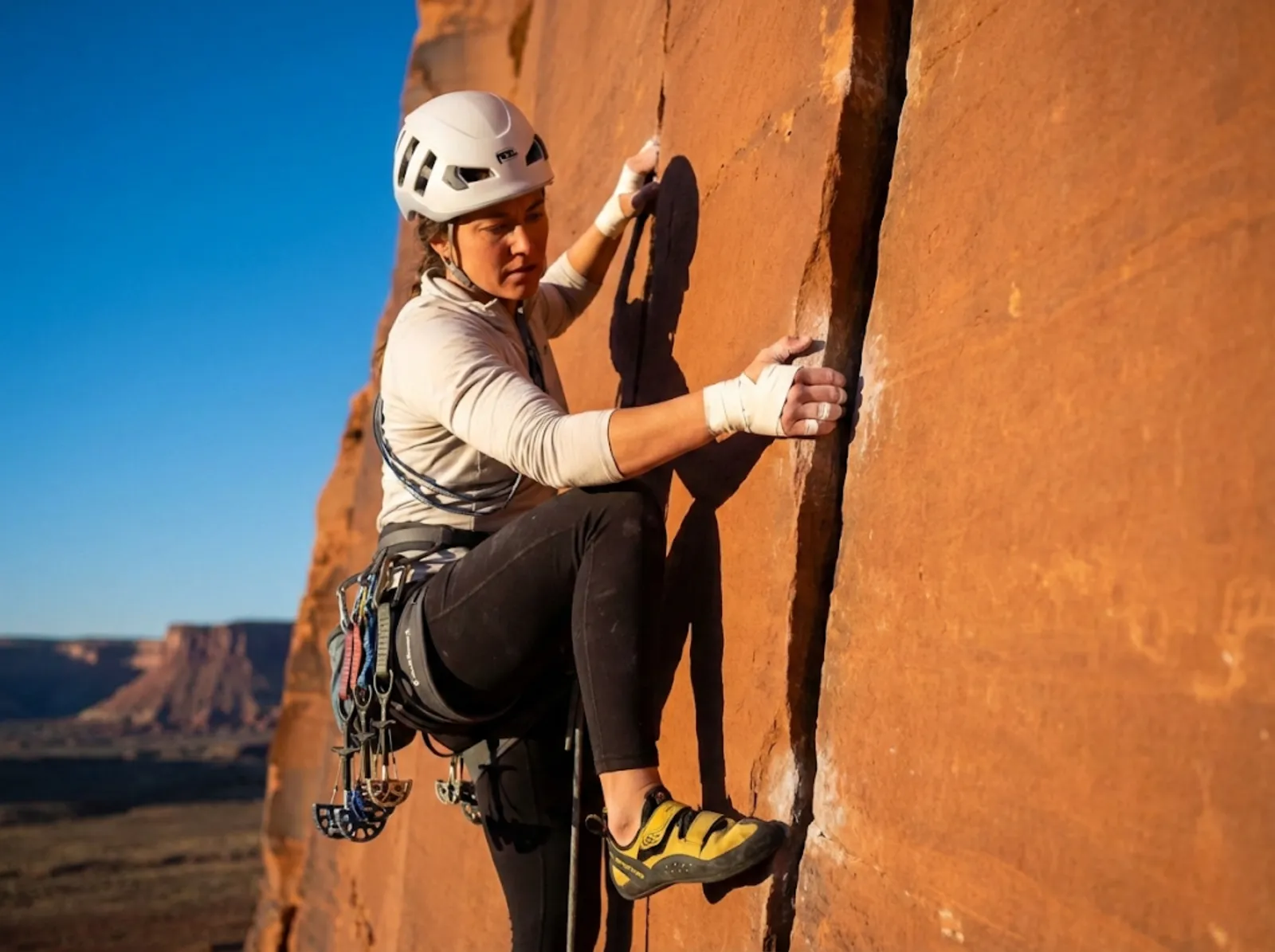
You’re ten feet above your last piece of gear when the crack narrows from fist-width to something your fingers barely fit. Your forearms are filling with blood, your calves are shaking on a lousy smear, and every instinct says layback. Don’t. That’s how you blow the sequence, pump out, and take a whipper onto a cam you’re no longer sure about.
What you actually need—right now, with your hand hovering at the lip of that narrowing—is to read the crack. After years of shoving my hands into rock from Indian Creek to Yosemite to the gritstone edges of the Peak District, I can tell you the difference between a frustrating day and a clean send almost always comes down to one skill: matching the right jam to the right width before you commit.
This guide breaks down exactly how to assess crack widths on sight, match them to the correct jamming technique, and correlate everything with your Camalot sizes—so you stop guessing and start climbing with mechanical precision.
⚡ Quick Answer: Crack climbing success depends on reading crack width accurately and matching it to the correct jam. A standard 2-inch crack fits most climbers’ hand jam. Fingers go in cracks under 1 inch, fists fill gaps around 3.5–4.5 inches, and anything wider demands off-width techniques like arm bars and heel-toe jams. Your personal hand size shifts these zones, so calibrate the chart to your own anatomy—not the textbook.
How Crack Sizes Actually Work (And Why Textbooks Get It Wrong)
Every crack climbing guide opens with the same chart: tips, fingers, hands, fists, off-width. And every chart pretends the categories are universal. They’re not.
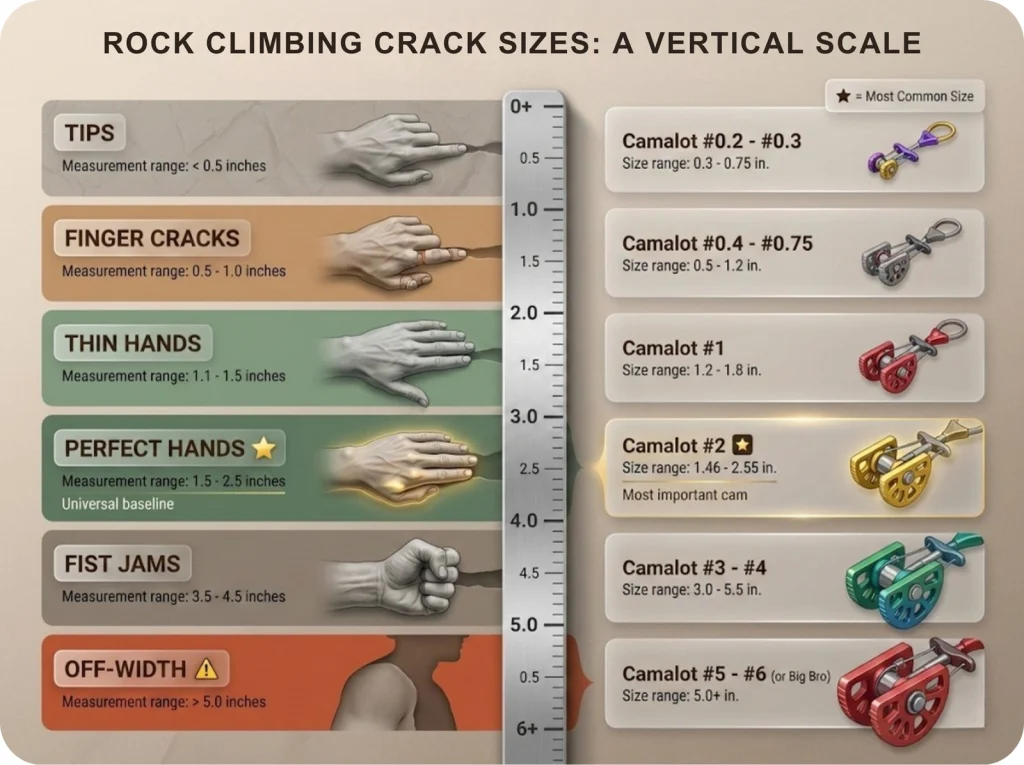
The standard crack size taxonomy runs five categories. Tips are anything under half an inch—first knuckle territory, protected with a Black Diamond Camalot #0.2 or #0.3. Finger cracks run from about half an inch to one inch, where you insert to the second or third knuckle and lock against a constriction. Hand cracks span roughly 1.1 to 3.0 inches, and within that range you’ve got thin hands, perfect hands, and wide hands—each demanding different thumb positioning. Fist jams fill the 3.5- to 4.5-inch gap, and everything wider than about five inches pushes you into the off-width nightmare.
A standard 2-inch crack is the universal baseline for a secure hand jam for most climbers, and the BD Camalot C4 #2 covers a range of 1.46 to 2.55 inches—making it the single most important cam on your rack.
Why Your Hands Change the Chart
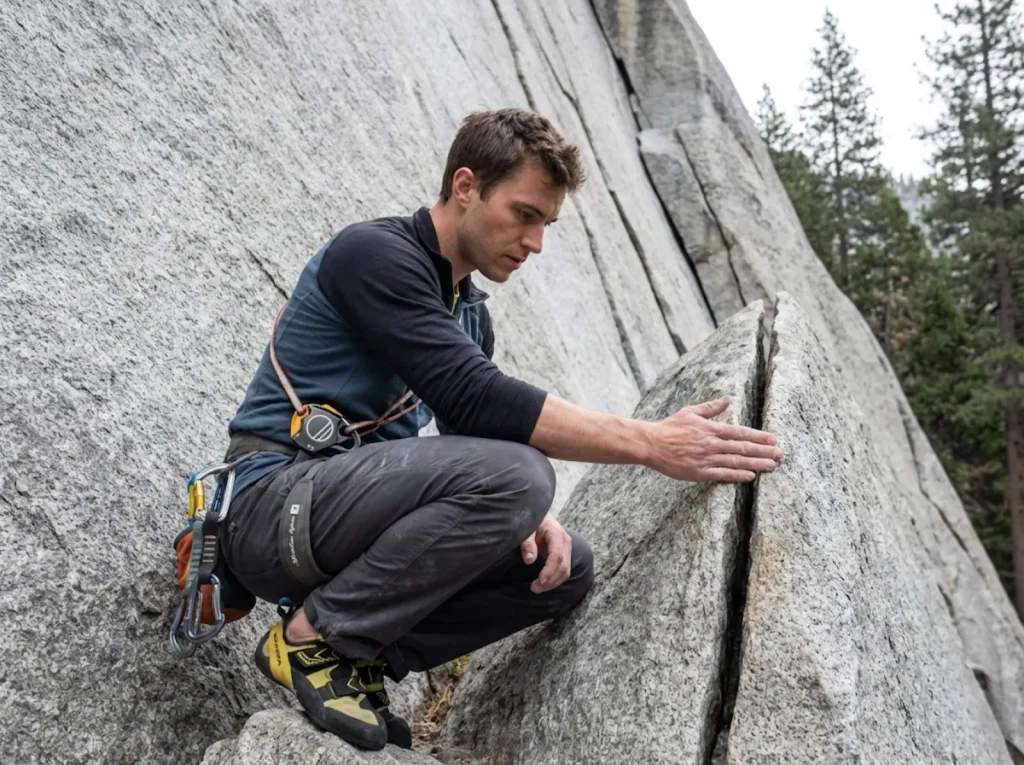
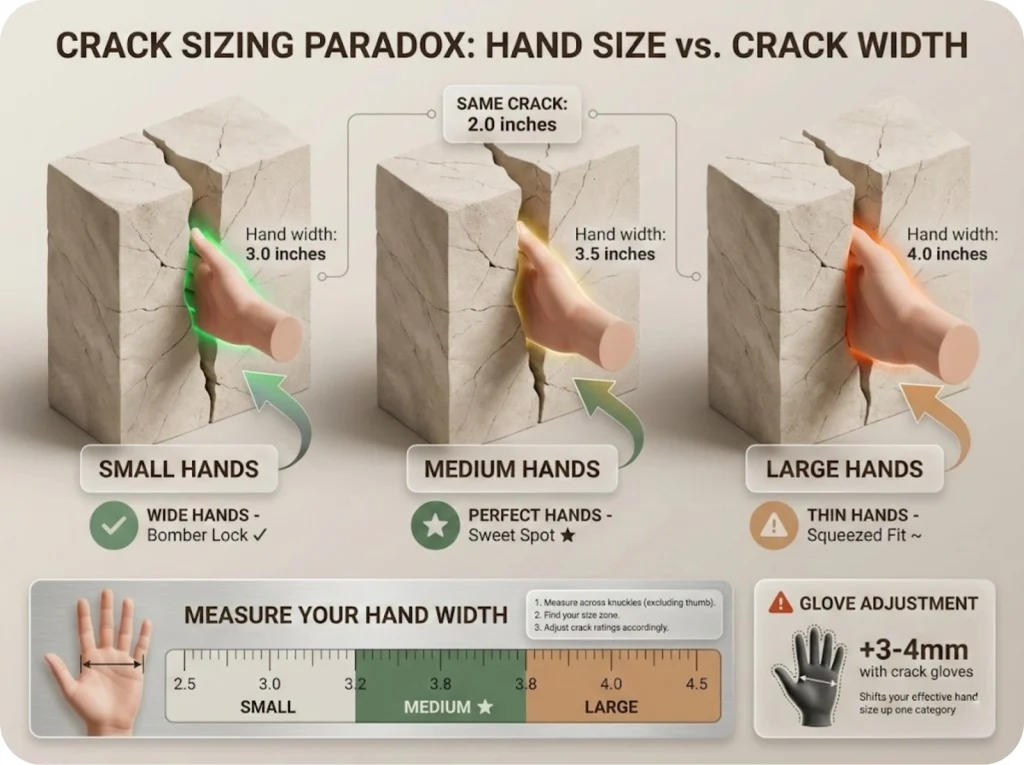
Here’s what nobody tells you on your first trip to Indian Creek: what constitutes “perfect hands” depends entirely on your anatomy. A climber with small hands might find a #1 Camalot crack to be bomber locks, while someone with large hands finds the same crack a thin-hand crux requiring a squeezed thumb and a prayer.
This “sizing paradox” is a primary cause of grading subjectivity at destinations where every route is a splitter and small differences in width matter enormously. It also explains why your partner floats a pitch that pumps you senseless—you’re not weaker, you’re just working a different size category with the same rock.
And here’s a detail most guides ignore: if you’re wearing crack gloves, the 3–4mm of rubber shifts your effective hand size. A crack that felt like perfect hands bare-skinned might become a thin-hand fight with gloves on. Keep that in mind when you’re sizing up a pitch.
How Rock Type Changes the Feel
Granite and sandstone are the two dominant crack substrates, and they feel completely different under your skin. Granite (like Yosemite or Squamish) has coarse grains and quartz crystals that bite hard and hold—your jams feel sharp, secure, and predictable. Sandstone (like Indian Creek or the UK) is feature-rich and often softer, but the feel changes drastically when wet.
This matters for safety. Sandstone strength can decrease by 8% to 78% when saturated with water, because the water weakens the binding agents holding the grains together. Millstone Grit in the Peak District shows a 41% reduction in strength when wet. Even if the surface feels dry, the internal structure might be compromised—making high-torque jams and gear placements dangerous.
Pro tip: Never climb on sandstone after rain, even if the surface looks dry. The internal grain structure weakens before the surface shows signs. Give it at least 24–48 hours to dry, depending on humidity.
Understanding how rock geology shapes climbing style and protection will change how aggressively you torque your jams and how much you trust your placements on different substrates.
The Mechanics of a Secure Jam (Pete Whittaker’s Five Rules Applied)
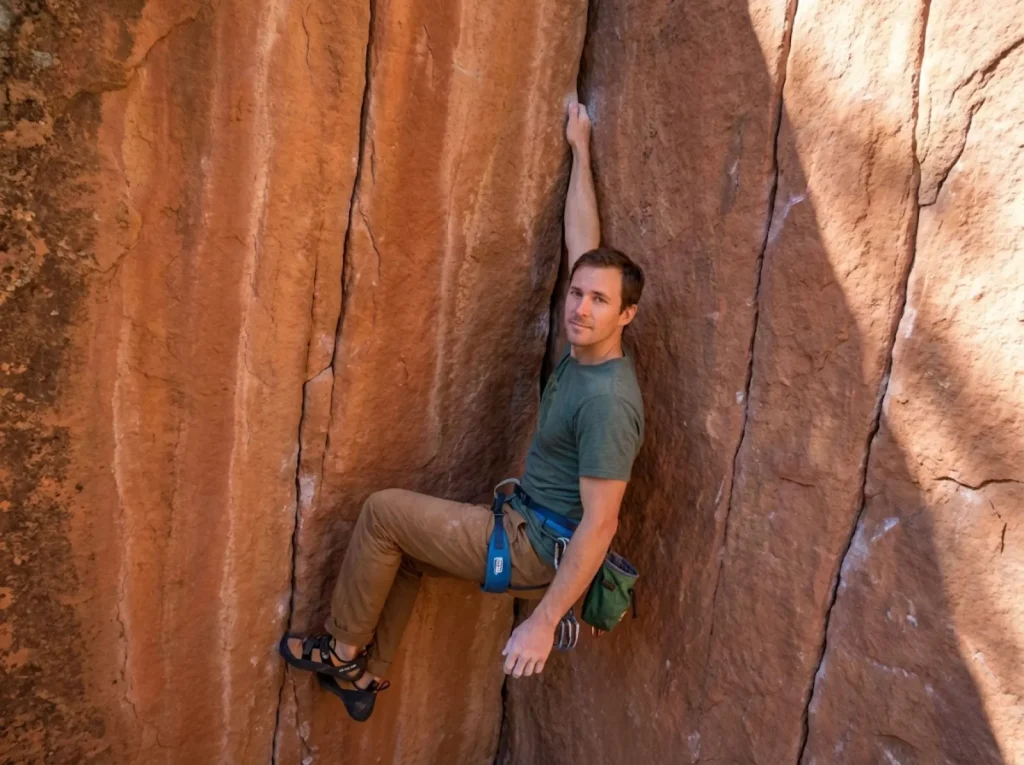
Most people treat crack climbing as wrestling. Stuff your hand in, squeeze hard, pull up. That approach works for about fifteen feet before your forearms inflate like balloons and you’re hanging on the rope wondering what went wrong.
Pete Whittaker—one half of the Wide Boyz and author of the definitive text on crack technique—framed it differently. His philosophy boils down to five rules, and the most important one is this: fill the space efficiently.
“Why use only two fingers on a large crimp when you could use all four?” Whittaker writes. “It’s the same with jamming: why insert only half of your hand when the crack can gobble your hand to wrist depth? Get that body part right in there.”
The most common mistake is performing the jam mechanics—the expansion, the squeeze—before the hand is fully inserted. You end up with poor surface area contact, which means poor friction, which means you grip harder, which means you pump out faster. Insert first, expand second.
Active vs. Passive Jams
This is the single most important concept in movement efficiency for crack climbing. An active jam relies on your muscular force and skeletal rotation to expand the body part against the crack walls—it takes effort to maintain. A passive jam slots behind a naturally occurring constriction and holds with minimal strength.
Always choose passive over active when the option exists. A bottleneck in the crack where your hand slots in and locks is free energy. You can hang there, shake out, place gear, and breathe—while your partner pumped out twenty feet below doing active jams the entire way.
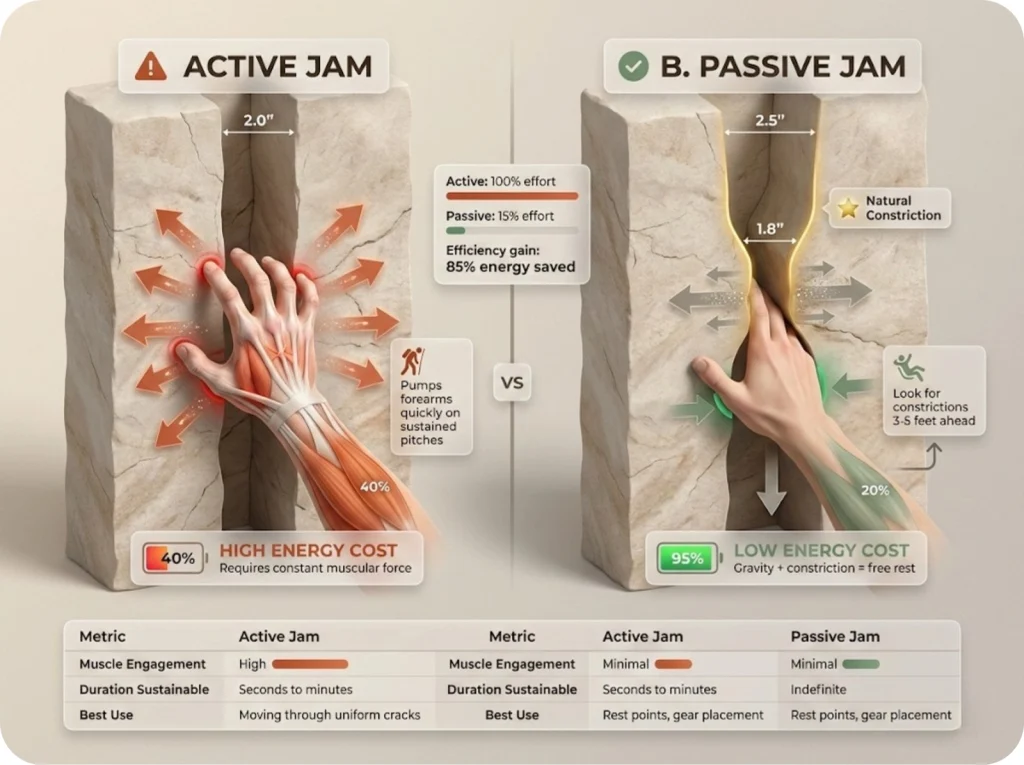
Pro tip: Look for constrictions in the rock 3–5 feet ahead of your current position. Slotting a jam behind one creates a passive rest that saves significant energy on sustained pitches.
Limb Alignment and the Ladder Analogy
Keep your limbs parallel to the crack walls. Elbows down, knees up. Twisting outward wastes energy and reduces jam stability—like climbing a ladder with your arms crossed.
Whittaker puts it bluntly: “If it’s painful, you’re probably doing it wrong. Ok yes, it might feel a little uncomfortable or abnormal to begin with, but like anything you adapt and get used to it. But pain? Definitely not.”
The test for correct alignment is simple: can you hang off the jam with barely any effort? If yes, your skeleton is doing the work, not your muscles. That’s the goal—structure not strength. If you’re tight-gripping inside the crack, something’s off with your body positioning or insertion depth.
Finger Cracks to Fist Cracks — Technique by Size
Finger Jams and Ringlocks (Tips to 1″)
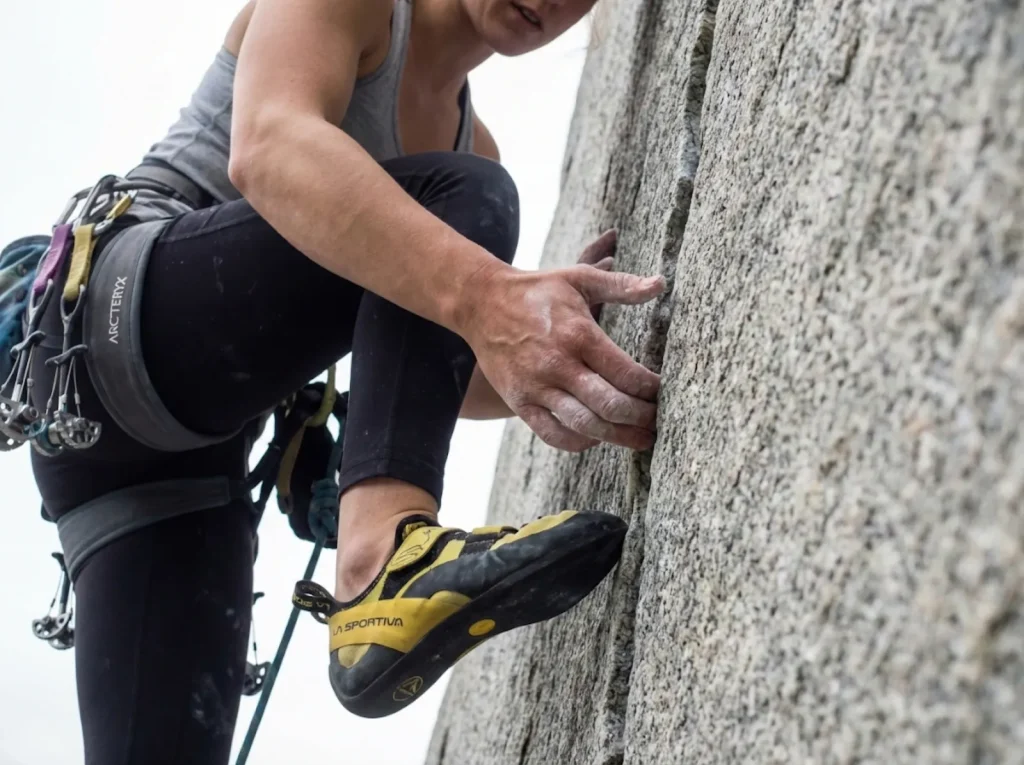
Tips cracks—anything under half an inch—demand first-knuckle precision. You’re working with almost nothing, and the margin between a secure lock and a greaser is measured in millimeters. Protect these with micro cams in the 7.5mm to 28mm range.
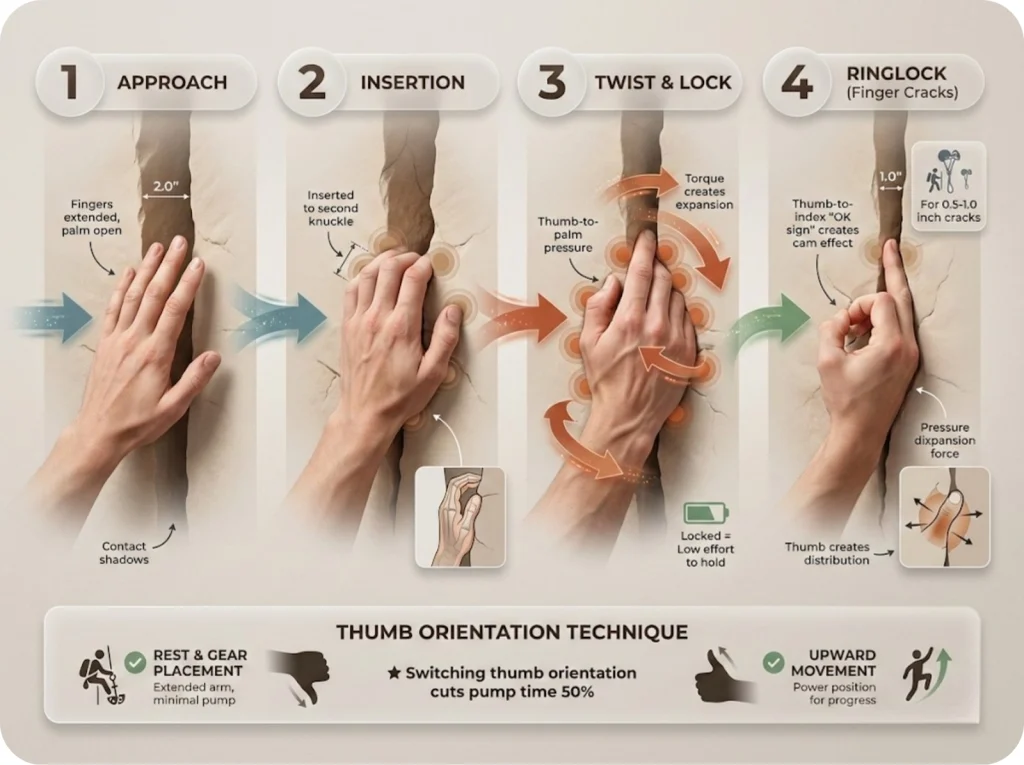
In proper finger cracks (0.5″ to 1.0″), insert to the second or third knuckle and apply torque—a rotational twist that locks your fingers between the walls. The key is twisting before you weight, not after. The ringlock technique takes this further: form an “OK” sign with your index finger and thumb to wedge into thin fissures that nothing else fits.
Pro tip: If the crack veers to the right, lead with your right hand in a thumbs-down position to maximize security and reach. Mirror this for left-veering cracks.
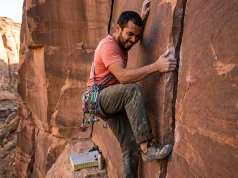
Hand Jams — Thin, Perfect, and Wide (1.1″–3.0″)
Thin hands (1.1″–1.5″) are the most technically demanding hand size. Cup your hand, squeeze the meat of the thumb against your palm, and fight for every inch. These go with a Camalot #0.75 or #1.
Perfect hands (1.75″–2.25″) are the sweet spot—a bomber hand jam that every crack climber lives for. Thumb-to-palm expansion creates a locked fit. This is where the Camalot #2 lives, and it’s the most secure jam in the entire taxonomy.
Wide hands (2.5″–3.0″) feel rattly. Your hand doesn’t quite fill the space, so you need rotation to create grip. These take a #3 and a willingness to trust something that never quite feels locked.
Thumb orientation matters more than most climbers realize. Rest and place gear on a fully extended arm using a thumbs-down jam, then move upward using a thumbs-up jam. This thumb-switching technique alone can cut your pump time in half on sustained climbing.
Fist Jams (3.5″–4.5″)
Clench your fist inside the crack, thumb tucked over your fingers, and let the expansion create opposition against the walls. Protected with a Camalot #4—the widest standard single-jam crack.
The difference between a rattly fist and a locked one is something you learn through mileage. The key mistake most climbers make is clenching too hard and burning out their forearms. Use just enough force to maintain contact. If you’re white-knuckling it, you’re doing too much.
Knowing how to clean and maintain your trad gear will keep your cams firing smoothly in these placements, especially after sandy Indian Creek sessions.
Off-Width and the Dark Arts (5″ and Beyond)
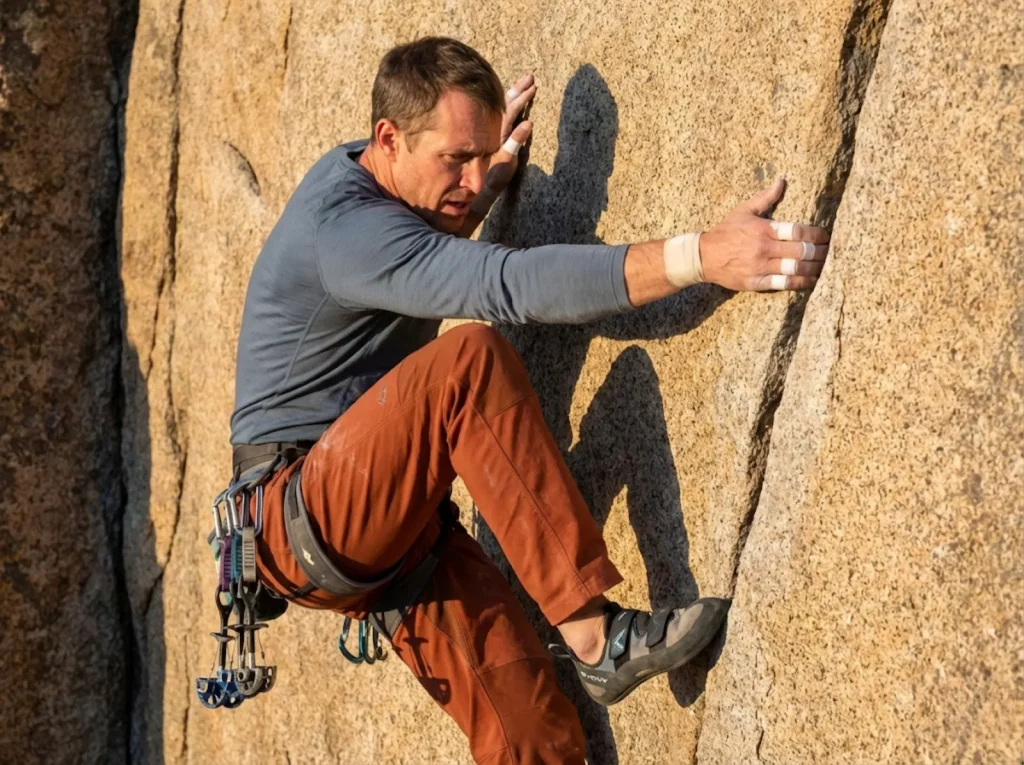
Off-width is the size every climber quietly hopes they’ll never encounter—too wide for a fist, too narrow for a chimney. Beth Rodden said it best: “Crack climbing was the most painful thing I had ever tried. Didn’t sticking human extremities into solid rock and hanging body weight on them go against everything moms teach you?”
Heel-Toe Jams and Arm Bars
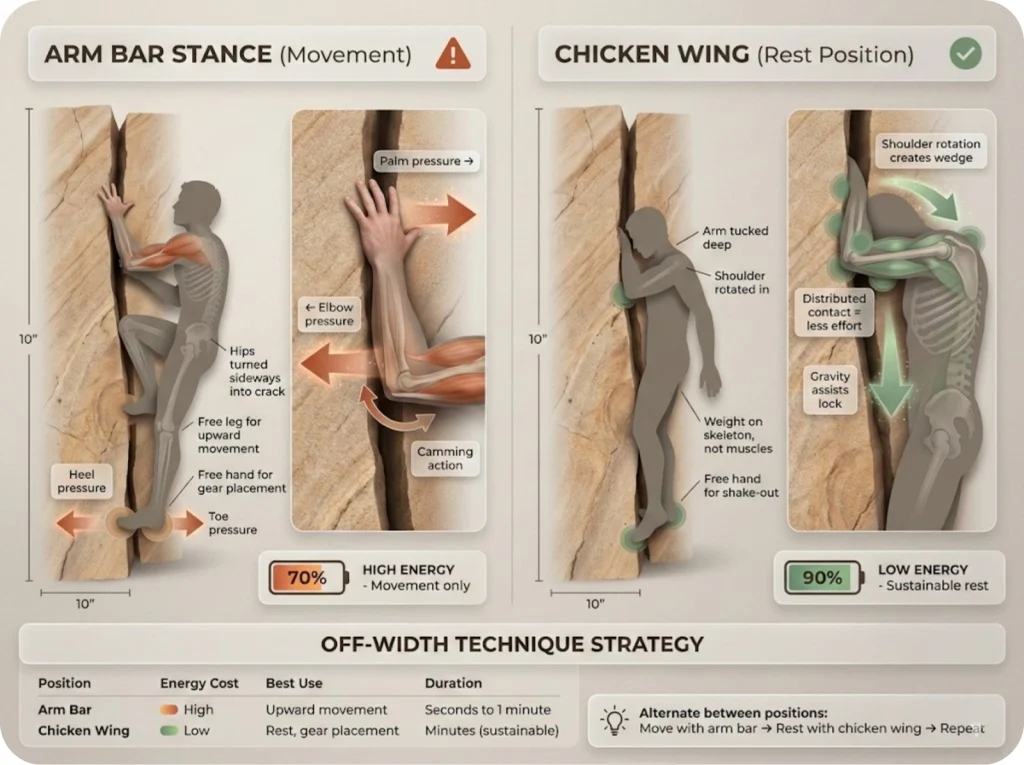
The heel-toe jam is your best friend in an off-width. Lock your foot across the crack—heel pressing one wall, toe pressing the other—and suddenly you have a solid rest platform where none existed.
For widths between 8 and 12 inches, the arm bar takes over: palm pushes one way, elbow pushes the other, creating a camming action with your entire arm. It’s exhausting for movement but necessary. For resting, switch to a chicken wing—tuck your arm deeper into the crack and use shoulder rotation to hold position with less effort.
Off-width demands a full toolbox: hand-fist stacks, fist-fist stacks, and T-stacks for varying widths. Pete Whittaker’s “Monster Cracks” required quadruple racks of cams—up to 46 units for a single pitch. The Wide Boyz trained for exactly two years on a wooden cellar replica before attempting Century Crack, graded 8c in the UK system. That’s the commitment this size demands.
When packing for a climbing trip, off-width protection means doubling or tripling your large cams—a reality that changes your budget and your back weight.
Reading Variable Cracks — When the Width Won’t Stay Put
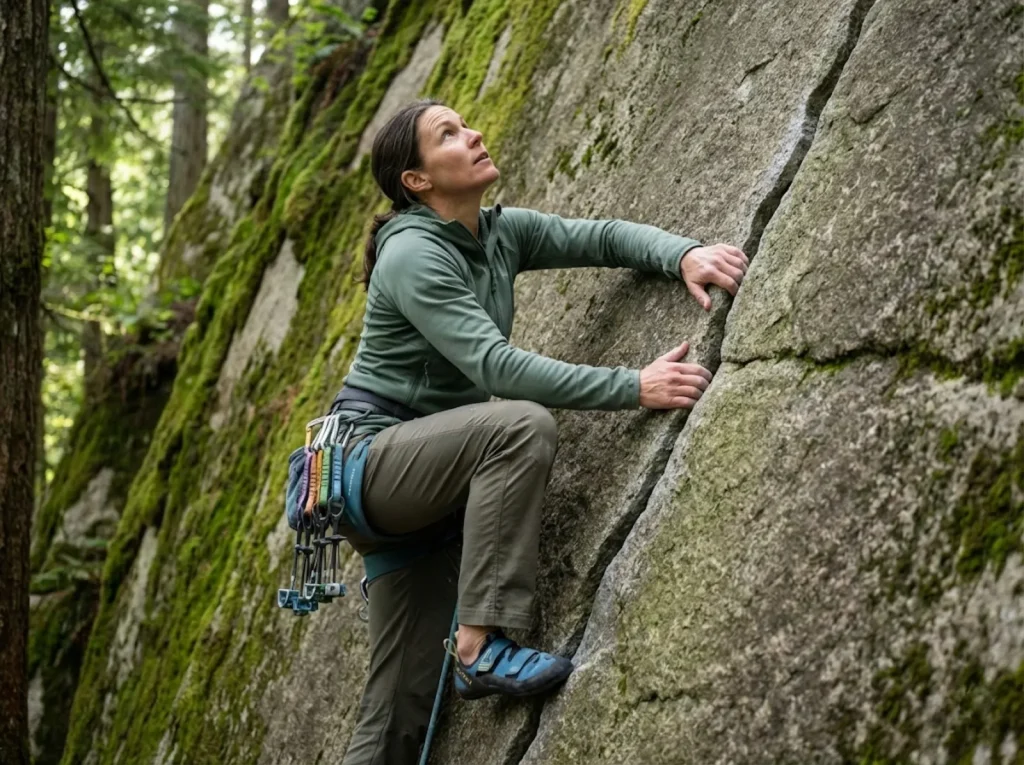
Most crack climbing guides assume you’re working a splitter—a perfectly parallel, clean fissure that stays one width from bottom to top. Real rock rarely cooperates.
Constriction Hunting
In a variable crack, your primary goal is identifying passive rests—those bottleneck constrictions where a jam requires the least energy. Scan 3–5 feet ahead, note where the crack narrows, and plan your sequence to rest at those points rather than fighting through them.
This is the real-time assessment methodology that separates experienced crack climbers from beginners: reading crack sizes as a continuous process, not a one-time measurement at the base.
Adapting Technique Mid-Pitch
Routes like “Shapeshifter” in Squamish and “West Crack” in Eldorado Canyon exemplify this challenge. A single pitch might start with an off-width arm bar and transition into tight finger locks within twenty feet. You might leave the ground with a #4 and finish on a #0.5.
The key mental skill is recognizing when to abandon one technique and switch to another without hesitation. That “toolbox” mindset replaces the panic of feeling your current jam become useless as the crack widens or narrows around you.
Gear racking strategy matters here too. If you’re expecting a variable crack, carry traditional protection in multiple sizes—doubles or triples in the most common ranges. The standard rack for Indian Creek’s splitter cracks might look uniform, but most real-world crags demand a spread across sizes.
The Gear-to-Crack Correlation Matrix
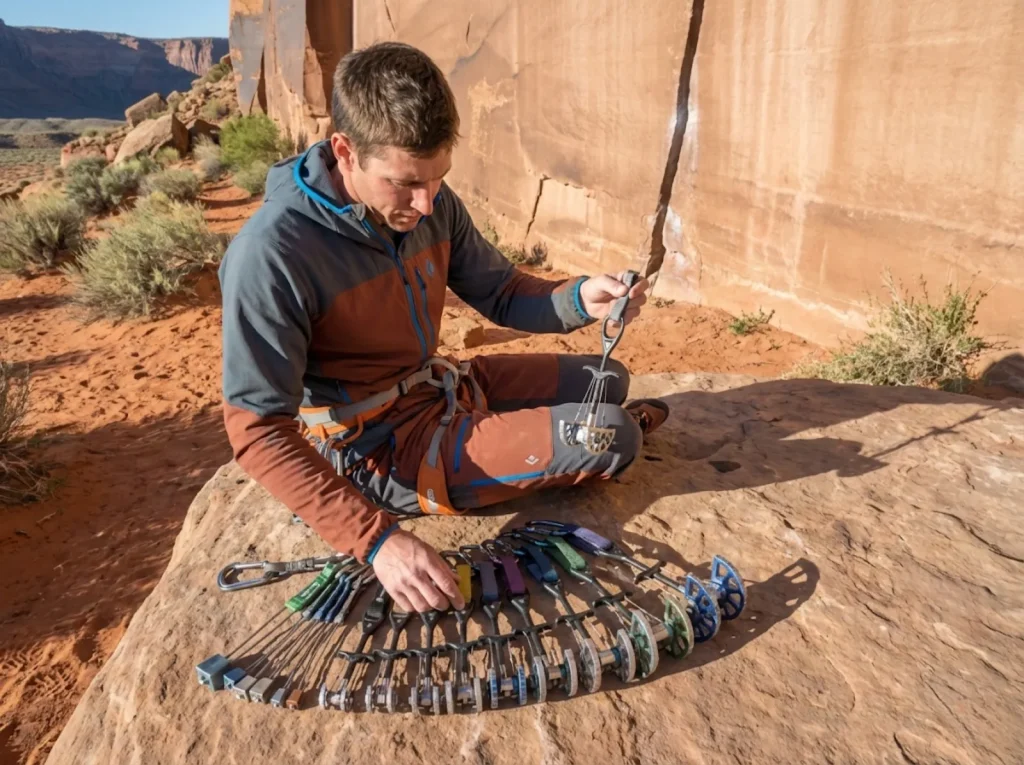
Standard Rack Mapping (Black Diamond Camalot C4)
Here’s the correlation stripped down to what you actually need:
- Tips (#0.2/#0.3): First knuckle, high precision, protected by micro cams in the 7.5–28mm range
- Fingers (#0.4/#0.5): Ringlocks to second/third knuckle jams
- Thin Hands (#0.75/#1): Cupped hand, squeezed thumb
- Perfect Hands (#2): Thumb-to-palm expansion, most secure and versatile
- Wide Hands (#3): Rattly jams requiring rotation
- Fists (#4): Clenched fist, thumb-over
In smaller sizes, head width matters. Narrower cam heads fit better in pin scars or uneven widenings where a fat-headed cam won’t seat properly.
Cam Brand Performance Comparison
The Camalot C4 (14kN strength) is the versatile standard. Wild Country Friends fit slightly wider for the same number. Totem Cams (9–13kN) shine in marginal, flaring, or uneven cracks where other cams walk. Black Diamond Ultralights (10–12kN) save weight on long routes but trade some security for grams.
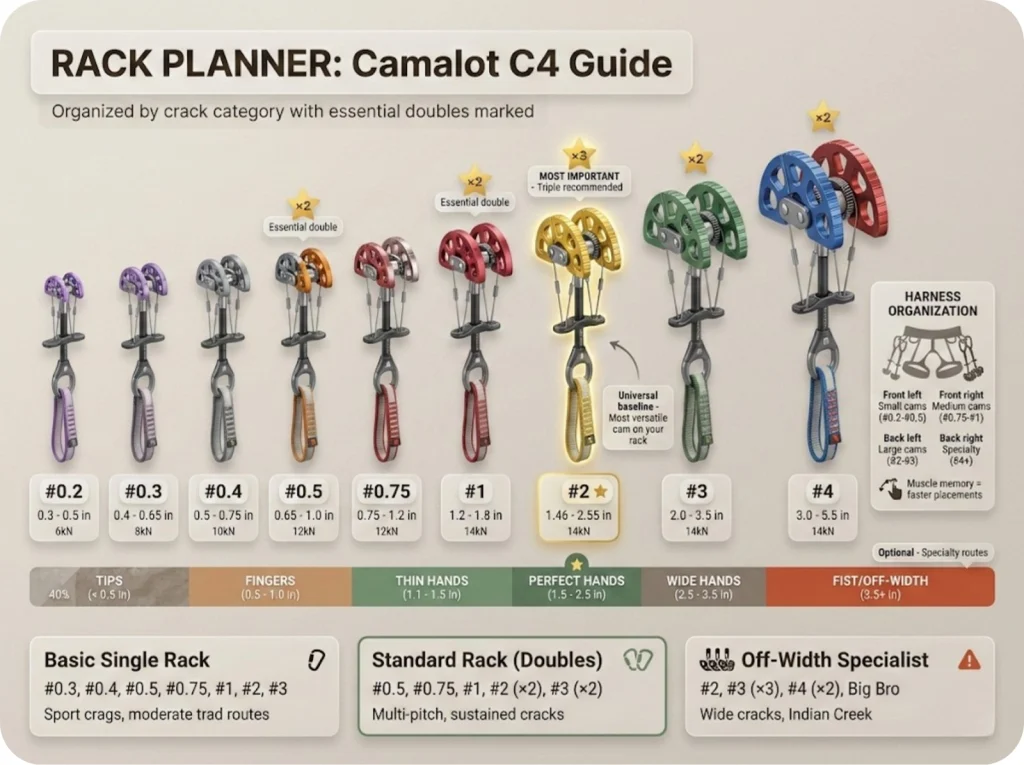
Organizing your harness gear loops so you can grab the right cam fast makes a real difference when your forearms are screaming ten feet above your last piece.
Skin, Tape, and the Pain You Can Actually Control
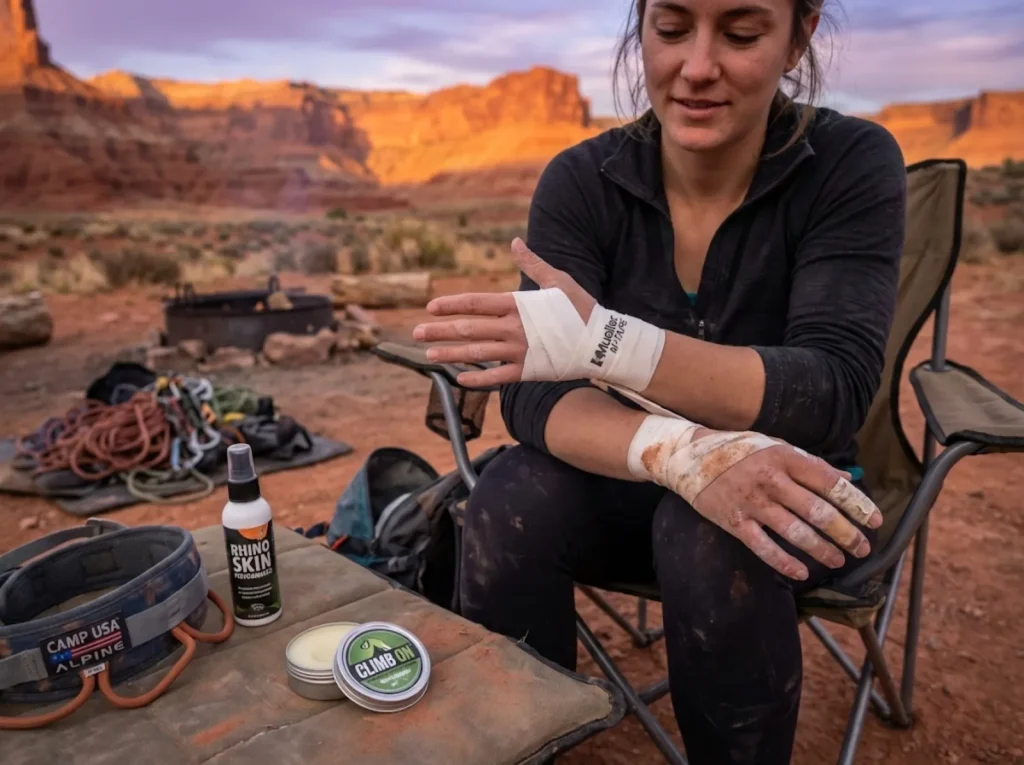
Building Tape Gloves That Last
A tape glove is a custom-built protective layer made from athletic tape. It shields the back of your hand from what experienced climbers call a skin ripper—the raw abrasion of granite or sandstone grinding against your knuckles every time you insert and torque a jam.
The wrong technique wraps too tight, which restricts blood flow and hand expansion—killing your jam quality. The right technique anchors around the wrist, wraps the back of the hand, and leaves the palm and thumb completely mobile for full grip. Practice your taping before you need it.
Skin Care Between Sessions
Professional crack climbers view skin as a finite resource. When you’re “running out of skin” on a multi-day trip, the party is over regardless of how strong you feel. Use products like Rhino Skin or Climb On balm overnight to accelerate repair.
Overuse injuries account for 65% of all reported climbing injuries, with the vast majority affecting fingers, wrists, and elbows. According to Mountain Rescue Association data, one third of climbing accidents occur during descent—but the wear on your skin and tendons from sustained crack pitches adds up long before you clip your rappel device. Managing your hide is injury prevention, not vanity.
Pro tip: Apply skin repair products (Rhino Skin, Climb On) every night during a crack climbing trip. Managing your skin is a skill equal to the climbing itself—run out of skin and you’re done, no matter how strong you feel.
If you’ve already pushed too hard and are dealing with finger pulley pain and recovery, knowing the difference between strain and rupture could save your season.
Conclusion
Three things will change your crack climbing more than anything else.
First, every crack tells you what it wants. Learn to read the crack—scan the width, find the constrictions, match the right jam to the right geometry instead of defaulting to raw strength.
Second, your hands are unique. The “perfect hand” size on a chart isn’t yours until you’ve calibrated it against your own anatomy and your own gear.
Third, structure beats strength. Every single time. A well-aligned passive jam in a constriction will hold longer than any amount of forearm power in a poorly read crack.
Next time you’re at the base of a crack pitch, spend thirty seconds reading the first fifteen feet before you pull on. Scan for constrictions, note where the width shifts, and pick your first three jams before your feet leave the ground. That thirty-second investment changes everything.
FAQ
What size crack is a hand crack in climbing?
A hand crack typically ranges from 1.1 to 3.0 inches, but it breaks into three sub-sizes: thin hands (1.1″–1.5″), perfect hands (1.75″–2.25″), and wide hands (2.5″–3.0″). Your personal perfect hands depends on your hand width—some climbers find bliss in a #1 Camalot crack while others need a #2.
How do you determine crack size for cam placement?
Compare the crack width against your body parts: fingertip-width means tips (#0.2–#0.3), two-finger-width means fingers (#0.4–#0.5), cupped-hand-width is thin to perfect hands (#0.75–#2), and clenched-fist-width is fists (#4). Most experienced climbers size by feel—your hand becomes the reference tool after enough mileage.
What is the hardest crack climbing size?
Off-fingers (between tips and proper fingers) and off-width (too wide for fists, too narrow for chimney) are widely considered the two most difficult sizes. Off-fingers leave nothing to lock against, and off-width demands full-body techniques that feel counterintuitive to anyone trained on face holds.
How does rock type affect crack climbing technique?
Granite offers high, stable friction from quartz crystals—jams bite and hold reliably. Sandstone is feature-rich but can lose up to 78% of its strength when wet, making gear placements unreliable after rain. Always check conditions before climbing sandstone cracks, and give wet rock at least a full day to dry.
Do crack climbing gloves change the crack size I can jam?
Yes. Adding 3–4mm of rubber from crack gloves shifts your effective hand size, potentially turning a perfect hands crack into a thin hands crux. Many experienced climbers tape instead of gloving for this reason, though gloves protect better during the learning phase when technique is less refined.
Safety Notice: Rock climbing and mountaineering are inherently high-risk
activities that can involve physical trauma or fatal incidents. The information on Rock Climbing Realms is for
educational and informational purposes only. Techniques and advice presented here are not a substitute
for professional, hands-on instruction. Conditions and risks vary by location. Always seek guidance
from a qualified instructor before attempting new techniques. By using this website, you agree that you
are solely responsible for your own safety. Any reliance you place on this information is strictly
at your own risk, and you assume all liability for your actions. Rock Climbing Realms and its authors
will not be held liable for any harm, damage, or loss sustained in connection with the use of this information.
Affiliate Disclosure: We are a participant in the Amazon Services LLC Associates Program, an
affiliate advertising program designed to provide a means for us to earn advertising fees by advertising and linking
to Amazon.com. As an Amazon Associate, we earn from qualifying purchases. We are also an official affiliate partner
of Black Diamond Equipment via the AvantLink network. If you click on a Black Diamond affiliate link and make a
purchase, we may earn a commission at no additional cost to you. We also participate in other affiliate programs.
Additional terms are found in the terms of service.