
In this article
Six burns in. Same sequence, same fall, same spot on the same 5.12c. Your forearms are full of battery acid, your fingertips are glassy, and that one crimp hold above the second bolt still feels like it was glued on as a joke. You’re not getting weaker — you’re getting stubborn. And stubbornness, without a plan, is just a fancy word for wasted skin.
Here’s the hard truth most climbers figure out too late: projecting isn’t about trying harder. It’s about trying smarter. After years of wasting burns on routes I had no business attempting — and watching better climbers send harder grades in half the sessions — the pattern became obvious. Every wasted burn is a diagnostic failure, not a strength failure. The difference between sending your goal route in four sessions versus fourteen comes down to a process — a repeatable, phase-driven system that treats your energy and skin like the finite resources they are.
This guide lays out the exact methodology. Four phases, from your first look at the route to clipping the chains on redpoint day. No guesswork, no grinding, no folklore. Just the system.
⚡ Quick Answer: Projecting a sport route efficiently means moving through four distinct phases: (1) scout the route bolt-to-bolt to learn beta and map every hold, (2) chunk the route into sections you can redpoint individually, (3) link those sections through overlapping until you can climb it with zero hangs, and (4) optimize conditions, warm-up, and mental state for the redpoint attempt. Limit your investment to roughly 10 attempts over 4 focused sessions — beyond that, diminishing returns set in and you’re better off training the specific weakness.
Why Most Burns Get Wasted Before You Even Touch the Rock
Choosing the Right Project
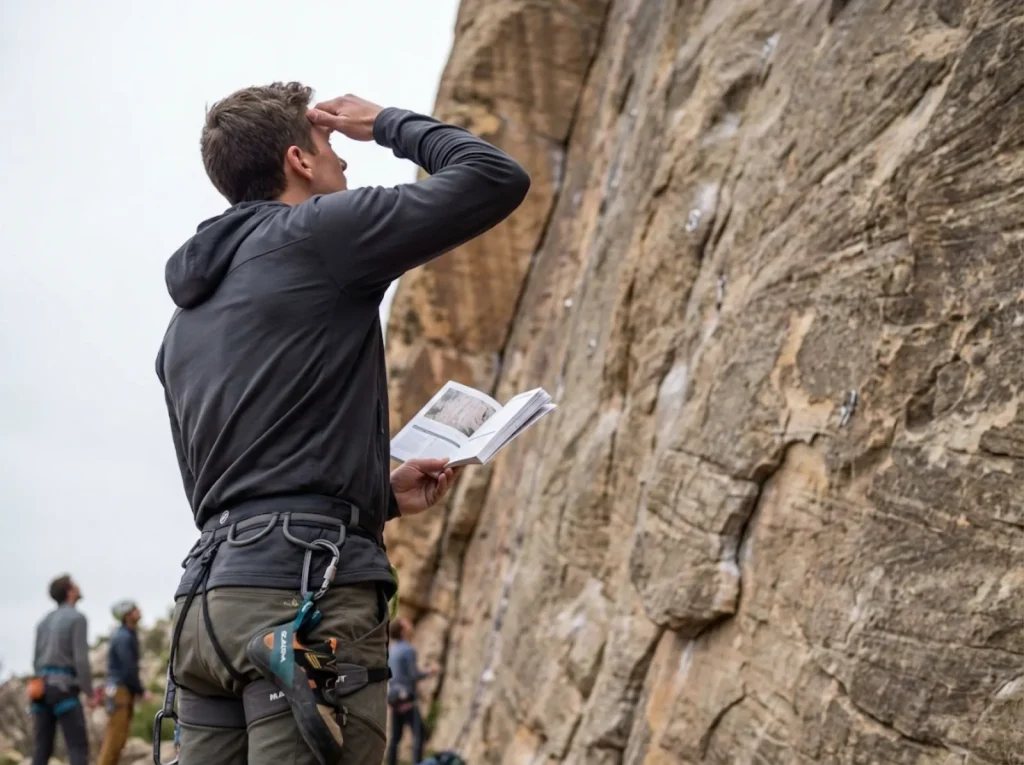
The first burn you waste on a sport route is the one you throw at the wrong project. Picking a route that’s too hard, too stylistically mismatched, or too far beyond your current fitness turns every session into a lottery ticket rather than a productive step forward.
A solid rule: your project should sit within one to two number grades above your most recent clean send. If you just redpointed 5.11c, aim for 5.12a to 5.12c — not 5.13a. Just as important, the style needs to fit. A climber who thrives on steep overhanging routes with big moves and kneebars won’t suddenly excel on a thin, technical slab just because the grade matches.
Eric Hörst’s 80/20 Guideline adds another layer of discipline. Spend roughly 80 percent of your outdoor time on routes you can send in one to three attempts — onsights, flashes, or quick redpoints. Reserve only 20 percent for hard, long-term projecting. The logic is straightforward: sending more routes builds a wider movement vocabulary, maintains confidence, and actually accelerates how fast you close the gap on your project. If you want a detailed breakdown of clean-send tactics, the complete redpoint mastery guide covers the full framework.
Conditions Planning — Dew Point Over Humidity
Most climbers check temperature and humidity before driving to the crag. That’s a start, but it misses the real variable: dew point.
Humidity is relative — it changes based on air temperature. The dew point tells you the absolute amount of water vapor in the atmosphere, and that’s what actually determines friction on rock. When the rock temperature drops below the dew point, condensation forms on holds. They get greasy, your skin slips, and you burn another attempt wondering why your hands won’t stick.
In summer, the best windows often show up late evening, when the rock — heated all day by the sun — stays above the dew point while the air cools. In winter, flip it: climb mid-afternoon when the sun has warmed the wall enough to stay above that threshold. Wind acts as a friction multiplier by wicking moisture from your skin and cooling the rock surface over time. A day with moderate wind, low dew point, and rock temperature just above that dew point is what seasoned projectors call “send temps,” and those conditions make a measurable difference in finger friction.
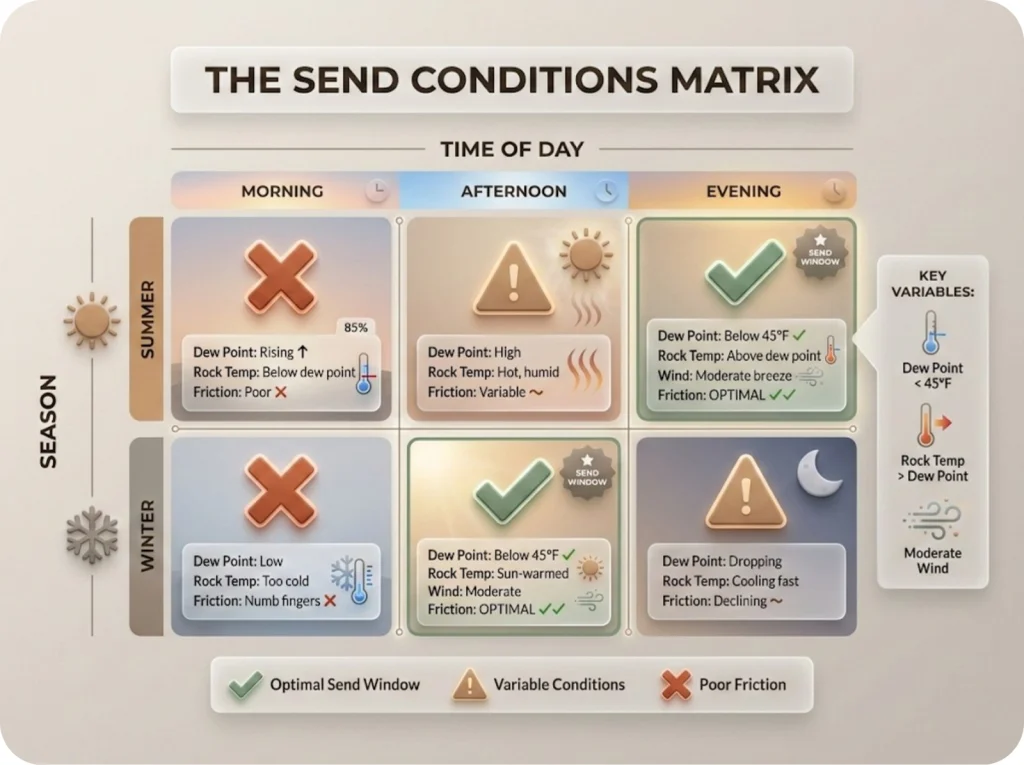
Pro tip: Check the dew point, not the humidity. If the dew point is below 45°F and there’s a breeze, you’ve found a window worth driving for.
Phase 1 — Scout the Route Like You’re Solving a Puzzle
The Bolt-to-Bolt Method
Your first session on a project is not a send attempt. Treat it like reconnaissance.
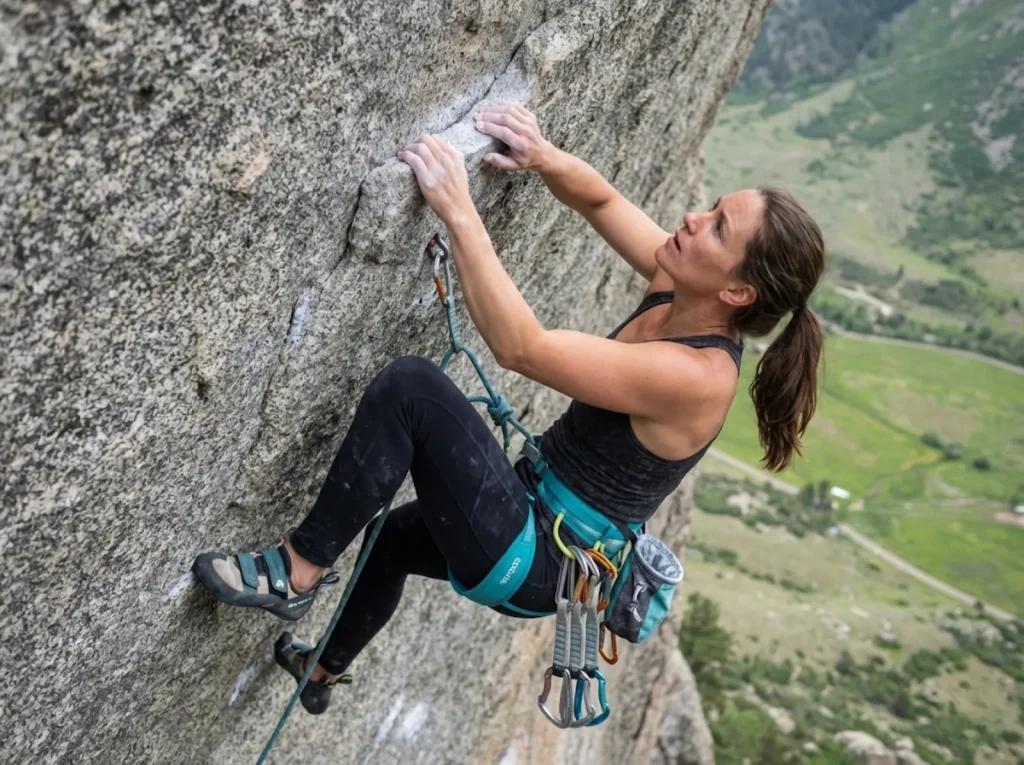
Climb bolt-to-bolt: hang on every quickdraw, inspect every hold, and test sequences without any pressure to link. The goal is to build a complete mental map of the route while conserving energy. Wear a watch — most climbers underestimate how long they spend hanging on the rope, and tracking rest intervals keeps the session productive rather than draining.
One trap to avoid: locking in the first sequence that works. The first beta is almost never the best beta. Commit to testing at least four to six variations on key crux sequences, even the ones that feel counter-intuitive. A beta breakthrough can cut the physical cost of a single move in half, and that savings compounds across the entire route.
Mapping and Documenting Your Beta
Draw the route on paper. Mark every hold, use arrows for pull direction, note foot placements. The physical act of mapping reinforces memory in a way that mental rehearsal alone won’t match.
Then film yourself. Video provides a viewpoint you can’t get while on the wall — hip proximity, arm extension, foot stability, how your gaze tracks between holds. Watch the footage in slow motion and compare it against videos of other successful ascents on the same route. Apps like OnForm or Kinovea let you draw lines over the footage and play attempts side by side to spot exactly where efficiency is breaking down.
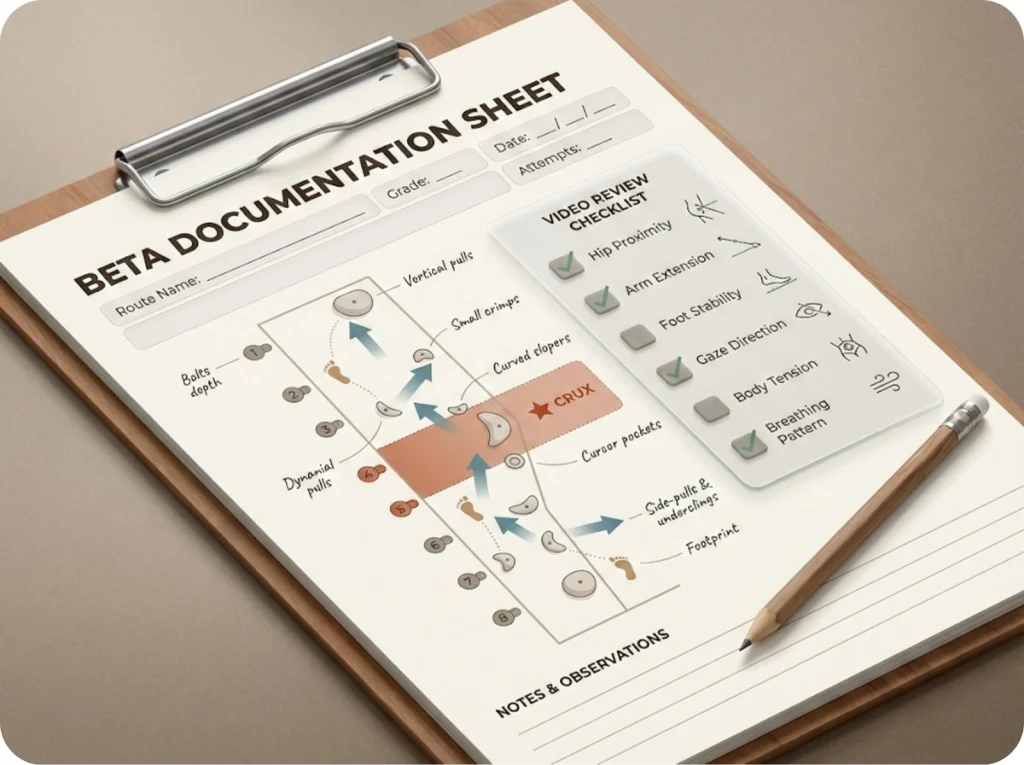
Pro tip: Film from the side, not just from below. A profile view reveals whether your hips are close enough to the wall and whether your weight is actually on your feet during the reaching phase.
Phase 2 — Chunk the Route and Build Small Wins
Breaking the Route into Sections
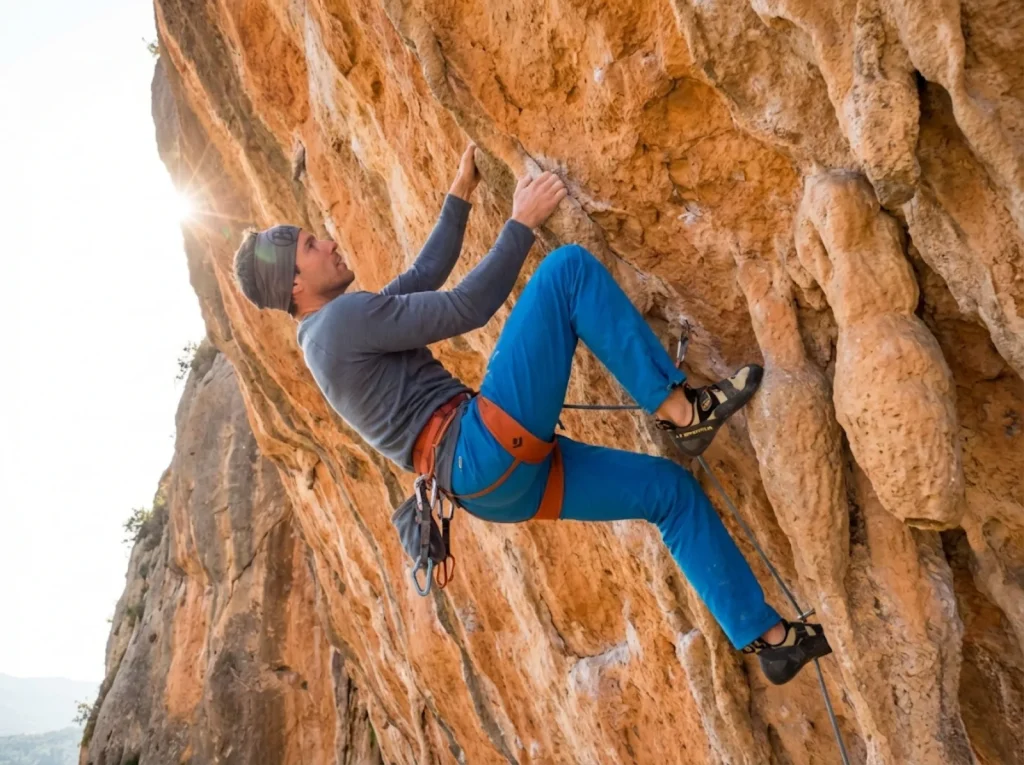
Once you can do every individual move, it’s time to deconstruct the route into pieces. Divide it into three to five logical chunks, separated by the best available rest positions — kneebars, no-hands rests, or the biggest jugs on the wall.
Treat each chunk as a mini-route to redpoint individually. Aim to climb each crux chunk two to three times from the hang without falling before calling it “wired.” This does something critical for your head: it produces a series of small attainable goals that keep your motivation alive. You’re sending something every session, even if you haven’t sent the whole route yet.
Rest Spot Optimization
The moves between cruxes — the technically easy “filler” — can decide how pumped you arrive at the hard sections. Refine your beta on these filler sections the same way you refine the crux. Shave off one extra hand match, find one better foothold, and you arrive at the next difficult sequence with five percent more in the tank.
Resting mid-route is a skill that needs deliberate practice. Learn exactly how long you need to shake at each rest to drop from “pumped” to “recovered.” Count the shakes. On redpoint day, you’ll know precisely when to leave each rest. No guessing, no overshaking, no wasted time with the pump clock running.
Phase 3 — Link the Sections and Escape One-Hang Purgatory
Overlapping — High-Pointing vs. Low-Pointing
Now the real work starts. You’ve wired the individual chunks — time to stitch them together.
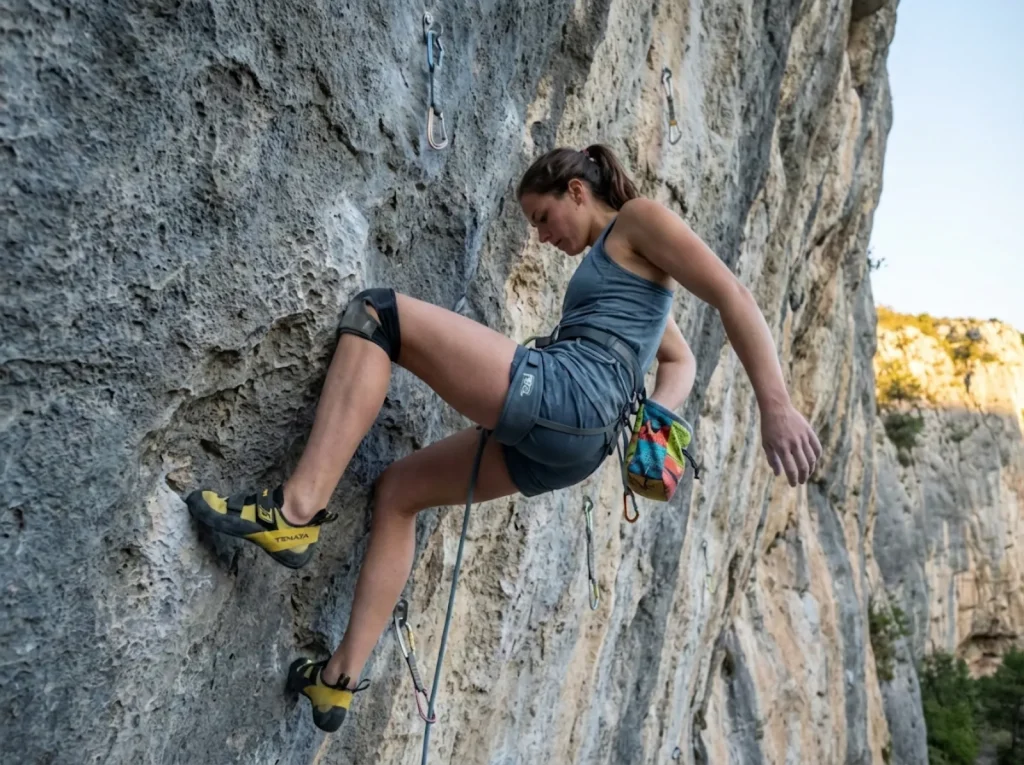
The overlapping technique builds confidence by proving you can execute hard moves while fatigued, not just fresh. Start at a rest position, climb through the crux to the next rest. Once that’s consistent, start from a lower point and overlap through the same section. Each successful overlap extends your proven range on the route.
Low-pointing — starting from the top and working down — is even more powerful. Begin from the third-to-last bolt, climb to the anchors. Then start from the fourth-to-last. Then the fifth. This ensures the final section of the route, which you’ll climb in maximum fatigue during the redpoint, is the most rehearsed section of all. Dan Mirsky’s framework puts it bluntly: overlapping exists to build proof that you can do the moves tired.
Efficient movement through moderate terrain matters as much as raw power on cruxes. If your flagging and drop-knee technique is sloppy on the easy sections, you’ll bleed energy before you even reach the hard part.
Breaking Out of One-Hang Purgatory
The “one hang” — climbing the entire route with just one fall — is a sign you’re close. It can also become a mental trap. If you consistently fall at the same spot for two or more sessions, the cycle has to break.
Ask three questions. Is the beta optimal? Is there a strength deficit? Is the mental game cracking at the crux? If progress regresses over two consecutive sessions, your body likely needs a deload period or a short, targeted training block before the send is possible.
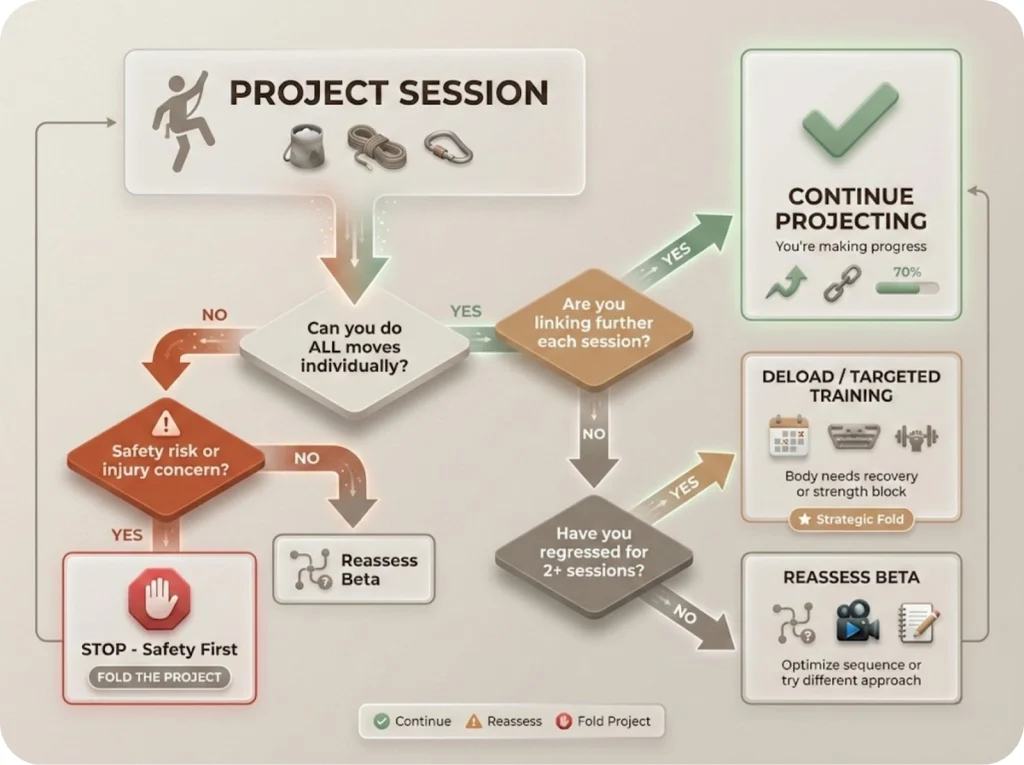
This is where Exit Criteria come in — a concept from Power Company Climbing that treats projecting like a disciplined performance trial, not an open-ended obsession. Set objective conditions for folding: safety risk, no progress by session three, regression over two sessions, or repeated failure on a high-variance move. Folding isn’t quitting — it’s strategic resource allocation.
Phase 4 — Optimize Everything for Redpoint Day
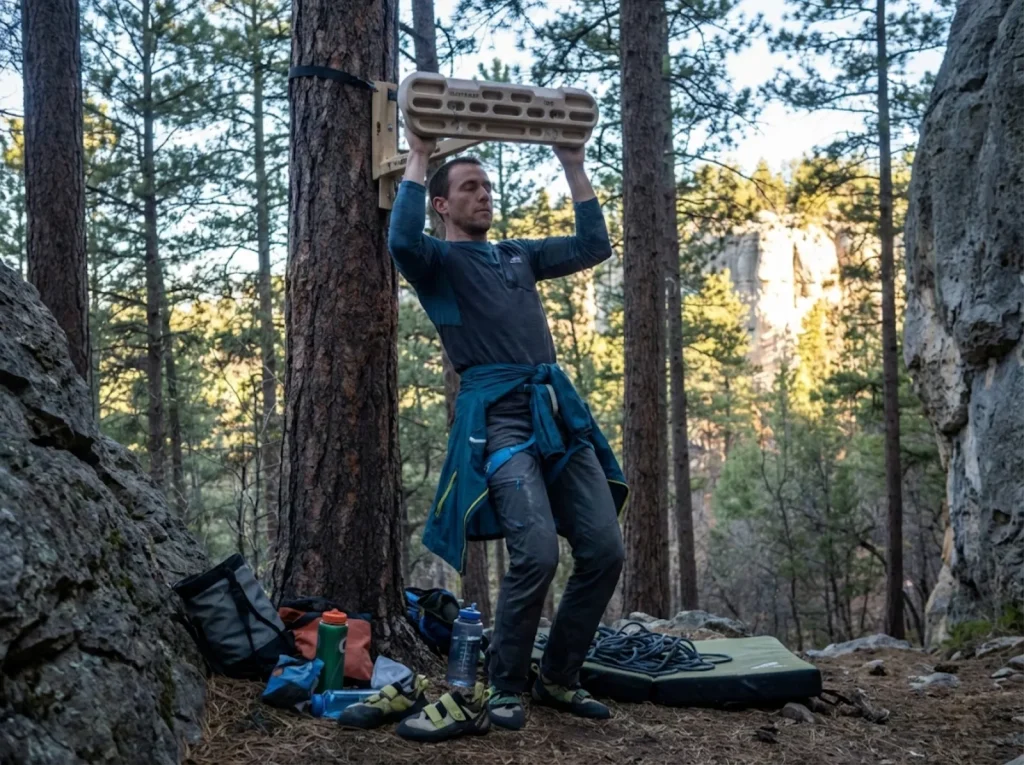
The Warm-Up That Actually Matters
A bad warm-up will waste a perfectly good burn. Your energy systems need to be fully online before you pull onto your project.
Here’s the protocol. Start with progressive finger recruitment on a portable hangboard — increasingly strenuous dead hangs to wake up the tendons and flexors. Follow that with mobility activation: shoulder circles, leg kicks, push-ups to fire up the muscles around your shoulder blades. Finish with a tactical priming lap — one moderately strenuous route or a bolt-to-bolt run to produce a light pump without triggering a catastrophic flash pump. The full warm-up sequence for sport climbing walks through every step.
The 10-4 Rule — Your Burn Budget
Eric Hörst’s 10-4 Rule puts a hard cap on your investment: limit a single project to ten redpoint attempts over four days of effort. The efficiency gains from repeated attempts tend to level off between the third and tenth burn. Beyond ten, most non-elite climbers stop learning new patterns and obsessively repeat the same narrow set of movements — what coaches call “stunted growth.”
If you haven’t sent it in ten, step back. Climb volume. Build a broader skill base. Then come back. If you’re not sure where the weakness lives, a data-backed climbing assessment can pinpoint exactly what to target.
Mental State — Nix the Fear, Climb the Move
On redpoint day, shift from analytical thinking to present-moment execution. This is the entry into flow — where movement becomes automatic and your body does what it’s been trained to do.
Pre-accept the possibility of failure. That radical acceptance eliminates the performance anxiety that leads to over-gripping and wasted energy. Research on climbing performance confirms that self-efficacy and the experience of flow are among the strongest psychological predictors of how hard a climber can send. Focus on one move at a time. Let the redpoint unfold.
Visualization bridges the gap between knowing the beta and trusting your body to execute it. Rehearse the send mentally — make the internal movie vivid, detailed, and bottom-to-top complete. Do this daily when you’re away from the crag. A structured mental training protocol turns this from vague advice into a repeatable practice.
Pro tip: Visualize from the first-person perspective, not the third person. Feel the holds in your hands, the texture under your shoes, the rhythm of your breathing between clips. That’s the movie that translates to the wall.
When the Project Won’t Go — Training Your Way to the Send
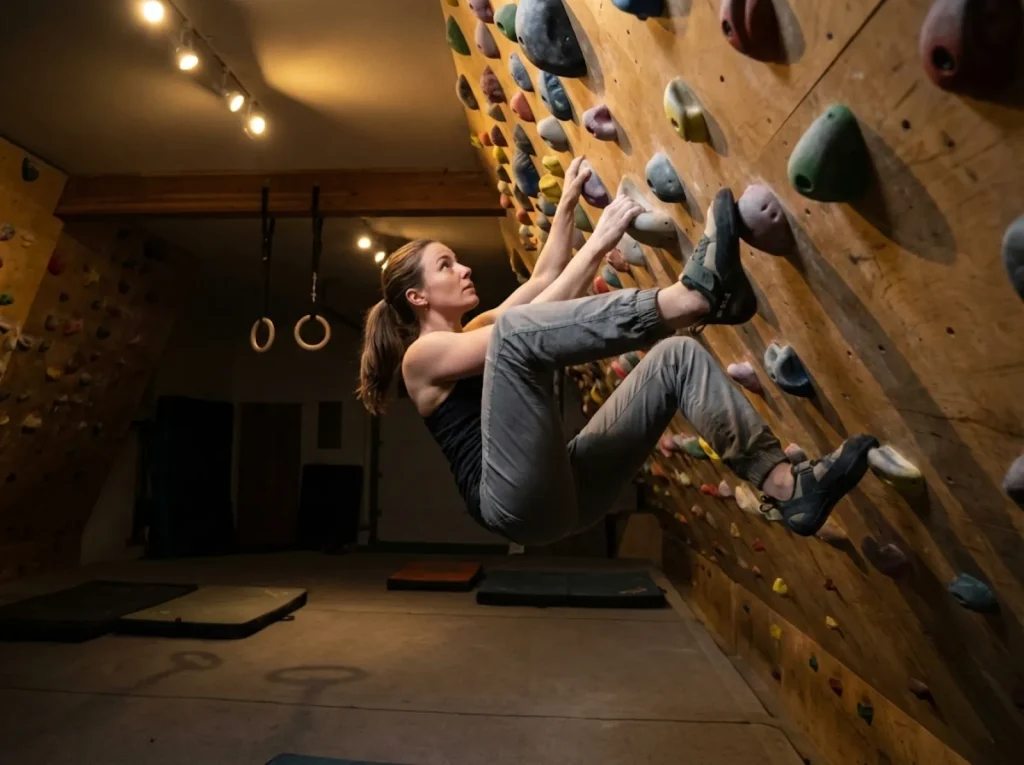
Diagnosing the Deficit — Power vs. Endurance
When tactics and conditions are optimized and the send still won’t come, the limitation is physical. The question is whether the deficit lives in power or endurance.
If you fall on specific moves — the boulder-problem crux — the gap is likely maximal finger strength or how fast you can produce force on small holds. The fix is a Strength/Power/Bouldering (SPB) training block: two sessions per week of limit bouldering or project-specific movements on a spray wall, plus two maintenance endurance sessions. Lattice Training data shows the 7-second maximal hang (as a percentage of body weight) is the single strongest predictor of sport climbing grade. If your hang numbers are low relative to your target grade, more burns on the route won’t close the gap — but structured hangboard training will.
If you fall because the route wears you down — arriving at the final crux with nothing left — the deficit is endurance. The protocol is high-volume submaximal climbing, one to four grades below your limit, three to four days per week. Climb more, not harder.
Building the Project Simulator
Set a “simulator” of your project’s crux at the gym — replicate the hold types, angles, and movement patterns on a spray wall or home board. Practice the hard moves under controlled conditions with no approach fatigue, no weather variables, and no logistics. After a one-month block, take a deload of several days, then return to the project to test your gains. A solid periodization framework keeps that training block structured so you peak at the right time.
The Send Isn’t the Point. The Process Is.
Projecting isn’t about sending one route. It’s about building a system that makes you a better, sharper, more efficient climber across every grade and every style. The four phases — scout, chunk, link, optimize — work because they prevent the two most common forms of wasted energy: climbing without a plan, and grinding past the point of productive returns.
If the send comes in four sessions, celebrate the efficiency. If it takes nine, honor the discipline. And if it doesn’t come in ten? Step back. Train. Climb volume. Come back stronger. Because the skills you build inside this system — reading rock, managing energy, controlling your head under pressure — those translate to every route you’ll ever touch.
Now go find your next project. Pick it wisely. Scout it patiently. And don’t waste a single burn.
FAQ
How many attempts should it take to send a project?
Eric Hörst’s 10-4 Rule recommends limiting investment to ten redpoint attempts spread over four days of effort. Efficiency gains from repeated attempts level off after the third to tenth burn. If you haven’t sent it by ten, step back, train the specific weakness holding you back, and return when the gap is closed.
What grade should my project be?
A good sport climbing project sits within one to two number grades above your most recent clean send. If your best recent redpoint is 5.11c, target 5.12a to 5.12c. The route’s style should match your strengths — or at least expose a weakness you’re motivated to develop.
What is the difference between projecting and redpointing?
Projecting is the entire multi-session process of working a route — scouting, learning beta, chunking, linking moves. Redpointing is the final clean ascent from the ground without falls or hangs on the rope. You project a route in order to redpoint it.
How do I know when to give up on a project?
Use Exit Criteria: if you can’t do all the individual moves by session three, if you regress for two consecutive sessions, or if a low-percentage move keeps failing after three to four honest efforts, it’s time to fold. Folding isn’t failure — it’s the smart allocation of limited time and energy toward a goal that’s currently achievable.
Should I project in the gym or outdoors?
Both. Use gym projects as mini-projects to build the discipline and mental stamina required for outdoor projecting. Practice bolt-to-bolt scouting, working sections, and overlapping indoors where logistics are simple. Then apply the same system on rock, where weather planning, skin management, and real-world conditions add the final layer of complexity.
Safety Notice: Rock climbing and mountaineering are inherently high-risk
activities that can involve physical trauma or fatal incidents. The information on Rock Climbing Realms is for
educational and informational purposes only. Techniques and advice presented here are not a substitute
for professional, hands-on instruction. Conditions and risks vary by location. Always seek guidance
from a qualified instructor before attempting new techniques. By using this website, you agree that you
are solely responsible for your own safety. Any reliance you place on this information is strictly
at your own risk, and you assume all liability for your actions. Rock Climbing Realms and its authors
will not be held liable for any harm, damage, or loss sustained in connection with the use of this information.
Affiliate Disclosure: We are a participant in the Amazon Services LLC Associates Program, an
affiliate advertising program designed to provide a means for us to earn advertising fees by advertising and linking
to Amazon.com. As an Amazon Associate, we earn from qualifying purchases. We are also an official affiliate partner
of Black Diamond Equipment via the AvantLink network. If you click on a Black Diamond affiliate link and make a
purchase, we may earn a commission at no additional cost to you. We also participate in other affiliate programs.
Additional terms are found in the terms of service.