
In this article
You pull into the gravel lot off Highway 9 at 7:45 AM, and two strangers in chalk-dusted hoodies are already arguing about whether The Spoon or Magoo Face is the better warm-up. Before you’ve laced your approach shoes, somebody asks if you need a spotter. That’s Castle Rock State Park — the most aggressively social bouldering destination in Northern California, and the place where Chris Sharma cut his teeth before the rest of the world learned his name.
I’ve been driving up Skyline Boulevard to these sandstone boulders for years, and I still make the same mistake: showing up without checking the weather station, only to find the rock sweating. This guide covers everything you need before making the drive — the Vaqueros sandstone rules that will save you from snapping holds off the wall, sector-by-sector beta so you don’t waste your session wandering, the parking and fees situation, and the gear strategy that keeps your ankles intact on these rounded top-outs.
⚡ Quick Answer: Castle Rock State Park in the Santa Cruz Mountains near Saratoga offers 378+ boulder problems on unique tafoni-sculpted sandstone, ranging from V0 to V12. Entry costs $10 per vehicle at the Kirkwood Entrance (6 AM to sunset). The rock demands a strict 48-72 hour drying period after rain — climb wet, and you’ll snap holds permanently. There is zero cell service, dogs are banned, and vehicle break-ins are a real concern. October through May gives you the best friction.
| Park Information | |
|---|---|
| Detail | Info |
| Park Fee | $10 per vehicle ($9 seniors) |
| Hours | 6:00 AM – Sunset |
| Rock Type | Vaqueros Sandstone |
| Grade Range | V0 – V12 |
| Total Problems | ~378 (Castle Rock + Sanborn) |
| Rain Rule | 48–72 hours minimum |
| Cell Service | NONE |
| Dogs | Prohibited |
What Makes Castle Rock Sandstone Different (And Why You Should Care)
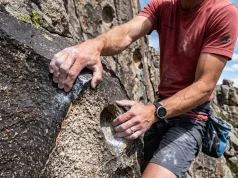
Tafoni Pockets, Huecos, and What the Rock Gives You
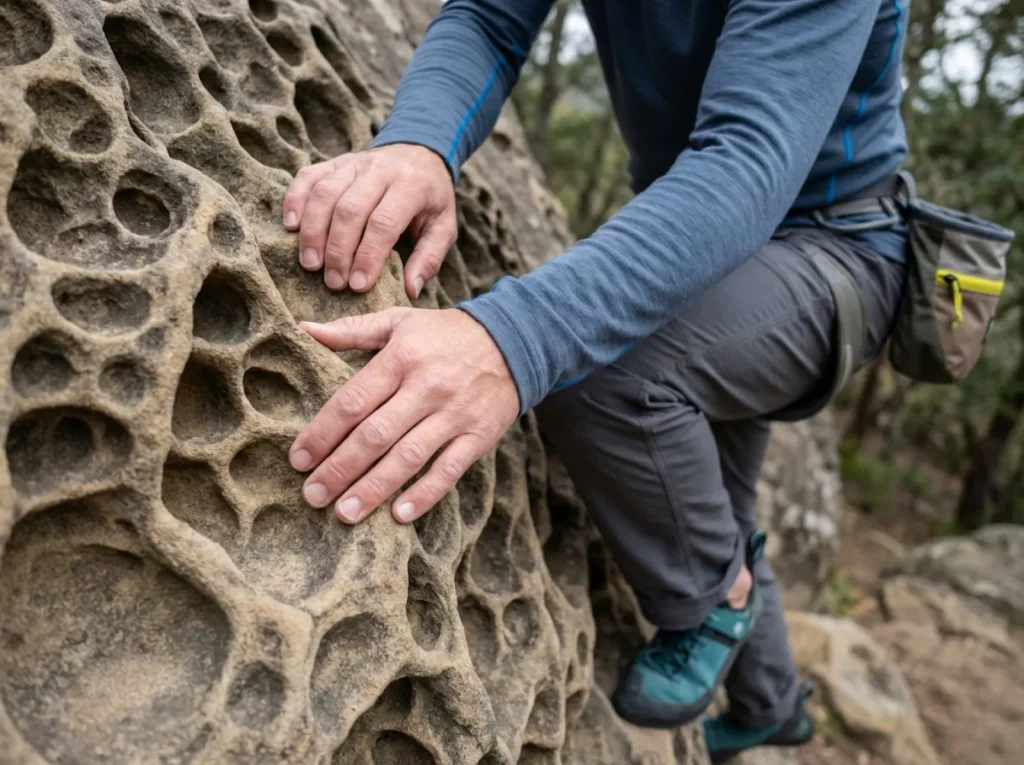
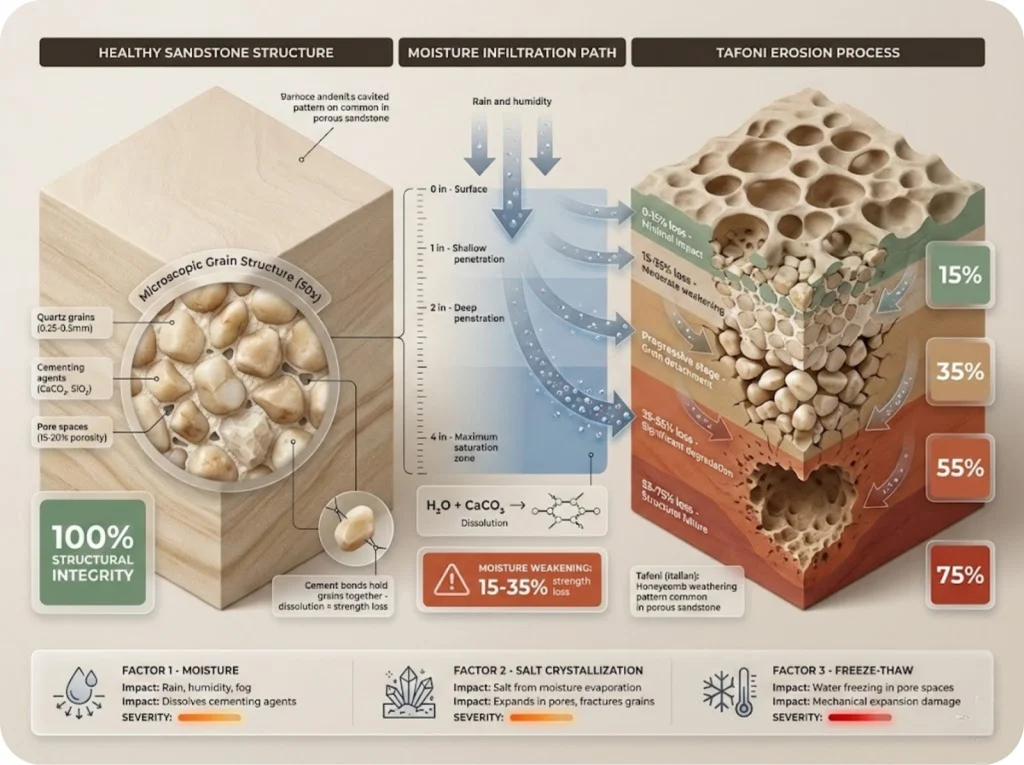
Vaqueros sandstone is not granite. It’s a sedimentary formation held together by silica and calcium carbonate — cementing agents, not crystalline bonds. That distinction matters because it shapes every hold you’ll touch and every climbing decision you’ll make on this rock.
The tafoni weathering is what makes Castle Rock look like no other climbing area in California. Honeycomb caves, sculpted arêtes, and deep huecos create a hold vocabulary that’s part jug-ladder, part friction-puzzle. The tafoni pockets give you holds that feel almost organic — positive where granite would be slick, textured where limestone would be polished.
But sandstone is moody. At 50°F on a winter morning, this rock feels like velcro. Above 90°F in summer, your hands slide off the same holds you crushed a month earlier. Temperature shifts how grippy this stone feels more than almost any other rock type in the Bay Area.
The 48-Hour Rain Rule (And the Soil Test That Proves It)
Here’s the thing that separates locals from visitors at Castle Rock: the rain rule.
Sandstone loses 15% to 75% of its strength when saturated. Moisture gets into the porous grain structure and weakens the bonds that hold the grains together. When you pull hard on a damp hold, you’re not testing your grip strength — you’re testing the rock’s will to stay in one piece.
High-profile problems like Donkey Dong have suffered permanent hold breakage from climbers ignoring drying periods. The community enforces a strict minimum of 48 hours after rain, and 72 hours after heavy storms. This isn’t a suggestion — it’s how you keep Castle Rock climbing alive for the next generation.
Before you start pulling on holds, try the soil test. Scrape away the top layer of dirt at the base of a route. If it’s dry and powdery to a depth of two inches, the rock core has likely reached safe moisture equilibrium. You can also check the AV151 weather station data at wetrockpolice.com/castlerock for real-time moisture and temperature readings specific to the Castle Rock ridge.
Pro tip: Bookmark wetrockpolice.com/castlerock on your phone before you lose signal. It’s the single most useful pre-trip resource, and it’ll save you a wasted two-hour drive on a day when the stone is still sweating.
If you want to understand the wet rock rule and why sandstone demands patience on a deeper level, the same physics apply at every porous crag in the American West. Respect California State Parks climbing regulations at Castle Rock — they exist because the alternative is losing classic lines permanently.
Chalk, Brushing, and the Polishing Problem
Excess chalk is a problem on sandstone that granite climbers rarely think about. Chalk buildup on porous stone “polishes” the surface, reducing friction for every climber who follows you. Over time, popular holds become noticeably slicker.
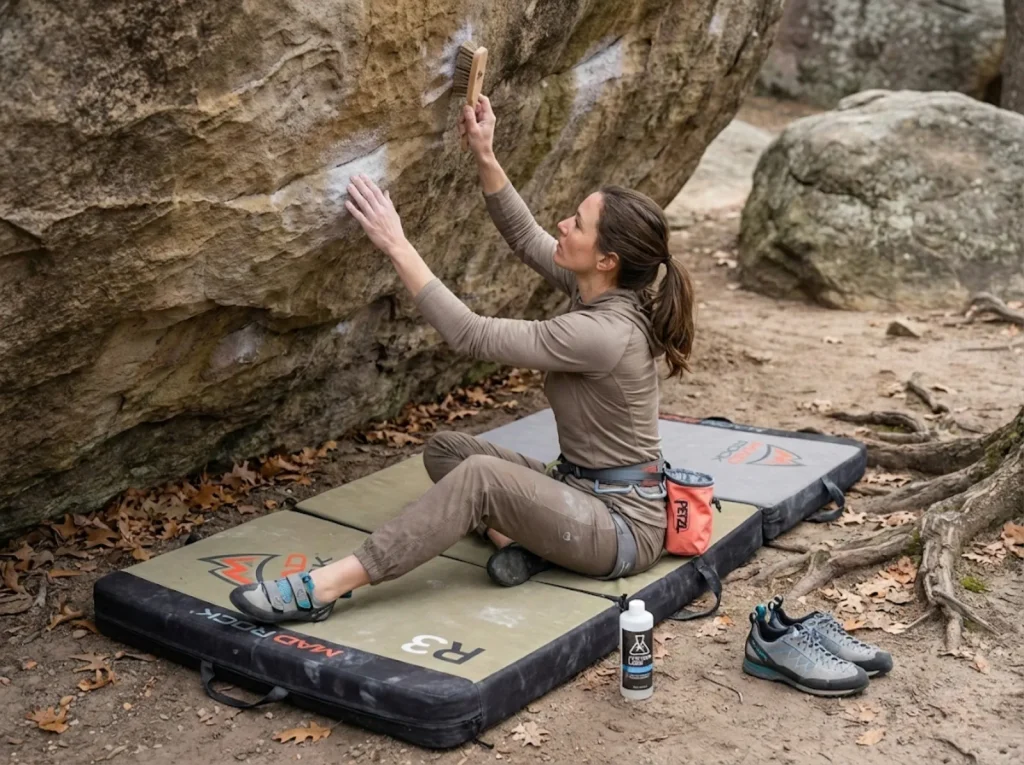
Use only boar’s hair brushes at Castle Rock. Wire brushes and nylon bristles damage the soft grain structure. Liquid chalk leaves less residue than block chalk on porous stone, so if you’re choosing between formats, go liquid.
Learn proper hold-brushing technique for sandstone and make it a habit. Spend 30 seconds cleaning your project’s holds before and after your session. The locals notice. It’s the fastest way to earn trust at the parking lot.
Planning Your Visit — Fees, Hours, and the Things Nobody Warns You About
Parking, Fees, and Gate Logistics
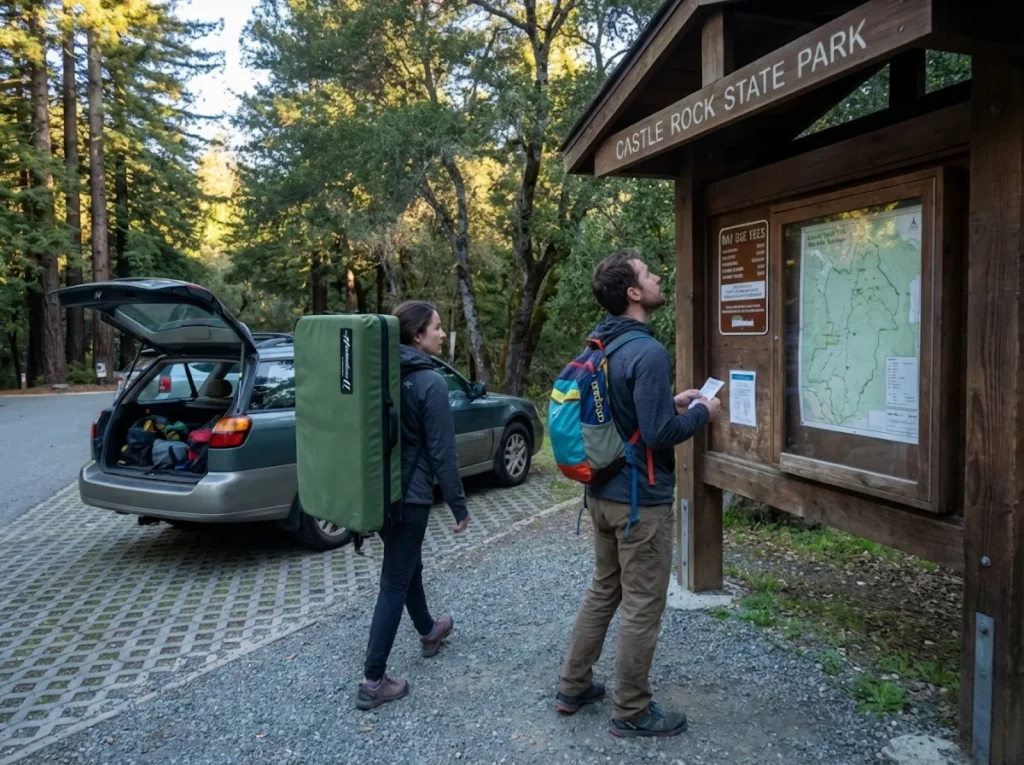
The primary entrance is the Robert C. Kirkwood Entrance on Highway 35 (Skyline Blvd) — modern amenities, permeable paving, native garden. Day use costs $10 per vehicle ($9 for seniors), and California State Park annual passes (Explorer, Poppy, etc.) are all accepted.
Park hours run 6:00 AM to sunset for day use. But the Kirkwood gate locks at dark — if you overstay, your car gets locked inside. Plan your exit before your last send attempt.
One of the most common first-timer mistakes is the “Old Parking Lot” versus “Main Parking Lot” confusion. Park at the wrong one, and you’re facing a mile-long road walk with crash pads on your back. Arrive before 9 AM on weekends, or budget 30 minutes of circling.
The Cell Service Problem (And Your Rideshare Exit Strategy)
There is zero cell reception within the park. None on the surrounding ridge. None along most of Highway 9. This means Uber, Lyft, and any app-based service is dead the moment you pass through the gate.
If you’re climbing solo, tell someone your plan and expected return time. Download trail maps and screenshot any route beta before you lose signal.
Pro tip: Save the number for Saratoga Taxi before you leave the city. It’s the only traditional car service that covers the Highway 9 corridor. When your phone is a brick inside the park, that pre-saved number is your only backup plan.
What’s Banned and Why
Dogs are prohibited on all trails and bouldering areas — no exceptions. Drones are strictly banned. Climbing is forbidden in the San Lorenzo Headwaters Natural Preserve to protect sensitive ecological resources. And bolt placement or replacement requires explicit park approval.
These rules exist because Castle Rock State Park sits in one of the most ecologically sensitive coastal mountain zones in California. The climbing community’s access depends on proving that boulderers can coexist with the ecosystem.
Sector-by-Sector Beta — Where to Climb Based on Your Grade
The Magoos and Castle Rock Loop (V0-V6 Core)
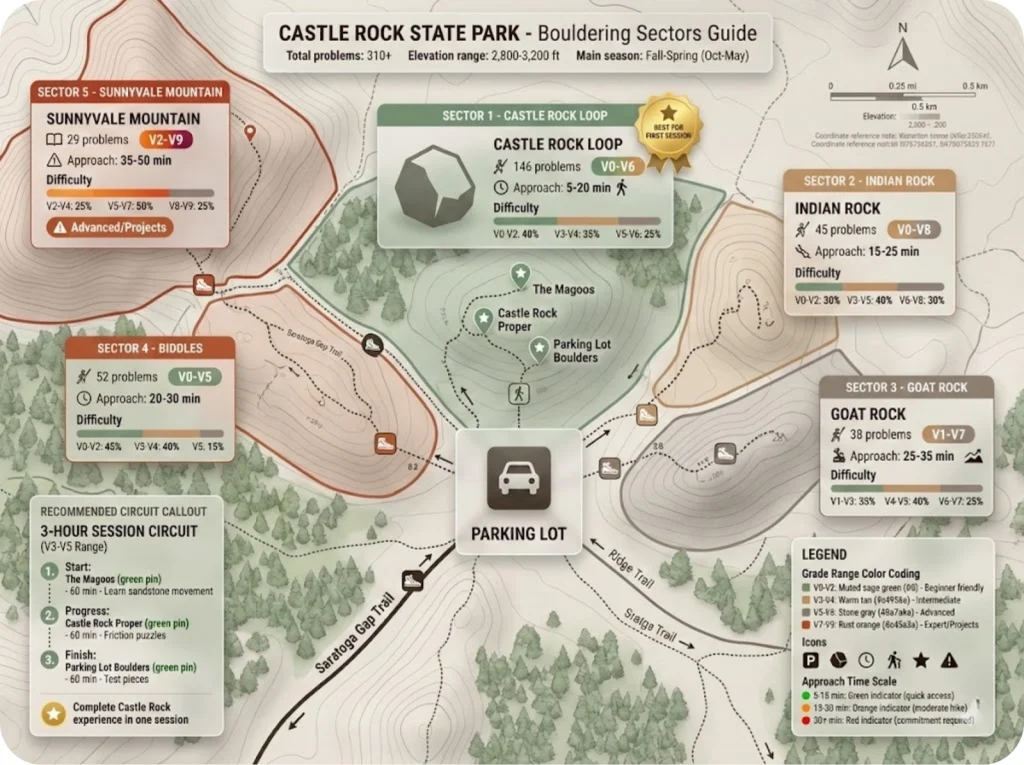
The Castle Rock Loop is the historical heart of the park: 146 problems, most within a 5-to-20-minute walk from the parking lot. If you only have one session, spend it here.
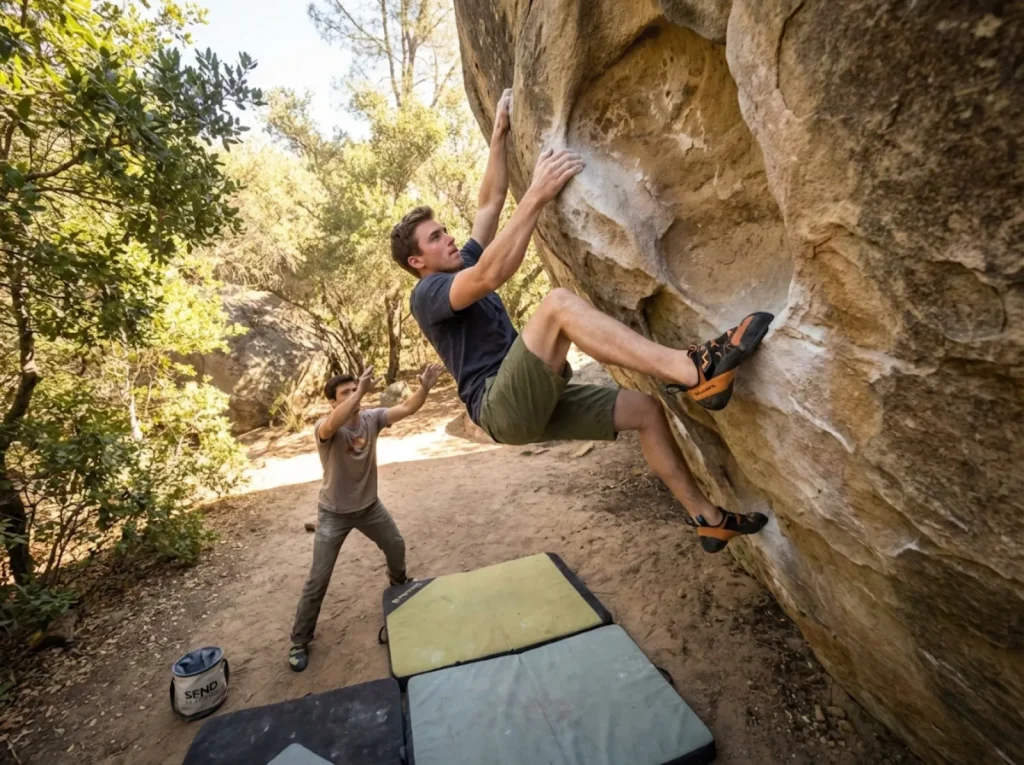
The Magoos is where you’ll find the “proper Castle Rock experience.” Foundational classics include Magoo Face (V1), Hueco Wall (V5-6), and The Slap (V4). Landings are generally flat, making this sub-sector ideal for learning sandstone movement patterns — the friction-dependent slopers, the wide-handed slapping technique, the rounded top-outs that demand full commitment.
At Castle Rock Proper, Waimea Wall (V1) and The Spoon (V1) showcase the signature style: large huecos and the kind of friction puzzles that make you rethink everything you learned in the gym.
Parking Lot Boulders sit close to the lot but hit harder. The Tree Problem (V4+) and Yabo Roof (V5) are mandatory test-pieces. If you’re visiting at a V-grade range of V3-V5, start at the Magoos, progress to Castle Rock Proper, and finish at the Parking Lot Boulders. That three-hour sequence gives you the complete experience.
For context on how understanding V-scale benchmarks works, the difficulty at Castle Rock tends to feel harder than gym grades because of the sandstone’s friction demands and the unique rock formations.
Indian Rock — Sanborn County Park Side (V2-V10)
Technically across Skyline Boulevard in Sanborn County Park, Indian Rock contains 117 boulder problems with “gym-like” density and consistently high-quality rock. The approach is absurdly short — 2 to 10 minutes from gravel pull-outs along Skyline Blvd. The main trail is wide and stable enough to accommodate wheelchair access, which is a genuine rarity in outdoor rock climbing.
Classic problems: Sharma Arete (V9), Lost Keys Traverse (V6), Thee Classic (V4). Indian Rock is the secret weapon on crowded weekends. Most visitors default to the main Castle Rock Loop, leaving this sector relatively empty.
Goat Rock and Remote Sectors (Low Traffic, Mixed Climbing)
Goat Rock requires a 1.3-to-1.5-mile hike with significant uphill sections — not a casual walk with crash pads. The Goat Rock Bouldering Circuit has 10 problems, but the area is primarily a destination for top rope climbing and trad.
More remote sectors like Biddles (22 problems, V1-V7), Sunnyvale Mountain (27 problems, V0-V4), and Muffins (13 problems, V3-V9) offer secluded alternatives. Sunnyvale Mountain is the most beginner friendly zone in the entire system — if someone in your group is a beginner rock climber, start there.
Gear Strategy for Castle Rock’s Unique Challenges
Crash Pads — How Many and How to Carry Them
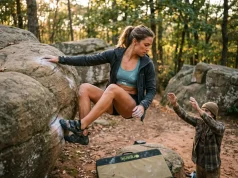
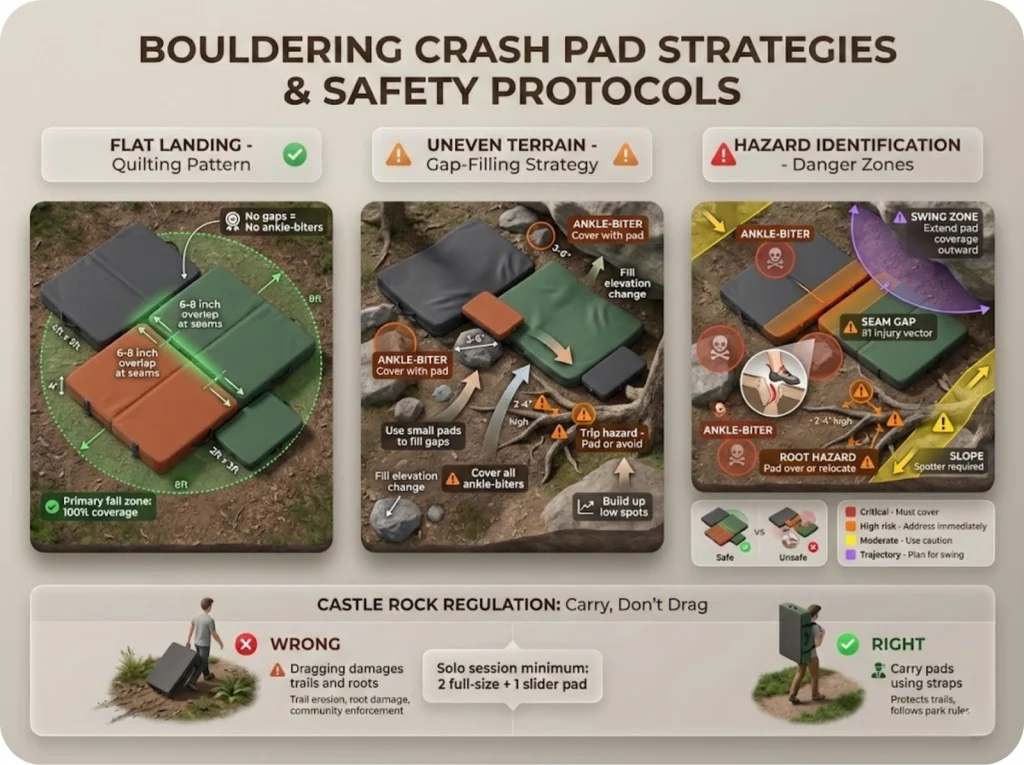
Solo sessions require a minimum of two full-size pads plus one “slider” for filling gaps. Groups should build a “quilt” of pads to eliminate ankle-biters — those hidden rocks at the base of problems that turn a clean fall into a hospital visit.
Pad seams are the number one injury vector at Castle Rock. Those gaps between pads catch ankles and twist knees. Overlap your edges, or fill the gaps with a small pad.
And here’s the regulation that catches first-timers: carry your pads, don’t drag them. Dragging accelerates trail erosion and damages the fragile root systems of native vegetation. It’s a park rule, and the community enforces it.
Shoes, Chalk, and Approach Footwear
Soft rubber shoes perform best on sandstone friction problems. A moderate downturn gives better toe purchase in deep huecos and tafoni pockets than an aggressive shoe designed for overhanging limestone.
Liquid chalk is preferred over block chalk on porous sandstone. Less residue, less polishing. Approach shoes are non-negotiable for the walk in — loose dirt sections with crash pads on your back demand real footwear, not flip-flops.
Pro tip: Bring a towel. Not for sweat — for wiping sand off your shoe rubber between attempts. Fine grit is invisible but it wrecks your friction on sandstone. Two seconds of wiping per attempt is worth more than twenty chalk-ups.
Vehicle Security — The Real Gear You Need
Castle Rock’s proximity to Bay Area urban centers makes trailhead vehicle break-ins a documented problem. This isn’t paranoia — community data from local forums confirms that thieves specifically target “out-of-town” looking vehicles at Silicon Valley trail parking areas.
The Clean Cabin strategy: leave absolutely nothing visible. Not charging cables, not empty bags, nothing. Leave the glovebox and center console open and empty to show there’s nothing worth breaking glass for. If your seats fold down, fold them so the trunk is visible and clearly empty.
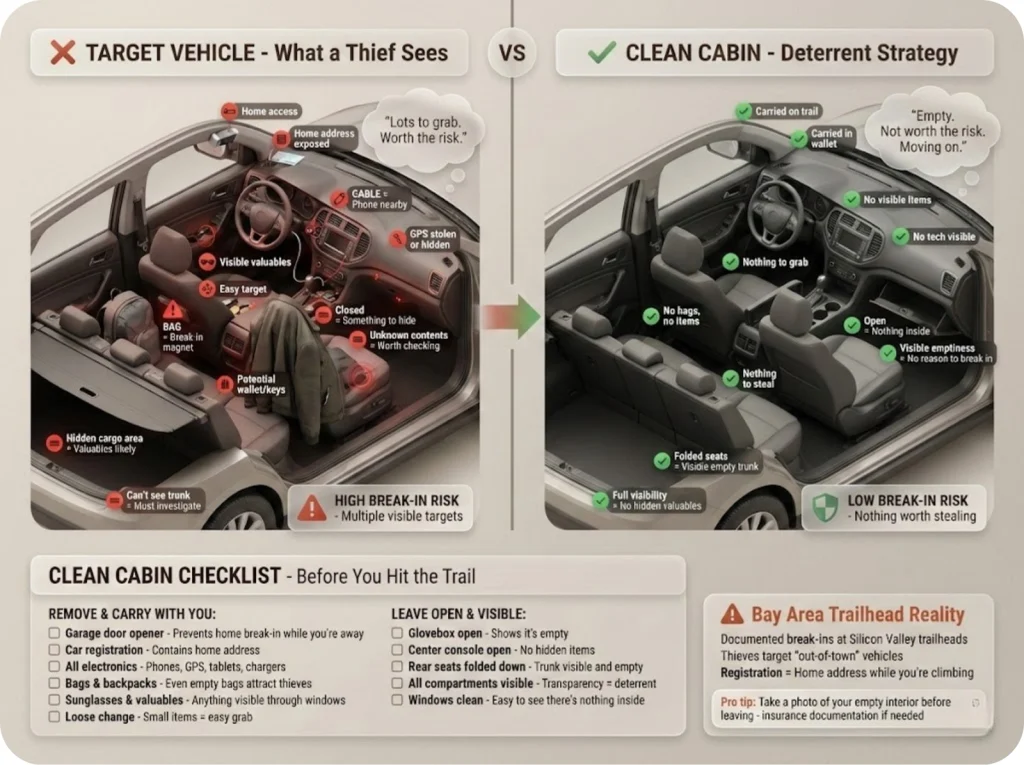
Carry your car registration and garage door opener WITH you on the trail. Thieves who find a registration use it to locate your home address — which is empty while you’re climbing.
Seasonal Playbook — When Castle Rock Is At Its Best
Fall and Spring (The Sweet Spot)
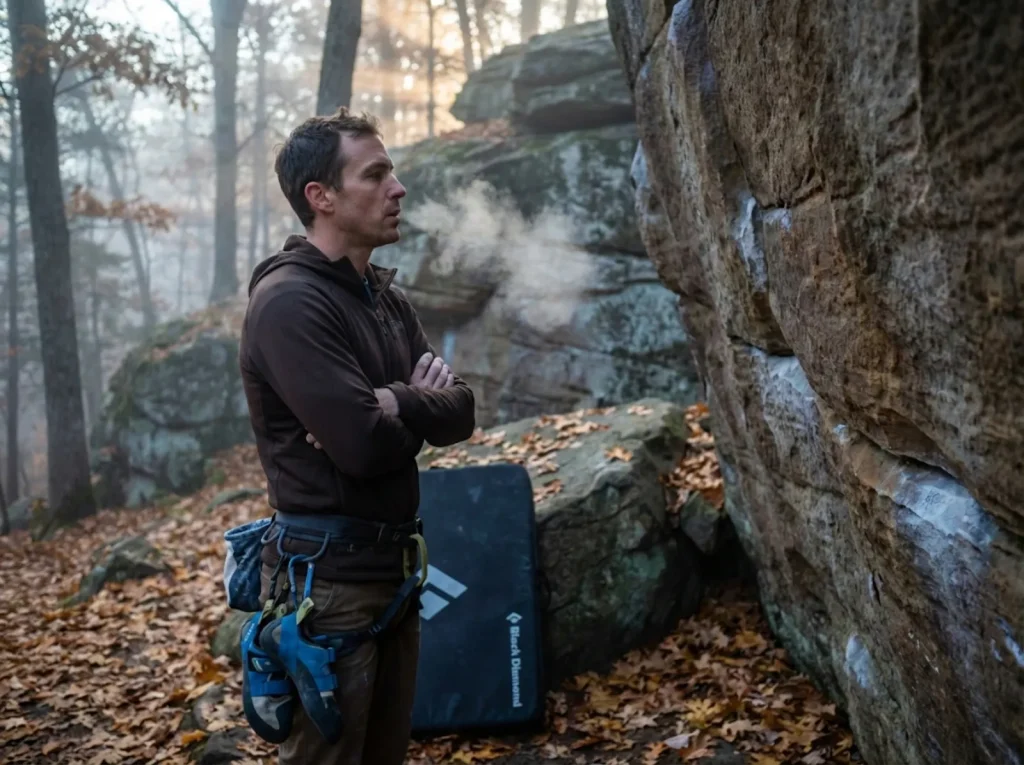
October through November and March through May deliver the best combination of friction, temperature, and daylight. Sandstone friction peaks when temperatures sit between 50-65°F with low humidity.
Fall benefits from the driest weather patterns in the Bay Area — fewer rain delays, more sendable days. Spring works too, but late-season storms can interrupt a good streak. Always check the AV151 data before committing to the drive.
The best single session I’ve had at Castle Rock was a November Tuesday at 55°F. The stone felt like it was grabbing back. That’s the friction window you want.
Summer Heat and Winter Rain Strategies
Summer temperatures above 90°F make friction-dependent slopers functionally impossible after 10 AM. But early morning sessions still work. Arrive at 6 AM, climb until 10, and you’ll get a solid four hours before the rock turns to glass.
Winter is Castle Rock’s wet season. Expect more rain days and stricter adherence to the 48-hour drying rule. But winter mornings below 50°F can produce spectacular friction if the rock is dry — just warm up thoroughly before crimping on cold sandstone. Cold stone and cold tendons are a recipe for finger injuries.
Understanding how temperature and humidity affect friction on sandstone helps you predict whether a session is worth the drive before you leave home. Monitor wetrockpolice.com for real-time moisture data.
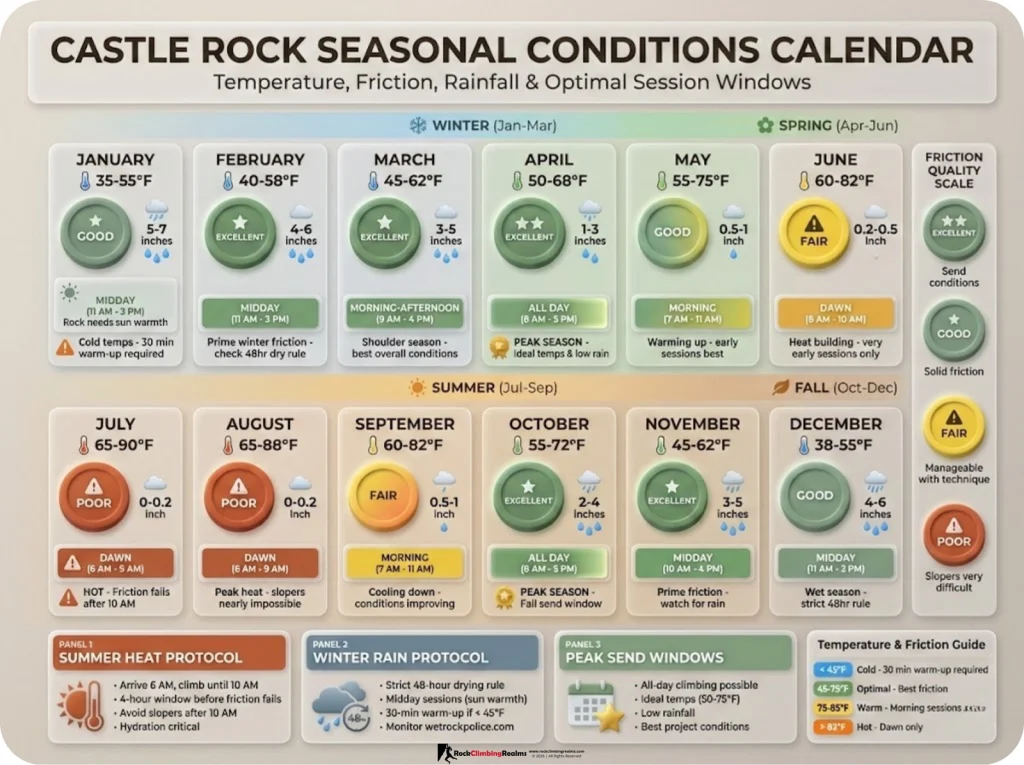
Pro tip: If the AV151 station shows rock surface temperature below 45°F, budget a full 30-minute warm-up on easy problems before touching anything at your limit. Cold sandstone punishes cold fingers harder than granite does.
The Castle Rock Community — Parking Lot Partners and Crag Culture
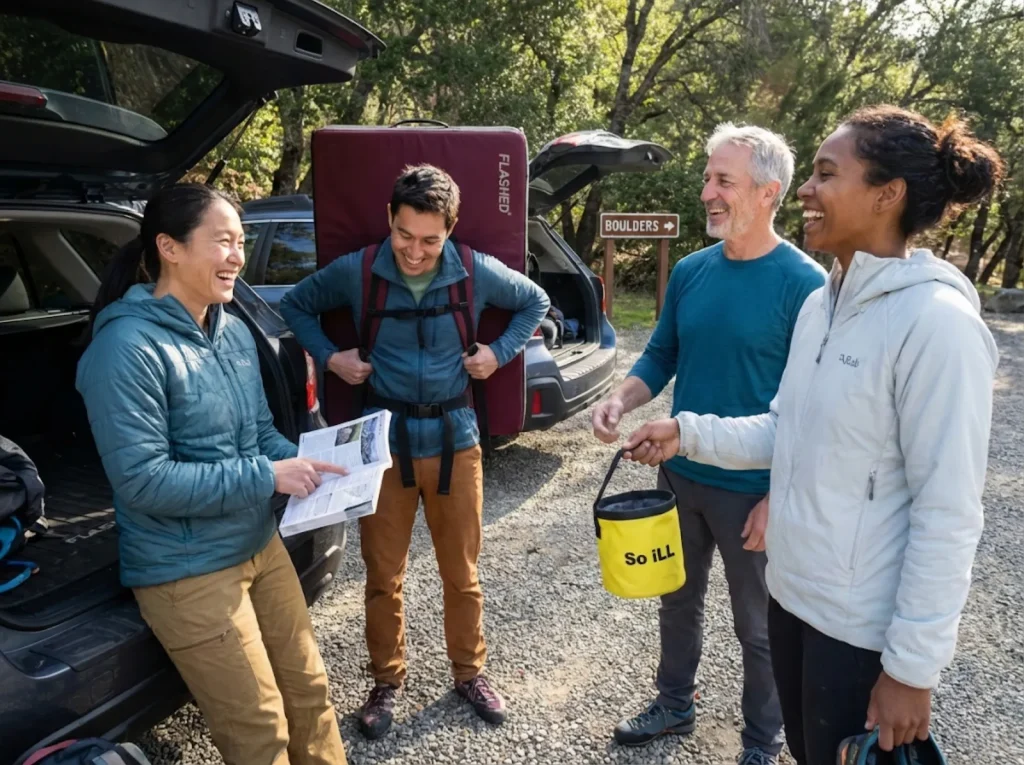
The “Parking Lot Partners” Phenomenon
Castle Rock has a decades-old culture of informal partner-finding. Show up solo, and you’ll likely be absorbed into a group before you finish warming up. The term “parking lot partners” describes the organic dynamic where Bay Area climbers congregate at the lot and form ad-hoc climbing parties.
This culture makes Castle Rock exceptionally welcoming for newcomers. You don’t need to know someone. You don’t need a crew. The social barrier is zero. The community is also self-policing: locals will diplomatically correct ethics violations — wet rock climbing, chalk abuse, pad dragging — in real-time. If you’re getting corrected, they’re doing you a favor.
Chris Sharma’s Training Ground and Historical Significance
Castle Rock is historically significant as the developmental training ground for Chris Sharma, one of the most influential boulderers in history. The area served as “bouldering school for most local climbers” for decades, shaping the technical style of the entire Bay Area climbing community.
The tradition of old-school classics named by Yabo and Cos alongside newer test-pieces reflects how this climbing area continues to grow. Understanding this history adds context to why the community takes sustainable climbing stewardship so seriously. They’re protecting a lineage, not just rock.
The Access Fund’s climbing stewardship guidelines apply here as much as anywhere. Castle Rock survives because the community acts like they own the place — in the best possible way.
Conclusion
Castle Rock packs more bouldering quality per square mile than almost anywhere in Northern California. But it demands respect for the stone, the regulations, and the community that keeps it all running.
Check the weather station before you drive. Carry your pads — don’t drag them. Clean your holds when you’re done. And show up early enough to park.
Pull up the AV151 data for your next dry window, load your pads, and head to the Magoos. The parking lot partners will take it from there. Now go send something.
FAQ
Can beginners boulder at Castle Rock State Park?
Yes. Castle Rock has dozens of V0-V2 problems, especially at Sunnyvale Mountain and the Magoos sector. The tafoni pockets provide positive holds that are more forgiving than slab granite. Bring a crash pad and start on the lowest problems until you understand the friction.
How long should I wait to climb at Castle Rock after rain?
A minimum of 48 hours, and 72 hours after heavy storms. Sandstone loses up to 75% of its strength when saturated. Check wetrockpolice.com/castlerock for real-time moisture data before driving out. If the rock feels damp, walk away.
Is there parking at Castle Rock State Park for bouldering?
The main parking is at the Robert C. Kirkwood Entrance — $10 per vehicle, open 8 AM to sunset. Arrive before 9 AM on weekends to guarantee a spot. Indian Rock parking is on gravel pull-outs along Skyline Blvd. There is no overflow lot.
Do I need a crash pad for bouldering at Castle Rock?
You need at least two full-size pads for solo sessions. Castle Rock’s rounded top-outs and hidden ankle-biters at the base make pad coverage non-negotiable. Groups should aim for a quilt of overlapping pads.
Are dogs allowed at Castle Rock State Park?
No. Dogs are prohibited on all trails and bouldering areas within the park. This is strictly enforced to protect local wildlife and maintain trail conditions.
Safety Notice: Rock climbing and mountaineering are inherently high-risk
activities that can involve physical trauma or fatal incidents. The information on Rock Climbing Realms is for
educational and informational purposes only. Techniques and advice presented here are not a substitute
for professional, hands-on instruction. Conditions and risks vary by location. Always seek guidance
from a qualified instructor before attempting new techniques. By using this website, you agree that you
are solely responsible for your own safety. Any reliance you place on this information is strictly
at your own risk, and you assume all liability for your actions. Rock Climbing Realms and its authors
will not be held liable for any harm, damage, or loss sustained in connection with the use of this information.
Affiliate Disclosure: We are a participant in the Amazon Services LLC Associates Program, an
affiliate advertising program designed to provide a means for us to earn advertising fees by advertising and linking
to Amazon.com. As an Amazon Associate, we earn from qualifying purchases. We are also an official affiliate partner
of Black Diamond Equipment via the AvantLink network. If you click on a Black Diamond affiliate link and make a
purchase, we may earn a commission at no additional cost to you. We also participate in other affiliate programs.
Additional terms are found in the terms of service.