
In this article
Your forearms are flash-pumped with lactic acid, the humidity is clinging to your skin, and you’re staring up at a 40-foot face entirely covered in sandstone chickenheads while the sun threatens to melt your shoe rubber. This isn’t a casual vacation crag; this is the proving ground of the South. This guide strips away the marketing hype to equip you with the technical beta, the physics of Arkansas sandstone friction, and the exact logistical blueprint needed to operate inside the newly modernized Horseshoe Canyon Ranch in 2026. If you want to understand how sandstone lithology dictates your underlying gear placement (and why you definitely need your stick clips), you need to know exactly what kind of rock you’re grabbing.
⚡ Quick Answer: Horseshoe Canyon Ranch (HCR) is the premier sport climbing destination in the Ozark region, offering over 900 bolted climbing routes on high-friction sandstone. As of 2026, the ranch is a modernized adventure resort managed by Ropeswing Hospitality, featuring Starlink Wi-Fi, e-MTB trails, and strict access policies like mandatory digital waivers and a zero-tolerance no dogs policy. Success here requires respecting the rock’s moisture limits, pacing yourself on steep moderates, and mastering technical edging.
Geological Mechanics of Arkansas Sandstone
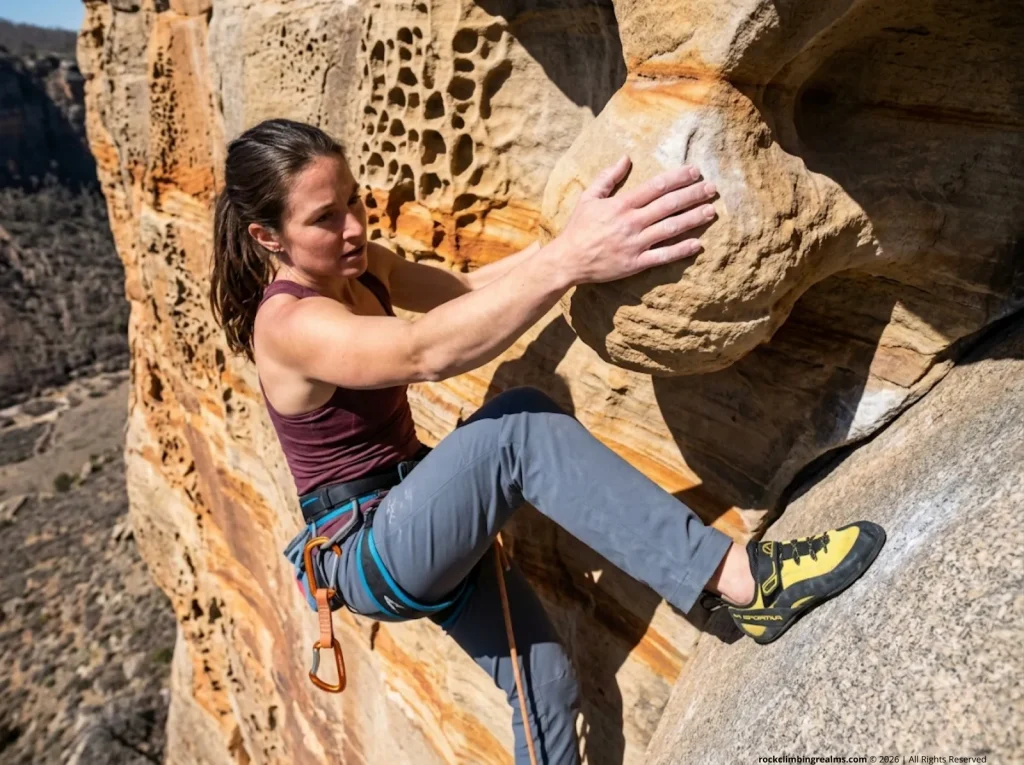
The physical reality of climbing at Horseshoe Canyon Ranch is dictated entirely by millions of years of geological pressure. The cliffs are carved from the Hale and Bloyd formations of the Pennsylvanian period, making them substantially older and more stable than many other crags in the region. This is exactly why the canyon has become a sustainable send destination for climbers across the Midwest and South. While the canyon offers world-class bouldering and some scattered trad lines, its reputation is built squarely on bolted ascents.
The Silica Cementation Advantage
What separates this Arkansas sandstone from the crumbling choss you’ll find in the northern ranges is a high degree of lithification. The quartz grains are bound together by secondary silica cement, creating a dense, heavily textured surface. This pristine aggregate actively supports the installation of highly durable bolted anchors, ensuring that the rock won’t become hazardously friable under the intense tension of lead falls. You can trust the rock structure, provided you respect its limits.
The Physics of Friction on “Chickenheads”
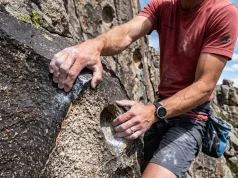
The interaction between your climbing rubber and this rock is driven by heavy asperity contact. You will rely on chickenheads—protruding, bulbous knobs of concentrated silica that resisted erosion while the softer matrix washed away. These features give you a massive mechanical advantage, allowing for high-pressure smearing and precise edging.
However, the high coefficient of friction on rock surfaces drops radically on the heavily trafficked classic routes. When you mix atmospheric moisture with decades of chalk accumulation, the expected sandstone friction simply vanishes. You have to actively hunt for the unpolished micro-texture.
The 24-Hour Rain Rule: Preventing Catastrophic Hold Failure
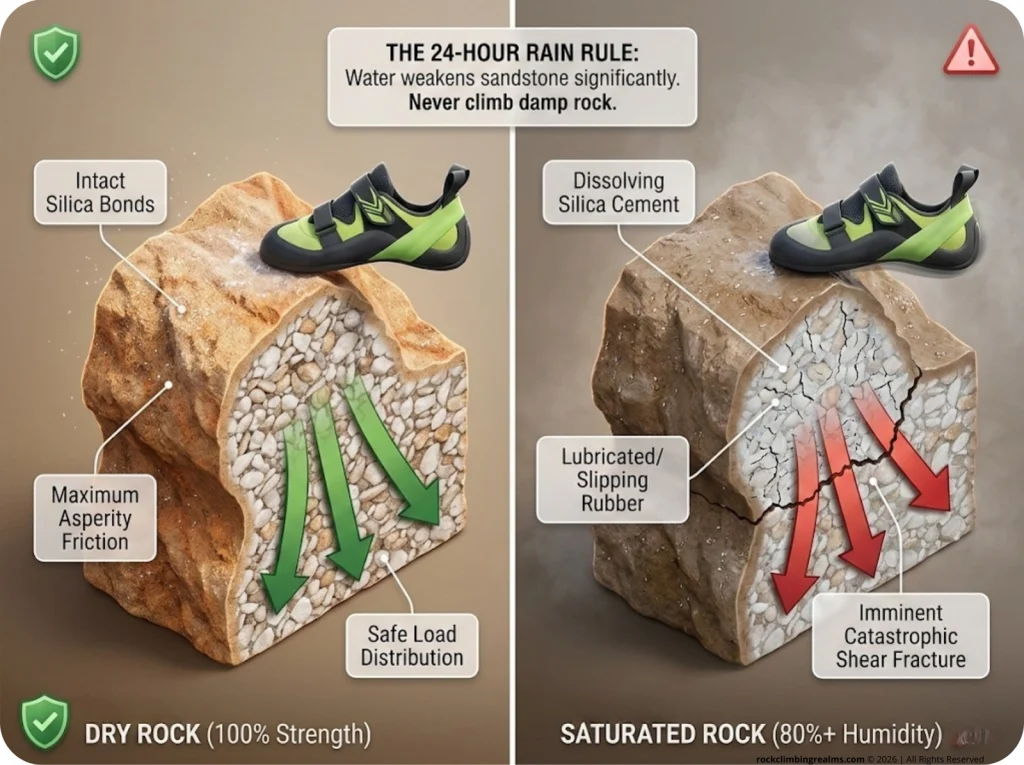
If there’s one rule that separates local veterans from ignorant tourists, it’s understanding the hazard of wet sandstone. Water acts as a destructive internal lubricant inside the rock’s pores, actively weakening the silica grain bonds. Attempting routes in high humidity (above 80%) reduces the structural integrity by up to 25%.
If you climb right after a rainstorm, that strength reduction plummets to 75%. Pulling on wet rock is categorically prohibited here. Fatigue loading on saturated rock causes sudden, catastrophic hold failure. When a classic jug snaps off, it’s gone forever.
Pro tip: If the ground at the base of the cliff is definitively wet and muddy, the rock is too wet to climb. Do not test the holds. Walk away and hit the mountain bike trails instead.
The Modern Infrastructure: Logistical Logistics for 2026
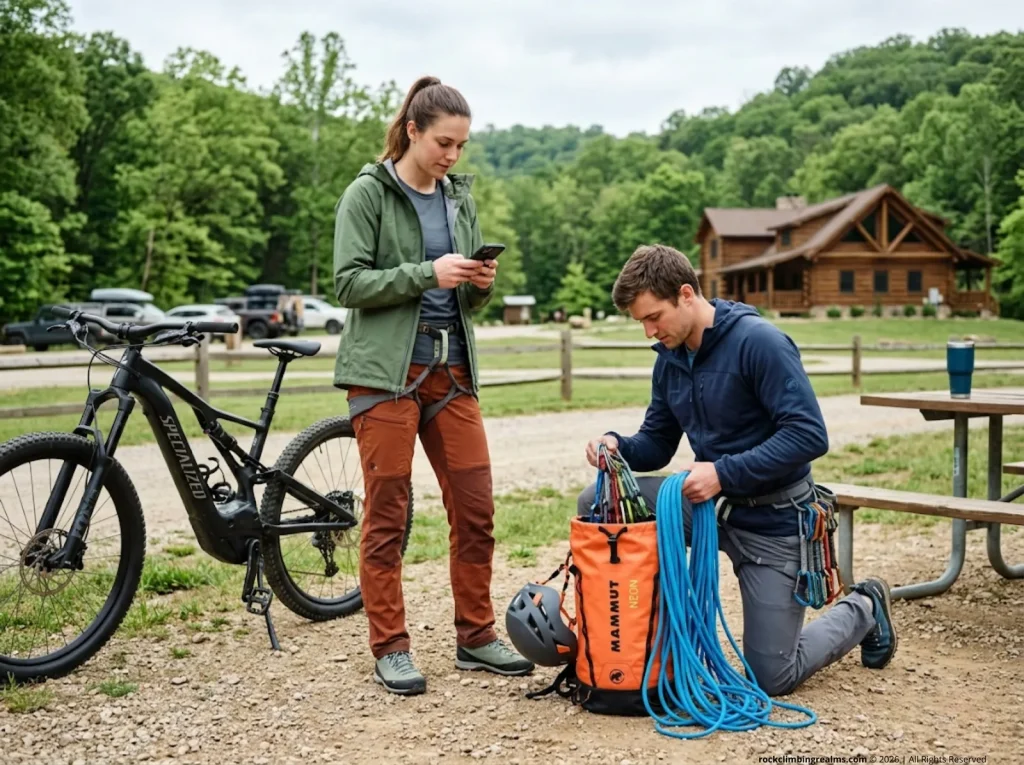
The days of HCR operating as a sleepy, family-owned dude ranch are over. Acquired by an entity affiliated with the Walton family and now managed by Ropeswing Hospitality, the canyon operates as a highly standardized, multi-sport adventure resort complete with a via ferrata. The horses are mostly gone, replaced by 20 miles of premium e-MTB trails known as the Electric Cowboy, but the infrastructure changes offer massive benefits for the modern climber.
Navigating Waivers, Fees, and Check-In
You cannot simply hike into the canyon anymore. Every single visitor must check in at the Trading Post to sign explicit digital waivers and secure a mandatory wristband. A standard adult day pass holds steady at $14, but your overnight camping fees are handled separately. The new East Side campsites offer vehicle-accessible, reservable plots for $40 per night, taking the guesswork out of your arrival. Showers and bathrooms remain centrally located.
The heavy economic footprint of climbers here actually secured the recreational liability exemptions protecting private landowners in the state legislature. But that goodwill vanishes instantly if you bypass the check-in protocols. Failure to display your wristband guarantees immediate removal and prosecution for trespassing.
The “Work-from-Crag” Paradigm: Starlink Performance
Cellular reception across the canyon floor remains virtually non-existent, leaving you cut off from the outside world once you hike down. However, the modernized Trading Co. now functions as a legitimate remote hub for the work-from-crag lifestyle. Management installed a Gen 3 Starlink Wi-Fi array that consistently yields 80-180 Mbps download speeds. With latency hovering around 30-60 ms, you can easily run video conferencing between sending sessions, though you might hit bottlenecks trying to upload massive video files.
Why the “No Dogs” Policy is Absolute
Do not bring your dog to the canyon. The no dogs policy is strictly enforced because the ranch deploys aggressive, free-roaming working dogs to protect their remaining livestock. Bringing a pet into this environment creates a severe collision and health hazard. Additionally, the local goats and horses routinely scavenge the staging areas beneath the popular climbing walls. Leaving your pack open is a guaranteed way to lose your lunch to a hungry horse. The management assumes zero liability for your chewed-up harness.
Strategic Sector Breakdown: Where to Send
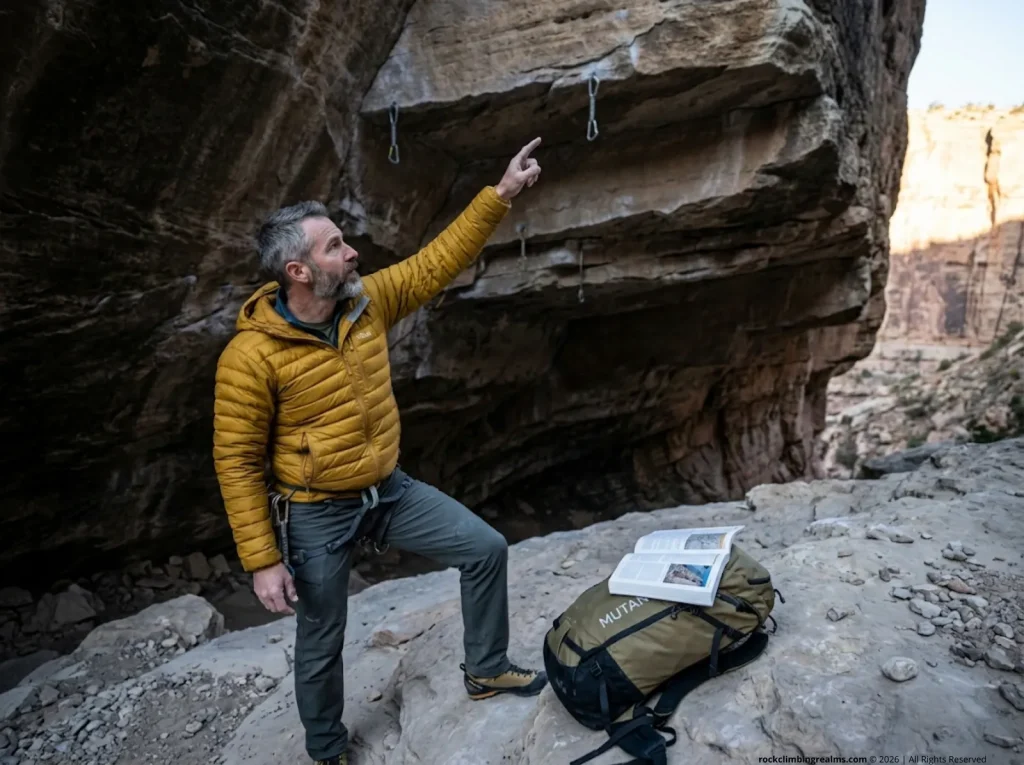
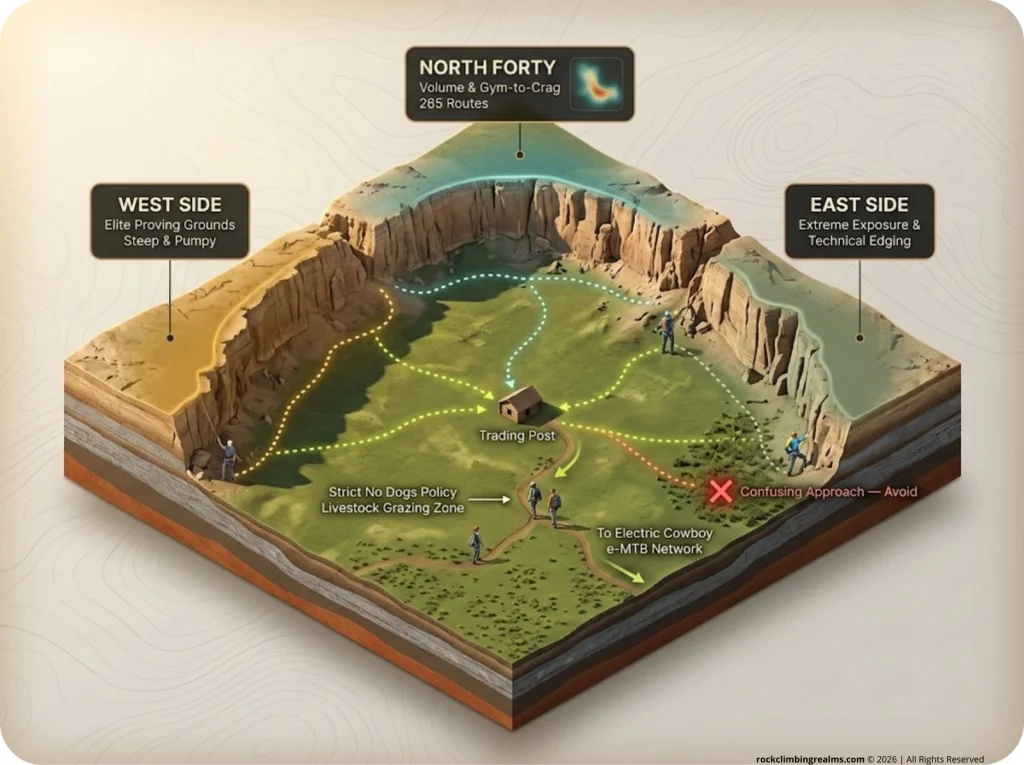
The canyon forms a massive U-shape, housing over 900 pitches that cater to every style of practitioner. Knowing how to navigate the sectors dictates your daily success. You don’t want to burn your energy wandering through the brush looking for a specific wall.
The North Forty: Volume and Progression
The North Forty is the undisputed heart of the canyon, holding 265 routes. It is widely considered a beginner paradise and acts as the primary gym-to-crag integration zone where you can build your first-timer’s tick list. You’ll find benchmark easy moderates like Cotton Candy (5.6) and Green Goblin (5.8) that swallow crowds all day long.
As you push into higher grades, the wall demands fierce vertical resistance. Taking on routes like Fat Hand (5.12a) forces you to dial in your efficient clipping positions, managing your lactic threshold before the pump spits you off the wall. Bring plenty of quickdraws; the volume here makes it an essential stop for anyone wanting to build fitness.
The East Side: Exposure and Vertical Technicality
If you want to escape the heavy crowds, pack your crag bag and hike 20 minutes uphill to the East Side. With 243 routes, this sector filters out the casual groups and rewards climbers looking for high exposure. The Roman Wall holds hyper-technical face climbing like Commodus (5.10b), which prioritizes absolute precision edging over brute strength. The steep Far East sub-sector is also a crucial tactical asset, as it remains remarkably dry during light, localized drizzles.
The West Side: The Elite Proving Grounds
The West Side is where the true elite athletes validate their training blocks. The Prophecy Wall defines this sector, demanding massive finger-strength and stick clips to avoid ground falls before the first bolt. The Prophet (5.14a) stands as the ultimate testpiece for professional-tier sport climbing in the Ozark region. Even breaking into the heavier grades requires mastering Taliban Soup (5.11), the classic gatekeeper route for the major overhangs.
Pro tip: Scout the approach path from the Cliffs of Insanity to the Far East sector on your first visit. The trail is confusing, and wandering through the wrong brush will cost you 30 minutes of sending time.
Hardware Standards and Safety Systems
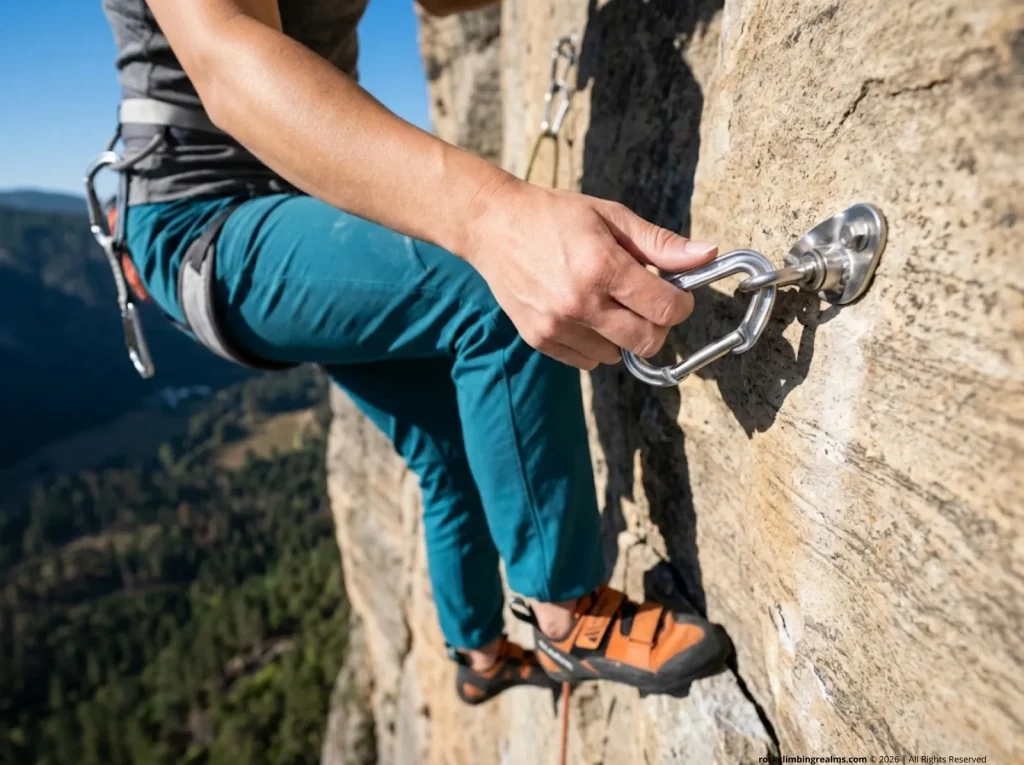
When you trust your life to a single half-inch bolt, you need to know exactly who placed it and what material it’s made of. The hardware ecosystem at HCR is arguably the best maintained in the nation.
The Stainless Steel Transition Explained
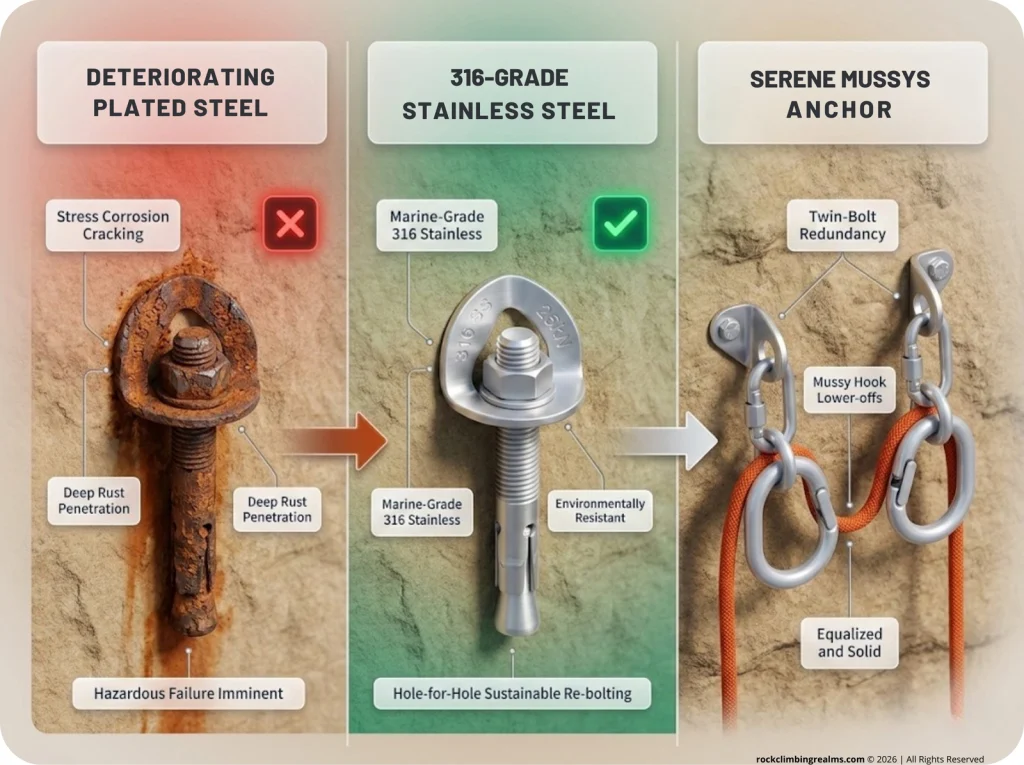
Years ago, high humidity caused severe stress corrosion cracking in the legacy plated steel bolts scattered across the canyon. To avert a disaster, the Arkansas Climbers Coalition (ARCC) executed a massive environmental overhaul. They systematically replaced over 2,100 failing bolts with premium 316-grade stainless steel re-bolting initiatives. They utilize a strict “hole-for-hole” replacement ethic, intentionally refusing to drill new holes that would permanently scar the aesthetic of the sandstone.
Validating Permanent Anchors and “Mussies”
At the top of almost every route, you’ll find twin-bolt anchors fitted with highly durable lower-off rings, universally referred to as “mussies.” These make cleaning routes incredibly fast and safe. But do not let this convenience breed complacency.
Even heavily maintained hardware requires relentless scrutiny. You must visually inspect the rock matrix immediately surrounding the expansion bolt every time you clip. Make sure you execute regular pre-climb safety checks with your partner, because the best hardware in the world won’t save you if your harness isn’t doubled back or your knot is unfinished.
Emergency Response and MOCS Protocols
Risk management is systemic here. The guides from the Memphis Outdoor Climbing School (MOCS) operate across the ranch strictly under AMGA scope-of-practice standards. All professional instructors act as Wilderness First Responders (WFR) or certified EMTs. The BETA Fund recently installed two permanent, comprehensive first-aid caches securely hidden on the property. Since cell service is nonexistent on the canyon floor, your primary lifeline in a crisis is sending a runner via the physical “buddy system” to the main lodge to trigger an emergency evacuation.
The Science of 24 Hours of Horseshoe Hell
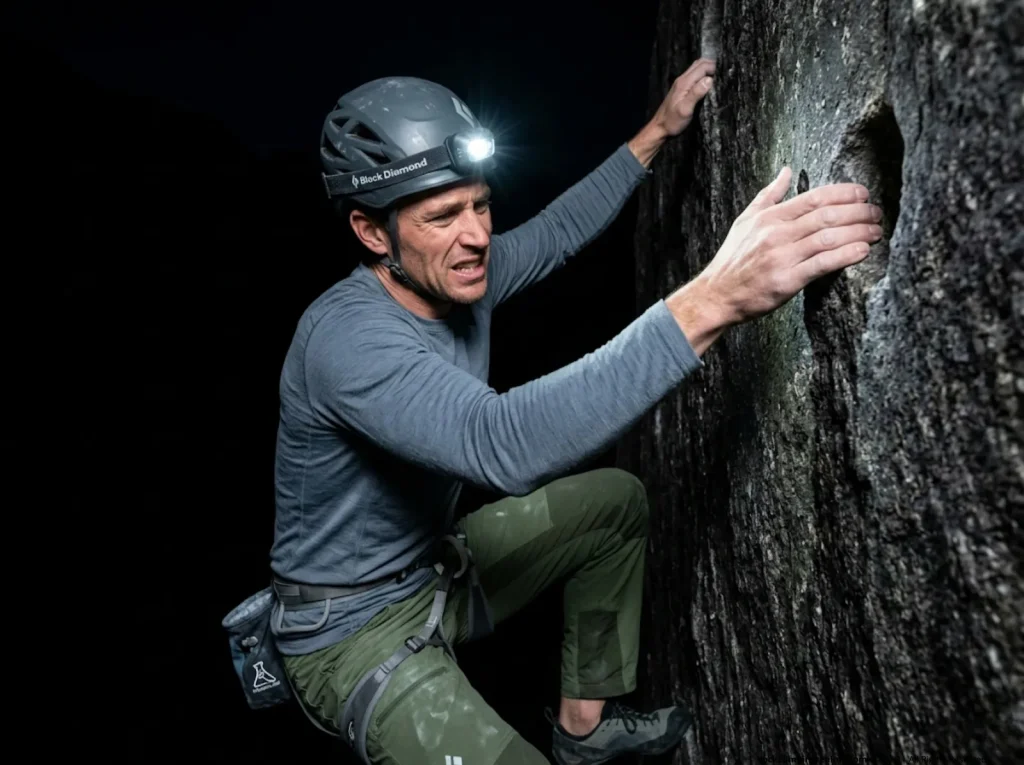
There is no climbing event in the world quite like 24 Hours of Horseshoe Hell (24HHH). This legendary competition is a brutal physiological stress-test that pushes the absolute limits of human endurance, transforming the entire canyon into a chaotic arena of headlamps and chalk.
Metabolic Management and Lactic Acid
Continuous upward progress for 24 hours straight floods your muscular tissues with acidity, drastically reducing your contractile force. The primary enemy here is hydrogen ion accumulation in your forearms. Successful competitors calculate aggressive pacing models based on YDS difficulties, offsetting hard, pumpy lines with deep, restful jug-hauls to actively clear lactic acid while still stacking points. Managing your forearm pump isn’t just a suggestion; it represents the fundamental barrier separating the elite teams from the rest of the pack.
Surviving the Circadian “Bleak Hours”
The true crucible hits during the “bleak hours” between 3:00 AM and 5:00 AM. Deep into the night, your natural drive for sleep aggressively impairs your coordination and heavily degrades your technical footwork execution. Core temperatures drop rapidly when you move out of the sun and stop climbing, increasing the immediate risk of cold-induced tissue injuries. The notorious festival costumes you see aren’t just for laughs; they serve a massive psychological function, boosting morale when your mind starts breaking down in the dark.
Pro tip: Do not waste time projecting hard routes at 4:00 AM. Stack volume on familiar moderates where you can climb dynamically without over-gripping. Keep moving to generate warmth.
Nutritional Engineering for 24-Hour Constant Output
If you run your pacing entirely on energy drinks, you will fail. Spiking your system with caffeine early causes a devastating crash during the most treacherous hours of the night. Mastering the nutrient timing strategies for climbing performance dictates that you focus on massive, continuous ingestion of simple carbohydrates to prevent absolute glycogen depletion. Competitors rely heavily on bananas—the high potassium and sodium content effectively staves off the agonizing, full-system cramps.
Environmental Tactics and Sustainable Stewardship
Access to this ecosystem is a privilege, not a right. Management closely watches how the climbing community treats the land. Failing to abide by strict environmental ethics threatens to lock the gates for everyone. The ranch maintains a formal partnership with Leave No Trace to promote responsible enjoyment of the outdoors, and every visiting climber is expected to uphold those standards.
Navigating High-Density Waste Disposal
With thousands of climbers pouring in during the prime seasons, proper human waste disposal is a highly scrutinized metric. Ignoring designated bathroom facilities directly threatens our standing with the ownership group. Pack out everything you bring onto the lower trails to prevent an unmanageable sanitary decay of the base soil.
Livestock Compatibility and the Pack-It-Out Rule
The pack-it-in, pack-it-out rule is absolute. Even discarding organic matter like fruit peels disrupts the delicate micro-ecosystem. The ranch operates a thriving population of grazing horses and goats completely adapted to wandering the property. Leftover food scraps attract this livestock directly to heavy fall zones, putting them at severe risk of collision with falling climbers. Also, watch out for seasonal ticks and chiggers in the tall grass near the staging areas.
Preserving Friction: Why You Must Brush Chalk
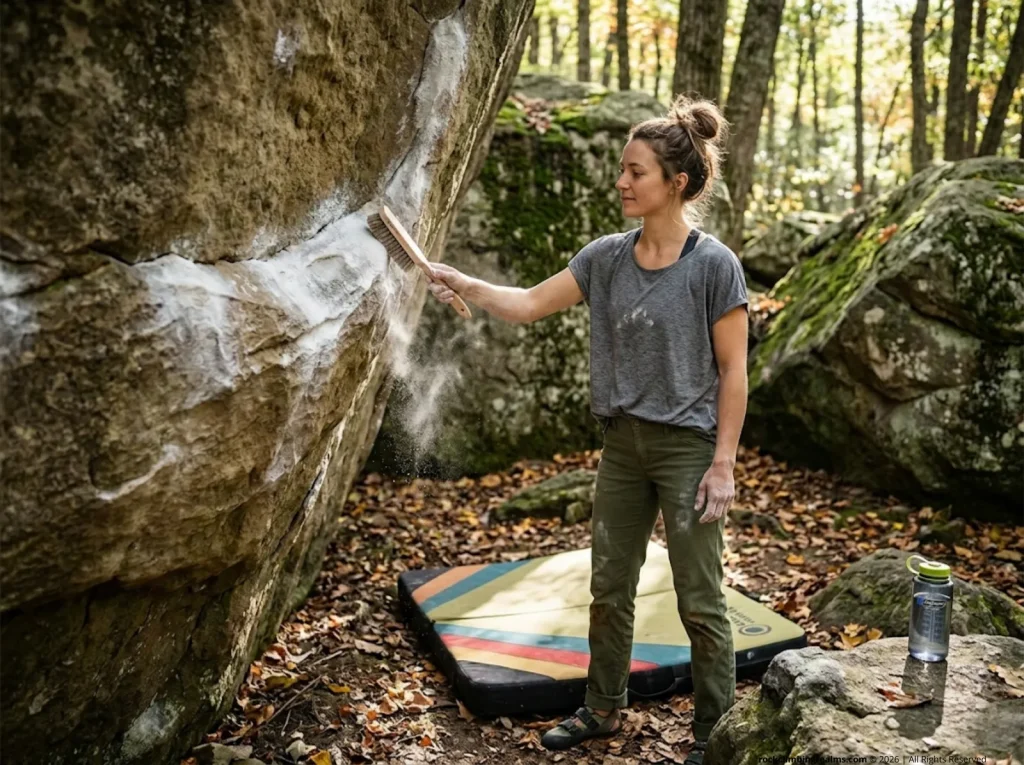
The modern climber relies heavily on high-friction chalk, but massive accumulations of this powder literally paste into the porous sandstone when mixed with atmospheric humidity. This layer permanently smooths out the mechanical bite needed to maintain the rock’s native traction. You must vigorously clean chalk off the rock after your attempts. Thoroughly brushing your tick marks and over-chalked holds upon route completion is the hallmark of a professional-grade practitioner.
Pro tip: Pack a stiff, natural boar’s hair brush. Nylon brushes can actually polish the sandstone further. Brush the hold gently but firmly to lift the chalk without destroying the silica grains.
Conclusion
We are looking at a fundamentally different crag than ten years ago. Horseshoe Canyon Ranch operates far beyond its origins as a basic dude ranch; it is the 2026 premier technical sport crag of the central United States. Mastering its sandstone requires far more than raw finger strength. It demands a sophisticated understanding of friction physics, strict adherence to the rigid logistics of the new management, and a deep respect for the environmental stewardship keeping the gates open. Lock down your digital reservations early, dial in your hardware knowledge, and bring these professional-grade protocols to your next attempt on the steep, unforgiving walls of the North Forty. Now go send something.
FAQ
Can you bring a dog to Horseshoe Canyon Ranch?
No, non-ranch dogs are strictly prohibited. The ranch employs aggressive working dogs to protect its livestock, making it a severe collision and health safety hazard for outside pets and other climbers.
How much does it cost to climb at Horseshoe Canyon in 2026?
A standard adult day pass is $14. Nightly camping fees range from $7 for a basic tent site up to $40 for the new vehicle-accessible East Side reservations.
Can you climb on the sandstone at Horseshoe Canyon Ranch in the rain?
Absolutely not. Arkansas sandstone loses 15% to 75% of its structural integrity when wet, and pulling on saturated holds will cause permanent, catastrophic destruction of the classic routes.
Is there cell service available at Horseshoe Canyon Ranch?
Cell service is virtually non-existent on the canyon floor. However, the modernized Trading Co. now features a high-speed Starlink connection (80-180 Mbps) fully capable of supporting remote work and video conferencing.
Safety Notice: Rock climbing and mountaineering are inherently high-risk
activities that can involve physical trauma or fatal incidents. The information on Rock Climbing Realms is for
educational and informational purposes only. Techniques and advice presented here are not a substitute
for professional, hands-on instruction. Conditions and risks vary by location. Always seek guidance
from a qualified instructor before attempting new techniques. By using this website, you agree that you
are solely responsible for your own safety. Any reliance you place on this information is strictly
at your own risk, and you assume all liability for your actions. Rock Climbing Realms and its authors
will not be held liable for any harm, damage, or loss sustained in connection with the use of this information.
Affiliate Disclosure: We are a participant in the Amazon Services LLC Associates Program, an
affiliate advertising program designed to provide a means for us to earn advertising fees by advertising and linking
to Amazon.com. As an Amazon Associate, we earn from qualifying purchases. We are also an official affiliate partner
of Black Diamond Equipment via the AvantLink network. If you click on a Black Diamond affiliate link and make a
purchase, we may earn a commission at no additional cost to you. We also participate in other affiliate programs.
Additional terms are found in the terms of service.