
In this article
Two hundred frames. That’s how many I shot the first time I brought a camera to a multi-pitch in Red River Gorge. I was standing at the base, craning my neck, zooming in on my partner as she fought through the crux pitch above me. Back at camp that evening, I scrolled through every single one. Harness straps, shoe soles, chalk-dusted rear end, sky. Not one shot showed her face. Not one captured the desperation in her fingers or the way her jaw clenched before she committed to the dyno.
Every image was a butt shot. And I had no idea why.
After years of shooting from ropes, static lines, and sketchy ledges across crags from Yosemite to Fontainebleau, I’ve learned one thing that changed everything about my climbing photography. The problem was never my camera. It was my position. If you’re standing below the climber and pointing your lens upward, you’re guaranteed to get garbage. Here’s how to fix that, stay safe doing it, and turn your photos into something that actually makes people feel what the send felt like.
⚡ Quick Answer: The single biggest improvement to your climbing photos is getting above the climber. Shoot from above or level to capture face, hands, and full body in frame. Use a fast shutter speed of at least 1/500s, shoot in overcast light or full shade for even illumination, and tell your partner to wear bright clothing that pops against the rock. You’ll need a static line, an ascender, and a progress-capture device like a Gri-Gri to safely reach an overhead shooting position.
Why Below-Angle Shots Fail (The Physics You’re Ignoring)
Foreshortening Ruins the Drama
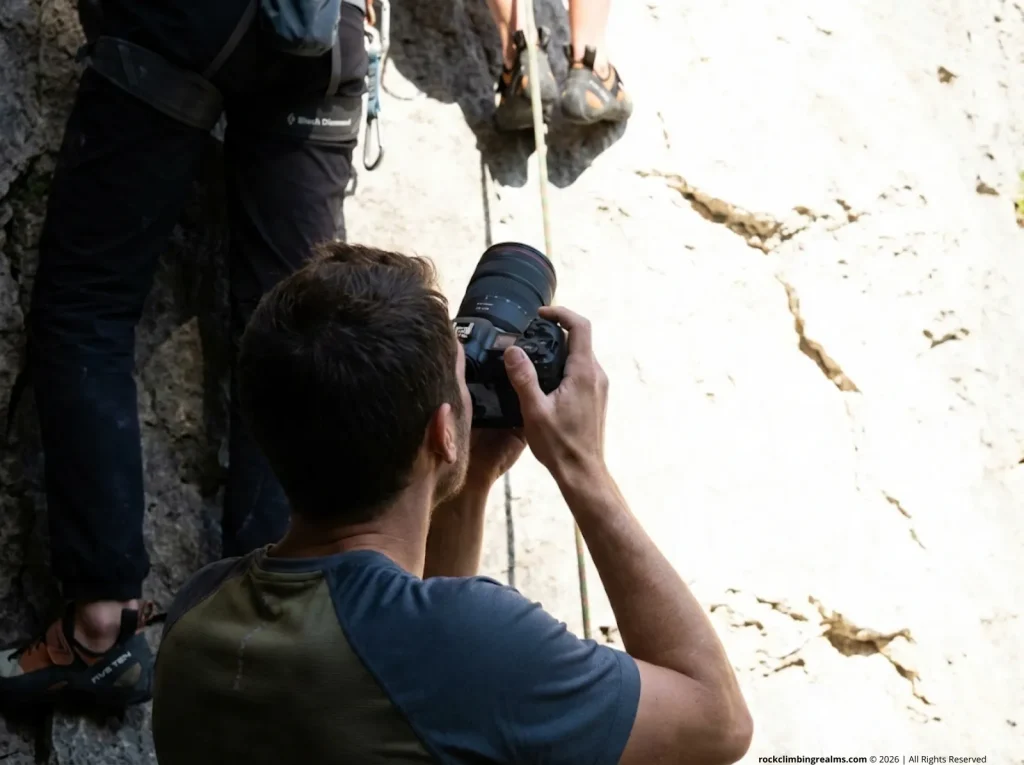
Point your camera straight up at an 80-foot wall and something ugly happens. That steep, proud line your partner is wrestling with compresses into what looks like a gentle slab. This is called foreshortening, and it’s the Silent Hazard of good climbing photography. The distance along your line of sight gets visually squashed, so a vertical cliff reads as flat terrain to anyone looking at the photo.
All the drama, the height, the exposure, the steepness that made you nervous just watching from the ground, gone in a single bad angle. Your viewer doesn’t feel the void. They feel nothing.
The Butt Shot Problem
Andrew Burr, who spent over 12 years shooting climbing for Climbing Magazine, is blunt about it. The number one mistake is shooting from below. You get the climber’s backside, their gear loops, the bottom of their shoes, and a whole lot of sky. The face? Hidden. The hands gripping the holds with white knuckles? Invisible. The intense expression that tells the entire story of the climb? Gone.
What the viewer sees is a chalk bag and a harness. What they should see is effort, tension, and the split-second decision between committing and bailing.
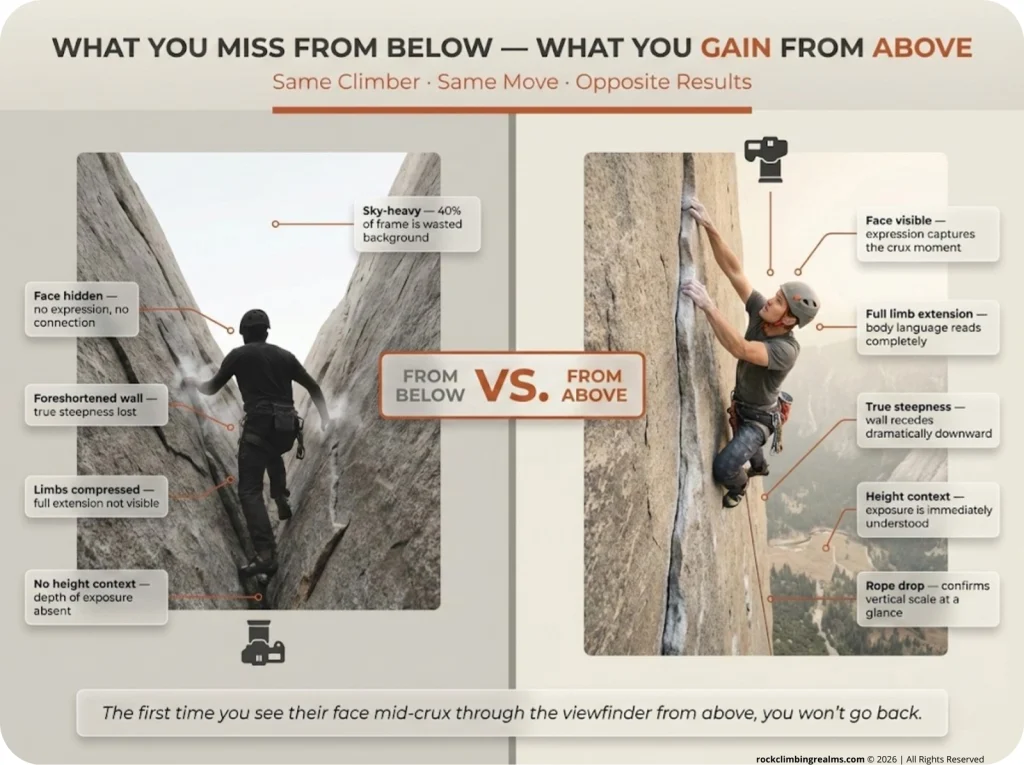
What You Miss From Below vs. What You Gain From Above
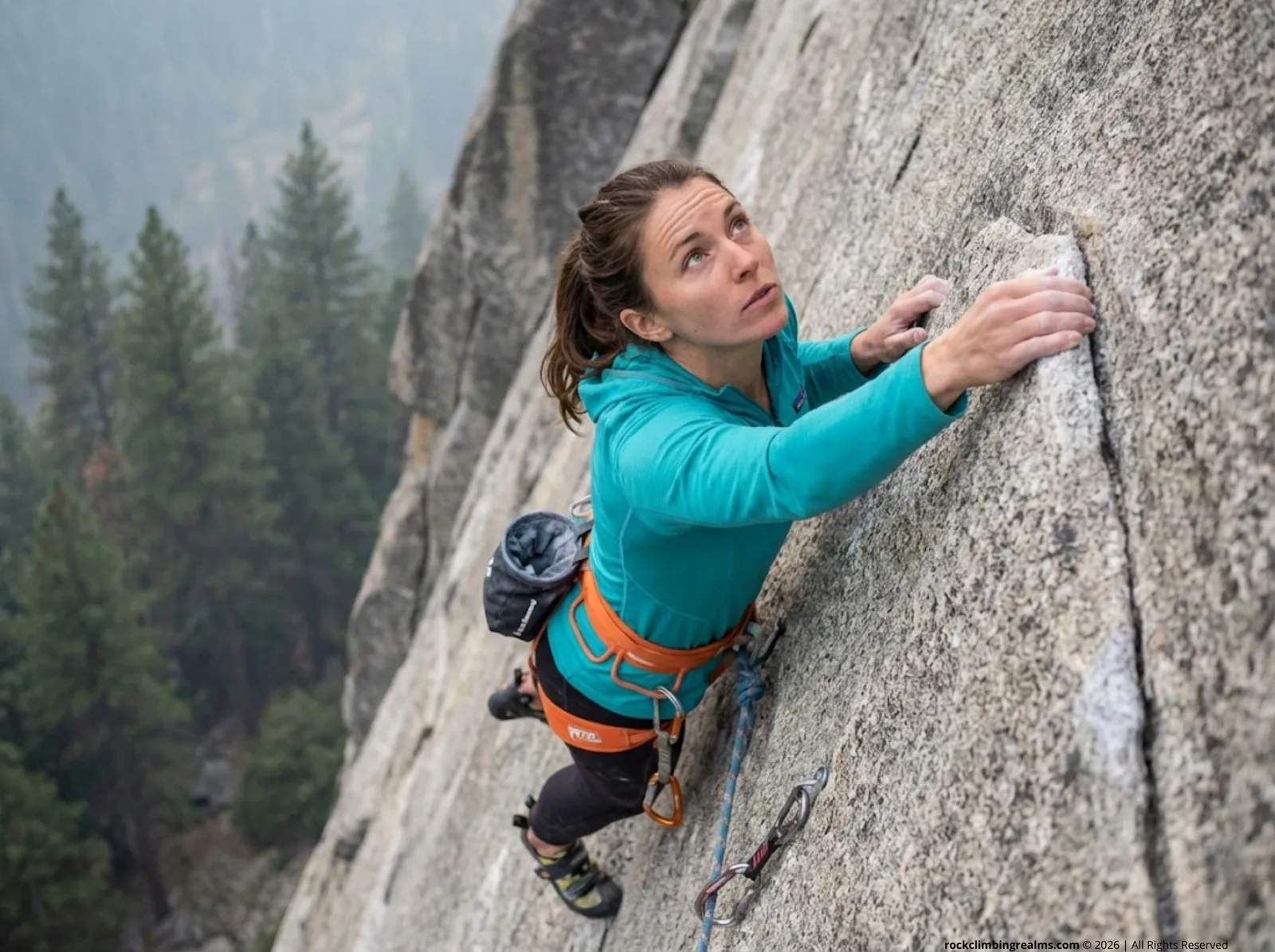
From above, you capture the climber’s face, the full extension of their limbs, the height context against the valley floor, and the true steepness of the route. From below, you get a foreshortened wall, a rear-view silhouette, and a sky-heavy background that robs every shot of its power.
The first time you jug above someone and see their expression mid-crux through the viewfinder, you’ll wonder why you ever pointed a camera upward from the ground. Before you get up there, though, make sure to run through a proper pre-climb safety check so your rigging session starts clean.
Pro tip: If you’re skeptical, try this at the climbing gym. Have a friend climb a 30-foot wall while you shoot from below. Then scramble up to the viewing area on the second floor and shoot the same route from above. Compare the two sets at home. The difference is instant.
Getting Above the Climber Safely
Static Lines vs. Dynamic Ropes
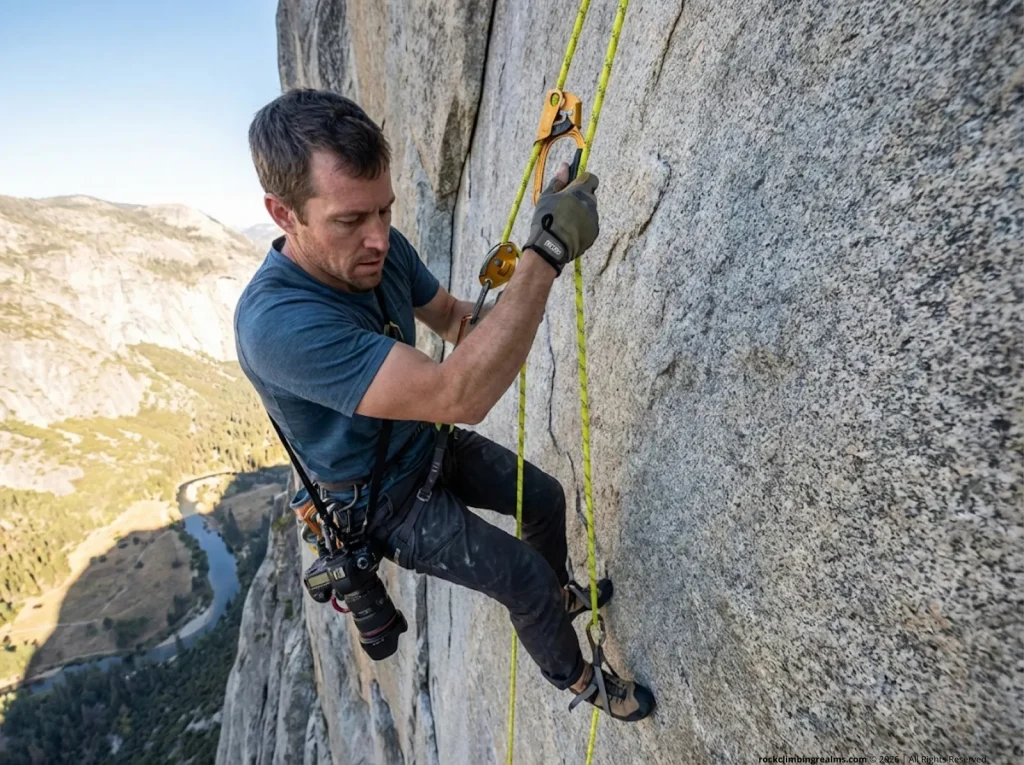
You cannot safely and efficiently jug on a dynamic climbing rope. Static ropes in the 9-10mm range, like the Mammut 9.8mm Crag Classic, are built for fixed-line ascending. They have minimal stretch, which means less bounce and more stability while you’re hanging in position and trying to frame a shot.
Dynamic ropes stretch under repeated jugging loads, and that stretch makes you bob up and down while destroying the rope’s core faster. Use your lead rope for leading. Fix a dedicated static line for photography.
Bombproof Anchor Setup
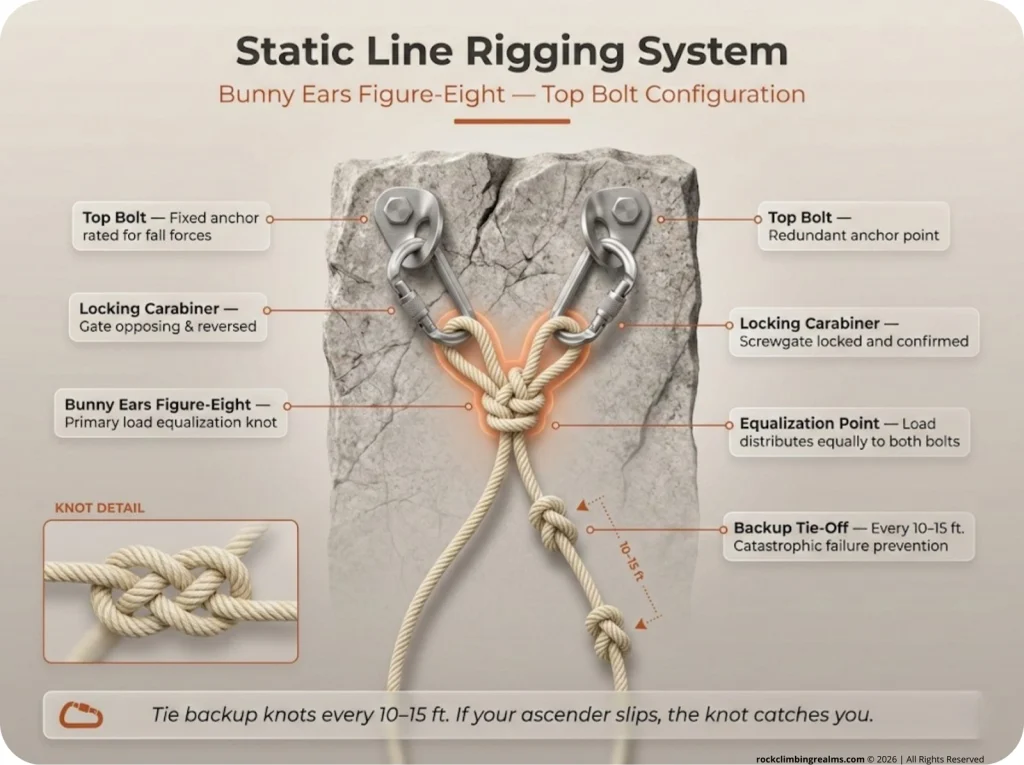
Anchor a bunny ears figure-eight knot to the top bolts for a redundant, equalized attachment point. Every safety protocol applies here the same way it does for any trad climbing anchor. SERENE principles. Equalized. Redundant. No extension.
If you can back-tie to a second anchor point, do it. Redundancy is not a suggestion when you’re hanging 80 feet off the deck with a camera dangling from your hip and no one belaying you. A poorly rigged anchor under sustained static load can slip or fail, and the consequences are exactly as bad as they sound. The UIAA safety standards for climbing equipment exist for this reason.
Pro tip: Before your first shoot, practice your entire rigging and static line jugging setup on a low-angle wall close to the ground. Work out the kinks where the stakes are low.
Jugging Technique for Photographers
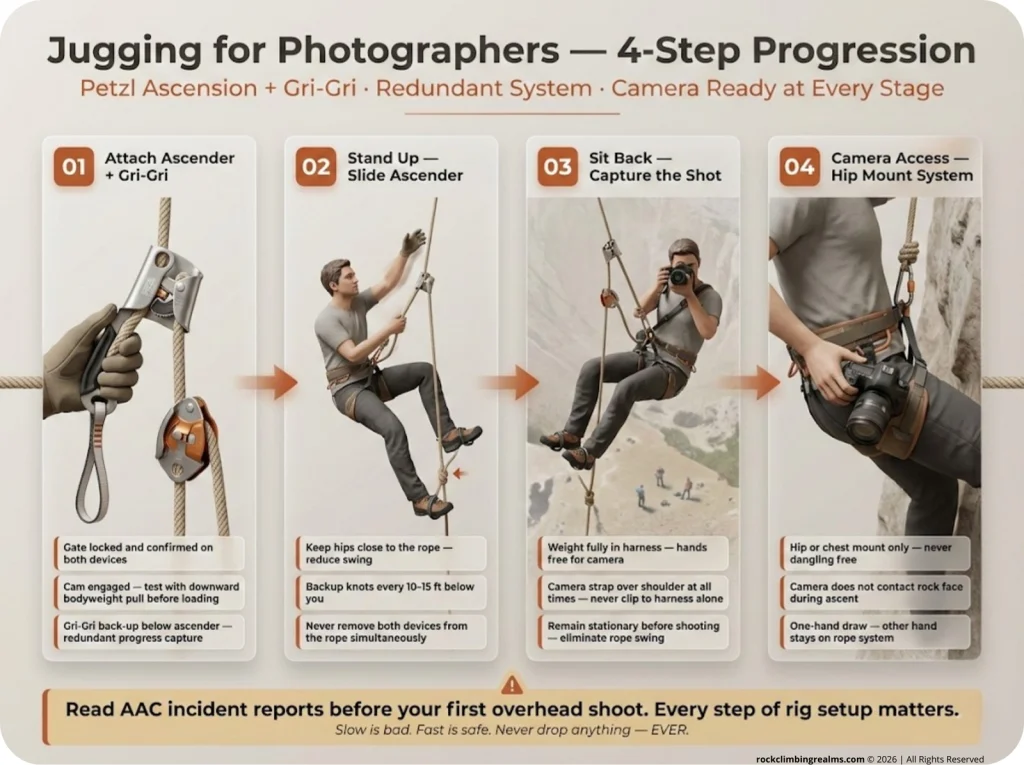
Use a Petzl Ascension ascender paired with a Gri-Gri for redundant progress capture. Burr puts it plainly: “The fastest way to ruin your reputation as a photographer is to suck at jugging. Slow is bad. You have to be fast… and you can’t drop anything—EVER.”
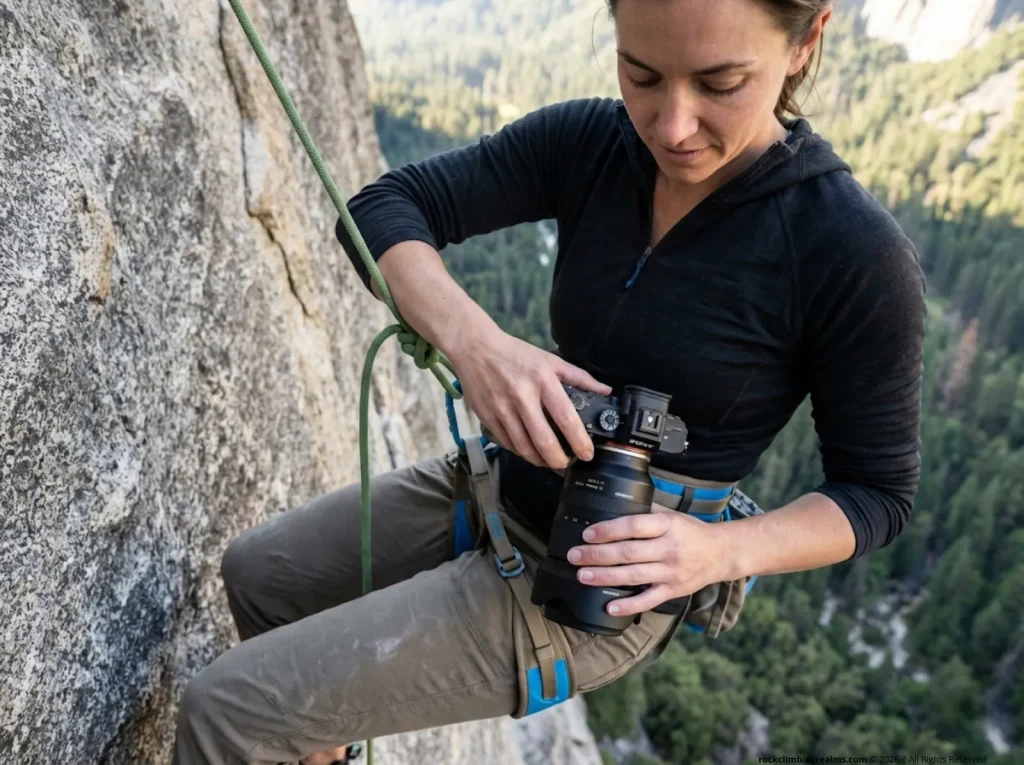
Speed matters because every minute you spend fumbling on the rope is a minute you’re blocking the route for your partner. Tie backup knots every 10-15 feet on the static line to prevent catastrophic failure if your ascender slips. Keep the camera in a hip harness or chest-mounted system so it stays accessible without bashing against the rock during the ascent.
If you’re new to rope ascent, master the 60-second rope ascent transition before you bring a camera into the equation. Get the systems clean first, then add the complexity of shooting.
The American Alpine Club incident reports document multiple cases of anchor and jugging failures. Read them before your first overhead shoot. Those reports are not bedtime stories — they’re the reason every step of your rig setup matters.
Composition Rules That Actually Work on Rock
Capture the Full Body in Context
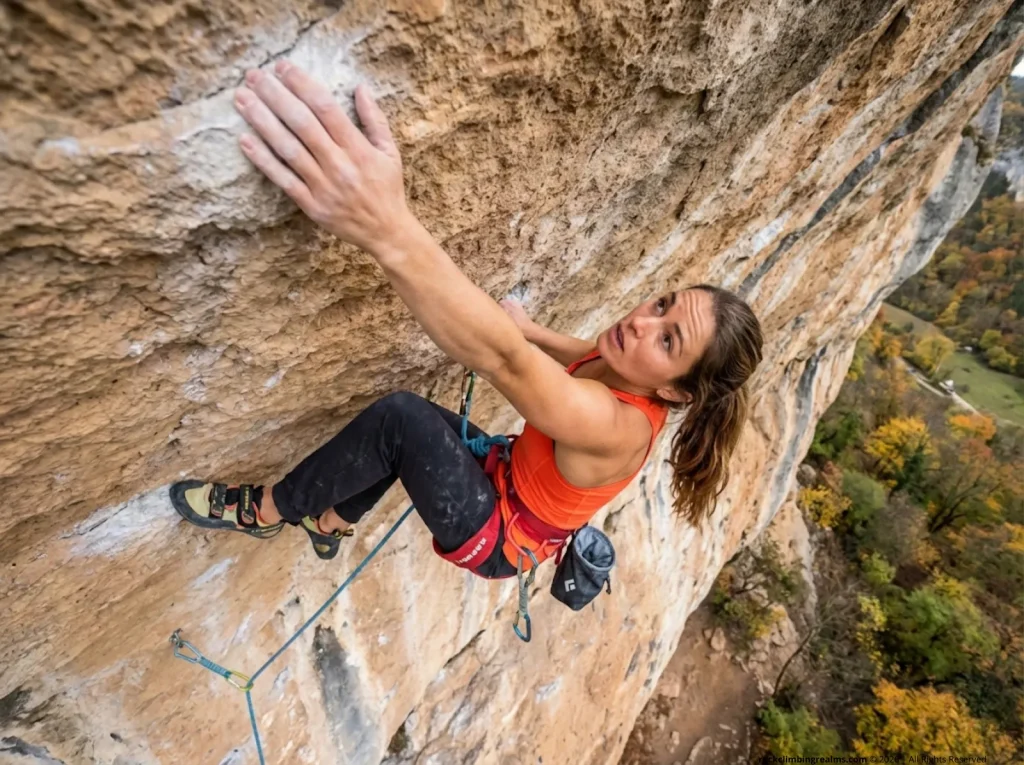
Shoot wider than you think you need. Cropping in post takes two seconds. Adding stunning scenery you cut out of the original frame takes zero seconds because you can’t do it. A wide angle lens in the 15-30mm range, like the Tamron 15-30mm f/2.8, exaggerates height and pulls the surrounding scene into frame.
Keep the climber’s full limbs visible. Head to foot, at least one hand and one foot on holds. This tells the story of the climb. The “artsy crop” that chops off an arm or both feet looks intentional on Instagram but is just lost information in climbing photography. Context is the content.
Bright Clothing and Visual Pop
A red jacket against gray granite pops harder than a black shirt that dissolves into shadow. Tell your climber to dress for the camera before the approach. Bright clothing doubles as a scale reference, helping the viewer understand how small a small climber looks against 300 feet of sandstone and sheer cliffs.
This is the simplest tip in the entire article. Zero skill required. Just wardrobe coordination.
Timing the Dynamic Moment
Shoot when the climber is mid-move. Dynamic outstretched poses with full extension, eyes up, hand reaching for the next hold — that’s the frame. Kaya Lindsay, a climber-photographer who shoots for Outdoor Prolink, keeps it direct: “Only take photos when your climber is looking up. Ropes in motion look awesome.”
Crank the shutter speed to at least 1/500 to freeze the decisive moment without blur. Wait for the crux, not the rest stance. The hardest section of the route produces the most dramatic body positions and the best photographs. If you know how to project a sport route, you already know the crux sequence, which means you know exactly when to press the shutter.
Light, Weather, and When to Shoot
Why Overcast Days Win
Cloud cover is a giant natural softbox. Overcast light diffuses evenly across the rock face, reduces harsh shadows, and preserves detail in the climber’s face and the texture of the holds. Direct midday sun? Blown-out highlights on exposed skin, pitch-black shadows in every crack and corner. Your camera can’t handle that contrast range, and neither can your viewer’s eyes.
Full shade works almost as well. If one side of the cliff is baking while the other sits in shadow, shoot the shaded side every time.
Golden Hour on the Wall
The first and last hour of sunlight wraps warm golden tones around the rock and the climber. But golden hour climbing on vertical terrain is not the same as golden hour in landscape photography. Wall orientation matters. An east-facing cliff gets morning light, a west-facing wall needs late afternoon. And the transition from golden to blown happens fast at altitude — you might have a 20-minute window before the magic disappears behind the ridge.
Cold-Weather Camera Handling
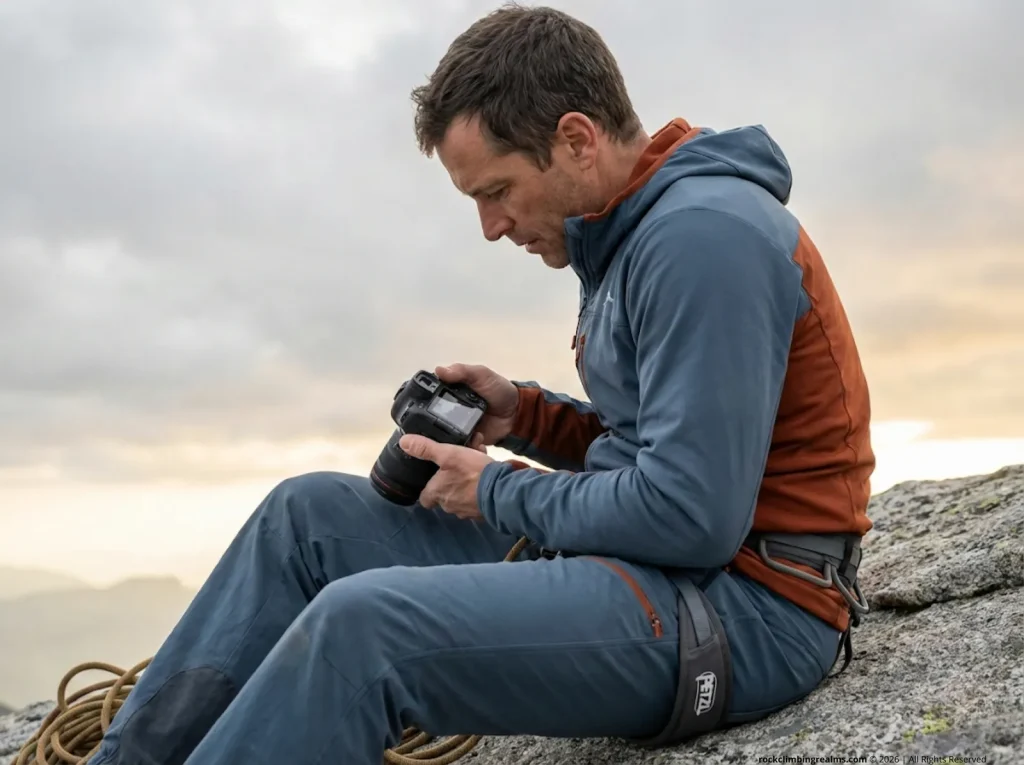
Battery life falls off a cliff below freezing. Warm batteries inside your jacket pocket or sleeping bag until the moment you need them. When you move a cold camera into a warm tent, condensation forms on the lens and sensor. Let it equalize slowly inside a sealed bag first.
Touch screens stop responding with gloves on. Know your camera’s physical buttons by feel. Learning this the hard way on a February multi-pitch when your Canon R6 dies at the crux is a lesson that sticks, but only because you missed every shot that mattered.
Pro tip: Carry two spare batteries on cold days and rotate them — one warming against your body while the other runs the camera. You’ll double your shooting time on winter climbing trips.
Gear That Works Without Slowing You Down
Smartphone Starter Setup
Most beginners already own a perfectly capable camera. Modern smartphones handle overcast light and fast shutter speeds well enough for your first season of overhead climbing photography. Attach a lanyard to your harness so the phone stays tethered. Use burst mode, shoot wider for cropping, and get started.
This is where 90% of beginner climbing photographers should start. Don’t let gear anxiety delay getting above the climber — planning versus gear is a false choice. The angle matters more than the sensor.
Dedicated Camera Rigs for the Wall
If you’re ready to step up, a mirrorless body like the Canon R6 or Nikon D610 paired with a wide angle single lens, such as the Tamron 15-30mm f/2.8, covers the demands of rope-level shooting. Mount the camera in a hip harness system so you can grab it mid-hang without unclipping anything.
For extended sessions, a bosun’s chair on the static line improves hanging comfort dramatically. Hours in a standard climbing harness compress your legs and drain your focus. The chair lets you sit naturally on a tiny ledge of fabric, leaving your hands free for framing.
Honest take: you don’t need a $3,000 camera body to nail overhead climbing shots. A well-positioned phone beats a poorly positioned DSLR every time.
What to Leave at the Base
Extra weight on the wall means slower jugging and higher fatigue. Bring one body, one lens, one spare battery, and nothing else. No tripods, no lens kits, no camera bags. This is vertical terrain with real consequences for dropped gear — minimal gear is the rule, not the exception.
Everything must be tethered. Camera, lens cap, battery door. Dropping a lens from 100 feet can injure your partner below. If you’re trying to figure out what to bring, the same mindset behind stripping your packing list to the essentials for a climbing trip applies here.
Use Your Photos to Sharpen Your Climbing
Reading Your Body Position in Photos
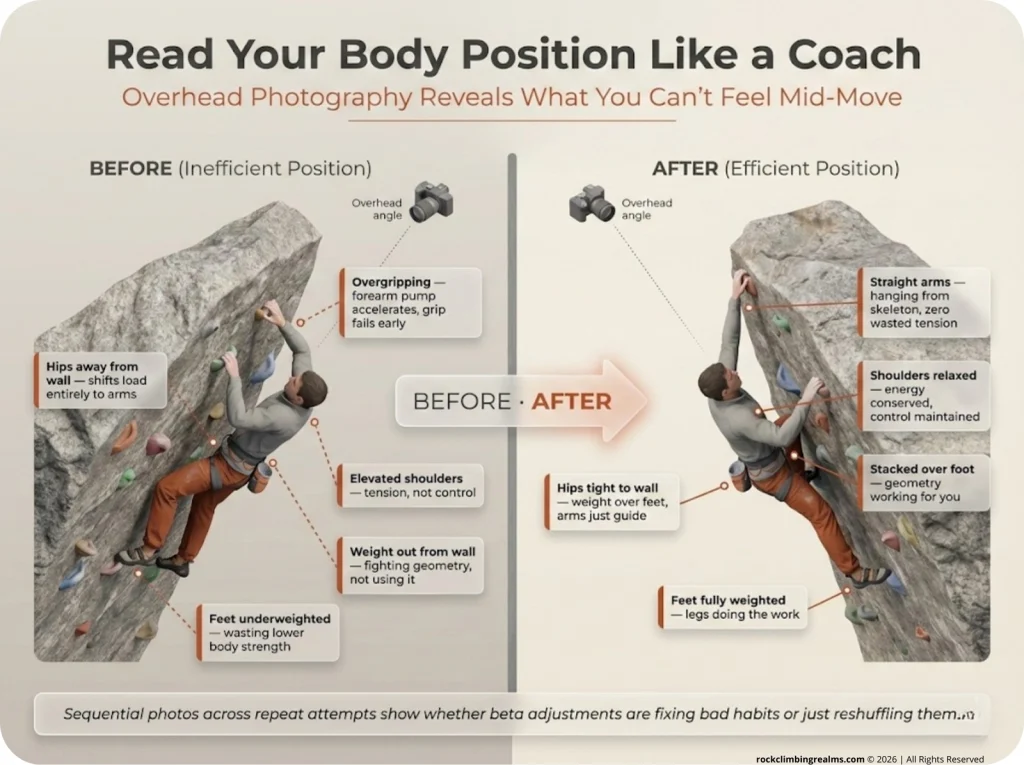
Here’s where overhead climbing photography becomes something more than documentation. It becomes a climbing training tool. Shoot from above the climber, and the images show hip position, foot placement accuracy, arm extension, and weight distribution with a clarity you can’t feel in the moment.
Look at your own photos the way a coach watches game film. Are your hips close to the wall? Are you overgripping? Is your center of gravity stacked over your feet? Compare your body position to efficient movement principles, and the gaps show up instantly. If you want to go deeper, run a proper climbing assessment using those images as your raw data.
Sequential photos of the same move across repeat attempts show whether your beta adjustments are improving your position or just shuffling the same bad habits around. This is how professional climbers and good photographers turn every session into measurable progress toward personal climbing goals.
Tracking Progression Over Time
Monthly photo comparisons of the same problem or route reveal technique improvements that memory can’t track. Analyze your own beta from three months ago and compare it to your actual climb today — you’ll see changes you didn’t even notice happening.
Document your redpoint sequence from approach to send attempt. The visual record tells the story of the climb in a way a logbook entry can’t. Share the incredible photos with your partner or coach for external feedback on movement quality.
I looked back at overhead shots from six months ago recently. My hips were miles off the wall. I couldn’t feel it during the climb, but the camera caught every inch of wasted energy. That’s the kind of feedback no spotter or belayer can give you in real time.
Conclusion
Three things change your climbing photos from forgettable to worth printing. First, get above the climber — foreshortening from below destroys the drama, hides the face, and wastes every frame. Second, rig your overhead position with a bombproof anchor, a proper static line ascent system, and backup knots, because safety is not optional when you’re hanging in space with a camera. Third, study those overhead shots the same way an athlete studies film — your body position, your foot placements, your grip tension all show up in ways you can’t feel during the actual climb.
Next time you’re at the crag, rig a static line before anyone ties in. Jug up, frame your partner from above, and capture the one great shot that actually shows what the send felt like. Then flip through those images later and find the one thing you’d change about your own movement. That’s climbing photography that serves the climb.
Now go send something.
FAQ
How do you take pictures while climbing?
You don’t shoot and climb simultaneously on lead. Fix a static line to the top anchors and jug into position above the climber using ascenders with a Gri-Gri backup. This gives you a stable, safe shooting platform without splitting your attention between climbing and the camera.
What is the best camera for climbing photography?
Your phone is good enough to start. If you want to step up, a mirrorless body like the Canon R6 paired with a wide angle lens (15-30mm) handles overhead shooting well. Position and timing matter more than sensor size — a $400 phone from above beats a $3,000 camera from below.
Is it safe to take photos while belaying?
Only when the climber is clipped in and stationary, never during active lead movement. Your belayer attention must never split during critical moments. For better results, assign a separate photographer on a fixed line.
What lighting is best for outdoor climbing photos?
Overcast skies or full shade produce even, diffused lighting that preserves detail in the climber’s face and the rock surface. Avoid direct midday sun — it blows out highlights and buries every crack in shadow.
How do you shoot from above while climbing?
Fix a static rope (9-10mm) to top anchors with a bunny ears figure-eight knot, then ascend using an ascender and Gri-Gri system. Tie backup knots every 10-15 feet. Once in position, shoot with a wide angle lens to capture the full body and surrounding terrain.
Safety Notice: Rock climbing and mountaineering are inherently high-risk
activities that can involve physical trauma or fatal incidents. The information on Rock Climbing Realms is for
educational and informational purposes only. Techniques and advice presented here are not a substitute
for professional, hands-on instruction. Conditions and risks vary by location. Always seek guidance
from a qualified instructor before attempting new techniques. By using this website, you agree that you
are solely responsible for your own safety. Any reliance you place on this information is strictly
at your own risk, and you assume all liability for your actions. Rock Climbing Realms and its authors
will not be held liable for any harm, damage, or loss sustained in connection with the use of this information.
Affiliate Disclosure: We are a participant in the Amazon Services LLC Associates Program, an
affiliate advertising program designed to provide a means for us to earn advertising fees by advertising and linking
to Amazon.com. As an Amazon Associate, we earn from qualifying purchases. We are also an official affiliate partner
of Black Diamond Equipment via the AvantLink network. If you click on a Black Diamond affiliate link and make a
purchase, we may earn a commission at no additional cost to you. We also participate in other affiliate programs.
Additional terms are found in the terms of service.