
In this article
Thirty seconds into my first comp boulder I was flash-pumped to the elbows, staring at a volume I had never touched in practice. The clock didn’t care. I had spent the previous six weeks “training” — which meant climbing hard three times a week with zero structure and calling it preparation. Three hours later I walked out with one top and a list of everything I should have done differently.
After years of competing in local gym comps and coaching climbers through their first events, I’ve watched the same pattern repeat itself hundreds of times. Talented climbers show up underprepared, gas out early, and leave frustrated. The fix isn’t more climbing. It’s smarter programming built around the same periodized training principles that guide every serious athlete in every sport.
This guide lays out the exact structure — training blocks, comp-style movements, taper protocols, and a day-of game plan — so you show up peaked instead of panicked.
⚡ Quick Answer: Train for your local comp using a structured 8–12 week periodized blueprint divided into three blocks: build strength first (limit bouldering + hangboard training), shift to power endurance and comp-specific moves in the middle weeks, then taper volume by 40–60% in the final 7–10 days while keeping intensity high. On comp day, warm up thoroughly with bodyweight exercises before touching the wall, pace your attempts across the full session window, and recruit a buddy to keep nerves in check.
Set a Goal That Actually Helps You Train
Pick Your Category and Define “Success”
Every local competition splits competitors by some combination of age, gender, and ability. Before you touch your training plan, figure out which category you’re entering and what “success” looks like for you. A climber gunning for a podium spot needs strict periodization. Someone entering their first comp to test themselves can afford a looser structure with more play.
The difference matters because vague goal setting produces vague training. “I want to do my best” sounds nice but gives you nothing to program around. “I want to flash every V4 and top at least two V5s” tells you exactly what grade range to train in and what energy systems to prioritize. Write that goal down. Stick it on your hangboard. You’ll see it every session.
If you’ve never benchmarked your current level, start there. Record your redpoint grade, your max hang on a 20 mm edge (bodyweight plus any added load), and how many 4×4 sets you can sustain before form collapses. Those three numbers become the baseline to measure weekly progress. If you want a deeper starting-point audit, a data-backed climbing assessment framework breaks the process into measurable steps.
Budget Your Calendar Backwards
Count backwards from comp day. If you’ve got 10–12 weeks, split them into three training blocks: weeks 1–4 for base and strength training, weeks 5–8 for power and specificity, and the final 7–10 days for taper. If you only have six weeks, compress the base phase into two weeks and prioritize the power block and taper. Whatever you do, never skip the week-of taper. It’s where the gains actually show up.
Build Power and Power Endurance in Blocks
This is the section most competitors skip entirely — and the one that separates a structured peak from random hard sessions the week before. These 6–12 week training blocks give your body time to adapt, layer adaptations, and peak on schedule.
Block 1 — Base and Strength (Weeks 1–4)
Your focus here is limit bouldering and foundational muscular strength. Pick 5–8 problems at 90–100% of your max effort and commit to full rest between attempts — five minutes minimum. This isn’t a cardio workout. You’re training neural drive and raw power.
Off the wall, add 30 minutes of antagonist and core work per session: push-ups, pistol squats, weighted pull-ups, and wrist extensors. Hangboard training happens twice a week during this block. Use the 20 mm edge for fingerboard max hangs: 10-second hangs at 80–90% of your max grip force, three minutes of rest, five sets. As Steve Bechtel puts it, training adaptations work in long waves — it takes 4–8 weeks to see a significant strength benefit. Start early.
For a broader look at how these blocks fit into a year-round cycle, a full periodization framework for climbers explains the progression logic in detail.
Block 2 — Power and Specificity (Weeks 5–8)
Now shift to 4×4 power endurance work. The protocol is straightforward: pick four moderate boulders (60–70% max effort), climb them back-to-back within four minutes, rest four minutes, and repeat. Quality matters more than quantity — if your form crumbles, stop the set. This builds the capacity you’ll need when the comp forces you to attempt multiple hard problems without full recovery.
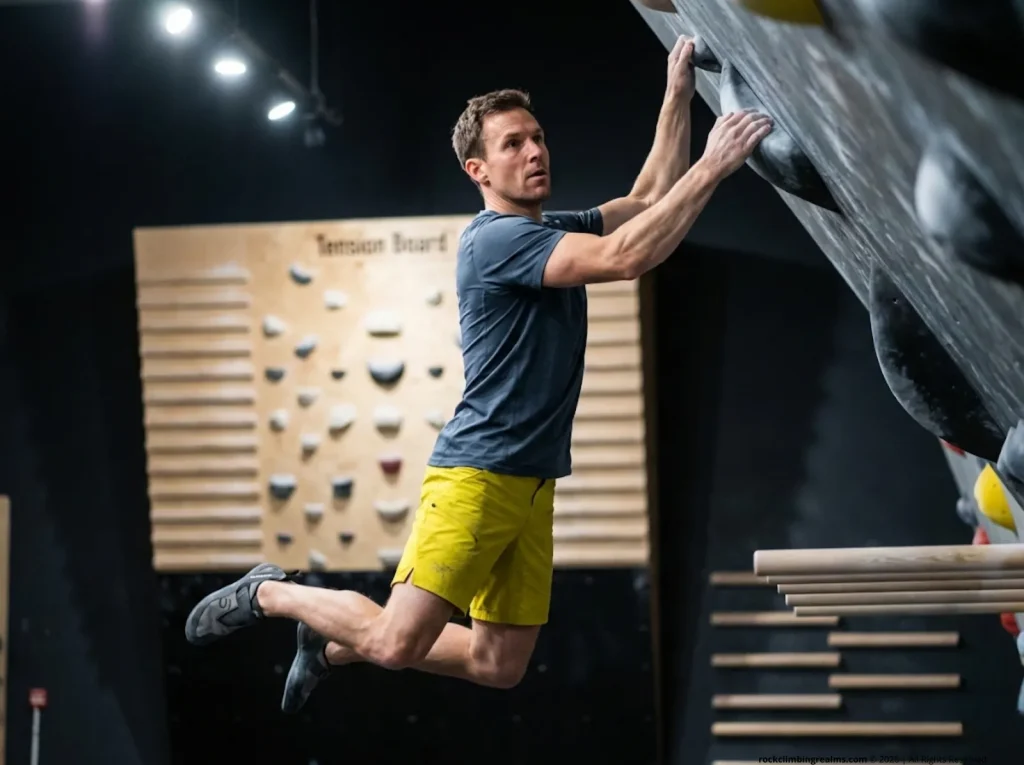
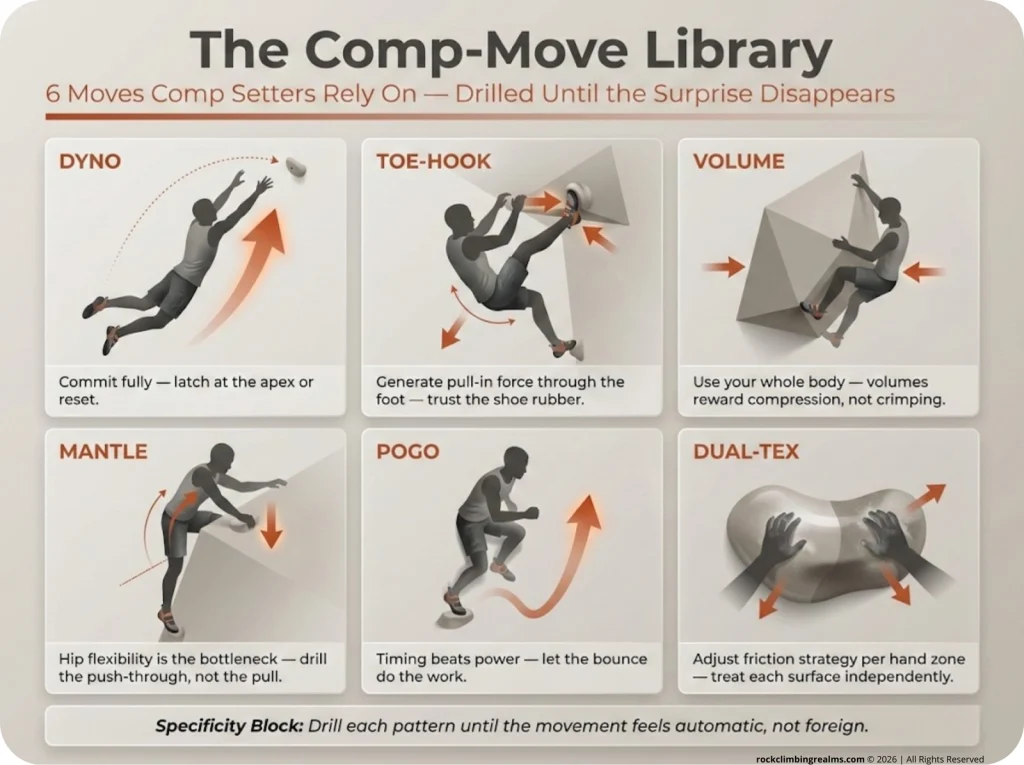
This is also when you start drilling comp-style movements: dynos, toe-hooks, volumes, mantles, pogos, and dual-tex holds. If your home gym doesn’t set comp-style settings, visit other gyms. Volumes and dual-tex feel alien if you only practice comp moves at one spot.
Pro tip: Practice comp moves at other gyms during this block. The unfamiliar setting forces adaptation and prepares you for the surprise factor on comp day.
Reduce fingerboard volume to maintenance — one session per week — and pour the recovered energy into on-wall specificity.
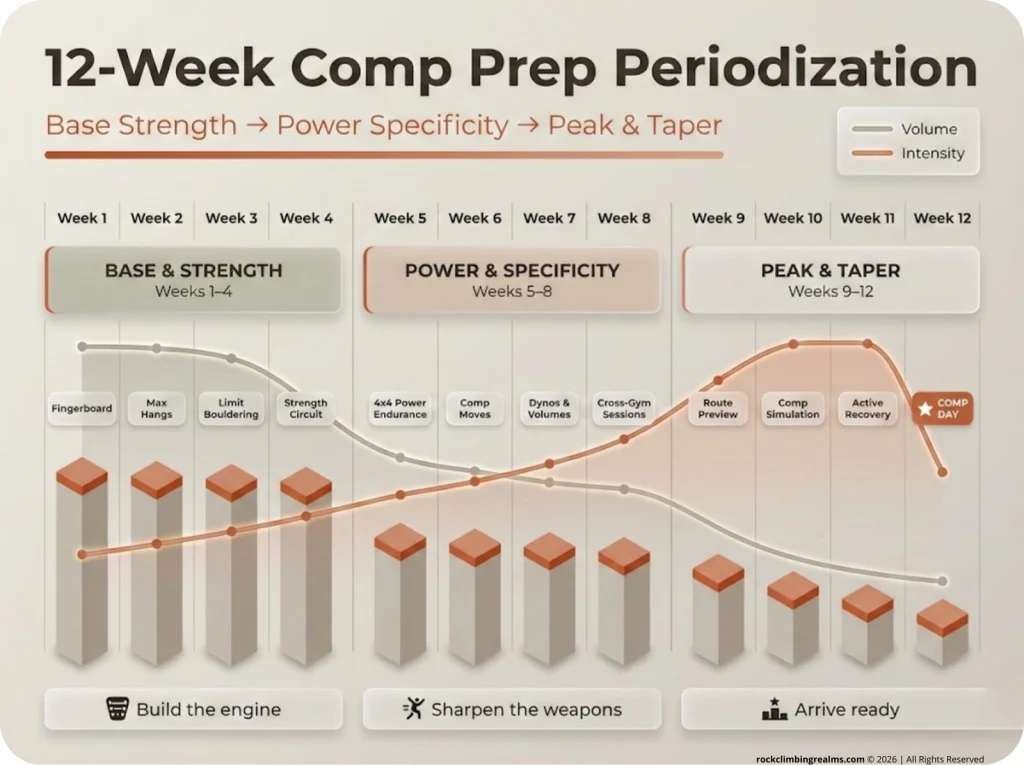
Block 3 — Peak and Taper (Final 7–10 Days)
Here’s where most climbers blow it. They keep training hard right up to the event, walk in fatigued, and wonder why their sends feel sluggish. The taper exists to let your body absorb every hour of work you’ve banked.
Cut total volume by 40–60% while keeping intensity high. Drop the 4x4s and limit bouldering entirely. Climb easy-to-moderate problems at high quality just to stay sharp. According to NSCA guidelines on optimal taper duration, this kind of volume reduction triggers supercompensation — a recovery-driven performance rebound that adds roughly a 3% gain. That might not sound like much, but 3% is the difference between sticking a crux hold and peeling off.
Prioritize sleep — eight-plus hours. Hydrate. Eat well. No new training stimuli. Trust the process.
Pro tip: If you feel guilty about “not doing enough” during your taper, that means it’s working. The restlessness is the adaptation happening.
Train Your Fingers Without Wrecking Them
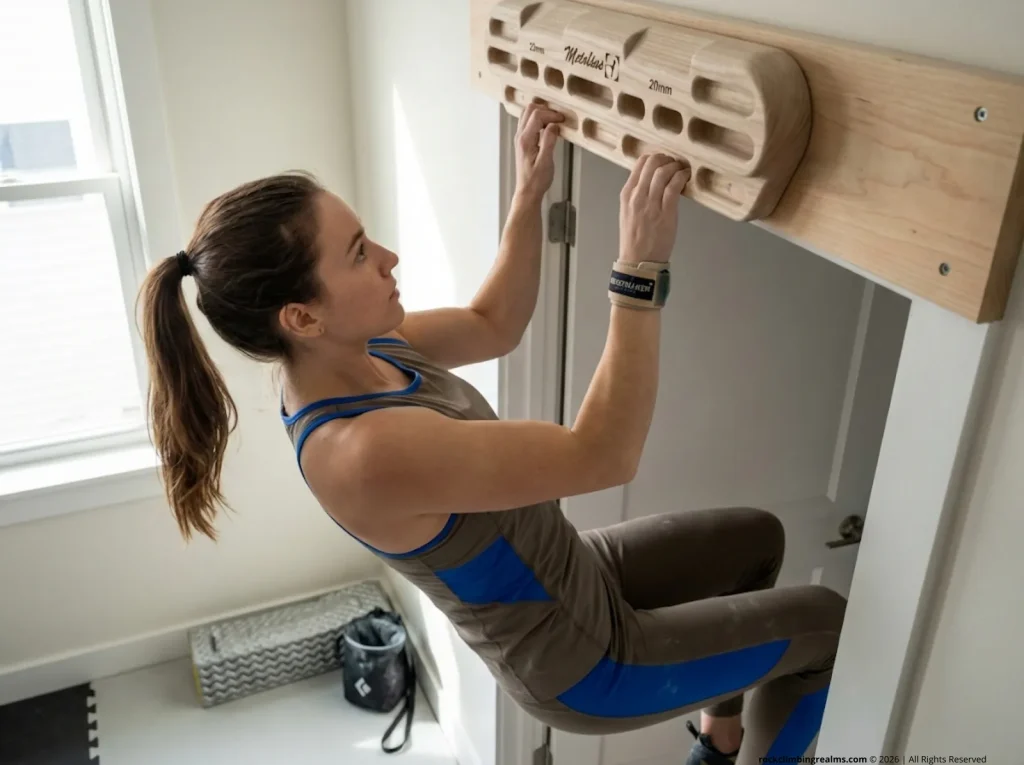
The 20 mm Edge Protocol
Finger strength is the single biggest physical limiter for most intermediate climbers in a comp setting. The standard protocol uses a 20 mm edge for max hangs: 10-second hangs, three-minute rest, five sets at 80–90% of your max grip force. Progress by adding weight — two to five pounds per training cycle — not by shrinking the edge. Smaller edges spike injury risk without proportional strength gain at this level.
Eric Hörst’s 7-53 protocol (7 seconds on, 53 seconds off) is an alternative that targets pure maximal recruitment. Either approach works. Pick one and stick with it for the duration of your base block.
If you’re new to fingerboarding, a safe hangboard blueprint for beginners walks through setup, form, and progressive loading before you add comp-level intensity.
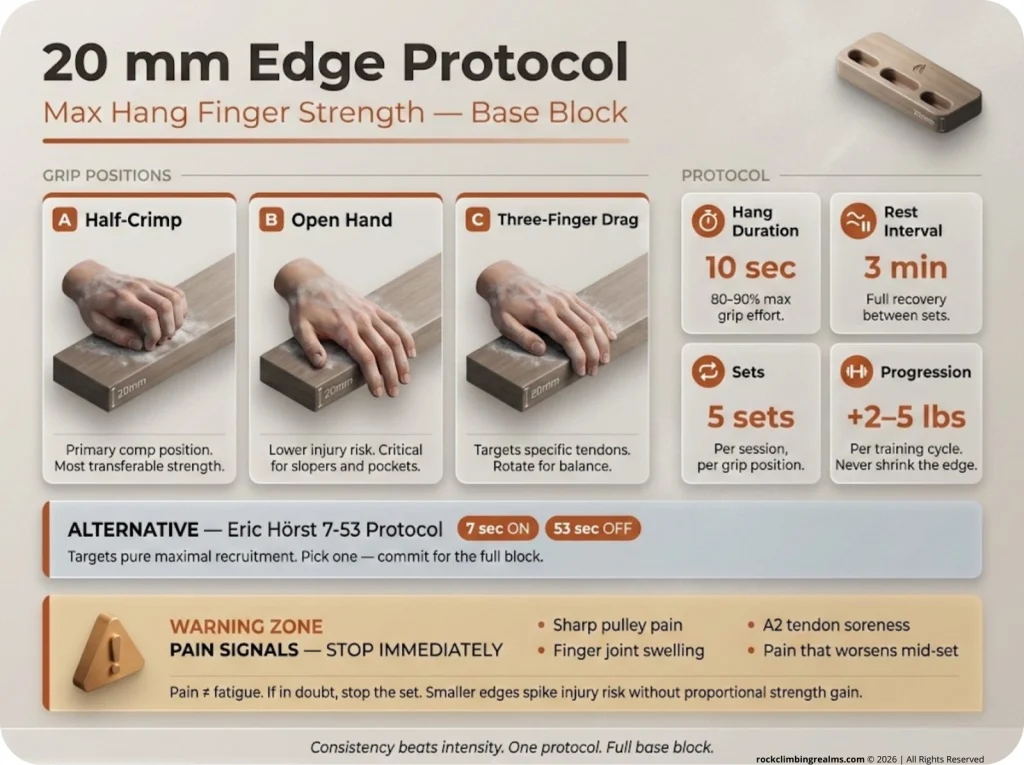
Injury Screening and Extensor Balance
Overuse injury incidence in climbing runs at approximately 4.2 per 1,000 climbing hours, with 93% classified as overuse and fingers as the most common site — confirmed by a 2023 systematic review on overuse injury risk factors in adult climbers. Before starting a hangboard cycle, run a simple injury-prevention mobility screen: squeeze a rubber ball hard for 10 seconds. If sharp pain fires in any digit, see a professional before loading.
Train wrist and finger extensors with rubber band extensions and reverse wrist curls. Climbing is a pulling sport, and the imbalance between flexors and extensors is where most injury-prevention fails. Catching problems early — before they become a six-week layoff — is the whole point of screening before each block.
Pro tip: Finger pain during hangs is a red flag, not a badge of honor. Stop, assess, and rule out pulley strain before you continue. A missed week now beats a missed season later.
Learn to Read Comp Boulders Before You Touch Them
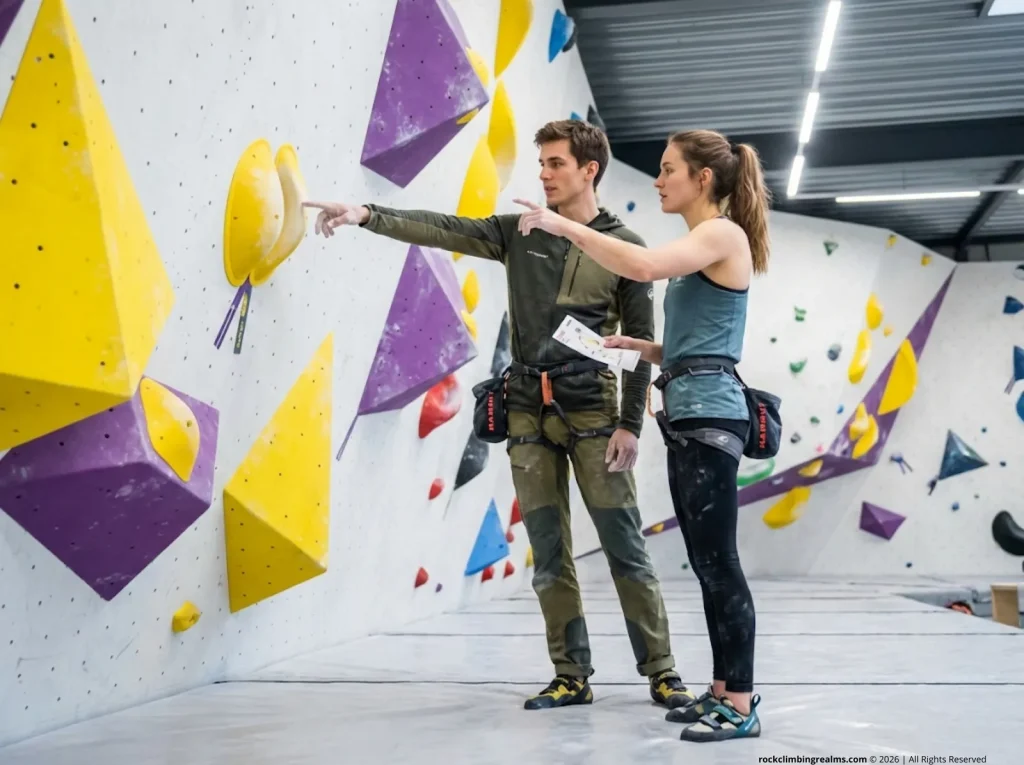
The Comp-Move Library You Need to Practice
Comp setters love moves that punish climbers who haven’t practiced them. Dynos demand full commitment — latch at the apex or miss entirely. Toe-hooks generate pull-in force through the foot, locking you under volumes or aretes. Mantles shift your body from pulling to pushing over a lip, and hip flexibility is usually the bottleneck. Pogos use a bounce start where timing matters more than raw power. And dual-tex holds force you to adjust friction strategies for each hand zone.
None of these moves are hard once you’ve drilled them. They’re just unfamiliar. That’s the trap. Spend your specificity block working through each movement pattern until the surprise factor disappears.
Reading Strategy on Comp Day
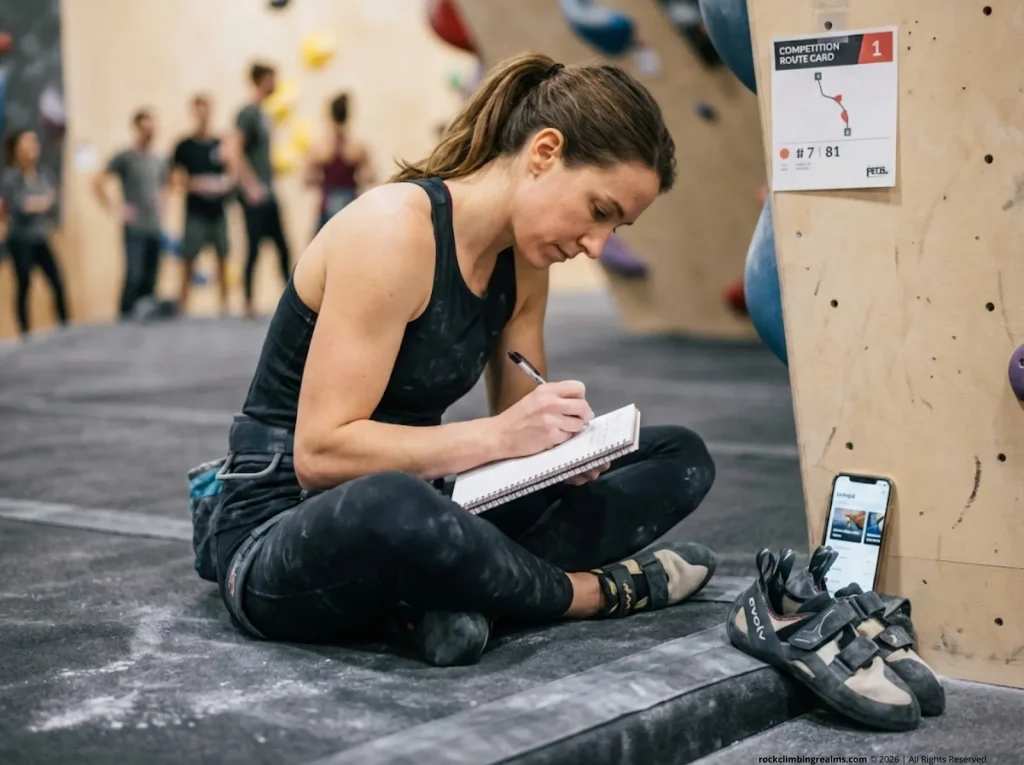
Before you touch a competition boulder, stand back and observe for 60 seconds. Identify the crux, the rest position (if one exists), and the exit sequence. Count the moves mentally and assign holds to body positions. Then watch someone of similar size and style attempt it. Their beta might not work for you, but it narrows the options.
The biggest mistake on comp day is overthinking every move. Have a three-step plan — start, crux, finish — and commit. If you want to go deeper on visual reading strategy, how to read competition boulder problems like a route setter breaks the process into a repeatable system.
Lock Down Your Comp Day Game Plan
Warm-Up Protocol That Prevents Flash-Pump
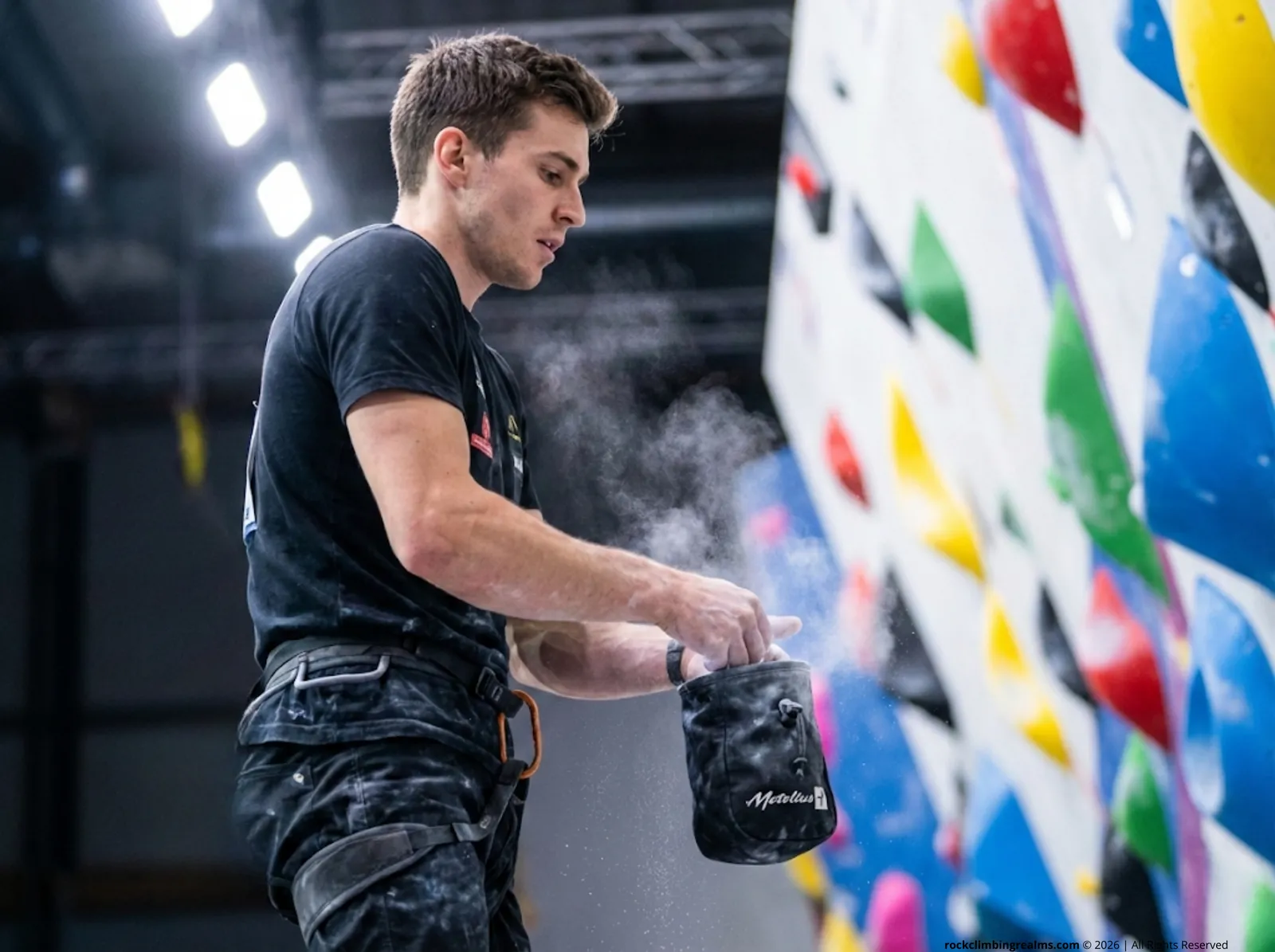
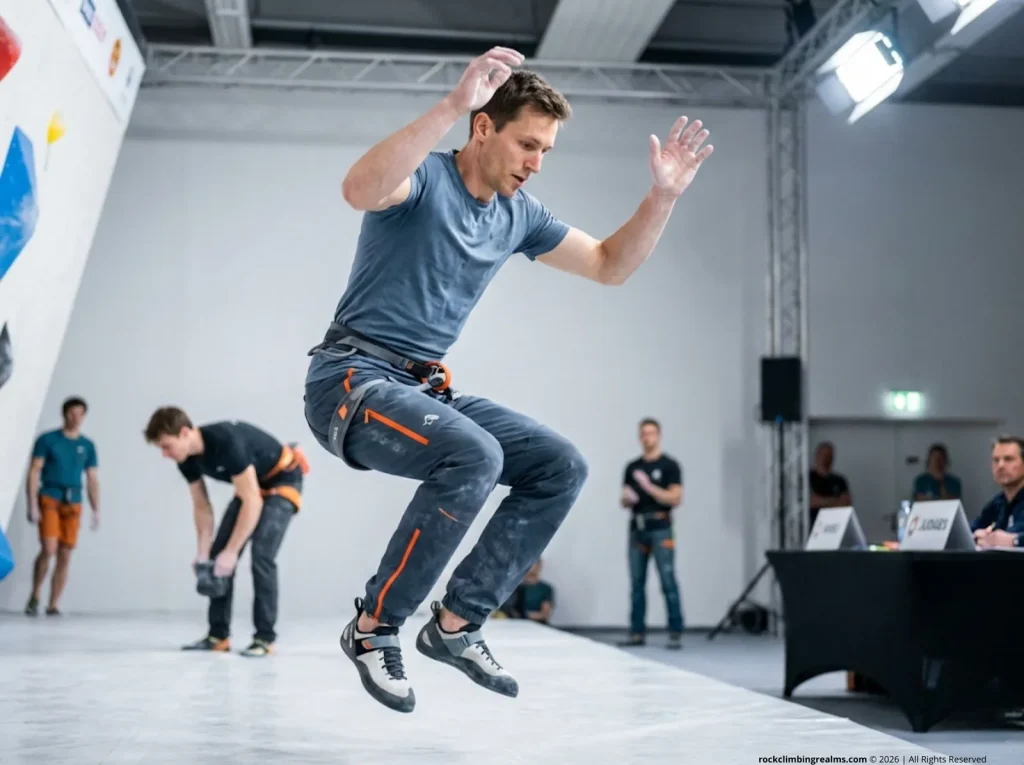
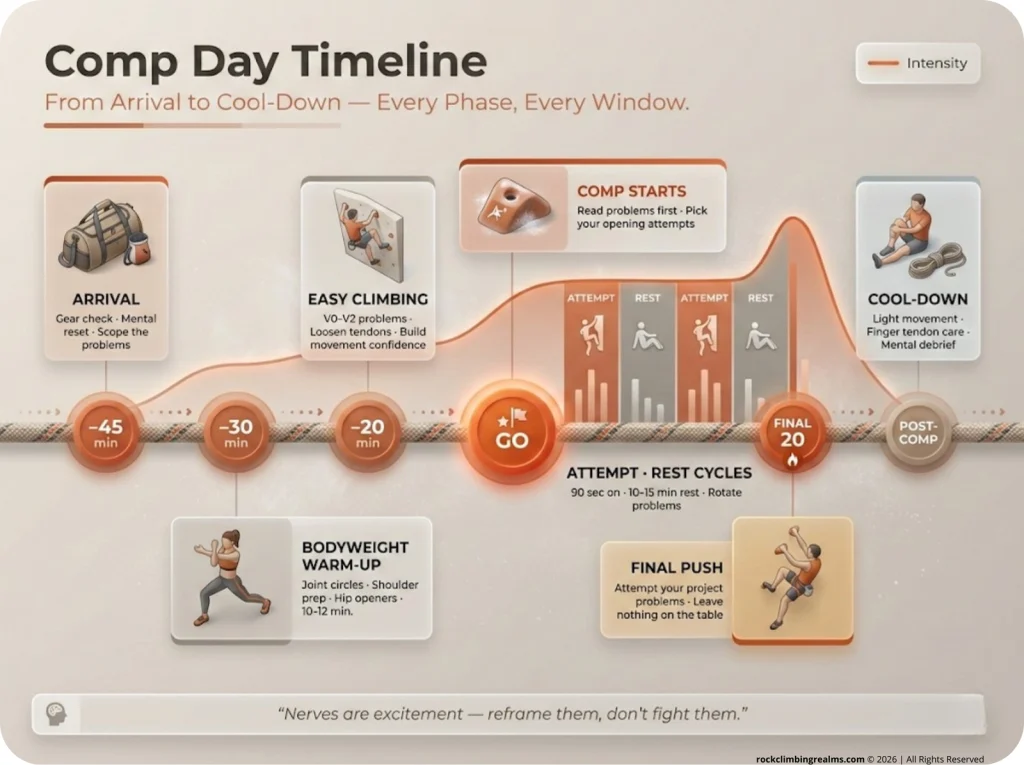
Arrive 30–45 minutes before your session starts. Begin with three sets of bodyweight work: a one-minute plank, 10 push-ups, and 10 jump squats. This is your warm-up routine — non-negotiable. Then climb three to five easy problems — V0 to V2 range — to activate pulling muscles and push blood through your forearms.
Flash-pump prevention is the number one comp day priority. Once your forearms are cooked in the first 20 minutes, recovery within the comp window is unlikely. Skip the temptation of “just trying” a hard warm-up problem. Save it for when it counts.
Pacing and Attempt Strategy
In a redpoint-format comp, attempt every problem at least once before revisiting anything. That first pass gives you beta intel and prevents tunnel vision on a single boulder. In a points scramble format, prioritize warm-up boulders for quick tops, then use remaining time for stretch attempts. If your event uses a fewest attempts scoring system, every burn counts — scout more, commit harder.
Rest three to five minutes between hard attempts. Eat small calories every hour — a banana, a granola bar, an electrolyte drink. A pacing strategy preserves energy across a 2–6 hour event window. Burning out in the first 30 minutes leaves sends on the table.
Buddy System and Nerves
Recruit a buddy and play the SEND game: take turns calling problems, cheer each other on, and turn anxiety into friendly competition. Most local comps foster a community vibe, not cutthroat rivalry. The social energy keeps you climbing loose, and mental reframing — treating nerves as excitement rather than dread — is the fastest way to settle into your mental game.
If pre-comp nerves are a recurring problem, a 4-week mental training protocol for climbers builds specific tools for managing arousal before performance events. Competition psychology isn’t fluff — it’s the edge that separates two climbers with identical strength.
Recover Right and Build Toward the Next One
Post-Comp Recovery Protocol (Days 1–7)
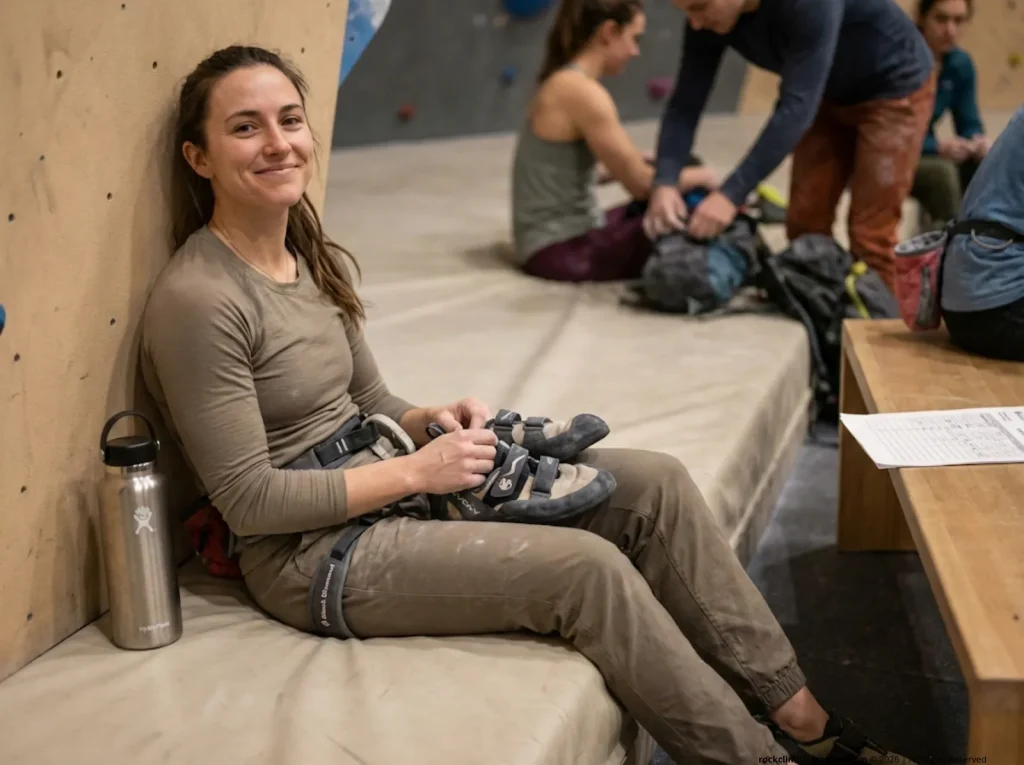
Days one and two: full rest. No climbing. Light walking, stretching, or yoga only. Days three through five: active rest day protocol — easy traversing, mobility work, foam rolling forearms and shoulders. Days six and seven: resume moderate climbing at 50–60% effort.
Bouldering competition events carry higher acute injury risk than lead formats. PMC data showing bouldering injury rates versus lead climbing puts the numbers at 1.47 versus 0.29 per 1,000 hours in elite events. Respect the post-comp recovery window after a comp that hammered your power system. To understand why rest works, the science behind climbing rest days and active recovery covers the supercompensation cycle in detail.
Post-Mortem and Long-Term Progression
Write a comp debrief within 48 hours. What went well? Where did you get stuck? Which moves felt unpracticed? Compare your pre-comp benchmarks — max hang, 4×4 capacity, flash grade — against your actual performance.
Then set targets for the next training cycle. Adjust block lengths. Add a new weakness — lead climbing endurance, slab technique, hip mobility, whatever the comp exposed. The post-mortem is where real progression happens. Every comp teaches you something the gym alone can’t.
Conclusion
Three things separate a peaked competitor from someone winging it. First, real comp programming happens in blocks — base strength, power endurance, taper — not random hard sessions the week before. Second, finger strength, comp-move familiarity, and a warm-up routine are the three vectors that decide whether you have a fun experience or a frustrating one. Third, the taper is where you earn back everything you invested. Cut volume, keep intensity, and trust the adaptation.
Pick a local comp 10–12 weeks out, benchmark your current grades and hang numbers, and start block one this week. You already know what winging it feels like.
Now go send something.
FAQ
How do I prepare for my first climbing competition?
Start training 8–12 weeks before the event using a periodized plan split into three blocks — strength, power or specificity, and taper. Reduce volume by 40–60% in the final 7–10 days while keeping intensity high. On comp day, warm up with bodyweight exercises before touching the wall and pace your attempts across the full session window.
How long should I taper before a climbing competition?
A 7–10 day taper works for most local comps. Drop total climbing volume by 40–60% but keep your session intensity high. This triggers supercompensation — a recovery-driven performance rebound that adds roughly a 3% gain.
What should I expect at a local climbing comp?
Most local comps run 2–6 hours with 10–40 boulder problems or lead routes. Formats vary — redpoint, points scramble, fewest attempts — so check with your gym beforehand. The vibe is typically community-driven and friendly, not cutthroat.
What is a good training plan for bouldering competition?
Focus on three pillars: limit bouldering for max power (5–8 hard problems with full rest), 4x4s for power endurance (four moderate problems back-to-back repeated four rounds), and hangboard max hangs on a 20 mm edge for finger strength. Wrap all three into periodized blocks that progress from strength to specificity to taper.
How do I not get nervous before a climbing comp?
Recruit a climbing partner and use the buddy SEND game to channel anxiety into fun. Arrive early enough to warm up slowly — flash-pump from rushing is the biggest day-of issue. Most local comps are community events, not Olympic qualifiers. Lean into that.
Safety Notice: Rock climbing and mountaineering are inherently high-risk
activities that can involve physical trauma or fatal incidents. The information on Rock Climbing Realms is for
educational and informational purposes only. Techniques and advice presented here are not a substitute
for professional, hands-on instruction. Conditions and risks vary by location. Always seek guidance
from a qualified instructor before attempting new techniques. By using this website, you agree that you
are solely responsible for your own safety. Any reliance you place on this information is strictly
at your own risk, and you assume all liability for your actions. Rock Climbing Realms and its authors
will not be held liable for any harm, damage, or loss sustained in connection with the use of this information.
Affiliate Disclosure: We are a participant in the Amazon Services LLC Associates Program, an
affiliate advertising program designed to provide a means for us to earn advertising fees by advertising and linking
to Amazon.com. As an Amazon Associate, we earn from qualifying purchases. We are also an official affiliate partner
of Black Diamond Equipment via the AvantLink network. If you click on a Black Diamond affiliate link and make a
purchase, we may earn a commission at no additional cost to you. We also participate in other affiliate programs.
Additional terms are found in the terms of service.