
In this article
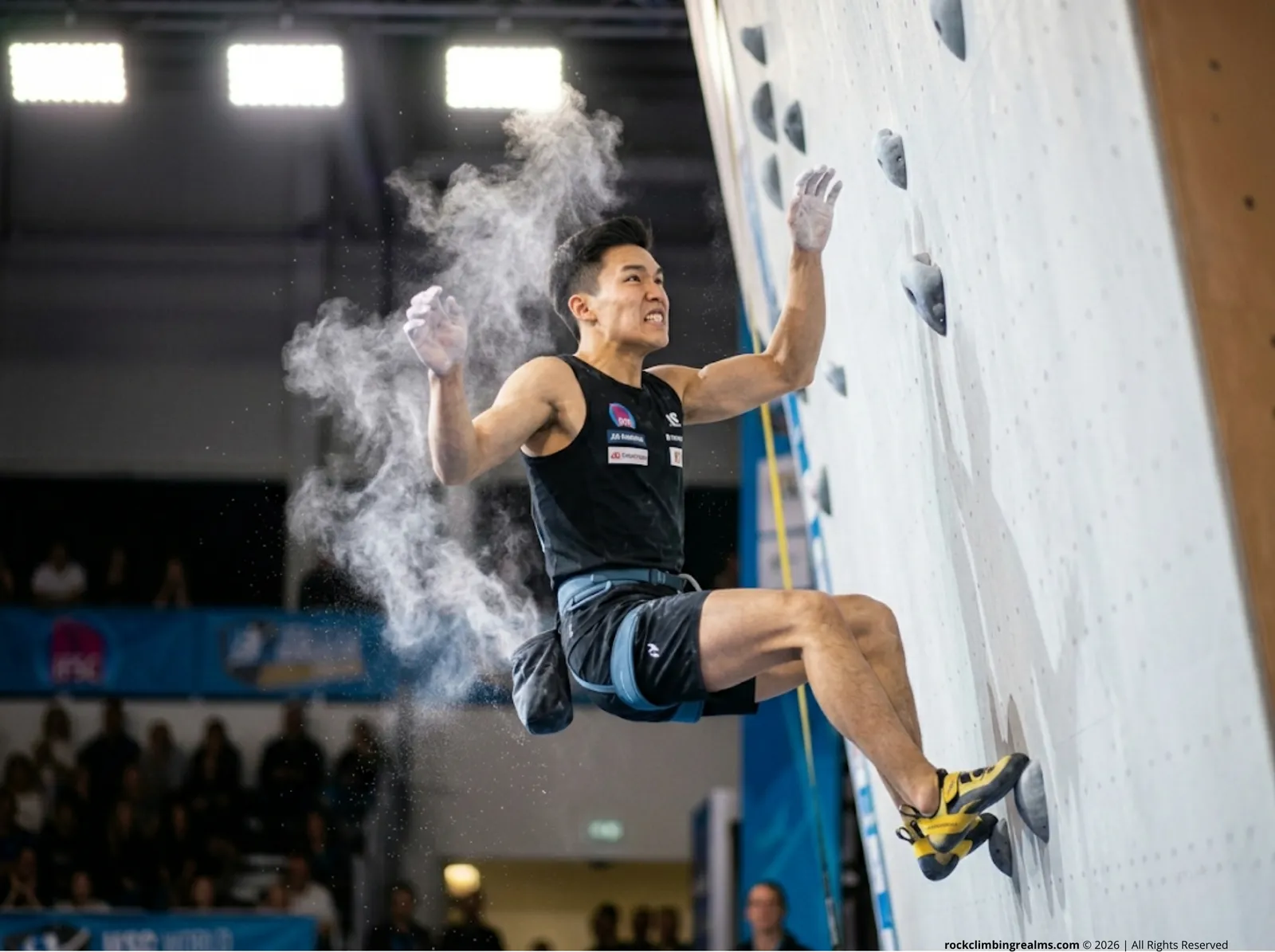
The buzzer sounds. Your foot leaves the pressure pad 0.099 seconds too early. False start. You grip the handlebar and stare at the wall, heart hammering, knowing the margin between a personal best and a disqualification is narrower than the width of a single hold. Sam Watson knows that margin better than anyone — his 4.79-second world record in April 2024 averaged 2.78 hand moves per second across 15 meters of resin-coated quartz. Every millisecond was earned, every wasted centimeter of hip travel cost him. And then there is the Tomoa Narasaki moment that broke a decade of orthodoxy: skip hold three, trust the swing start, and let the physics do the rest.
By the end of this piece, you will understand why the fastest climbers move the way they do, and you will have the metrics to diagnose where your own ascent leaks time.
⚡ Quick Answer: Speed climbing technique comes down to three physics problems. First, maintain vertical momentum by minimizing lateral hip movement and air time — every dyno decelerates you. Second, stay inside the ATP-CP energy window (under 10 seconds) so your body runs on raw chemical power instead of lactate-producing glycolysis. Third, synchronize your limb frequency — elite climbers average 2.78 moves per second, and rhythm matters more than raw strength.
The IFSC Speed Wall as a Physics Laboratory
 Mad Rock Remora slippers” class=”wp-image-14792″/>
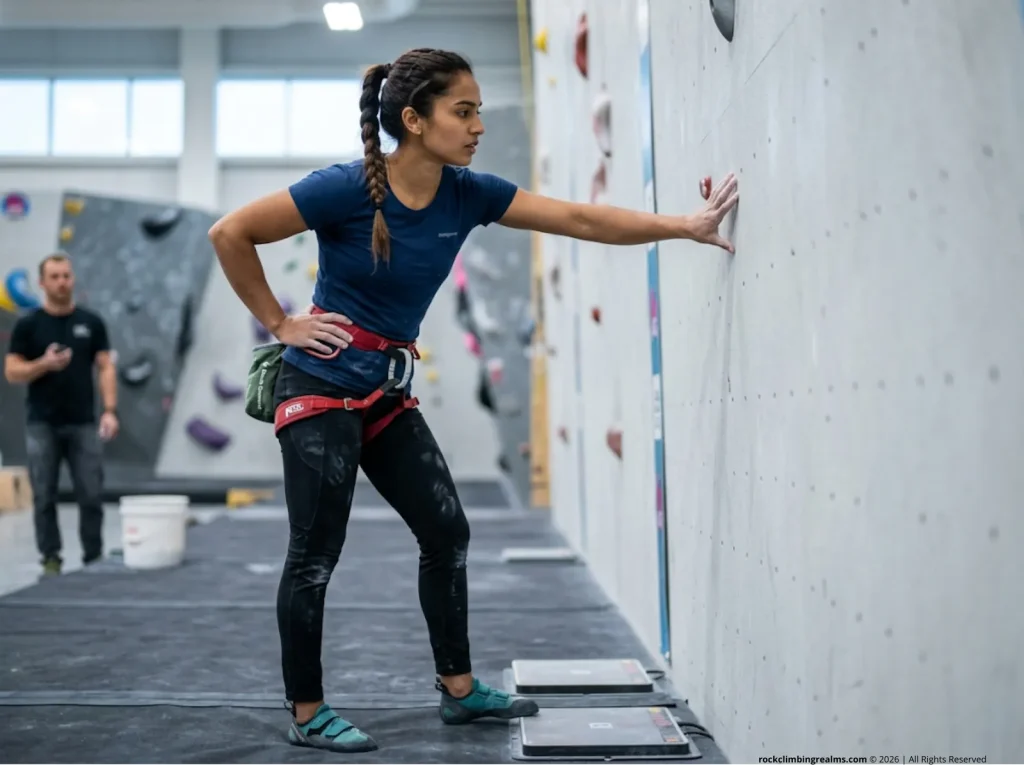
The IFSC governs multiple competitive formats, but the speed wall is the only one where the playing field is physically identical everywhere on earth. Fifteen meters tall. Five-degree overhang. Twenty large hand holds. Eleven small foot holds. The route grades around 5.10c — modest by most standards. The difficulty is not in the moves. It is in executing them at a pace that would make your lead-climbing brain short-circuit.
That 5-degree overhang is doing more than you think. It splits your body weight into two forces: one pulling straight down the wall (the part you use) and one pulling you away from the surface. The wall surface uses resin-quartz with a specific grain size — 0.1 to 0.4 millimeters — and that grain is what lets you smear between holds. Without that friction, the outward pull wins every time, and your feet slide. Every technique on this wall has to account for that constant outward tug. Constant inward tension is not optional. It is the cost of doing business on a 5-degree plane.
Timing is recorded to one-thousandth of a second. False starts trigger if your foot leaves the pad faster than 0.100 seconds. The pressure pad monitors that threshold and the system does not care about intent. You flinch, you are out. Same wall, same holds, same timing worldwide. The only variable is the climber.
The ATP-CP Engine: Racing the 10-Second Clock
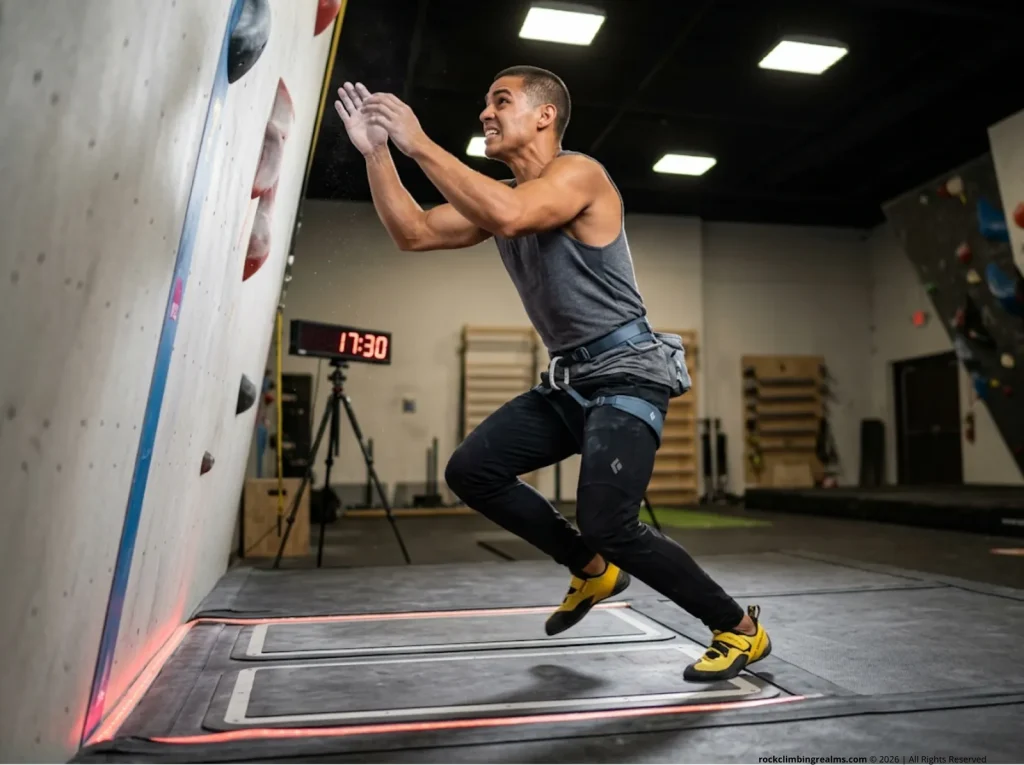
Your body has three energy systems. Speed climbing uses exactly one of them — and only for about ten seconds. The ATP-CP system runs on stored chemical energy in your muscles. No oxygen required. No lactate buildup. Just raw, pre-loaded explosive power. Olympic coach Libor Hroza calls speed climbing “a track meet gone vertical,” and he is right — the metabolic demands are closer to a 100-meter sprint than to any other form of climbing.
The first three seconds burn pre-stored ATP directly — the highest power output your muscles can produce. It fuels the explosive start and the first dyno. After that, phosphocreatine takes over, donating a phosphate to ADP to synthesize new ATP and buying you roughly seven more seconds of near-maximum effort.
Then the floor drops out. Phosphocreatine stores run dry somewhere around the 10-12 second mark, and your body switches to the glycolytic system. Power output falls 15-20 percent almost immediately. Climbers call this the “Alactic Cliff.” Sam Watson finishes in 4.79 seconds, entirely within the Goldilocks zone. If you are trying to break 10 seconds, that metabolic deadline is the primary barrier standing in your way. The way how the body’s energy systems interact across different climbing demands becomes obvious the second you hit the cliff — your arms go numb, your grip softens, and the wall suddenly feels twice as far away.
Rebuilding those phosphocreatine stores takes one to two minutes. Sprint for ten seconds, rest for two full minutes. Anything shorter and you are training half-depleted — your times will look fine, but the quality of each effort drops with every rep. Track coaches have used this principle for decades. Climbers are just catching up.

Pro tip: If your fourth sprint feels harder than your first, your rest interval is too short. Set a timer. Two minutes minimum between full-effort attempts, no exceptions.
The Mechanics of Explosive Movement
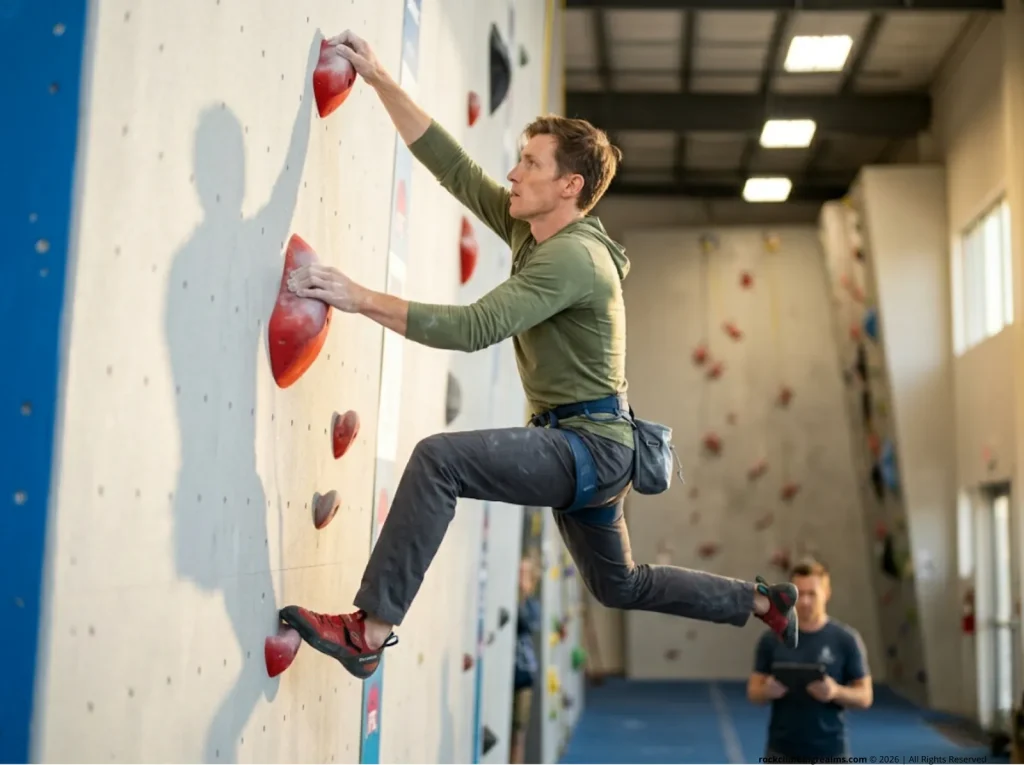
Here is where most climbers waste their ATP-CP window: they pull with their arms and let their legs float. The Campus Trap wrecks more speed attempts than any other technical error. A proper start drives mass upward through the posterior chain — calves, hamstrings, glutes. Your arms handle precision, not force generation. If your first move feels like a pull-up, you are doing it wrong.
Video analysis of competitive climbers shows a clear pattern: the fastest finishers have the highest hand speed and the shortest grip time per hold. Elite males average 2.78 moves per second, and every extra millisecond of hand contact compounds across the entire route. Average elite contact time per hold sits at 0.35 seconds. They grab, they go.
Then comes the first dyno. All four limbs leave the wall. You are airborne. And the moment that happens, gravity starts winning. As technical analyst Josh puts it: “When you have zero points of contact with the wall, you are slowing down. Always. Minimize flight time.” The peak of your vertical speed happens at the transition between hand release and next hand contact. That instant — the catch — is where momentum is either preserved or destroyed. If your body swings away from the wall, you lose. If your hips stay tight and your center of mass tracks straight up, you keep the speed you built on the ground. The physics behind dynamic climbing movements apply here in their most extreme form: a poorly caught dyno on the speed wall does not just cost you a move, it breaks the rhythm that makes the rest of the route possible.
Pushing hard through your toes at each foot placement is what converts horizontal push into vertical acceleration. On the speed wall, your toes are doing more work than your fingers.
The Tomoa Skip: The Move That Shattered Records
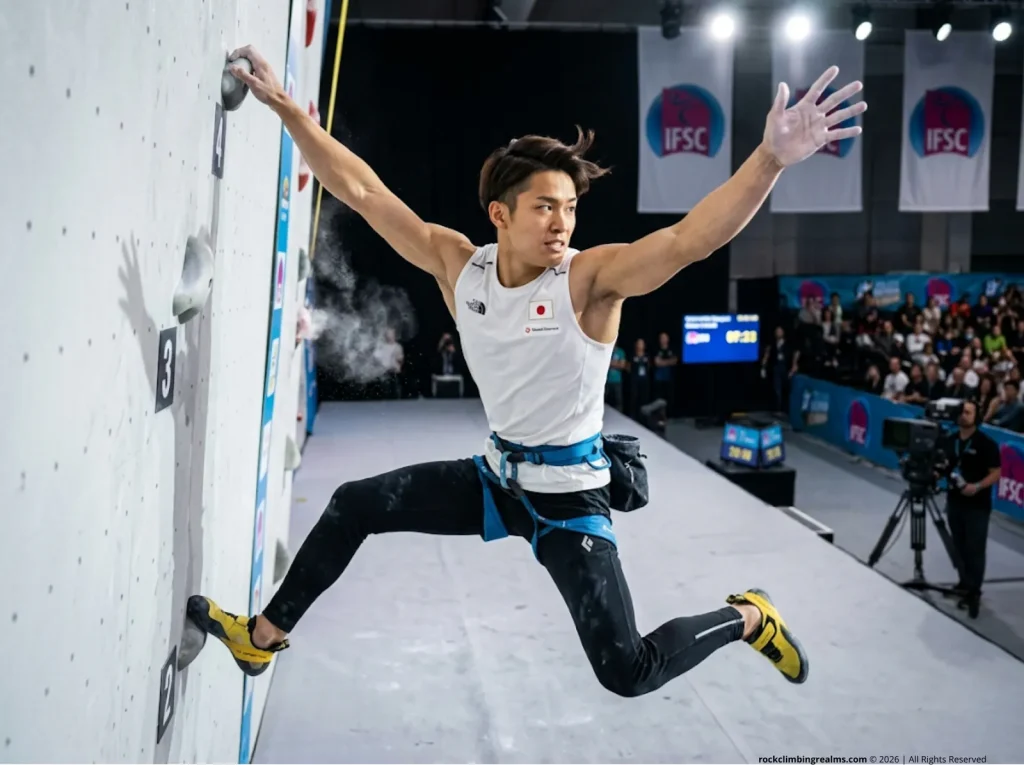
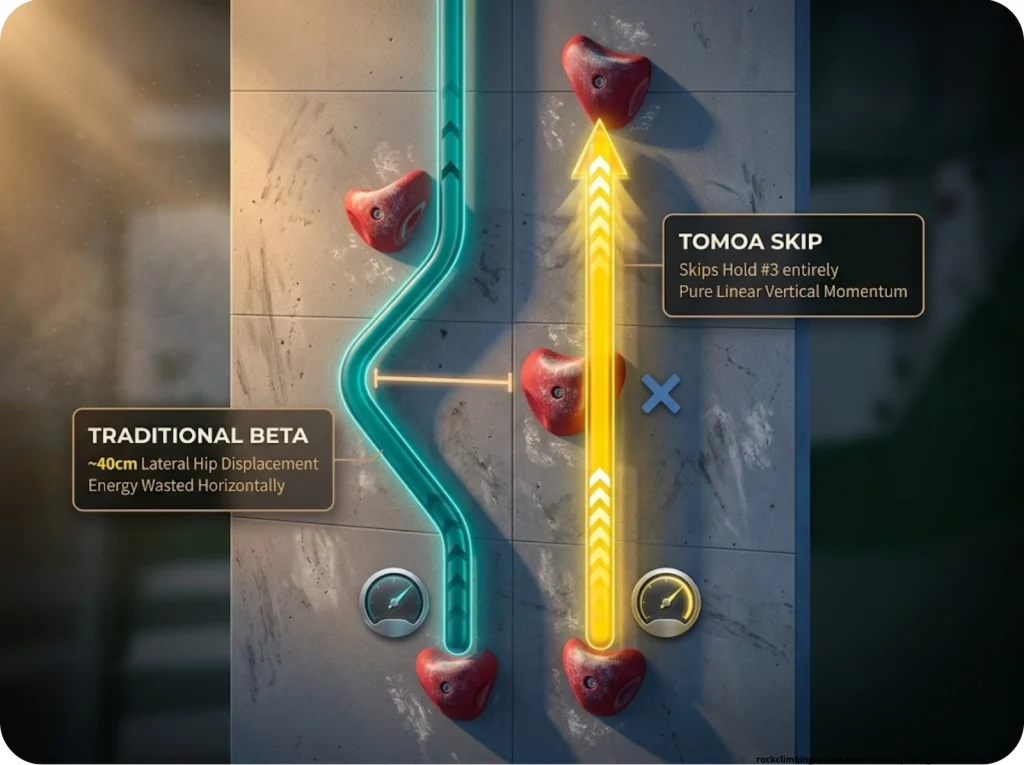
In 2018, a Japanese boulderer named Tomoa Narasaki looked at the standardized speed beta and decided hold three was a waste of time. The Tomoa Skip skips that third hold entirely to maintain upward speed instead of executing a lateral shift. It broke ten years of orthodoxy overnight and turned speed climbing from a lateral stepping discipline into a vertical sprint.
The physics are straightforward. By skipping hold three, the climber eliminates roughly 40 centimeters of sideways hip movement. That lateral movement was not just wasted time — it was wasted energy being redirected away from the only direction that matters: up. Colorado State University’s statistical analysis of the Tomoa Skip’s efficiency gains shows the move produces a 0.85x time multiplier. A seven-second climber can theoretically drop to 5.98 seconds just by adopting this beta.
But the Skip only works if you generate enough initial speed. It requires a swing start to build momentum that carries you past hold three without touching it. If your launch speed is too low, you decelerate, reaccelerate, and lose more time than the traditional beta would have cost. The margin for error is razor-thin. How elite climbers decode complex movement sequences in competition is exactly what Narasaki did here — he read the geometric relationships between the first four holds and found a faster path nobody had bothered to look for.
Arm span and Ape Index may influence Skip efficiency, but no mathematical sweet spot has been established. What is clear is that the Skip demands specific timing and not every climber can make it work. For those who can, it is the single biggest time saver in the sport.
Center of Mass Trajectory and Movement Smoothness
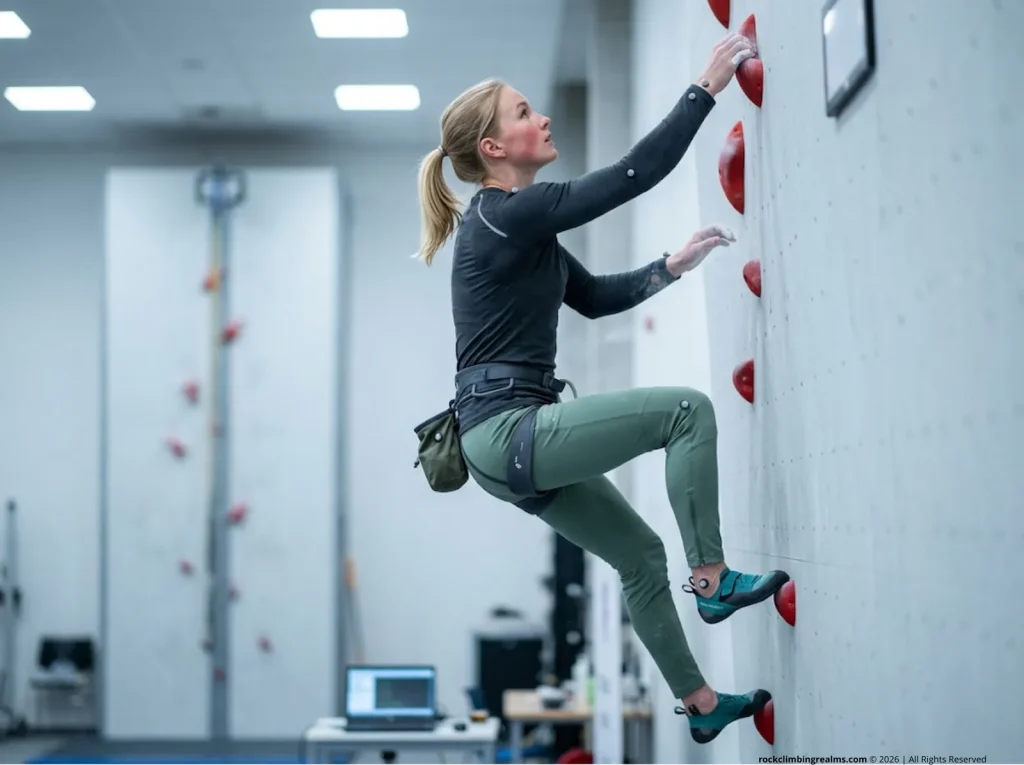
Every climber has a center of mass — the point where all your weight balances. Track that point during a speed ascent and you will see something most climbers never think about. Pierre Legreneur’s motion capture research shows the average climber’s center of mass drifts 24.1 centimeters straight away from the wall. That is nearly ten inches of wasted motion. Your body is pulling away from the surface, fighting gravity in the wrong direction, and you are probably not even aware of it.
Here is the problem with video analysis: stick a tracking marker on a harness and the path looks clean. But harness markers lie. When a climber dynos, limb flexion shifts the true center of mass far from the harness position. Detailed motion analysis reveals that gap can reach 24.1 centimeters. Your phone camera and a side-angle recording will not catch it. The movement looks smooth on 2D video and wobbles in three dimensions.
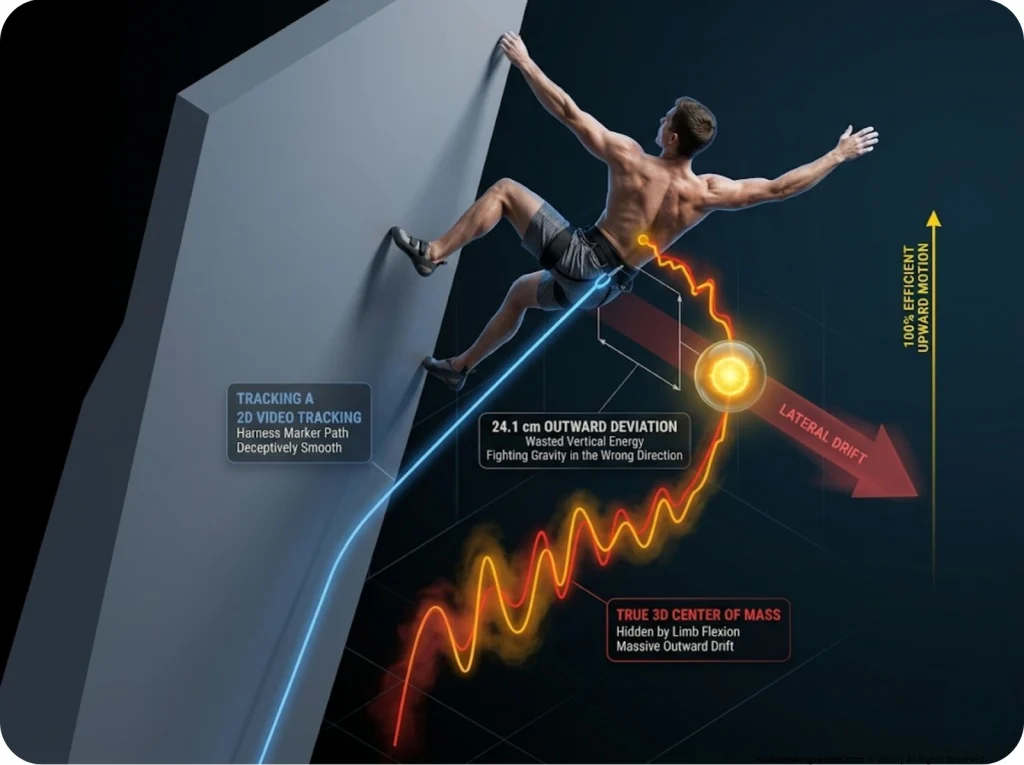
Movement smoothness is measurable. Lower numbers mean smoother, more efficient movement. Elite males average 0.103 on this scale. Elite females average 0.140. Higher-velocity athletes move in a straighter line — they are not stronger, they are losing less energy to sideways displacement. How anthropometric factors like the Ape Index influence climbing biomechanics plays a role here, because individual body proportions affect how efficiently your center of mass can track a straight line.
Roughly 83 percent of a climber’s effort converts into upward motion. The remaining 17 percent vanishes into outward drift, limb repositioning, and air-time deceleration. A seven-centimeter hip deviation at peak velocity can separate a world record from a qualification failure.
Pro tip: Set up a side-angle camera at the gym and count how many holds your hips drift away from the wall. If you see more than two or three noticeable swings in a single ascent, your center of mass control needs work before you add speed.
Speed Climbing Footwear: The Honest Breakdown

The La Sportiva Cobra 4.99 is the industry standard for speed climbing. No laces, no closure system, microfiber upper — a purpose-built slipper for one job: going up a standardized wall as fast as possible. It features a heat-sealed TPU coating that reduces friction during accidental wall contact. When your shoe brushes the wall at four meters per second, that TPU lets the foot slide instead of snag. Snagging destroys momentum. The slide preserves it.
Now the anti-sell. These shoes are disposable. The thin microfiber uppers and soft Vibram XS Grip2 rubber wear through the toe box fast under high-velocity contact. You are not buying a long-term investment. You are buying a consumable tool with a limited shelf life. The Cobra Eco version swaps XS Grip2 for FriXion rubber, and athletes consistently report it as harder and less sticky. How climbing shoe rubber compounds compare in friction and durability matters here because how much grip the rubber gets against the resin-quartz wall is the limiting factor for shoe performance — the rubber has to work with the wall surface, not against it.
Professionals size these slippers two to three sizes below street shoes. That eliminates rolling during high-torque lateral moves and creates a “performance mold.” It also hurts — bunion pain, numbness, the whole package. If you have wide feet or pre-existing foot issues, the Mad Rock Remora is a better choice: less specialized, more forgiving, still a slipper profile. Do not torture yourself into a shoe that does not fit.
Pro tip: If you are transitioning from gym climbing to speed, do not buy dedicated slippers until you are consistently under 12 seconds. Until then, your soft bouldering shoes with tight lacing will work fine. The shoe matters less than the technique at recreational speeds.
Injury Mechanics and Safe Progression

Speed climbing looks safe because of the auto-belay and the standardized route. The real problem hides in the physics of velocity. When a climber catches a hold at roughly 4 meters per second, the force spike on finger pulleys and tendons is enormous — far beyond what most climbers experience in lead climbing or bouldering. That is the hidden injury risk nobody warns you about.
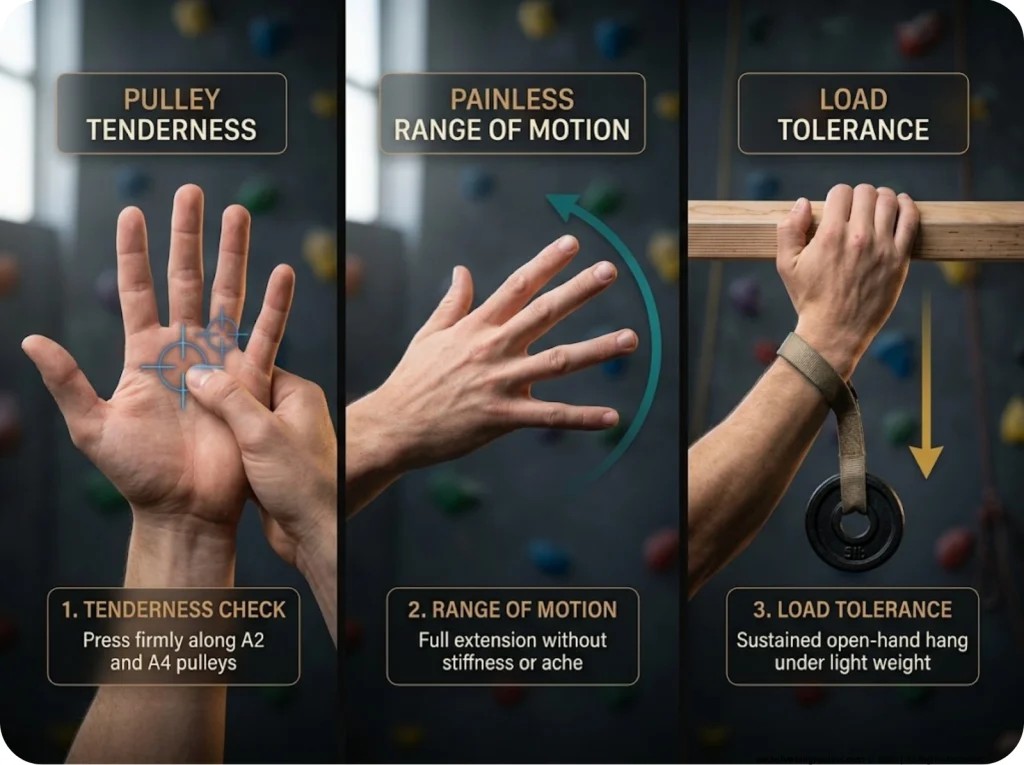
Cold starts are the leading cause of pulley injuries in speed climbers. A max-effort dyno on unprepared tendons — A2 and A4 pulleys specifically — is a recipe for tears that sideline you for months. The “Jittery Start” pattern, where false starts stem from over-reliance on arms instead of the posterior chain, often indicates insufficient warm-up. If your hands are grabbing before your legs have fired, your body is telling you it is not ready.
Run the 3-Step Check before every speed session: painless range of motion in all fingers, no tenderness when pressing each pulley, and a load tolerance confirmation (hang a small weight from an open-hand position). If any of those three fail, you are not warming up — you are gambling. The biomechanics behind common climbing injuries and how to prevent them applies with extra force here because contact velocities are higher and repetition is more frequent.
“Eat your vegetables” — spend the first 30 minutes on technical drills. Slab work, silent feet, slow precise movement. That is non-negotiable tendon preparation. Then ramp up gradually, starting at 60-70 percent velocity and building over weeks. Finger load adaptation takes weeks, not days. When your form starts degrading during a training block, stop. Neurological fatigue accumulates past 15 seconds of total max effort. The Alactic Cliff applies to your nervous system as much as your muscles.
Pro tip: Never do your first full-speed attempt of the day cold. Run three to four sub-maximal starts at 60 percent effort, with full two-minute rest between each one. Your tendons do not have a fast-forward button.
Three Things to Take to the Wall
Speed climbing is a solvable physics problem. The ATP-CP system gives you roughly ten seconds of maximum power, and every technique decision has to preserve vertical momentum inside that window. Waste it on lateral movement or unnecessary air time and the wall wins.
The difference between a five-second climb and an eight-second climb is not strength — it is limb frequency rhythm, center of mass control, and minimizing the wasted motion in your movement path. Smooth equals fast. Wobbly equals slow.
The Tomoa Skip is the single most impactful technique innovation in the discipline’s history, but it only works when your initial velocity exceeds the cost of the air time it requires. If you cannot generate enough launch speed, stick to the standard beta and clean up your hip path instead.
Film your next speed session with a side-angle camera. Count your hand contact time per hold and your moves per second. The data will tell you exactly where you are losing time — and that is the first step toward fixing it.
Now go send something.
FAQ
What grade is the speed climbing route?
The IFSC standardized speed route grades at approximately 5.10c (YDS) or 6a+ (French). The individual moves are well within most recreational climbers’ ability — the challenge is executing them at 2.78 moves per second with zero hesitation.
How many holds are on a speed wall?
The standardized IFSC speed wall contains exactly 20 large hand holds and 11 small foot holds at fixed positions. Every competition wall worldwide uses this identical layout, making speed climbing the most repeatable discipline in the sport.
What is the Tomoa Skip?
The Tomoa Skip is a technique innovation originated by Tomoa Narasaki in 2018 where the climber skips the 3rd hold entirely to maintain upward speed instead of executing a lateral shift. Colorado State University research shows it produces a 0.85x time multiplier, potentially shaving nearly a full second off elite times.
How do I get faster at speed climbing?
The three biggest levers are: train the ATP-CP system with a strict 1:12 work-to-rest ratio so every attempt is at full explosive power; minimize your center of mass deviation to reduce wasted energy; and optimize limb frequency — elite climbers average 2.78 moves per second, and every extra millisecond of contact time compounds across all 20 holds.
What energy system does speed climbing use?
Speed climbing is powered almost entirely by the ATP-CP system, which provides roughly 10 seconds of maximum explosive output without relying on oxygen or producing lactate. Once phosphocreatine stores deplete past the 12-second mark, power output drops 15-20 percent almost instantly — which is why world-record ascents stay well under 5 seconds.
Safety Notice: Rock climbing and mountaineering are inherently high-risk
activities that can involve physical trauma or fatal incidents. The information on Rock Climbing Realms is for
educational and informational purposes only. Techniques and advice presented here are not a substitute
for professional, hands-on instruction. Conditions and risks vary by location. Always seek guidance
from a qualified instructor before attempting new techniques. By using this website, you agree that you
are solely responsible for your own safety. Any reliance you place on this information is strictly
at your own risk, and you assume all liability for your actions. Rock Climbing Realms and its authors
will not be held liable for any harm, damage, or loss sustained in connection with the use of this information.
Affiliate Disclosure: We are a participant in the Amazon Services LLC Associates Program, an
affiliate advertising program designed to provide a means for us to earn advertising fees by advertising and linking
to Amazon.com. As an Amazon Associate, we earn from qualifying purchases. We are also an official affiliate partner
of Black Diamond Equipment via the AvantLink network. If you click on a Black Diamond affiliate link and make a
purchase, we may earn a commission at no additional cost to you. We also participate in other affiliate programs.
Additional terms are found in the terms of service.