
In this article
You’re 80 feet off the deck, hanging from a single piece, and you know exactly why you’re pumped — but you have no idea why the crux felt unsolvable yesterday and clicked today. The sun angle was different. The humidity dropped. You didn’t write any of that down. You wrote “felt good.” You wrote nothing a future version of yourself can use.
I’ve been climbing long enough to watch the same pattern repeat across partners, seasons, and crags. The send gets documented. The failure doesn’t. The conditions get approximated. The anchor geometry never gets mentioned. Everyone leaves the crag with a story. Almost nobody leaves with data.
That’s the gap this guide addresses. A forensic trip report isn’t a diary — it’s a technical archive. Your future self, your partners, and anyone who climbs after you deserve more than a vibe check.
⚡ Quick Answer: A complete climbing trip report documents five categories of data: ascent style (per UIAA Norm 1), anchor geometry with estimated angles, pitch-by-pitch beta starting with Macrobeta before Microbeta, time-stamped micro-climate conditions, and a Failure Log capturing near-misses and bail decisions. Most public reports skip 80% of this content. The difference between a useful report and a useless one isn’t length — it’s specificity. Start with the data you’d want to find if you were reading someone else’s account before your first attempt.
The Ethical Foundation — Style, Honesty, and What You Owe the Community

The first time I saw a trip report that just said “good conditions” for a Yosemite crack, I understood why climbers get sandbagged. Good conditions where? At 7 AM or 2 PM? That’s not a report. That’s a postcard.
The UIAA Norm 1 — reporting style with honesty defines honest reporting as the single most important obligation in climbing documentation. “Style” means the rules you accepted during the ascent: ground-up, pink-point, redpoint, hangdogged, or any deviation from local convention. Without it, the grade tells the next climber almost nothing about whether they’re ready.
Understanding what those UIAA safety certification standards mean for your gear documentation shows how institutional this expectation runs — it’s not opinion, it’s the framework that keeps community beta trustworthy.
“Style” isn’t ego. It’s data. A pink-point ascent and a redpoint are different achievements, and that difference affects grade validity for whoever reads your report next. Document deviations explicitly. “Used existing draws on bolts 3–7 due to party traffic” is honest. Omitting it converts your report into misinformation.
Digital integrity falls under the same framework. The UIAA explicitly prohibits visually manipulated media that misrepresents difficulty. A contrast-enhanced crux photo that makes holds look larger than they are isn’t a flex — it’s a safety issue.
The National Park Service runs the same playbook. Their Mountaineering Standards require trip logs to be “appropriate, accurate, and well-maintained.” Your permit closeout timing gets tracked by land managers who use it in access decisions. Your report is part of conservation infrastructure whether you think about it that way or not.
The AAC’s Accidents in North American Climbing (ANAC) series exists entirely because climbers documented what went wrong honestly. Every sanitized report — every “it worked out fine” with no context — weakens the collective record that the whole community relies on.
Pro Tip: Keep the NPS field observation form structure in your phone notes before a significant climb. Fill it in immediately after each pitch. Memory reconstruction at the car is worth a fraction of what you captured on the wall.
UIAA Norm 1 — Defining Honest Style for Every Ascent Type
Three dimensions of honesty cover every ascent. Ascent style (ground-up vs. top-rope preview), protection used (fixed vs. removable), and fall record. These aren’t overlapping categories — each one answers a different question for the next party.
“Pink-point” versus “redpoint” isn’t semantic splitting. Pink-point means pre-placed gear. Redpoint means you placed it yourself on the send burn. That difference calibrates whether a specific rack and a specific grade combination is achievable together. If your report doesn’t specify, the next climber has to guess.
The AAC Accident Report Standard — Applied Proactively
The AAC format separates Contributing Factors (fatigue, low blood sugar, poor visibility) from Intensifying Factors (wet rock, high wind). Contributing factors are human. Intensifying factors are environmental. The distinction matters because one you can control before you leave the car.
Apply this framework proactively. A near-miss documented in AAC format is usable safety data. An un-filed near-miss is a wasted warning.

Safety Systems on Paper — Anchor Physics Nobody Documents

Here’s the data most trip reports permanently bury: the actual geometry of the anchor you built.
I’ve pulled a piece off a route that felt solid during a practice redpoint, only to find in my log that I’d placed it at 145° — 100% of load on a marginal cam. I had documented the anchor geometry two seasons earlier and forgot. The entry saved me from repeating the mistake on a route with no margin for error.
Vector forces in climbing anchor systems split along the direction of the rope or sling. The force each anchor point carries depends entirely on the internal angle between anchor legs. At 60° internal angle, each leg holds 58% of load. At 90°, it’s 71%. At 120°, each point is holding 100% — you’ve eliminated the benefit of a two-point system. At 150°, each point absorbs 193% of the climber’s weight. The UIAA safety standards for dynamic ropes and rock anchors lay out how these thresholds connect to equipment testing.
The “120-degree rule” is the single most consistently underdocumented piece of anchor geometry knowledge in community beta. If you built a two-point anchor and the internal angle was near 120°, write that down. Someone else needs to know.
For the anchor failure chains that expose the geometry mistakes most climbers don’t report, the pattern is almost always the same: the angle looked fine and nobody measured.
Documenting Anchor Angles — The 60°/90°/120° Decision Log
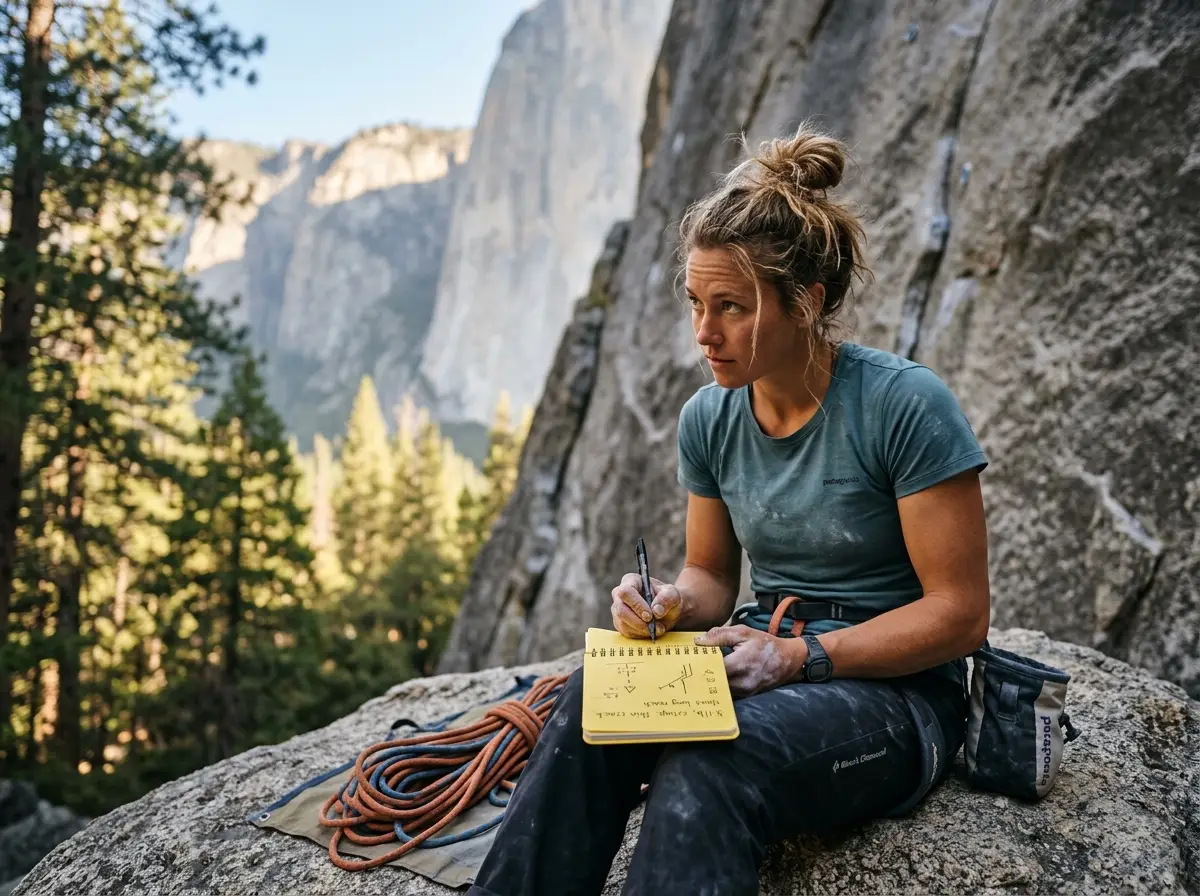
Use a pocket notebook or voice memo to log the estimated internal angles at each belay station during the climb. A simple triangle sketch with the angle labeled takes 10 seconds. It communicates what prose cannot.
Color-code your angle ranges mentally: green at 60° or below, yellow through 90°, red up to 120°, and flag anything beyond that separately. Field estimation is imprecise — report ranges (“approximately 80–100°”) rather than false precision. A range is more honest and still useful.
Pro Tip: Photograph gear placements before removing them on your redpoint burn. The visual record costs 5 seconds and is the best anti-sell documentation you can produce. A cam that walked in a flared crack at your local crag is information the whole community needs.
Anti-Sell Gear Analysis — What Failed, Walked, or Underperformed
The “anti-sell” obligation is real. If a specific cam walked in a specific crack type, that belongs in your report, not just in your head. UIAA 101 (dynamic ropes) documentation means recording the number of falls held and any visible sheath deformation post-climb. UIAA 123 (rock anchors) means noting corrosion on stainless hardware, especially in marine or high-humidity environments.
Gear that passed inspection but behaved unexpectedly deserves its own subsection. That’s the entry that stops someone from trusting a piece they shouldn’t.
The American Death Triangle — Naming, Flagging, and Educating
The American Death Triangle (ADT) is common on older fixed anchors, and almost nobody names it in their reports when they encounter it. At 120° internal angle, the ADT delivers nearly 2x loads — double what the anchor was designed to bear under normal redundancy assumptions.
If you used or encountered an ADT configuration, name it explicitly. “Fixed rappel anchor at Pitch 4 terminus was configured in a potential ADT alignment. Pull direction was well below 90°. No failure occurred. Recommend inspection and re-rigging.” That sentence takes 30 seconds to write. It might matter to someone.
Biomechanical Beta — Macrobeta vs. Microbeta and the Sunk-Cost Trap

I spent three sessions trying to reverse-engineer someone else’s microbeta on a 5.12a crux. The tick marks were in the wrong place for my height. The route made zero sense until I stopped reading their report entirely and found my own pattern. The whole mystery was a center-of-mass issue, not a handhold issue.
That’s the sunk-cost trap. Climbers who spent 10 sessions figuring out specific microbeta tend to over-document it at the expense of the macrobeta that actually explains the move. Your beta chronicles the obsession, not the solution.
Professional beta documentation has three tiers. General Beta is the line itself. Macrobeta covers full-body movement principles. Microbeta gets into specific hand and foot placements. You document in that order, every time. The research on route previewing strategies and climbing fluency confirms that gaze behavior and sequencing strategy — both macrolevel skills — determine performance far more than memorized sequences.
Before you can document beta effectively, you need to be able to read the route before you climb it — the same visualization framework for reading routes before you climb them applies directly to how you organize your written beta after.
The 5 Atomic Elements — Writing Macrobeta That Transfers
Macrobeta that transfers across body types covers five elements.
Tension describes the full-body isometric state — “full hip-to-shoulder tension required to maintain contact on the smear.” Position places the center of mass — “hip directly under left heel-hook, not under the right hand.” Rhythm specifies timing — “the dead-point window opens approximately 0.3 seconds after the left foot loads the crimp.” Commitment flags no-fall zones explicitly — “no-fall sequence from move 3 to move 6.” Effort uses a Rating of Perceived Exertion (RPE) scale — a number from 1 to 10 that tells the next climber how much they’ll be holding on.
RPE is hard to document in the moment. Use voice memos immediately post-crux. Physical memory for specific sequences decays within 15 minutes of completing the pitch.
The Microbeta Trap — When Specific Details Mislead
Microbeta that works for a 5’8″ climber with short fingers may be actively harmful guidance for a 6’2″ climber with long arms. When you document specific hold positions, flag them: “specific to approximately 5’8″–5’10” with normal ape index: crimp the left edge with a 3-finger half crimp.”
Without that qualifier, your beta is misinformation in a different body.
In-Situ Recording — Capturing Data While Hanging From Your Harness
Voice memos remain the highest-value in-situ recording tool. Record immediately after completing a pitch, before the sequence fades. Graph paper sketches with color-coded hand and foot positions create a spatial record that prose can’t replicate. A Garmin fenix 7 logs attempted versus successful sequences, grades attempted, and rest timer data automatically — no active note-taking required.

Pro Tip: Designate a “beta note” ritual as part of your belay anchor setup routine. The moment you clip in, you have 45–60 seconds while your second climbs to dictate a voice note. That window exists whether you use it or not.
Environmental Forensics — Micro-Climates, Friction, and Geological Hazards

The day I cracked 5.13 wasn’t because I got stronger overnight. I wrote in my log that the temp was 48°F and dew point was 28°F — a combination I’d never documented on that route before. I don’t know if I’d have connected the pattern without the environmental data. The crag looked identical. The air was not.
“Weather” in a casual climbing trip report is useless data. “At 10:15 AM, direct solar loading hit the crux sloper and destroyed friction” is actionable intelligence. Applying mountain meteorology principles to your on-crag condition logging turns what looks like a weather app screenshot into a friction window map worth reading.
Solar loading is the most consistently missing data point. At Red Rocks, certain routes become cooker conditions if the Blue Diamond forecast exceeds 60°F with no wind. That’s hard-won beta almost never documented. Rock porosity matters too — limestone and certain sandstones go greasy with humidity changes that don’t show in regional forecasts. Document the tactile condition: “chalked holds still felt tacky” versus “completely blown out.”
Wind channels add another layer. Summit conditions and approach conditions diverge dramatically. Both matter — they determine safety at transition points like anchor setup and rappelling.
For geological hazards, the USGS Geologic Hazards Science Center — understanding rockfall and slow gravitational failures distinguishes between slow gravitational failures (sackung, ridge cracking) and acute rockfall. A trip report that notes “heard a single rockfall event at approximately 11 AM from the upper headwall” adds to a chronology no single agency can replicate on its own.
Solar Loading Maps — Documenting When the Route Condition Changes
Build a pitch-by-pitch solar loading timeline. Example format: “Pitch 1 (N-facing): shaded all day. Pitch 2 (SE-facing): direct sun from 9 AM to 1 PM. Crux slab: shaded by feature until 11:45 AM.” Cross this against the route’s wall aspect using a compass on-route.
Friction windows are the most actionable data in any trip report and the most consistently absent from public beta.
Rock Condition Taxonomy — Beyond “Wet” and “Dry”
Five states cover what you actually encounter on holds: (1) Dry/pristine, (2) Dusty, (3) Sweaty/greasy from humidity, (4) Damp/seeping, (5) Wet/running. Document specific holds at crux sections, not just overall conditions. Note chalk accumulation. “Upper crux crimp over-chalked; brushed to restore friction before attempt” tells the next party exactly what gear prep they need before their first go.
Geological and Hazard Observation Logging
Log rockfall events: time, apparent origin zone, estimated size, observer position. Single data points become patterns over a season of aggregated reports. Flag new cracks at fixed anchor placements, sackung at established descents, and bergschrund conditions on alpine objectives. These entries have no value in isolation. Aggregated, they’re the early warning system land managers can’t build without community contribution.
The Failure Log — Documenting What You Chose NOT to Do

I have one bail entry that I revisit every season. We were one pitch from the summit. Conditions were fine. My entry reads: “bailed due to partner fatigue and crew dynamics.” That decision was correct. Documenting why I turned back teaches me more than documenting any summit.
The 2024 ANAC data contains a finding that should make every expert climber uncomfortable: experienced climbers sustained significantly more accidents (33) than beginners (6). The explanation is normalized deviance — the gradual acceptance of lower safety standards because previous violations didn’t produce an accident. This isn’t beginner recklessness. It’s expert drift. And it doesn’t show up in reports because nobody documents the decisions that almost went wrong.
The human factors behind climbing accidents — AAC research on normalized deviance and transitions identifies transitions as the highest-vulnerability moments: swapping leads, preparing to rappel after tagging the summit, switching from belay to rappel device. These are where most severe accidents occur and where documentation is most consistently absent.
A near-miss template with four fields gives you structure without bureaucracy. Hazard Source: what detected it — a partner check, a near-slip, an external visual. Severity Rating: 1 to 5. Mitigation Action: what specifically stopped the accident. “Backup prusik deployed at anchor” is useful. “Was being careful” is not. Recommendations: actionable guidance for the community.
The pre-climb risk assessment you run before the route becomes the baseline your Failure Log entries are measured against — building a pre-climb risk matrix that feeds directly into your Failure Log entries shows how these two documents work as a pair.
Document interpersonal heuristics too. “Felt hesitant to question anchor configuration due to partner’s higher experience level” is safety data. Normalizing its documentation breaks the silence that gets climbers hurt.
The Near-Miss Template — A Standardized Format
Hazard Source names what triggered awareness: partner check, a visual cue, the feel of something moving. Severity Rating uses a 1–5 scale, with 5 being near-fatal. Mitigation Action explains what stopped the accident — specifically, not generally. Recommendations give the next party concrete guidance.
“Fixed rappel anchor at Pitch 6 shows corrosion on aluminum rap rings. Recommend inspection before use.” That sentence might outlive you.
Documenting Transitions — The Highest-Risk Moments
Every pitch transition is a potential accident chain. Document the protocol you used: BRAKES checklist, closed-system verification, Third Hand setup and test. Explicitly note if any transition procedure was skipped and why. Have your partner confirm the protocol in the log. Solo memory is not reliable enough for life-safety documentation.
The rappelling accident data that proves why transition documentation matters shows exactly where the chain breaks most often — and it’s almost never the dramatic moment. It’s the routine one.
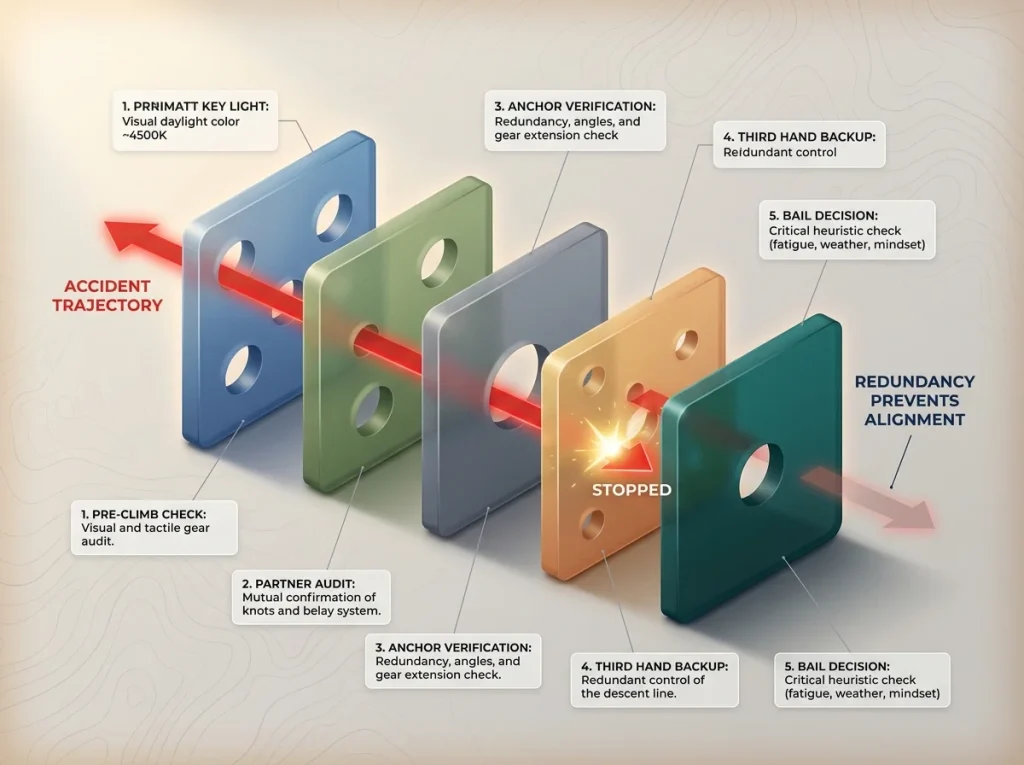
The Swiss Cheese Model Applied to Trip Reports
Every near-miss is a moment where multiple “holes” aligned but the accident didn’t break through every layer. Documenting which layer caught the hazard — partner check, gear redundancy, bail decision — shows which defenses are working and which holes are growing.
Understanding the Swiss Cheese Model and how it applies to every climb you log makes this framework concrete and visual. Reports that capture the full sequence create institutional knowledge. “Almost had an issue but it worked out” creates nothing.
The Digital Stack — Field Recording Tools and Where to Publish

I started pulling my phone out at every anchor to dictate a 60-second voice note the season I broke through my 5.12 plateau. Three months later I found a correlation between ambient temperature, approach pace, and redpoint success rate. The data was there the whole time. I’d just never collected it.
Voice memos are the highest ROI tool in the stack. Immediate, hands-free, and reliable on a hanging belay. Dictate pitch-by-pitch before your partner follows. A Garmin fenix 7 logs timestamped logistics automatically — attempted versus successful routes, grades, rest timers — without active note-taking.
Gaia GPS and CalTopo produce GPX track exports for approach and descent that are the most underused piece of beta on any trip report. A precise descending line has saved more parties than almost any other single data point. CalTopo’s slope shading communicates terrain angle hazard for winter approaches in a way prose cannot. USGS 7.5-minute topographic maps as a base layer are standard in American Alpine Journal (AAJ) quality reporting. They’re nearly absent in Mountain Project beta.
The National Park Service mountaineering field observation standards for in-situ data collection treat documentation as a professional act. Adopting their standard for recreational reports raises the quality floor for everyone.
For the climbing apps that actually improve your route tracking and documentation workflow, the field recording tools above connect to platform-specific submission formats that vary by objective type.
Photo discipline separates useful reports from bragging sessions. An annotated photo showing exact gear placement, rappel anchor rigging, or approach trail junction outperforms 500 words of prose. The summit selfie contributes nothing to forensic beta reporting.
Voice Memo Protocol — The Anchor-to-Anchor Dictation System
Trigger: every time you clip into a belay anchor, start a voice note before your partner unclips from below. Template: pitch number, quality of gear placements and anchor, crux description using the 5 Atomic Elements, and one Failure Log flag if anything felt off.
Transfer to written log within 24 hours. Pitch-specific detail degrades fast. What feels vivid at the car is fragmented by morning.

Where to Publish — Matching Platform to Report Type
Mountain Project is the standard for sport climbing and bouldering beta. SummitPost handles structured expedition and alpine documentation. 8a.nu tracks personal ascent records and grade verification — the closest thing climbing has to a scorecard. The AAJ is the authoritative institutional record for significant first ascents, requiring formal submission.
Maintain a private forensic log — Notion, Google Docs, or structured text — that goes deeper than any public platform allows. Share what’s useful publicly. Keep the full data set for yourself and your partners. The data logging that actually changes your climbing lives in the private archive.
Conclusion
Three things. First: a trip report without style declaration and anchor physics is incomplete. Grade means nothing without knowing how the climb happened. Anchor geometry means nothing without the angles. Document both, every time. Second: macrobeta before microbeta, always. Tension, Position, Rhythm, Commitment, Effort transfer across body types. Specific hold sequences often don’t. Lead with what works for everyone, and flag what’s climber-specific. Third: the Failure Log is the most valuable part of your report. What you chose not to do, what nearly went wrong, and why you bailed are the entries that change community behavior. A near-miss in template format is worth more than a summit photo.
On your next climb, run the voice memo protocol from the first anchor. Document the internal angle at your belay station. Log one environmental condition data point. You don’t have to overhaul your reporting overnight — but start the habit where it matters most: on the sharp end, in real time.
Now go send something.
FAQ
What is included in a climbing trip report?
A professional-grade climbing trip report includes: location with GPS coordinates, ascent style per UIAA Norm 1, anchor geometry and gear analysis, pitch-by-pitch movement beta starting with Macrobeta, micro-climate conditions with time-stamped data, and a Failure Log documenting near-misses and bail decisions. Most public reports skip most of this content and reduce to narrative without technical value. The 5-Point Technical Beta Checklist covers all five categories in a format you can fill in at the anchor.
How do you explain climbing beta?
Climbing beta is technical information about how to climb a specific route. Professionally documented beta has three tiers: General Beta (the line and grade), Macrobeta (full-body movement principles — tension, position, rhythm, commitment, effort), and Microbeta (specific hand and foot placements). Macrobeta transfers across body types. Microbeta is often climber-specific and should be labeled as such — otherwise it is misinformation in a different body.
Where can I post climbing trip reports?
Mountain Project is the most widely used platform for sport climbing and bouldering beta. SummitPost is the standard for alpine and expedition reports. 8a.nu tracks personal ascent records and grade verification. For significant first ascents, the American Alpine Journal (AAJ) is the authoritative institutional record. Maintain a private forensic log that goes deeper than any public platform allows — the full data set lives there.
How do you take good climbing beta photos?
A useful beta photo is annotated. It shows gear placement position, rappel line alignment, anchor configuration, or crux handhold orientation. A summit selfie is not beta. Shoot anchor setups from a vantage that shows the full system, not just individual pieces. Use a waterproof marker to note angles or sequence numbers on tape and photograph it. Include scale — a hand, a carabiner, a partner — to prevent spatial distortion.
What do expert climbers forget to document most often?
The pattern in the 2024 ANAC data shows expert climbers are statistically more likely to have accidents than beginners — largely because their reports (and their safety habits) gradually accept more risk when nothing has gone wrong. The most consistently missing entries from expert climbers: transition protocols during rappel setup, interpersonal heuristics (social pressure to continue), and cognitive state at decision points (fatigue, hunger, dehydration). These are the Failure Log entries that matter most, and they are the ones almost nobody files.
Safety Notice: Rock climbing and mountaineering are inherently high-risk
activities that can involve physical trauma or fatal incidents. The information on Rock Climbing Realms is for
educational and informational purposes only. Techniques and advice presented here are not a substitute
for professional, hands-on instruction. Conditions and risks vary by location. Always seek guidance
from a qualified instructor before attempting new techniques. By using this website, you agree that you
are solely responsible for your own safety. Any reliance you place on this information is strictly
at your own risk, and you assume all liability for your actions. Rock Climbing Realms and its authors
will not be held liable for any harm, damage, or loss sustained in connection with the use of this information.
Affiliate Disclosure: We are a participant in the Amazon Services LLC Associates Program, an
affiliate advertising program designed to provide a means for us to earn advertising fees by advertising and linking
to Amazon.com. As an Amazon Associate, we earn from qualifying purchases. We are also an official affiliate partner
of Black Diamond Equipment via the AvantLink network. If you click on a Black Diamond affiliate link and make a
purchase, we may earn a commission at no additional cost to you. We also participate in other affiliate programs.
Additional terms are found in the terms of service.