
In this article
The first time you summit a real alpine peak and you’re back at the car by noon with the whole afternoon still ahead, something clicks. You realize the summit was never the point. I’ve watched climbers chase peaks for years before they understood that alpinism isn’t measured by what you stand on top of — it’s measured by how you got up there and how you got back down. This guide breaks down what alpinism actually is, how it differs from mountaineering and expedition climbing, the skills it demands, and the honest path into it.
What Is Alpinism — and Why “Light and Fast” Means More Than You Think
Most people who type alpinism into a search bar want to know one thing: is it just a fancy word for climbing mountains? The short answer is no. Alpinism is a specific way of climbing high peaks, and the difference isn’t about the mountain — it’s about your relationship to it.
Mountaineering gets you up the hill. Alpinism asks what kind of climber you want to be when you get there.
The official UNESCO description calls it “the art of climbing up summits and walls in high mountains, in all seasons, in rocky or icy terrain,” using physical, technical, and intellectual skill with axes, crampons, and rope. That definition matters because of who wrote it. In 2019, alpinism was inscribed as an Intangible Cultural Heritage of Humanity by France, Italy, and Switzerland — the first climbing practice ever recognized this way. You can read the full text in UNESCO’s 2019 inscription of alpinism as an Intangible Cultural Heritage of Humanity, and it’s worth a look, because it frames alpinism as an ethical practice and not just a sport.
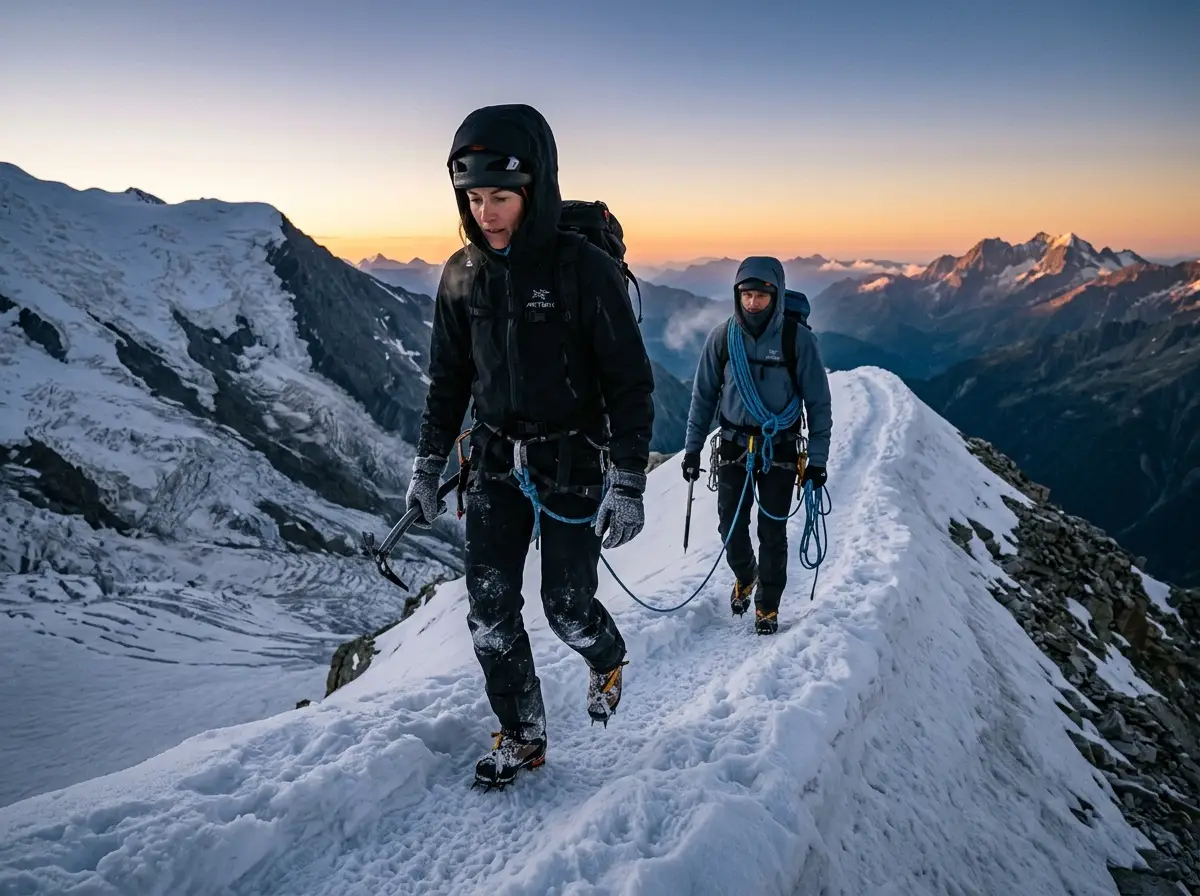
The phrase you’ll hear over and over is light and fast. It sounds like a gear philosophy. It isn’t. Light and fast means small teams, no supplemental oxygen, no fixed ropes hung up the route, no army of porters stocking camps.
You carry everything on your back and you do all the climbing yourself. The trade-off is real: you give up the safety net of a stocked camp below you, and in exchange you move quickly enough to slip through a weather window before the mountain notices you’re there.
That’s why style sits at the heart of alpinism. A summit reached by siege tactics — fixed lines on every pitch, weeks of stocking camps, bottled oxygen — counts for less in the climbing world than a fast, clean, self-supported push up the same wall. The three obligations baked into the UNESCO framework say it plainly: leave no lasting traces, help fellow climbers in trouble, and stay in harmony with the mountain environment. If you want to understand the full skillset this philosophy demands, start with the fundamental alpine climbing skills that everything else builds on.
Alpine Style vs. Expedition Style — the Philosophical Divide That Changes Everything
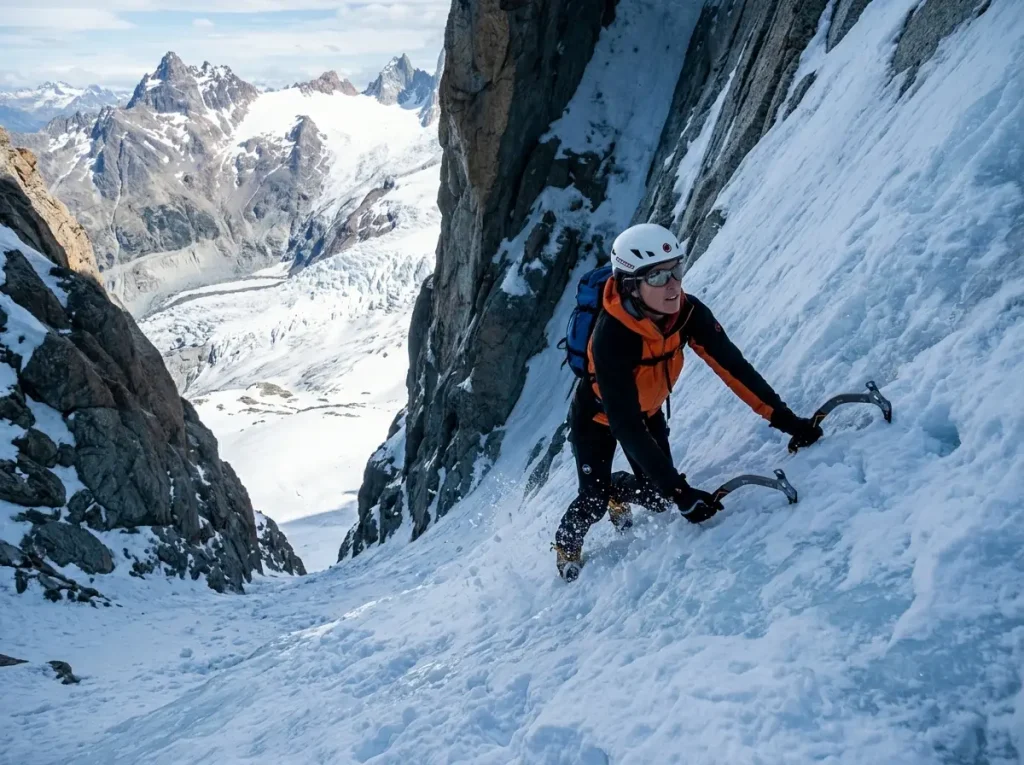
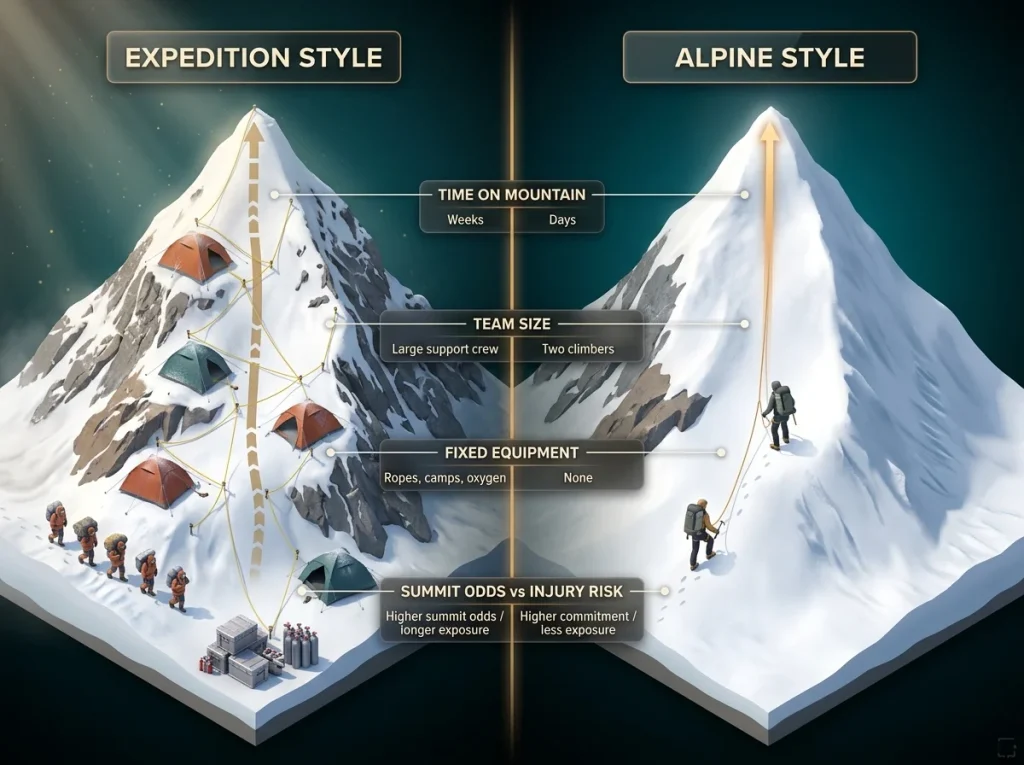
Picture two teams below the same peak in Patagonia. One sets up a string of camps, fixes rope on every pitch, and rotates up and down the mountain for three weeks, slowly stocking the route. The other team — two climbers — leaves base camp at midnight and tries to climb the whole thing in a single push, carrying their food, fuel, and shelter on their backs.
They might not make it. But if they do, and they come home safe, the climbing world treats their ascent as the greater achievement. The reason that’s true tells you everything about alpinism.
Expedition style, also called siege style, is built to maximize the odds of reaching the summit. Multiple camps, fixed ropes, bottled oxygen, rotating teams, and hired support staff all stack the deck toward standing on top. Alpine style flips the priority. One team, one push, everything carried — it maximizes commitment and minimizes the trace you leave on the mountain. You don’t get to wait out a three-day storm with hot food and a warm bag at a camp below. You’re committed the moment you leave the ground.
Here’s the part beginners find backwards: on serious peaks, speed is safety. The longer you’re on a face, the more rolls of the dice you take against rockfall, shifting seracs, and afternoon storms.
A team that moves through a hazard zone in four hours is exposed for four hours. A team that fixes ropes and rotates for two weeks is exposed, in pieces, the whole time. That’s why a fast alpine ascent of a serac-threatened route is often the safer choice, not the reckless one.
The cost gap is just as stark. An alpine-style attempt on a major peak is two climbers with plane tickets, a permit, and personal gear — a fraction of what a full expedition with logistics support runs. This is also why the climbing world now grades major first ascents by whether they were done alpine style: it changes how the whole achievement is read. The same mindset scales down to your own progression, whether you’re eyeing a Cascade volcano or an accessible Himalayan alpine objective like Island Peak as a first taste of altitude.
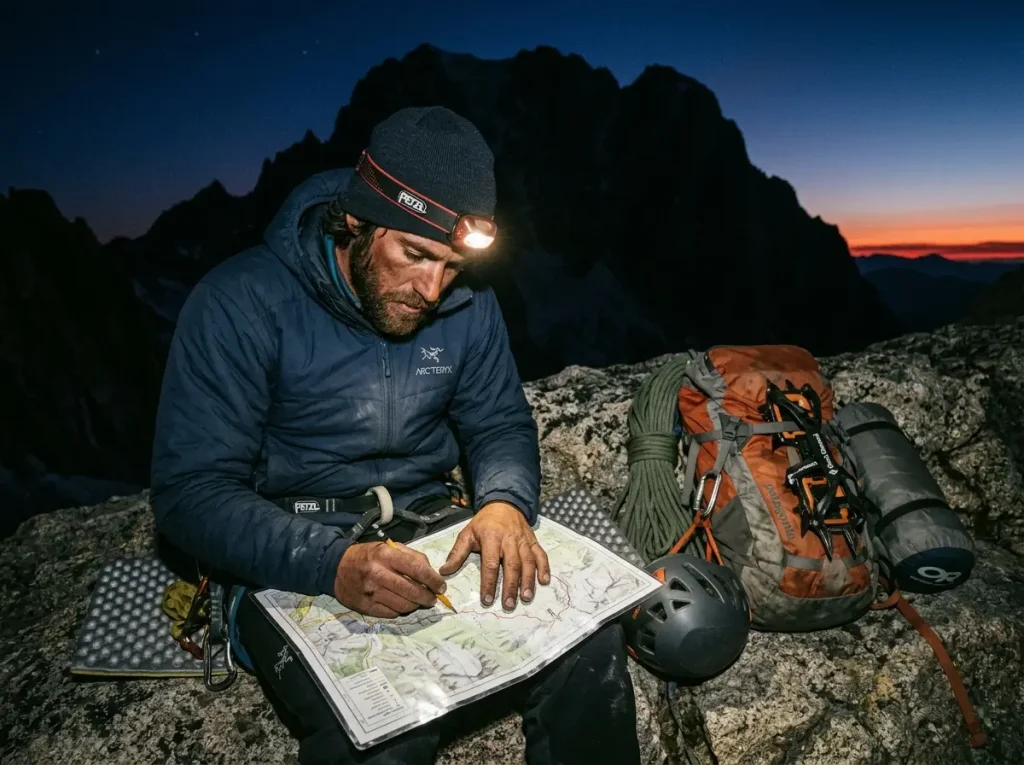
When people say “fast,” they don’t mean rushing. They mean efficient. The fast teams aren’t sprinting — they’re never standing around. No fumbling for gear, no re-racking at every belay, no debating the route mid-pitch. They sorted all that the night before with the headlamp on the topo. Speed on a mountain is mostly the absence of wasted minutes.
Alpinism vs. Mountaineering — A Distinction That Actually Matters
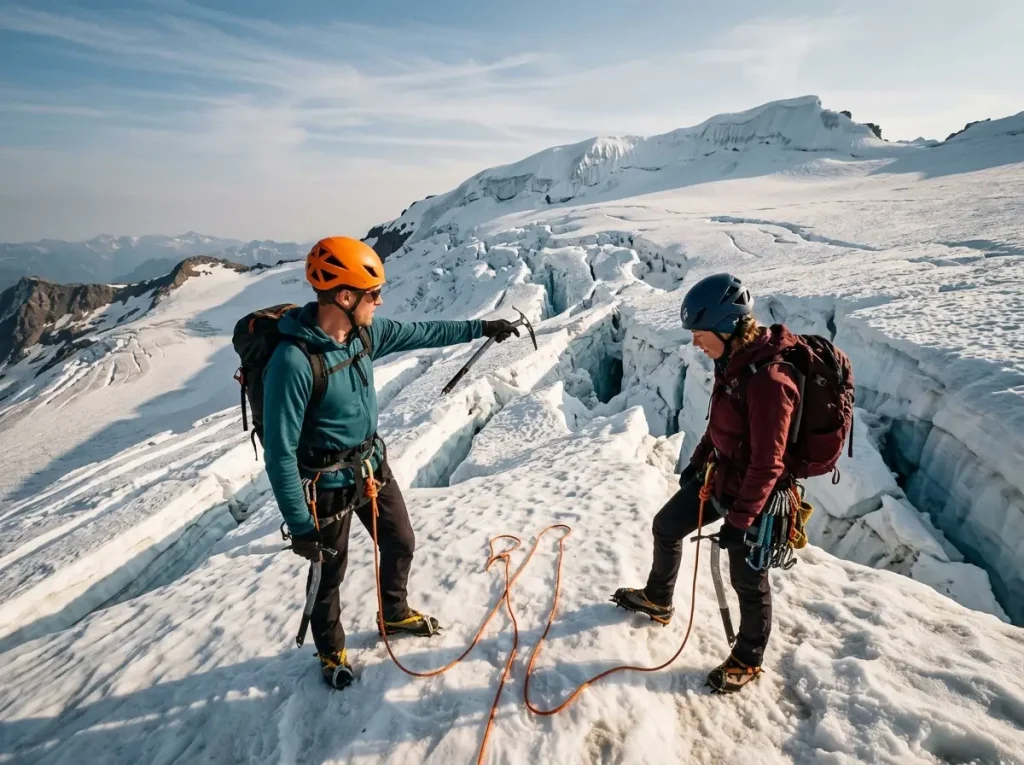
Walk into a gear shop and you’ll hear both words used like they mean the same thing. On the mountain, alpinists and mountaineers will push back on that.
The cleanest way to hold it in your head: all alpinism is mountaineering, but not all mountaineering is alpinism. This isn’t snobbery. It describes a real difference in approach, risk profile, and the skills you actually need.
Mountaineering is the broad category — getting up a mountain using any mix of hiking, scrambling, and technical climbing. That umbrella covers guided summit climbs, peak-bagging trips, and full siege-style expeditions. Alpinism is the subset defined by the alpine-style approach: fast, light, small team, ground-up, self-sufficient. A guided client clipped to a fixed line on a stocked route is mountaineering. Two climbers carrying everything for a single-push ascent are practicing alpinism.
The technical floor sits higher, too. Alpine climbing generally assumes you can handle low fifth-class rock and at least beginner water ice, often with a pack on and a long day already in your legs. General mountaineering can happen well below that bar. Alpine teams also accept more exposure to objective hazards as a deliberate trade for speed — they move through terrain without the backup of fixed lines, betting that being quick beats being anchored.
That higher bar is exactly why the alpine guiding credential is the hardest one going. The IFMGA certification (its US equivalent runs through the AMGA) finishes with a punishing multi-day alpine exam, and it exists because managing real alpine terrain — for yourself and a client — is its own demanding craft. If you’re weighing whether to hire help for your first serious objectives, learning how to find an IFMGA-certified mountain guide is the smartest early move you can make.
A Brief History of Alpinism — From Mont Blanc to the Greater Ranges
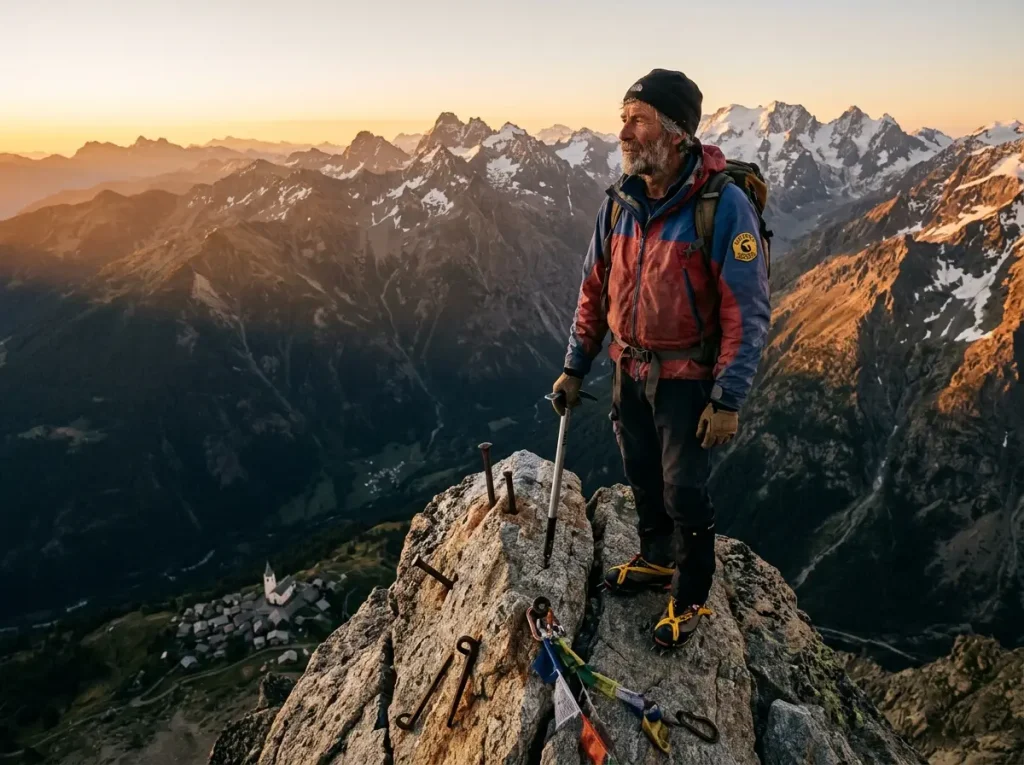
Alpinism didn’t appear out of nowhere, and the reason climbers care so much about style and leaving no trace has a direct ancestor in a single bad afternoon in 1865. The whole history is really a 240-year argument about what responsible mountain climbing looks like, played out on bigger and more remote peaks each generation.
It started in 1786, when Jacques Balmat and Michel Paccard summited Mont Blanc. Two locals, minimal gear, a single push to the top — the entire light-and-fast idea traces back to that climb.
Then came the Golden Age of Alpinism from 1854 to 1865, eleven years in which European climbers knocked off most of the major Alpine summits. The era closed on the Matterhorn in 1865, when Edward Whymper’s team reached the top and then, on the descent, four of the seven climbers were lost in a roped fall. That accident forced the first serious public reckoning with rope work, teamwork, and shared responsibility on a mountain — questions alpinists still chew on today.
From there the practice moved to the Greater Ranges — the Andes, the Alaska Range, and eventually the Himalayas. Same philosophy, far bigger and less forgiving terrain.
The modern benchmark arrived in 1978, when Reinhold Messner climbed Nanga Parbat without supplemental oxygen, then went on to solo and oxygen-free ascents that redrew the ceiling of what alpine style could do at altitude. Decades later, Ueli Steck took light-and-fast to its logical edge with a 2:22 solo of the Eiger North Face. The 2019 UNESCO recognition simply put an official stamp on what climbers already knew: alpinism is a living cultural practice, not just a pastime.
The Skills Every Alpinist Needs — and the One Most Guides Skip
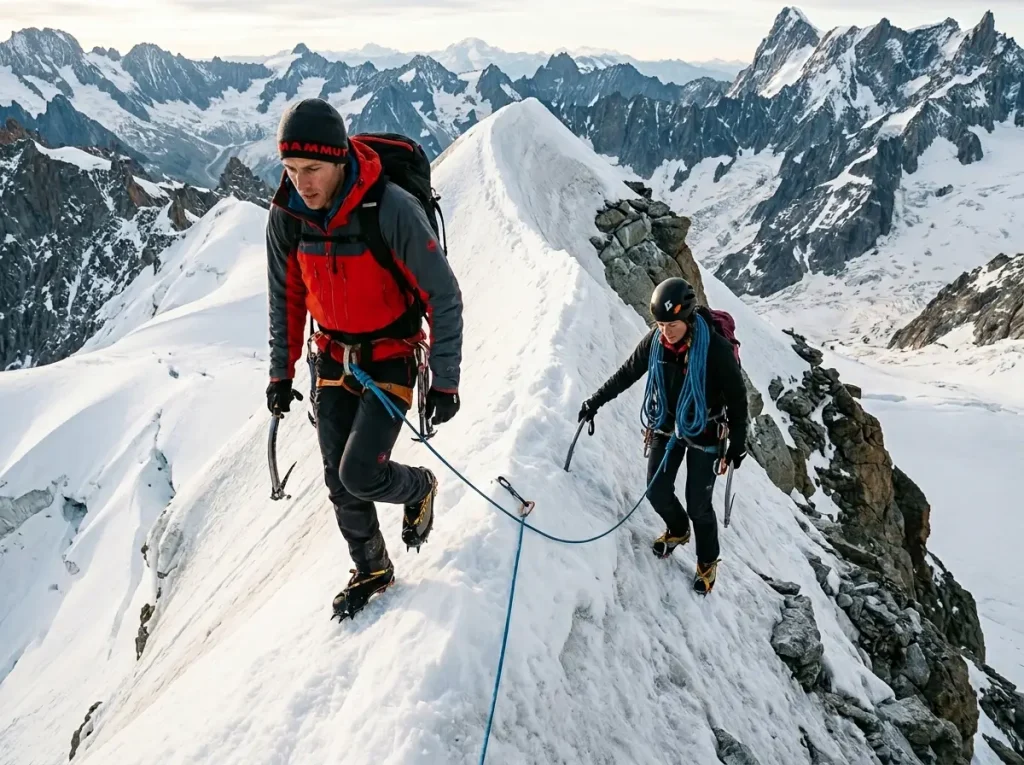
Most resources hand you a list — ice axe, crampons, glacier travel — and call it a skill set. That list isn’t wrong, but it skips the technique that actually separates a climber who moves fast in the mountains from someone practicing alpinism: moving together on a rope. We’ll get there. First, the layers everyone needs to build.
The foundation layer is rock. You want solid trad climbing to roughly 5.7 to 5.8, clean rappelling, and the ability to build an anchor without thinking hard about it. The snow and ice layer comes next: crampon technique, front-pointing, French technique on lower-angle slopes, glacier rope travel, and crevasse detection.
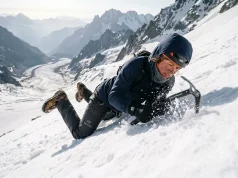
Sitting underneath all of it is self-arrest — the reflex that stops a slip before it becomes a slide — and there’s a reason it’s worth mastering ice axe self-arrest until it’s pure muscle memory. Then there’s the anchor layer, which on snow means a whole separate toolkit. Pickets, deadmen, bollards, and T-trenches all hold without rock, and building snow anchors that hold is its own skill you can’t fake when it counts.
You’ll also need a navigation layer — route finding in a whiteout, compass and map work, reading snow stability, and recognizing avalanche terrain before you walk into it. Wrap all of that in weather reading: cloud build, pressure trends, and the afternoon convection window that turns a calm morning into a lightning problem by two o’clock. The American Alpine Club’s framework for managing risk in the alpine is the clearest US-based starting point if you want to think about hazard like the people who study it do; their risk management guidance is written for working climbers, not academics.
Now the technique competitors skip: simul-climbing, also called moving together. Both climbers move at the same time, connected by a shortened rope with roughly 30 to 50 feet between them and at least two pieces of protection clipped in along the way. You use it on terrain that’s too serious to leave unroped but not hard enough to justify stopping and belaying every pitch.
Here’s the part that surprises people: the rope isn’t catching a clean fall the way it does at the crag. It’s friction and feedback, a thin margin that buys you a chance. The unbreakable rule is that you only simul terrain you’d feel comfortable soloing — if you wouldn’t downclimb it without a rope, you have no business moving together on it.
The mechanics reward a few tricks the magazines never mention. The weaker climber leads, which feels backwards until you think it through: if the leader comes off, both climbers are in trouble, so you want your strongest climber trailing and ready to drop into a self-arrest.
A progress-capture device like a Tibloc or MicroTraxion placed at a crux cuts the force on the follower if they slip. And you carry the spare rope in coils on your back, ready to pay out the instant a partner punches through a snow bridge into a crevasse. The video below shows the rhythm of it better than any paragraph can.
The first time you move simultaneously with a partner across a glacier at five in the morning — the crampons crunching in the dark, the rope twitching with your partner’s pace, nobody saying a word — is the moment most alpinists point to and say that’s when it clicked. The gear matters here too: this is the terrain where a low-profile alpine climbing harness earns its keep over a bulky sport rig, where your crampons need to match your boots and the ice, and where a dialed layering system keeps you moving instead of stopping to fight your zippers. If your route involves real ice pitches, the discipline carries over from the same checklist climbers run through before they lead ice.
Simul-climbing scares people for the wrong reason. They fixate on “we’re both moving with no belay.” The real risk isn’t the moving — it’s the gap between pieces. Keep two solid pieces between you and your partner at all times. When you place a new one, your partner cleans the old one, and the count stays honest. Run out of gear before you can place? You stop and belay. No exceptions.
Alpine Hazards — What Alpinists Worry About (and What They Don’t)
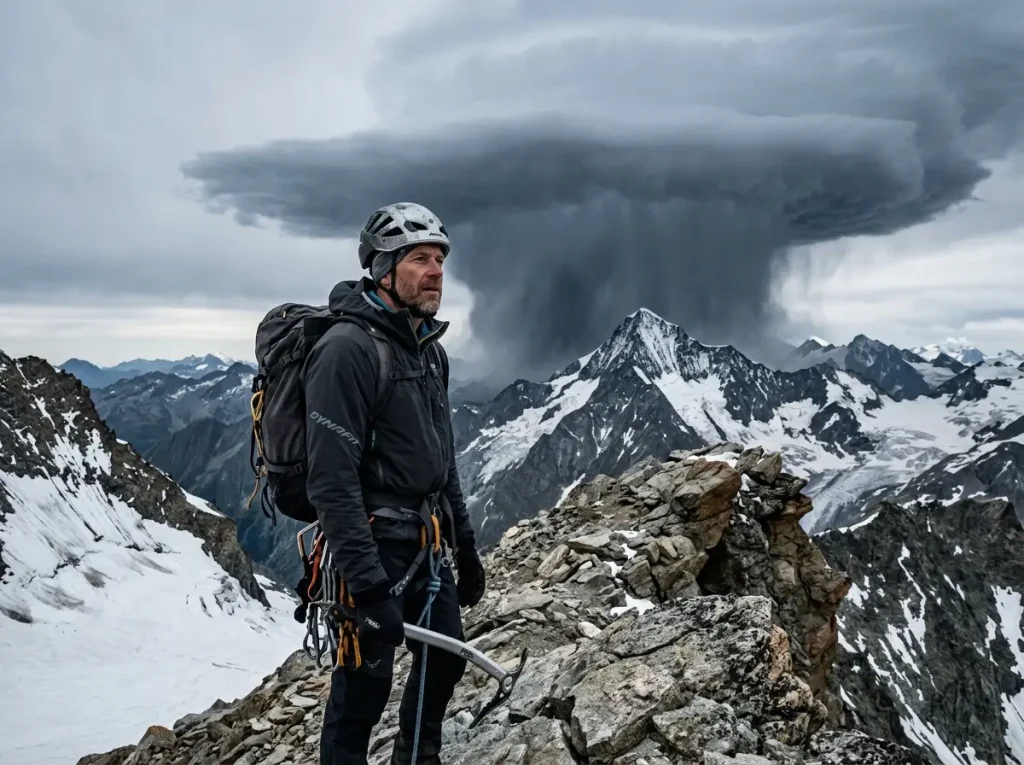
The conversations beginners have about alpine risk tend to fixate on the wrong things. They worry about the hard moves. Experienced alpinists worry about the temperature at noon, the soft snow waiting on the descent, and whether their partner will actually honor a turnaround time.
The mountain rarely catches climbers because the climbing was too hard. It catches them because of what happens around the climbing.
Hazards split into two buckets, and knowing which is which changes how you make decisions. Objective hazards sit outside your control: rockfall that picks up as the afternoon thaw loosens the face, serac collapse that fires on no schedule you can predict, avalanche slopes that demand real terrain knowledge, and lightning that builds with the afternoon. You manage these with timing and route choice, not bravery — which is exactly why assessing rockfall exposure on any alpine route belongs in your planning before you ever leave the trailhead. Subjective hazards come from inside the rope team: summit fever, the optimism that says it’ll clear up, the quiet peer pressure of nobody wanting to be the one who calls it, and the bad judgment that creeps in when you’re tired.
That second bucket is where the turnaround decision lives, and it’s the skill no competitor explains well. Set a hard turnaround time at the trailhead, before your judgment gets foggy, and treat it as non-negotiable. Most serious alpine incidents happen on the way down, when teams pushed past their cutoff and ended up descending in deteriorating weather or fading light.
The data backs this up: the International Alpine Trauma Registry’s injury analysis shows the alpine environment itself — not the difficulty of the moves — generates most of the serious accidents. The descent is also where altitude can ambush you, from the mild headache of acute mountain sickness to the serious conditions HAPE and HACE, and the rule there is simple: if in doubt, go down.
There’s a planning habit that ties all of this together. Alpine routes get built around weather windows, not calendar dates. A solid two-day window on Rainier beats a five-day trip spent watching clouds.
Build flexibility into the schedule, accept that you’ll sometimes drive home without summiting, and remember the oldest line in the game: the summit is optional, the descent is mandatory. When a descent does go wrong and you’re caught out overnight, knowing the difference between a controlled cold night and a real emergency comes down to whether you’ve thought through surviving an unplanned alpine bivouac before you needed to.
By the time someone in the team asks “should we turn back?”, it’s almost always already too late. The question itself is the signal. Don’t wait for the group to talk itself into asking it out loud near the top, when everyone’s tired and the summit looks close. Decide the trigger at the car — a time, a cloud, a snow condition — and when it shows up, you go down without a meeting.
How to Get Into Alpinism — A Realistic Progression (Not the Vague Advice You’ve Read)
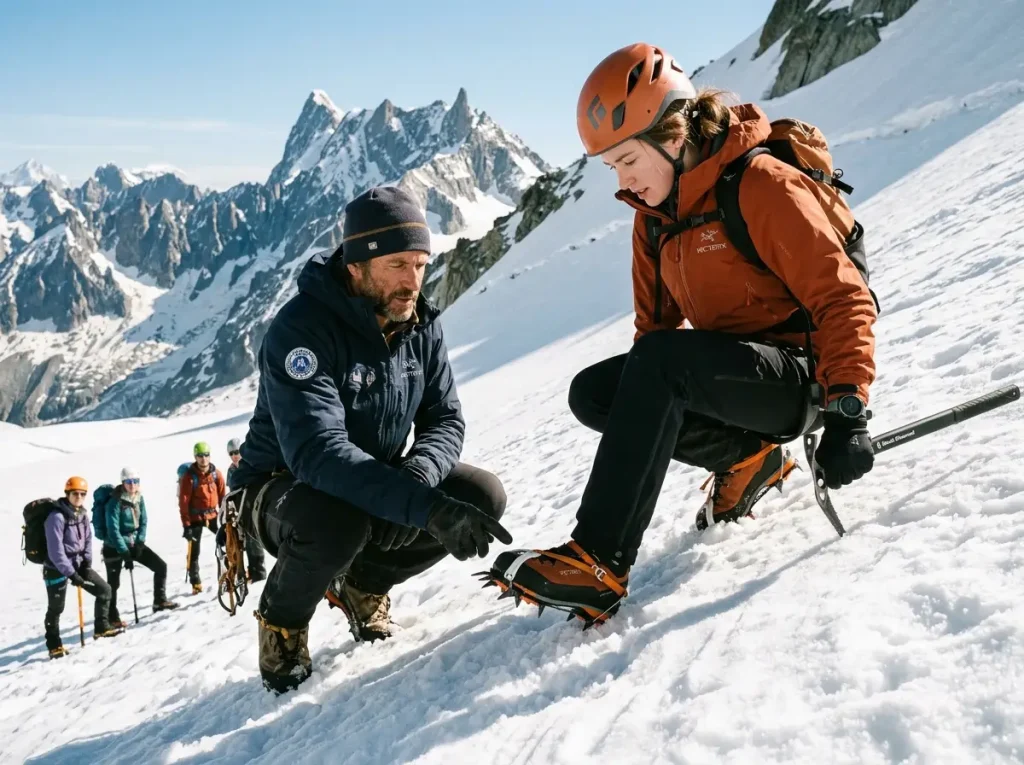
Every “how to get into alpine climbing” guide says the same useless thing: start on smaller mountains. Smaller than what? In what order? With which skills already in place?
Here’s the progression a good guide would actually walk you through, broken into phases you can plan a few years around.
Phase 1 — Build the foundation (1 to 2 years). Get your rock climbing to 5.7 to 5.8 trad outdoors, learn basic backcountry navigation, take a wilderness first aid course (WFA or the longer WFR), and stack up real camping and backcountry nights. None of this is alpine yet. It’s the prerequisite layer that makes everything above it possible, and skipping it is how people stall out a year in.
Phase 2 — Take your first alpine course. The AAI Alpinism 1 program — six days, most of it on Mount Baker — is the most accessible entry point in the US, covering glacier travel, crampon and ice axe work, self-arrest, crevasse rescue, and snow anchors in one shot. Run an AIARE Level 1 avalanche course alongside it before you touch winter or alpine terrain. These two can happen in the same season.
Phase 3 — Climb accessible glaciated peaks. This is where it gets concrete. Mount Baker (10,781 ft) is the classic first objective; from there the progression runs to bigger Cascade volcanoes and California’s Mount Shasta. Working Mount Shasta as a serious alpine progression step teaches you altitude, glacier travel, and early starts on real terrain, and a nearby peak like Mount Hood does the same — though it pays to study the mistakes most Hood climbers make before they reach the summit before you go. If you’re east of the Cascades, the alpine objectives in Rocky Mountain National Park cover the same ground. In the Alps, the Breithorn and Allalinhorn are the gentle entry points before something more committing like the Mont Blanc normal route. Work all of these with a guide or an experienced mentor.
Phase 4 — Step into technical alpine terrain. Multi-pitch ice, mixed rock-and-ice routes, longer and more committing approaches, and crevassed glaciers where real route finding kicks in. This is where simul-climbing stops being a concept you read about and becomes a tool you actually reach for.
Phase 5 — The Greater Ranges. High-altitude objectives like Island Peak in Nepal (20,305 ft) and Aconcagua (22,837 ft) add the variables of real altitude, longer commitment, and expedition logistics. When that step gets concrete, start with the details of planning your first Himalayan alpine objective at Island Peak, because the logistics matter as much as the climbing at that level.
Hiring an IFMGA-certified guide for Phases 2 and 3 isn’t a shortcut or a sign of weakness. It’s the fastest legitimate way up the curve — a good guide will teach you more in six days than most climbers stumble into over years of trial and error. As for timeline: most dedicated climbers reach Phase 3 competence in two to three years, and Phase 5 readiness usually takes five to ten. There’s no skipping steps, and if you try, the mountain will let you know.
The climbers who progress fastest aren’t the strongest ones. They’re the ones who repeat easy objectives until the systems are automatic. Do Baker three times before you touch Rainier. Boring? A little. But when you’re rope-team managing a crevasse field at altitude with a storm building, you want glacier travel to be something your hands do while your head watches the weather. Earn the boring competence first.
Where This Leaves You
Alpinism isn’t defined by the peak. It’s defined by how you climb it — small team, single push, no fixed ropes, carrying your own way up and down. That style is both faster and philosophically distinct from siege-style mountaineering, and it’s the reason the climbing world cares as much about the how as the whether.
The skill set runs wider than rock climbing alone: glacier travel, snow anchors, self-arrest, simul-climbing, weather reading, and the hardest skill of all, the turnaround decision you have to make before your judgment gets tired. And the path in is real and laid out — take the course, build the layers in order, hire qualified help early, and repeat the easy stuff until it’s automatic.
Start where it actually begins. Get the specific techniques this approach demands locked in — ice axe self-arrest, snow anchors, and glacier travel are the foundation every alpine day is built on. Pick one, drill it until it’s reflex, and then go find some easy snow to practice it on.
Frequently Asked Questions
01What is the difference between alpinism and mountaineering?
Mountaineering is the broad activity of climbing mountains by any means, including guided summit climbs and siege-style expeditions. Alpinism is a specific subset defined by alpine style: light teams, a single push, no fixed ropes, and self-sufficiency. You can mountaineer with siege tactics; alpinism demands a particular approach.
02How risky is alpine climbing compared to other styles?
Alpine climbing carries more objective hazards, such as rockfall, avalanche, and weather, than sport or trad climbing. The International Alpine Trauma Registry logged 71 alpine-style accidents in 2024, but that figure reflects how many people climb this way rather than a higher per-person injury rate.
03What skills do you need to start alpine climbing?
You need rock climbing to about 5.7 to 5.8 trad, crampon and ice axe technique, glacier travel, snow anchor building, self-arrest, and basic navigation. Most beginners take a structured course like AAI Alpinism 1 before stepping onto real alpine terrain.
04How long does it take to get into alpinism?
Most dedicated climbers reach entry-level alpine competence in two to three years. Getting ready for technical alpine terrain, like mixed routes and committing approaches, usually takes five or more years. The timeline depends on how often you climb and whether you take structured courses.
Safety Notice: Rock climbing and mountaineering are inherently high-risk
activities that can involve physical trauma or fatal incidents. The information on Rock Climbing Realms is for
educational and informational purposes only. Techniques and advice presented here are not a substitute
for professional, hands-on instruction. Conditions and risks vary by location. Always seek guidance
from a qualified instructor before attempting new techniques. By using this website, you agree that you
are solely responsible for your own safety. Any reliance you place on this information is strictly
at your own risk, and you assume all liability for your actions. Rock Climbing Realms and its authors
will not be held liable for any harm, damage, or loss sustained in connection with the use of this information.
Affiliate Disclosure: We are a participant in the Amazon Services LLC Associates Program, an
affiliate advertising program designed to provide a means for us to earn advertising fees by advertising and linking
to Amazon.com. As an Amazon Associate, we earn from qualifying purchases. We are also an official affiliate partner
of Black Diamond Equipment via the AvantLink network. If you click on a Black Diamond affiliate link and make a
purchase, we may earn a commission at no additional cost to you. We also participate in other affiliate programs.
Additional terms are found in the terms of service.