
In this article
When someone says they want to climb the Eiger North Face, they almost always mean one line: the Heckmair Route, the 1938 classic that made the wall famous. But the face above Grindelwald holds close to forty named routes, and most of them have been climbed by a handful of people ever. The honest question was never which route to pick. It is whether you are ready for any of them, because the grade on paper is the friendliest lie in alpine climbing. Here is the classic line feature by feature, the forty routes behind it, and the gut-check nobody hands you before you rack up.
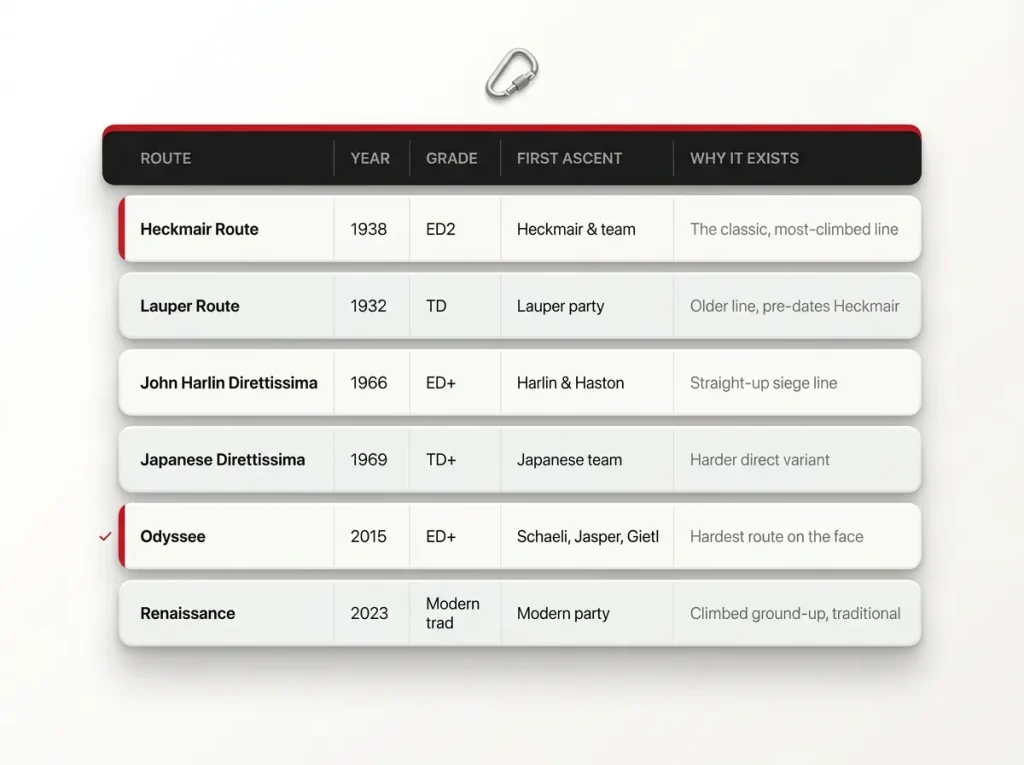
Here is how the major routes on the face compare at a glance.
| Route | Grade | First Ascent | Notes |
|---|---|---|---|
| Heckmair Route | ED2, V+/A0, WI4/M6 | 1938 | The classic and still the most-climbed line |
| Lauper Route | TD | 1932 | Older northeast-face line, pre-dates Heckmair |
| John Harlin Direttissima | ED+, M8- | 1966 | Straight-up siege line, cost Harlin his life |
| Japanese Direttissima | TD+ | 1969 | Harder direct variant of the wall |
| Odyssee | ED+ | 2015 | Widely regarded as the hardest route on the face |
| Renaissance | Modern trad | 2023 | Climbed ground-up in traditional style |
What the Eiger North Face Actually Is
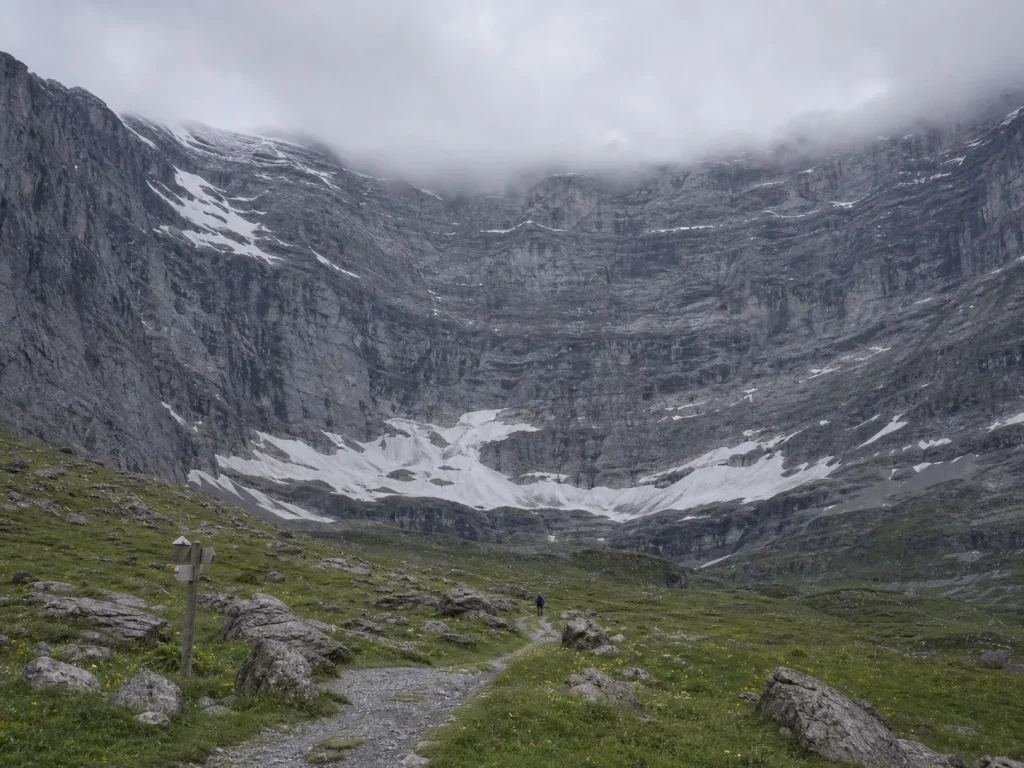
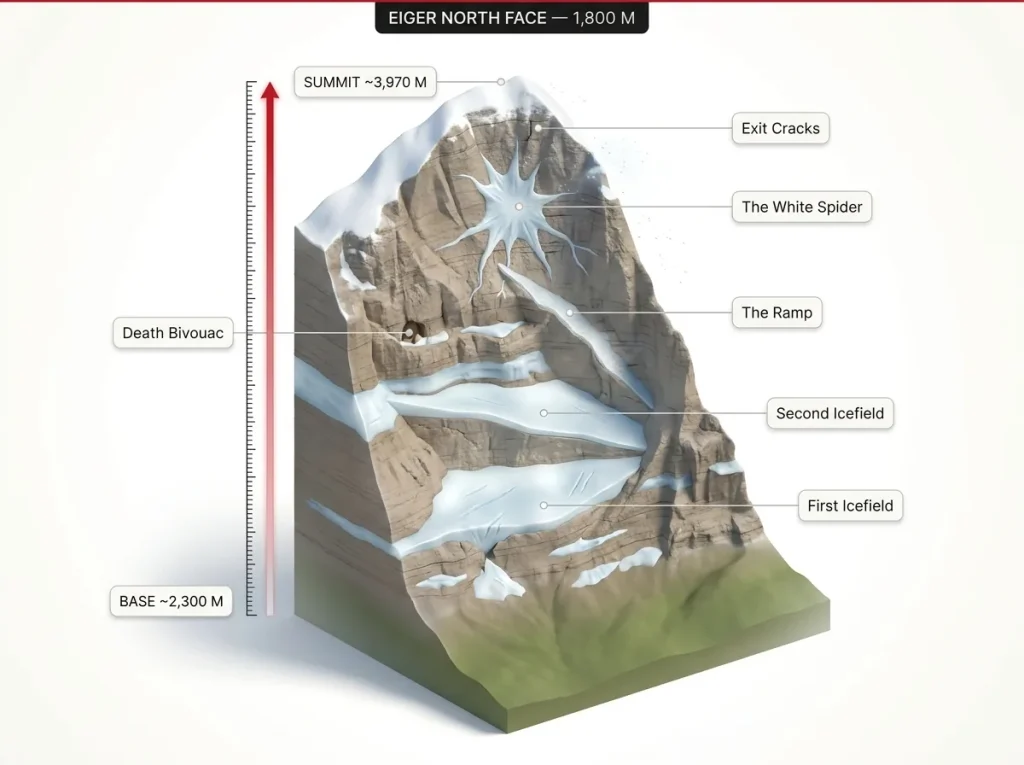
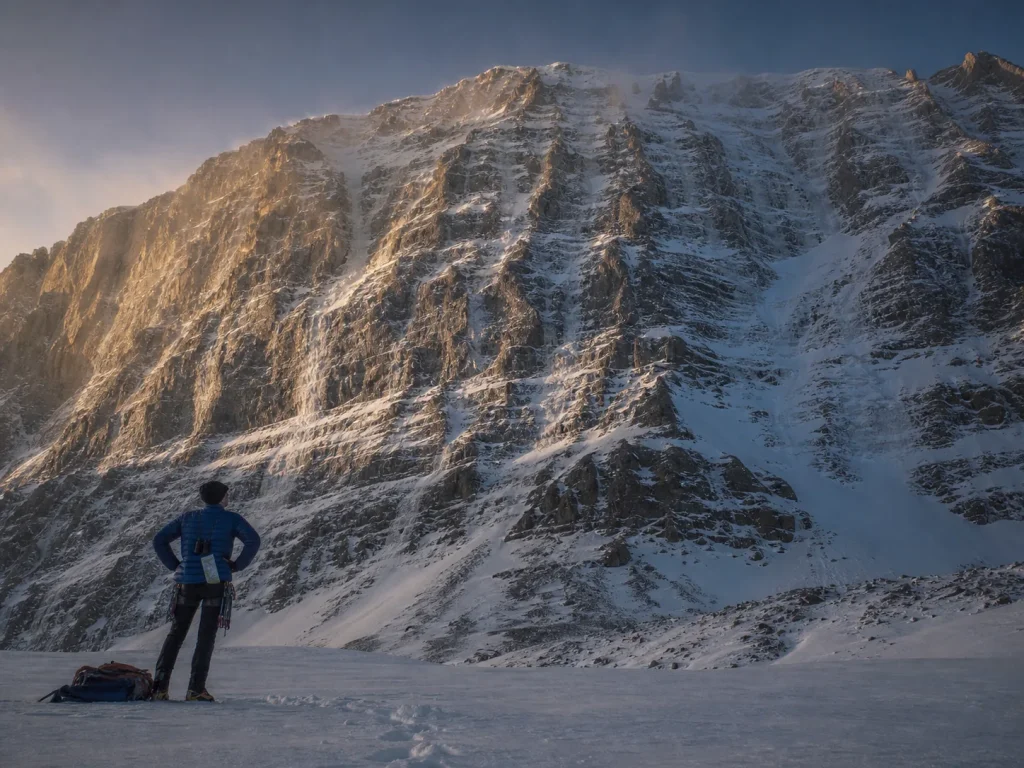
Before you talk routes, you need the shape of the thing. The Eigerwand, or Nordwand, is a concave limestone wall rising about 1,800 meters above the meadows of Kleine Scheidegg in the Bernese Oberland, a short train ride above Grindelwald. That is roughly four kilometers of climbing from the base to the summit, and the wall is famous enough to be one of the world’s most demanding famous mountain peaks, the kind of objective climbers measure a whole career against.
The rock is the problem baked into the geology. It is Schrattenkalk limestone, and its layers dip toward the north, which is a technical way of saying the holds slope the wrong way and the whole face sheds loose stone. That downsloping rock is why the wall has a reputation instead of just a grade.
The German nickname tells you the rest. Nordwand means north wall; climbers turned it into Mordwand, the murder wall, after the fatal attempts of the 1930s, and the name stuck because the record earned it. The Eiger sits in a club of exactly three, the great north faces of the Alps, alongside the Matterhorn’s north face and the Grandes Jorasses. The concave shape is not just scenery. It funnels weather and debris down onto the climbing, so a passing storm arrives bigger than the forecast promised.
The History That Built the Reputation
You cannot understand why a permanent rope hangs on one traverse until you hear what happened before 1938. In 1935, Max Sedlmayr and Karl Mehringer froze at around 3,300 meters on the face. The spot they reached is now named after that first fatal attempt, and climbers still call it Death Bivouac today.
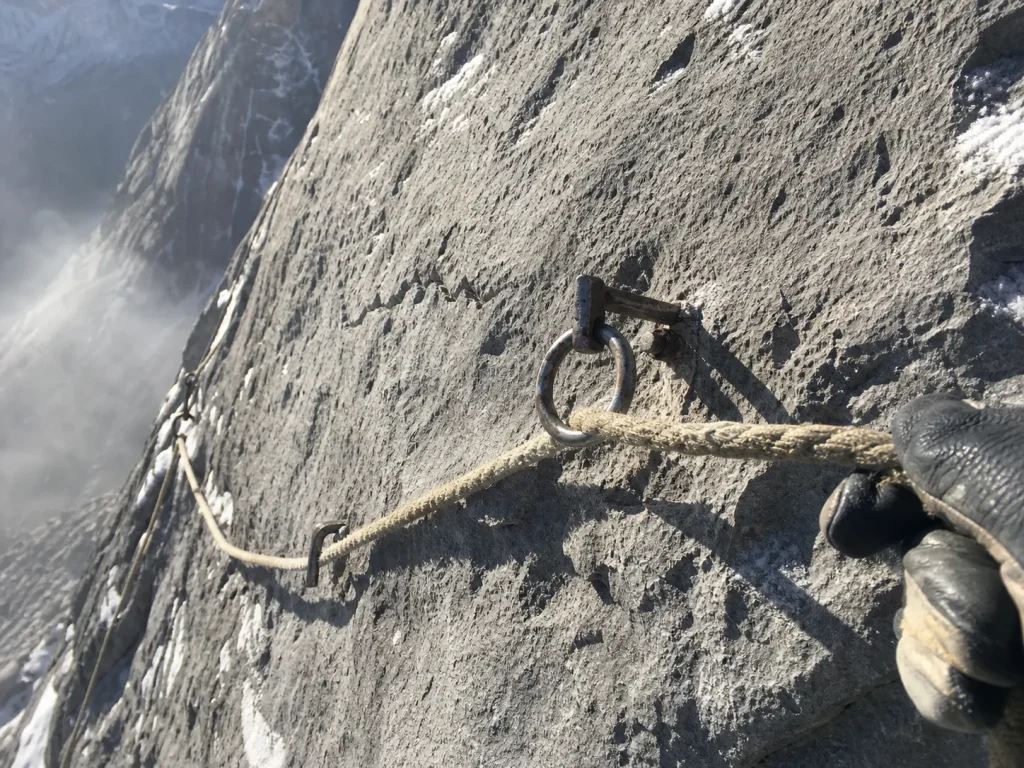
The next year was worse and more instructive. In 1936, a team of four got caught retreating from high on the wall. Willy Angerer was struck by rockfall, the party turned around, and then they hit the trap: the Hinterstoisser Traverse, named for Andreas Hinterstoisser of that team, only goes cleanly in one direction. Without a fixed rope in place, they could not reverse it, and all four lost their lives, Toni Kurz last of all, within sight of rescuers. That single fact is the reason a rope stays permanently fixed on that traverse now.
The wall was finally climbed in July 1938 by Anderl Heckmair, Heinrich Harrer, Ludwig Vörg, and Fritz Kasparek, two separate teams that merged on the face and topped out together on the 24th. That line became the Heckmair Route, and it carries the same objective-hazard math that humbles climbers on Robson’s Emperor Face: the rock and the weather do the damage, not the difficulty rating. The mountain remembers its dead in its rigging. That fixed rope on the Hinterstoisser is a monument you clip into.
The Heckmair Route, Section by Section
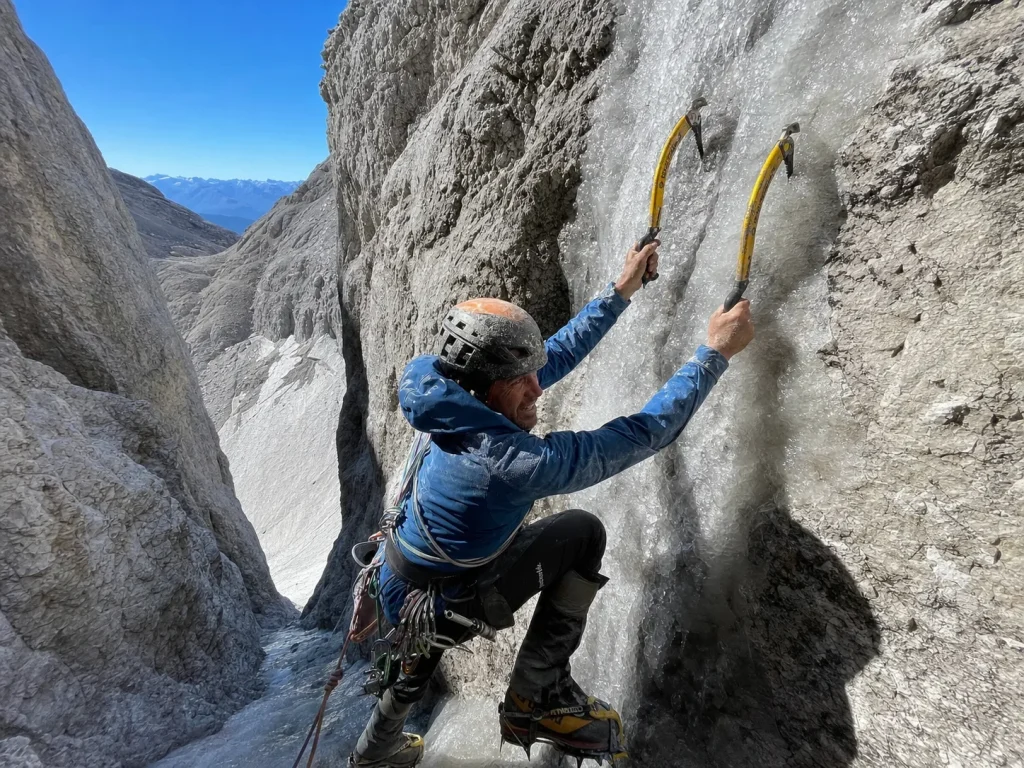
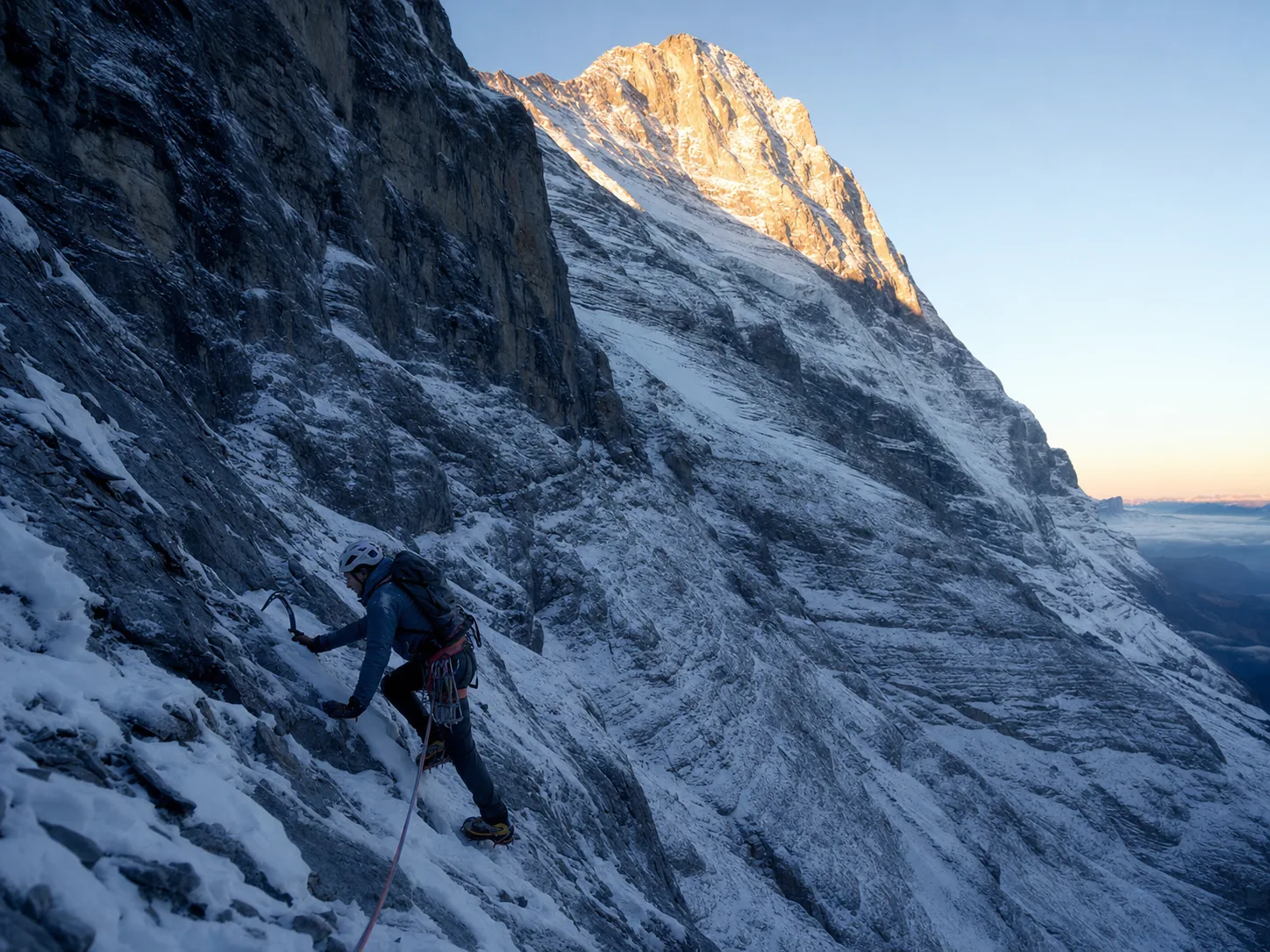
This is the route everyone means, and told in order the named features stop being word-salad and become a sequence you can picture. The line runs: Difficult Crack, then the Hinterstoisser Traverse, the First Icefield, the Ice Hose, the Second Icefield, up to Death Bivouac, then The Ramp, the Brittle Ledges, the Traverse of the Gods, the White Spider, the Exit Cracks, and the summit icefields.
The grade is ED2 on the UIAA scale, with rock to V+ and a point of aid (A0), ice to WI4, and mixed climbing to M6. It covers roughly 1,700 to 1,800 meters, and fit parties climb it in one to two days, with most taking up to three. The icefields between the rock bands mean long stretches of front-pointing on steep water ice, not just the technical cruxes people remember. The way a modest number can undersell a real route is the same trap as the Owen-Spalding’s 5.4 on the Grand Teton: the figure describes the moves, not the conditions.
The White Spider, or Das Spinne, is the exit icefield high on the wall, named for the ice-veins that radiate out from it like legs. It is also the funnel that every falling stone and snow slough passes through on its way down, which is why timing matters more there than technique.
Protection is sparse by design on several of the crux pitches. Climbers who have been on the Traverse of the Gods describe powder-covered rock and what they bluntly call rubbish belays, two marginal pieces and a prayer, even on a good-condition day. And the Hinterstoisser still only goes one way without that fixed rope. Reversing it is exactly the trap that caught the 1936 team.
What the Grade Really Demands
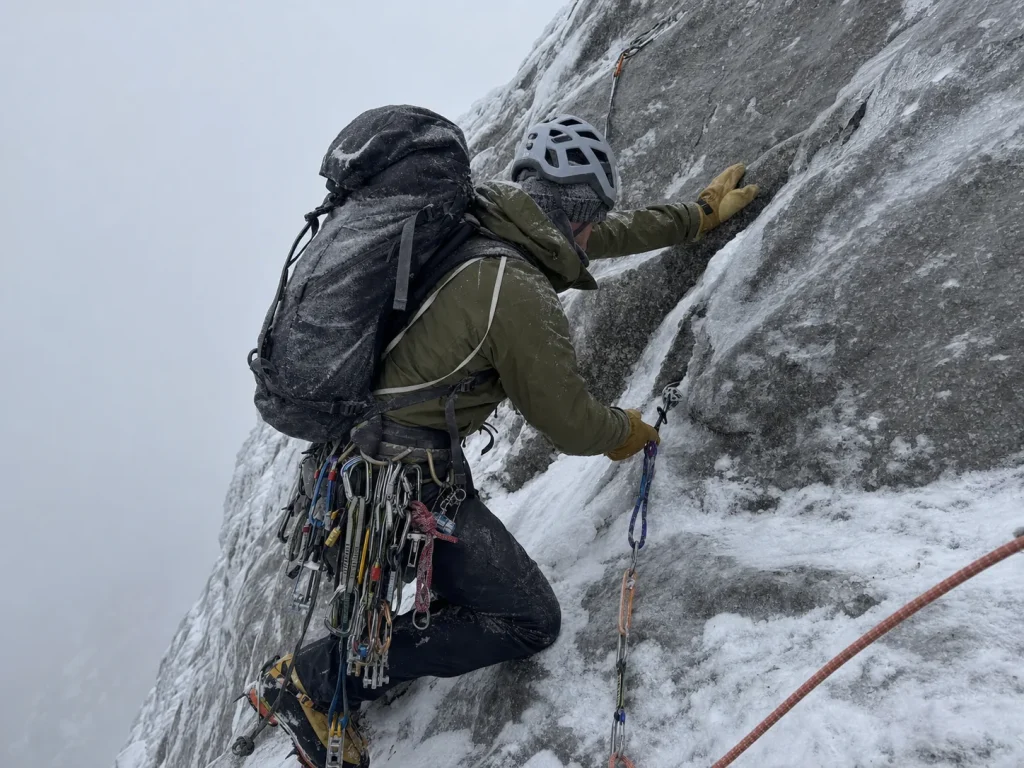
Here is the part every competitor skips. ED2 and WI4 and M6 are just letters until you translate them into a readiness bar you can measure yourself against, and the honest bar is higher than the numbers suggest. A useful version, drawn from coaches who prepare people for exactly this face, goes like this: you should be able to comfortably lead and follow 5.7 snow-covered rock, in sub-freezing cold, carrying a 12-kilogram pack, and keep moving 12 to 14 hours a day without falling apart, on back-to-back days.
Read that again, because the gap hides in it. Leading 5.7 in a warm gym is a Tuesday. Leading 5.7 on iced-up rock at altitude, loaded, with rockfall a possibility and retreat difficult, is a different sport that happens to share a number. That is the same reason fit climbers still fail on the Grand Teton: fitness and readiness are not the same currency.
The prep is not optional either. Even an alpinist of Steve House’s caliber climbed the Eiger five times by three easier routes before his first attempt on the North Face. The neighboring lines and the nearby Mönch and Jungfrau are the homework, not a bonus.
Stop measuring yourself by your redpoint grade and start measuring the ugly stuff: how you move roped up in the cold, loaded, hour after hour. The Eiger doesn’t care what you send at the gym. It cares whether you can still make good decisions on day two with numb hands.
To put the difficulty in perspective from the other end, consider the speed record. Ueli Steck soloed the Heckmair Route in 2 hours, 22 minutes, 50 seconds in 2015, the officially recognized record for the fastest solo climb of the face. That is the same wall a competent roped team needs one to three days to climb. Speed records show you what is possible for one extraordinary person, not what is sane for you.
The 40 Routes Beyond Heckmair
This is the section nobody else writes, and it is the reason the wall is more interesting than its reputation. Today there are close to forty distinct named routes on the North Face, running from the 1932 Lauper Route all the way to modern lines like Odyssee (2015) and Renaissance (2023). A bare list of them tells you nothing, so here is what they actually mean.
The Lauper Route came first, in 1932, an older line on the northeast side of the face that pre-dates the Heckmair by six years and is still a serious undertaking. The John Harlin Direttissima of 1966 is a different animal entirely: a straight-up siege line, the plumb-line the earlier climbers deliberately avoided. It cost Harlin his life when a fixed rope broke, and Dougal Haston finished it with the rival German team after a month of effort on the wall. That word, direttissima, is the whole point: a route that ignores the natural weakness and goes dead vertical, harder on purpose.
The Japanese Direttissima (1969) and the Czech Pillar (1976) follow the same logic, harder direct and free variants that avoid the classic line for the challenge of it. The list keeps growing across the decades, the Geneva Pillar (1979), the visionary Métanoïa (1991), La Vida es Silbar (2000), and The Young Spider (2001) each adding a harder or bolder line to the same wall. And at the top of the difficulty scale, Odyssee (2015), put up by Roger Schaeli, Robert Jasper, and Simon Gietl, is widely regarded as the hardest route on the face, as documented in the American Alpine Club’s own account of the Odyssee first ascent. Renaissance (2023) went up ground-up in traditional style, a modern statement about how the wall can still be climbed.
Here is the honest filter, though. For all but a tiny number of working alpinists, the Eiger North Face means the Heckmair. The other routes exist, and they are real, but most have been climbed by a few people ever and belong to a different tier of the sport than the one this article is for. If you want to know how the Eiger stacks up against the world’s most difficult mountains, the answer is that the Heckmair earns its place through hazard and commitment, while the hardest lines on the same wall push into territory only a dozen or so climbers touch.
Why Summer Is the Rockfall Season
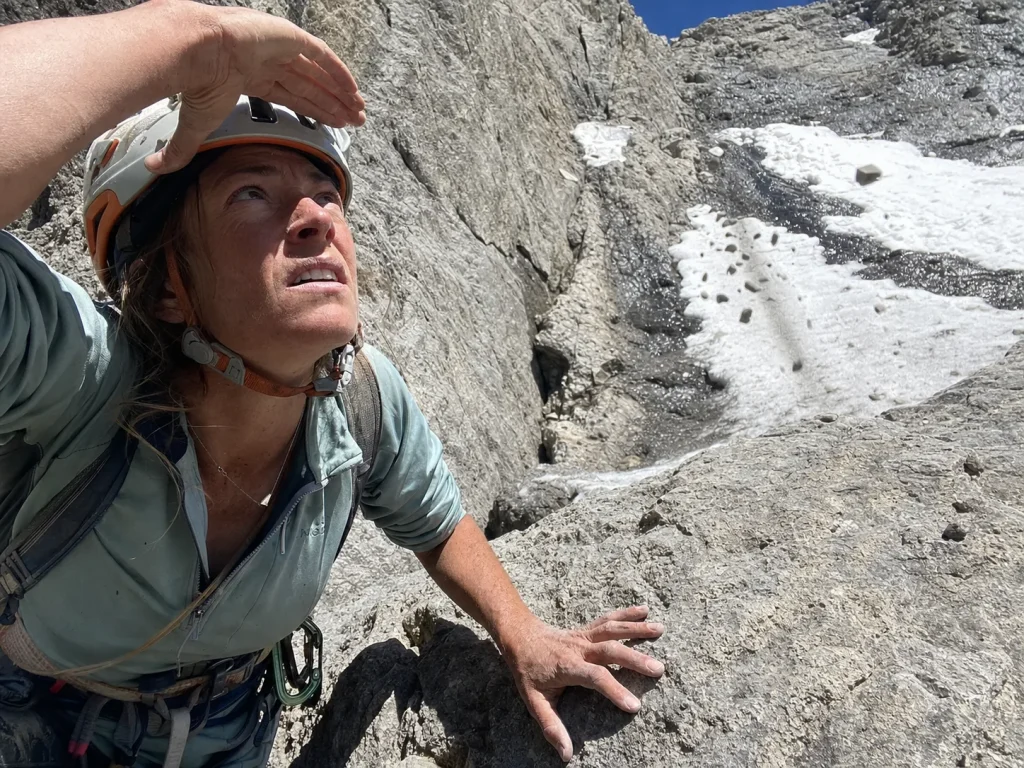
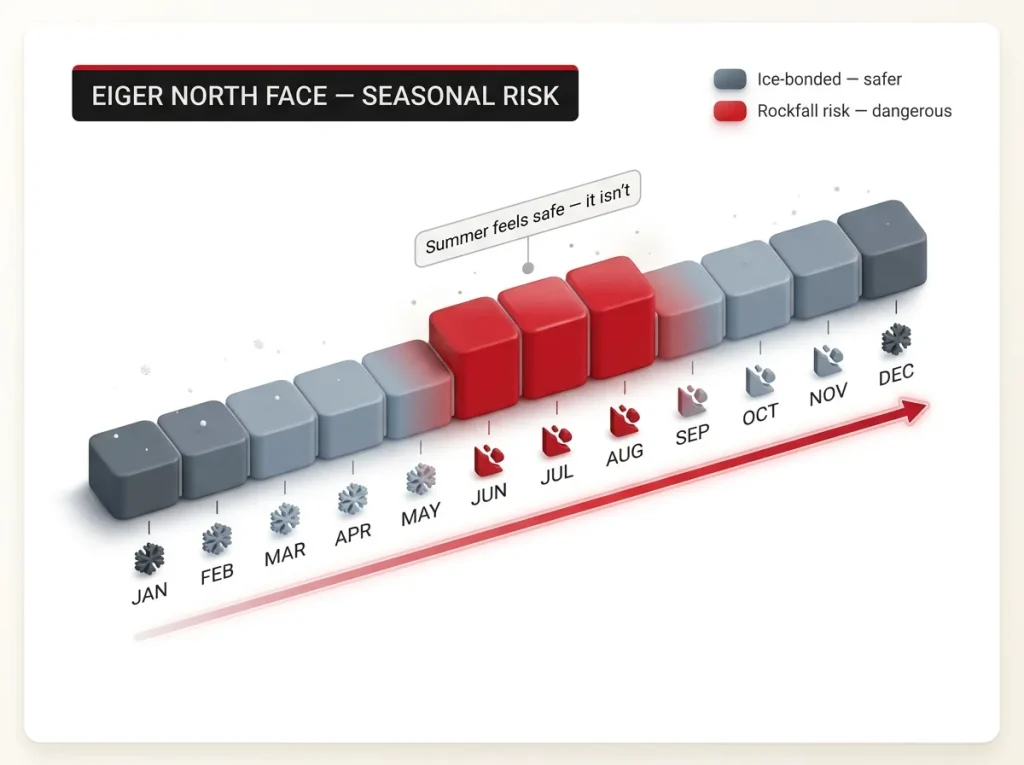
Everyone assumes summer means good weather means go. On this wall it is the opposite, and once you understand the mechanism it stops sounding backwards. The rock is held in place by cold. When the face is plastered in snow and ice through late autumn, winter, and early spring, that loose limestone is frozen into position and the climbing is safer. The best conditions are counterintuitive: warm, wet, sticky snow that bonds into ice after a warm summer followed by cold nights.
Dry conditions are the hazard. In summer, sun hits the upper face in the afternoon, the ice that was gluing everything together releases, and the wall starts shedding stone down those same funnels the White Spider drains. The season that feels safest is the one that kills the most people, which is exactly the kind of season-window call that decides a Rainier climb in July too, just with the logic inverted.
Don’t just read tomorrow’s forecast. Track the previous ninety days of temperature and precipitation, weighting the last week heaviest, through a service like MeteoSwiss. Conditions on this face are a seasonal accumulation, not a single day’s weather, and the wall you get is built by the month before you arrive.
There is a field read worth learning too. Veterans check ice color at a glance: ice is either blue or gray, snow is white, and knowing which one you are looking at tells you fast whether a pitch will actually hold a screw. You can watch the current forecast through the national forecasting service climbers actually watch for this face, but the ninety-day history is what tells you if the wall is in shape at all.
The Bivouac Reality
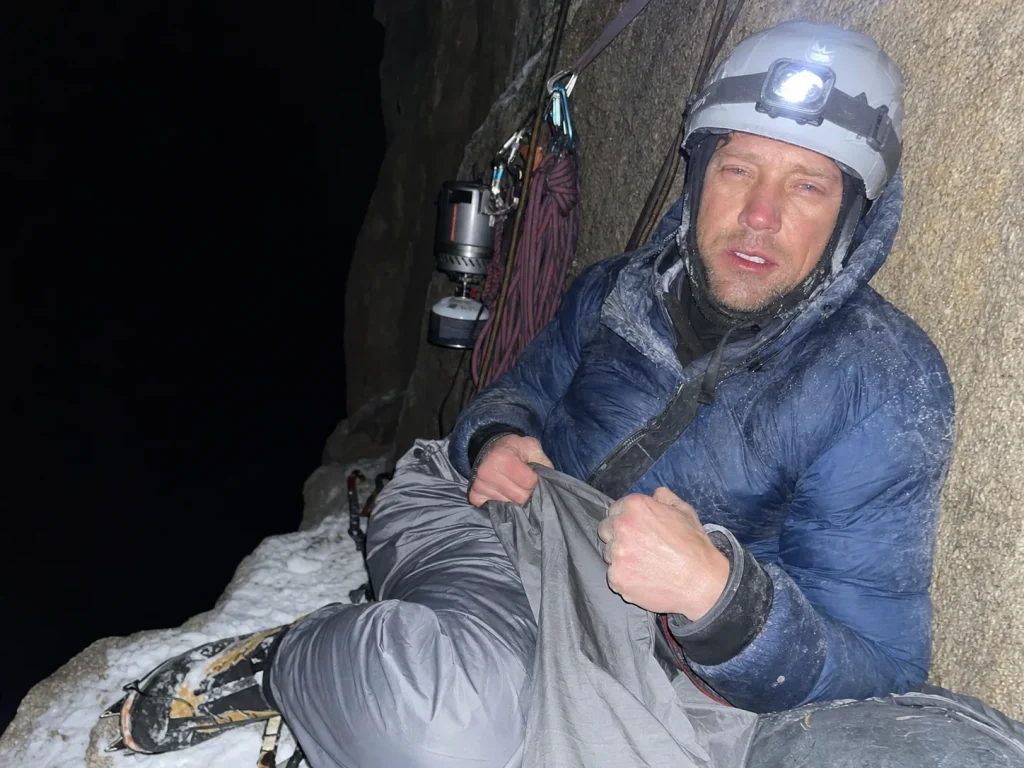
Death Bivouac gets name-dropped in every account of the wall, but almost nobody tells you what an overnight on this face actually involves. Here is the honest version: there is basically one good ledge, it holds only a small number of parties, and if you are not on it when night falls, you are hanging off your gear.
That one good ledge is Death Bivouac itself, described by climbers who prepare for the route as the only decent bivouac on the face besides the sites up on the summit ridge. It fills fast. Arrive late and your alternatives are exposed stances, not ledges, which means your whole day has to be planned around reaching it in time. On this wall, timing the bivy is as much a skill as climbing the pitches.
What that looks like when it goes sideways is worth hearing straight from the wall. One climber’s account of three days on the face describes two grim, spindrift-pummelled bivouacs, lashed to a single ice screw at the top of the Spider, then hanging from the ropes in the exit chimneys. That is the version that does not make the highlight reel, and it is far more common than the climbed-it-in-a-day stories. The name is a warning, not decoration, and the same way the icefall on Huascarán stops more climbers than the summit, the bivouac logistics here turn back people who could handle the actual climbing.
The Objective Hazards That Still Bite
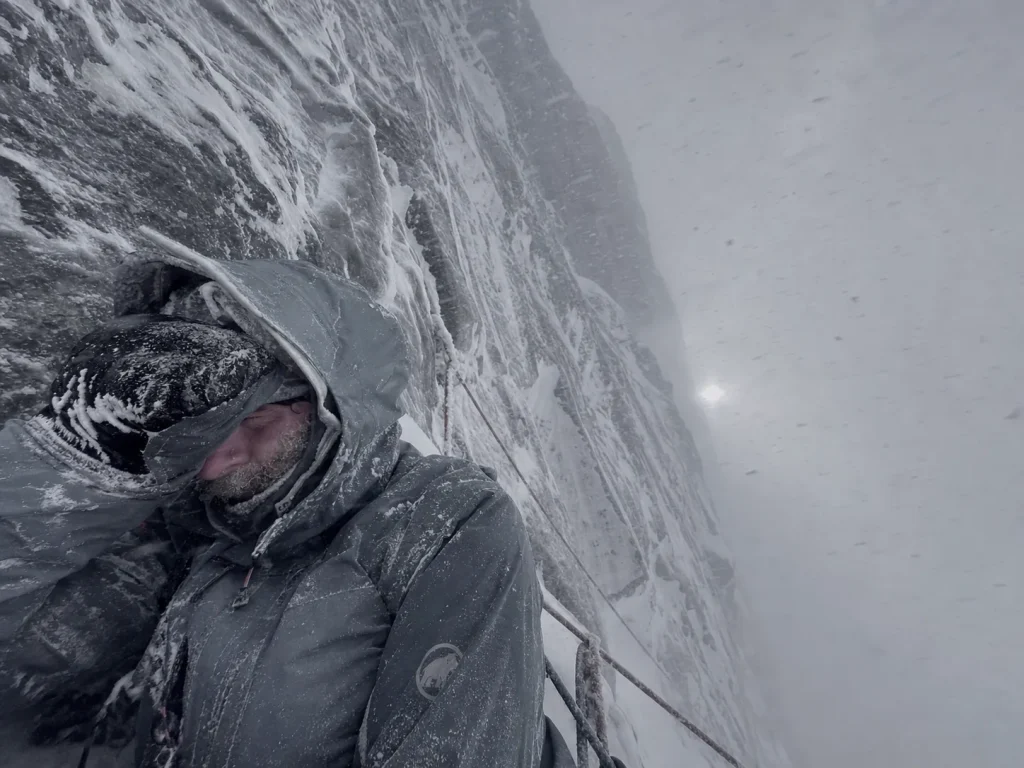
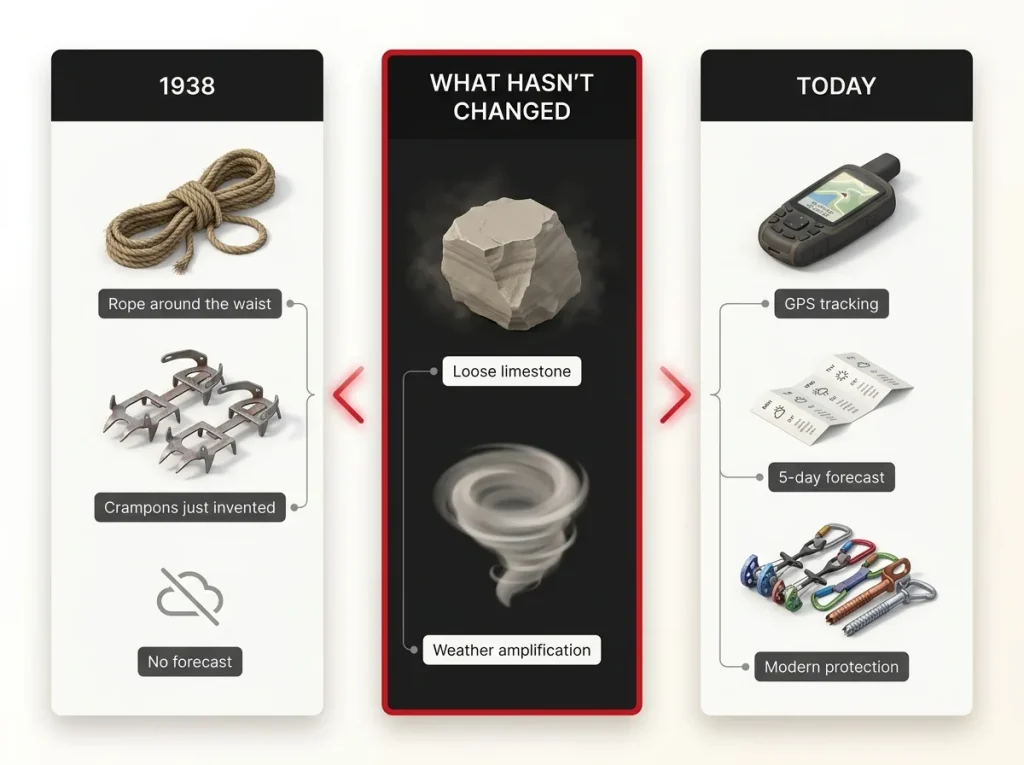
So is the Eiger North Face still as lethal as its reputation? The honest answer: the tools got better, the wall did not. Some of the Mordwand mystique is a story about 1930s equipment, ropes tied around the waist and crampons that had just been invented. But the loose rock and the weather violence are current, not historical.
Start with the record, because it is a record and not hype. The face has claimed a large number of climbers since 1935, at least 64 by careful counts and higher by some. That reputation was earned in fatalities, and the hazards behind it have not been engineered away.
Recent proof: in September 2023, roughly 200 cubic meters of rock let go near the Ghilini-Piola Direttissima after a 20-degree temperature drop. That is not a 1938 problem. That is the permafrost and ice bonding breaking down on a schedule nobody controls, on a wall people were standing under. The concave face amplifies weather, extreme cold sits near the bottom of the thermometer in winter, and avalanche and storm behavior are baseline conditions, not worst-case ones. These are the same alpine hazards, rockfall, avalanche, and cold, that decide most objective climbs, just concentrated on one wall.
Here is the reframe that matters. Modern forecasting, GPS tracks, and better protection genuinely lower the risk, but they lower it by helping you avoid the hazard, not by removing it. The loose limestone is still loose. The weather still funnels. A friendlier reputation does not mean a friendlier mountain, and this wall deserves that clear-eyed honesty every time. And the descent has its own teeth. Climbers warn that the Eiger is not easy to get down except in perfect weather, and GPS accuracy degrades among the small rock bands right when you need it most.
The Gear and the Homework Before You Go
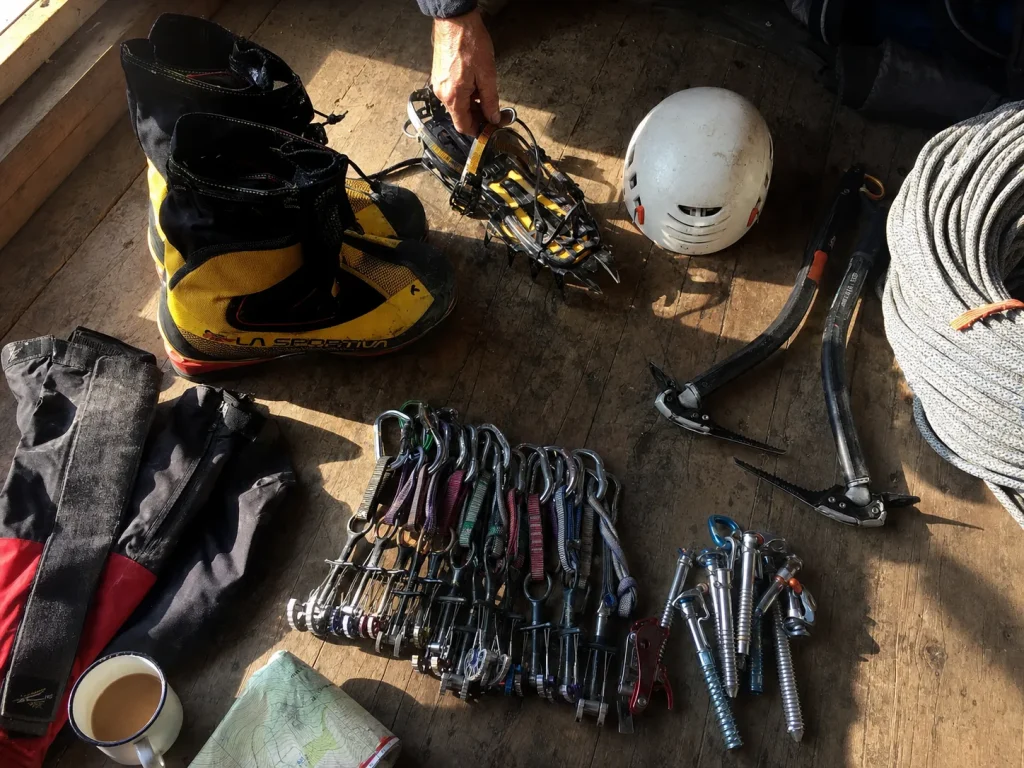
End on action, not inspiration. The gear list is the easy part, and it is not exotic. You want double 60-meter ropes, or a single for experts moving fast, ice tools, 12-point crampons, a harness, a helmet, a small rack of cams and offsets, nuts, a few pitons, and ice screws. That is standard alpine kit. The wall does not ask for special equipment; it asks for competence with ordinary equipment in bad conditions.
The homework is the actual point. Climb the Mönch, the Jungfrau, or an easier route on the Eiger itself, the South Ridge or West Face, before you touch the North Face, and treat a Matterhorn ridge as the readiness benchmark it is. The prep climbs are where you find out whether the face is your next step or two steps too far.
On the exit sections, expect powder over rock and belays you wouldn’t trust at the crag. Carry the ability to protect thin, marginal placements, not just a fat rack of bomber cams. The skill that gets you up the last third isn’t strength, it’s being comfortable running it out when the gear is bad and staying calm about it.
The most useful thing you can bring to this wall is not something you buy. It is the season of alpine routes you climb before it, because this is alpinism in its most distilled form, and no purchase substitutes for the miles.
The Bottom Line on the Eiger North Face
Three things to carry away. First, the Eiger North Face almost always means the Heckmair Route, but it is genuinely one of close to forty named lines, most of them out of reach for all but a few climbers. Second, the grade undersells the wall: the real bar is 5.7 on iced-up rock, loaded, all day, two days running, with the homework climbs already done. Third, the reputation is partly a historical equipment story, but the loose rock and the weather are entirely current, as the 2023 rockfall proved.
The honest next step, if this wall is on your list, is not the Eiger. It is the route before the route. Go climb the Mönch, the Jungfrau, or a Matterhorn ridge first, and let that tell you the truth about where you stand.
Frequently Asked Questions
01How many climbers has the Eiger North Face claimed?
At least 64 climbers have lost their lives on the Eiger since 1935, most of them on the North Face, and some counts run higher. The Mordwand nickname reflects a real record, not marketing.
02Why is the Eiger North Face called the Mordwand?
Mordwand (murder wall) is a play on Nordwand (north wall) that stuck after the fatal attempts of the 1930s. It is community shorthand for the face’s reputation, not an official name.
03What is the hardest route on the Eiger North Face?
Odyssee, established in 2015, is widely regarded as the hardest route on the face. The classic Heckmair Route is the most-climbed line but far from the most difficult of the roughly forty named routes.
04What is the best time of year to climb the Eiger North Face?
Late autumn through early spring, when winter conditions bond the loose rock in place. Summer feels safer but is the worst window, because sun-warmed rock sheds constant rockfall through the afternoon.
05How long does the Heckmair Route take?
Fit parties climb the Heckmair Route in one to two days; most take up to three, with at least one bivouac. Elite soloists have done it in under 2.5 hours, but that reflects what is possible, not what is realistic for a roped team.
Safety Notice: Rock climbing and mountaineering are inherently high-risk
activities that can involve physical trauma or fatal incidents. The information on Rock Climbing Realms is for
educational and informational purposes only. Techniques and advice presented here are not a substitute
for professional, hands-on instruction. Conditions and risks vary by location. Always seek guidance
from a qualified instructor before attempting new techniques. By using this website, you agree that you
are solely responsible for your own safety. Any reliance you place on this information is strictly
at your own risk, and you assume all liability for your actions. Rock Climbing Realms and its authors
will not be held liable for any harm, damage, or loss sustained in connection with the use of this information.
Affiliate Disclosure: We are a participant in the Amazon Services LLC Associates Program, an
affiliate advertising program designed to provide a means for us to earn advertising fees by advertising and linking
to Amazon.com. As an Amazon Associate, we earn from qualifying purchases. We are also an official affiliate partner
of Black Diamond Equipment via the AvantLink network. If you click on a Black Diamond affiliate link and make a
purchase, we may earn a commission at no additional cost to you. We also participate in other affiliate programs.
Additional terms are found in the terms of service.