
In this article
You’re stripped to a damp base layer, sweating, at nearly 20,000 feet. The tent that was a freezer at 4 a.m. has turned into a sauna by 9, and you’re sucking warm water and waiting for the sun to drop so you can survive the night that’s supposed to make you stronger. That’s the contradiction of Camp 1, the strangest stop on the highest of the world’s famous mountain routes and peaks. Most explainers tell you the elevation and move on. This one tells you what the place actually does to you, why it exists, and why the way climbers use it is changing fast.
Where Camp 1 Sits in the Western Cwm
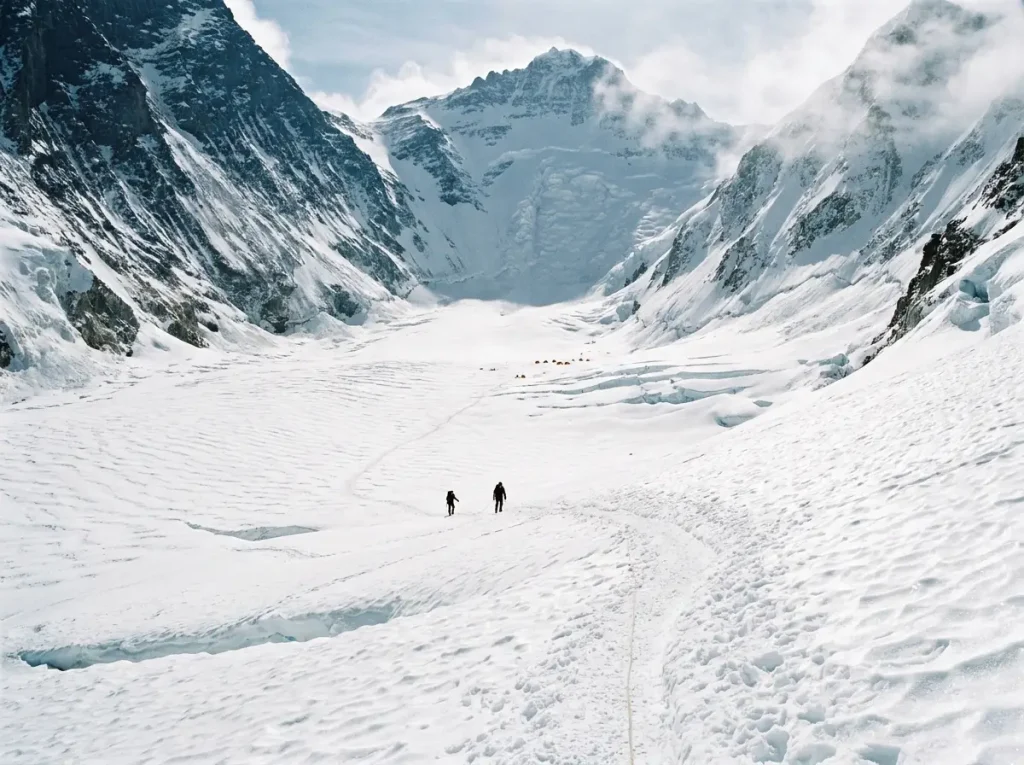
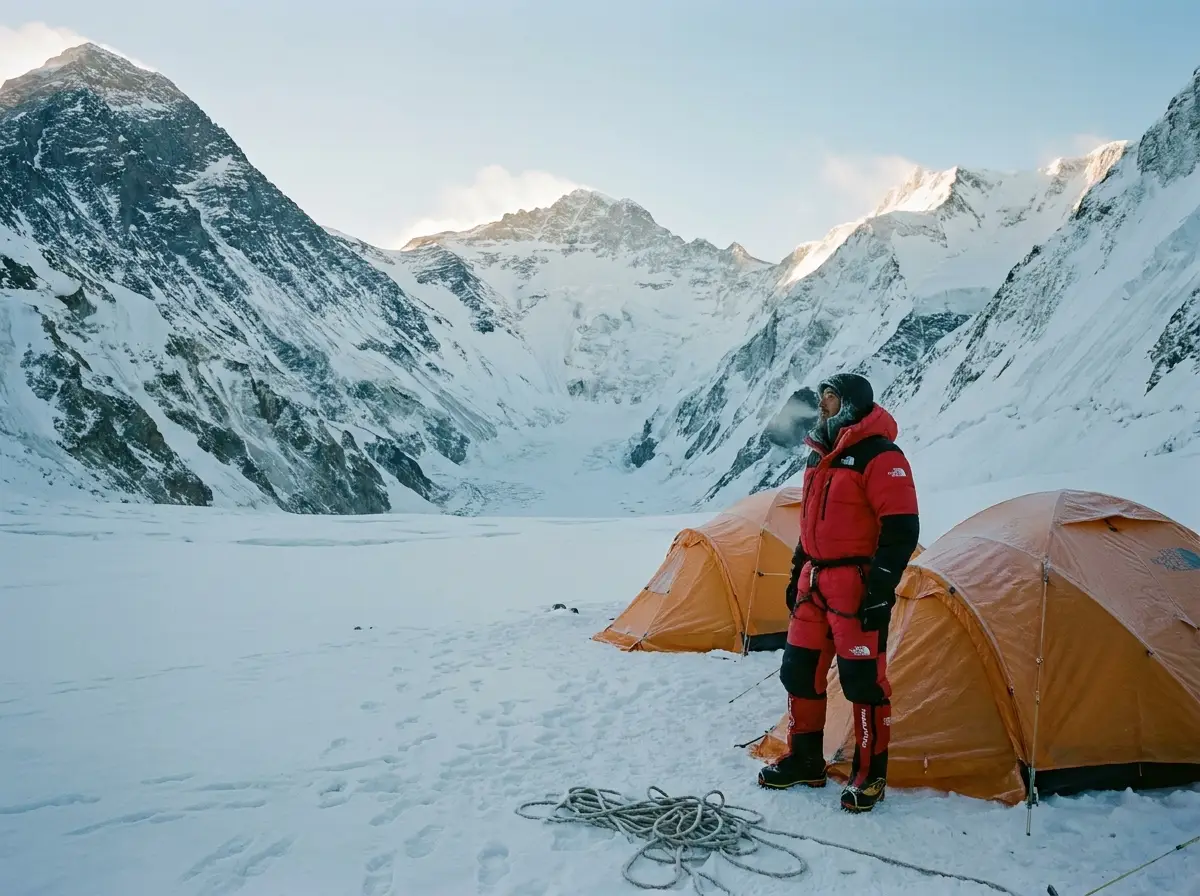
Picture the south side of the mountain as a staircase. Base Camp sits at 5,364 meters on the rubble-strewn Khumbu Glacier. Above it, a frozen waterfall of broken ice blocks the way. Climb through that, and you step out onto a flat white basin at 6,065 meters. That basin is the Western Cwm, and Camp 1 is the cluster of tents pitched right at its mouth.
The 19,900-foot gateway
Camp 1 is the first established camp above Base Camp, which is why climbers call it the gateway, or the weigh station, into the upper mountain. It marks the end of the Icefall ordeal and the start of a different kind of grind. From here the route runs up the Cwm to Camp 2 at 6,400 meters, and eventually to the South Col high above.
One thing worth nailing down: you’ll occasionally see Camp 1 listed near 5,943 meters (19,500 feet). The figure most sources and Google’s own snippet agree on is 6,065 meters, so that’s the number to trust. A hundred meters either way matters less than understanding that you’ve crossed into territory where the air holds barely half the oxygen of sea level.
The Valley of Silence
The Western Cwm is a flat glacial basin walled on three sides by the steep flanks of Everest, Lhotse, and Nuptse. Those walls do something eerie: they block the wind. The whole basin goes still and quiet, which is how it earned the nickname the Valley of Silence. It sounds peaceful. It isn’t. That stillness is exactly what turns the place into an oven a few hours after sunrise, and we’ll get to why.
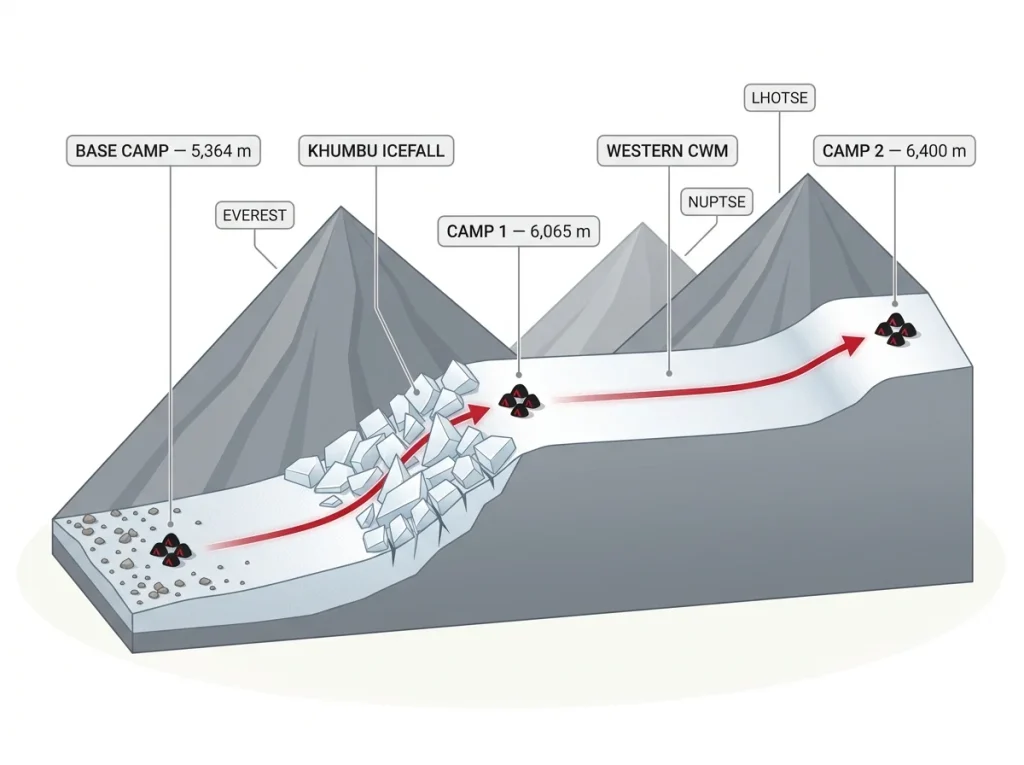
Crossing the Khumbu Icefall to Reach Camp 1
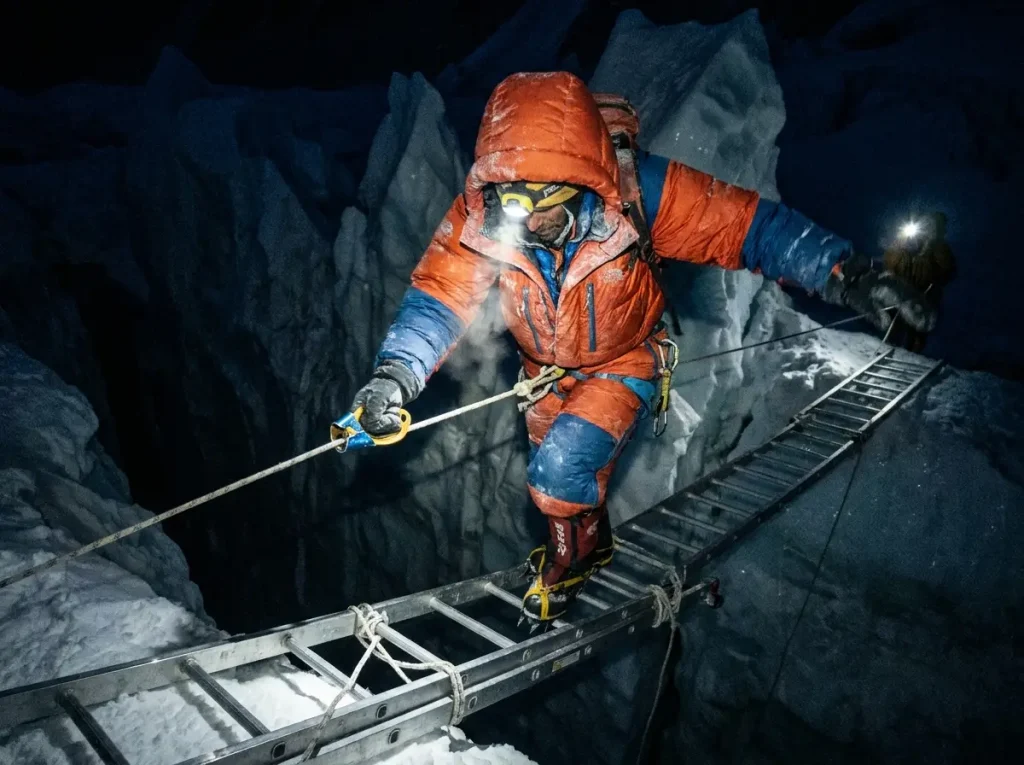
There’s no soft way to reach Camp 1. The only path from Base Camp runs straight up the Khumbu Icefall, a slow-motion avalanche of house-sized ice blocks called seracs that creak, shift, and topple without warning. A single serac collapse can bury the route in seconds. Ask anyone who’s done the rotations and they’ll tell you the same thing: the Icefall is the most hazardous ground on the entire route, and you cross it in the dark.
Ladders, ropes, and pre-dawn timing
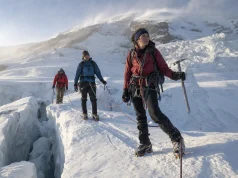
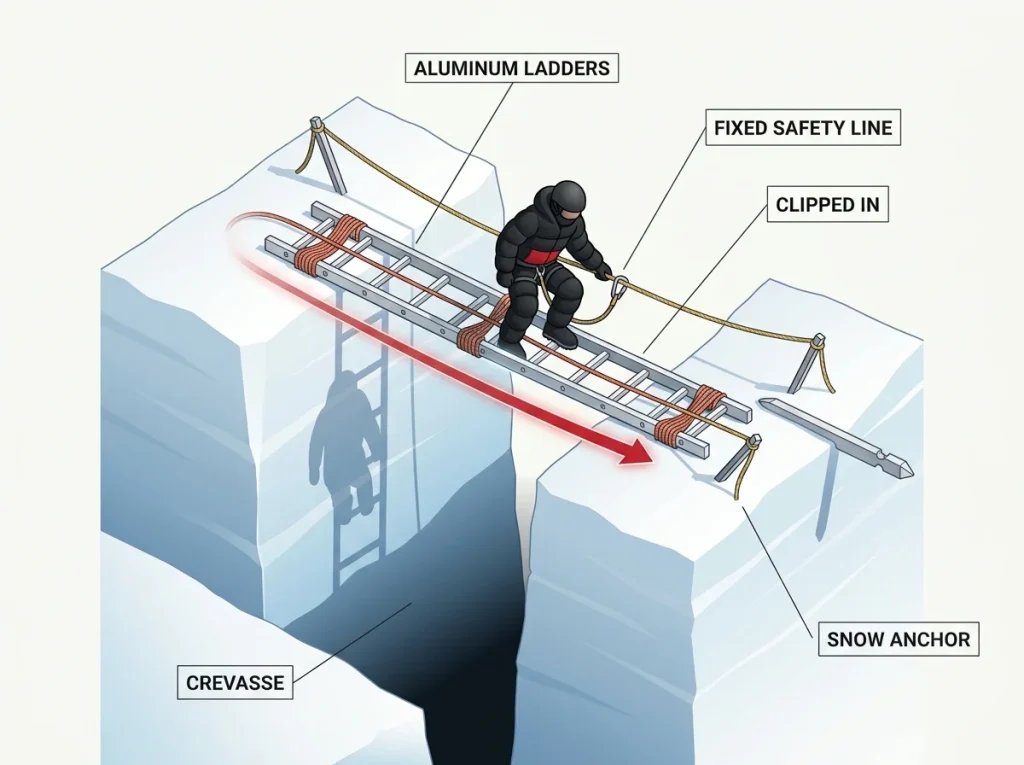
The Icefall is laced with crevasses too wide to step over, so the route runs across aluminum ladders lashed end to end and anchored with fixed ropes. You clip an ascender, the handled jumar that grips the rope, onto the fixed line, cross one ladder at a time, and try not to look down into the blue ice below. Climbers move before dawn for a reason: the ice is frozen hardest in the cold hours and least likely to shift. By the time the sun hits, the structure starts to soften, and that’s when blocks let go.
A fit member typically crosses in three to six hours; less-experienced climbers can take five to seven on their first push. The Sherpa team does it in two to three, often hauling loads. None of that is a stroll. It’s a half-day of the most exposed movement in mountaineering, performed half-asleep with a headlamp.
The reason any of it is passable at all comes down to the Icefall Doctors, the specialized Sherpa crew who rebuild the ladder-and-rope route through the shifting ice and re-fix it as the season grinds it apart. Without them, there is no Camp 1.
For the full kit climbers wear through this section, from the down suit, high-altitude boots, and crampons to the mountaineering helmet, harness, and ice axe, our 8000-meter gear list with the rent-versus-buy math breaks it down piece by piece.
Why the safe part feels terrifying
Here’s the dark joke veterans repeat: you’re three ladders deep over a crevasse, the sky still black, your headlamp on the next aluminum rung, and that’s the safe part of your day. They mean it. Once you clear the Icefall and stand at Camp 1, you’ve survived the statistically worst ground on the mountain. Everything above is colder and thinner, but nothing else moves under your feet the way the Icefall does.
The Solar Oven: Camp 1’s Heat-and-Cold Whiplash
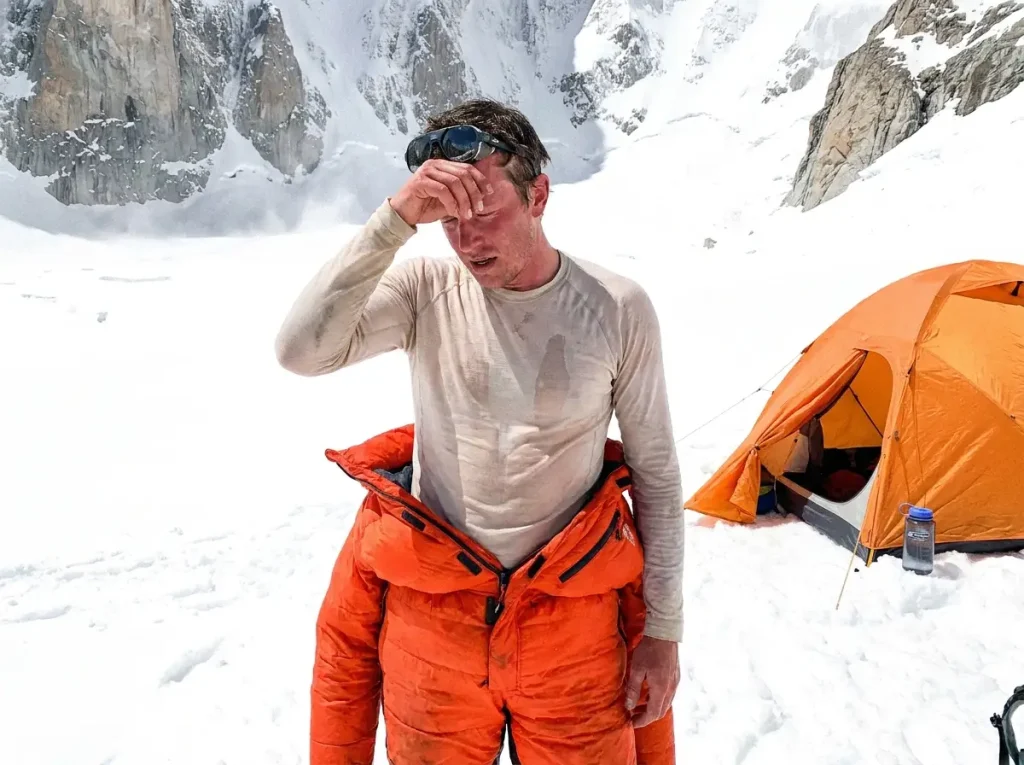
This is the part nobody warns you about properly. You train for cold. You buy the warmest suit you can afford. Then you arrive at Camp 1 and spend the middle of the day trying not to overheat at almost 20,000 feet. The temperature swing here is not a footnote. It’s the single hardest thing to manage about the place.
Why a windless valley becomes a furnace
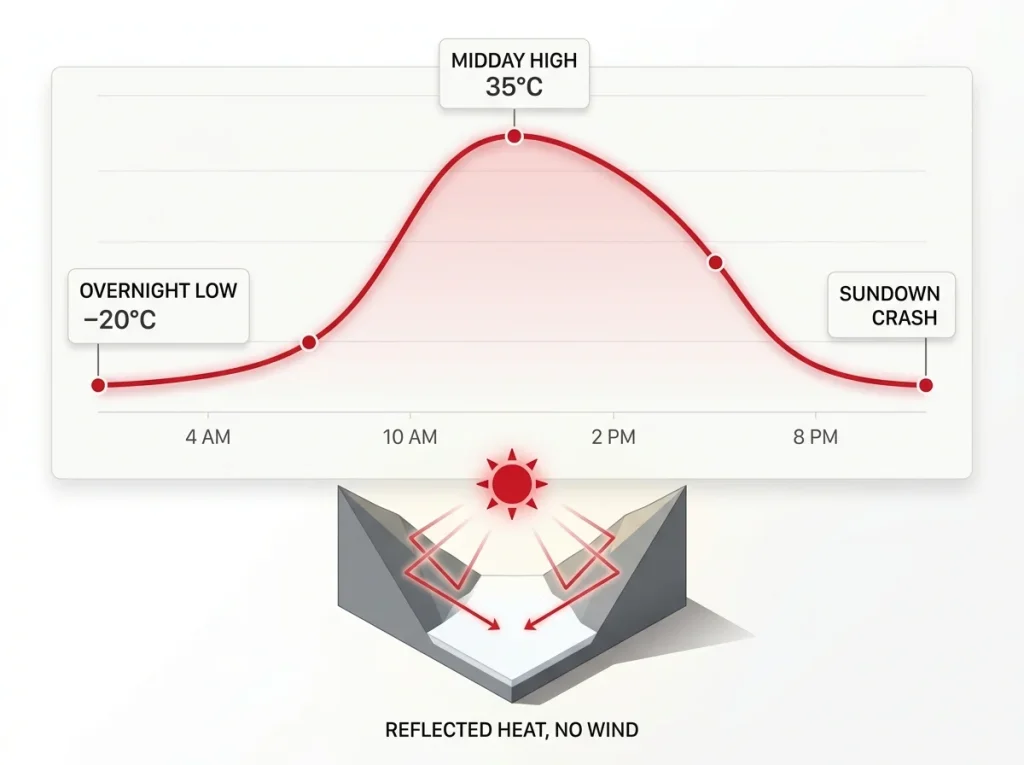
The Western Cwm is a bowl of snow with reflective walls on three sides and no wind to move the air. When the sun crests those walls mid-morning, the snow throws solar radiation back at you from every direction, and there’s no breeze to carry the heat away. Daytime temperatures in the Cwm can climb toward 35 °C (95 °F) between 6,000 and 6,800 meters. You are standing on a glacier, near the height of cruising aircraft, sweating like it’s August in the desert.
That reflected sun does more than cook you. It blasts your eyes with UV exposure fierce enough to cause snow blindness in a few hours, which is why nobody moves through the Cwm without glacier glasses clamped on.
Then the sun drops behind the ridge. In minutes, not hours, the temperature falls below freezing. Nights in the Icefall and lower Cwm run roughly −15 to −25 °C. The same spot that cooked you at noon can be lethal by dusk.
What the swing does to a climber
The heat is the sneaky hazard. It dehydrates you fast, drains your legs, and tempts you to strip down and linger, which is exactly the wrong move. Veteran teams are off the snow and into Camp 1 before the oven kicks in. The cold is more honest about wanting to hurt you; the heat just quietly empties your tank. Climbers describe sweating inside a −20 °F sleeping bag that feels absurdly warm by 9 a.m. and barely adequate by 9 p.m.
Drink past the point you want to. The Cwm’s dry, reflective heat pulls water out of you faster than any cold camp, and dehydration at altitude is what turns a manageable headache into something that ends your climb. Personal Sherpas wake clients with hot tea for exactly this reason: hydration is the biggest lever you control up here.
The window when the Cwm is survivable at all is narrow, which is part of why the timing of the whole expedition season is planned so tightly around the spring weather.
What a Night at Camp 1 Actually Feels Like
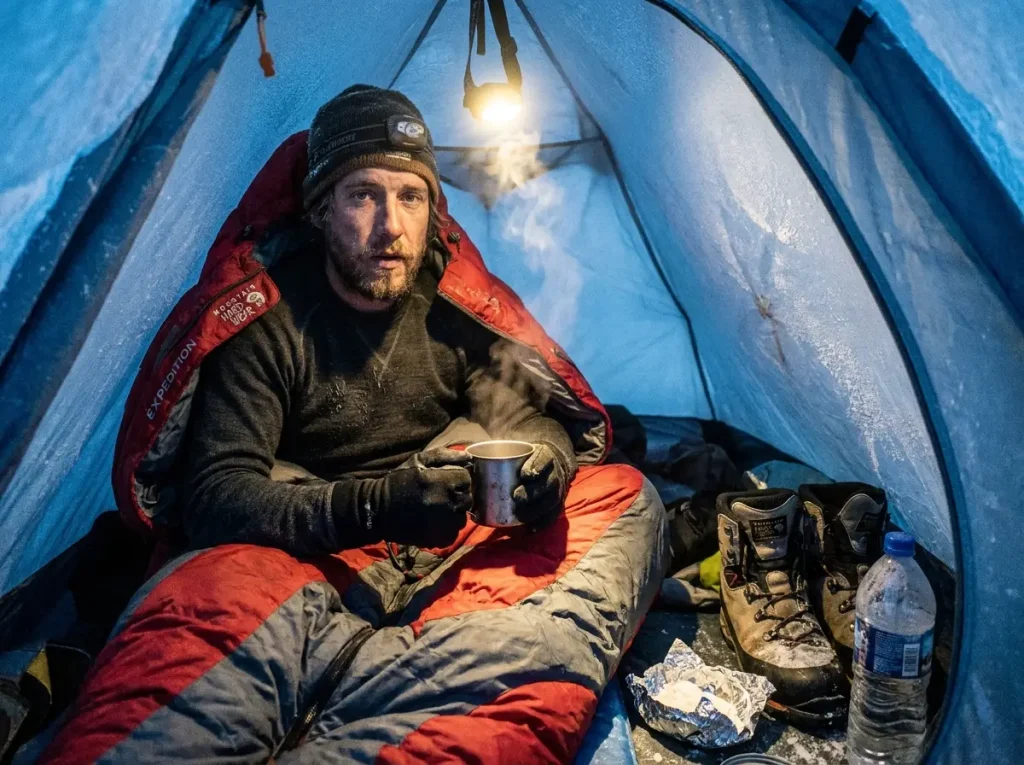
Competitors will tell you climbers “spend a night to acclimatize” and leave it there. What they skip is how that night actually feels, which is rough. The first time through, most people expect Camp 1 to be a rest. It is the opposite of rest.
The survival routine
A night at Camp 1 is a checklist of small miseries managed in sequence. You force down water you don’t want. You choke down food with zero appetite, because your gut shuts down at altitude even though you need the calories. You lie in a too-warm bag as the temperature crashes outside, and you don’t really sleep so much as drift in and out, waking with a pounding heart and a dry throat.
You feel worse, not better, and that’s the point. Your system is under genuine stress up here, starved of oxygen, working overtime to adapt. The discomfort isn’t a sign something’s wrong. The discomfort is the adaptation happening.
How long climbers stay
On a normal rotation, a team sleeps one night at Camp 1, sometimes two, then either climbs higher to tag Camp 2 or descends all the way back to Base Camp to recover. Nobody settles in at Camp 1. It’s a stress dose, not a home. The anecdote that captures it: you collapse into that overheated bag after six hours in the Icefall, a Sherpa presses a mug of hot tea into your hands, and the shared misery of your tentmates is the only real comfort on offer.
Go in expecting to feel awful at Camp 1, because the climbers who expect to recover here are the ones who get rattled. Treat the bad night as proof the rotation is working, not a reason to doubt your fitness. Mentally reframing it as a job to get through, not a hardship to endure, keeps a lot of first-timers in the game.
Camp 1 and the Acclimatization Rotation
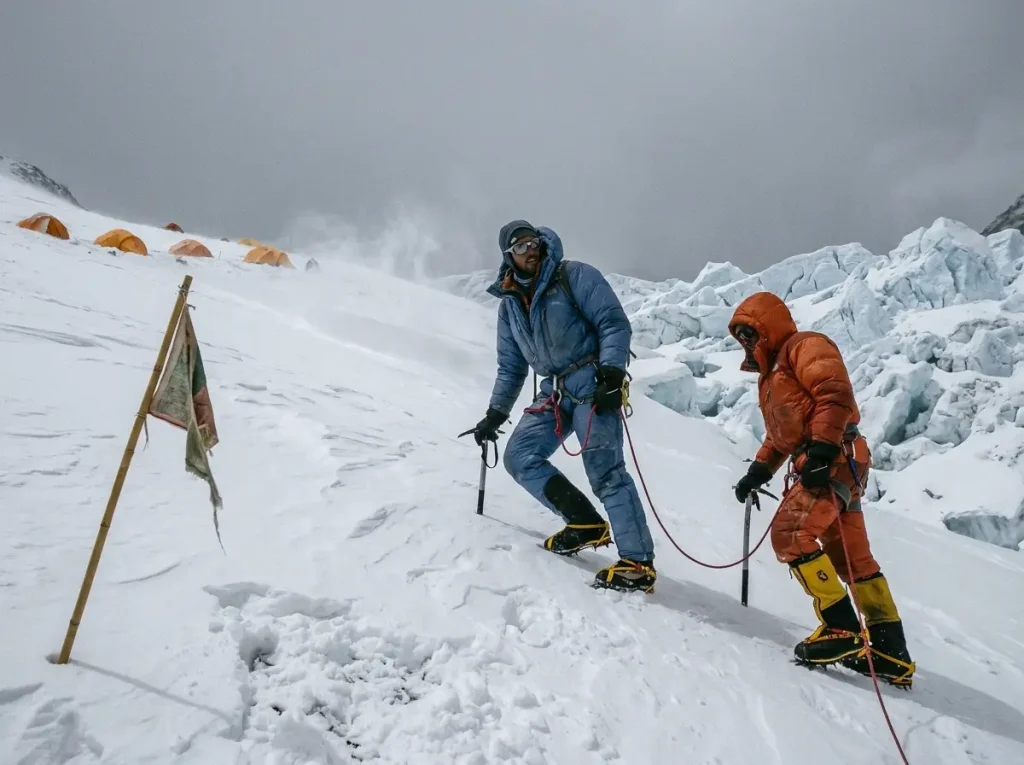
So why bother sleeping at a place that beats you up? Because Camp 1 is one rung on a ladder your body has to climb before the summit is survivable. Skip the rungs and the mountain removes you, sometimes permanently.
Climb high, sleep low
The traditional acclimatization plan is built on a simple phrase: climb high, sleep low. Climbers make three to four rotations through the Icefall, sleeping at Camp 1, then tagging higher camps and descending to recover, until they’ve banked roughly 10 to 15 days of sleeping at altitude before a summit bid. Camp 1 is where that process starts for real. It’s the first place you sleep above the Icefall, and the first serious dose of the stress that forces your physiology to change.
Why your blood rebuilds itself
The mechanism is genuinely strange. At altitude your body ramps up production of oxygen-carrying red blood cells while plasma volume drops, so each unit carries more oxygen. As the UIAA’s mountain-medicine guidance on Everest explains, this rebuild takes time and cannot be rushed. That’s the whole reason Camp 1 exists as an overnight stop instead of a place you walk through.
Why skipping rotations is a serious risk
Push too high too fast and the consequences aren’t subtle. Altitude sickness escalates from a headache and nausea into HACE or HAPE, where fluid collects in the brain or the lungs, and both can become fatal within hours. The climbers who cut their rotation count to save days on the mountain are the ones most likely to find that edge.
Understanding the acclimatization protocol that keeps AMS from turning into HACE or HAPE is non-negotiable before anyone steps onto the Icefall. It’s also why serious outfits insist climbers arrive already able to handle a 7,000-meter peak, one of the real prerequisites for an Everest attempt that has nothing to do with the permit.
Resist the urge to trim a rotation when the weather looks good and you feel strong. Feeling strong on a single good day is not the same as being acclimatized, and the days you “save” are the cheapest thing you can buy back. Guides bank the full rotation count on purpose, because the alternative is a helicopter, if you’re lucky.
The Push Above Camp 1 to Camp 2
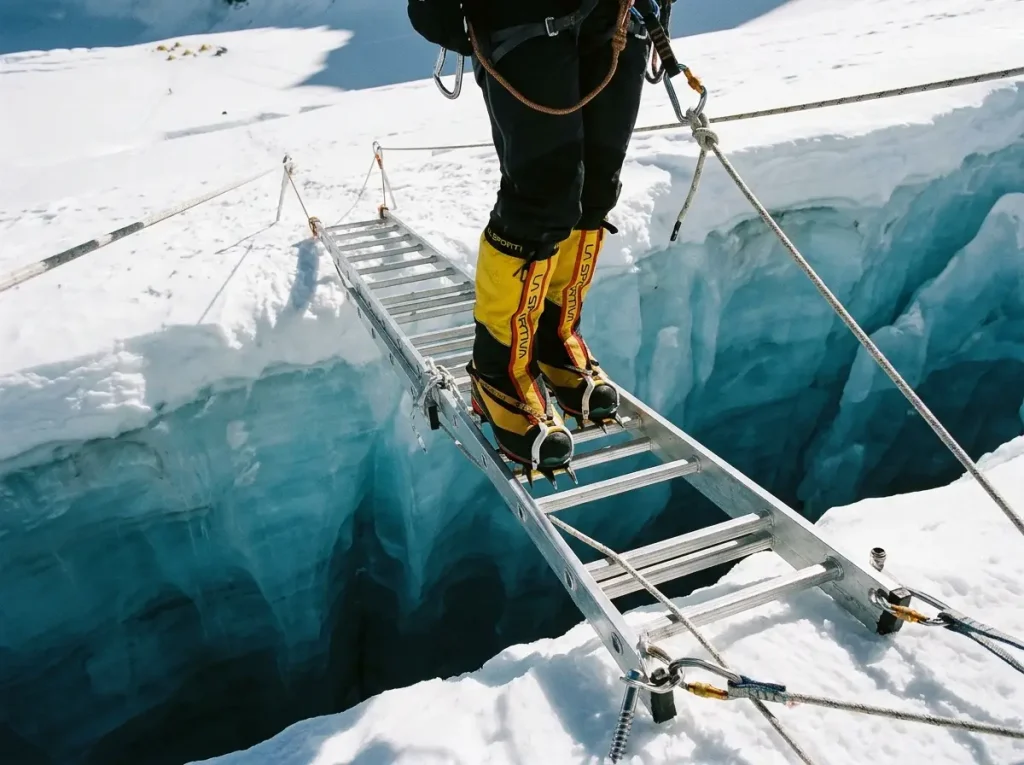
Leaving Camp 1 toward Camp 2 looks easy on a map. The Western Cwm is flat, after all. Then you start walking and discover the “flat” valley is a minefield of cracks, some of them deep enough to swallow a bus.
Ladders over the void
The route up the Cwm crosses many horizontal ladders lashed over crevasses, plus a few short ice walls you climb directly. You clip to a fixed line, walk the rungs one boot at a time over a blue slot that fades to black, and keep your eyes on the far anchor. It’s slower and more nerve-wracking than the elevation profile suggests, because every crossing is a small commitment with real exposure underneath.
A route that re-forms all season
The crossing you make in April is not the crossing you make in late May. As the season warms, crevasses widen and deepen, snow bridges weaken, and ladder spans get longer to reach across the growing gaps. The approach to Camp 2 that started as firm snow can turn to frozen scree and then to slush. This is a moving puzzle that the rope-fixing teams re-solve constantly, and it’s a big reason timing matters so much on the upper mountain.
Cross the Cwm’s ladders early, while the snow bridges are still frozen hard. The same rule that governs the Icefall governs the route above Camp 1: warm afternoon sun weakens everything you’re standing on. Timing your crossings to the cold hours is a safety tool, not a flex.
Camp 2 at 6,400 meters is the next real camp, often called Advanced Base Camp, where teams actually base for higher pushes. From there the route climbs the Lhotse Face toward the high camps. If you want to see where this staircase ends, our guide to Camp 4 on the South Col covers the last stop before the summit push.
Why Modern Expeditions Are Rethinking Camp 1
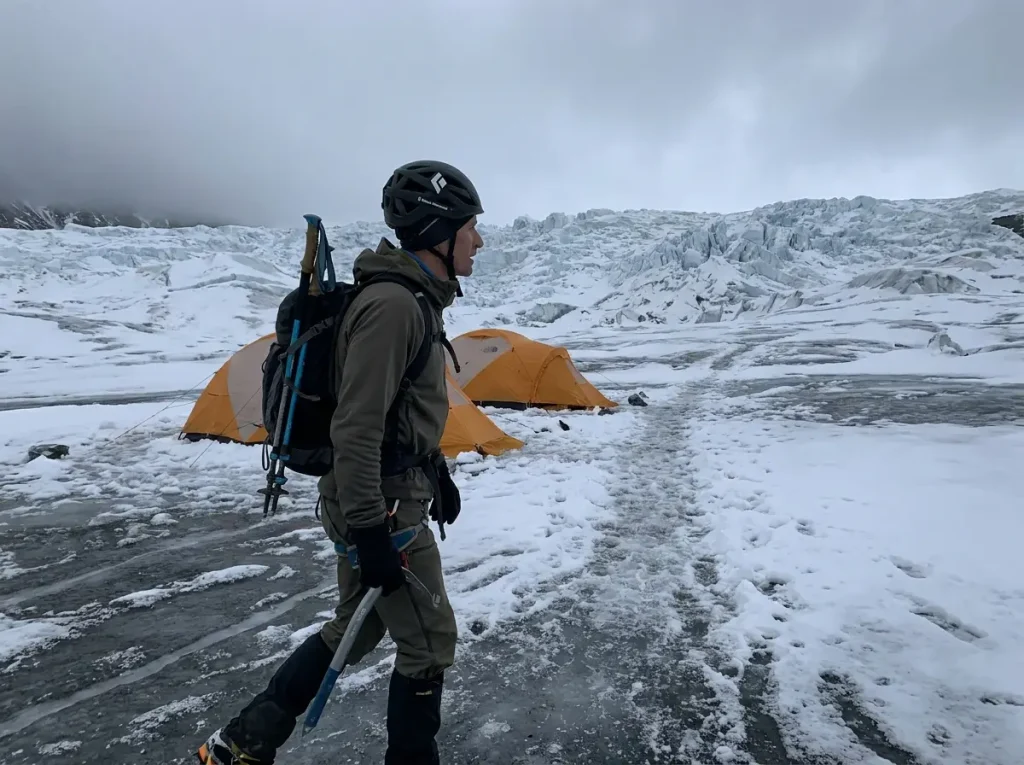
For decades, the answer to “how do you use Camp 1” was simple: sleep there three or four times on your rotations. That’s no longer the only model, and the ground itself is changing too. A 2026 picture of Camp 1 has to account for both.
The flash expedition model
A growing number of outfits now have clients pre-acclimatize at home. Climbers sleep in hypoxic tents for around eight weeks, slowly tricking their systems into adapting to roughly 7,000 meters before they ever fly to Nepal and trek into the Himalaya. They then compress the whole climb into about three weeks and push Base Camp to Camp 1 to Camp 2 in a single move, crossing the Icefall just once each way.
The trade-off is real. Cutting Icefall crossings from six or eight down to two is the single biggest risk-reduction lever available on Everest today, because the Icefall is where so much goes wrong. The cost is that Camp 1 stops being a planned overnight and becomes a pass-through, barely a pause on the way to Camp 2. The first fully pre-acclimatized Everest team did this in 2016, and the approach has spread since. The live-high, train-low science behind those pre-acclimatization tents is the same physiology the traditional rotations exploit, just front-loaded at home.
A gateway on melting ice
The other shift is slower and harder to manage. Climate change is destabilizing the Khumbu Icefall from the inside. Meltwater seeps into the ice and acts as a lubricant, speeding up how fast the blocks move and collapse. The Icefall is thinning, Base Camp now sits roughly 50 meters lower than it did in the early expedition era, and the Khumbu Glacier is receding around 30 meters a year. All of that shifts where Camp 1 can safely be pitched, and makes the gateway to the upper mountain less predictable every season.
Put the two trends together and Camp 1’s role is genuinely in flux. The economics and logistics of how teams move through it are shifting too, which we cover in our breakdown of what a modern Everest expedition actually costs and how operators tier their service.
Conclusion
Camp 1 is a 6,065-meter gateway, not a destination. The freezer-to-furnace whiplash, the broken night, the ladders over black crevasses: that’s the price of admission to the Western Cwm, and there’s no way to buy it down. It exists to stress your physiology into adapting, which is why the worst night you’ll have on the mountain is also the one doing the most good. And its role is shifting under everyone’s feet, as flash expeditions turn it into a pass-through and a warming Icefall rewrites the route year after year.
Next time you follow an Everest season online, watch how teams talk about their rotations. Camp 1 is where the mountain starts quietly deciding who gets to go higher, long before anyone reaches the summit.
Frequently Asked Questions
01How high is Camp 1 on Mount Everest?
Camp 1 sits at 6,065 meters (19,900 feet), just above the Khumbu Icefall at the entrance to the Western Cwm. It’s the first major camp above Everest Base Camp, which sits at 5,364 meters.
02How long do climbers stay at Camp 1?
Usually just one night per rotation, sometimes two, before climbing higher or descending to recover. Camp 1 is an acclimatization stop, not a base, so teams never settle in there for long.
03How cold, and how hot, does it get at Camp 1?
Both extremes in one day. Nights drop to roughly −15 to −25 °C, while the windless Western Cwm can heat toward 35 °C (95 °F) by mid-morning as snow walls reflect the sun. The whiplash is harder to manage than the cold alone.
04Why is the Khumbu Icefall so hazardous to cross?
It’s a constantly moving glacier of unstable ice blocks and hidden crevasses that can shift or collapse without warning. Climbers cross before dawn on ladders and fixed ropes, when the ice is frozen hardest, to lower the risk.
05Can you skip Camp 1 on Everest?
Increasingly, yes. Flash expeditions that pre-acclimatize climbers in hypoxic tents at home often push straight through Camp 1 to Camp 2, treating it as a pass-through rather than an overnight, which cuts hazardous Icefall crossings.
Safety Notice: Rock climbing and mountaineering are inherently high-risk
activities that can involve physical trauma or fatal incidents. The information on Rock Climbing Realms is for
educational and informational purposes only. Techniques and advice presented here are not a substitute
for professional, hands-on instruction. Conditions and risks vary by location. Always seek guidance
from a qualified instructor before attempting new techniques. By using this website, you agree that you
are solely responsible for your own safety. Any reliance you place on this information is strictly
at your own risk, and you assume all liability for your actions. Rock Climbing Realms and its authors
will not be held liable for any harm, damage, or loss sustained in connection with the use of this information.
Affiliate Disclosure: We are a participant in the Amazon Services LLC Associates Program, an
affiliate advertising program designed to provide a means for us to earn advertising fees by advertising and linking
to Amazon.com. As an Amazon Associate, we earn from qualifying purchases. We are also an official affiliate partner
of Black Diamond Equipment via the AvantLink network. If you click on a Black Diamond affiliate link and make a
purchase, we may earn a commission at no additional cost to you. We also participate in other affiliate programs.
Additional terms are found in the terms of service.