
In this article
In the documentary that made him famous, not one person interviewed wanted Alex Honnold to actually do it. Not Tommy Caldwell. Not the climbers who knew the route. Not Sanni McCandless, the woman he was falling in love with on camera. The public watched Free Solo and saw a fearless daredevil flirting with the void; the climbing world watched the same footage and saw something closer to the opposite, the most methodical climber alive executing a plan he had rehearsed for years. This is the story of how a gym kid from Sacramento became that climber, what he actually achieved, and why the fearless label gets him exactly backward.
How a Sacramento Gym Kid Became a Climber

Everyone fixates on the fearlessness. The reassuring, almost boring truth underneath it is roughly three decades of mileage that started on plastic holds, not raw nerve. Honnold is, before anything else, a gym kid who never stopped.
A Sacramento Kid, Not a Climbing Dynasty
Alexander Honnold was born on August 17, 1985, in Sacramento, California, to an ordinary suburban household rather than a climbing family. His father, Charles Honnold, and his mother, Dierdre Wolownick, a community-college language professor, raised him in a setting with no particular connection to big walls or alpine peaks. The most famous climber alive came from a normal Sacramento home, which is part of why so many climbers find his origin relatable.
The Gym Rat Origin
He started climbing in a gym at age five. By ten he was climbing several times a week, and as a teenager he competed in youth national and international competitions. That early volume matters more than any brain scan: what looks like a missing fear response is built on top of nearly thirty years of accumulated movement, technique, and time on rock. The base came first, long before the headlines.
Dropping Out for the Van
Honnold earned an International Baccalaureate diploma at Mira Loma High School and enrolled at the University of California, Berkeley to study civil engineering. He dropped out after he lost his father in 2004, committed to climbing full time, and began living out of a van so he could chase routes year-round. That decade of van life would become part of his legend, and his place in the lineage of legendary American climbers was already taking shape.
The Rise From Gym Kid to Free-Solo Pioneer

Climbers did not learn Honnold’s name from a movie. They learned it years earlier, when a quiet twenty-something started repeating benchmarks that only one or two humans had ever touched.
2007: Astroman and the Rostrum in a Day
In 2007, Honnold free soloed both Astroman and the Rostrum in a single day, matching Peter Croft‘s legendary 1987 link-up. To non-climbers that sentence lands flat. To anyone who climbs, it was the announcement that someone new could operate at a level the sport thought belonged to history. Repeating a Croft benchmark, ropeless, told the climbing world he was the real thing.
2008: Moonlight Buttress and Half Dome
The next year raised the stakes again. He free soloed Moonlight Buttress, a roughly 1,200-foot 5.12d finger crack in Zion, then months later the Regular Northwest Face of Half Dome, around 2,000 feet at 5.12a. These were not short, hard boulder solos. They were long, sustained routes, much of it insecure crack climbing, with no protection, two of the boldest ropeless ascents anyone had done, back to back in a single season.
Notice what these early solos have in common: every one of them sat well below Honnold’s hardest roped climbing. The soloists who survive are the ones who only go ropeless on terrain they can climb with a wide margin, never at their limit. The margin is the discipline, not the absence of it.
Earning a Place Among the Legends
By the end of the 2000s, Honnold had moved from promising junior competitor to a professional climber spoken alongside the sport’s boldest soloists. He was not alone in pushing limits in that era; contemporaries like Chris Sharma were redrawing what was possible in their own corners of the sport, from hard sport routes to rope-free deep-water soloing. What set Honnold apart was scale: he was bringing that level of control to walls thousands of feet tall.
Free Soloing El Capitan, the Climb That Defined Him

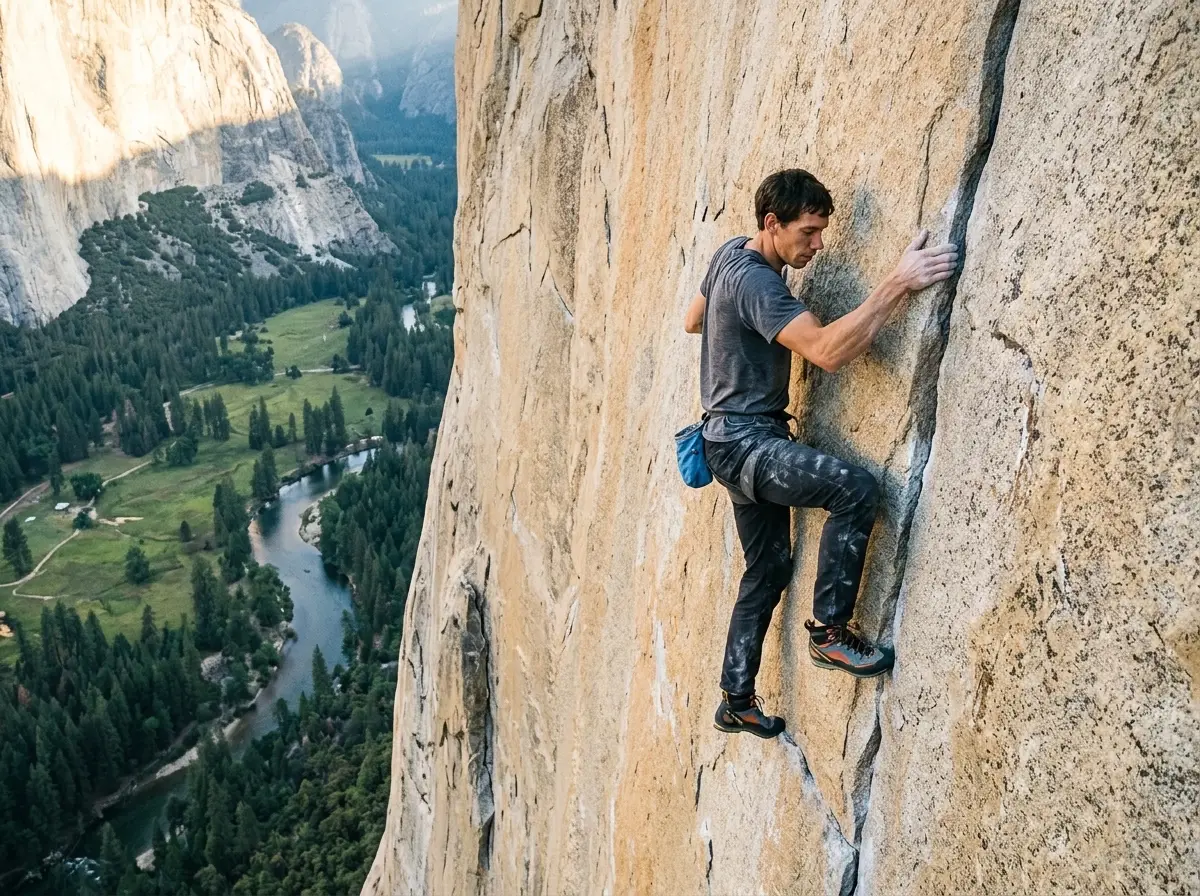
This is the one everyone knows by the poster image: a tiny figure pressed against an ocean of granite, no rope anywhere. A climber can tell you what is actually happening in that picture, and why it is considered the greatest feat of its kind, period. It helps to start with what free soloing even is, because the word gets used loosely.
Free soloing means climbing with no rope and no protection, where a serious mistake is final. It is a different universe from what free climbing actually is, and how the two differ: free climbers use a rope for safety and climb the rock with their hands and feet, while free soloists remove the safety net entirely. Honnold built his life on the granite of Yosemite National Park, and El Capitan was the wall that would define him.
June 3, 2017: Three Hours, Fifty-Six Minutes, No Rope
On June 3, 2017, Honnold became the first person to free solo El Capitan, climbing the Freerider route, graded 5.13a and rising roughly 2,900 to 3,000 feet, in three hours and fifty-six minutes. He started up at 5:32 a.m. in a pair of La Sportiva TC Pro shoes. No human had ever soloed El Capitan before, and no one has repeated a free solo of Freerider since. It is widely called one of the greatest athletic accomplishments of any kind, in any sport.
The Boulder Problem and the Karate Kick
The hardest moment of the route is a section called the Boulder Problem, a near-blank slab roughly 2,300 feet off the ground that demands the most precise climbing on the wall. On solo day, Honnold unlocked it with a wide, splayed “karate kick” to a distant foothold instead of an explosive double-dyno, choosing the lower-risk version of the sequence. This is the single lowest-percentage move on the climb, the spot where the whole thing could end.
What separates that move from recklessness is how he arrived at it. He had rehearsed the Boulder Problem on a rope hundreds of times, refining the karate-kick beta until it was a known quantity rather than a gamble. The public sees “no ropes” and thinks improvisation. The reality was the opposite: years of preparation compressed into one rehearsed, deliberate motion.
The line climbers repeat about ropeless climbing is that you only solo what you have downclimbed in your sleep. Honnold’s preparation is that idea taken to its furthest point: rehearse a sequence until it is automatic, then rehearse it more. On the wall, the goal is to have zero new information left to discover.
Why Freerider, Not The Nose or the Salathé
Competitors list El Cap routes; a practitioner ranks them. Honnold soloed Freerider specifically because its hardest climbing is concentrated into short sections and its most insecure passages are brief relative to the alternatives, which made it the achievable free-solo line. The Nose and the Salathé Wall each carry their own trade-offs between El Cap’s classic lines, with longer stretches of the kind of climbing that offers no good rest. Route choice was not a detail. It was the skill that made the solo possible.
What 5.13a Means When You Solo It
Here is the piece general-audience articles always skip. On the Yosemite Decimal System used to grade American rock climbing, Honnold redpoints up to around 5.14d in sport climbing and boulders into the V12 range, which means Freerider’s 5.13a sat several letter grades below his physical limit. He did not solo at his maximum; he soloed with a deliberate buffer. That gap between his roped ceiling and the grade he soloed is the entire reason the climb was controllable rather than a coin flip, and it is the most misunderstood number in the whole story.

Beyond El Cap, the Rest of a Once-in-a-Generation Résumé

Strip away the El Capitan solo and Honnold would still own one of the deepest résumés in climbing. This is the part casual fans rarely hear, and it is the proof that the solo was not a single act of nerve but the visible tip of a complete climber.
The Fitz Traverse and a Piolet d’Or
In 2014, Honnold and Tommy Caldwell linked the entire Cerro Fitz Roy skyline in Patagonia, a sustained piece of alpine climbing known as the Fitz Traverse, and were awarded the 2015 Piolet d’Or, the sport’s highest alpine honor. It proved he was a mountaineer, not only a Yosemite specialist. Beyond that award, his recognitions include a Golden Piton, the American Alpine Club’s Underhill Award, and a National Geographic Adventurer of the Year honor. The partnership mattered too: Caldwell is one of the few climbers operating in Honnold’s orbit, and his longtime partner’s training methods shaped both of their hardest projects.
Speed on the Nose
In 2018, Honnold and Caldwell set the Nose speed record on El Capitan at 1:58:07, the first sub-two-hour ascent of that roughly 3,000-foot line as a roped team. The achievement, logged in the American Alpine Club’s record of the sub-two-hour Nose ascent, shows the endurance-and-efficiency side of his climbing rather than solo nerve. The Nose itself has a long history of milestones, including Lynn Hill’s historic free ascent of the same wall, a benchmark of a different and equally singular kind.
From a Greenland Sea Cliff to Taipei 101
In 2024, Honnold led the first ascent of Ingmikortilaq, a roughly 3,750-foot remote sea cliff in eastern Greenland, with Hazel Findlay, climbing loose rock in sub-freezing storms for the National Geographic series Arctic Ascent, and pairing the climb with climate science. Then in January 2026 he free soloed and buildered Taipei 101, around 1,667 feet, live on Netflix’s Skyscraper Live, topping out the spire in 1:31:34. It was the highest urban free solo ever attempted, a discipline climbers call buildering, and his most divisive feat, with parts of the climbing community arguing he had crossed from athlete into spectacle.
The Mind Behind the Climbs

The brain scan gets weaponized to make Honnold a freak who feels nothing. The real and less clickable truth is that his calm is a tool he prepares his way into, which turns out to be a far more useful story about the mental game for any climber who actually has to manage fear.
The “No Fear” Brain Scan, Honestly
In 2016, neuroscientist Jane Joseph ran Honnold through a functional MRI and found that his amygdala, the brain region tied to fear response, barely activated to images that lit up a control subject’s vividly. There was no brain damage involved; either his amygdala under-fires or his frontal cortex regulates it unusually well. He has also spoken about seeing himself on the autism spectrum, which is best understood as something he has described about himself rather than a confirmed clinical diagnosis. The honest reading is narrow: the scan may explain how he stays physically calm under exposure that would freeze most people. It does nothing to make a fall survivable, and it does not make him reckless.
Preparation, Not Recklessness
The daredevil framing collapses the moment you look at how he works. Honnold prepares with years of roped laps, memorizing routes sequence by sequence until the movement is automatic, which is the exact inversion of impulsive risk-taking. That process is a more extreme version of the kind of structured mental training most climbers actually use to perform under pressure. The label that fits is not fearless. It is prepared.
If you take one thing from the amygdala study, make it this: it explains calm, not safety. Staying relaxed lets Honnold execute a plan he has already locked in. It does not change what a fall costs. For everyone else, fear is the system working as intended, and the skill is managing it, not switching it off.
Why He Solos Below His Limit
What only climbers notice is the depth of the base under the headline solos. The V12 bouldering and the roughly 5.14d redpoint ceiling are what make a 5.13a feel controllable without a rope. The link-up mentality, what climbers call enchainment, tells the same story: Astroman and the Rostrum in a day, the Yosemite Triple, the sub-two-hour Nose, all of it reveals endurance and efficiency rather than a single burst of courage. The achievements are the product of a deep, all-around game built across sport climbing, trad climbing, bouldering, and alpine climbing, not one outlier stunt.
Films, Books, and the Free Solo Phenomenon

Non-climbers know Honnold because of one Oscar. Climbers know the film is a brilliant, partial story, and the space between those two facts is worth naming.
Free Solo and the First Climbing Oscar
Free Solo (2018), directed by Jimmy Chin and Elizabeth Chai Vasarhelyi, won both the Academy Award and the BAFTA for Best Documentary Feature, the first climbing film ever to win the Oscar. It is the reason climbing went mainstream and the reason a general audience knows Honnold’s name at all. The film turned a niche pursuit into a dinner-table conversation almost overnight.
Alone on the Wall and the Rest of the Media
Honnold’s memoir Alone on the Wall (2015), co-written with David Roberts, lays out his story in his own words, and the rest of his media footprint runs deep: the Valley Uprising history of Yosemite climbing, the Arctic Ascent series, and the Climbing Gold podcast. Together they make him one of the most documented climbers in the sport’s history. None of it required him to become a different person on camera.
The Story the Film Didn’t Tell
The triumphant edit left things out. A Climbing.com opinion piece argued that the Free Solo documentary handled some uncomfortable truths, the emotional cost and his relationships, while sidestepping others, and that the man is more complicated than the version that reached theaters. The tension was real and never hidden: in the film itself, nobody interviewed actually wanted him to do the climb. That ambivalence, more than the summit, is what makes the story land.
Life Off the Wall, Family, the Foundation, and Net Worth

The daredevil of the headlines is now a married father of two who gives away roughly a third of a modest income. The arc from a Ford van to a Las Vegas house is the human throughline that ties the whole biography together.
From a Van to a Vegas House
Honnold married Sanni McCandless in 2020, and the couple has two daughters, June, born in 2022, and Alice, born in 2024. After a decade living out of a van, he is now based in Las Vegas. The risk calculus of a father of two has visibly shifted from the single climber audiences met in Free Solo, and he has talked openly about that change.
The Honnold Foundation
In 2012, Honnold founded the Honnold Foundation, which channels solar-energy access to underserved communities around the world. He pledged roughly one-third of his income to it, and in recent years has personally covered the foundation’s operating costs so that outside gifts go straight to programs. It runs on trust-based grantmaking rather than vanity philanthropy, funding projects from solar microgrids to solar-powered boats in the Amazon.
What He’s Actually Worth
Honnold’s net worth is estimated at around $2 million, modest for someone of his fame, though figures vary by source and some estimates run higher. His income comes from sponsors including The North Face, Black Diamond, La Sportiva and Goal Zero, from reported speaking fees in the tens of thousands per appearance, and from film and book work. The anti-materialist authenticity readers respect is real: a van-life decade, a third of his earnings given away, and no celebrity excess to speak of.
Conclusion
Three things hold up at the end of the story. The achievements are real and singular: the first and only free solo of El Capitan, a Piolet d’Or, a Greenland first ascent. The engine behind them is preparation, not a missing fear response. And the man came out the far side of all of it settled, generous, and oddly normal.
The responsible note is the one the climbing world should always attach to his name. Honnold is a singular outlier, not a template. Admire the achievement, and never copy the method, because free soloing has no margin for error and gives nothing back when it goes wrong. The part of his story any climber can actually use is the process, the rehearsal, the base-building, the honest management of fear. Take that to your next project, and leave the rope on.
Frequently Asked Questions
01How did Alex Honnold become famous?
His 2017 free solo of El Capitan, captured in the Oscar-winning documentary Free Solo, made him the most famous climber alive. Climbers already knew him from his bold 2007 and 2008 ropeless ascents years before the film reached a general audience.
02What is Alex Honnold’s most famous climb?
The June 3, 2017 free solo of El Capitan via the Freerider route, the first ever, climbed in three hours and fifty-six minutes. It is widely regarded as one of the greatest athletic feats of any kind, and no one has repeated a free solo of the route since.
03What is Alex Honnold’s net worth?
His net worth is estimated at around $2 million, with figures varying by source. The income comes from sponsorships, speaking fees and film and book work, and he has pledged roughly a third of it to his solar-focused foundation.
04Has anyone else free soloed El Capitan?
No. Honnold’s 2017 ascent remains the only free solo of El Capitan, and no one has repeated a ropeless ascent of Freerider. The concentrated difficulty and the wide margin he built through years of rehearsal are part of why it stands alone.
05What is Alex Honnold doing now?
He is still climbing and has expanded into exploration and live events, with a 2024 first ascent in Greenland and a January 2026 live free solo of Taipei 101. Off the wall, he is a Las Vegas father of two who runs the Honnold Foundation.
Safety Notice: Rock climbing and mountaineering are inherently high-risk
activities that can involve physical trauma or fatal incidents. The information on Rock Climbing Realms is for
educational and informational purposes only. Techniques and advice presented here are not a substitute
for professional, hands-on instruction. Conditions and risks vary by location. Always seek guidance
from a qualified instructor before attempting new techniques. By using this website, you agree that you
are solely responsible for your own safety. Any reliance you place on this information is strictly
at your own risk, and you assume all liability for your actions. Rock Climbing Realms and its authors
will not be held liable for any harm, damage, or loss sustained in connection with the use of this information.
Affiliate Disclosure: We are a participant in the Amazon Services LLC Associates Program, an
affiliate advertising program designed to provide a means for us to earn advertising fees by advertising and linking
to Amazon.com. As an Amazon Associate, we earn from qualifying purchases. We are also an official affiliate partner
of Black Diamond Equipment via the AvantLink network. If you click on a Black Diamond affiliate link and make a
purchase, we may earn a commission at no additional cost to you. We also participate in other affiliate programs.
Additional terms are found in the terms of service.