

In this article
Gravity doesn’t care how hard you sent the crux pitch or how exhausted you feel. It exerts a constant, uniform acceleration of 9.8 meters per second squared on your body, regardless of your experience level in technical rock climbing or mountaineering.
For many climbers, reaching the anchors feels like the finish line. In reality, it is just the halfway point. You are now entering the most statistically dangerous phase of the day.
While the ascent demands a physical fight, the descent tempts you with psychological surrender. As a certified climbing guide and instructor, I have seen too many competent climbers treat rappelling as a casual commute.
To survive the return trip year after year, you must reject the casual mindset of just “getting down.” Instead, adopt the engineering rigor of a Closed System. This step-by-step guide outlines a specific “Zero Error” protocol—from hardware selection to the final rope recovery—designed to mechanically prevent separation from the rock.
Why Is the “Closed System” Approach Necessary for Survival?
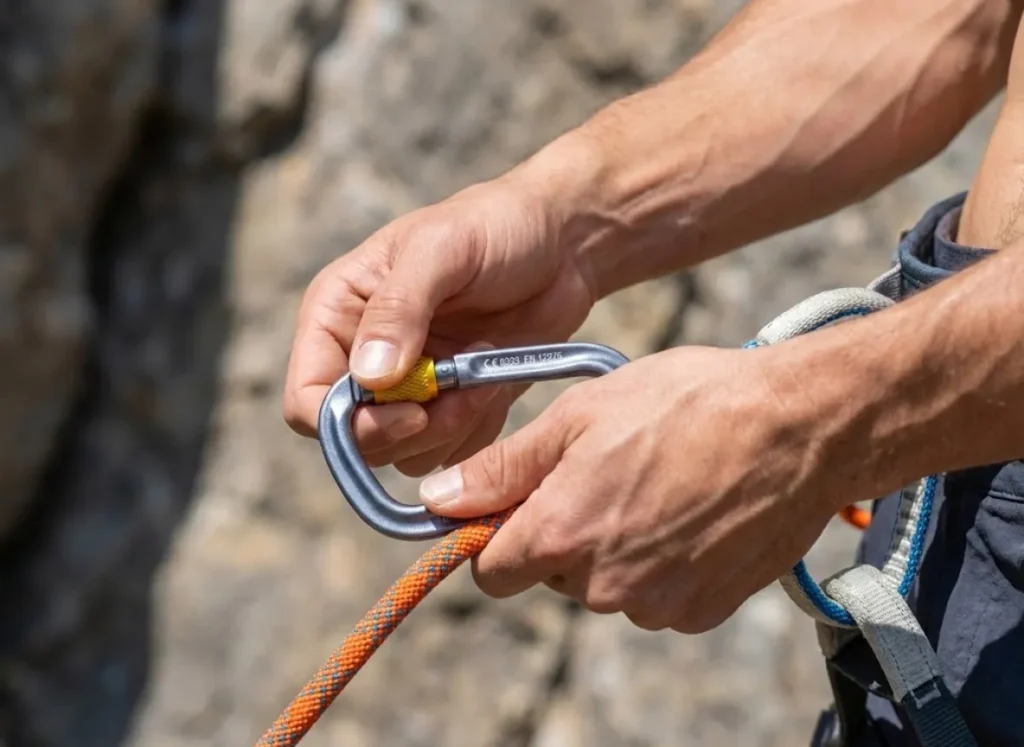
Rappelling—essentially just lowering your own mass down a climbing rope—is statistically the most dangerous part of a climb. It removes the redundancy of a dynamic belay chain, forcing you to rely entirely on a static mechanical system.
Why is rappelling statistically the most dangerous part of a climb?
When you lead a pitch, you are protected by a dynamic system: a belayer, a stretchy climbing rope, and multiple pieces of protection. Rappelling strips away that safety net. You are entrusting your life to a single rappel anchor point and a static sequence of rappel gear.
According to a detailed analysis of North American climbing accidents, a significant percentage of fatalities occur during the descent. The most common causes are not gear failure, but human errors like rappelling off the end of uneven ropes or misrigging the rappel device.
The Closed System protocol treats the descent as a continuous loop. The climber is bounded by knots at the bottom and mechanically backed up at the device. This removes the option for an “open” exit where the rope runs out.
The danger is amplified by “Summit Fever” and the natural relaxation response that follows a successful climb. Fatigue invites complacency management issues. Unlike an ascent where you actively test holds, a rappeller passively loads a system that must hold 100% of the time.
To effectively plug the latent holes in your safety practices, it helps to visualize the risks. This is about preventing accident layers from aligning, similar to understanding the Swiss Cheese Model where a single error slips through multiple defenses until catastrophe strikes. Adopting an engineering mindset shifts your focus from “skills” to “protocols,” utilizing fail-safe mechanisms that operate even if you become incapacitated.
How Do You Select the Right Hardware for a Safe Descent?
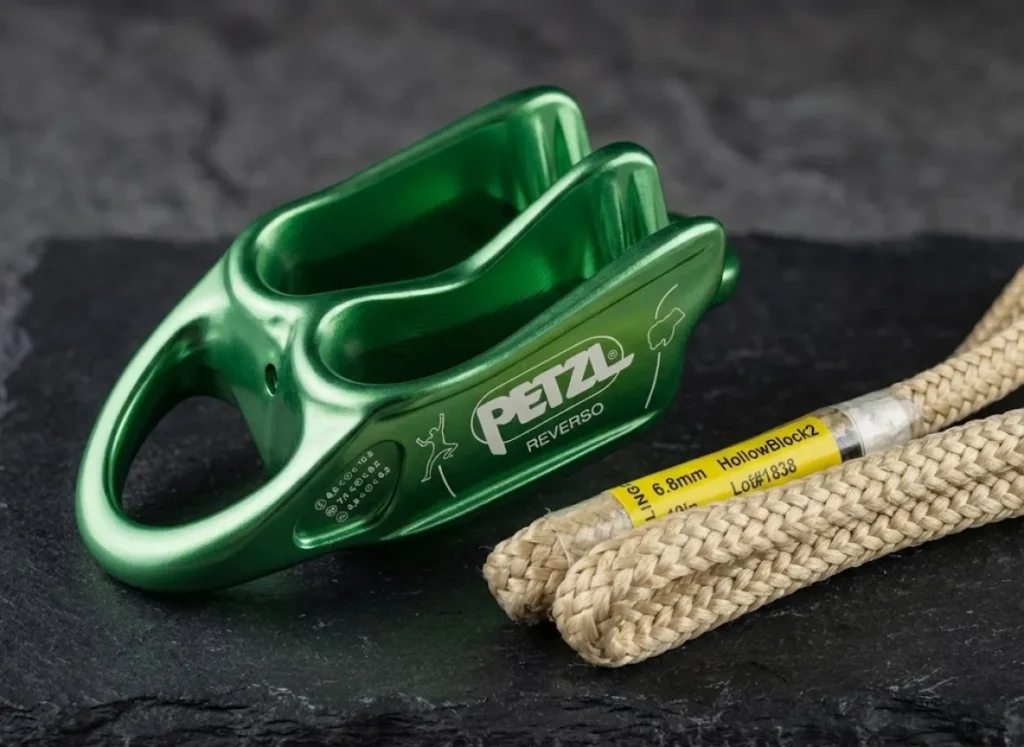
Your rappel gear is your lifeline. In this section, we distinguish between recreational choices and the professional safety standards required for a Zero Error descent.
Should you use a Tube Device or an Assisted Braking Device (GriGri)?
For standard multipitch rappelling, a tube style rappel device (like an ATC or Pivot) is the superior tool. It accommodates two strands of rope, allowing for retrieval, while acting as an effective heat sink.
Tube devices utilize a V-groove friction channel to generate approximately 2.0 to 2.5 kN of braking force. This force is modulated by your brake hand grip strength. Crucially, the aluminum body dissipates the intense thermal energy generated by friction physics. This prevents rope glazing on long, fast descents.
While belay devices decoded: ATC, GriGri, & Passive explains the mechanics in depth, it is worth noting here that an Assisted Braking Device (like the GriGri) is limited to single-strand descents. Using a GriGri for retrievable rappels requires advanced “blocking” techniques (e.g., using a Reepschnur). These introduce complex failure points if rigged incorrectly.
For a standard descent, the ATC or similar tube provides the best balance of heat dissipation and simplicity. However, since a tube device does not auto-lock, the system remains “open” to gravity unless you introduce a mechanical fail-safe.
The safety standards for braking devices define these mechanical requirements, emphasizing that user control is critical.
Why is the “Third Hand” Friction Hitch mandatory?
A friction hitch (such as an Autoblock, Prusik knot, or Klemheist) attached to the brake strands below your device acts as a “dead man’s switch.” If you let go of the rope due to rockfall impact, a medical emergency, or panic, the hitch cinches tight and arrests the descent.
This rappel backup (often called a third hand backup) is non-negotiable. It protects against the loss of control that leads to ground falls. Typically, the hitch is attached to the belay loop in an extended setup, separating it from the device to prevent mechanical interference.
Pro-Tip: Extend your rappel device using a sling or PAS. This places the device at eye level for better inspection and keeps the friction hitch comfortably below on the belay loop, ensuring the hitch never gets sucked into the device.
Material selection matters here. Standard 6mm nylon cord is effective but has a lower melting point (around 245°C). In a high-friction slide, nylon can fuse. The “Zero Error” standard recommends Aramid hollow-braids (like a HollowBlock) for their superior heat resistance (up to 500°C) and consistent bite on various rope diameter compatibility ranges.
| Nylon Accessory Cord vs. Sterling HollowBlock Comparison | ||
|---|---|---|
| Feature | Nylon Accessory Cord (6mm) | Sterling HollowBlock (Technora) |
| Heat Resistance | Moderate. Can glaze or melt under high friction generated during a panic situation or rapid descent. | Superior. Virtually impossible to melt during normal rappelling use; specifically designed to withstand high friction. |
| Grip on Wet Ropes | Good, but performance degrades on wet or icy ropes, where it may slip. | Excellent. Bites hard and maintains grip even on thin, wet, or icy ropes due to hollow-braid construction flattening against the rope. |
| Melting Point | ~245°C (473°F). Susceptible to failure if the knot runs and generates heat. | ~500°C (932°F). Highly resistant to decomposition even under extreme heat. |
Mastering the 8 core climbing knots is essential, but specifically for the friction hitch, correct dressing knots ensures it engages instantly when weighted.
Which Knots Ensure the Integrity of the System?
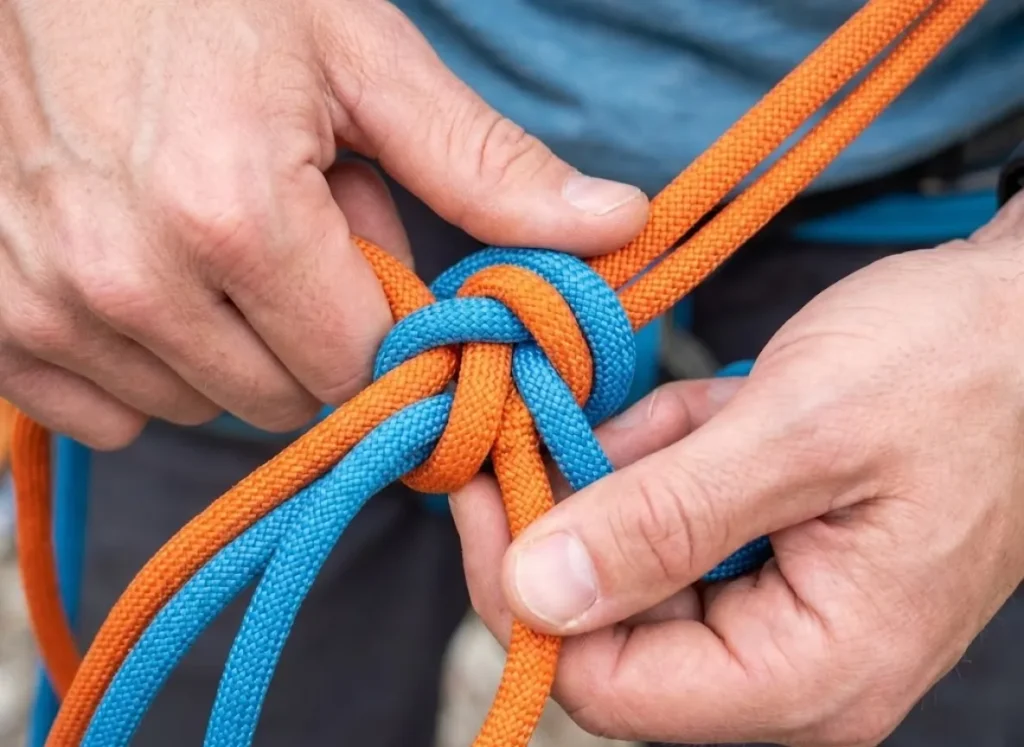
With the hardware selected, the integrity of the descent systems depends on the knots that connect the ropes and close the system’s boundaries.
Is the Flat Overhand Bend (EDK) actually safe for joining ropes?
Yes. The Flat Overhand Bend (often called the EDK) is the preferred knot for joining rappel ropes because its asymmetrical profile allows it to roll over rock edges rather than getting stuck.
Unlike the bulky Double Fisherman’s Bend, the EDK sits flat against the rock. This significantly reduces the risk of a stuck rope—a dangerous scenario that forces a re-ascent.
Proper dressing is critical. You must tighten the knot by pulling all four strands individually. Tails must be left at a minimum of 12-18 inches (30-45cm). Technical analysis of rappel knots confirms that a well-dressed EDK does not roll or capsize until loads exceed ~6.2 kN (1,400 lbs). This far surpasses the static load of a rappeller, which is typically only 1-2 kN.
You must distinguish this from the “Flat Figure-Eight,” which is unstable and can untie itself under low loads. The complete climbing rope guide offers more context on how different dynamic rope diameters interact with these knots.
How do Stopper Knots prevent the most common fatal error?
Stopper knots create a physical “Hard Stop” at the end of the rope, making it mechanically impossible to rappel off the system.
“Rappelling off the end of the rope” remains a primary cause of accidents in our sport. The protocol requires tying a Triple Barrel or bulky Double Overhand knot in each rope strand independently. This ensures the mass cannot pass through the rappel device.
These knots must be tied before the rope is thrown. This ensures the system is closed from the very first moment of deployment. Tying rope ends separately prevents the “closed circuit” from twisting around branches or rock features, reducing tangle risks in wind.
Experienced rappellers often fall into a complacency trap, omitting this step during routine maneuvers. Preventable accidents in Yosemite highlight how often this specific error leads to tragedy. The knot is your final firewall.
Pro-Tip: When you reach the next anchor, do not untie your stopper knots until you are securely clipped in and have verified the next rappel setup.
Learning from climbing mistakes requires us to acknowledge that we are fallible. In a Zero Error system, the descent is not considered “rigged” until the bottom of the loop is physically blocked.
How Do You Execute the “Zero Error” Protocol?
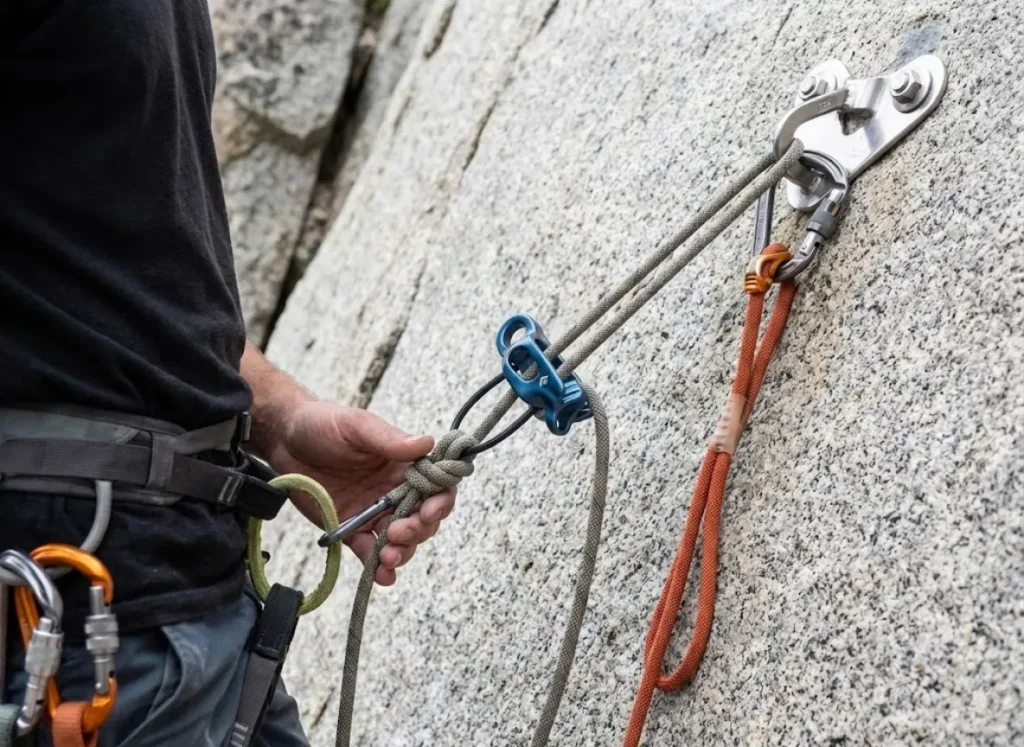
Safety relies on the sequence of movement. We use aviation-style gear checklists to govern the moment you disconnect from the anchor.
How do you safely transition from cleaning the anchor to rappelling?
The “Tether-Weight-Transfer” protocol ensures there is never a millisecond where the climber is not mechanically secured to a life-support point.
- Secure: Clip your Personal Anchor System (PAS) to the master point. Weight it to verify security before calling “off belay.”
- Thread & Close: Thread the rope through the rappel rings. Immediately tie a figure-eight on a bight and clip it to your harness loop before untying your original tie-in knot.
- Transfer: Rig your rappel device and backup on your rappel extension.
- Test: Weight the system fully while still backed up by the PAS.
This “load test” verifies that the device is threaded correctly and the friction hitch is holding before the final safety tether is removed.
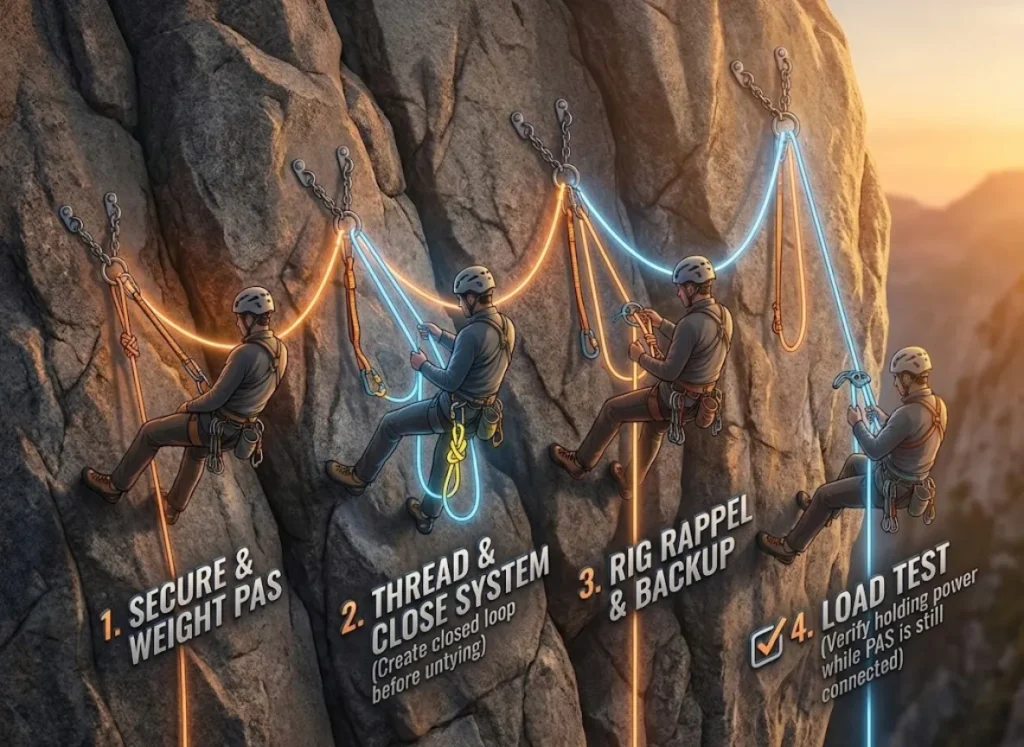
Reviewing how to clean a sport anchor provides the full procedural context for this transition. Additionally, the role of checklists in safety cannot be overstated—they prevent complacency in high-risk environments.
What is the BRAKES acronym for pre-flight verification?
BRAKES is a mnemonic device used to verify every component of the system before unclipping the anchor tether.
- B – Buckles: Check that harness setup buckles are double-backed and snug. Refer to our guide on perfect harness fit for details.
- R – Ropes/Device: Verify the rope is threaded correctly (up/down orientation) and the locking carabiner (preferably an HMS carabiner) is locked.
- A – Anchor: Confirm anchor redundancy, solidity, and that the rope runs through rappel rings or maillons (rapid links), not the hangers.
- K – Knots: Check the EDK is dressed with long tails and Stopper Knots are present. Verify the middle mark alignment.
- E – Ends/System: Confirm rope ends reach the next station and the system is closed.
- S – Safety/Backup: Verify the friction hitch is engaged and effective.
Use a partner-check communication script (e.g., “Carabiner?” -> “Locked”) to combat the normalization of deviance. Cognitive aids in medicine and aviation validate the efficacy of these acronyms in preventing human error.
How Do You Adapt the System to Environmental Hazards?
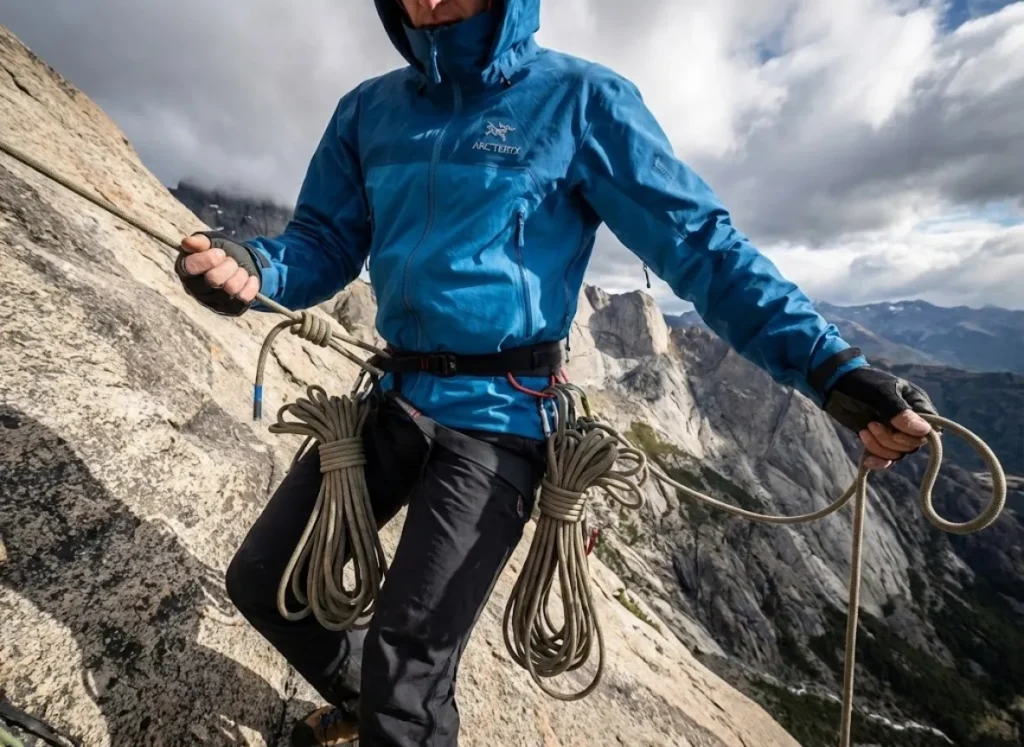
High winds and complex rock features require adaptive tactics to keep the descent systems controlled.
How do you manage ropes in high winds or complex terrain?
In high winds, do not throw the ropes. Use the “Saddlebag” technique for high-wind rope management.
Butterfly coil the ropes and clip them to harness loops (saddlebags) to feed them out manually as you descend. This prevents the wind from blowing loose ends into cracks or trees, avoiding rope tangles.
On low-angle slabs where a throw won’t slide, use a Rope Bomb. Coil the rope tight and wrap the end to create a heavy “torpedo.” This allows you to cast the rope cleanly into open air.
For traversing rappels, use the “Tram” method. Clip a quickdraw between your belay loop and the tensioned guide rope. This prevents dangerous pendulum risks if you lose footing.
If a rope sticks, follow the technical rescue guidelines hierarchy: Flick (waves) -> Vector (change angle) -> Reepschnur (tagline pull). The cardinal rule is to never ascend a stuck rope unless it is visually verified to be safe. A rope caught on a flake can pop loose under the upward force of jugging.
These tactics are part of broader alpine rope management, ensuring you anticipate hazards before they occur.
Final Thoughts on the Closed System
How to rappel safely is an engineering challenge, not a break. You must treat it as a closed system protocol where you are bounded by knots and backed up by friction.
Redundancy is mandatory. A Tube Device combined with a Third Hand backup creates a fail-safe brake that operates independently of your hands. The Tether-Weight-Transfer and BRAKES checklist serve as psychological firewalls, preventing errors during the critical rappel transitions.
Before your next multipitch rappelling objective, practice the saddlebag technique and the BRAKES script at a local gym to ease the gym to crag transition. Turn these protocols into instinct.
FAQ – Frequently Asked Questions about Rappelling Safety
Can I rappel with a GriGri?
Yes, but it is best suited for single-strand descents (like fixing a route) rather than standard multiple rappels. Retrieving a rope with a GriGri requires complex blocking systems that increase risk if rigged incorrectly.
Is it better to lower or rappel to clean an anchor?
Lowering or rappelling is a matter of crag ethics and wear-and-tear prevention. Rappel on aluminum rings or chains to prevent dangerous grooving caused by rope friction and dirt. Lower only on steel carabiners or mussy hooks explicitly designed for high-wear lowering at sport crags.
What should I do if my rope gets stuck?
Attempt to flick the rope or walk away from the wall to create a vector pull that changes the angle on the anchor. Warning: Do not ascend a stuck rope unless you can see exactly what it is caught on; it may dislodge and cause a fall.
Should I use a Dyneema or Nylon sling for extending my rappel?
Use Nylon (or a dedicated PAS) because it has elastic properties that can absorb energy during a shock load. Static rope materials like Dyneema slings have very low stretch and can generate dangerous impact forces on anchors and the body if shock-loaded.
Safety Notice: Rock climbing and mountaineering are inherently high-risk
activities that can involve physical trauma or fatal incidents. The information on Rock Climbing Realms is for
educational and informational purposes only. Techniques and advice presented here are not a substitute
for professional, hands-on instruction. Conditions and risks vary by location. Always seek guidance
from a qualified instructor before attempting new techniques. By using this website, you agree that you
are solely responsible for your own safety. Any reliance you place on this information is strictly
at your own risk, and you assume all liability for your actions. Rock Climbing Realms and its authors
will not be held liable for any harm, damage, or loss sustained in connection with the use of this information.
Affiliate Disclosure: We are a participant in the Amazon Services LLC Associates Program, an
affiliate advertising program designed to provide a means for us to earn advertising fees by advertising and linking
to Amazon.com. As an Amazon Associate, we earn from qualifying purchases. We are also an official affiliate partner
of Black Diamond Equipment via the AvantLink network. If you click on a Black Diamond affiliate link and make a
purchase, we may earn a commission at no additional cost to you. We also participate in other affiliate programs.
Additional terms are found in the terms of service.