
In this article
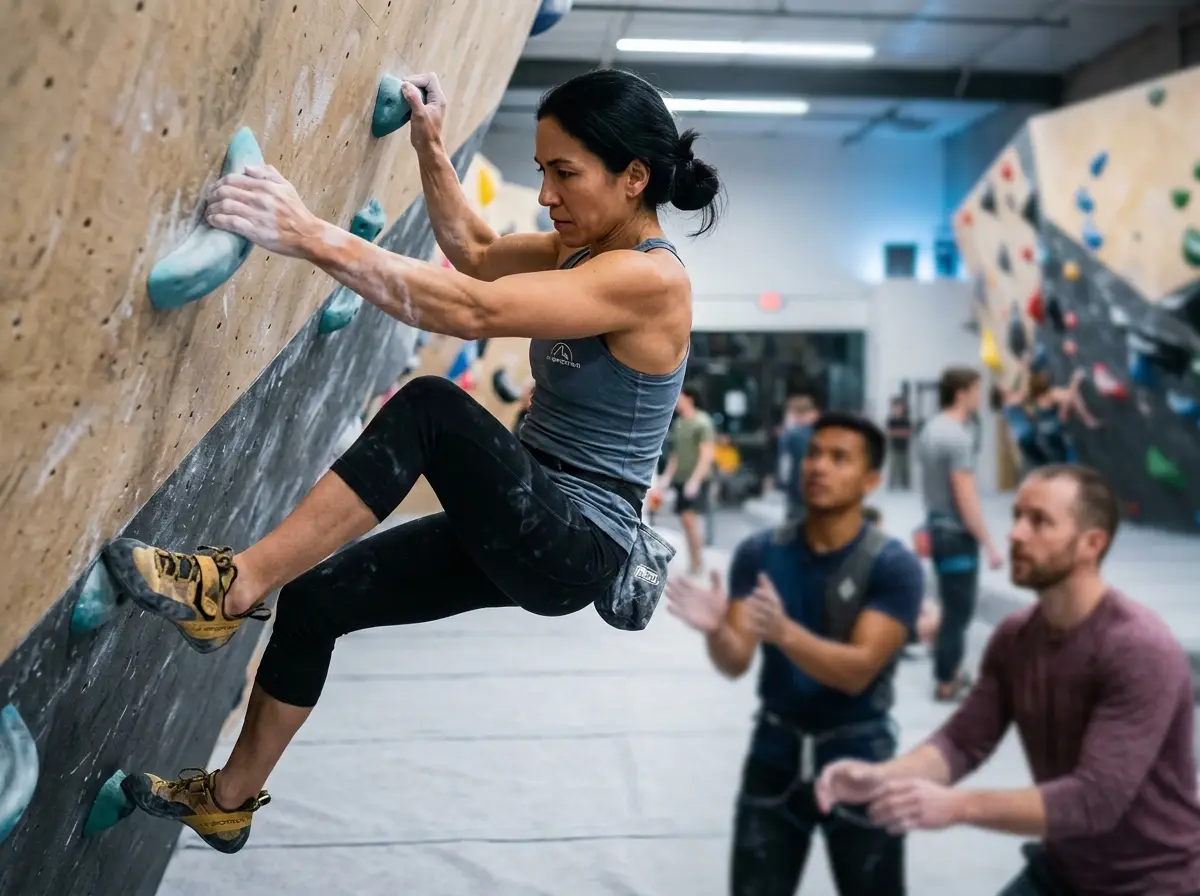
Tuesday night. 7 PM. A member walks in, looks at sixty people sending routes across four walls, sits in the corner, climbs two problems without saying a word to anyone, and cancels eleven weeks later. You never saw it coming. They left a five-star review — “great walls, great setting” — and still walked away. You didn’t lose them to a competitor. You lost them to loneliness inside your own building.
I’ve watched this happen in gyms that had excellent routesetting, solid safety protocols, and genuinely good staff. The walls weren’t the problem. The community architecture was.
The Climbing Wall Association reports that climbing gyms average a one-year retention rate of roughly 39.6%, compared to 72.4% for traditional fitness clubs. That 32-point gap isn’t a marketing problem. It’s an engineering problem — and it has documented technical solutions.
⚡ Quick Answer: Climbing gym retention failures trace back to four fixable systems: spatial design that eliminates the social zone where conversations happen, fall zone clearances that create dead space instead of neutral ground, acoustic environments that cause fatigue before members form habits, and onboarding processes that treat beginners as customers rather than practitioners-in-training. Fix the floor plan first. Then the acoustics. Then the onboarding calendar. The 90-day retention cliff is real — but it’s not inevitable.
The Retention Math Owners Refuse to Run
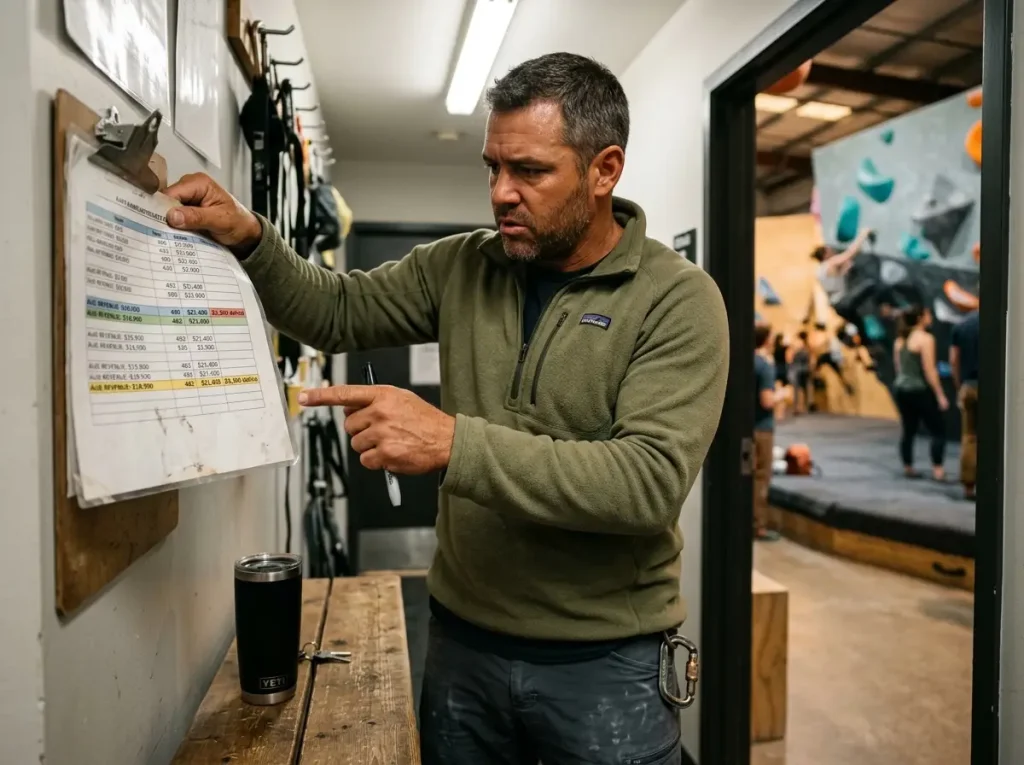
Most owners track revenue and cancellations. Almost none track the five numbers that actually predict whether those cancellations are coming.
The CWA’s 39.6% one-year retention figure is the starting point for understanding how climbing gyms actually generate revenue — and where that revenue quietly disappears. Member retention and churn rate aren’t soft metrics. They’re the difference between a gym that grows and one running perpetual discount campaigns to break even.
The five KPIs that matter: Attrition Rate (cancelled memberships divided by active memberships, tracked monthly), Length of Stay (total months stayed divided by total members), Net Promoter Score (promoters minus detractors), Average Revenue Per Visit (total revenue divided by check-ins), and the 14-Day Return Rate — the one most owners ignore. That last number measures whether first-timers come back within two weeks, making it the most accurate proxy for whether your social onboarding worked. Treat anything below 35% as a structural alarm.
The first 90 to 120 days are where retention is won or lost. Members visiting two to three times per week during this window show dramatically higher lifetime value than those under four visits per month. A gym that pairs its beginner lesson with a “30 Days Unlimited” offer sees first-timer conversion jump from 29% to 47%. That’s a habit engineering window — close it correctly and you keep a member for years.
I’ve sat with owners who had beautiful gyms and couldn’t figure out why members left at the 90-day mark like clockwork. When I asked if they tracked 14-day return rates, I got blank stares. That number alone would have told them everything they needed to know.
Pro tip: Survey new members at day 30 and day 90 with one question: “Do you feel like you know at least two other members by name?” Two people. That’s the social anchor that predicts long-term retention. If the answer is consistently no, you have a space design problem, not a friendliness problem.
Ray Oldenburg’s Third Place theory explains the rest. Climbing gyms aren’t competing against other gyms for a member’s loyalty — they’re competing against coffee shops, courts, and bars for the third place slot in someone’s social week. A gym that becomes a genuine Third Place keeps members through plateaus, price increases, and life changes. One that stays a workout venue loses them the moment something better fills that slot. That distinction — venue versus community — is the entire game.

Architectural Proxemics: Designing Space That Forces Interaction

Here’s what most owners get wrong: they design climbing gyms, not community spaces. Every square foot goes to wall panel. The floor fills up. Members have nowhere to pause, nowhere to linger, nowhere to talk.
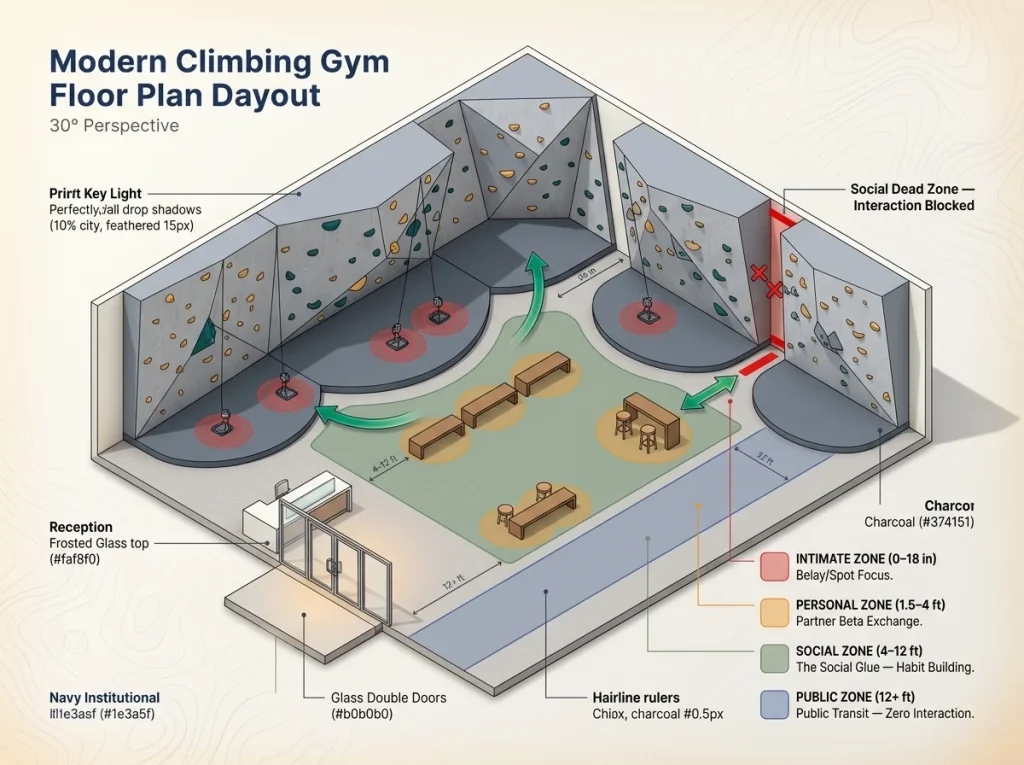
Edward Hall’s proxemics framework identifies four interpersonal zones: Intimate (0–18 inches), Personal (1.5–4 feet), Social (4–12 feet), and Public (12 feet and beyond). The Social Zone is where beta gets exchanged verbally, where mentors coach, and where the actual social glue forms. Most gym floor plans accidentally eliminate it by filling everything with panels.
Walk your floor and classify every square foot. If 90% is either Public Zone (walking between walls) or Intimate Zone (belaying and spotting) with almost no Social Zone in between, you’ve found your retention problem — built into the concrete.
The fix is Pause Points: intentional architectural gaps where climbers rest and interact without obligation. Place benches at natural fall zone boundaries — already cleared for safety. Connect these decisions to your climbing gym business plan’s spatial allocation before committing the CapEx. Changing a floor plan after concrete is poured costs ten times what getting it right in design does.
Shared Struggle Zones finish the job. Put a V2, a V4, and a V6 at the same wall angle in adjacent but safely spaced positions. Climbers of different levels watch the same movement and talk — not because you programmed a social event, but because you designed the wall that way.
Pro tip: Design at least two “destination spots” visible from the entrance that are clearly not climbing walls. A gear wall with community chalk bags. A projector screen showing send footage. A small shelf of guidebooks. These signal that you can stay here and belong even when you’re not on the wall.
Open sightlines from the entrance also matter. A newcomer who can see climbers of all levels from the door — people falling, people laughing, people working the same problem four times in a row — gets their fear normalized before they’ve committed to anything. The best gyms use Reveal Architecture to close the deal: turn a corner during the welcome tour and show something impressive. That jaw-drop moment on the first visit creates an emotional tag to the space that the member keeps re-experiencing for months. Fix the floor plan first. Everything else follows from that.
The Physics of Safe Socialization
Route density planning is where I’ve seen the most expensive community mistakes. A setter places three V5s in a tight radius because they look visually impressive on the wall photo. Fall zones overlap. Nobody can stand anywhere safe long enough to have a conversation. The Social Zone disappears.
The UIAA/industry standard is 2.5 meters (about 8.2 feet) of clear padding from the outermost bouldering surface. Under that clearance, the space between problems is a dead zone: too hazardous to stand in, too narrow to sit in. According to UIAA standardization guidelines for climbing facility safety, when those zones are respected the cleared area becomes Neutral Ground — status is flattened and two climbers who’d never otherwise speak end up dissecting the same V4.
The barn door swing is the detail setters miss most. On a steep overhang, the body swings laterally when a climber comes off. Place an adjacent route too close and that swing radius puts the falling climber into a neighbor’s space. Beyond the liability, nobody can stand comfortably near either route — which ends the lingering, ends the conversation.
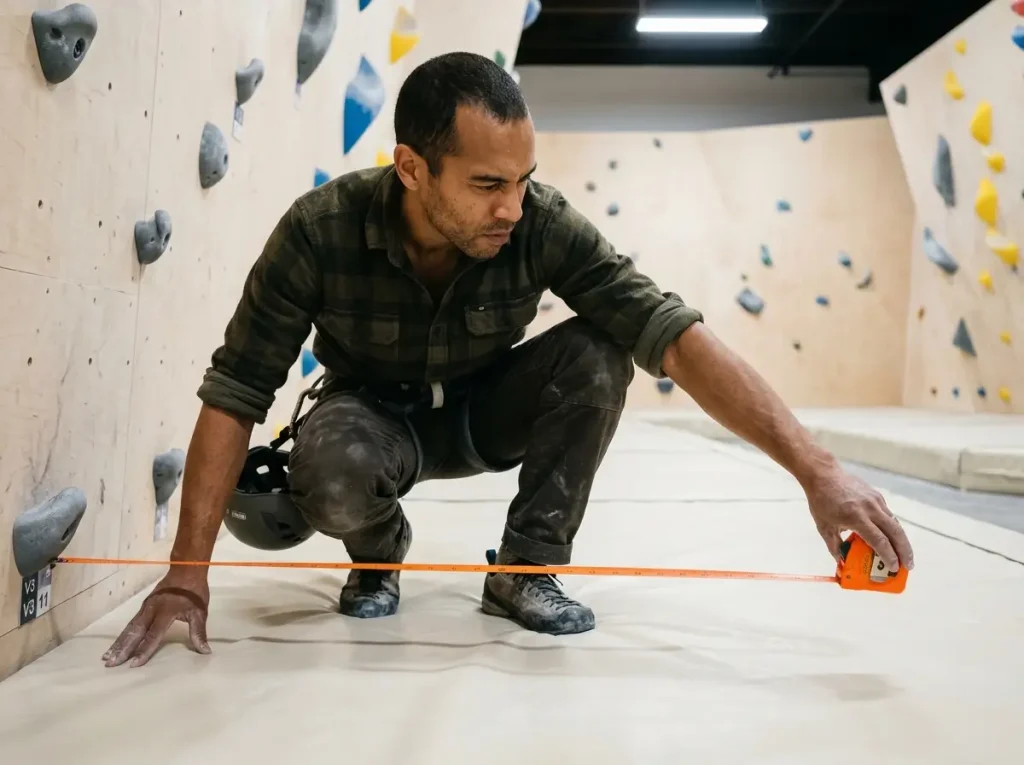
Map your bouldering floor with circles at 2.5m radius from each problem’s outermost point. Any overlap is a social dead zone. Non-overlapping cleared space between circles is a potential Pause Point. Redesign routes to maximize the latter.
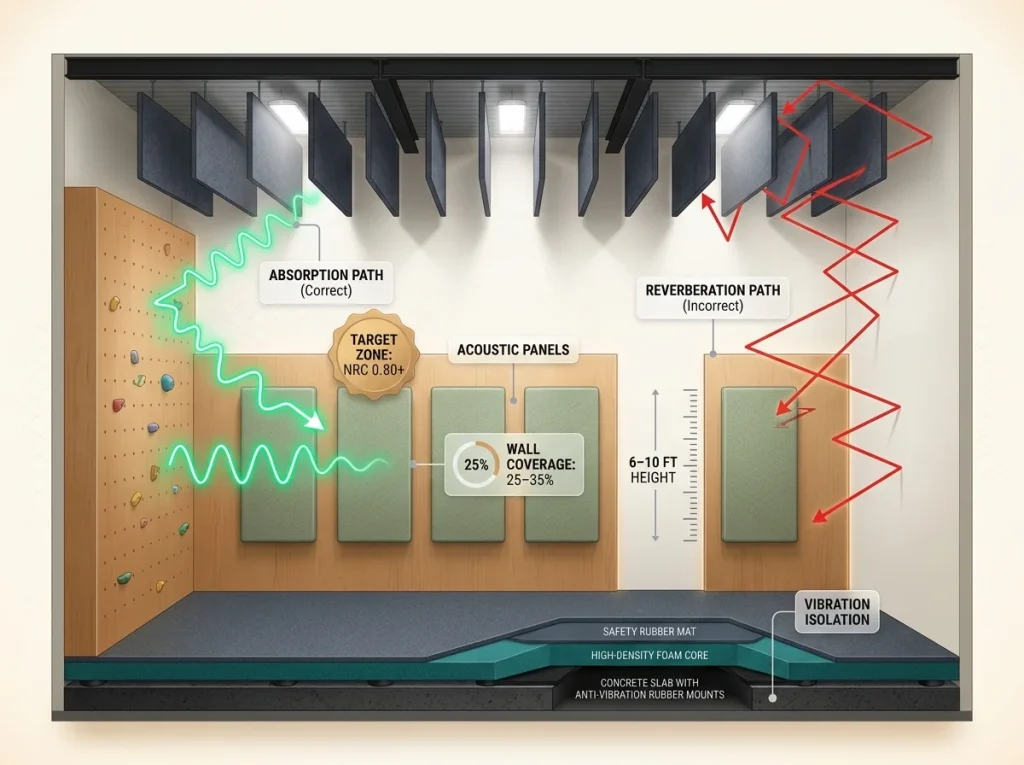
Acoustic damping for social clarity is the invisible retention variable. A gym with NRC materials below 0.70 causes speech clarity to degrade enough that members experience social fatigue within 45 to 60 minutes — they don’t identify the cause, they just leave earlier. Target 0.80+ NRC across 25–35% of wall surface area, with acoustic panels 6–10 feet above the floor and ceiling baffles to break up sound across the open span. Vibration isolation flooring handles the subliminal “thud” stress that accelerates early departures.
The quietest gym I ever walked into felt wrong — too controlled, too still. The loudest one I’ve worked with had members bouncing off the walls and leaving after 45 minutes without knowing why. The target is somewhere in between: a room where you can hear the person next to you without shouting, and where the thud of a fall doesn’t ping off every surface twice.
Most owners don’t think about acoustics until they’re dealing with member complaints. By then, the habit of leaving early is already formed. Acoustic investment is retention investment — and it’s one of the few infrastructure decisions that pays back in months, not years.
Technical Onboarding: Engineering the Rite of Passage
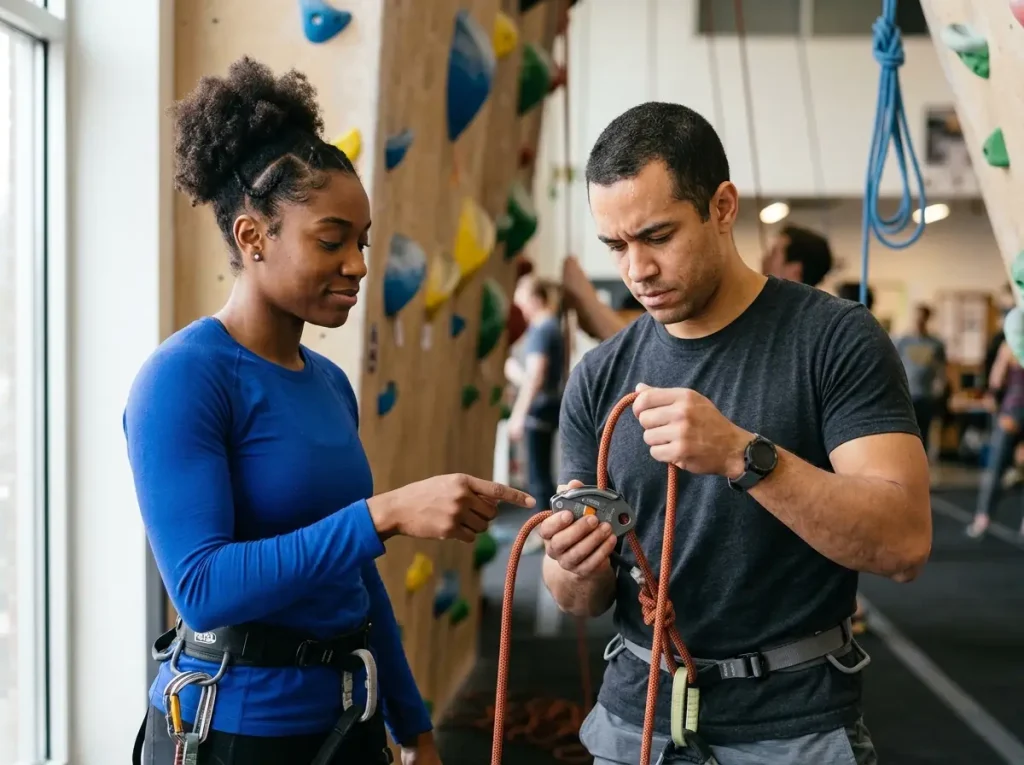
The belay check is not an administrative gate. Every gym treats it like one, and that’s the mistake.
When a climber passes their lead belay check, something changes — not their technique, their identity. They shift from customer to practitioner. That identity shift is measurable in retention data. Most staff say: “You’re approved for lead climbing.” The better version is: “You’re now part of the lead floor community.” Same information, different identity frame. This is why what it actually takes to pass a lead climbing certification matters to gym owners as much as to the members sitting for the check — the tone shapes how someone enters the community.
Social Facilitation Theory (Zajonc, 1965) explains why beginner onboarding processes must happen in low-arousal environments. When beginners are watched, they execute incorrect dominant responses — they freeze, rush, or revert to habit. Designing dedicated learning zones away from the main social floor reduces this effect and improves skill acquisition during the critical first weeks.
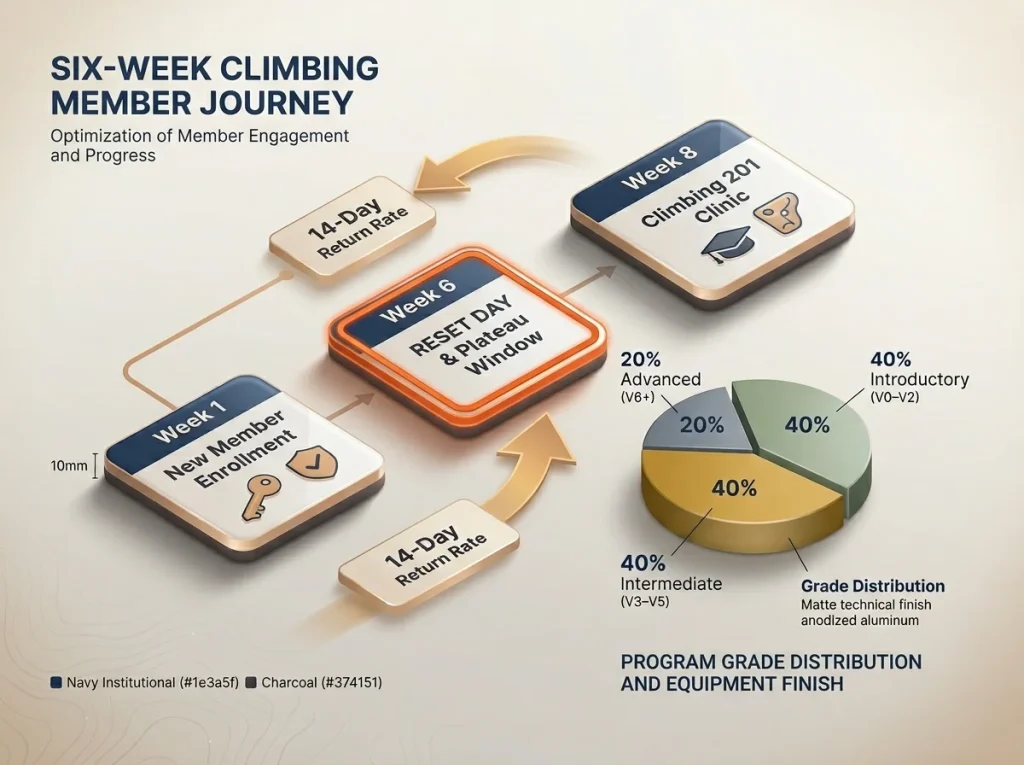
Progressive skill clinics address the plateau burnout that hits most gyms around weeks 8–12. Three tiers: Climbing 101 (fundamentals, fall technique), 201 (footwork, reading sequences, technique plateaus), 301 (lead climbing, outdoor transition). Include these free with all active memberships. Clinic attendees show 2–3× higher Length of Stay than non-attendees — they’re your highest-ROI retention program. Calendar your 201 clinic at weeks 6–8. The timing matters. You don’t set the hook after the fish has already left.
Pro tip: Track which members attend clinics and cross-reference with their Length of Stay data. The retention math justifies offering clinics free. Run the numbers once and you’ll never charge for a beginner clinic again.
The gym-to-crag educational pipeline is the counter-intuitive one. Sixty percent of regular indoor climbers also climb outdoors. Owners fear that teaching outdoor skills steals members from the gym. The data says the opposite: members who learn SERENE/ERNEST anchor standards and rappelling protocols in the gym have a reason to return and report. They come back with stories. They recruit partners. They buy gear through the shop because they trust the technical education they got from the same source. Explore the full gym-to-crag transition protocol to understand how to structure it.
Organized outdoor trips are also the highest-density social bonding events in your entire programming calendar. A 48-hour crag trip forges six-month friendships. Nothing in your digital programming calendar comes close — and if you’re not running at least one per season, you’re leaving your best retention tool on the table.
Managing Social Friction: Beta Ethics and Inclusion Systems

Beta exchange is the cornerstone of climbing community culture. It’s also the fastest way to lose new members — especially women — if you don’t manage it deliberately.
The beta spraying paradox: experienced climbers have a genuine instinct to share knowledge, and that instinct is culturally valuable. But unsolicited advice reads differently to a new member. They hear: “You’re doing it wrong.” They feel: “I don’t belong here.” According to the systemic barriers that undermine climbing gym inclusivity, this pattern disproportionately affects women, who also report unsolicited spotting (physical contact without consent) as a major reason for early cancellation.
Posting a beta ethics policy removes approximately zero percent of unsolicited beta. Operationalizing it through staff modeling is the mechanism. Staff publicly ask before spotting, ask before suggesting anything. Members mirror what they see staff do on the floor. It takes 60 to 90 days of consistent modeling before the culture shifts — but it does shift. Knowing the gym climbing etiquette rules that members actually break gives you the script for how staff should model that behavior without making it feel like enforcement.
Weekly community circles — a 10-minute informal group at a consistent time — normalize asking for beta rather than spraying it. Earplugs or headphones are a legitimate behavioral signal: a climber in focus mode doesn’t want advice. Teaching members to recognize these cues is part of the gym etiquette curriculum, not an afterthought.
Pro tip: Post your beta ethics policy in the bathroom, not just at the entrance. People read bathroom walls. They skim entrance posters while looking for a locker.
Affinity Nights work when they’re consistent, well-marketed, and led by community members — not by management. A Women’s Climbing Night organized by a regular member is social capital. One organized by the owner is optics. The distinction is felt immediately by everyone in the room.
Sliding-scale access programs (the “Climb4Community” model) increase demographic diversity, which in turn raises overall NPS and 12-month retention across all membership demographics — not just the subsidized segment. Access Fund climbing ethics and inclusivity resources provide the baseline framework for building programs that reflect genuine cultural awareness. Robust loaner programs for shoes and harnesses reduce first-session abandonment significantly — removing the “you need expensive gear to start” barrier before it drives away your next long-term member.
On the digital side: many community apps generate resentment more than engagement. What actually works is a physical partner board at the entrance and a gym-specific social account that highlights member sends with consent. Kilterboards and MoonBoards give your analytical members a real global network to engage with — not a synthetic one you had to design and moderate.
Routesetting as Social Engineering
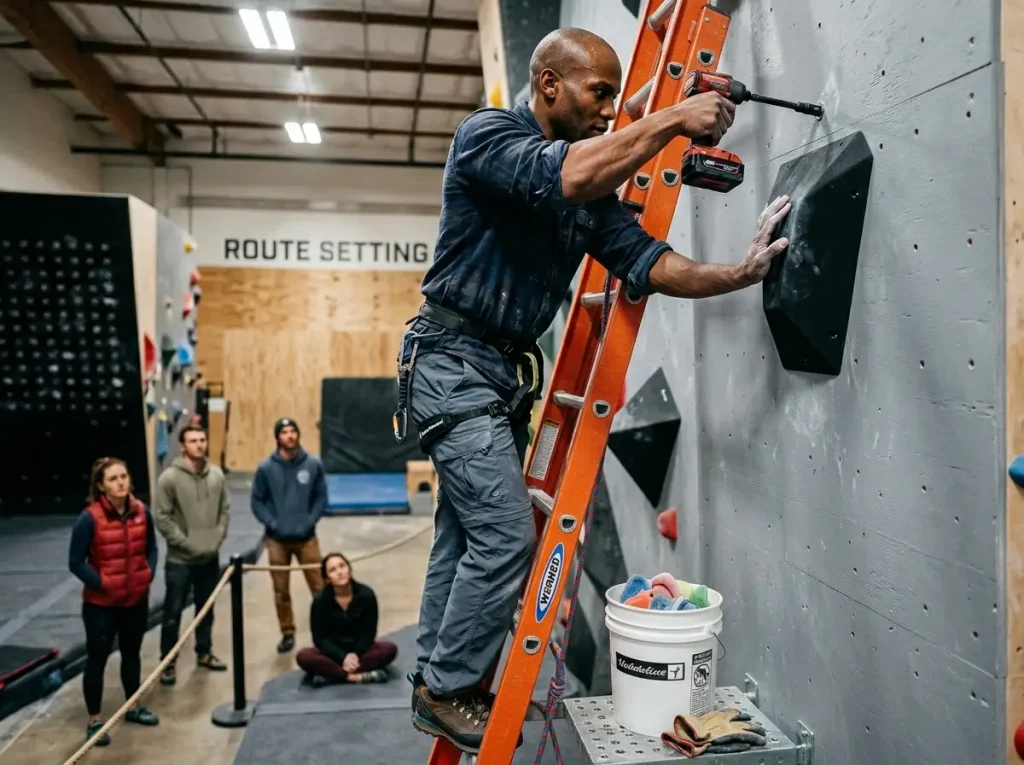
The best community gym I’ve worked with reset every six weeks without fail. Members planned their projects around the cycle. Reset day was a social event — people gathered to watch new problems go up. The routesetting team became part of the community identity. That’s not an accident. That’s a designed system.
Routesetting frequency is one of the top decision factors when a climber selects a gym. Stale routes mean stale community. A 4–6 week cycle is the industry optimum — shorter cycles prevent deep project investment, longer cycles allow routes to become familiar obstacles rather than active projects. Understanding how gym route grading actually works from the setter’s perspective gives owners the internal logic they need to have real conversations with their setting team instead of just asking “when’s the next reset?”
Visible Progression Paths are what turn individual routes into community architecture. A wall designed with gradually increasing difficulty on one continuous visual area — V1 through V5 on the same angle — gives members a “north star” route. A problem they can see getting closer as they improve. When they finally send it, they want to tell someone. That’s the moment community happens.
Shared Progression compounds this: when climbers work similar angles at different grades in adjacent space, they recognize familiar faces through repeated micro-interactions. Those micro-interactions accumulate into actual friendships. It happens over weeks, not days, and it happens because you put the right routes next to each other — not because you scheduled a mixer.
Grade distribution matters too. The target is roughly 40% introductory (V0–V2, 5.7–5.10a), 40% intermediate (V3–V5, 5.10b–5.11d), and 20% advanced (V6+, 5.12+). A gym that under-invests in beginner routes is slowly eliminating its own onboarding pathway. You can’t build a 90-day conversion rate improvement program if there’s nothing for beginners to work on when they show up.
Pro tip: Cross-reference your reset calendar with your 14-day return rate data. If a reset falls within the 14-day window of a first-timer’s visit, their return probability goes up — new problems are a built-in excuse to come back. Time your resets strategically, not just operationally.
The routesetting calendar and the social calendar are the same document. Every setter decision — what grade, what angle, what sequence — is also a community decision. When your team understands that, the work changes.
Conclusion
Three things to take away from this.
First: community is infrastructure, not culture. The 32-point retention gap between climbing gyms and traditional fitness clubs doesn’t close with better staff training. It closes when you redesign your floor plan, your acoustic environment, and your programming calendar as an integrated social engineering system. These are engineering problems with documented solutions.
Second: the 90-Day Cliff is winnable. Pairing a beginner lesson with unlimited access jumps conversion from 29% to 47%. Layer free progressive clinics (101, 201, 301) timed to the plateau window on top of that, and you can engineer the habit-forming period instead of hoping it happens on its own.
Third: social friction is a design flaw. Beta spraying, cliquey regulars, degraded acoustics, overlapping fall zones — none of these are “gym culture problems.” They are fixable engineering problems. The fixes exist. Most owners just haven’t treated them as operational priorities.
Walk your gym floor this week with a tape measure and your floor plan. Classify every square foot by proxemic zone. If your Social Zone is smaller than your Public Zone, you’ve found your retention leak. Now go build the space that earns loyal members.
FAQ
What is the average member retention rate for a climbing gym?
According to Climbing Wall Association industry benchmarks, climbing gyms average about 39.6% one-year retention — roughly half the 72.4% average for traditional fitness clubs. That gap is primarily driven by the absence of systematic community-building programs during the critical 90-day retention window. Gyms that implement structured social onboarding and progressive clinics consistently outperform this baseline.
How do you manage beta spraying in a climbing gym?
The most effective approach is operationalizing a Consent-Based Interaction policy through staff modeling, not just posted signage. When staff visibly ask before offering advice or spotting, members mirror the behavior within 60–90 days of consistent implementation. Supplementing this with weekly community circles and etiquette-focused onboarding reduces unsolicited beta without requiring confrontational enforcement.
What events drive the most engagement in bouldering gyms?
Three formats consistently outperform: reset-day observation events (members gather to watch new routes go up), progressive skill clinics timed to plateau windows at weeks 6–10, and organized outdoor trips. Outdoor trips generate the highest social bonding density of any program format and have the strongest measurable impact on 6-month retention data. The Kilterboard and MoonBoard access model also creates genuine digital community engagement because it connects members to a real global network of setters.
How can I make my climbing gym more inclusive?
Start with the physical barriers: robust loaner programs for shoes and harnesses reduce first-session abandonment. Address behavioral barriers next: enforce gym etiquette standards for spotting and beta through staff modeling, not just posted policy. Structurally, consistent Affinity Nights led by community members (not management) and sliding-scale access programs increase demographic diversity — and raise overall NPS scores across all membership segments, not just the groups the programs target.
What is the ideal bouldering fall zone clearance for a climbing gym?
A minimum of 2.5 meters (approximately 8.2 feet) of clear padding from the outermost climbing surface is the UIAA and industry standard. From a facility architecture and design perspective, this clearance is also the minimum buffer needed to create usable Neutral Ground between problems — enough space for two climbers to sit, rest, and exchange beta without blocking traffic or creating a hazard. Below this threshold, the area is a dead zone for both safety or social interaction.
Safety Notice: Rock climbing and mountaineering are inherently high-risk
activities that can involve physical trauma or fatal incidents. The information on Rock Climbing Realms is for
educational and informational purposes only. Techniques and advice presented here are not a substitute
for professional, hands-on instruction. Conditions and risks vary by location. Always seek guidance
from a qualified instructor before attempting new techniques. By using this website, you agree that you
are solely responsible for your own safety. Any reliance you place on this information is strictly
at your own risk, and you assume all liability for your actions. Rock Climbing Realms and its authors
will not be held liable for any harm, damage, or loss sustained in connection with the use of this information.
Affiliate Disclosure: We are a participant in the Amazon Services LLC Associates Program, an
affiliate advertising program designed to provide a means for us to earn advertising fees by advertising and linking
to Amazon.com. As an Amazon Associate, we earn from qualifying purchases. We are also an official affiliate partner
of Black Diamond Equipment via the AvantLink network. If you click on a Black Diamond affiliate link and make a
purchase, we may earn a commission at no additional cost to you. We also participate in other affiliate programs.
Additional terms are found in the terms of service.