
In this article
The foam compressed to nothing under my heel. One second I was ten feet up on a granite arête outside Bishop, the next I was flat on my back staring at the sky, ankle throbbing, wondering why a pad I’d bought six months ago had just bottomed out on a V4 topout. I pressed my fist into the foam afterward. The impression stayed. That pad was dead — I just hadn’t known the signs.
After years of outdoor bouldering across Squamish, Rocky Mountain National Park, and Fontainebleau, I’ve learned that your crash pad isn’t just a piece of gear you throw under a boulder. It’s an engineered safety system with a shelf life, and most climbers don’t understand how it works until it fails them.
This is everything the product page won’t tell you — how foam actually degrades, why your folding system matters more than you think, and how the pad under your feet shapes every decision you make on the rock.
⚡ Quick Answer: A quality bouldering crash pad uses a multi-layer foam sandwich construction — closed-cell foam on top to spread your weight across the pad, open-cell foam in the middle to absorb the hit — and the whole system wears out over 3-5 years of regular use. Your pad’s protection depends on foam density (not just thickness), proper placement based on fall trajectories, and regular maintenance. Replace any pad that fails the fist rebound test.
The Foam Sandwich That Decides Whether You Walk Away
Open-Cell vs. Closed-Cell: Two Jobs, One System
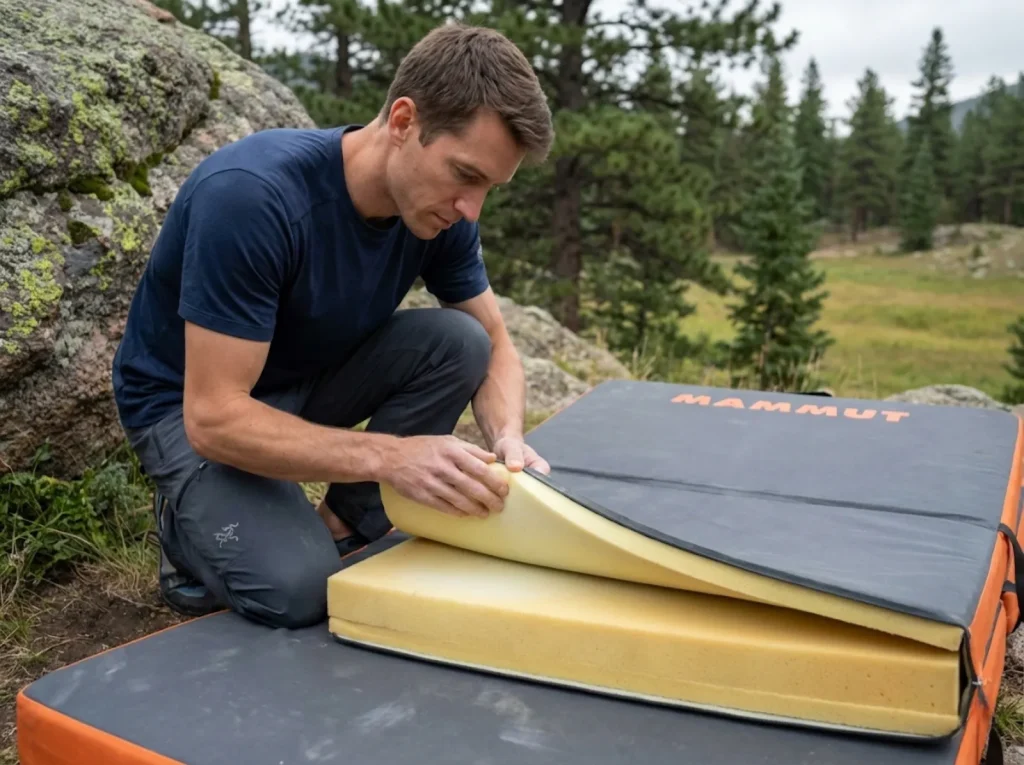
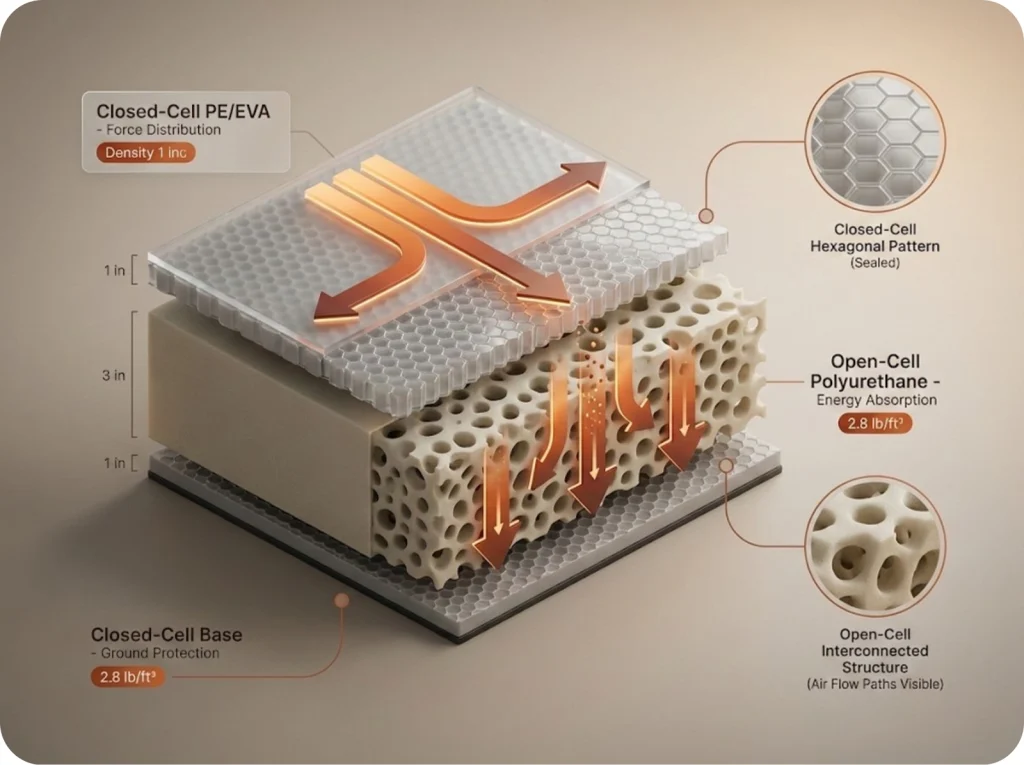
Every modern crash pad runs on the same basic principle: layers of different foam doing different jobs. The top layer is closed-cell foam — usually PE foam or EVA foam — and its job is to spread the force of your landing across a wider area. Without it, your heel punches straight through to the ground. That’s what bottoming out feels like, and it’s the fastest way to snap an ankle.
Below that sits the thick center of open-cell foam, typically polyurethane foam. This stuff works like a controlled spring. When you land, air squeezes out through millions of tiny connected cells, and the resistance from the foam’s internal structure is what actually absorbs your fall. The thicker and denser this layer, the more punishment it can take.
A standard foam sandwich construction runs about half an inch to one inch of closed-cell on top, two to three inches of open-cell in the middle, and another thin closed-cell layer on the base. But here’s what the spec sheet won’t tell you: foam density matters more than thickness. A pad with 2.8 lb/ft³ foam at four inches will outperform a cheaper 1.3 lb/ft³ pad at five inches — especially after a season of heavy use.
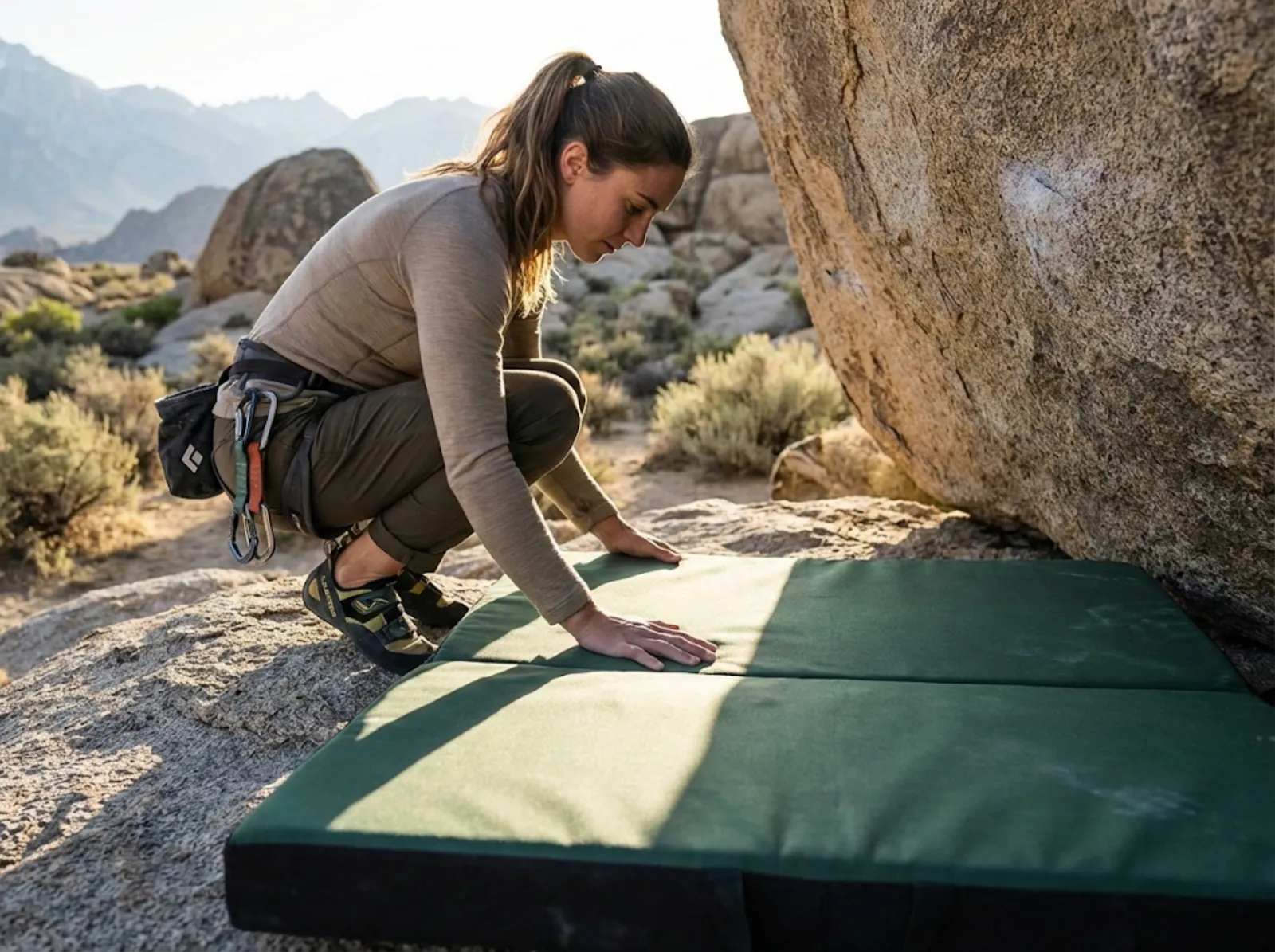
Pro tip: Press your fist into your pad’s foam. If it rebounds in under two seconds, the foam is healthy. If it holds the impression like memory foam, start shopping for a replacement.
Some manufacturers use chemical hardeners to fake firmness in low-density foam. It feels great in the store. By season two, the additives break down and you’re falling onto what might as well be a yoga mat. If you’re serious about knowing what separates quality crash pad foam from the cheap stuff, density is the number to watch.
Reticulation: The Process That Separates Cheap From Bombproof
The reticulation process is the single biggest quality indicator that never appears on a product label. Reticulation removes the thin membranes between foam cells, leaving only the structural skeleton. This maximizes airflow through the foam so it compresses evenly during a high-speed impact.
There are two ways to do it. Chemical quenching runs foam through a caustic bath — it works, but leaves a rough surface. Thermal reticulation is the premium method: the foam goes into a pressure vessel, the air gets vacuumed out, and an explosive hydrogen-oxygen mix is ignited. The resulting flame front vaporizes every membrane while leaving smooth, polished support structures behind. It sounds extreme because it is. Thermally reticulated foams compress more uniformly under fast impacts, which matters most on highball bouldering problems above fifteen feet.
When Your Pad Dies: The Compression Set Timeline
Foam degradation isn’t sudden. It’s a slope. Most pads lose 15-20% of their cushioning ability per season of heavy use — three or more sessions a week. Heat accelerates the process. Leave your pad in a hot car where temperatures can climb past 110°F, and you’re cooking the polyurethane foam into early retirement.
The average pad lasts three to five years for weekend climbers. If you’re bouldering daily outdoors, expect 18-24 months. Run the cost-per-use analysis: a $300 pad used 100 days a year for four years costs $0.75 per session. A $150 pad that dies in 18 months costs more per protected session and gives you degraded protection for the last six months. You can track this alongside the rest of your kit using a proper gear degradation tracking system.
Folding Systems and Why the Wrong One Gets You Hurt
Hinge, Taco, and Baffled: Three Designs, Three Trade-offs
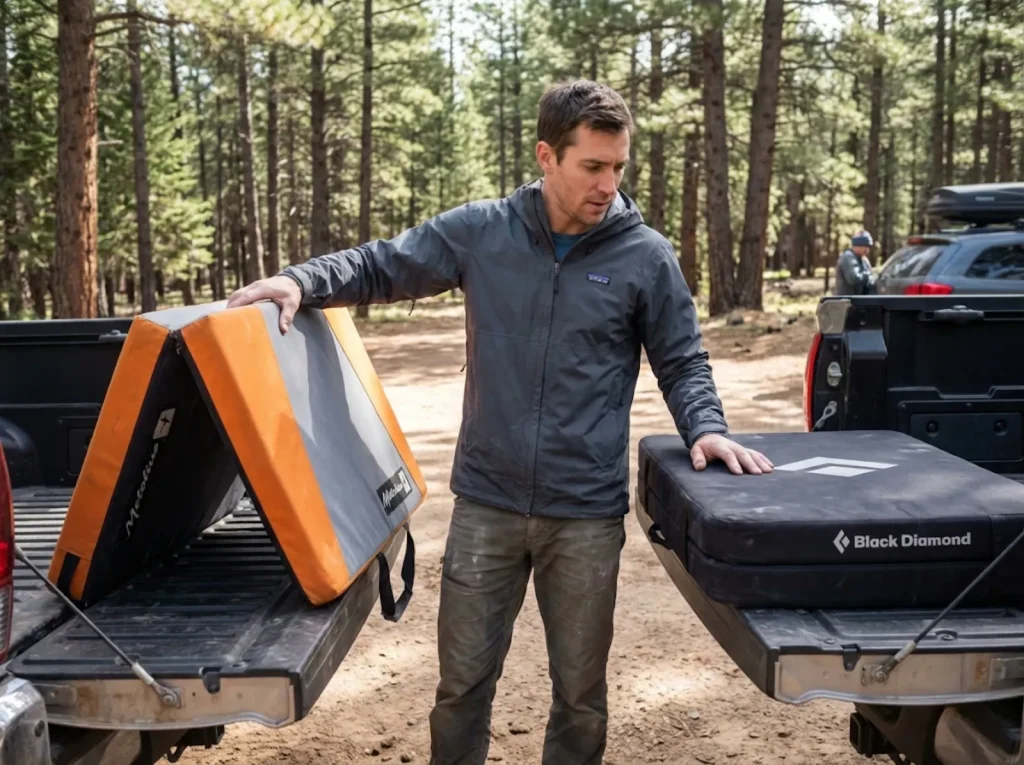
The hinge fold cuts the foam completely at the fold point. It packs flat and travels well, but that cut creates a gutter — a seam where your ankle can catch and invert on landing. Manufacturers like Metolius mitigate this with angled hinge designs that cut the foam at 45 degrees so the layers overlap when the pad lies flat.
The taco fold bends a continuous sheet of foam without any cut. No gutter, no seam — but that constant tension on the foam accelerates compression set at the crease. Store a taco pad folded for a few months and you’ll feel the dead strip running down the middle.
Baffled fold designs, like the Mad Rock Duo, use tubes filled with shredded recycled EVA foam. These pads drape over talus, roots, and uneven rock like nothing else, conforming to terrain that would leave a flat pad rocking like a seesaw. The trade-off is weight and potential for uneven foam distribution inside the tubes.
The tri-fold splits the difference — three panels, two hinges, compact car storage. Metolius Magnum runs this design at 70 by 47 inches, giving you a massive footprint that folds down small. The compromise? Two seams to manage instead of one.
The Storage Mistake That Ruins Half Your Pad’s Life
Storing a taco pad folded is the most common way climbers destroy protective gear without realizing it. Those foam cells sit under constant compression at the crease, and within months, the deformation becomes permanent. Seasonal storage protocols are simple: store every pad flat, open, in a climate-controlled space. Not the garage. Not the car. Not leaned against the wall, folded.
If your pad gets wet — and at some point it will — open the shell, pull the foam layers out, and dry everything separately before reassembly. Moisture breeds mildew and accelerates foam rot from the inside out.
Pro tip: Clean your pad’s shell with a stiff brush and mild soap every few months. Grit from chalk and dirt acts like sandpaper on nylon fibers with every fold.
Landing Zone Geometry: Placing Pads for How You Actually Fall
Reading Fall Trajectories Before You Leave the Ground
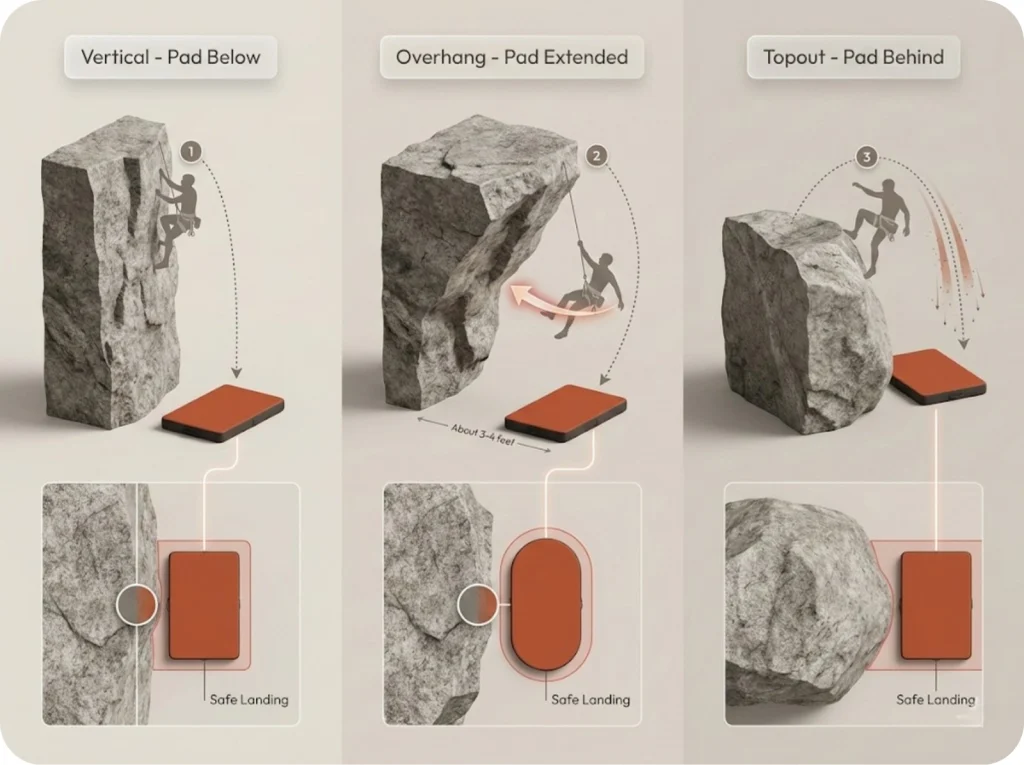
Most climbers drop their pad directly below the problem and start climbing. That works on a vertical wall with a flat landing. It fails everywhere else.
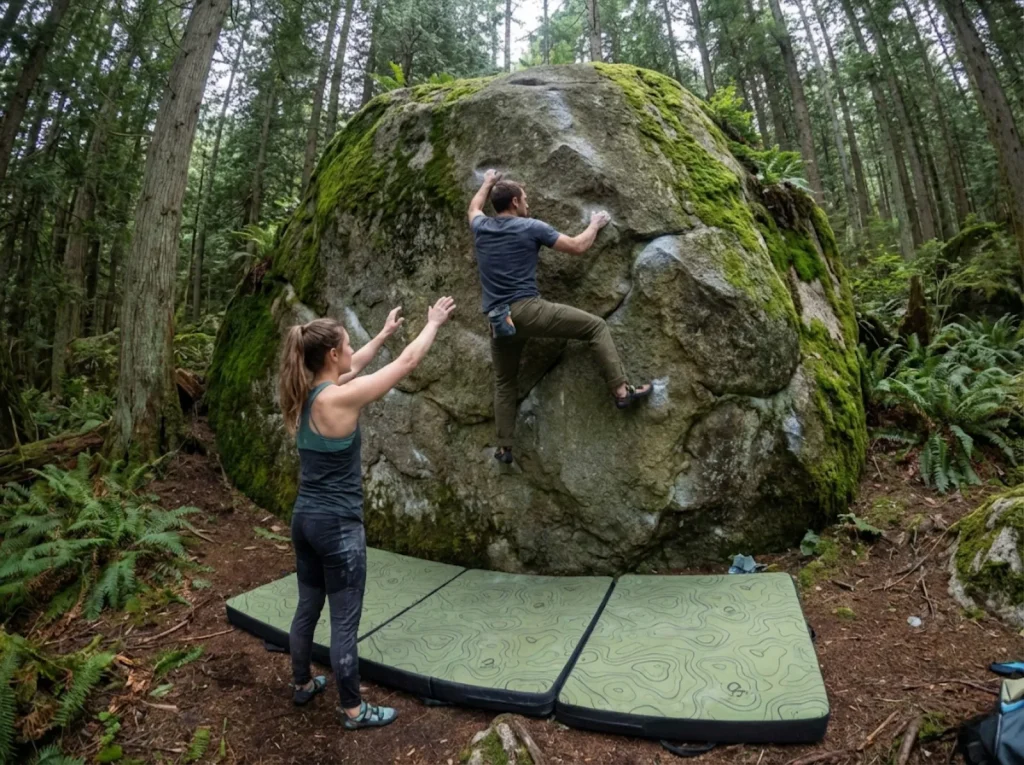
On overhangs and roofs, falls arc outward. Your body swings like a pendulum, and you land feet away from where you started. The pad needs to account for where the swing takes you, not where you’re standing now. Topout falls are even trickier — they eject you backward over the lip. Your pad goes behind the boulder, not under it.
Walk the base before you climb. Look at each crux section and ask: if I fall here, where do I actually go? Then position your pads section by section to match.
Tiling Multiple Pads Without Gaps
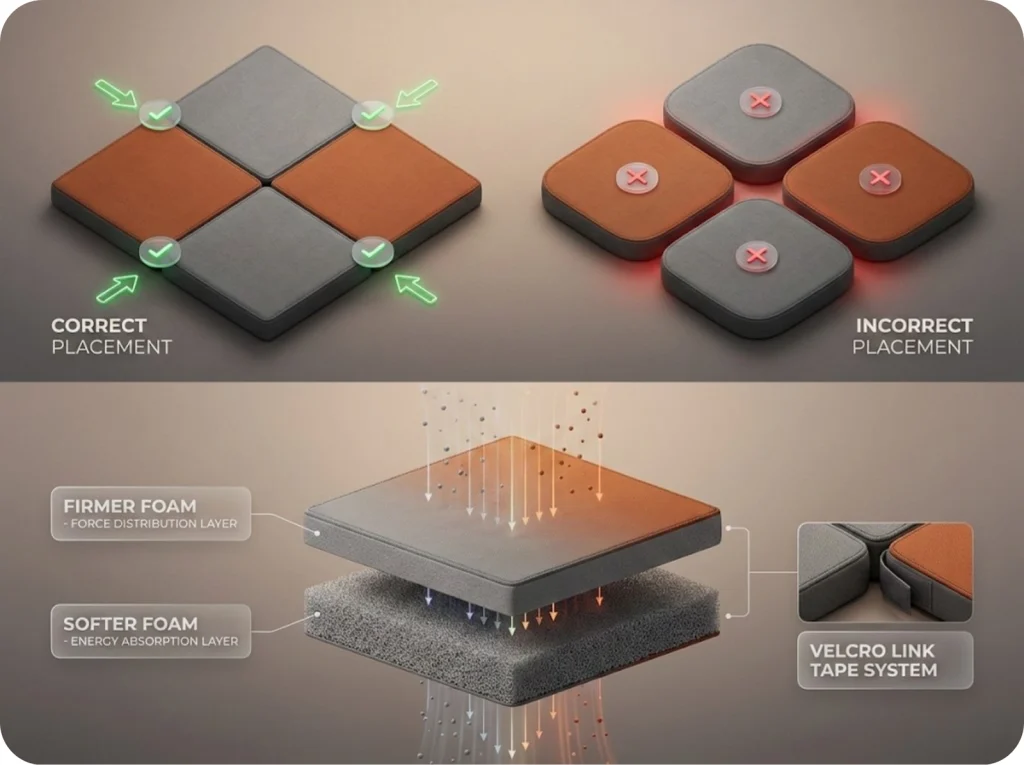
The Tetris method is simple: butt square-cornered pads tight together with no overlap, no gaps. Rounded corners create dead space where an ankle can slip through. That’s why square corners aren’t an aesthetic choice — they’re a safety standard.
The hard-on-soft stacking rule matters when you piggyback multiple pads. Place the firmer pad on top so it spreads the load before the softer pad absorbs it. Reverse this and your body punches through the soft top into the firm base. You can find the complete breakdown of stacking pads to eliminate gaps in landing zones in our dedicated guide.
Modular systems like the ZigZag Double Link physically bond pads together with Velcro link tape, preventing the slide-apart problem that plagues loose pad setups on talus. At roughly four pounds per unit, you can build a custom landing zone from modular pieces.
Spotting: Your Human Backup System
A spotter’s job isn’t to catch you. It’s to guide your hips onto the pad and protect your head from hitting bare ground. Thumbs tucked — to prevent fractures — arms extended, ready stance. Move with the climber as they traverse. For the full breakdown on how fall angles connect to crash pad placement, check our dedicated guide. You can also study the essentials of mastering spotting and crash pad coordination for multi-pad setups.
Never spot from directly below. A knee to the face is a real scenario. Stand at the edge of the landing zone, guiding trajectory. When multiple spotters are working, communicate positions out loud: “I’ve got the left side.” “Watching the lip.”
The Mental Game: How Your Pad Changes What You’ll Try
The Affect Heuristic on the Boulder
Here’s the part nobody talks about: your pad doesn’t just protect your body. It changes your brain.
As a session progresses, your perception of risk drops while your error rate climbs. Endorphins flood your system, creating a mood your brain reads as “safe” — even when the objective danger hasn’t changed. Researchers call this the affect heuristic, and a Frontiers in Psychology study on risk perception shifts during climbing documented exactly how it works.
Psychological confidence factors amplify the problem. A thick, firm pad encourages you to try problems you’d otherwise walk away from. That’s not inherently bad — confidence enables performance. But a degraded pad should trigger the opposite behavior, and it almost never does. Climbers don’t reassess their safety equipment mid-session. They just keep sending.
The numbers back this up. In 2024, the American Alpine Club’s analysis of human factors in climbing accidents showed 33 accidents involving expert climbers versus only six involving beginners. Experience breeds familiarity. Familiarity breeds a kind of blindness to risk that the climbing community calls risk normalization.
Flow State vs. Reckless Confidence
The flow state in climbing — total immersion where action and awareness merge — is one of the sport’s greatest rewards. Bouldering psychotherapy has shown results comparable to cognitive behavioral therapy for treating depression. The focus required to solve a boulder problem forces your brain to stop ruminating.
But flow can mask deteriorating judgment. The climber who “feels dialed” often stops checking pad placement mid-session. Build a habit: re-evaluate your pad position and foam condition every four or five attempts. Treat it like a pre-flight checklist, not a one-time setup. For a deeper look at building structured mental training protocols for managing fear and focus, we have a dedicated guide.
The Injury Data That Should Change How You Boulder
The Numbers Nobody Wants to Talk About
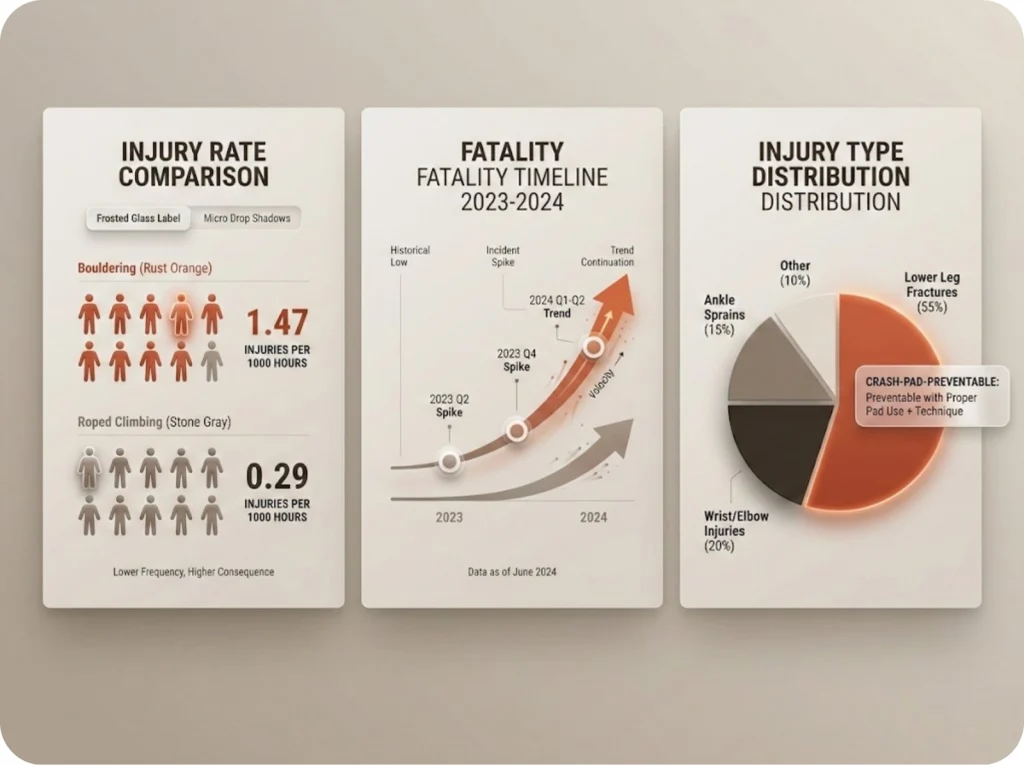
Bouldering’s injury rate sits at about 1.47 per 1,000 climbing hours — roughly five times higher than roped climbing at 0.29. That stat comes from a comprehensive study on injury patterns and risk factors in climbing published in PMC. Ankle sprains and lower leg fractures dominate the data, and both are directly influenced by pad quality and placement.
The gym to outdoor transition is the highest-risk window. Indoor climbing gyms lay down uniform twelve-inch-thick flooring across flat surfaces. That creates a false sense of security. Outdoors, your landing zone might be talus, tree roots, or a slope — and your pad coverage is a fraction of what the gym provides. If you’re making that jump for the first time, start with our guide on essential bouldering gear for gym-to-outdoor transitions.
Falling Technique: The Skill Your Pad Can’t Replace
No pad saves you from bad falling technique. Stiff-legging a landing with locked knees is the primary cause of lower leg fractures. Instead, absorb the initial impact with bent knees, then roll onto your back or side. That roll spreads the remaining force across your torso’s larger surface area into the pad.
Arms go in front of your chest or tucked. Never brace behind you. Backward bracing with extended arms is how wrist fractures and elbow dislocations happen, and they’re entirely preventable.
Pro tip: Practice falling on a flat, clean pad from four to six feet before attempting any highball problem. Build the motor pattern before you need it under stress. It should feel automatic, not improvised.
Buying Smart: What the Spec Sheet Won’t Tell You
Reading Shell Fabric Like a Climber, Not a Shopper
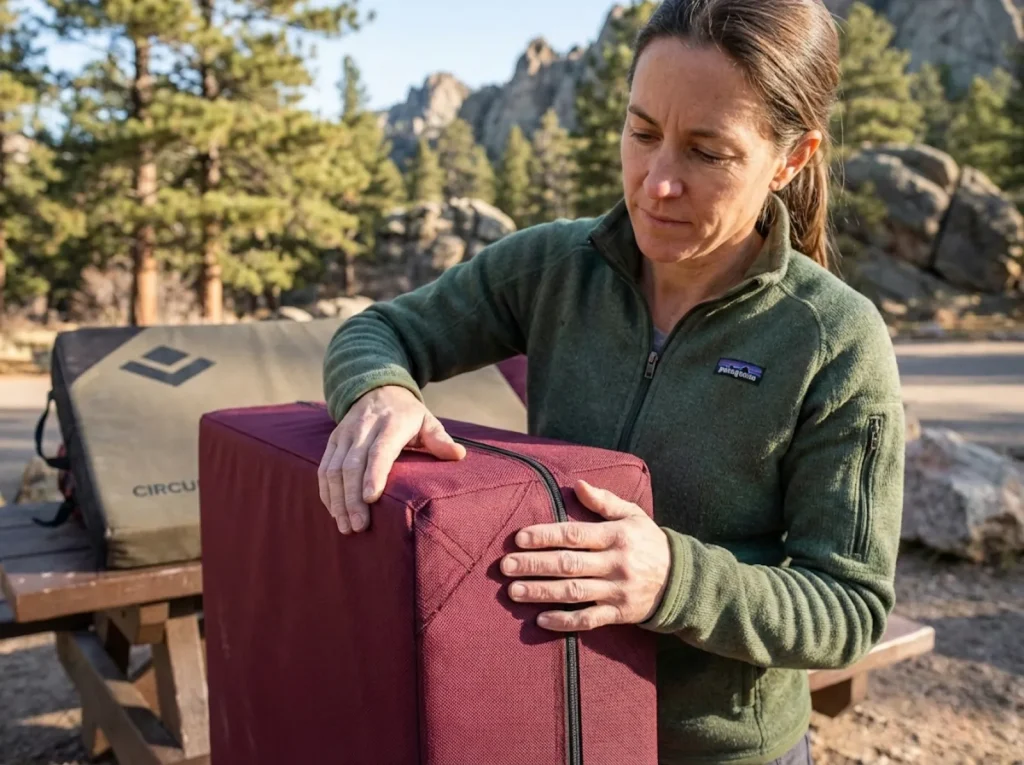
The denier rating measures the weight of the yarn — higher numbers mean heavier, tougher fabric. Standard pads run 500-900D nylon. Heavy-duty pads, like the Organic lineup, use 1050D ballistic nylon with a dense basketweave pattern originally built for military-grade protection. That’s shell durability you can feel with your fingers.
But denier alone doesn’t tell the full story. Weave pattern, C0 DWR coating, and reinforcement at stress points — corners, hinge, carry attachment — all contribute to how long a shell survives granite abrasion resistance. ZigZag uses 840D recycled fabric sourced from roughly 74 recycled plastic bottles per pad, and it matches virgin nylon in durability.
One universal rule: never drag your pad between problems. It destroys the shell, chews up the trail, and violates Leave No Trace principles. Carry it. Always.
Matching Pad to Terrain and Style
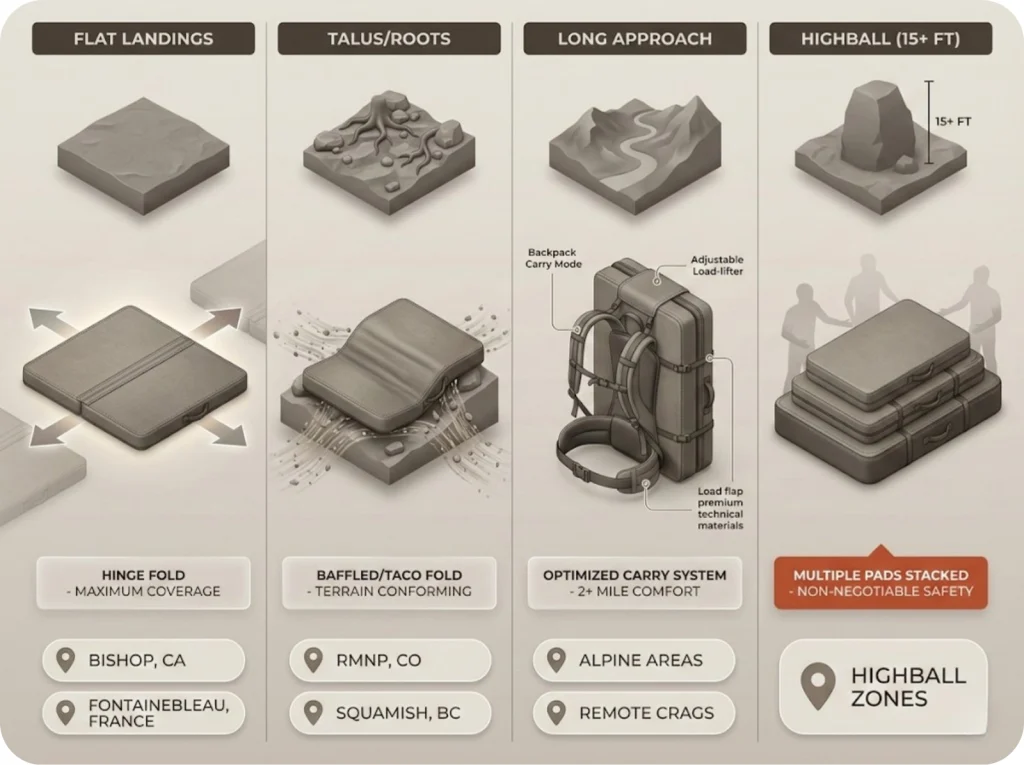
Flat landings at Bishop or Fontainebleau? A hinge fold pad lies perfectly flat. Tile multiples together for maximum coverage. Talus and root chaos at Rocky Mountain National Park or Squamish? A baffled fold or taco fold pad will conform where a flat hinge pad just rocks.
Long approaches demand attention to the carry system. Look for load flap systems, load-lifter straps, and padded hip belts. The difference between a comfortable two-mile alpine approach and a brutal one comes down to approach hike comfort — and that’s entirely a function of the harness, not the foam.
For highball bouldering above fifteen feet, minimum five inches of foam and multiple stacked pads are non-negotiable. Bring spotters. Bring backup.
The Repairability Factor Most Buyers Ignore
Organic Climbing offers foam core replacement because their 1050D nylon shell outlasts the foam by years. Buy once, replace the guts. That’s the real sustainability metric — repairability over recyclability.
Look for zippered or Velcro foam access panels that let you swap worn layers without trashing the entire pad. DIY repair protocols for torn shell fabric are straightforward — contact cement and nylon patches solve 90% of damage. A ten-minute fix can extend your pad’s life by seasons.
Conclusion
Three things will change how you boulder from here.
First, your pad’s foam is an engineered system with a countdown clock. Learn the fist test. Track compression set. Retire pads before they fail you mid-send — not after.
Second, pad placement is a skill, not a default. Read fall trajectories, tile without gaps, and recheck positions every few attempts. The landing zone you set before your first try may not match where you’ll actually fall on attempt five.
Third, the mental game matters as much as the gear. Thick foam breeds confidence. Confidence without discipline leads to the injury ward.
Next session, before you pull on, spend five minutes reading the fall trajectories on your project. Position your crash pads for where you’ll actually land, not where you’re standing now. Then trust the system and commit.
FAQ
How thick should a bouldering crash pad be?
Four inches is the minimum for general outdoor bouldering. For highball problems above fifteen feet, go with five inches or stack two pads. Thickness matters less than foam density — a dense four-inch pad outperforms a cheap five-inch pad after six months of use.
How long do crash pads last before they need replacing?
Three to five years for weekend climbers using the pad once or twice a week. Daily outdoor boulderers may need a replacement in 18-24 months. Check monthly with the fist rebound test and retire any pad with visible compression set that doesn’t recover within three seconds.
Can you use a gymnastics mat as a crash pad for bouldering?
Not safely. Gymnastics safety equipment lacks the closed-cell foam distribution layer that prevents bottoming out on point-load impacts like heel strikes. They also lack shell durability for outdoor terrain and don’t fold into a carry format for approaches.
What size crash pad do I need?
A single full-size pad — roughly four by five feet — covers most moderate bouldering. For highball projects or problems with traversing cruxes, you need two to three pads tiled together. Start with one quality full-size pad, then add a second before upgrading to specialty pads.
Is it worth buying an expensive crash pad?
Run the math. A $300 pad that lasts four years at 100 sessions costs $0.75 per session. A $150 pad that dies in 18 months costs more per protected session and offers degraded protection for its final months. Buy the best foam you can afford — your ankles are doing the cost-per-use analysis every time you fall.
Safety Notice: Rock climbing and mountaineering are inherently high-risk
activities that can involve physical trauma or fatal incidents. The information on Rock Climbing Realms is for
educational and informational purposes only. Techniques and advice presented here are not a substitute
for professional, hands-on instruction. Conditions and risks vary by location. Always seek guidance
from a qualified instructor before attempting new techniques. By using this website, you agree that you
are solely responsible for your own safety. Any reliance you place on this information is strictly
at your own risk, and you assume all liability for your actions. Rock Climbing Realms and its authors
will not be held liable for any harm, damage, or loss sustained in connection with the use of this information.
Affiliate Disclosure: We are a participant in the Amazon Services LLC Associates Program, an
affiliate advertising program designed to provide a means for us to earn advertising fees by advertising and linking
to Amazon.com. As an Amazon Associate, we earn from qualifying purchases. We are also an official affiliate partner
of Black Diamond Equipment via the AvantLink network. If you click on a Black Diamond affiliate link and make a
purchase, we may earn a commission at no additional cost to you. We also participate in other affiliate programs.
Additional terms are found in the terms of service.