
In this article
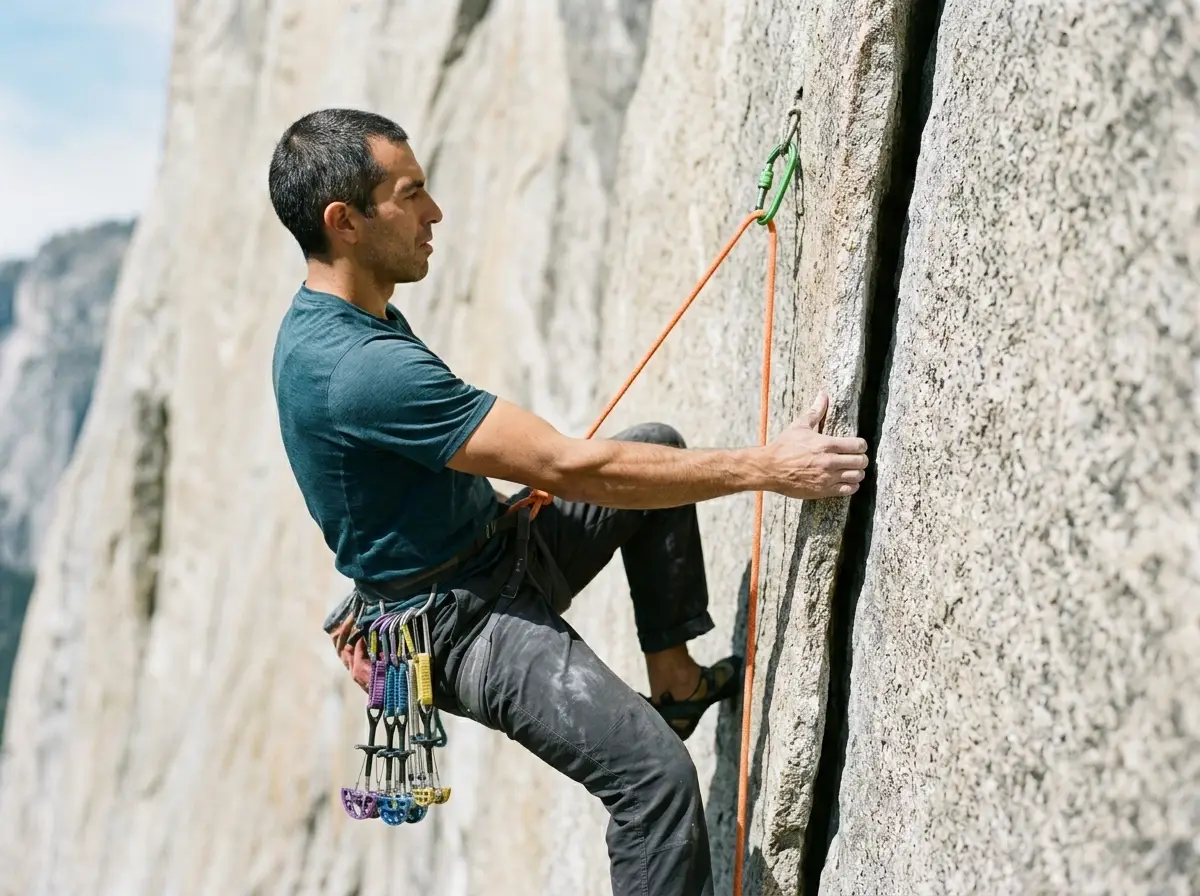
Standing at Stanage Edge, I watched a climber shuffle back down from a route marked “HVS 5b” — one he’d told himself was “just a solid 5.10b.” He had the fingers. He didn’t have the gear placements, the runout tolerance, or the head for it. Three letters and two numbers stood between him and a ground fall, and he hadn’t understood a single one.
That’s the problem with most climbing grade conversion charts. They give you the numbers. They skip the translation.
This article delivers the trad climbing grade conversion chart serious climbers actually use — the one that maps the hazard, commitment, and mental demand encoded in every grade. We’ll decode the British dual-grade system, cross-reference YDS, French sport, and UIAA, dig into fall physics and protection ratings, and show you why a “safe” 5.11a can be a far lower-stakes lead than a “hazardous” 5.9 R.
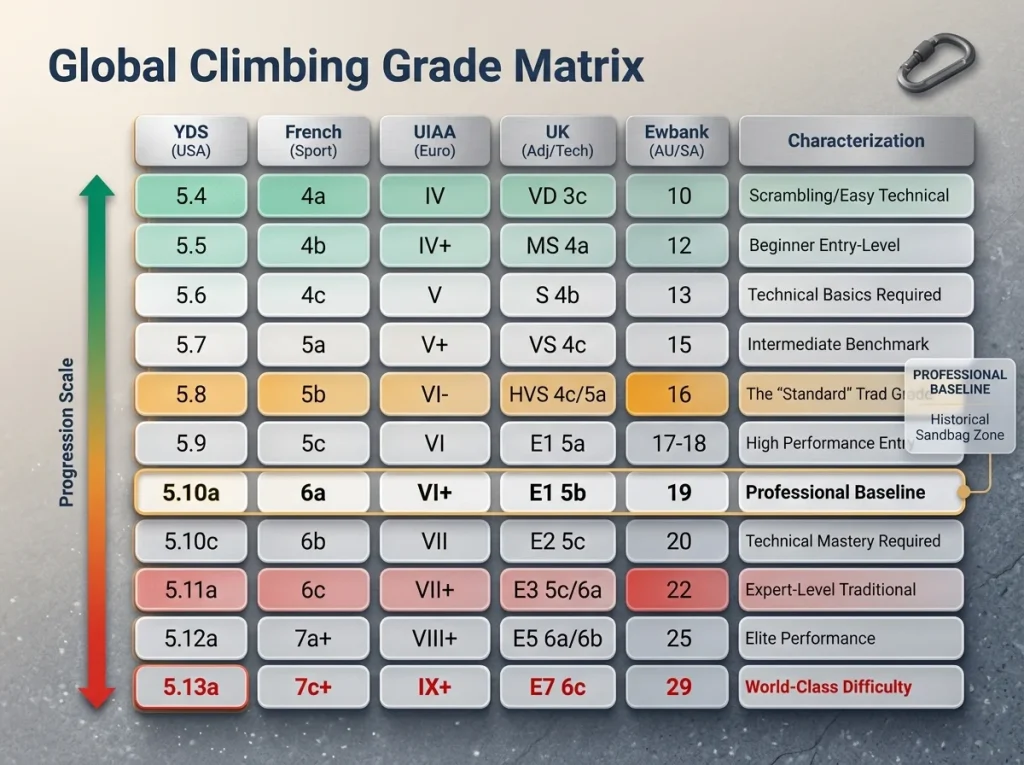
⚡ Quick Answer: No single chart translates perfectly between international grading systems because each measures something different. YDS captures the hardest single move; the British adjectival grade captures the full experience — gear, exposure, fear, and physical demand. Working baseline: 5.10a ≈ E1 5b ≈ French 6a ≈ UIAA VI+ ≈ Ewbank 19. Treat every conversion as an approximation. Always check regional culture, R/X modifiers, and rock type before trusting a number with your life.
The Grade Conversion Chart: Your Full International Matrix
To understand how YDS, French, and UIAA grades are structured, accept one uncomfortable truth: no conversion is exact, because each system measures a different thing. The American Alpine Club international grade comparison chart is the closest thing to a definitive reference — and even they label their columns “approximate equivalents.”
| Rock Climbing Grade Conversion Chart | |||||
|---|---|---|---|---|---|
| YDS (USA) | French (Sport) | UIAA (Euro) | UK (Adj/Tech) | Ewbank (AU/SA) | Characterization |
| 5.4 | 4a | IV | VD 3c | 10 | Scrambling/Easy Technical |
| 5.5 | 4b | IV+ | MS 4a | 12 | Beginner Entry-Level |
| 5.6 | 4c | V | S 4b | 13 | Technical Basics Required |
| 5.7 | 5a | V+ | VS 4c | 15 | Intermediate Benchmark |
| 5.8 | 5b | VI- | HVS 4c/5a | 16 | The “Standard” Trad Grade |
| 5.9 | 5c | VI | E1 5a | 17-18 | High Performance Entry |
| 5.10a | 6a | VI+ | E1 5b | 19 | Professional Baseline |
| 5.10c | 6b | VII | E2 5c | 20 | Technical Mastery Required |
| 5.11a | 6c | VII+ | E3 5c/6a | 22 | Expert-Level Traditional |
| 5.12a | 7a+ | VIII+ | E5 6a/6b | 25 | Elite Performance |
| 5.13a | 7c+ | IX+ | E7 6c | 29 | World-Class Difficulty |
The YDS: Open-Ended by Accident
The Yosemite Decimal System wasn’t born in Yosemite — it started at Tahquitz Rock in Southern California in the 1950s. The “5” in 5.10a means 5th class: terrain where a rope is required for life safety. The scale was originally closed at 5.9, the consensus limit of the human body. When Royal Robbins and Yvon Chouinard blew past it, the scale had to open up. Letter sub-grades (a, b, c, d) were added at 5.10 and above. Below 5.10, you get +/- or nothing.
A 5.10a at Ten Sleep can feel nothing like a 5.10a at Tahquitz. Same number, different planet. Treat the YDS as a regional approximation.
Pro tip: The letter grade is not consistent across crags. Check Mountain Project comments for any new area — regulars will tell you in the first three posts if the grades run stiff or soft.
The French Sport Grade and the UIAA Scale
French sport grades (6a, 6b, 6c, 7a, etc.) measure sustained physical exertion. The hardest move counts, but so does the pump building through every move before it. Half-grades use a “+” modifier — 6a+, 7b+ — to slot between full grades.
Here’s the critical confusion: a UK Technical Grade 6a and a French 6a are not the same thing. The UK 6a describes only the hardest move on a trad line. The French 6a describes the full physical experience on a sport route calibrated to bolt ladders. Confusing them is how gym-to-trad climbers get humbled fast.
The UIAA scale runs Roman numerals I through X+, standardized by the International Union of Alpine Associations in 1967. Grade VI was declared “the absolute limit of the humanly possible” — a ceiling since blown past repeatedly. The UIAA international climbing grade and safety standards now extend to X and beyond. Used predominantly in Germany, Austria, and Switzerland for alpine and multi-pitch terrain, the UIAA sits between YDS and French in granularity.
These systems look compatible on paper. On rock, they argue constantly.
The British Dual-Grade System: Where Safety Becomes a Number
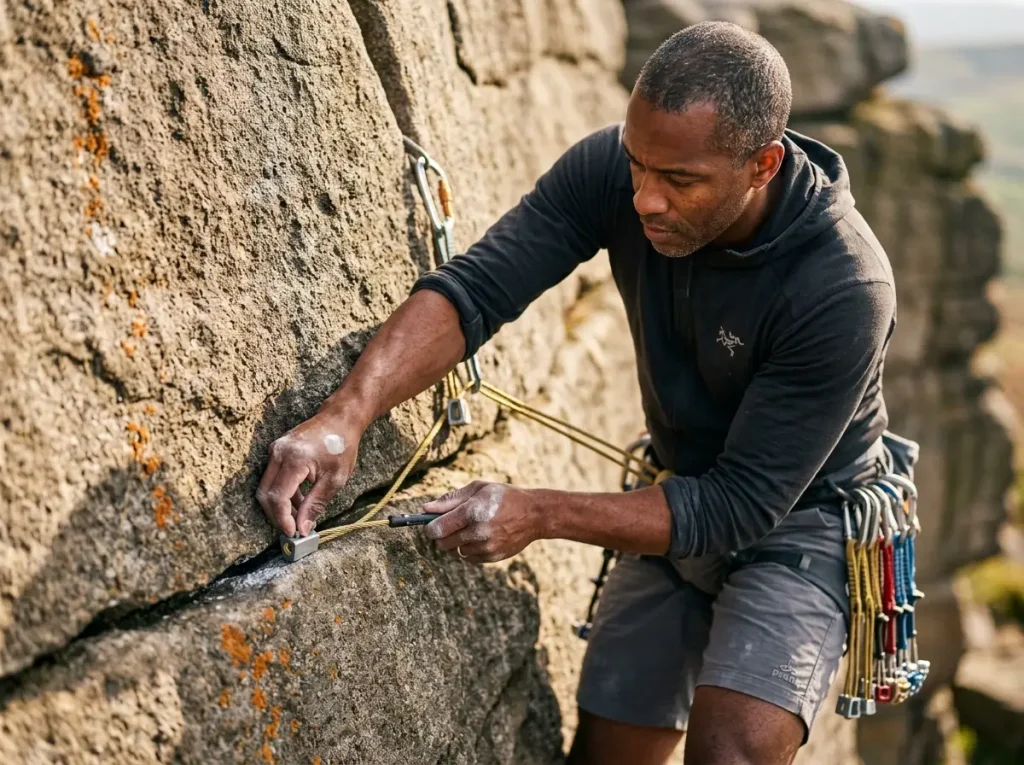
What makes trad climbing fundamentally different from sport isn’t just that you place your own gear. It’s that you make real-time judgments about consequence — and nowhere is that more systematically encoded than in the British dual-grade system. Two independent grades on every route: the adjectival grade and the technical grade. Read them together and you get information no other system provides.
The balanced pairings work like this: VS 4c → HVS 5a → E1 5b → E2 5c. A route matching this pattern is well-protected and consistently graded. When the pairing deviates, the grade stops being information and starts being a warning. Per BMC’s explanation of UK traditional climbing grades: “The technical grade is there to give an indication of the hardest move… irrespective of how many of them there might be, how strenuous it is, or how frightened you are.”
Adjectival Grades: Reading the Route’s Personality
The adjectival grade runs from Moderate through VS, HVS, and then into the open-ended E-grades. HVS is the hinge point — it’s where gear quality and mental composure first become decisive, and it’s where many UK climbers plateau for years.
The E-grade starts at E1 and currently reaches E11, which James Pearson has climbed. Pearson put it plainly: “The idea of the Trad Grade is to give a representation of the whole climb, including overall difficulty, how good the trad climbing gear is (or isn’t) and the hardest single move.” Every grade above E4 implies that a fall may involve a factor approaching 2.0 on the top piece. That is not a footnote. That is the route.
The first time I read an E3 5b pairing, I assumed it was a misprint. The moves felt moderate. What I hadn’t figured out yet was that “moderate” crux difficulty on serious terrain just means you’ll be plenty pumped and scared before you ever get there — the grade is telling you about the route, not just the move.
Technical Grades and Unbalanced Pairings
The technical grade (4a through 7b+) measures one thing only: the hardest single move, stripped of context, exposure, and gear quality. A UK technical 6a crux is roughly equivalent to a V3/V4 bouldering problem — that translation anchor is useful for calibrating pure physical capability against the grade.
The position of that crux matters more than the move itself. A 6a crux at the first clip, backed by bomber wires, is a very different experience from the same 6a move appearing 40 feet above the last marginal placement. Same technical grade. Radically different consequence.
When the adjectival grade is high and the technical grade is low — say, E2 5b — the moves are easier than expected for that E-grade, but the route is still committed. That gap means sustained climbing with sparse gear, or long runouts between placements. The reverse — Low Adj / High Tech, like VS 5a — is the “one-move wonder.” Hard move, excellent protection, clean fall. The community has its own language for this: “stout for the grade” means the adjectival undershoots the quality of placements. “Soft” means the technical level is low relative to the adjectival. Neither is printed in the guidebook. You learn it at the crag.
Pro tip: Identify the crux location before you leave the ground. If it sits at the end of a long runout with thin gear below it, the technical grade is the last thing you should be thinking about.
Understanding this pairing system changes how you read every British route description — and it’s the single most important skill any climber transitioning from YDS or French grades to UK trad will develop.
The Physics Behind the Grade: Fall Factors, kN, and What Actually Breaks
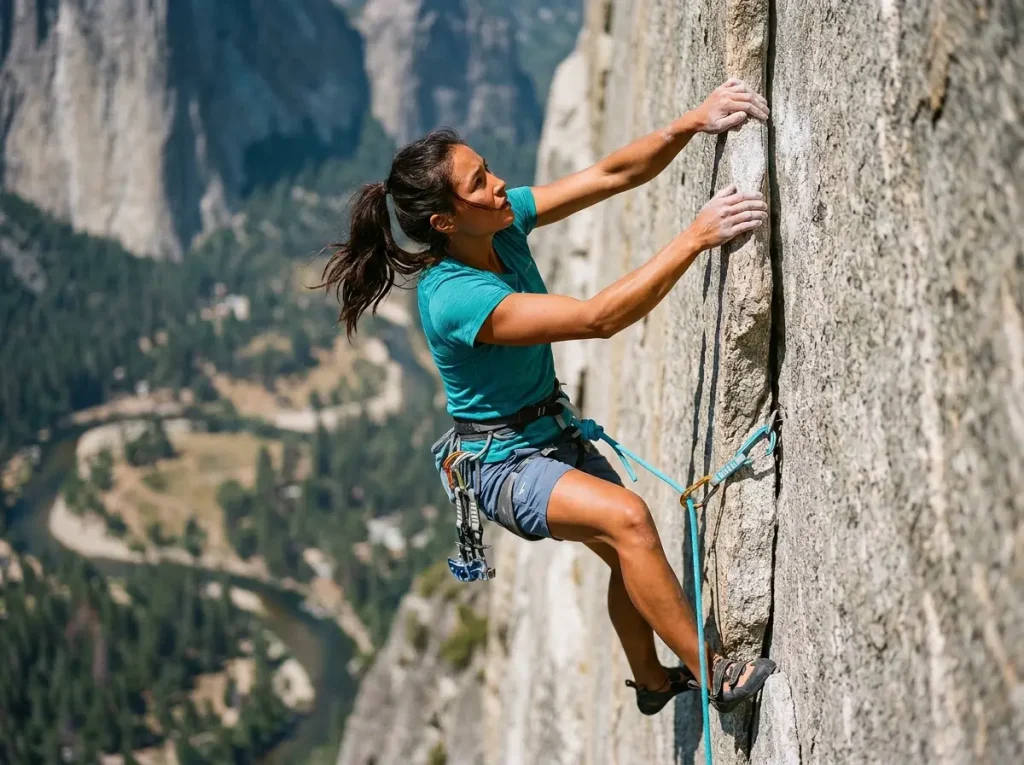
The numbers on the grade chart measure difficulty. They do not measure force. That distinction matters when you’re evaluating whether a route is actually safe to lead.
One kN is roughly 100 kg of force. A static 80 kg climber applies 0.8 kN. The moment they fall, they become a dynamic mass generating kinetic energy. How much that rope can absorb depends on how UIAA safety standards define kN limits and fall ratings — specifically, on fall factor.
Fall Factor = Fall Distance ÷ Rope Length. Maximum theoretical value: 2.0. A factor 0.3 fall generates roughly 2.5 kN on the climber; the top piece takes approximately 4.0 kN due to the Pulley Effect — the rope runs through the top carabiner and back to the belayer, so the anchor absorbs the climber’s load plus the braking force. Most small micro-nuts are rated 2–4 kN. A standard Factor 1.0 fall generates 6.0 kN on the top piece. The math on that is not good news.
R and X Modifiers, and Rope Drag
The American system adds R (Runout — serious injury likely from a fall) and X (Extreme runout — ground fall probable) to YDS grades where protection is absent or inadequate. These modifiers appear most often at old-school sandstone and basalt crags: Desert Southwest slabs, Eldorado Canyon corners, certain Joshua Tree faces.
A 5.10a R is categorically more hazardous than an E1 5b with bomber wires. The technical rating is lower, but the survival margin is smaller. Most conversion charts ignore R and X entirely, which is how climbers get into trouble treating a “safe-looking” grade as a safe route.
Pro tip: On any route listed as R or X in the American database, check Mountain Project comments and local guidebook language before you rack up. The grade is not the story. The gear is.
Here’s the variable no conversion chart prints: rope drag. When rope zig-zags through gear at awkward angles, friction builds up and the section between the belayer and the top piece can’t stretch freely. Effective rope length can drop from 25 meters to as little as 12 on a wandering pitch — effectively doubling the fall factor without the climber adding a foot of runout. Alpine draws reduce rope bend angle and are the primary mechanical fix. On a route described as “airy finish” in the guidebook, that word signals potential runout above the last gear. If your placements were clustered low and the rope is snaking through four pieces at odd angles, the force on that last piece during a fall is significantly higher than the grade number implies.
I learned the rope drag lesson the expensive way — a shallow fall that ripped two pieces because I’d let the rope zig-zag across a wandering crack instead of extending each one. The grade said E1. The gear said otherwise.
The Sandbag Problem: When the Grade Lies
A sandbagged route is one where the assigned grade is significantly easier than the actual difficulty — usually for historical reasons. When the YDS was closed at 5.9 in the 1950s, first ascensionists refused to propose a higher number regardless of what the rock demanded. Routes got stacked at “5.9+” as a catch-all until the scale had to open up.
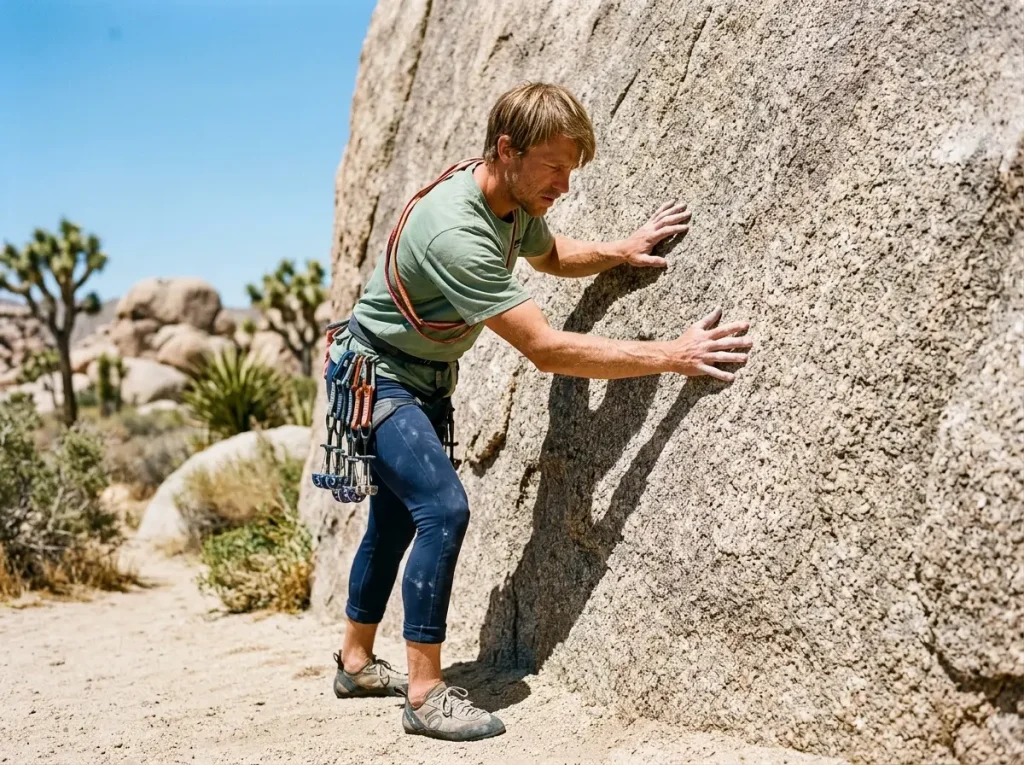
Joshua Tree is the textbook sandbag crag. The movement depends on body tension and precise smearing on high-friction quartz monzonite — what makes Joshua Tree grades notoriously stiff is that friction-dependent difficulty doesn’t translate numerically. You won’t see it in the grade. You’ll feel it underfoot. “Treat every 5.8 with the same respect as a gym 5.10. The old-school friction grades do not care about your feelings.”
Tahquitz in California has 5.9 routes that would carry 5.10c or 5.10d at modern crags. The Gunks demand specific pulling technique for horizontal cracks. On the other side, modern sport areas in Wyoming and Colorado often calibrate generously — the problem arrives when climbers cross over to trad with the same grade expectation but none of the gear-placement or runout experience to back it up.
Rock Type as an Unlisted Grade Modifier
Limestone grades consistently — positive edges, good friction, you get what the number says. Granite varies widely: slabs depend on friction and body tension, crack routes on hand technique, and neither translates cleanly to the other. Sandstone holds larger features but softer rock; formations like Elbe Sandstone in the Saxon climbing tradition ban metal protection entirely, requiring knotted slings. Gritstone in the Peak District feels bombproof when dry and like ice when damp — the entire E-grade culture evolved around its specific friction properties. The AMGA requires guide candidates to lead 5.10a on “various rock types” for precisely this reason. Same number, very different climb.
Before any unfamiliar crag, get beta on 3–5 routes at your comfortable onsight grade. If they feel hard, adjust expectations upward. If they feel soft, treat the harder lines with proportional extra caution.
The Commitment Grade: What the Chart Doesn’t Show
The NCCS Commitment Grade — I through VI — measures something no difficulty chart does: time in the system. Grade I is a few hours. Grade VI is El Capitan. The AMGA requires guide candidates to manage Grade III routes (most of a day), which means professional guides think in terms of time and logistics, not just crux grades. A 5.11a on a 50-meter sport crag and a 5.11a on a 12-pitch Grade V big wall are connected by a number and separated by a chasm — weather, bivouac, water, routefinding in failing light. None of that shows up in the technical grade.
For serious alpinists, use the AMGA Rock Guide program certification standards as a calibration point for professional commitment-grade awareness, then build a structured risk assessment matrix before committing to a multi-pitch objective. The Alaska and Russian Grade systems extend this further — weighting objective hazards like glacial travel, serac fall, and psychological stress in ways the YDS doesn’t touch. According to UIAA mountain safety guidelines, objective hazard assessment is a mandatory component of professional route planning, not an optional add-on.
Pro tip: Before any Grade IV or harder objective, write out the descent. The exit beta is more likely to hurt you than the crux. The route goes up. The rain comes sideways.
When you’ve internalized the commitment grade alongside the technical difficulty, the conversion chart becomes a starting point, not an answer.
Conclusion
Three things worth carrying with you:
First, a grade is a language, not a measurement. The YDS measures the hardest move. The British system measures the full experience — moves, gear, exposure, and psychological commitment. Converting between them requires understanding what each system is actually saying, not just matching numbers.
Second, the physics don’t care about the grade. A 5.10a R with a fall factor approaching 2.0 will load your micro-nuts beyond their rated capacity regardless of how moderate the number looks. kN awareness isn’t optional for trad climbing.
Third, regional variance and commitment grades complete the picture. If you don’t know whether a crag runs stiff or soft, and if you haven’t assessed the NCCS grade alongside the technical difficulty, you have half the information.
Take the matrix. Check the regional reputation, the R/X modifier if it’s American, the adjectival/technical pairing if it’s British, the commitment grade if it’s multi-pitch, and the rock-type ecology before you leave the trailhead. That is how pros use a conversion chart.
FAQ
What is a 5.10 in British trad grades?
A 5.10a roughly translates to E1 5b in the British system — assuming balanced protection and a consistent pairing. Sparse gear or sustained difficulty could push the adjectival grade to E2 or E3 even with the same crux, making the route significantly more serious than the number implies.
How do UK climbing grades work?
UK trad grades use two independent numbers: an adjectival grade (Moderate through E11) covering overall seriousness — gear quality, exposure, and psychological commitment — and a technical grade (4a through 7b+) covering only the hardest single move. Read both together and you know whether a route is safe but physically hard or easy moves with a serious fall.
Is trad climbing harder than sport climbing at the same grade?
Not harder in terms of movement — the physical crux translates reasonably well. Trad is harder systemically: you place your own gear, manage rope drag, and make real-time decisions under exposure that sport climbing eliminates. Same demands on your fingers. Very different demands on everything else.
What does E1 mean in climbing?
E1 is the first level of the British Extreme grades, running from E1 to E11+. Accessible to experienced trad climbers, it pairs with Technical Grade 5b at the balanced standard. A fall has real consequences — not necessarily unsurvivable, but it demands competent gear placement and composure.
What does an R or X rating mean in climbing grades?
R (Runout) and X (Extreme runout) flag YDS grades where protection is inadequate. R means a fall will likely cause serious injury; X means a ground fall is probable. Most conversion charts omit these entirely — which is why a 5.10a R is often more hazardous than an E1 5b with solid placements.
Safety Notice: Rock climbing and mountaineering are inherently high-risk
activities that can involve physical trauma or fatal incidents. The information on Rock Climbing Realms is for
educational and informational purposes only. Techniques and advice presented here are not a substitute
for professional, hands-on instruction. Conditions and risks vary by location. Always seek guidance
from a qualified instructor before attempting new techniques. By using this website, you agree that you
are solely responsible for your own safety. Any reliance you place on this information is strictly
at your own risk, and you assume all liability for your actions. Rock Climbing Realms and its authors
will not be held liable for any harm, damage, or loss sustained in connection with the use of this information.
Affiliate Disclosure: We are a participant in the Amazon Services LLC Associates Program, an
affiliate advertising program designed to provide a means for us to earn advertising fees by advertising and linking
to Amazon.com. As an Amazon Associate, we earn from qualifying purchases. We are also an official affiliate partner
of Black Diamond Equipment via the AvantLink network. If you click on a Black Diamond affiliate link and make a
purchase, we may earn a commission at no additional cost to you. We also participate in other affiliate programs.
Additional terms are found in the terms of service.