
In this article
Ask ten people to name the hardest mountain on Earth and nine will say Everest. They are picturing the highest mountain and quietly assuming that highest must mean hardest. It does not, and the climbers who do this for a living never rank them that way.
Among mountaineers, the most difficult mountain to climb splits into two separate questions: which peak you are least likely to walk away from, and which one demands the most actual climbing skill. This guide settles that argument, then does what the ranked listicles skip, explaining what makes a mountain hard in the sport’s own language and scaling those ideas down to peaks a strong amateur could realistically train toward.
Why the “Hardest” Mountain Isn’t One Number
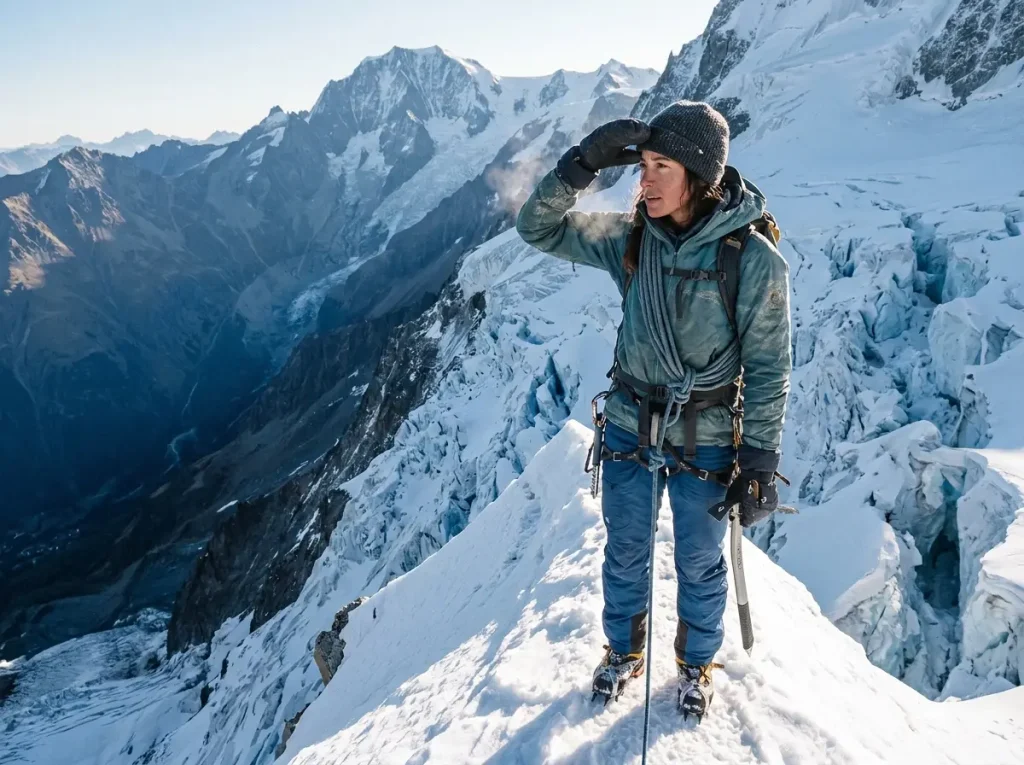
Get two climbers arguing about the hardest mountain to climb and the conversation usually stalls inside a minute, because they are answering different questions. One of them means the peak you are least likely to walk away from. The other means the peak with the climbing that is hardest to actually pull off. Those are not the same mountain, and pretending they are is how every version of this argument goes in circles.
Before you can crown anything, you have to pin down which kind of hard you are measuring. There are really three, and they point at three different summits.
Most Fatal, Most Technical, or Just Highest
The first axis is fatality rate, usually expressed as a fatality-to-summit ratio: out of everyone who has stood on top, how many never made it back. By that measure Annapurna I leads, and it is not especially close.
The second axis is technical difficulty, which is about the climbing itself, how steep, how sustained, how much hard rock and ice you have to solve. That title goes to K2. The third axis is raw elevation, and that is Everest’s alone at 8,849 meters.
Almost every ranked list online quietly blends these three into one number and then argues about the result. Keep them separate and the picture snaps into focus. A peak can top one axis and sit mid-pack on the others, which is exactly what happens here.
Objective Hazard vs Technical Difficulty
There is a distinction underneath all of this that separates climbers who have spent real time in the mountains from those who have only read about them: objective hazard versus technical difficulty. Objective hazard is the kind of risk you cannot train away, an avalanche releasing above you, a serac calving, a rock coming down the gully. You can do everything right and still be in the wrong place at the wrong second. Technical difficulty is the opposite; it is the part you can answer with skill, fitness, and good footwork.
This matters because the most fatal mountains are not always the ones with the hardest moves. Some peaks take their toll through hazard and bad luck, others through sheer climbing difficulty, and a few through both. Lump them together and you will never understand why the answer keeps changing depending on who you ask.
Where Everest Actually Fits (the Highest, Not the Hardest)
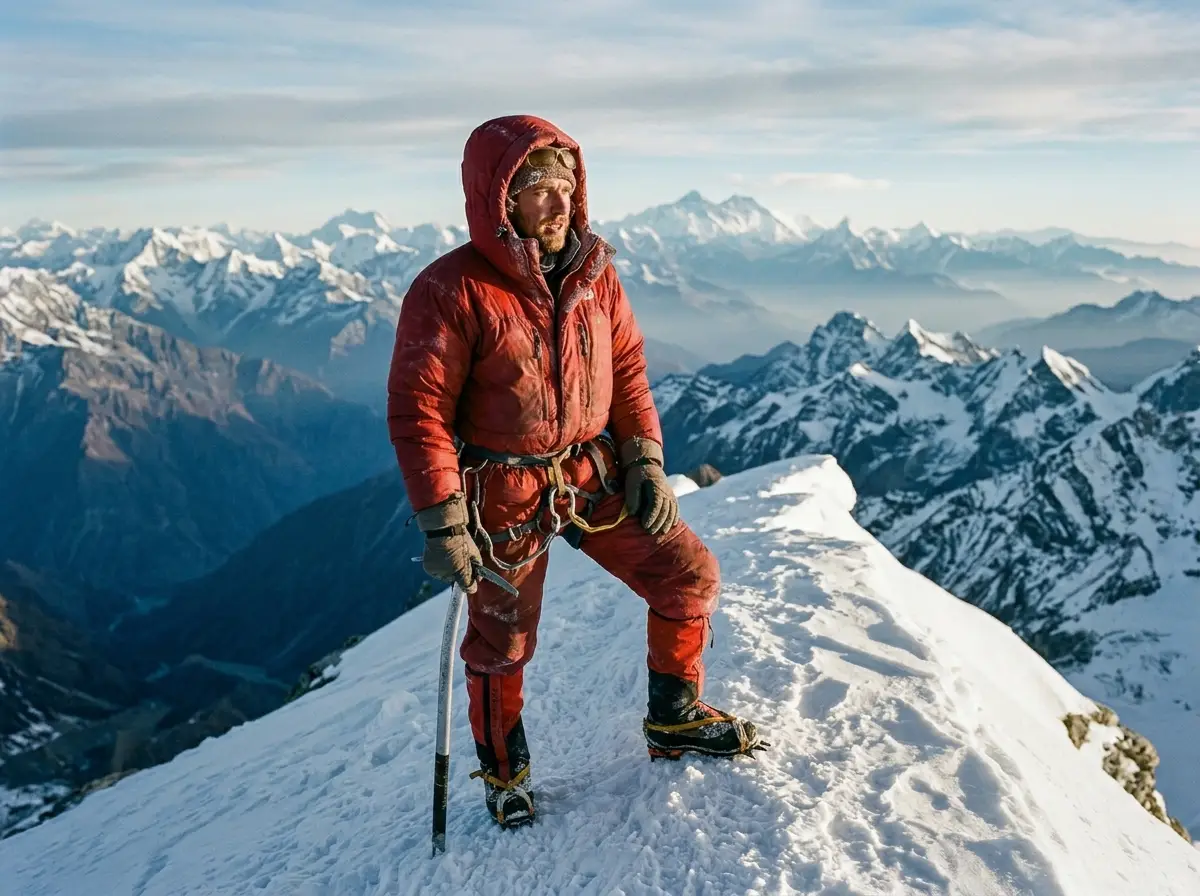
Mount Everest is the highest point on the planet, and that height is a genuine problem. Its core challenge is altitude, not the climbing. The standard routes are largely a long, brutally cold walk through thin air with a few fixed sections, which is precisely why guided clients with limited technical experience can reach the summit in a good season. Take nothing away from the suffering involved; just understand what kind of suffering it is.
The real obstacle up there is the lethal band of altitude above 8,000 meters, where the air no longer holds enough oxygen to keep you alive for long. Above that line your acclimatization stops working, altitude sickness and frostbite turn into constant threats, your judgment frays, and every extra hour costs you. That is an altitude problem and a logistics problem, not a measure of how hard the climbing is. If you want the full picture of what that expedition actually involves, what an Everest expedition actually demands is a different kind of hard from what comes next.
K2 the Savage Mountain
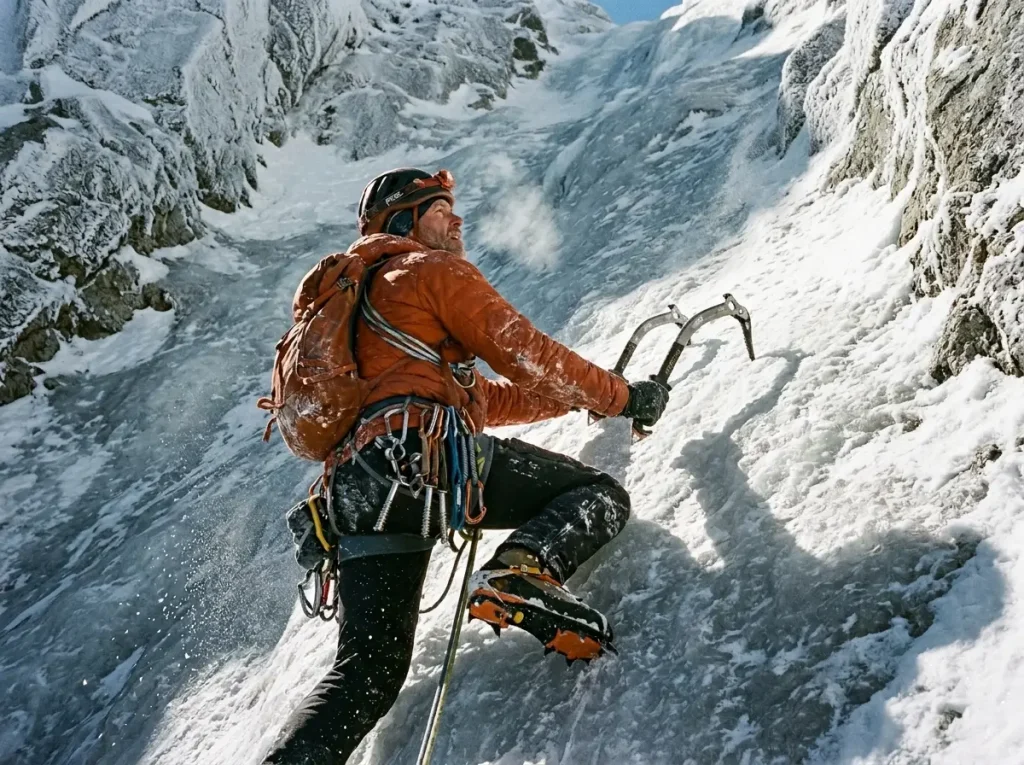
If technical difficulty is the question, K2 is the answer, and most serious alpinists will give it without hesitating. At 8,611 meters, this Karakoram giant is the second-highest mountain on Earth, but it climbs nothing like the highest. Everest lets you recover; K2 never does. That single difference is most of the case for calling it the most difficult mountain to climb in pure climbing terms.
The Mountain With No Rest
From Advanced Base Camp to the summit, K2 holds a sustained slope of roughly 45 to 80 degrees with no real flat section anywhere on the route. There is nowhere to stand up straight, drop your pack, and breathe. On Everest you get the long plod across the South Col; on K2 you are climbing genuinely steep ground the entire way, at an altitude where your engine is already starving.
That relentlessness is what separates it from a peak like the Matterhorn, where the difficulty comes in concentrated pitches with stances between them. On K2 the difficulty just never switches off. If you want a sense of sustained technical ground on a scale you could actually visit, a classic technical alpine peak like the Matterhorn is the readable version of the same idea, only thousands of meters lower and with somewhere to rest.
The Bottleneck and the Serac
Then there is the Bottleneck, the single most feared stretch in high-altitude climbing. It is a couloir of roughly 50 to 60 degrees sitting directly under a hanging serac, a cliff of glacial ice perched about 100 meters above the climbing line. Climbers are exposed to it for hours, and there is no skillful way through.
You cannot out-climb a block of ice the size of a building deciding to let go. You move fast, you keep your eyes up, and you accept the odds. That is objective hazard in its purest form, layered on top of climbing that is already at the edge of what is possible that high.
When someone calls a peak hard, ask whether they mean the climbing or the hazard. A mountain can be technically straightforward and still have a fearsome reputation purely because of what hangs over the route. Those are two different problems, and only one of them gets easier as you get better.
Why It Earned “the Savage Mountain”
The nickname is older than most of the modern attempts. After the 1953 American expedition fought its way off the mountain in a storm, climber George Bell summed it up in the line that stuck: he called K2 a savage mountain. The name fit and never left.
Decades of steep ground, brutal weather windows that slam shut in hours, and that serac over the Bottleneck have only confirmed it. The footage below, from Alan Arnette, who summited K2 and is one of the most reliable voices on 8,000-meter climbing, shows the sustained steepness and the Bottleneck better than any paragraph can.
Why Annapurna Tops the Fatality List
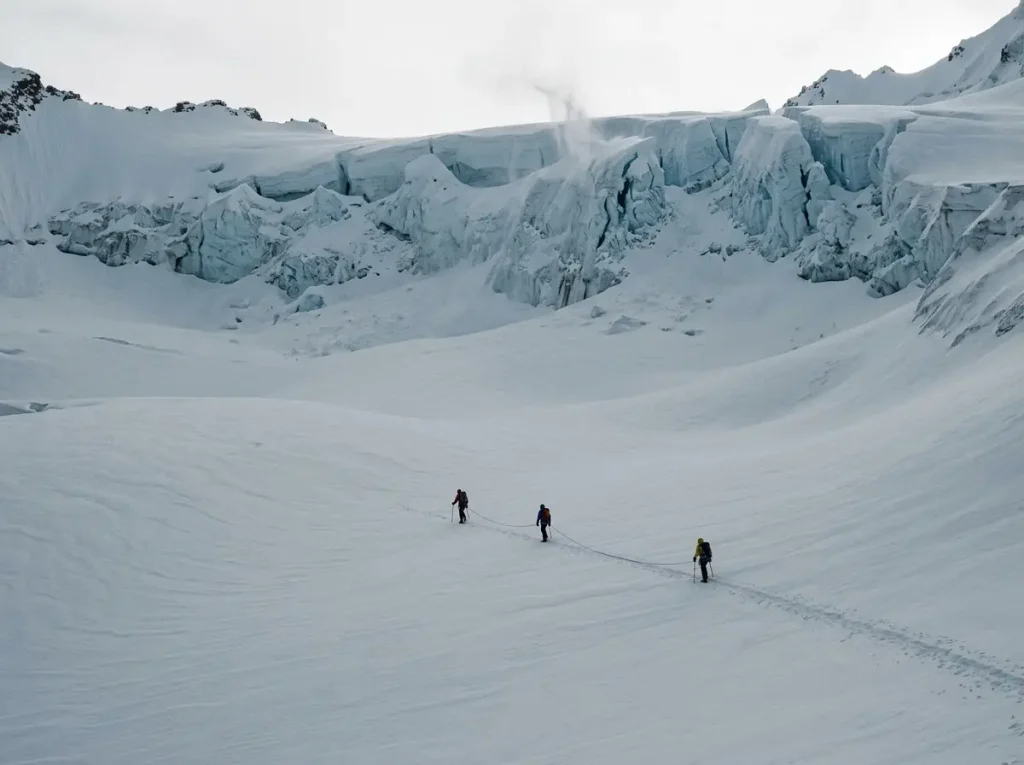
Here is where the listicles get sloppy. They reach for K2 when the question is which mountain is most likely to take your life, and the data does not back them up. By the numbers, Annapurna I has long held the highest fatality-to-summit ratio of any 8,000-meter peak. That is a different crown from K2’s, and it belongs to a different mountain for a clear reason.
What the Fatality Ratio Actually Says
Over the long historical record, Annapurna has run close to one fatality for every three people who reached the summit. Sit with that ratio for a second. It is not a measure of how hard the moves are; the standard line on Annapurna is not as technically vicious as K2’s. It is a measure of how often the mountain itself decides the outcome regardless of how well you climb.
The reason is what the slopes do, not what they ask of your hands and feet. Annapurna is loaded with avalanche terrain, hanging glaciers, and weather that turns without much warning. The hazard is spread across the whole route rather than concentrated in one named crux. You are exposed to it for the entire climb.
Avalanche Terrain and Objective Hazard
This is objective hazard at scale. An avalanche slope does not care that you placed perfect protection or that your fitness is dialed. The same storm that would be an inconvenience lower down becomes a slab release at altitude.
On Annapurna, the toll comes from the accumulation of risk, the slow math of spending days under terrain that can let go at any time. Skill lowers your odds; it does not zero them out.
That is also why Annapurna gets less attention than K2 from people who only read about climbing. There is no single iconic pitch to point at, no Bottleneck to photograph. The hazard is diffuse, which makes it easy to underrate and exactly as serious.
Why the Highest Fatality Rate Isn’t the Hardest Climbing
So Annapurna and K2 split the honors cleanly. K2 is harder to climb; Annapurna is more likely to cost you everything. One asks more of your skill, the other exposes you to more you cannot control. Understanding that split is the whole point, because it reframes how you read every ranking you will ever see on this topic.
It also changes how a smart climber makes decisions on a hazard-heavy peak. When the hazard is objective rather than technical, the most important skill is not footwork; it is knowing when to turn around before the mountain makes the choice for you.
How to Read Fatality Stats Without Being Misled
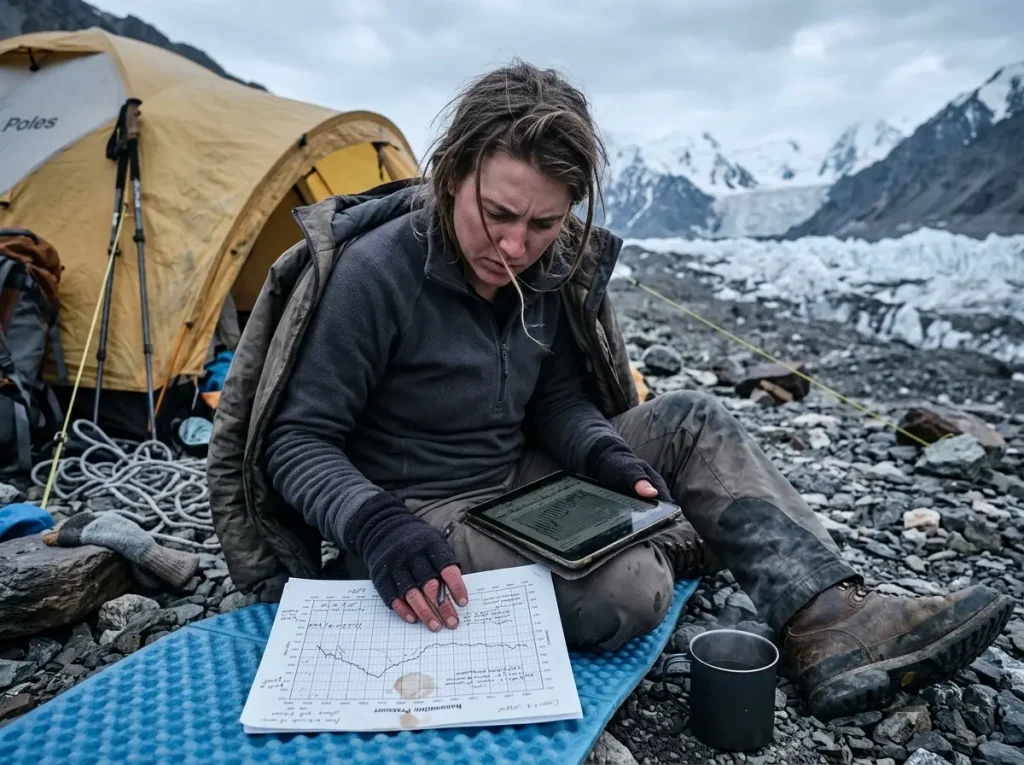
If you go looking for Annapurna’s fatality rate right now, you will find it quoted as 32 percent, 27 percent, and 13 percent on three different pages, all presented as fact. None of them is lying, exactly. They are measuring different things and not telling you which. This is the part no competitor explains, and it will change how you read every number on this subject.
Why the Same Mountain Shows 13%, 27%, and 32%
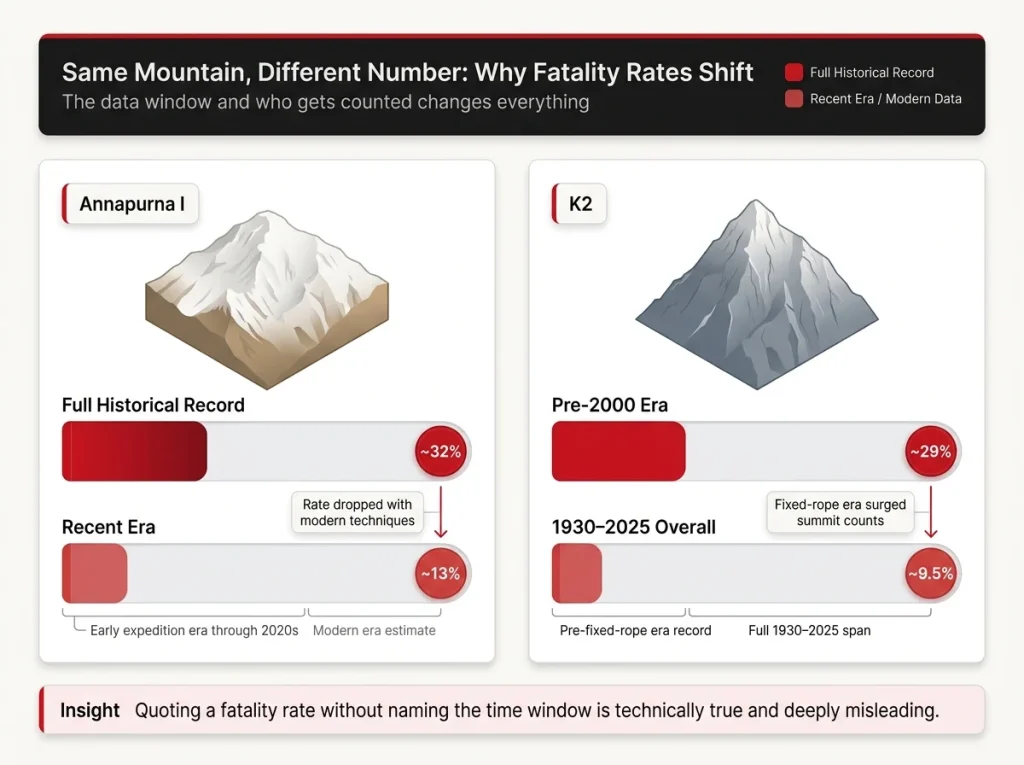
A fatality rate is not a single fixed property of a mountain. It is a fraction, and both the top and the bottom of that fraction move depending on the years you include. Annapurna reads around 32 percent across its full historical record, stretching back to the early expedition era when almost nothing about high-altitude climbing was understood. Limit the data to the recent era, with fixed ropes, modern forecasting, and better gear, and the same mountain comes in closer to 13 percent.
Neither figure is wrong. The 32 percent is the honest long-record number; the 13 percent is the honest modern one. Quote either without saying which window you used and you have technically told the truth while leaving a completely false impression.
Before you trust any mountain fatality percentage, ask two questions: over what years, and who got counted. A number without a time window and a clear definition of who is included is a vibe, not a statistic. The honest sources always tell you both.
Who Gets Counted (Porters, Sherpas, and the Data Window)
The other half of the fraction is who counts as a climber. Some tallies include the high-altitude workers, porters and Sherpas, who fix the ropes and carry the loads and are exposed to the same hazards more often than the clients are. Other tallies quietly leave them out. That single choice can swing a mountain’s rate noticeably, and it is rarely stated on the page.
K2 is the cleanest example of how much the window matters. Across the full span from 1930 to 2025, its overall rate sits near 9.5 percent, which sounds almost reasonable.
But before the year 2000 it was running close to 29 percent, the same league as Annapurna. A surge of summits in the fixed-rope era since then dragged the long-run average down. The low modern number hides how lethal the mountain was for most of its history.
The Modern Fixed-Rope Era (Why Old Numbers Overstate Today’s Risk)
The flip side is that quoting only the brutal historical figure overstates the risk a well-supported climber faces today. Fixed ropes through the hard sections, reliable weather forecasting, and far better equipment have genuinely lowered the odds on the commercial routes. Everest sits in the 1 to 3 percent range now for exactly these reasons, which is another reminder that it is the highest peak and nowhere near the hardest.
Decoding “Technical” the Way Climbers Actually Do
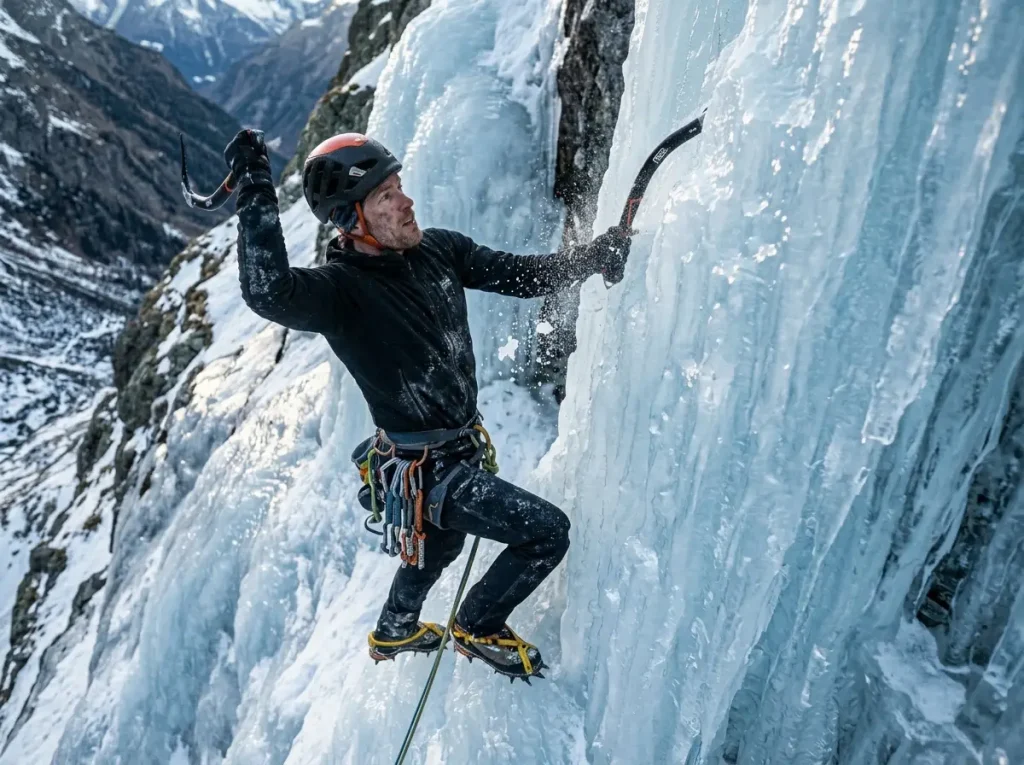
Up to now we have been using the word technical as if it were self-explanatory. It is not, and the fact that the ranked lists never define it is their biggest blind spot. Climbers have a precise language for difficulty, several languages actually, and once you can read them, hard stops being a feeling and becomes something you can look up. This is the section that turns you from someone arguing about mountains into someone who understands them.
The Alpine Scale (F to ED, the All-In Difficulty Grade)
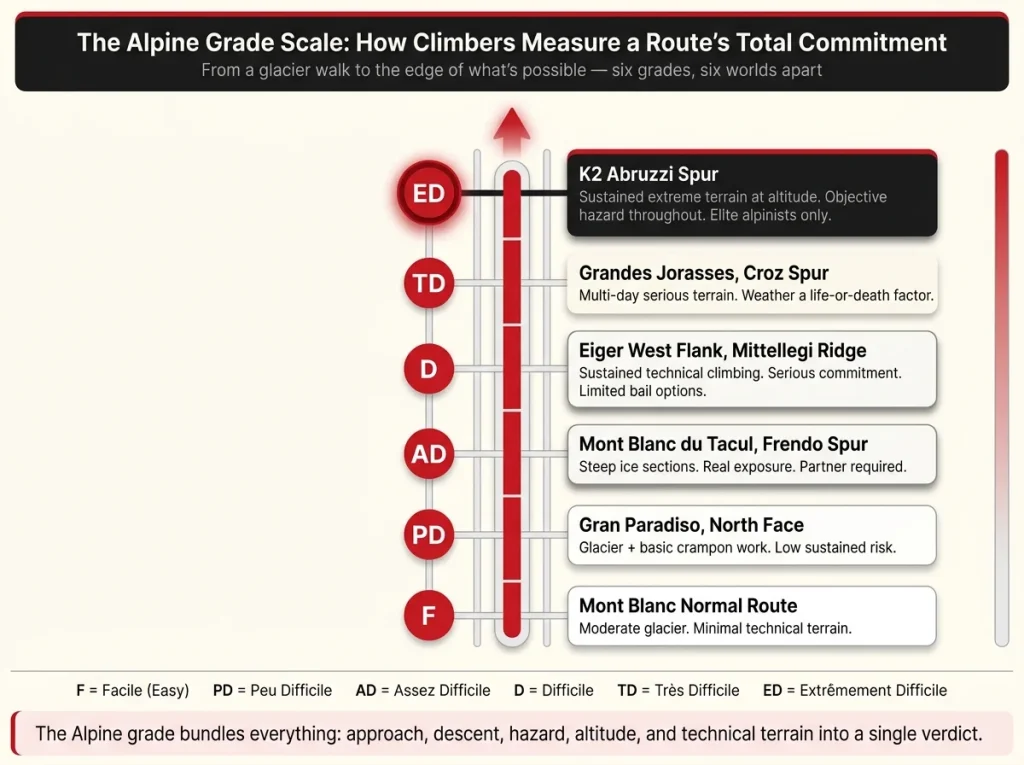
The overall Alpine grade runs F, then PD, AD, D, TD, and ED, short for Facile through Extrêmement Difficile. The key thing most people miss is that this scale is not just about steepness. It bundles the whole package: the approach, the descent, the objective hazard, the altitude, and the technical climbing all roll into one grade. An ED route is not just steep; it is serious in every dimension at once.
That is why a single Alpine grade tells an experienced climber so much. It is a summary of how committing the whole undertaking is, not a rating of the crux move. If you want the precise definitions, the alpine difficulty grade scale climbers actually use lays out exactly what each step covers.
Commitment Grades (I to VII, How Long You’re Committed)
Then there are the commitment grades, the NCCS system that runs with Roman numerals from I to VII. This one measures time and consequence: a Grade I might be an hour or two, while a Grade VII means weeks on the mountain with no easy way to bail. This is the axis altitude-only peaks lack. A trade route up a big peak can be long but escapable; a Grade VII face commits you to days or weeks where retreat is its own serious problem.
Commitment is the dimension that armchair rankings completely miss. It is not how hard one move is; it is how long the mountain holds you and how badly things go if you need to get off in a hurry.
Ice, Rock, and Mixed (WI, YDS, Different Scales for Different Ground)
Finally, the specific terrain gets its own scales. Ice climbing uses WI grades, water ice from WI1 up through the genuinely extreme. Rock in the United States uses the Yosemite Decimal System, the familiar 5.6, 5.10, 5.13 progression for technical rock, while much of Europe rates the same stone on the UIAA grade scale. Mixed rock-and-ice ground has its own M grades.
Each scale measures a different kind of difficulty, which is the entire reason there is more than one.
This is why a short, vertical, sea-level wall can carry a harder technical grade than a Himalayan trade route. The wall is pure climbing difficulty; the big peak is altitude, hazard, and commitment. Different scales, different currencies, not directly convertible. If you want to get in the habit of checking these before you commit to anything, how to research a route’s difficulty rating before you go is a skill worth building early.
Same Mountain, Different Beast
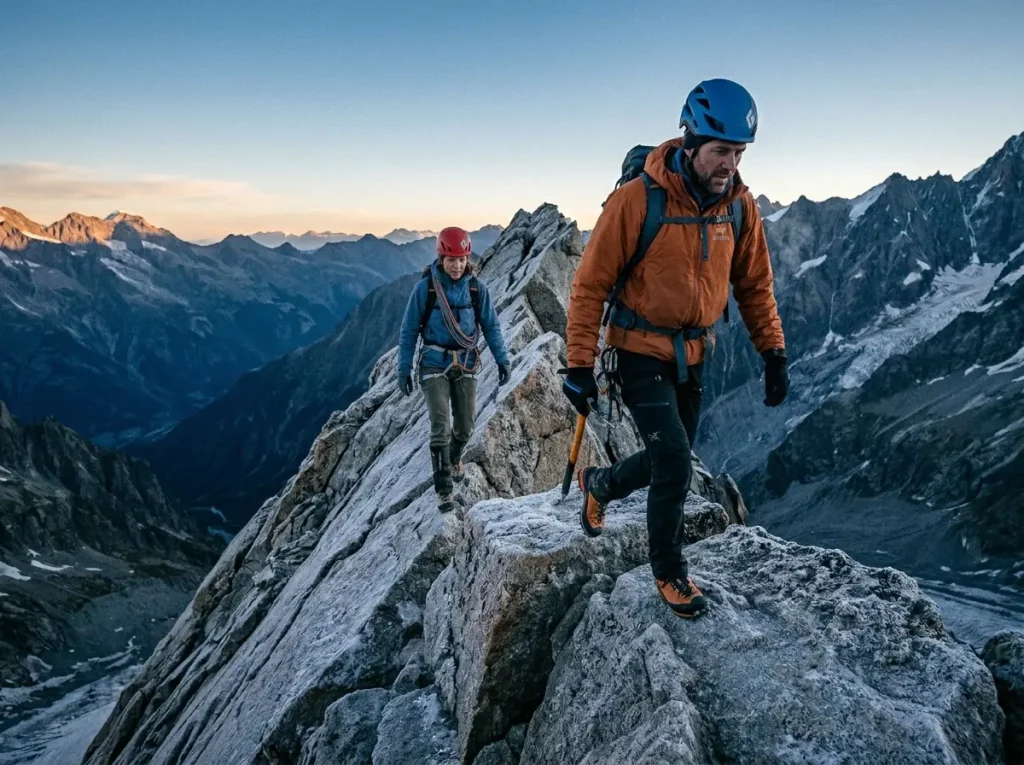
Here is the twist that breaks every simple ranking: the mountain is only half of the difficulty. The other half is how you choose to climb it. Two people can both say they summited K2 and have done two completely different things. Naming the peak is not enough; you have to name the style and the line.
Alpine Style vs Siege Style
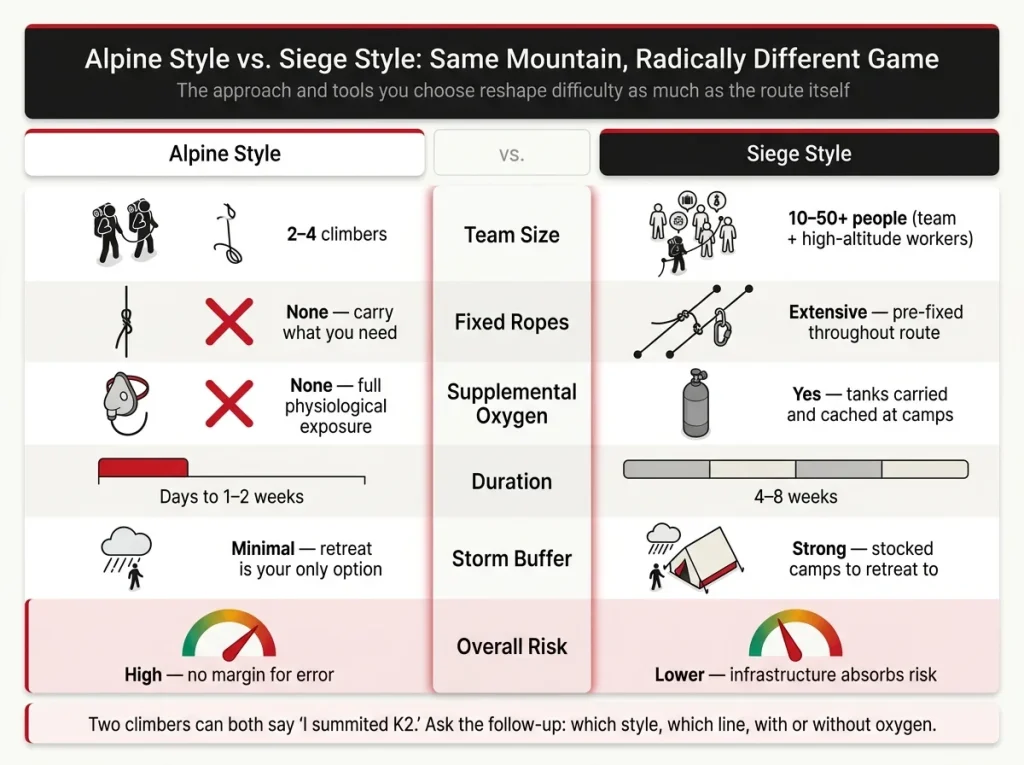
The two ends of the spectrum are alpine style and siege style, sometimes called expedition style. Siege style is the big-machine approach: stocked camps, fixed ropes, ladders over the worst sections, supplemental oxygen, porters carrying loads, and weeks of buildup. It is slower and far safer, with a storm buffer built in because you can retreat to a stocked camp.
Alpine style is the opposite philosophy. A small team carries everything it needs and climbs the route in a single push, no fixed ropes, no preplaced camps, no oxygen. It is faster and far more committing; if a storm traps you high, there is no stocked tent waiting below. Same mountain, radically different difficulty.
A peak that is only serious in siege style can be at the absolute limit in alpine style. For a taste of what fast-and-light commitment looks like on terrain you can actually study, a fast-and-light objective like Mount Robson’s Emperor Face is alpine-style thinking made visible.
With and Without Oxygen (the Altitude Variable)
The biggest single variable in that choice is supplemental oxygen. Climbing an 8,000er without it is not a slightly harder version of the same climb; it is a different physiological event. Bottled oxygen effectively lowers the altitude your system experiences by thousands of feet. Strip it away and the thin-air zone above 8,000 meters hits with full force, your pace collapses, and your margin for any mistake shrinks toward nothing.
This is why purists draw such a sharp line. A summit with oxygen and a summit without it are not the same achievement, because they were not the same difficulty. The mountain did not change; the rules the climber accepted did.
When two climbers compare summits of the same peak, the honest question is never just whether they topped out. Ask how: which line, alpine or siege style, with or without oxygen. Those answers separate two ascents that look identical on paper and were worlds apart on the mountain.
Trade Route vs First-Ascent Face
The line matters as much as the style. Every famous peak has a trade route, the standard, most-traveled way up, and that line is usually a fraction of the difficulty of a hard new face on the very same mountain. The handful of climbers who have done all fourteen eight-thousanders without bottled oxygen, the bar Reinhold Messner set when he became the first to climb them all, were playing a different sport from the guided clients on the trade routes, even when the summit was identical. So when someone names a mountain as the hardest, the first honest question back is always: by which route, and in what style.
The Other Mountains in the Conversation
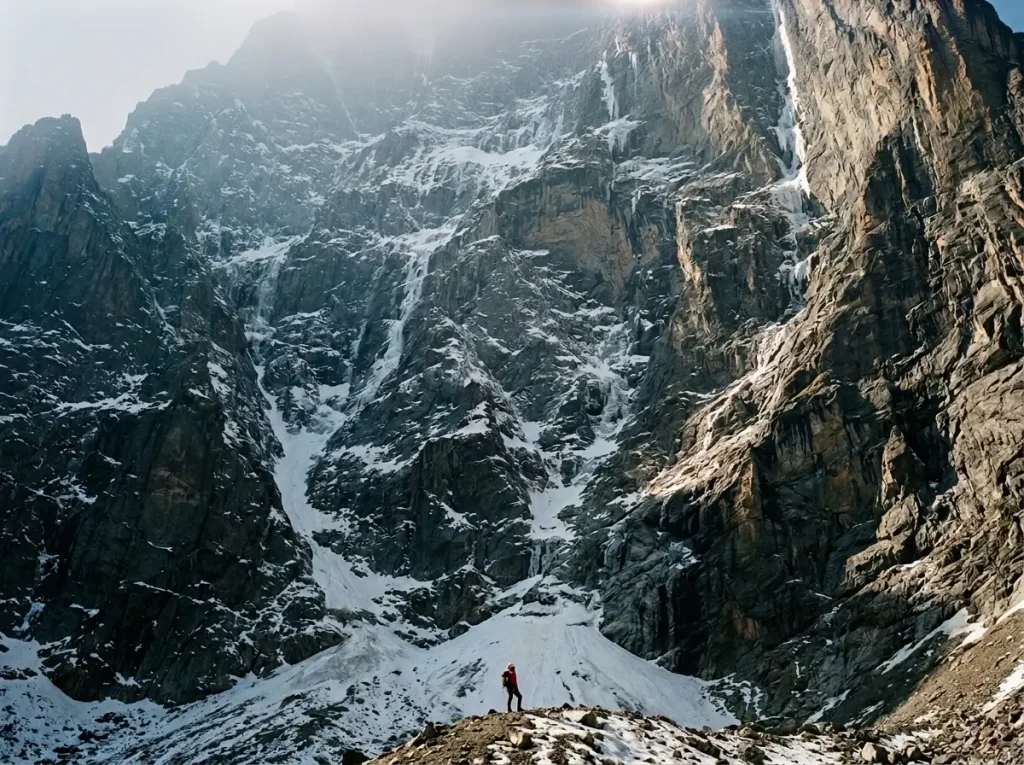
Once you can read difficulty properly, the rest of the field makes sense. K2 and Annapurna take the headline crowns, but several other peaks belong in any serious version of this conversation, and one of them is hardest of all for a reason that has nothing to do with climbing.
Nanga Parbat and the Rupal Face
Nanga Parbat in Pakistan earned its fearsome reputation early, when one expedition after another was turned back with heavy losses in the first decades anyone tried it. Its showpiece is the Rupal Face, which rises roughly 4,600 meters, about 15,090 feet, from base to summit. That is the highest mountain wall on Earth, a single sweep of climbing taller than many entire mountains.
The Messner brothers made the first ascent of it in 1970, and decades later it has seen only a handful of complete repeats, which is the clearest measure of hard there is: how few people have ever pulled it off. For the full history, the American Alpine Club’s account of the Rupal Face is the authoritative record.
The Technical Legends Below 8,000 m
Not every contender is an 8,000er. The Eiger’s North Face in the Alps, with its rockfall and its grim history, made its name as a test of nerve and mixed climbing. Cerro Torre in Patagonia is a fang of granite plastered in rime ice and lashed by some of the worst weather on the planet, technically harder than anything on a Himalayan trade route.
Back in the Karakoram, the granite spires of the Trango Towers and Baintha Brakk, the peak climbers know as the Ogre, rank among the hardest big-wall climbing objectives anywhere, altitude aside. Kangchenjunga, the third-highest peak, adds extreme remoteness to serious climbing.
These mountains prove the central point one more time: hardest to climb and highest are simply not the same list. A serious technical peak does not need to be the tallest to outclimb the giants. Even outside the Himalaya, a serious non-Himalayan technical peak like Huascarán in Peru carries real objective hazard and demands real skill.
The Mountain You’re Not Allowed to Climb
Then there is the twist ending. The genuinely unclimbable peak is not unclimbable because of its difficulty. Gangkhar Puensum, the highest unclimbed peak on Earth at 7,570 meters, sits on the border of Bhutan, which has banned all mountaineering since 2003 out of respect for local beliefs that the high peaks are sacred, and partly because the remote terrain offers almost no rescue access if an attempt goes wrong. People could attempt it; they are simply not permitted to.
Some mountains stay hardest of all because the answer is no.
What This Means If You Actually Climb
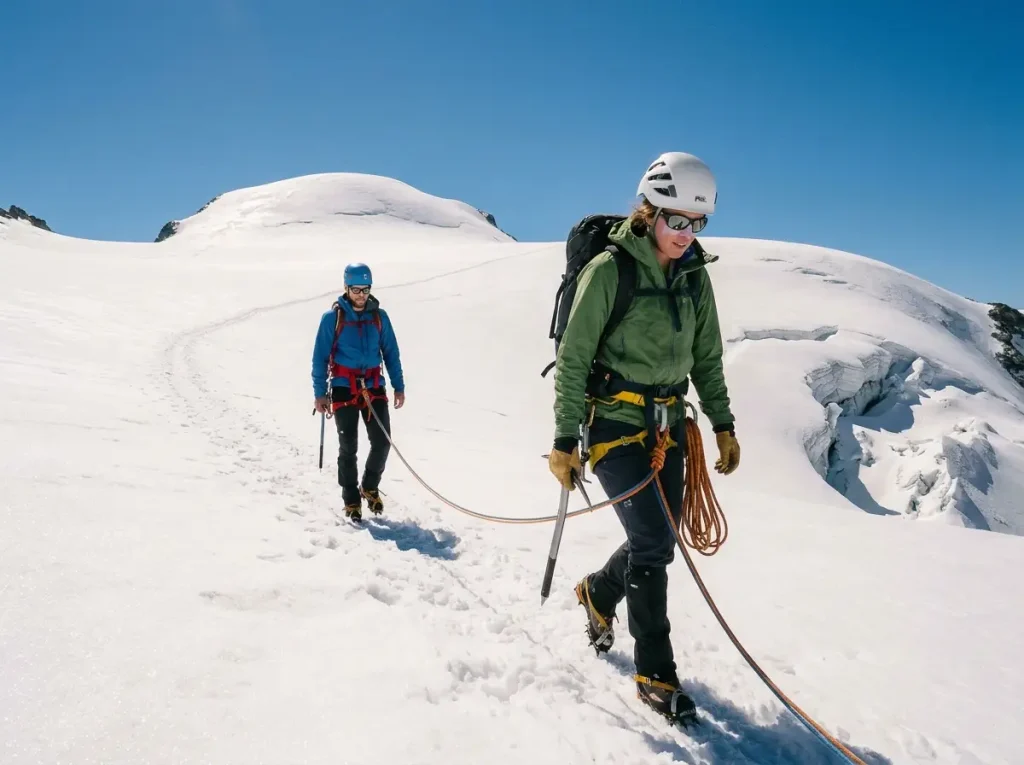
None of this is much use if it stays a bar argument about peaks you will never see. The real payoff is that the same ingredients that make K2 and Annapurna so hard live on mountains a fit, committed amateur can actually train toward. Learn to read them on a small peak and you are reading the same language the giants speak.
The Four Ingredients That Scale
Strip the 8,000ers down and the difficulty comes from four things: mixed terrain, weather windows, objective hazard, and commitment. Every one of those scales down. A modest glaciated peak has crevasses, changing weather, and real consequences, just at a level where a mistake is survivable and a lesson instead of the end. Master reading those four ingredients low, and you are building the exact judgment the big peaks demand, on terrain that forgives you.
Mount Rainier, the Training Ground
Mount Rainier at 14,410 feet is the classic American proving ground for bigger objectives, the standard feeder for Denali, Aconcagua, and eventually the Himalayas. It has everything the big peaks have in miniature: glacier travel, crevasse hazard, real altitude, and the endurance grind of a long summit day. It is hard enough to teach you and attainable enough to actually attempt. A guided or well-prepared summer climb on Mount Rainier is where a lot of serious mountaineering careers genuinely start.
The Grand Teton, Real Exposure and Attainable
If your interest leans toward technical rock rather than glaciers, the Grand Teton is the benchmark. Its classic route involves low-grade technical rock, around 5.5 to 5.6, with big, serious exposure underneath you. For a fit amateur it is often the hardest thing they have ever done, and it demands real rock skill and genuine composure with air under your heels, without requiring a Himalayan permit or a month of your life. Our full Grand Teton climbing guide walks through what that route actually asks of you and how to build toward it.
Do not start on a glacier you cannot read. Spend a season learning ice axe self-arrest, crampon technique, and rope-team travel on low-angle snow before you trust your life to any of it on a serious peak. The big mountains reward the people who got bored doing the basics first.
Conclusion
There is no single most difficult mountain to climb, and anyone who hands you one answer is flattening a question with three real answers. Annapurna carries the highest fatality rate, K2 is the most technically demanding, and Everest is the highest while being neither the hardest nor the most fatal. Once you can separate those axes, the endless rankings stop contradicting each other and start making sense.
The deeper lesson is that difficulty is a language, not a vibe. The grades, the styles, the line, and the objective hazard all carry specific meaning, and reading them honestly is what separates understanding a mountain from just fearing it. Pick an attainable objective, learn to read its grade and its hazards the way this article reads the giants, and build from there. The big peaks will still be there; the whole point is to come back from the ones you choose.
Frequently Asked Questions
01What is the hardest mountain to climb in the world?
K2 is the usual answer for the hardest mountain to climb in pure technical terms, while Annapurna I carries the highest fatality rate. It comes down to the metric: climbing difficulty points to K2, fatality odds point to Annapurna.
02Is K2 or Annapurna harder to climb?
They are hard in different ways. K2 is more technically difficult, with sustained steep rock and ice and no rest. Annapurna has a higher fatality rate because of avalanche and objective hazard. K2 asks more skill; Annapurna exposes you to more you cannot control.
03Is K2 or Everest harder?
K2 is significantly harder to climb. Everest is higher, but its main challenge is altitude, not technical terrain. K2 is steeper, more sustained, and more hazardous, with a much higher historical fatality rate.
04Which mountain has the highest fatality rate?
By fatality-to-summit ratio, Annapurna I has historically had the highest of the 8,000ers, around one fatality for every three summits over the long record. Recent-era numbers are lower thanks to fixed ropes and better forecasting, but it remains among the most serious.
05What is the hardest mountain to climb in the US?
Denali in Alaska, at 20,310 feet, is the hardest major US peak: extreme cold, heavy self-supported loads, glacier travel, and a high-latitude altitude effect that makes it feel taller than it is. Mount Rainier is the standard training ground climbers use to prepare for it.
Safety Notice: Rock climbing and mountaineering are inherently high-risk
activities that can involve physical trauma or fatal incidents. The information on Rock Climbing Realms is for
educational and informational purposes only. Techniques and advice presented here are not a substitute
for professional, hands-on instruction. Conditions and risks vary by location. Always seek guidance
from a qualified instructor before attempting new techniques. By using this website, you agree that you
are solely responsible for your own safety. Any reliance you place on this information is strictly
at your own risk, and you assume all liability for your actions. Rock Climbing Realms and its authors
will not be held liable for any harm, damage, or loss sustained in connection with the use of this information.
Affiliate Disclosure: We are a participant in the Amazon Services LLC Associates Program, an
affiliate advertising program designed to provide a means for us to earn advertising fees by advertising and linking
to Amazon.com. As an Amazon Associate, we earn from qualifying purchases. We are also an official affiliate partner
of Black Diamond Equipment via the AvantLink network. If you click on a Black Diamond affiliate link and make a
purchase, we may earn a commission at no additional cost to you. We also participate in other affiliate programs.
Additional terms are found in the terms of service.