

In this article
Almost every article on this topic is a two-way fight between Velcro and laces, with slippers waved at in a closing paragraph. That framing hides the thing that actually matters: two of these closures let you change your mind after the shoe is on your foot, and one of them locks the fit in at the factory and never gives it back. Peer-reviewed research on climbers’ feet points at cumulative pressure rather than one bad session, which makes the ability to relieve that pressure mid-day a real variable and not a convenience.
Ask anyone who has spent a full day on a multi-pitch route and they will tell you the same thing. Here is how each climbing shoe closure system actually works, what each one is good at, and which discipline it belongs to.
Here is the short version before we get into the mechanics.
| Closure | Best For | Biggest Strength | Biggest Limitation |
|---|---|---|---|
| Velcro | Gym sessions and bouldering | On and off in seconds between attempts | Strap position is fixed once you leave the ground |
| Lace | Trad, multi-pitch, crack, all-day sport | Tension can be shifted zone by zone, any time | Slow to put on, and bulky lacing catches in cracks |
| Slipper | Technical footwork, smearing, indoor training | Maximum sensitivity through a soft, unbroken upper | No in-session adjustment at all, and sizing errors are permanent |
How Each Closure System Actually Works

Before you can pick one, it helps to know that these are three different pieces of engineering and not three styles of the same part. Two of them add a tensioning device to a shoe. The third one removes the device entirely and changes how the shoe is built to compensate. That distinction drives everything else in this guide, and it sits alongside the other big construction variable covered in the wider climbing shoe buying guide.
Closure is not a comfort feature bolted onto the outside of a shoe. It changes how load moves through the foot, which is why university research on footwear biomechanics in climbing treats climbing footwear as a load-distribution problem rather than a preference. Aggressive downturn and hard downsizing compress the forefoot by roughly 20 to 30 percent, concentrating pressure on the first and second metatarsal heads. How much of that you can relieve halfway through a session is decided entirely by which of these three you bought.
Velcro (Hook-and-Loop): Two or Three Strap Points, Fixed Once You Commit
A hook-and-loop closure applies tension at two or three discrete points across the top of the foot. Each strap pulls a panel of the upper down and holds it there with a hook surface biting into a loop surface. That is the whole mechanism.
The consequence people miss is that tension only exists where the straps are. Between them, the upper does whatever the last shape tells it to. And once you set the strap on the ground, that setting is the fit you climb with, because reaching down to re-strap on a route is not a realistic move.
What Laces Adjust That Nothing Else Can
A lace-up closure threads tension through a row of eyelets running from the toe box to the ankle. Every eyelet is an independent adjustment point, so pressure can be added where a foot needs holding and released where it needs room.
That is the practical difference. A high instep can be relieved without giving up toe tension. A narrow heel can be drawn in without crushing the forefoot further. Nothing about the other two closures allows that kind of zonal control.
Slip-Lasted Slippers — A Sewn Sock Stretched Over a Hard Last
A slipper is not a lace shoe with the laces left off. Slip-lasted construction means the upper is sewn into a closed sock shape and then stretched over a hard last, the internal foot-shaped mold the shoe is built around, with no straps, no eyelets and no buckle anywhere on it, usually with nothing but a heel loop at the back to pull it on. Tension comes from the upper material itself pulling against your foot.
Which means the fit was decided at the factory and finalized the day you bought it. Climbers call these slippers, and the shorthand is accurate: you step in and that is that.

Closure is one of several construction variables that decide how a shoe performs, and it works alongside the rubber compound underneath rather than independently of it.
Velcro Climbing Shoes, and What the Speed Actually Costs You
Nearly every rental pair in every gym on the planet is Velcro. That means most climbers’ entire sense of what a climbing shoe feels like was shaped by a closure they never actually chose.
Where Velcro Genuinely Wins
Velcro climbing shoes come on and off in seconds. In a bouldering session where shoes come off between problems, that adds up in a way that is genuinely practical rather than theoretical. Across three hours and thirty attempts, the time you are not spending on laces is time your feet spend recovering.
That speed is also why Velcro dominates gym settings and why it is the kid-friendly default for newer climbers who have not yet developed a feel for how tight is tight enough. If you are still figuring out bouldering shoes and how they should sit on your foot, the shorter feedback loop helps. Our guide to picking a bouldering shoe by foot shape goes deeper on that first-pair decision.
The Trade You Make for That Speed
Strap position is committed. You set it at the ground and that is the fit you have until you come down, which is fine for a four-move boulder problem and much less fine on a long route.
The hook side also clogs. Chalk dust, dirt and grit work into the teeth over months of gym use, and grip degrades. Straps abrade against rock and against each other inside a pack. No manufacturer publishes a session count for strap wear-out, and the honest framing is that heavy gym use shows on the straps before it shows anywhere else on the shoe.
Close the straps before the shoes go in your pack. Left open, the hook side spends the whole drive home grabbing every piece of fabric it touches, and that is exactly how the teeth fill with lint and lose their bite.
Velcro Picks Worth Your Money

The Kubo sits in the middle of the market on purpose. It is not a competition shoe and it does not pretend to be one, which is exactly why it survives a three-hour session instead of forcing you to pull it off every four minutes. The two-strap layout gives you a coarse forefoot adjustment and a coarse midfoot adjustment, and that is the ceiling of what Velcro offers.
If you want the same closure at a lower spend, the EVOLV Defy and its women’s counterpart the EVOLV Elektra (men’s · women’s) run a flat, neutral last that is genuinely forgiving for a first pair. They are the budget-friendly crossover from gym rentals, and the flat profile means you can leave them on between problems without counting the minutes.
Lace-Up Climbing Shoes and the Adjustment Nobody Else Gets
The moment laces prove their worth is not in the shop. It is four pitches up at a hanging belay, when your feet have swollen and you still have three pitches to go.
Zonal Fit, or Tightening One Part of the Foot Without the Rest
Because tension runs through every eyelet, lace climbing shoes let you build a fit rather than accept one. Snug at the toe box, looser across a high instep, drawn in at the ankle: three different pressures on three different parts of the same foot.
This is the closure that adapts to an awkward foot shape instead of demanding you find a shoe that matches it. It is also why laces are the standard on shoes intended for long days, where all-day comfort is worth more than a fast transition.
The Cost: Slower On, Slower Off, and Something to Snag
Laces are slower. Not dramatically, but enough that nobody sane laces up for a single boulder problem and unlaces after it.
Bulky lacing also catches. Inside a granite or sandstone crack, a raised lace bed abrades against rock and hangs up during foot jamming, which is why crack shoes run their lacing as low and flat as the design allows. On the upside, a lace is the one part of a climbing shoe you can replace yourself for pocket change, so a snapped lace ends a pitch rather than a shoe.
Carry one spare lace in your chalk bag on any multi-pitch day. It weighs nothing, and a lace that snaps at the second-to-last eyelet turns an otherwise fine pair of shoes into a problem you cannot solve at a belay.
Lace Picks Worth Your Money
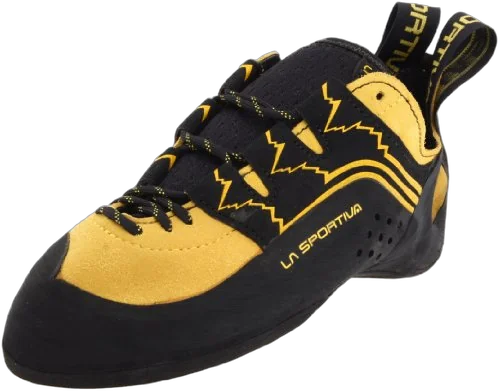
What makes the Katana Lace the reference point is the range of the lace bed. It runs far enough down toward the toe that you can genuinely tune forefoot pressure, which is the one adjustment Velcro cannot offer at all. If you want to see where it sits relative to its siblings, how the rest of the La Sportiva lineup is laid out puts the whole range in order.
For a first lace pair, the La Sportiva Tarantulace (men’s · women’s) is the budget-friendly entry point. Flat last, forgiving fit, and the same zonal adjustment in a shoe you will not resent wearing while you are still learning what a correct fit feels like.
Slipper Climbing Shoes, the Closure Everyone Skips

Ask five climbers what a slipper is for and four will say gym training. Then hand them an aggressive downturned competition slip-on and watch that definition come apart.
What Slip-Lace Is Actually Built For
Slipper climbing shoes trade adjustment for feel. With no lace bed and no straps interrupting the upper, there is nothing between your foot and the shoe but a single layer of material, which is why they excel at smearing and delicate technical footwork where you need to read what the rock is doing through the sole. The same soft, uninterrupted upper also puts more rubber in contact with the wall during toe hooking, since there is no strap edge to break the surface.
They are also the shoe most climbers reach for during high-volume indoor training, because a soft slip-on demands more from the foot itself. The Five Ten NIAD Moccasym remains the archetype here, an unlined slip-on that defines the category for most climbers who have heard of slippers at all.
The Zero-Adjustment Problem
Here is the part nobody says out loud. A slipper does not have less adjustment than the other two closures. It has none.
There is no lace to loosen at a belay, no strap to re-set at a rest, no mechanism of any kind. If the shoe is too tight at hour three, it is too tight at hour three and your only option is to take it off. That single fact should shape how you buy one, because break-in makes it worse rather than better.
Leather uppers relax up to a half or even a full size as they break in, and synthetics relax roughly half a size at most. That stretch runs one direction only and it is permanent.
A lace shoe can be re-tensioned to compensate for it. A slipper cannot, which makes a sizing mistake on a slip-on the least forgiving error of the three closures. If yours ended up tighter than you can live with, stretching a too-tight pair without wrecking them is the only lever you have left.
Buy a leather slipper for where it ends up, not where it starts. If it feels just snug in the shop it will be sloppy in two months, and there is no closure on the shoe to take that slack back out.
Slippers Are Not Just Beginner Gear
The category runs to both ends of the market, and that is the part the two-way comparisons keep missing. The SCARPA Instinct S sits at the aggressive end, a downturned slip-on on a sticky rubber sole, built for advanced climbers chasing maximum sensitivity on small holds, not for beginners easing into the sport.
That shoe only makes sense if you are already clear on whether you are ready for an aggressive shoe at all, because an aggressive fit plus zero adjustment is a demanding combination. If the model interests you, where this sits in Scarpa’s current lineup puts it in context against the rest of the range.
Matching Closure to Your Discipline

The useful question is not which closure is best. It is how long the shoe stays on your foot in one sitting. A five-minute boulder attempt and an eight-hour trad day have opposite priorities even though both are climbing, and once you frame it that way the answer usually picks itself.
Gym and Bouldering, Velcro’s Home Turf
Shoes come off between problems. That is the entire argument, and it is a good one. When you are pulling shoes on and off twenty times in a session, transition speed stops being a convenience and starts being the difference between climbing warm and climbing stiff.
Gym climbing shoes also live a hard life on plastic, so the coarse durability of a strap system holds up fine against the abuse. Velcro is the right default here and it is not close.
Sport Climbing: Fit Precision Beats On/Off Speed
On a redpoint burn the shoe stays on for the whole route, so transition speed stops mattering and precision fit takes over. Either closure works, which means the decision comes down to your foot rather than the discipline.
Aggressive downsizing is more common in sport climbing shoes than anywhere else, and that is where a lace bed starts to earn its place, because a shoe you sized hard is a shoe you will want to loosen between attempts. Our breakdown of the sport climbing picks broken down by route angle covers how angle changes that calculation.
Trad, Multi-Pitch and Crack: Where Laces Stop Being Optional
Here the shoe stays on for hours across pitches, and mid-day adjustability stops being a luxury. Trad climbing shoes are laced almost universally for exactly this reason.
Crack climbing adds a second argument. Bulky straps abrade and catch against granite and sandstone inside a jam, so crack specialists run a low, flat lace bed instead. The La Sportiva TC Pro is the reference shoe in this category, with a stiff edging platform and a high ankle cuff that takes the abuse of repeated foot jamming. If crack is where you are headed, the shoes built specifically for crack compares the field properly.

Foot Swelling and the Thing Nobody Warns You About

Everyone expects climbing shoes to hurt. Almost nobody gets told the difference between the pain that is normal and the numbness that is not, or that acting on it quickly is a privilege your closure either grants you or does not.
Why Feet Swell Mid-Session
Feet swell over a long day. Heat, gravity, hours of repeated loading, and the simple fact that a foot in a compressed shoe does not drain well. The fit you set at the car is not the fit you have at pitch five.
That matters more than it sounds, because the compression is already significant before any swelling starts. A peer-reviewed study comparing climbers’ feet to the general population found that climbers with five or more years in the sport showed hallux valgus in both feet at a rate of 53 percent, against 4.5 percent in the general adult population aged 17 to 44. That is cumulative years of pressure rather than one tight afternoon.
Pain Versus Numbness: Where the Real Line Is
In a study of 100 climbers averaging around the 5.11 grade, 81 percent reported acute foot pain while wearing climbing shoes. Pain in climbing shoes is closer to the norm than to a warning sign, which is worth knowing before you assume something is wrong with your fit.
Numbness is different. A separate community-cited figure puts tingling or numbness at around 65 percent, and that one is not breaking in. Foot circulation loss is the line worth acting on, and the honest test is simple: pain that stops when you take the shoe off is normal, sensation that takes minutes to return is not.
What Each Closure Lets You Do About It
This is where the three closures stop being equivalent. A lace shoe can be loosened a notch at a hanging belay or a walk-off and re-tightened before the next pitch, with the adjustment spread across the whole foot. Velcro gives you one coarse re-set if you can reach it. A slipper gives you nothing at all.
On a long route, loosen your laces one notch at every hanging belay whether your feet hurt yet or not. Waiting until it is uncomfortable means you have already spent two pitches with reduced circulation you did not need to spend.
Foot Shape, Volume, and Where Laces Pull Ahead

Two climbers can buy the identical model in the identical size and have completely different weeks. The reason usually is not the shoe. It is that one of them has a foot the last was never drawn for.
Wide, Narrow, and Everything Between
The last shape determines real fit independent of the number printed inside the shoe. A wide feet and narrow heel combination is the classic mismatch, and it is the case where laces stop being a preference and start being the solution, because they are the only closure that can draw the heel and midfoot in without crushing the toes further.
Narrow feet run into the opposite problem, where a shoe cinches down fine at the strap points and stays sloppy everywhere else. Again the eyelet run is what fixes it, and the same goes for an irregular foot shape that no single last was ever drawn to hold.
High Arches and High Volume
A high arch or a high-volume foot pushes instep pressure upward, and a two-strap system tends to concentrate that pressure at one point rather than spread it. That is the single most common reason a Velcro shoe that fits the toe correctly still feels wrong across the top of the foot.
Brands draw their lasts to different templates, which is why fit threads keep sorting climbers by shape rather than by size. Wide, high-volume feet tend to land at Butora or Ocun, while narrower feet more often get on well with Tenaya or Red Chili. Worth knowing before you assume every brand runs the way La Sportiva does.
Heel Volume and Gendered Lasts
Gendered lasts differ in heel volume and overall width, not just in size range, which is why several picks in this guide come as separate men’s and women’s models rather than one unisex line. If the heel is the part that never sits right for you, how women’s lasts differ in heel volume and width is worth reading before you downsize again. A shoe that fits everywhere except the heel is a last problem, and downsizing further will not fix it.
The Sizing Trap Nobody Tells You About

I wear a 42 in the Velcro version is the sentence that ends with a non-returnable pair of shoes in the back of a closet. It is the most expensive assumption in this entire topic and almost nobody names it.
Same Model, Different Closure, Different Fit
The Velcro and lace versions of the same named model routinely fit differently in the same nominal size. This is not a manufacturing inconsistency. The last and the upper construction genuinely change between closure versions, because a lace bed requires a different panel layout than a strap system does, and that changes the internal volume.
Take a Katana against a Katana Lace. Same brand, same model family, same number on the box, and a different fit on your foot. If you have only ever owned one closure type, this is the trap waiting for you the first time you switch.
Why the Break-In Direction Matters
Uppers relax. A leather upper goes up to a half or a full size, a synthetic upper roughly half a size at most, and the direction is always looser. Never tighter.
So you are not sizing for how the shoe feels today. You are sizing for where it lands in two months, and the amount of correction available to you afterward depends entirely on the closure.
Laces can take the slack back out. Velcro can take some of it. A slipper cannot take any.
How to Size Each Closure Without Guessing
Start from what a correct fit is supposed to feel like in the first place, because what a correctly fitted climbing shoe should actually feel like is a different sensation than most people expect, and then adjust by closure from there.
Laces are the most forgiving of a sizing error, so a half size of uncertainty is survivable. Velcro sits in the middle: a strap can absorb some stretch but not a full size of it. Slip-lace is the least forgiving of the three, which means it is the one closure where you should try the shoe on in person if you possibly can.

How Long Each Closure Actually Lasts

Nobody retires a shoe because the closure died. They retire it because the closure died around the same time the sole did, and suddenly the math on a resole stops working.
What Fails First on Each System
Velcro fails by degrees. The hook teeth clog with chalk and grit, and repeated tension cycling flattens them, so grip fades gradually rather than failing outright. It is worth saying plainly that no manufacturer publishes a session count for this, and that absence is itself the reason every article you read hedges on the question.
Laces fray at the eyelets and abrade badly inside cracks, and they are also the only closure you can replace for the price of a coffee. That is a genuine durability advantage that rarely gets counted as one.
Slippers have neither failure mode and a worse one instead. There is no strap to replace and no lace to re-tension, so when the upper stretches out or a rand that is starting to separate appears along the toe, the fit life of the shoe is simply over.
Maintenance That Actually Extends the Life
Clean the chalk out of the hook side with a stiff brush every few weeks. Close the straps before the shoes go in a pack. Replace laces before they snap rather than after, since a lace that fails always fails at the worst eyelet.
Heat and sweat are the shared enemy across all three, and they matter most on downturned models, where keeping the downturn from relaxing out is the difference between two seasons and four.
When It’s a Resole and When It’s a Replacement
The honest calculus is about the upper, not the sole. A shoe with a healthy upper and a worn sole is worth resoling, and reading the wear that tells you it’s resole time will tell you when to send it.
A shoe with a stretched-out slip-lasted upper is not worth resoling, no matter how good the new rubber would be, because you would be paying to put a fresh sole on a shoe that no longer holds your foot. That asymmetry is a real ownership cost of the slipper category and it deserves to be part of the buying decision.
From Rental Velcro to Your First Real Pair

The gym did not pick Velcro for you because it is the best closure. It picked Velcro because forty people a night need to get shoes on and off fast.
Why Almost Every Rental Shoe Is Velcro
Rental fleets run on turnover and abuse tolerance. A strap survives being yanked by someone who has never worn a climbing shoe, and it gets a beginner in and out of the shoe in fifteen seconds instead of two minutes. That is a business decision, not a performance verdict.
It has a side effect nobody intends. Every new climber’s default sense of what a climbing shoe is comes preloaded with a closure the gym chose for its own logistics, and most first purchases quietly inherit it.
What to Buy First, and Why It Might Not Be Velcro
A lace pair can be the better first purchase for someone building a long-term habit. Sizing is more forgiving while you are still learning what correct feels like, the resole economics are better over two or three years, and you get adjustment room as your feet adapt to being climbed in. Our full first-pair walkthrough goes through the whole decision if you are at that stage.
Slip-lace is a poor first shoe, and that is worth being blunt about. It is the closure with the least tolerance for a buyer who does not yet know their own fit, and buying one as a first pair means committing to a decision you are not equipped to make yet.
On spend, the honest answer is that an entry-level Velcro pair and an entry-level lace pair sit in the same rough tier, so this is genuinely a decision about closure rather than about budget. Beginner climbing shoes in either closure cost about the same, which means you get to pick on merit.
Building Toward a Two-Shoe Quiver
Experienced climbers rarely expect one shoe to do everything. The two-shoe quiver is the standard arrangement: one aggressive or technical pair for short powerful efforts, and one all-day lace pair for long routes.
That is not a purchase to rush. Your first pair tells you which discipline actually holds your attention, and the second pair answers a question you cannot ask yet.
The Bottom Line
Three things to take with you. First, the closures differ most in how much control you keep after the shoe is on your foot: laces keep the most, Velcro keeps some, slippers keep none. Second, pick by how long the shoe stays on in one sitting rather than by the discipline label, because that is the variable that actually changes what you need. Third, size for where the upper ends up after break-in and not for where it starts, and give yourself the most margin on the closure with the least adjustment.
Your next move is simple enough. Work out which of the three sittings your climbing actually looks like, pick the closure that matches, and then spend your effort on getting the size right rather than on second-guessing the closure. Once the pair is yours, making whichever pair you pick last longer is where the real money savings live.
Frequently Asked Questions
01Should I get laced or Velcro climbing shoes?
Choose by how long the shoe stays on your foot in one sitting. Under ten minutes at a time, as in gym bouldering, buy Velcro. Hours at a time on sport, trad or multi-pitch routes, buy laces for the mid-day adjustment.
02Are climbing shoes better with laces or without?
Without covers two very different shoes. Velcro gives you fast transitions with two or three fixed adjustment points. Slip-lace gives you maximum sensitivity with no adjustment at all. Laces beat both for long days and forgiving sizing.
03Are laces better than Velcro?
Laces are better at fit precision, mid-session adjustment and field repair. Velcro is better at transition speed and simplicity. Neither wins outright, which is why most experienced climbers eventually own a pair of each.
04What is a slip-lace or slipper climbing shoe good for?
Slippers suit delicate smearing, technical footwork and high-volume indoor training, plus aggressive performance climbing at the high end. They are a poor first pair, because zero adjustment plus permanent break-in stretch punishes any sizing mistake.
Safety Notice: Rock climbing and mountaineering are inherently high-risk
activities that can involve physical trauma or fatal incidents. The information on Rock Climbing Realms is for
educational and informational purposes only. Techniques and advice presented here are not a substitute
for professional, hands-on instruction. Conditions and risks vary by location. Always seek guidance
from a qualified instructor before attempting new techniques. By using this website, you agree that you
are solely responsible for your own safety. Any reliance you place on this information is strictly
at your own risk, and you assume all liability for your actions. Rock Climbing Realms and its authors
will not be held liable for any harm, damage, or loss sustained in connection with the use of this information.
Affiliate Disclosure: We are a participant in the Amazon Services LLC Associates Program, an
affiliate advertising program designed to provide a means for us to earn advertising fees by advertising and linking
to Amazon.com. As an Amazon Associate, we earn from qualifying purchases. We are also an official affiliate partner
of Black Diamond Equipment via the AvantLink network. If you click on a Black Diamond affiliate link and make a
purchase, we may earn a commission at no additional cost to you. We also participate in other affiliate programs.
Additional terms are found in the terms of service.