
In this article
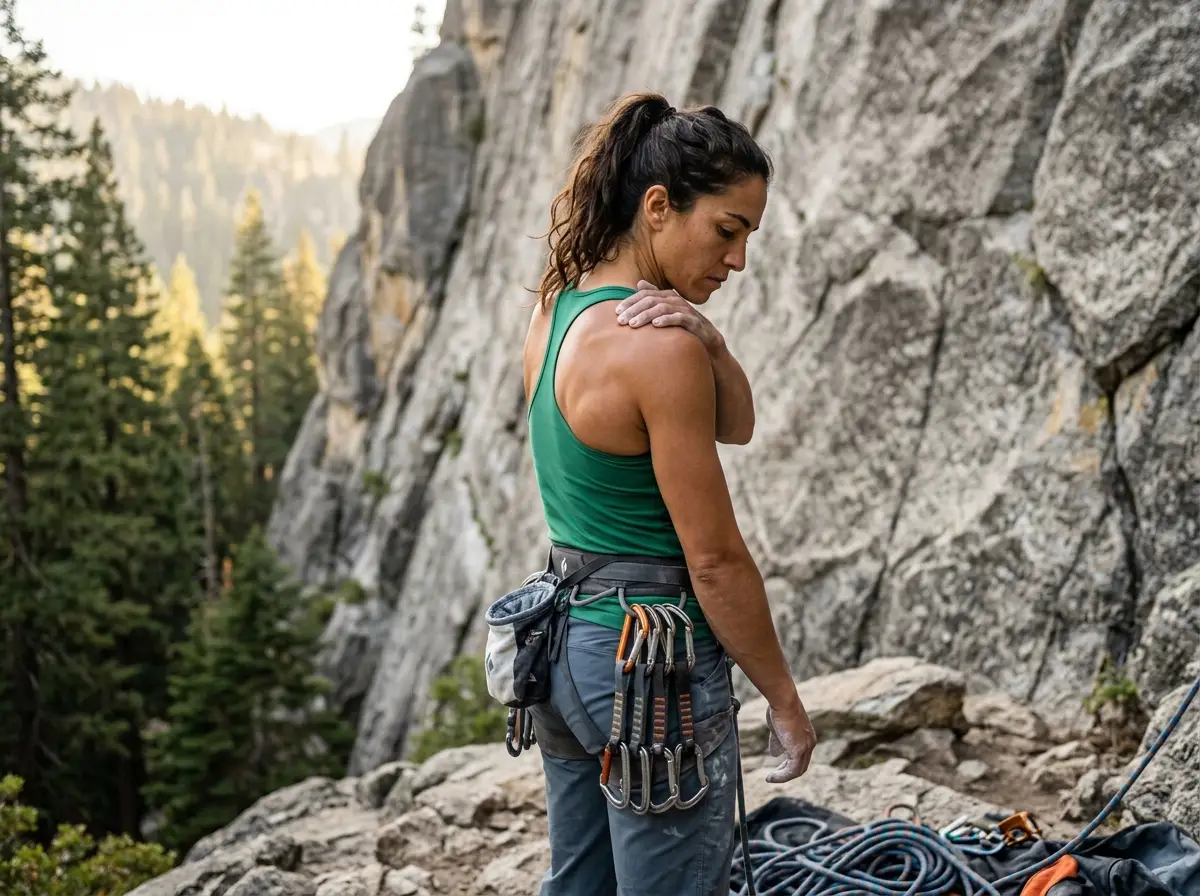
Six weeks off the wall. Your project sits exactly where you left it — same moves, same sequence, same crux. But your right shoulder still ignites every time you reach past 90 degrees. You’ve done the band exercises everyone recommends on r/climbharder. You’ve iced it, rested it, maybe seen a physio who handed you a generic rotator cuff sheet. And the moment you grab a hold and commit to a lock-off, the same burning sensation fires behind your deltoid.
This is the loop that traps climbers — not for lack of effort, but for lack of a framework built around how climbing actually loads the shoulder. The same rehab that works for a baseball pitcher or a swimmer often makes things worse for us, because the force vectors are completely different. Drawing on scapulohumeral mechanics, MVIC loading parameters, and Dr. Jared Vagy’s Rock Rehab Pyramid, what follows is a phased protocol designed for climbing-specific loading patterns — from your first pain-free hang to pulling limit routes under full load.
⚡ Quick Answer: Most shoulder rehab fails climbers because it treats us like generic overhead athletes. The real fix starts with thoracic spine mobility (not the shoulder itself), followed by a phased load progression: Phase 1 rebuilds scapular control at 10–20% effort, Phase 2 drives tendon remodeling at 40–60%, and Phase 3 returns you to climbing-specific loading at 80%+. Rush any phase, and you restart the clock. The climbers who recover fastest are the ones who entered the protocol early and exited it clean.
| Shoulder Injury Mechanical Causes & Treatment Phases | ||
|---|---|---|
| Injury Type | Primary Mechanical Cause | Phase to Address |
| Subacromial Impingement (SIS) | Scapular dyskinesis, poor upward rotation | Phase 1 → Phase 2 |
| Rotator Cuff Tendinopathy | Overuse + internal rotation dominance | Phase 2 → Phase 3 |
| SLAP Lesion | Peel-back mechanism / Gaston loading | Phase 1–3 (conservative) or surgical consult |
| Scapular Dyskinesis | Serratus anterior weakness, thoracic kyphosis | Phase 1 → Phase 2 |
Why the Climbing Shoulder Breaks Down (And It’s Not What You Think)

Between 50% and 82% of climbers sustain at least one injury annually, and shoulder pathology — specifically impingement, labral tears, and rotator cuff tendinopathy — accounts for 25–33% of all clinical presentations. Those numbers are worse than baseball and swimming. Most people hear that and assume it’s because climbing is so demanding on the shoulder. That’s partly true, but it misses the real driver.
Climbing is an internal rotation dominant sport. Your lats and pectorals are doing most of the work when you pull, and both muscle groups internally rotate the humerus and haul the shoulder complex forward. Those are also the two most powerful pulling muscles in the body. So you’re using your strongest muscles to do something that’s actively destabilizing the joint. Every session.
The result shows up in the data. In a healthy shoulder, the humerus and scapula move in a 2:1 ratio — for every two degrees of arm lift, the scapula rotates one degree upward to create clearance. In climbers, that ratio has been measured at 3.6:1. The scapula barely moves while the humerus drives overhead. The acromion doesn’t rotate out of the way in time. The supraspinatus tendon gets pinched against it. That’s the mechanical definition of subacromial impingement — and it happens hundreds of times per session.
According to MRI data, 80% of elite climbers show MRI-detectable lesions without clinical pain. That’s not reassuring. It means structural damage accumulates well before you feel it. And 80% of shoulder injuries are overuse pathologies, not acute trauma — the continuum runs from reactive tendon, to tendon disrepair, to degenerative failure. By the time it hurts, you’re already three steps into a process that started months ago.
Pro tip: Film yourself doing a shoulder clock test from behind. Asymmetrical winging — one scapula lifting while the other stays flat — is invisible from the inside but obvious on camera. If you see it, fix the asymmetry before you add any load.
If you want to go deeper on the prevention side, bulletproofing your climbing shoulders for the long term covers the prehab framework from this same structural base.

The Mechanical Self-Audit: Diagnose Before You Prescribe

Here’s where most rehab goes wrong. Climbers treat all shoulder pain as the same thing and follow the same protocol regardless. But clinicians distinguish between at least four separate conditions — subacromial impingement syndrome (SIS), internal impingement, labral tears (SLAP), and rotator cuff tendinopathy — and each one responds to a different loading progression. Run the wrong protocol on the wrong diagnosis and you’re not recovering. You’re reinforcing the injury pattern.
You don’t need imaging to get a working diagnosis. Three field tests will tell you most of what you need:
Field Self-Test 1 — Hawkins-Kennedy Test: Raise your arm to shoulder height with elbow bent at 90°, then internally rotate the forearm downward. A sharp pinch deep in the shoulder is a positive result — strong indicator of subacromial impingement and supraspinatus involvement.
Field Self-Test 2 — Jobe’s Empty Can Test: Raise your arm at 30° from the body in the scapular plane, thumb pointing down. Weakness or pain signals supraspinatus involvement. This is why your shoulder collapses on a full can movement before you even reach failure.
Field Self-Test 3 — O’Brien’s Active Compression Test: Arm at 90° forward, crossed slightly across the body, thumb down. Pain in this position that goes away when you flip your thumb up is a strong indicator of a SLAP lesion — damage to the superior labrum. If you get a positive O’Brien’s, that warrants seeing a sports physiatrist before any Phase 3 loading. SLAP lesions can progress to surgical intervention if loaded in the wrong position.
One other benchmark worth checking: overhead reach should exceed 170°. If you can only get to 160° and you’re compensating by leaning your trunk to one side, what you have isn’t a shoulder problem. It’s a thoracic mobility problem wearing a shoulder costume.
Testing for Scapular Dyskinesis
Have a partner watch your shoulder blades during bilateral arm raises. If the medial border of one scapula lifts off the ribcage — that’s winging — your serratus anterior is too weak to hold it down. The inferior angle popping during the lowering phase is a lower trapezius timing delay, and that single dysfunction is probably the primary driver of your impingement under overhead load.

The Thoracic Spine Connection
A kyphotic spine magnitude correlates directly with climbing grade. The harder you climb, the more hunched your thorax tends to be. 85.19% of regular climbers have functional pectoral contracture, confirmed by the Dega test. And thoracic posture significantly impacts scapular kinematics and subacromial space — a point the Journal of Orthopaedic & Sports Physical Therapy documented in detail.
Here’s the practical screen: lie on your back on the floor, arms at your sides. Try to lower both arms flat to the ground while keeping your lower back flat. If you can’t — if your arms hover and your back arches — you have a thoracic restriction driving the shoulder problem. Fix the thorax first.
For the active mobility work component, active range of motion work for the shoulder complex through FRC methodology gives you the controlled range framework.
Phase 1 — Reset: Mobilize the Tracks Before You Load Them

Most climbers skip this phase. They rest for a week, feel 40% better, and get back on the wall. Then they’re back in the same loop six weeks later. The 14-day minimum for moderate-to-severe presentations isn’t arbitrary — it’s the minimum tissue protection window before the tendon can tolerate load without re-triggering the inflammatory response. Light traversing on juggy terrain at zero overhang is acceptable for minor presentations. Overhangs and anything past 90° — no.
Phase 1 is about restoring the tracks the scapula moves on, not treating the shoulder directly. That distinction matters.
Soft tissue work first: 8–10 minutes of self-myofascial release on the infraspinatus, pectoralis minor, and posterior capsule. Lacrosse ball on the infraspinatus while lying on your side, foam roller on the pecs against a wall. This isn’t optional wellness fluff — these tissues are what’s pulling the shoulder forward and collapsing the subacromial space.
Thoracic mobilization sequence: Foam roll extension over the roller (10 reps at multiple levels of the thoracic spine), kneeling thoracic rotations (10 each direction), cat-cow for spinal articulation (10 reps). This is the spine work. This is what opens the tracks. Without this, every shoulder exercise is working against a structural disadvantage.
The climbing mobility program to restore your overhead reach gives you the fuller protocol for this phase.
Submaximal isometrics: The goal here is 10–20% of maximal voluntary isometric contraction (MVIC). Shoulder flexion, abduction, and external rotation holds using a wall or doorframe as resistance. Hold for 30–40 seconds. These low-load contractions don’t stress the labrum or rotator cuff. What they do is activate blood flow, reset neural drive, and reduce the perceived threat before you start loaded work. Think of it as waking the tissue up before asking it to work.
The red flag to know: any pain above 3/10 during Phase 1 isometrics means regression. Not modification. Regression. That’s not a sign of weakness — it’s the tissue telling you the load is still too high. Inadequate rest between tendon loading episodes leads to degenerative failure, and the UIAA Medical Commission is as authoritative a source as you’ll find on this.
Pectoral Doorway Stretch Protocol
Doorway stretch at three angles: arm at 60° (anterior deltoid and shoulder capsule), 90° (pec major sternal head), and 120° (pec minor). Hold each 30–45 seconds, two sets, twice daily. Do not force range. The goal at this phase is fascial mobility, not structural lengthening under force. Combine wall slides at the end — they activate serratus anterior simultaneously and begin retraining the scapular rhythm before any overhead load is introduced.
Pro tip: Run Phase 1 for its full 14 days even when you feel better at day 5. Subjective pain reduction doesn’t mean tissue recovery. The climbers who re-injure at Week 12 almost always cut Phase 1 short.
Phase 2 — Stabilize: Building the Force Couple Architecture

Phase 2 is where the real structural work happens. Weeks 3–6, targeting 40–60% MVIC. You’re not building strength here — you’re retraining the force couple that keeps the humeral head centered in the shallow glenoid socket.
Here’s the problem you’re solving: the deltoid, when it elevates the arm, produces a massive superior force pulling the humeral head toward the acromion. Without a counter-force, it jams there. The rotator cuff — specifically subscapularis, infraspinatus, and teres minor — must produce a simultaneous compressive and downward force vector to keep the ball in the socket. In climbers with scapular dyskinesis, that counter-force is delayed or absent. The serratus anterior is weak. The lower trapezius fires late. And the shoulder cycles through micro-impingements hundreds of times per session.
At 60% MVIC, connective tissues undergo a process where mechanical load triggers collagen synthesis and realigns fiber structure — this is the sweet spot for tendon remodeling. Don’t push to 80% MVIC in this phase. 80% is for neural recruitment, and that comes later. Rushing to 80% when tissues are still remodeling is how Phase 2 turns into Phase 1 again. This context on climbing injury trends and the rise of shoulder pathology shows exactly why that distinction is missing from most generic rehab advice.
Key Exercises — Scapular Control Series
Scapular Pull-Ups: Dead hang position → depress both scapulae downward without bending your elbows → hold 5 seconds → lower. 3 sets × 10 reps. This is pure lower trapezius and serratus anterior work. There’s no glenohumeral loading. This is the foundation.
Serratus Push-Up Plus: Standard push-up position → at the top of the movement, add an extra end-range protraction, pushing your shoulder blades apart as far as possible. That final push specifically targets serratus anterior. Without it, you’re just doing a push-up. 3 × 12.
Wall Slides (W + T + Y patterns): Back against the wall, forearms flat against the wall → slide arms into Y position while maintaining contact. If your forearms peel off the wall during the slide, that’s the thoracic and serratus restriction showing itself. Keep contact. That’s the drill.
I-Y-T Prone Sequence: Lying face down, light weight or no weight. I (arms forward), Y (arms angled at 30°), T (arms at 90°). The Y specifically recruits the lower trapezius in its most functional position. Don’t rush the rep speed.

Rotator Cuff Rebuilding — Banded Rotations
Banded external rotation in neutral: Elbow at your side, band anchored at elbow height, rotate the forearm outward against resistance. This trains infraspinatus and teres minor directly against the internal rotation dominance of lats and pecs. That imbalance is the root structural problem. You’re correcting it rep by rep.
Progression order: neutral external rotation → 90° abducted external rotation (which mimics actual climbing positions) → side-lying external rotation for pure isolation. Don’t skip to 90° abduction until neutral is pain-free through full range.
The cue worth memorizing: “bending the bar.” During all rowing and pulling movements, attempt to externally rotate your hands as if you’re trying to break the bar apart. This maximizes external rotator recruitment and actively centers the humeral head. Your pull-ups will feel different immediately.
After working through the banded rotation protocol, the antagonist training program to balance the internal rotation dominance gives you the longer-term framework for maintaining this balance once you’re back climbing.
Phase 3 — Integrate: Sport-Specific Loading and Return to Climbing

Phase 3 begins at Week 6 and extends through Month 4+. This is where you reintroduce climbing-specific loading — active hangs, pull-up progressions, and eventually overhang terrain. It’s also where most re-injuries happen, because the subjective experience of feeling recovered outpaces the actual structural recovery of connective tissue.
The first concept to fix is the passive hang. Hanging loose on a bar or hold, fully relaxed, feels easier. That’s exactly why it’s hazardous. In a passive hang, you’re loading the joint capsule, the labrum, and the skeleton — not the muscles. The humerus drifts superiorly and jams against the acromion, causing chronic micro-trauma to the supraspinatus tendon with every second you spend there. The myth that hanging on your bones conserves energy is a reliable path to a SLAP lesion.
An active hang uses three cues simultaneously: scapular depression (pull shoulder blades down from your ears), axial extension (lengthen the neck, slight chin tuck), and external rotation torque (screw your hands into the bar as if trying to rotate them outward). These three cues together centralize the humeral head in the glenoid and load the stabilizers, not the passive structures. The subacromial space opens. The supraspinatus decompresses. That’s the goal of every second on the wall, not just during rehab.

Start with 25% bodyweight assistance (banded pull-ups or an assisted pull-up machine) and progress by approximately 10% per week. The Full Can exercise — raising light weights at 30° in front of the body in the scapular plane — is the only safe path back to overhead load in early Phase 3 weeks. It isolates the supraspinatus without triggering impingement.
The Collagen Window Protocol
Tendons are essentially avascular — they don’t get direct blood supply. They get nutrients through mechanical loading, the way a sponge soaks up water when squeezed. This is why the Collagen Window timing protocol matters.
The sequence: consume 15g hydrolyzed collagen + 50mg Vitamin C, then wait 30–60 minutes for amino acid levels to peak in the bloodstream, then perform a 10–15 minute targeted loading session — your rotator cuff routine, scapular control work, or active hangs. Research from Keith Baar and Eric Hörst shows this sequence doubles markers of collagen synthesis compared to loading without the nutritional primer. The amino acids are in the bloodstream, the mechanical loading acts as the pump, and the tendon matrix gets what it needs to rebuild.
This is not a supplement replacing rehab. It’s a timing protocol that maximizes the biological yield of each targeted loading session. For the broader application of nutrient timing for connective tissue repair, the nutrition timing article gives you the full context.
Return-to-Climbing Progression
Weeks 1–2 back on rock: juggy traverses only. No overhanging routes. No lock-offs past 90° elbow. If it hurts above 2/10 during or within 24 hours, you’re moving too fast.
Weeks 3–4: introduce moderate face climbing — 5.9 to 5.10 range — monitoring for any shoulder girdle pain during or within one day of climbing.
Weeks 5–8: vertical to mildly overhanging terrain. Begin projecting sequences that require lock-offs.
Month 4+: return to limit bouldering and overhang climbing. Begin loading at 80% MVIC — the neural recruitment phase — only after Phase 2 is pain-free and scapular mechanics are symmetrical. The most common re-injury window is Weeks 12–16, when climbers feel recovered but connective tissues haven’t regained full tensile strength. Don’t use “feeling good” as your metric. Use time-in-protocol.
Pro tip: Track sessions with a simple pain log. Note shoulder girdle discomfort on a 0–10 scale during climbing and 24 hours after. Any upward trend across three sessions in a row means reduce load, not push through.
The Gaston Problem and Advanced Load Scenarios

Not all holds are equal risk for a rehabbing shoulder. Most climbers don’t realize there’s a physics difference between a sidepull and a Gaston, and that difference determines whether a move is safe to attempt during rehab.
A sidepull creates a centration force — the pull direction compresses the humeral head into the center of the socket. The joint loads, but the humeral head stays where it belongs. A rehabbing shoulder can generally handle carefully selected sidepull terrain.
A Gaston, on the other hand, creates a distracting force. The grip orientation pulls the humeral head away from the socket, mimicking the clinical Load-and-Shift test for instability. For a climber with any labral pathology, this is the single most hazardous move type to attempt before full recovery.
Here’s the mechanism: during a Gaston with the arm in high abduction and external rotation, the biceps tendon twists and pulls the superior labrum away from the bone. That’s called the peel-back mechanism, and it’s responsible for SLAP lesions in overhead athletes across multiple sports. If a route requires repeated Gastons, avoid it until Month 4+ of the protocol. Substitute with sidepull-heavy routes that build centration strength without distracting force.
Dynos carry a different risk. When you catch a dynamic move, the posterior deltoid must decelerate the arm eccentrically. That eccentric deceleration is where roughly 80% of dyno-related rotator cuff strains occur. The preparation cue: fire the “bending the bar” external rotation torque the instant the hand contacts the hold. Pre-loading the stabilizers before impact is the difference between a solid catch and a tweaked shoulder.
Integrating Closed-Chain vs. Open-Chain Loading
Open-chain exercises (OKC): the hand moves, the body is fixed. Dumbbell external rotation, band work. Useful for isolated motor pattern retraining in Phases 1 and 2.
Closed-chain exercises (CKC): the hand is fixed, the body moves. Pull-ups, ring rows, climbing itself. Higher joint proprioception, greater co-contraction of stabilizers, more direct functional transfer to climbing movement. CKC exercises are superior for Phase 3 and beyond — your shoulder learns stability while bearing load in positions that actually mirror climbing.
The proprioception cue to practice on every Phase 3 session: “sucking the ball.” Visualize pulling the humerus into the socket rather than just pulling on the hold. It shifts load from prime movers to stabilizers. You won’t consciously feel the difference the first few sessions, but your shoulder will.
Campus board return protocol: no campus board before Month 5 from protocol initiation. Start with single-rung matches only — no dynamic moves. Progress to laybacking movements before any dynamic lunges. Follow the scapular activation principles for campus board training when you’re ready.

Prehab Is Cheaper Than Surgery — The Maintenance Protocol

The data on risk factors is clear: male gender, grades V6+/5.12+, more than 10 years climbing, and thoracic kyphosis. You can’t change two of those. You absolutely can change the other two. And the one thing that predicts future injury better than almost anything else is footwork.
Shoulder pain correlates with poor footwork. When a climber can’t stay on the wall with their feet, the upper body compensates and assumes a disproportionate share of the load. Climbing your footwork into the ground is shoulder prehab. Most people don’t think of it that way.
The “Waffle Volume” trap: climbers add rehab exercises at the end of a long, hard session when stabilizer muscles are already exhausted. This is counterproductive. Prehab done on fatigued stabilizers reinforces poor movement patterns instead of correcting them. Do your scapular control work first in a session, or better, on a dedicated session.
Weekly maintenance minimum: 2× per week dedicated scapular control work, 1× per week thoracic spine mobility. Monthly monitoring metrics: passive overhead reach measurement, scapular clock video for winging, external rotation strength test compared to baseline. A monthly 10-minute check tells you more than waiting for pain to show up.
For the broader context, shoulder pathology rates and asymptomatic findings in elite climbers give you the epidemiological grounding. And the broader science of climbing injury prevention and treatment connects this maintenance protocol to the full injury prevention framework.
The 10-Minute Pre-Climb Shoulder Routine
This takes less time than tying your shoes three times while your partner stalls at the base. Run it before every session during rehab and continue it indefinitely:
- 90 sec thoracic foam roll (5 full breath cycles at each spine segment)
- 10× Scapular Clock in all 4 directions
- 10× Band External Rotation, light band, each arm
- 10× Serratus Push-Up Plus
- 2× Active Dead Hang, 20 seconds each, all three active cues engaged
Eight to twelve minutes. Non-negotiable.
Red Flags — When to Stop and See a Doctor
Constant pain at rest — not just during movement — is a possible acute tear. That’s a doctor visit, not a Phase 1 modification.
Pain accompanied by numbness or tingling down the arm is cervical nerve involvement, not a shoulder problem. Stop all loading and get imaging.
Pain above 4/10 during any Phase 1 exercise: seek a sports physiatrist before continuing.
No measurable improvement in pain-free range of motion after 4 weeks of Phase 1: imaging required to rule out full-thickness rotator cuff tear or labral detachment. Four weeks with no measurable progress is a diagnostic signal, not a patience test.
Three Takeaways Worth Carrying Off This Page
The shoulder is downstream of the spine. Every rehabbed rotator cuff sitting on a hunched, rigid thoracic spine will re-impinge the moment you return to climbing. The thoracic extension work isn’t a warm-up you can skip — it is the protocol.
Load intensity is not guesswork. 60% MVIC drives tendon remodeling. 80% recruits fast-twitch neural drive. Using the wrong intensity at the wrong phase doesn’t speed up recovery. It restarts the injury cycle.
Every passive hang is a micro-injury. Every second you spend hanging on your bones degrades the non-contractile tissues protecting your labrum. Active shoulder engagement isn’t a warm-up habit — it’s the difference between a climbing career and a surgical timeline.
Run the self-audit tests this week. Identify your phase. Start Phase 1 even if your shoulder only hurts a little. The climbers who recover fastest are not the ones who pushed through — they’re the ones who entered the protocol early and exited it clean.
FAQ
Can I keep climbing with a shoulder impingement?
Light, jug-heavy traversing at zero overhang is generally tolerable in Phase 1, but any route requiring overhead reaches past 90° or internal rotation under load will extend your recovery timeline. The honest answer: yes, you can, but you’re borrowing against your recovery. Two to three weeks of conservative rest at Phase 1 is almost always faster than six months of climbing through it.
How do I stabilize my shoulders for rock climbing?
Shoulder stability in climbing is primarily a scapular issue, not just a rotator cuff issue. The serratus anterior and lower trapezius govern scapular upward rotation — without them engaged, the rotator cuff is fighting gravity from a losing position. Train Scapular Pull-Ups, Serratus Push-Up Plus, and banded external rotations 2× per week to rebuild the force couple architecture that keeps the glenohumeral joint centered.
How long does shoulder rehab take for climbers?
For moderate presentations — impingement, minor rotator cuff tendinopathy, scapular dyskinesis — expect 12–16 weeks to safe return to full climbing. For labral pathology (confirmed SLAP lesion, conservatively managed): 6–9 months. For post-surgical stabilization: 9–12 months minimum. The most common mistake is returning to limit climbing at Week 10 feeling good — re-injury peaks at Weeks 12–16, when the subjective experience outpaces connective tissue recovery.
What’s the difference between shoulder impingement and a SLAP tear for climbers?
Impingement is a mechanical event — the supraspinatus tendon gets pinched between the humerus and acromion due to poor scapular mechanics. A SLAP tear is a structural injury to the superior labrum — the ring of fibrocartilage that deepens the glenoid socket. Impingement responds well to conservative rehab. A SLAP tear requires surgical consultation if conservative management — Phase 1–3 protocol — shows no improvement. Use O’Brien’s self-test as an initial screen, confirm with MRI arthrography.
Are scapular pull-ups better than regular pull-ups for shoulder rehab?
In Phases 1 and 2, yes. A regular pull-up loads the glenohumeral joint at 90%+ MVIC before stabilizers are strong enough to maintain centration, creating high risk for mid-pull humeral head migration. A scapular pull-up isolates serratus anterior and lower trapezius without loading the labrum or rotator cuff at hazardous intensities. Transition to full pull-ups only when Phase 2 is pain-free and scapular mechanics are symmetrical bilaterally.
Safety Notice: Rock climbing and mountaineering are inherently high-risk
activities that can involve physical trauma or fatal incidents. The information on Rock Climbing Realms is for
educational and informational purposes only. Techniques and advice presented here are not a substitute
for professional, hands-on instruction. Conditions and risks vary by location. Always seek guidance
from a qualified instructor before attempting new techniques. By using this website, you agree that you
are solely responsible for your own safety. Any reliance you place on this information is strictly
at your own risk, and you assume all liability for your actions. Rock Climbing Realms and its authors
will not be held liable for any harm, damage, or loss sustained in connection with the use of this information.
Affiliate Disclosure: We are a participant in the Amazon Services LLC Associates Program, an
affiliate advertising program designed to provide a means for us to earn advertising fees by advertising and linking
to Amazon.com. As an Amazon Associate, we earn from qualifying purchases. We are also an official affiliate partner
of Black Diamond Equipment via the AvantLink network. If you click on a Black Diamond affiliate link and make a
purchase, we may earn a commission at no additional cost to you. We also participate in other affiliate programs.
Additional terms are found in the terms of service.