
In this article
The sound of an ankle folding sideways on granite stays with you. I was spotting a friend on a V3 traverse at Squamish — no pads, just a flat-looking clearing of dirt and scattered stones. He slipped off a slopey rail maybe five feet up, landed with one foot on a hidden rock the size of a baseball, and his ankle turned so hard I heard the pop from ten feet away. Three-hour drive to the hospital. Six weeks in a boot. A $4 problem that cost him half a season.
That moment changed how I think about padding, terrain, and the decisions we make before we pull on. After years of bouldering outdoors — with pads, without pads, on everything from desert sand to root-tangled forest floors — I’ve seen what goes right and what goes sideways. This article breaks down the real risks of bouldering without a crash pad, the injury math, and the decision framework that separates a calculated choice from a reckless one.
Quick Answer: Bouldering without a crash pad significantly increases your risk of ankle sprains, fractures, and back injuries — ankle injuries alone account for 36.7% of all bouldering ER visits. Low traverses on flat ground are defensible without padding, but anything above chest height on uneven terrain is a gamble with your season.
Why Every Bouldering Fall Is a Ground Fall
The Physics You Can’t Negotiate
In sport climbing, you fall onto a rope. In trad, you fall onto gear. In bouldering, you fall onto whatever is underneath you. Every single time. No catch, no slack, no second chance. That sounds obvious until you realize most gym climbers have never actually processed what it means outdoors, where “underneath you” might be compacted dirt, granite slabs, or a field of ankle-sized rocks.
The physics behind each discipline make bouldering unique: even a fall from six feet generates roughly 2,000 newtons of force on your legs and ankles if you land stiff-legged. That’s enough to sprain an ankle or fracture a heel on hard ground.
What the Numbers Actually Say
According to a study of 430 bouldering patients in emergency departments, ankle injuries account for 36.7% of all bouldering injuries presented to ERs. Knee injuries follow at 16.8%, then elbows at 12.3%. And here’s the part most people miss — only about half of climbers who sprain an ankle actually seek medical treatment. The real numbers are worse than the published data suggests.
The Gym-to-Crag Wake-Up Call
In the gym, you fall onto 12 inches of purpose-built foam. Outdoors, you fall onto nature. The gap between those two experiences shocks people. That V2 topout that felt like nothing inside suddenly puts you 12 feet above a granite slab with no padding and a landing zone you haven’t scouted. Before you leave the ground on any outdoor problem, look down. Study what you’d hit. This habit alone prevents more injuries than any piece of gear.
Pro tip: Walk the landing zone before your first attempt. Get on your hands and knees if you need to. One hidden rock under a layer of pine needles can end your trip.
The 4 Injuries You’re Most Likely to Get Without a Pad
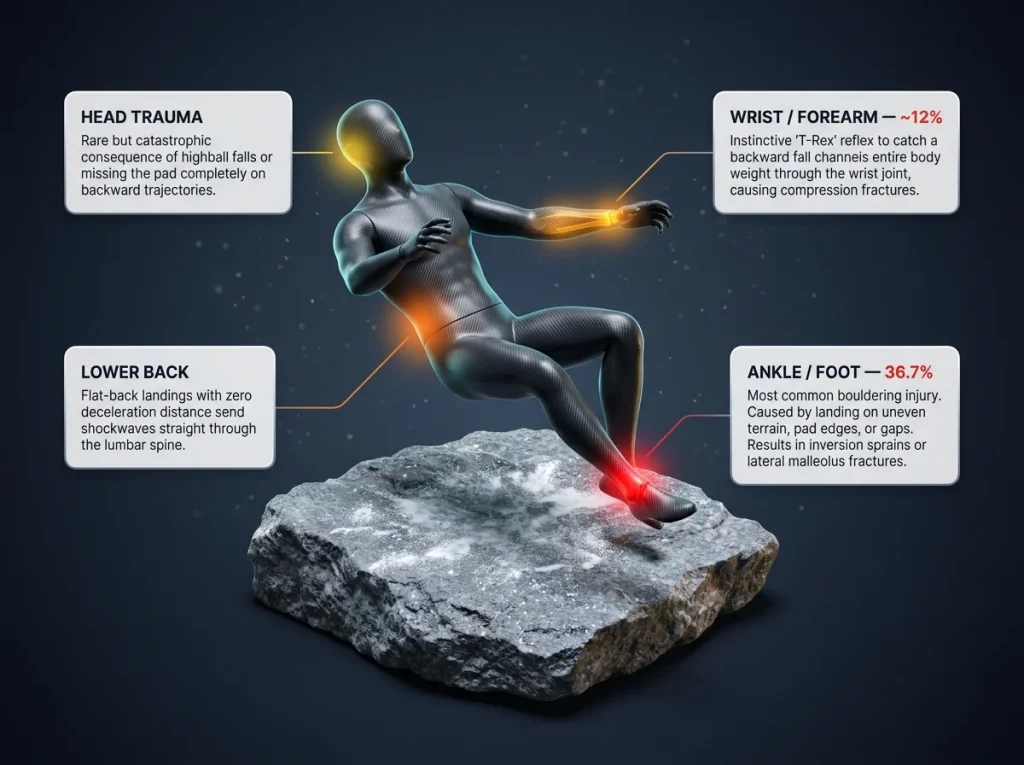
Ankle Sprains and Fractures
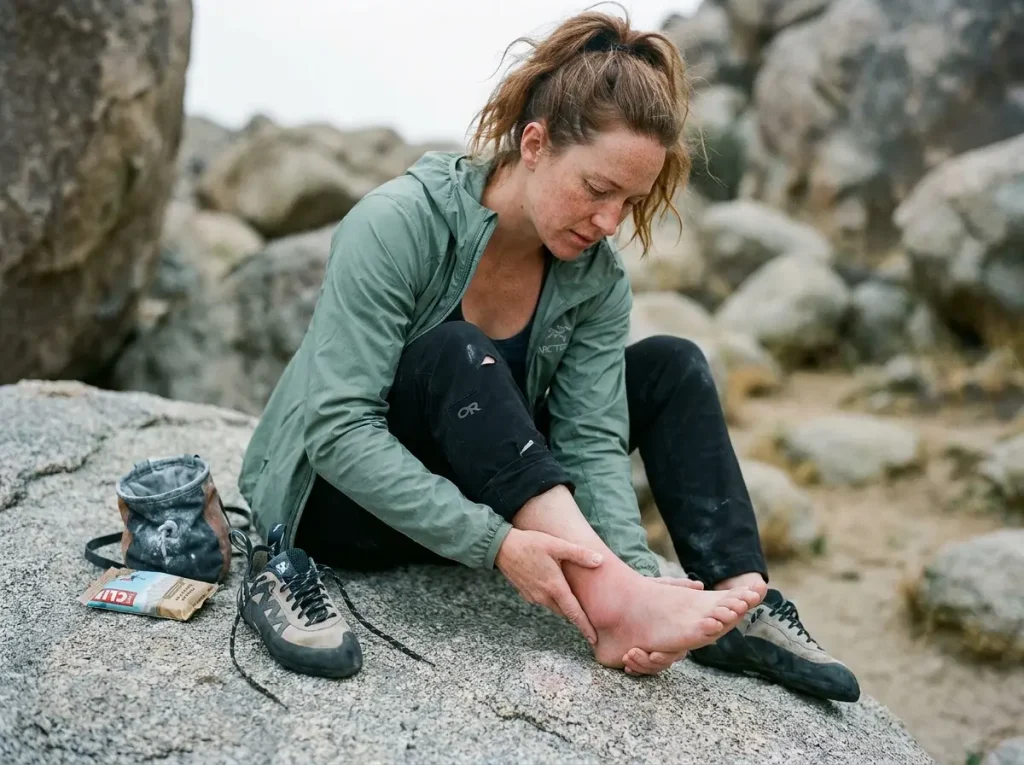
The most common bouldering injury by a wide margin. Without a pad to normalize the landing surface, every pebble, root, and slope becomes a lever working against your ankle joint. Landing on the edge of a rock or stepping into a gap between stones creates the classic inversion sprain — or worse, a fracture of the lateral malleolus. If you’ve ever rolled an ankle on a trail, imagine doing it with the full force of a six-foot fall behind it.
If it happens, here’s the field fix for a rolled ankle that buys you enough stability to walk out.
Wrist and Forearm Fractures
Your instinct when you fall backward is to throw your hands out behind you. That reflex exists to protect your head and spine, but it channels your full weight plus fall momentum straight through your wrists. On a pad, the foam absorbs most of that energy. On hard ground, something breaks. Wrist fractures from bouldering falls are the second most frustrating injury because they’re almost entirely preventable with proper fall technique.
Lower Back Compression
A flat-back landing onto rock or compacted dirt sends a shockwave straight through your lumbar spine. Without padding, there’s zero deceleration distance — your back absorbs the full impulse. This is the injury people don’t see coming because the fall doesn’t look dramatic. You just land flat on your back on hard ground and feel fine for about three seconds before the pain starts.
Head and Spinal Trauma
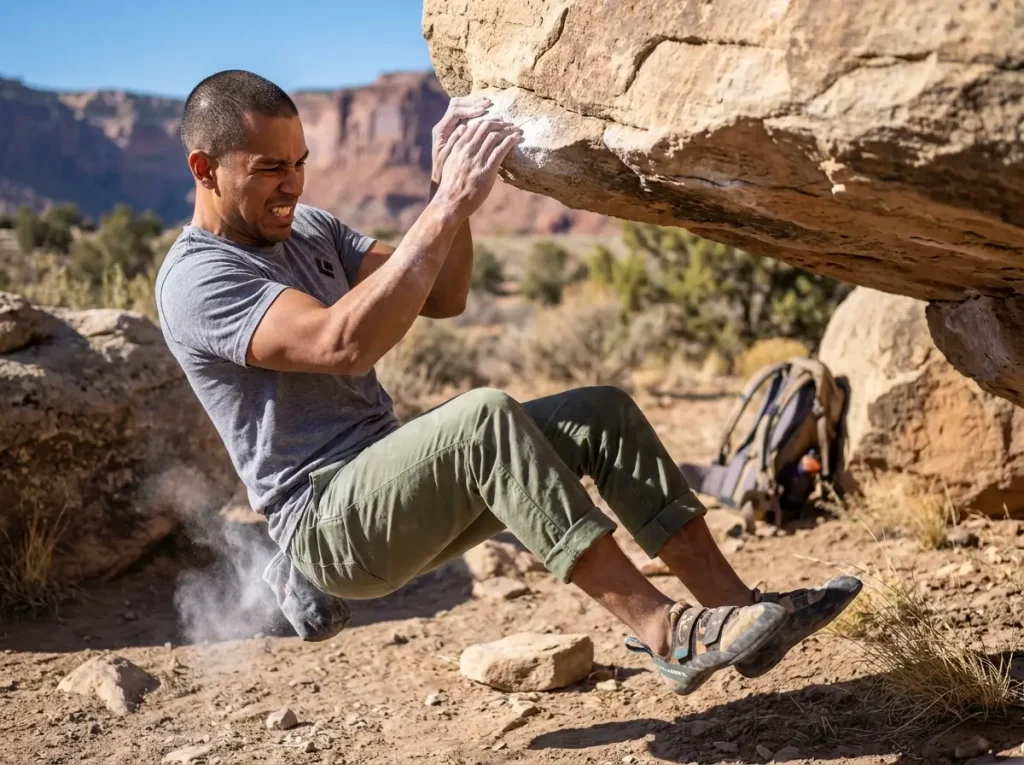
Rare but catastrophic. On highball problems or bad topouts, a backward fall without a pad can put your head on a direct collision course with rock. This isn’t the kind of injury you walk off. It’s the kind that changes lives. The risk is low on problems under six feet, but it scales fast with height and complexity.
How Terrain Changes the Risk Equation
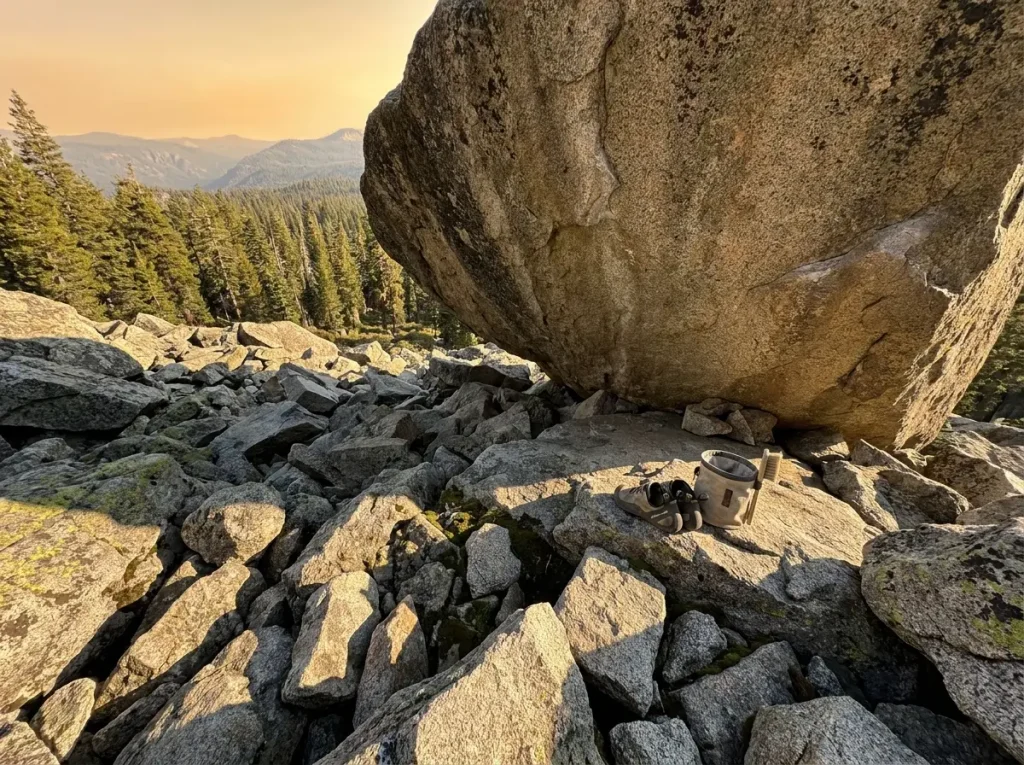
Flat Dirt and Grass — The Lowest Risk Without a Pad
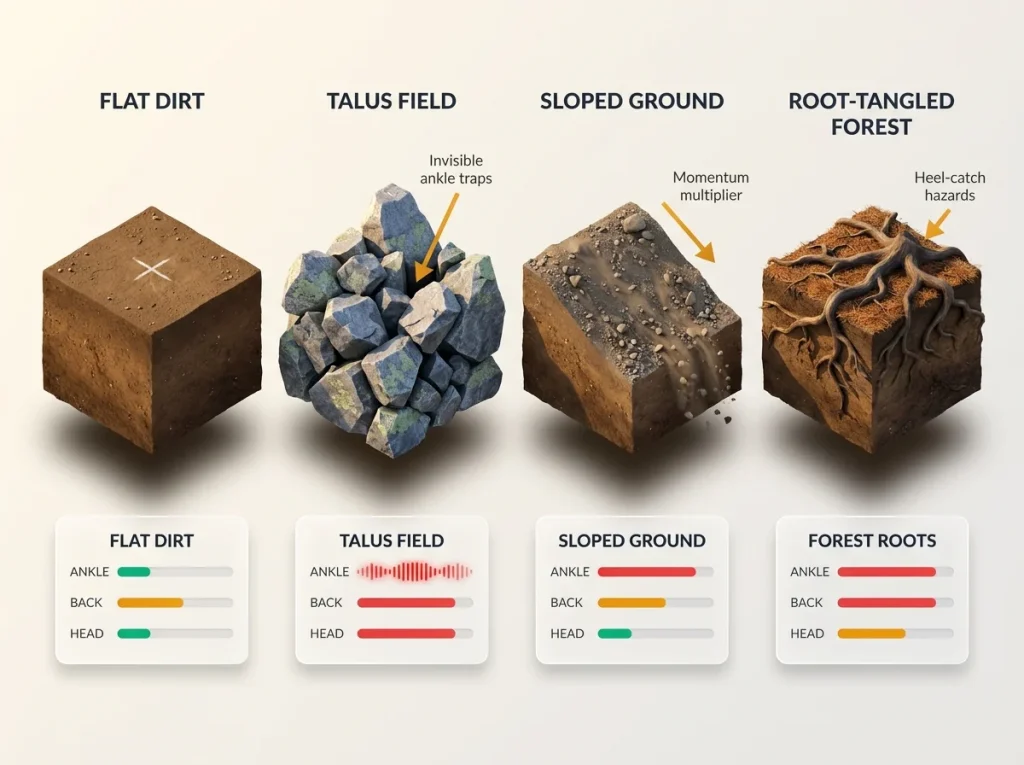
If you’re going to boulder without padding, flat packed dirt or short grass over level ground is the least bad option. It’s still harder than foam — you’ll feel every landing in your knees — but the surface is predictable. No hidden rocks, no ankle-turning edges, no gaps to catch a heel. This is the terrain where experienced climbers make a defensible choice to skip the pad on low problems.
Talus and Rocky Ground — Where Ankles Go to Fold
Talus fields are the most hazardous padless landing zones in bouldering. The gaps between rocks are invisible from above, the surfaces are uneven, and individual stones can shift under your weight. A study by researchers at Frontiers in Sports and Active Living found that the most accident-prone bouldering scenario involves falling from the upper section of a wall and landing on feet — exactly what happens on talus without padding. At areas like Squamish and Bishop, talus landings are the norm, and eliminating gaps in landing zones is the primary job of your pads.
Pro tip: If the landing zone has rocks bigger than your fist and gaps between them, that terrain has already decided for you — you need pads, period.
Sloped Landings and Root-Tangled Floors
A sloped landing redirects your momentum downhill. Your downhill leg takes two to three times the force of the uphill leg, and your ankle has almost no chance of staying neutral. Root-covered forest floors — common at Fontainebleau, Magic Wood, and Pacific Northwest areas — add trip hazards to the equation. Roots grab your heel or twist your foot mid-landing. Wet conditions make everything worse. Rubber shoe soles on damp rock or mud offer almost zero traction on impact.
Reading Terrain Like a Veteran
Good boulderers don’t just read the rock above them. They read the ground below. Before you commit to a problem, where you drop your pad matters more than you think — and when you don’t have a pad, reading the terrain is all you’ve got. Identify the flattest area, check for hidden hazards, and plan your fall direction. Veterans do this automatically. If you’re newer to outdoor bouldering, force yourself to spend 30 seconds on the ground assessment before you touch the rock.
When Climbers Intentionally Skip the Pad
Low Traverses and Warm-Up Circuits
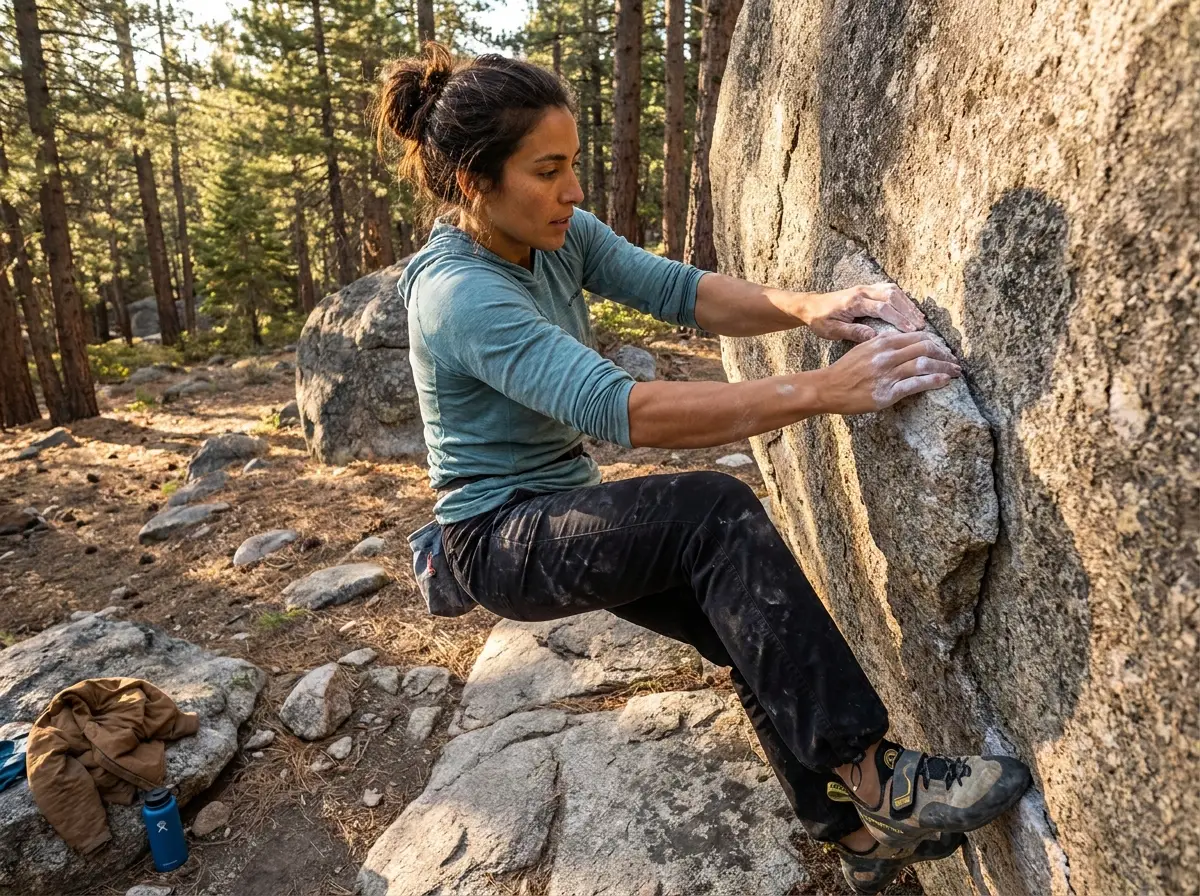
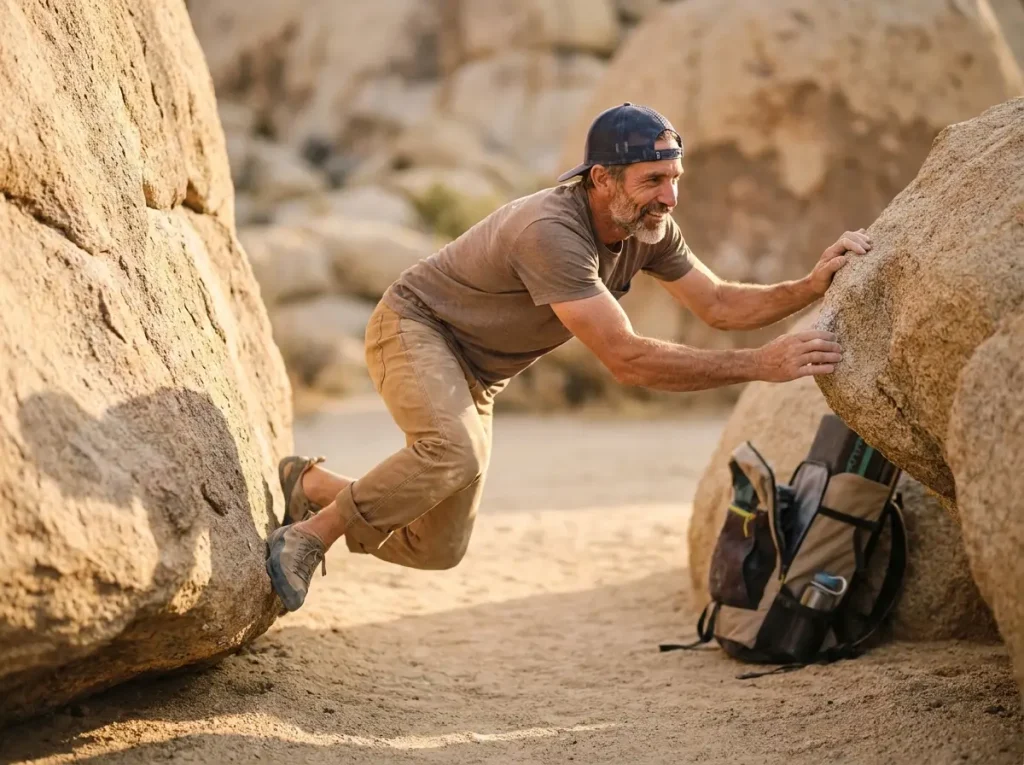
Not every padless session is irresponsible. Low traverses — problems where your feet never get above three or four feet — over flat ground represent the lowest-risk scenario in outdoor bouldering. Veterans at areas like Hueco Tanks and the Front Range regularly warm up on low problems without deploying pads first. It’s the same risk as jumping off a short wall, which everyone does without thinking twice.
Approach boulders near the parking lot — the ones you do in approach shoes to loosen up — fall into this category. The key distinction is height and terrain: chest height or below, on flat ground, with controlled movements. No dynamic throws, no uncertain topouts.
The Historical Context
Before 1992, all bouldering was padless. John “Verm” Sherman, who put up hard problems at Hueco Tanks through the 1980s, described the era bluntly: you had to be a masochist to be a boulderer. Climbers like Ron Kauk improvised with mattresses and sofa cushions wrapped in duct tape. The first commercial crash pad — the Sketch Pad, made by Verm and Bruce Pottenger — changed the sport permanently. Pads didn’t just reduce injuries. They opened terrain that was previously too risky to attempt.
The outdoor bouldering ethics protocol has evolved since then. Modern pads are light, portable, and effective. Choosing to skip them requires a reason beyond “I don’t feel like carrying one.”
The Overconfidence Trap
Here’s the angle nobody talks about: pads can create false security. “I have pads, so I’ll try the highball” is how people end up falling from 15 feet onto a pad that shifted, or landing on the edge and rolling off into the rocks. Measured padless climbing on low problems — where you choose your problems based on consequence, not ambition — can sometimes produce better outcomes than overconfident pad-assisted attempts on high problems with bad landings. The pad isn’t a magic shield. It’s one piece of a risk management system that includes judgment, fall technique, and honest self-assessment.
Fall Technique That Saves You With or Without Pads
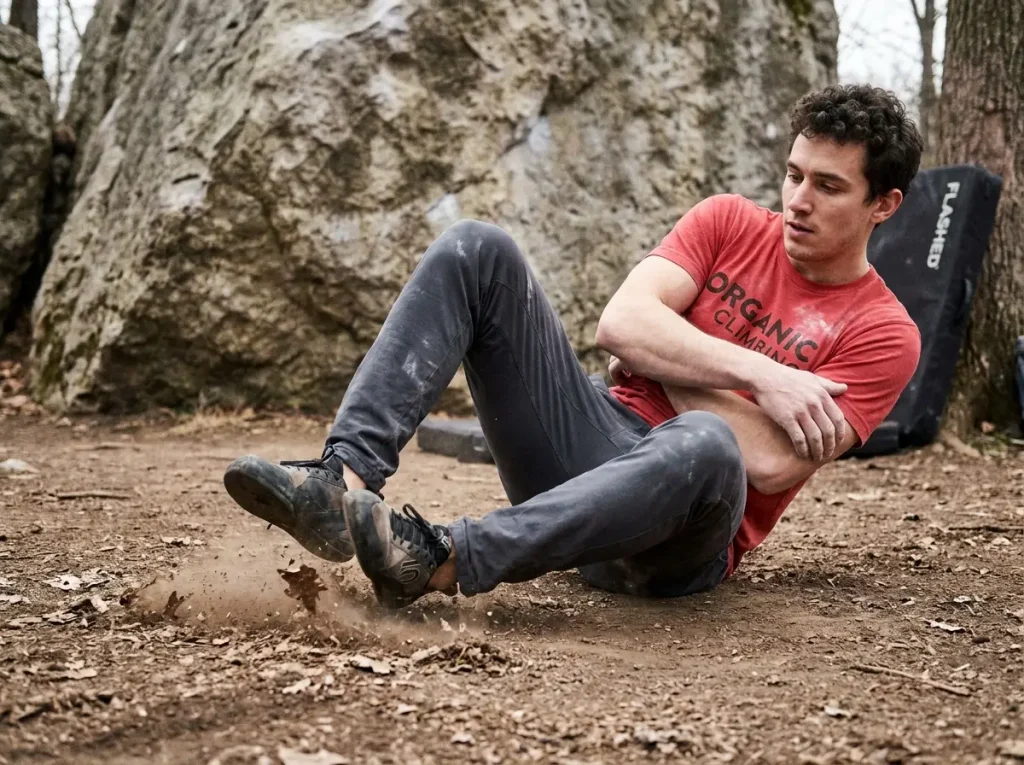
The Landing Sequence That Distributes Force
Good fall technique is the closest thing to insurance that doesn’t cost anything. The sequence: land on both feet in a shoulder-width stance with soft, bent knees — never locked. Let your butt drop toward the ground as your legs absorb the impact. Then roll backward, letting your back contact the surface while your arms are tucked tight against your chest. This distributes impact force across your feet, legs, butt, and back instead of concentrating it in one joint.
The “wet noodle” concept captures it: don’t resist the fall. Absorb and redirect. Your legs are your primary shock absorbers, but they work best when the rest of you follows through instead of fighting the momentum.
T-Rex Arms and the Wrist Protection Rule
The single most preventable bouldering injury is the wrist fracture from an outstretched hand. When you fall, your arms go into T-Rex position — elbows bent, forearms pulled tight against your chest, hands near your collarbones. This is counterintuitive because your survival instinct screams “catch yourself.” Override it. Your wrists can’t handle the load. Your back and legs can.
Pro tip: Borrow a trick from judo — when you land on your back, slap the ground with your forearms and palms flat, slightly away from your torso. The slap distributes force across a wide area and engages your core to stabilize your torso. It sounds odd. It works.
Downclimbing — The Fall That Never Happens
The best fall technique is not falling at all. Downclimbing is the most underrated skill in bouldering — the ability to reverse your moves and get back to the ground under control when a problem feels wrong, the sequence doesn’t go, or you’ve gotten higher than you’re comfortable with. Most climbers never practice it because it feels like quitting. It’s not. It’s the skill that lets you keep climbing at 50. Check our practice falling drills for structured progression on controlling your descent.
Practice Before You Need It
Falling well is a trained skill, not a natural one. Start on low problems — three to four feet — and practice dropping off intentionally. Work through the landing sequence ten times before you even start climbing for the session. Graduate to slightly higher drops as your confidence builds. The goal is making the correct landing mechanics automatic so they fire when you don’t have time to think. Read about bouldering fall mistakes that send you to the ER for the specific errors to avoid.
Solo Bouldering Without a Pad — The Compounding Risk
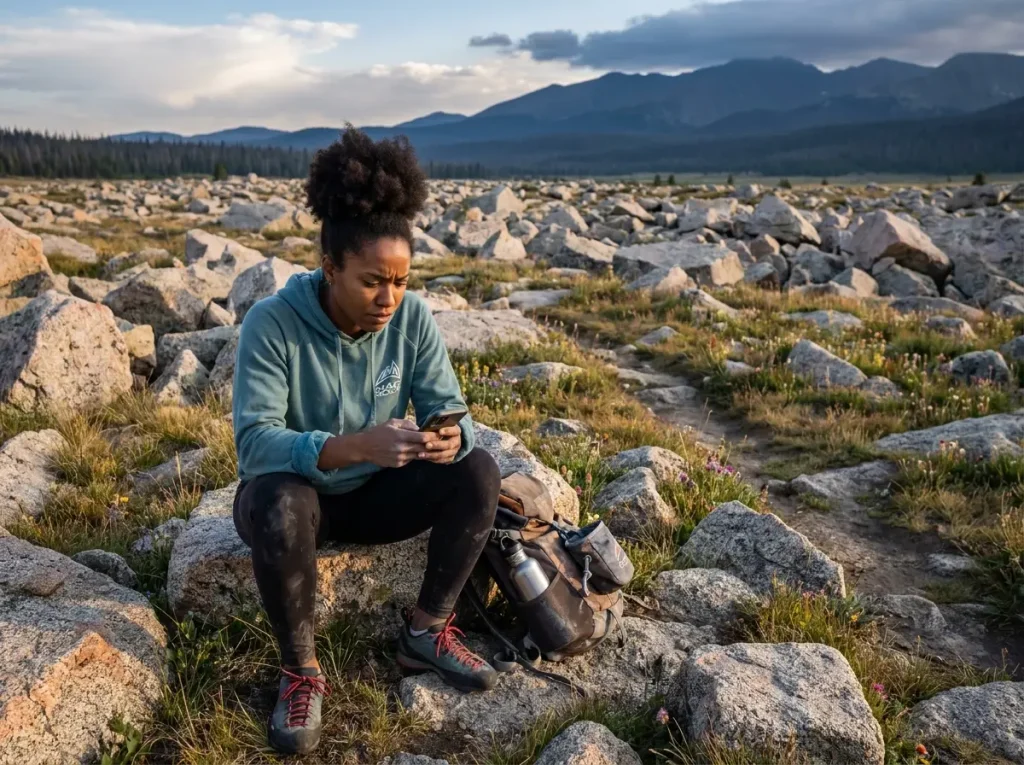
When Nobody’s Watching Your Back
Solo bouldering is common. Solo bouldering without a pad in a remote area is where the risk math changes completely. Without a spotter, nobody redirects your fall, nobody moves pads (if you had them), and nobody calls for help if you can’t get up. Every risk factor from the previous sections — ankle sprains, wrist fractures, back injuries — now exists in an environment where getting hurt means getting hurt alone.
The Self-Rescue Calculation
A rolled ankle at your local crag with friends is an inconvenience. The same injury three miles from the trailhead, alone, with no cell service, is a potential emergency. The Accidents in North American Climbing database includes cases where straightforward bouldering injuries became serious situations purely because of isolation and delayed rescue. The injury itself wasn’t life-threatening. The location made it so.
A Practical Framework for Solo Sessions
If you’re going to boulder solo without a pad — and some climbers will, no matter what anyone says — build guardrails around the risk. Stay below chest height on flat, predictable ground. Stick to problems you’ve done before or problems with obvious, low-consequence movement. Tell someone exactly where you’re going and when you’ll be back. Carry a whistle and a headlamp — two items that weigh almost nothing and could save your life if you’re stuck after dark. Read the pre-climb safety checklist before your next session, solo or otherwise.
Pro tip: Set a phone timer for your expected session length. If you haven’t checked in by that time, whoever you told knows something might be wrong. This costs zero effort and it’s the one thing that gets help moving if you need it.
Conclusion
The crash pad changed bouldering forever because it removed the one variable that sent the most people to the hospital — hard, unpredictable ground underneath every fall. Skipping it puts that variable back in play.
Three things to carry out of this article: first, terrain is the risk multiplier — flat ground under four feet is one world, talus under a highball is another, and you should never treat them the same. Second, fall technique matters more than any gear — bent knees, T-Rex arms, back roll, and the discipline to downclimb when things feel wrong. Third, if you’re going solo and padless, build guardrails into your session: stay low, tell someone your plan, and carry a whistle.
The pad isn’t heavy. The hike isn’t that long. But if you choose to go without one, at least make that choice with your eyes on the ground, not just on the rock.
Q1 Is it safe to boulder without a crash pad?
It depends on height, terrain, and your fall skills. Low traverses below chest height on flat ground carry minimal risk without a pad. Anything above head height on uneven or rocky terrain raises the hazard level significantly — ankle injuries alone represent 36.7% of bouldering ER visits.
Q2 What are the most common bouldering injuries?
Ankle sprains and fractures lead at 36.7% of ER cases, followed by knee injuries at 16.8% and elbow injuries at 12.3%. Landing on uneven ground, pad edges, or between pad gaps accounts for a large portion of ankle trauma specifically.
Q3 How do you fall safely while bouldering?
Land on both feet with bent knees, let your butt drop toward the ground, and roll backward with your arms tucked against your chest. Never lock your knees on impact and never throw your hands behind you to catch yourself — that's how wrists break.
Q4 Can you use a mattress instead of a crash pad?
Climbers improvised with mattresses for decades before commercial pads existed. A mattress provides some cushion but lacks the dual-density foam structure that modern crash pads use to absorb impact properly. Mattresses also shift on uneven terrain and don't protect ankles from edge-rolling the way purpose-built pads do.
Safety Notice: Rock climbing and mountaineering are inherently high-risk
activities that can involve physical trauma or fatal incidents. The information on Rock Climbing Realms is for
educational and informational purposes only. Techniques and advice presented here are not a substitute
for professional, hands-on instruction. Conditions and risks vary by location. Always seek guidance
from a qualified instructor before attempting new techniques. By using this website, you agree that you
are solely responsible for your own safety. Any reliance you place on this information is strictly
at your own risk, and you assume all liability for your actions. Rock Climbing Realms and its authors
will not be held liable for any harm, damage, or loss sustained in connection with the use of this information.
Affiliate Disclosure: We are a participant in the Amazon Services LLC Associates Program, an
affiliate advertising program designed to provide a means for us to earn advertising fees by advertising and linking
to Amazon.com. As an Amazon Associate, we earn from qualifying purchases. We are also an official affiliate partner
of Black Diamond Equipment via the AvantLink network. If you click on a Black Diamond affiliate link and make a
purchase, we may earn a commission at no additional cost to you. We also participate in other affiliate programs.
Additional terms are found in the terms of service.