


In this article
Mid-session at a highball in Bishop. You’re on a third-season pad that looks fine from the outside. You stick the crux—feet-first, pushing all your force into both heels—and the pad just gives way with a dead thud. There’s no bounce. There’s no catch. You just slam into the earth. That’s the unmistakable sound of foam that hit its terminal compression set months ago, masquerading as safety equipment.
By the end of this breakdown, you’ll understand the molecular mechanisms dictating foam degradation. You’ll recognize the deceptive “loaded foam” trap brands use to sell cheap setups, and you’ll know exactly how to evaluate whether your gear is still a functional arrest system or just a bag of dead air.
⚡ Quick Answer: Crash pad foam breaks down at a molecular level due to repetitive mechanical stress and cell wall rupture. Most budget pads use low-density foam filled with mineral additives that pack out within two seasons. True pad longevity requires high polymer density, specifically cross-linked polyethylene and chemically stable polyurethane, which resist compression set and maintain their impact attenuation capability substantially longer
| Foam Type Characteristics & Specifications | ||||
|---|---|---|---|---|
| Foam Type | Cell Structure | Primary Function | Layer Position | Lifespan Indicator |
| PE | Closed-cell | Force distribution | Top/Bottom shield | Guttering/Creases |
| XLPE | Closed-cell (3D network) | Premium load distribution | Top/Bottom shield | Micro-crazing |
| PU | Open-cell | Kinetic absorption | Core sandwich | Packs out (Loss of ILD) |
| EVA | Closed-cell | Flexibility/Rebound | Landing layer or baffles | UV surface cracking |
| Loaded PU | Open-cell + Fillers | Budget showroom firmness | Core | Crumbling structure |
The Molecular Architecture of Crash Pad Foam

To understand why some pads last a decade while others die quickly, look past the nylon shell and into the chemistry. The foam does the actual work. It acts as a highly engineered system designed to manage impact force through mechanical deformation.
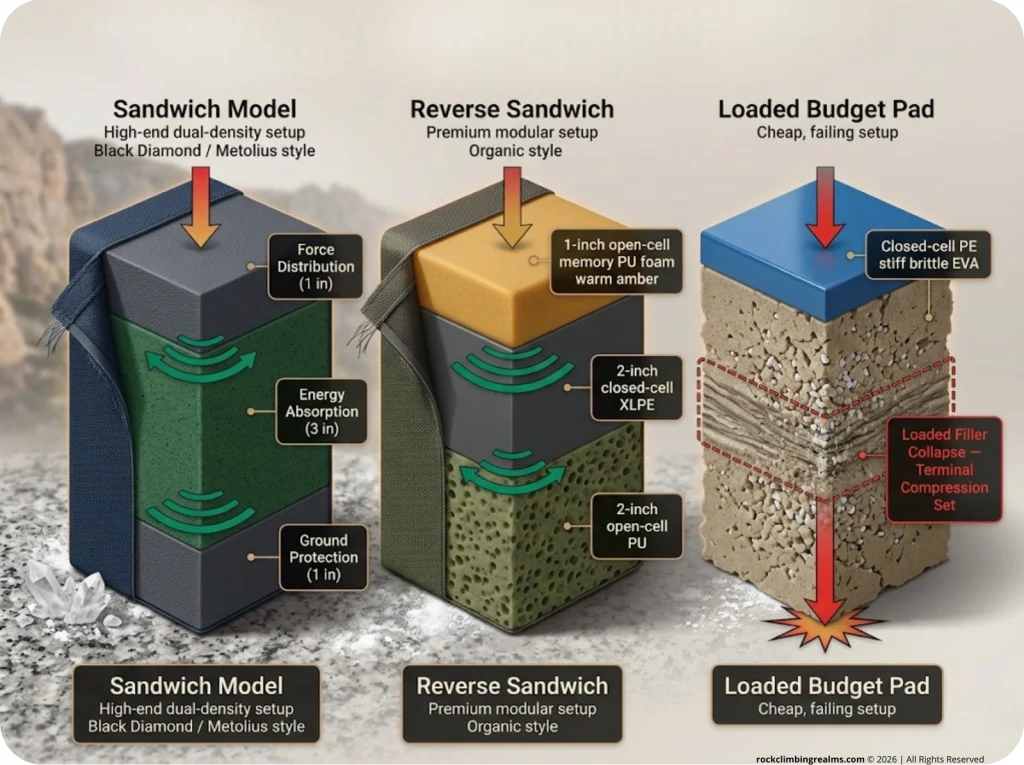
A functional structure relies on closed-cell foam to distribute point-load force. When you fall, the stiff top layer spreads your weight out. Without this distribution, the soft inner core would immediately hit its limit, causing a catastrophic bottoming out against the ground. Premium pads rely on an intensive cross-linked structure to maintain this support.
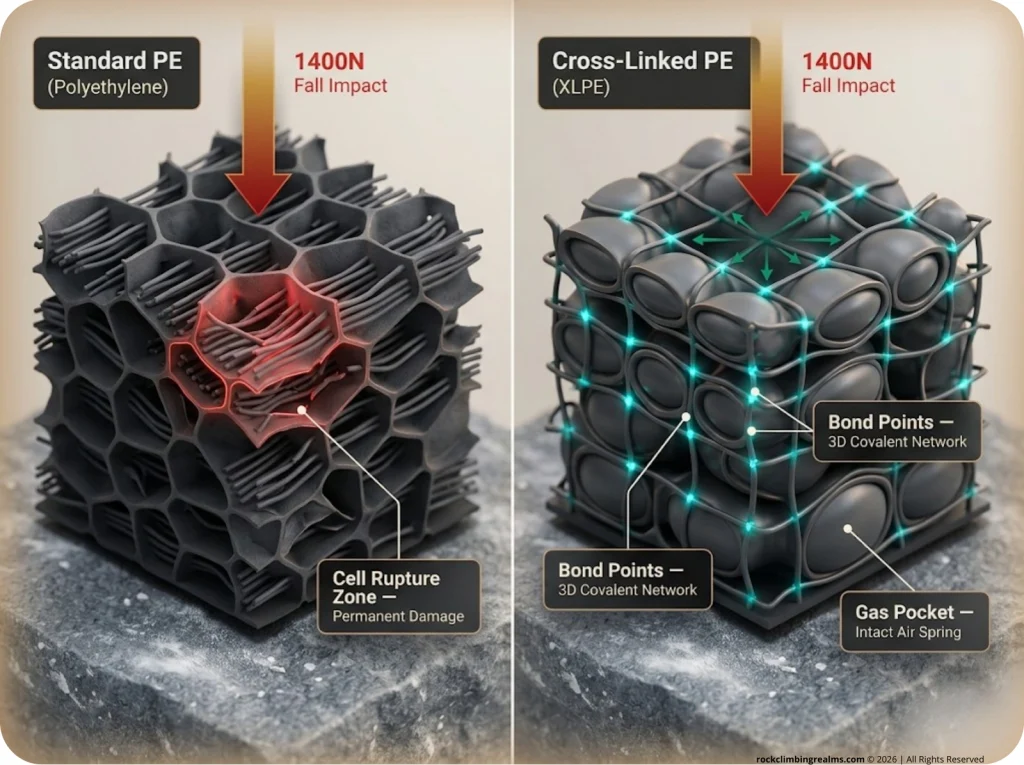
Standard polyethylene (PE) serves as a common structural force-distribution layer. It uses linear polymer chains that provide moderate resistance but lack long-term elastic memory. Brands like Organic Climbing and Asana drop standard PE in their flagship setups, operating instead with cross-linked polyethylene (XLPE). This process locks polymer chains together with covalent bonds, transforming flat plastic into a robust 3D molecular network that drastically increases longevity.
The internal core relies on polyurethane (PU), hitting the mark as the open-cell catch layer. These interconnected cell walls allow air to expel rapidly on impact and pull back in during rebound. This physical air displacement handles energy dissipation effectively. Some manufacturers lean into a memory effect PU variant to minimize energy restitution, stripping the awkward bounce off your landing.
Pro tip: The XLPE difference isn’t noticeable when pulling a pad off the rack at REI. You feel it in year three. A four-hundred-dollar XLPE pad catches like new, while a cheap PE pad sounds like someone dropping a sack of wet textbooks.
When cross-referencing polymer foam energy absorption mechanisms in sports applications, the technical difference dictates how to choose a crash pad based on foam architecture. You aren’t buying the brand logo; you’re buying the density of the polymer matrix.
Polyolefin Structures — PE vs. XLPE
Standard PE handles impacts adequately but hides a severe vulnerability: structural fatigue. Under the high-pressure loading of a nasty fall, the cell walls—frequently thinner than 3 microns—simply rupture. Once a closed cell pops, it stays dead forever.
XLPE creates a vastly different scenario. The 3D covalent cross-linking builds structural stability that acts like armor. It rebounds relentlessly, resists solvents, and blocks moisture. When your heel strikes, XLPE forces that point-load force across a massive surface track before it ever hits the soft core. High-end brands demand XLPE, while mass-market setups stick to standard PE to trim manufacturing overhead and overall pad weight.
Copolymer Resilience — EVA’s Double-Edged Chemistry
Ethylene-vinyl acetate (EVA) acts as a rubber-like structural alternative. Its field performance swings based on the vinyl acetate (VA) ratio. A heavier VA content delivers stronger elasticity and keeps the foam highly flexible in sub-freezing temperatures.
Pads utilize EVA because its kinetic rebound frequently beats standard PE. The drawback is its rapid deterioration from sunlight. EVA degrades quickly through massive UV photo-oxidation. When left exposed to sun, the vinyl acetate bonds break down, causing savage surface brittleness and stripping its shear strength capability. Store your pad in a hot car trunk, and you compound that visible degradation with heat-accelerated compression set.
Kinetic Absorption — How PU Open-Cell Foam Works
The open-cell foam core handles the deceleration. Because the internal cells directly connect, a fall acts like a piston forcing air out of the microscopic lattice. This massive air displacement and the physical buckling of the cell walls bleed your impact force away instantly.
This intense mechanical action forces foam hysteresis, meaning it absorbs the violent sting of a fall efficiently, but generates localized internal heat doing so. Premium PU handles the friction, shedding repeat impacts without structural damage. Cheap PU takes the heat, burns its own bonds from the inside out, and permanently flattens.
The Physics of the Fall — Why Your Heel Strike destroys Pads

Every landing acts as a violent physics equation, and your pad is the singular variable keeping your ankles intact. The problem isn’t taking a fall flat across your shoulders. The real destruction comes from point loading mechanics.
A falling climber generates impact force that a foam system must dissipate. It accomplishes this solely by stretching the load over a deceleration distance. When a setup dies, it shrinks that critical distance. The peak force shooting up through your skeletal system spikes.
A flat-back landing spreads your entire mass. A heel landing focuses your full weight ruthlessly onto four square centimeters. That force easily breaks the foam’s compressive strength and brutally crushes the internal structure. This leaves permanent “crush bands”—layers of densified, crushed cells representing dead space.
Pro tip: One bad, panicked heel strike early in a cold morning session outputs more permanent foam damage than two weeks of flat-back landings in spring weather. Temperature drops combined with massive point loads shatter cheap cell walls.
Medical reporting confirms this grim reality. According to fall scenario data from bouldering injury research, 67% of climbing injuries affect lower limbs, with 74% coming directly from feet-first falls. Degraded foam gives you 3.35 times the mathematical probability of a severe ankle roll compared to firm material. Practicing the biomechanics of a safe bouldering fall paired with an advanced landing technique means absolute zero if the ground underneath you collapses.
impact force and Deceleration Distance — The Physics Simplified
Your mass and speed determine the force generated, and the pad buys you time to stop. A pad suffering a dense 30% compression set lost its functional deceleration distance. Your feet smash straight into the lower density elements too fast.
A clean four-meter drop applies roughly 1,400 Newtons of peak force to your frame on sound foam. On dead foam, that impact number skyrockets past 3,000 Newtons. The ugliest part is that a dead pad often looks structurally immune on the outside.
Surface Stress and Cellular Buckling — What Happens Inside on Impact
When you slam a heel hard, the localized stress concentration sparks crush band formations deep inside the core layers. These obliterated cells never fight back. Every subsequent fall landing in that exact radius compounds the decay.
This structural failure explains why the center of your pad turns to mush while the edges still fight back. Catching a 15% drop in total pad thickness measured at the center confirms terminal foam fatigue.
The “Imaginary Safety” Effect — Why Dead Pads Are Especially hazardous
Dead foam lies to your face. It retains its boxy shape exactly, convincing you it’s safe to toss yourself at a limit move.
The probability of hitting the physical earth climbs steeply with every consecutive session. A single wavered touchdown on an old pad tears ligaments outright and fractures talus bones quickly. Ten solid months of physical therapy and surgery statements eclipse the few hundred dollars you saved running an expired catch system.
The Compression Set Crisis — How Foam “Packs Out”

Foam doesn’t naturally get soft; it undergoes a documented technical failure known as compression set resistance collapse. This identifies the permanent deformation that refuses to bounce back after sucking down a massive load.
When standard closed-cell polyethylene squashes, the internal cell pressure spikes. If that localized pressure beats the wall strength, the microscopic balloons burst. When you pull off the padding, negative pressure traps those ruptured cells flat, severely accelerating the packing out process.
A budget PU system easily records a 30% compression shift within a season. You visually miss it happening, but the mechanical fatigue ensures the foam stops kicking back. Premium R-value precision during engineering halts this, but budget operations dodge the chemistry to maximize speed instead.
Pro tip: Stop trusting the visual check. Compression set collapse hides invisibly inside the core. Test your foam density monthly. Refuse to wait until you bottom out to realize your primary protection is junk.
Real field durability generates objective data through ASTM D3574 compression set testing explained by industrial engineers. You need to grasp how pad integrity integrates into your overall bouldering safety system because a great spotter can’t fix dead plastic.
The Mechanics of Compaction — Cell Rupture and Loft Loss
Cell wall bursting operates like a one-way bleed valve. Heavy polymer boasts solid cell walls that endure the heaviest impacts. Cheap loaded foam leans on paper-thin walls effectively masked by powder.
Looking at the support factor—mapping the load metric at 65% compression versus 25%—high-density foam clocks a 1.80 ratio. Loaded budget foam scores a pathetic 1.10. That mathematically means immediately at the point where a fall turns violent, the cheap padding gives up.
Shore Durometer Ratings — How to Measure Firmness
Objective foam hardness leverages shore durometer ratings. A solid, resilient catch core scales at Shore OO 30–50. The stiff outer distribution shield scales up to Shore A 25–60.
Engineers map this pressing a firm probe solidly into the material. The landing strip requires a rating reading Shore A 30 minimally. When that top level drops below 20, it permanently stops spreading force safely. This diagnostic cuts exactly through the ridiculous marketing hype surrounding firmness claims.
Isocyanate Stoichiometry — Why R-Value Determines PU Longevity
The hidden performance core of PU manufacturing relies fully on the NCO/OH molar ratio, identified clinically as the R-value. A chemically stable polymer network demands a clean 0.95 ratio or higher.
When factories throttle that downward to 0.9 to speed up daily curing times, compression set collapse jumps by 30%. You score a chemically volatile mattress that blows out inside 18 months. Gear brands refuse to post this poor stoichiometry openly on a product tag.
The Loaded Foam Deception — Why Budget Pads Lie

The climbing sector harbors a heavy transparency deficit regarding foam chemistry. Lots of generic pads feel rock solid on the floor, tricking you into thinking you bought serious protection. That constitutes the loaded foam con.
Manufacturers dump mineral fillers ranging from calcium carbonate to straightforward talc tightly into cheap, low-grade PU. They superficially juice the apparent density up to 2.5 pounds per cubic foot. You haul it out of the shop, and the overall pad weight screams top-tier quality. But your money bought dead rock dust, zero polymer mass.
Smashing under the kinetic violence of real bouldering, these abrasive additives just grind the delicate cell walls into garbage within a single projecting block. The filler fractures fast, leaving loose, skeletal structures that instantaneously blow out under your heels. Proper high-polymer-density matrices withstand heavy flex fatigue continuously for seasons without snapping.
Pro tip: Run a physical scale check before you hand a shop your cash. Actual weight confirms real polymer density. If you cross-reference reviews on OutdoorGearLab showing a generic model acting stiff while underweighing an Organic rig, you are funding loaded foam. The physics don’t lie.
Industrial researchers analyzing the fatigue compression mechanics in closed cell foam structures prove powder additives cannot fake real structural integrity. Validate this documentation exactly before evaluating crash pad foam quality before you buy.
Additives vs. Polymer Density — The Chemistry of the Con
Calcium carbonate stays cheap, heavy, and inert. It offers absolutely zero assistance concerning structural tear resistance or long-term cell resilience.
Zooming to the microscopic footprint, loaded foam resembles a plastic sponge packed tight with loose gravel. Every single granular piece creates a tiny crack initiation point. Pound out 50 heavy impact falls, and those particles rip brutally through the foam lines, destroying its core capability to force back.
The Showroom Trap — Why New Pads Feel Identical
For the initial thirty days outdoors, a loaded budget option and a top-line XLPE module feel terrifyingly identical. The thick additives hold strong, masking the extreme structural weakness below the surface.
Pound past the fifty-session threshold, and the drop-off is sickening. The loaded units dump 40% of their total compression set resistance rapidly. The XLPE models rarely register a 5% dent. You can’t spot this trap standing on the floor.
Brand Foam Strategies — How the Top Manufacturers Build Their Pads
Different manufacturing floors engineer varying structural answers to energy dissipation.
Organic Climbing packs an XLPE/PU memory foam hybrid hitting 17–20 pounds. They handle pads as long-term modular safety systems, utilizing easily replaceable core foam pieces when the structure eventually gets packed down.
Black Diamond pushes a dual-density PE/PU format. The Circuit and massive Mondo implement a proven ground-up layering approach to deflect standard crushing.
Petzl fields a highly condensed 3-layer foam sandwich optimized fully for technical transport. The Alto rests around 13 pounds total. It boasts outstanding zip-closure shielding, but the drastically lower density struggles in intense highball drop scenarios.
Metolius consistently builds an angled hinge rig pulling only 9 pounds. It targets the aggressive budget demographic directly but runs a drastically lower tier density optimized for moderate bouldering exclusively.
Mad Rock throws shredded EVA baffles tightly inside the shell. These multi-density laminates contour brilliantly to jagged landing rocks. The glaring flaw is the shredded structural layout burning out twice as fast due to extreme surface area limits of the chopped foam pieces.
Environmental Stressors — What the Storage Shed Is Doing to Your Pad

If intense physical abuse fails to smoke your foam setup, ambient ignorance will. Heavy environmental extremes ruthlessly obliterate polymer chains right inside the shed before you ever hike out.
Let’s address thermal sensitivity. Shoving EVA near its hard glass transition temperature directly triggers cold weather brittleness. Stomping on a frozen pad causes the microscopic cell walls to fracture mechanically. One harsh fall on frozen rigid closed-cell material permanently ends its functional loft capability.
Intense heat damages just as severely. Throwing a pad inside a massive 150-degree trunk softens the entire molecular matrix. Severe heat triggers constant internal slippage right between the core polymer chains. Striking a sun-baked block inflicts extreme destruction instantly. Add in nasty water soaking through a high denier Cordura nylon shell, and you force the open-cell core directly into rapid hydrolysis, rotting the primary urethane linkages.
Pro tip: The two fastest methods to destroy your entire floor setup: crushing it folded backward in a parked van, and launching onto it mid-January ignoring the temperature. Keep the rig directly in the sun for twenty solid minutes before you commit to hitting it hard.
Serious laboratory researchers study the explicit temperature effects on polyurethane foam mechanical properties because ambient air wrecks energy absorption mathematically. This drives the importance of crash pad care in the field — vegetation damage and outdoor storage when throwing your protection in the damp mud.
Thermal Sensitivity — The Cold Session and the Hot Car
EVA hits an aggressive brittle state roughly around zero degrees Celsius. The synthetic material transitions directly from elastic to an icy glass state. Instead of properly flexing underneath your aggressive full weight, it cracks microscopically instantly.
Intense heat roasts the internal matrix structure. Left in a baking garage, internal foam deforms down under its own native mass without any added physical hit.
Moisture and Hydrolysis — The Silent Rot
Heavy moisture rips urethane linkages effectively. Tossing a soaking system in the closet breeds a damp, horrible microclimate inside the tough shell.
This trapped humidity incites heavy mold generation while chemically snapping the polymer down into tiny pieces. Storing a wet setup for thirty days destroys 20% of its native support muscle. Avoid the hit by standing the block vertically out of direct UV rays and blasting massive airflow constantly until the core zeroes out.
Storage Protocols That Extend Pad Life
You have to store the rig flat. What hinge type you purchased doesn’t matter if it’s compressed under pressure. Taking a taco hinge or a standard clamshell hinge and crushing it forcibly folded for serious months destroys 70% of the mathematical attenuation along the fold path. You dig a permanent gutter directly in the exact center zone.
Leave the block laying inside a dry room holding cool temperatures. Hit the outer shell quickly with a vacuum, because packed abrasive dirt grinds through directly like razor wire exactly when the foam compacts underneath you. Throw down a skinny slider pad handling the massive initial shock and easily extend your heavy primary block’s lifespan drastically.
Diagnosing a Dead Pad — The Field Tests That Work
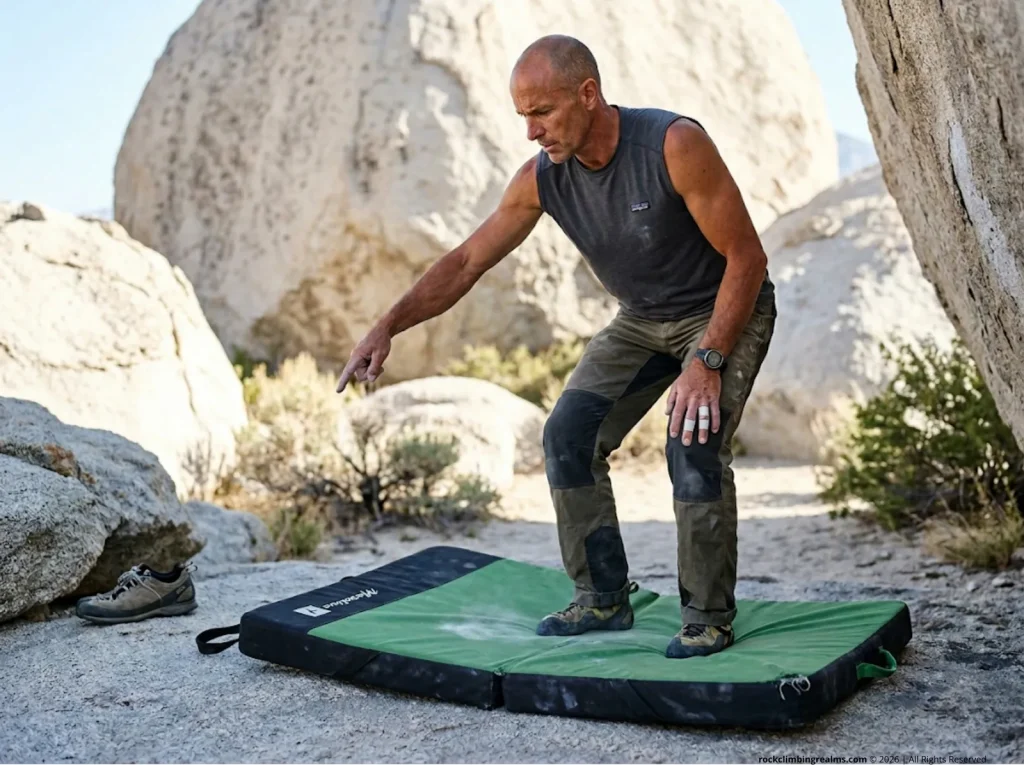
It proves hard to manually distinguish fresh broken-in setups from fully blown-out trash. You desperately need an explicit, hard process to confirm your catch system isn’t failing you on the impact strike.
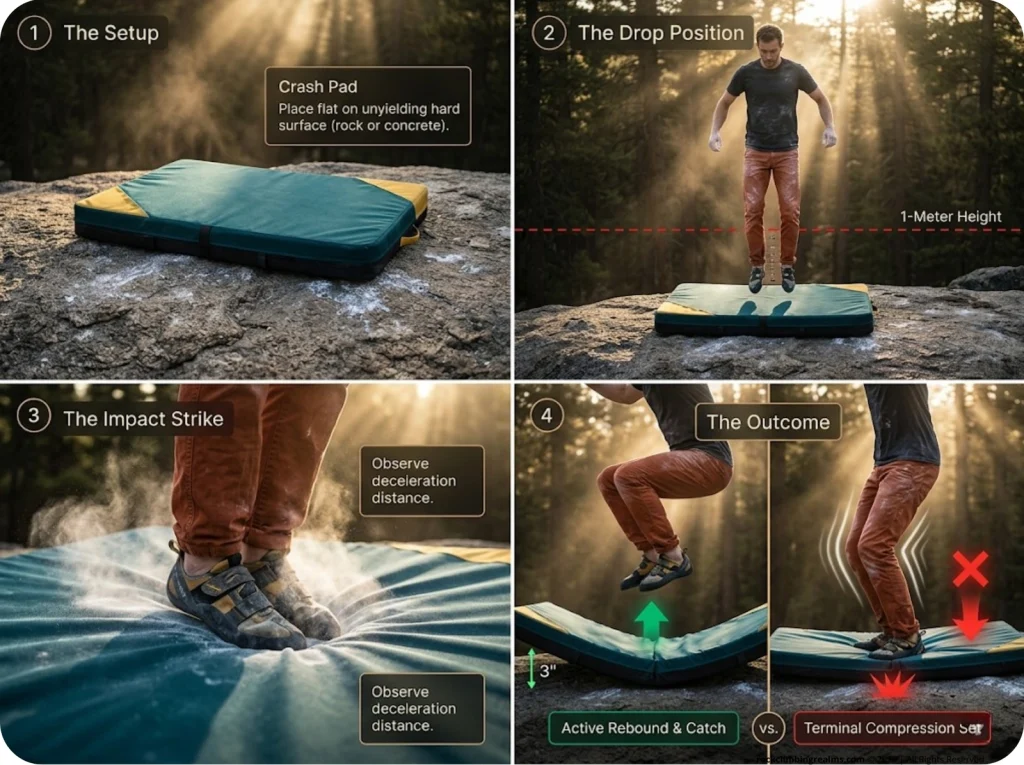
The harshest test remains the explicit foam failure test, commonly identified as the Land Feel Test. Conduct the check directly against a flat concrete strip—absolutely no grass or dirt. Leap into the strict center falling from exactly one meter high. Solid engineering catches you quickly pushing noticeable return bounce. A blown matrix produces a dead slap. If the bottoms of your climbing shoes strongly feel the concrete, legally retire the trash instantly.
Merge this directly with tight pad thickness measurements. Run a stiff ruler measuring the dead center comparing directly against the stiffened outer edges. A straight 15% missing volume proves brutal structural collapse. Execute tight side-by-side drop tests utilizing a tight ten-pound weight measuring the physical depth cratering.
Pro tip: Check the system utilizing the exact LFT method once a month during the main projecting block. Sparing thirty tight seconds absolutely tells you exactly how destroyed your open-cell structure looks inside.
Mapping out exactly when the block hits terminal collapse manages systematic gear retirement criteria across your climbing kit. Visual checking the nylon fails to show chemical breakdown deep inside the system.
The Land Feel Test — A Field Protocol for Any Climber
Plant yourself roughly at belt height, one exact meter, floating directly over your flat target. Leap directly inward.
If the internal layers lock tight handling your mass properly, you look fine. If you instantly bang the absolute bottom pushing zero energy bounce whatsoever while slamming into the hard slab, cut the physical block quickly, making a basement couch immediately. Recheck it after hauling in massive drops exceeding the four-meter limit specifically.
Thickness and Shore Measurements — Quantifying the Decline
Pull out an explicit stiff metal measuring rig. When the strict absolute middle drops one solid inch deeper than the outermost corner edge, your internal crushed layers fully cemented permanently tight.
You execute an informal direct breakdown push tightly in the driveway. Drop a massive iron plate straight down hitting the dead center spot while timing the exact physical compression for a solid minute. If that heavy ring sinks roughly 20% lower than the original baseline height, your actual core failed chemically.
The Retirement Decision — When Safety Requires Action
There holds exactly zero financial justification allowing you to hit hardcore limits relying on dead gear.
If tight cash jams you, downgrade a blown setup acting as secondary sliding armor exclusively. Slam it directly under a fresh, dense system pushing massive stack numbers high. Never deploy it trying to secure your main hit. The Organic replaceable setups let you keep the intense nylon layout exactly while just dropping fresh structural modules inside constantly.
Conclusion
Foam ages deep at the intense molecular chemical level, exactly not at the bright visual marker level whatsoever. If you idiotically wait directly until the thick outer nylon cover officially explodes tearing away before retiring the rig, you risked your actual critical ligaments dropping heavy on permanently dead trash constantly for heavy seasons straight.
Compression set resistance loss holds the executioner role primarily. When exactly dense polymer severely stops fighting back refusing the physical re-loft command, the expensive brand logo stamped onto the top stays irrelevant.
The actual loaded foam industrial process runs relying exclusively on consumer ignorance. cheap layers feel aggressive sitting inside the gear shop exactly because you squeezed active thick rocky powder, not properly cross-linked synthetic density chemically. That cheap stiffness borrows severe time right before the absolute core structure snaps instantly.
Go push the exact Land Feel Test standing in the hot driveway right immediately today. Hit it hard dropping from the specific waist height. If it grabs you, throw it into the dark truck quickly. If it directly slaps the rock ground stopping fast, you know what exactly happens constantly to massive chemical polymers.
FAQ
What is the difference between open and closed cell foam for crash pads?
Closed-cell takes your initial point load and spreads it wide so you don’t punch a hole through the mat. Open-cell foam absorbs impact force internally by forcing air quickly out of its matrix to slow your frame down. Top-tier layouts sandwich a heavy open-cell core directly between dense closed-cell outer shields.
How long do bouldering pads last?
Pad lifespan relies on massive polymer weight. Generic blocks crammed tight with heavy mineral load fillers push the absolute terminal compression set, dying in exactly twelve to eighteen fast months holding minimal sessions. A legitimately dense XLPE heavy core holds heavy physical drops maintaining hard structural integrity pushing three heavy to five solid years quickly.
Why are some crash pads so stiff?
Legitimate dense stiffness comes from a secure 3D continuous network locking tightly inside heavy thick polymer. Total fake aggressive stiffness happens pushing severe rocks dumped straight inside trash low-density material. The budget mat tightly feels heavy the single first exact solid day easily, but the cheap chemical layout snaps wildly tearing into dead heavy dust inside one massive hard projecting active timeline.
Can you replace the foam in a crash pad?
You can push it, but few brands support this move. Organic Climbing manufactures modular replacement pieces exactly designed so you don’t just dump a good thick nylon cordura skin layout directly into heavy trash. Changing physical internal pieces on standard builds requires cutting and sourcing your exact custom precise XLPE blocks demanding finding specific proper density matches.
How do I know if my crash pad is dead?
You commit the LFT pushing hardcore side-by-side drop tests onto hard driveway concrete. If you launch three exact tight feet hitting stopping pushing a massive heavy hard thud lacking bounce, that internal layout officially snapped. Check the direct middle measuring exactly looking for a severely thick heavy 15% missing measurement compared to heavy firm stiff edges or visually spotting a tight heavy permanent line exactly matching the direct hinge, throwing that block out of active heavy primary severe action instantly efficiently.
Safety Notice: Rock climbing and mountaineering are inherently high-risk
activities that can involve physical trauma or fatal incidents. The information on Rock Climbing Realms is for
educational and informational purposes only. Techniques and advice presented here are not a substitute
for professional, hands-on instruction. Conditions and risks vary by location. Always seek guidance
from a qualified instructor before attempting new techniques. By using this website, you agree that you
are solely responsible for your own safety. Any reliance you place on this information is strictly
at your own risk, and you assume all liability for your actions. Rock Climbing Realms and its authors
will not be held liable for any harm, damage, or loss sustained in connection with the use of this information.
Affiliate Disclosure: We are a participant in the Amazon Services LLC Associates Program, an
affiliate advertising program designed to provide a means for us to earn advertising fees by advertising and linking
to Amazon.com. As an Amazon Associate, we earn from qualifying purchases. We are also an official affiliate partner
of Black Diamond Equipment via the AvantLink network. If you click on a Black Diamond affiliate link and make a
purchase, we may earn a commission at no additional cost to you. We also participate in other affiliate programs.
Additional terms are found in the terms of service.