
In this article
Most climbers spend their first alpine season terrified of the dramatic fall — the slip on a steep face, the textbook self-arrest, the moment the posters at every mountaineering shop train you to picture. I did too, right up until I watched a partner nearly slide off a low-angle ridge on the walk down from an easy summit, guard completely gone, the hard part already behind us.
That is where alpine days actually unravel: on the moderate ground, late, when you have stopped paying attention. The skills that keep you alive up high are rarely the flashy ones. Here are the seven that separate climbers who come home from the ones who don’t.
Skill 1: Ice Axe Control
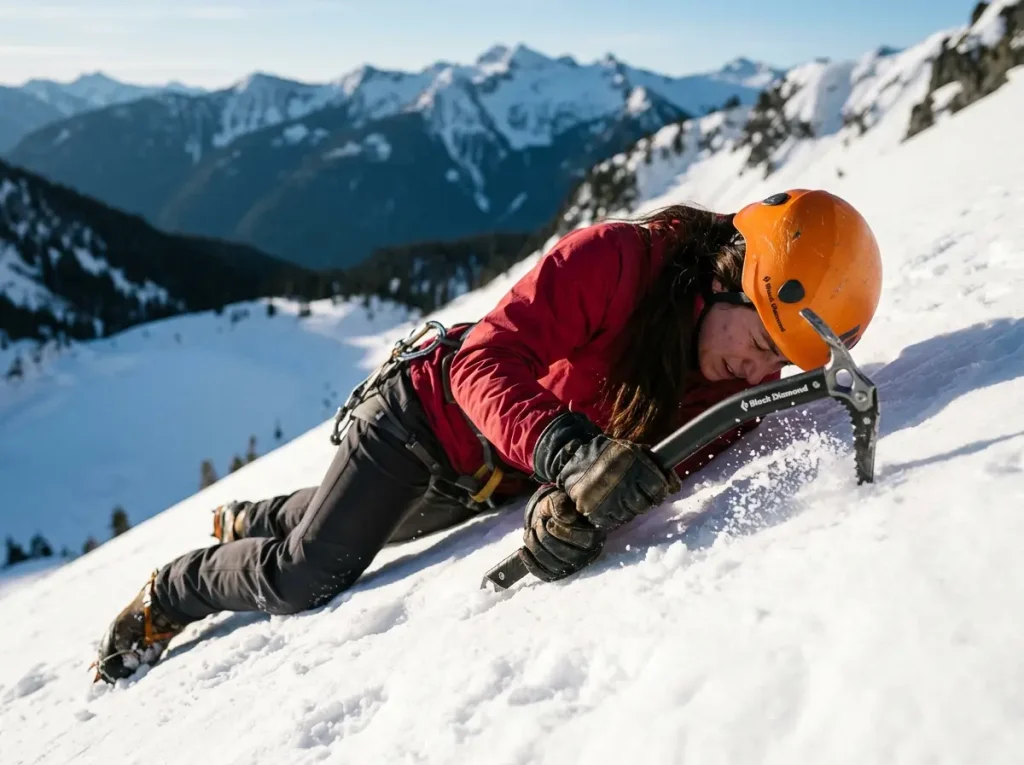
The self-arrest posters at every gear shop sell you a tidy story: you slip, you roll onto your ice axe, you stop. It is a comforting story. It is also the wrong thing to build your alpine climbing on.
The axe earns its keep long before you are ever sliding — in the boring, unglamorous grip you hold on every step up a snow slope. Get that grip right and you mostly never test the dramatic part.
How to Hold Your Ice Axe (The Grip Most People Get Wrong)
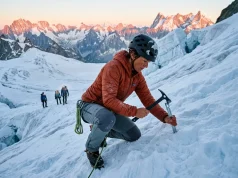
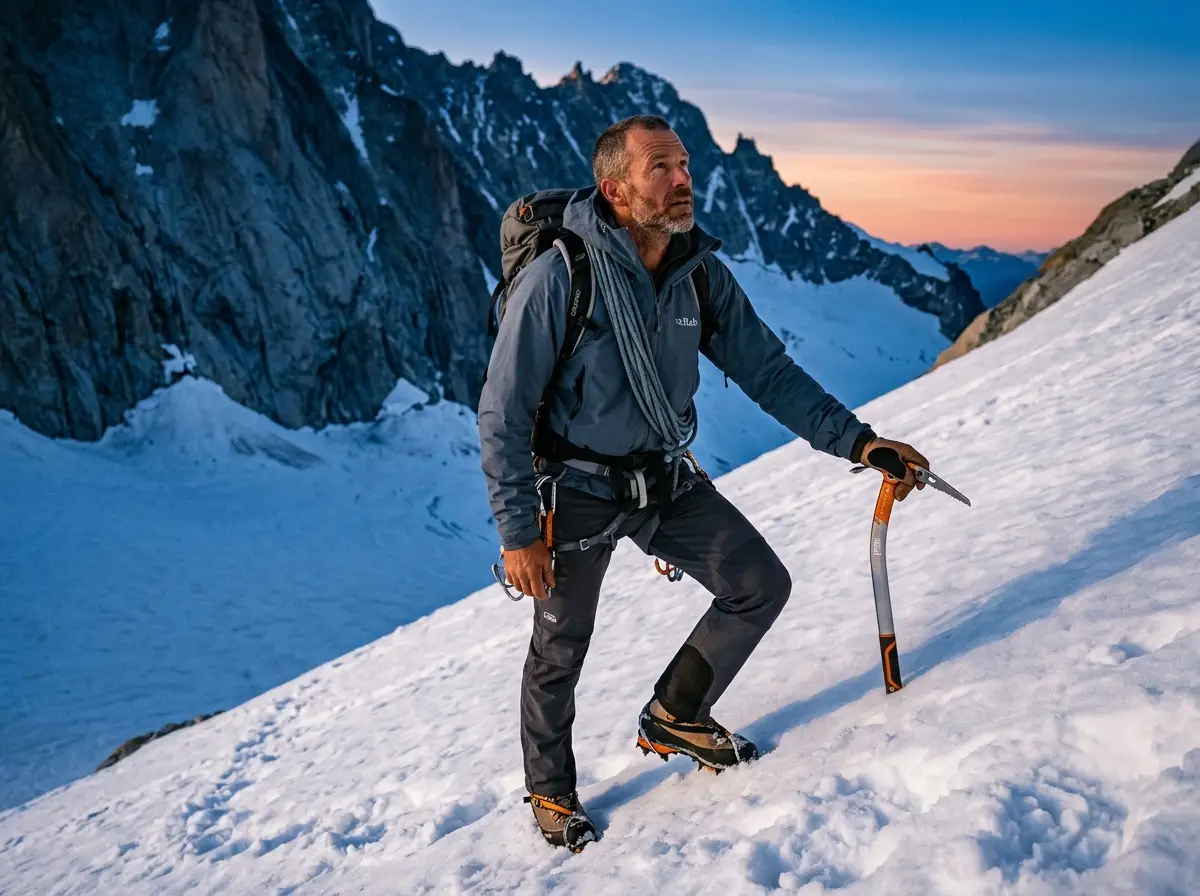
The default is the cane position: spike down into the snow, pick pointing forward, your uphill hand wrapped over the head of the axe. It looks almost too casual, like you are using a walking stick, and that is exactly the point — it gives you a third point of contact and lets you pivot instantly into a stronger position when the slope steepens.
Most beginners blow this on day one. They grab the axe like a hammer, or point the pick backward, and now the tool is useless before they even need it. The fix is dull and it works: hold it in the cane position every single step, switch hands every time you change direction on a traverse, and let it become automatic on easy ground so your hands already know the move when the ground is not easy.
Walking Positions and When to Switch
As the angle kicks back, you move from cane to dagger position (holding the head and driving the pick into the slope at chest height) and finally to the self-arrest grip on genuinely steep, committing terrain. The thing nobody tells you at the trailhead: on slopes past 40 degrees with hard, consolidated ice, a self-arrest is often a fantasy. The American Alpine Club’s snow climbing principles (read them here) put it bluntly — on that kind of surface the axe primarily prevents falls rather than arresting them. You stop the fall by not falling: solid crampon work, weight over your feet, and an axe already planted before you needed it.
Self-Arrest: Practice Before You Need It
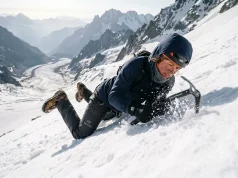
The American Alpine Club tracked snow travel accidents for over a decade, and the failure pattern that showed up again and again was not broken gear — it was Failure to Self-Arrest. In plain terms: people who never drilled it on a safe slope assumed they would figure it out the first time it mattered, with adrenaline running and a real slope under them. They do not figure it out. You have to practice from every starting position — face down with your head uphill, face down head downhill, flat on your back, feet first — on a gentle runout with no rocks below, until the response is muscle memory.
If you want the full breakdown, our guide to the exact self-arrest technique walks through each one. And watch it done before you try it — the grip transition is far easier to see than to read.
The first time most people practice self-arrest, they discover their pick hand is on backward — the exact wrong move they would have made in a real slide. That is the whole reason to practice. Find that mistake on a soft training slope with a flat runout, not at hour eight on a frozen couloir.
Skill 2: Crampon Footwork and Snow Movement
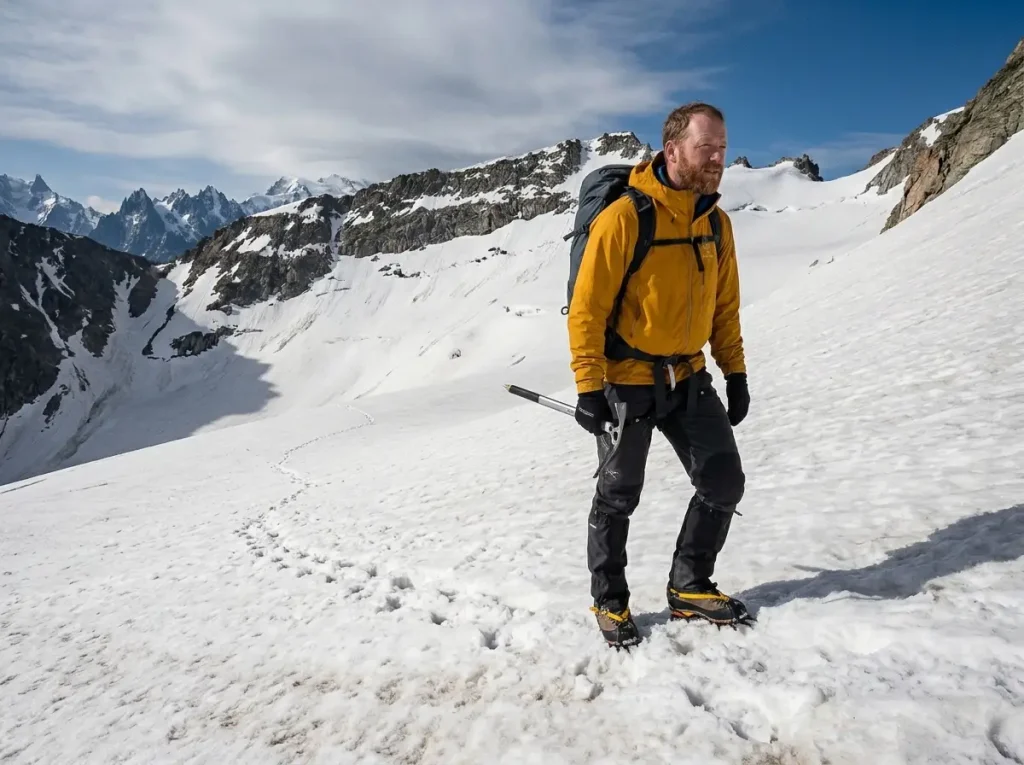
Everyone front-points. It feels confident — toes biting in, calves engaged, the whole foot pointed at the slope like you mean it. Then you front-point for three hours on a 35-degree slope and arrive at the actual steep section with your calves already cooked.
The guides next to you are not doing that. They are flat-footing past you on the same ground, relaxed, saving the high-output technique for when the terrain actually demands it.
French Technique: Your Calves’ Best Friend
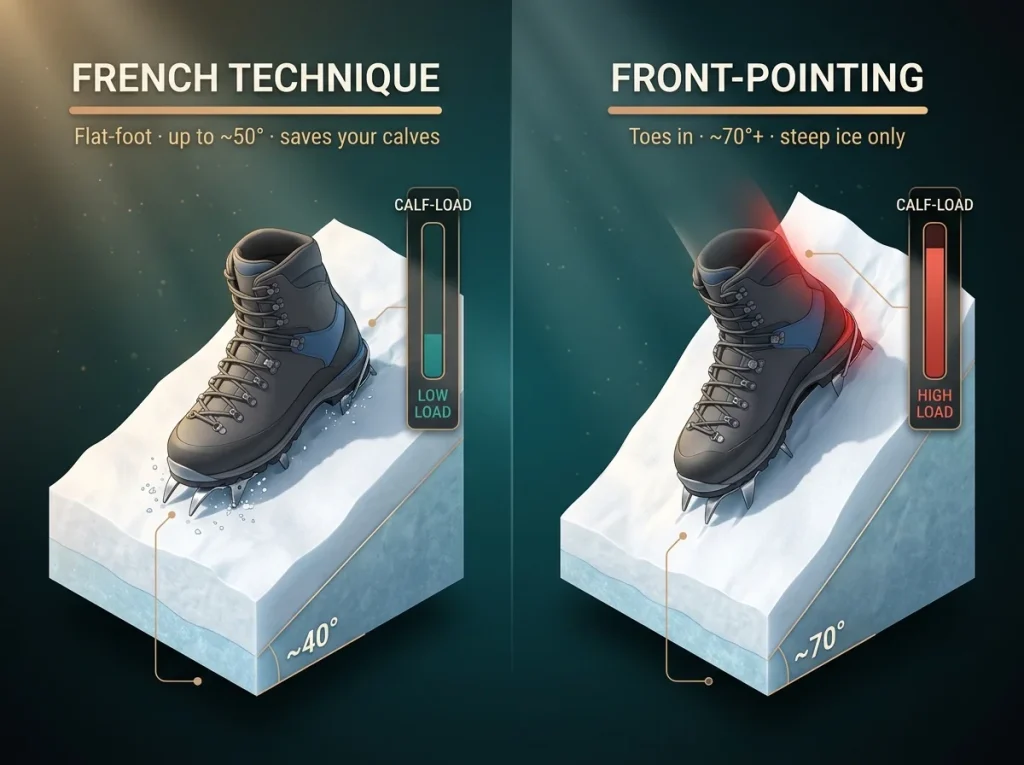
French technique — flat-footing, all the bottom points of the crampon flat against the snow — is the workhorse of moderate alpine terrain, good up to around 50 degrees. It engages your larger leg muscles instead of burning out your calves, which means you can sustain it for the long hours an alpine day actually takes. It feels less secure at first because your ankles have to roll to keep the points flat, and your instinct screams to point your toes in. Ignore the instinct.
On firm névé the flat foot holds beautifully, and your legs will thank you six hours later when you still have something left for the descent. For the full picture of where this style fits in the bigger discipline, here is a complete overview of the alpine climbing style.
Front-Pointing: Only When You Actually Need It
Front-pointing, the Austrian technique, belongs on genuinely steep ground — roughly 70 degrees and up, steep ice, mixed pitches. Up there it is the right tool, the only tool. The mistake is using it everywhere because it feels safer, then having nothing left in the tank when you reach the part that requires it.
Most American guide instruction teaches a hybrid — the American technique — where you blend flat-foot and front-point and switch fluidly as the angle changes underfoot. Learn to read the slope and match the technique to it, instead of bulldozing every pitch on your toes.
Descent Footwork: Where Most Accidents Begin
Going down is where careful climbers get sloppy. The plunge step — locked knee, aggressive heel strike, weight committed downhill — is what keeps you stable descending soft or moderate snow, and it is the exact technique people abandon when they are tired. They start side-stepping everything, tip-toeing, and that hesitant footwork is what catches a crampon point and starts a slide.
One more thing nobody mentions in the manuals: crampon points snag gaiters and pant cuffs constantly, and a snagged point on the descent is a textbook trip-and-fall mechanism. Walk a hair wider than feels natural, keep your steps deliberate, and treat the way down with the same attention you gave the way up.
Skill 3: Glacier Travel and Rope Team Setup
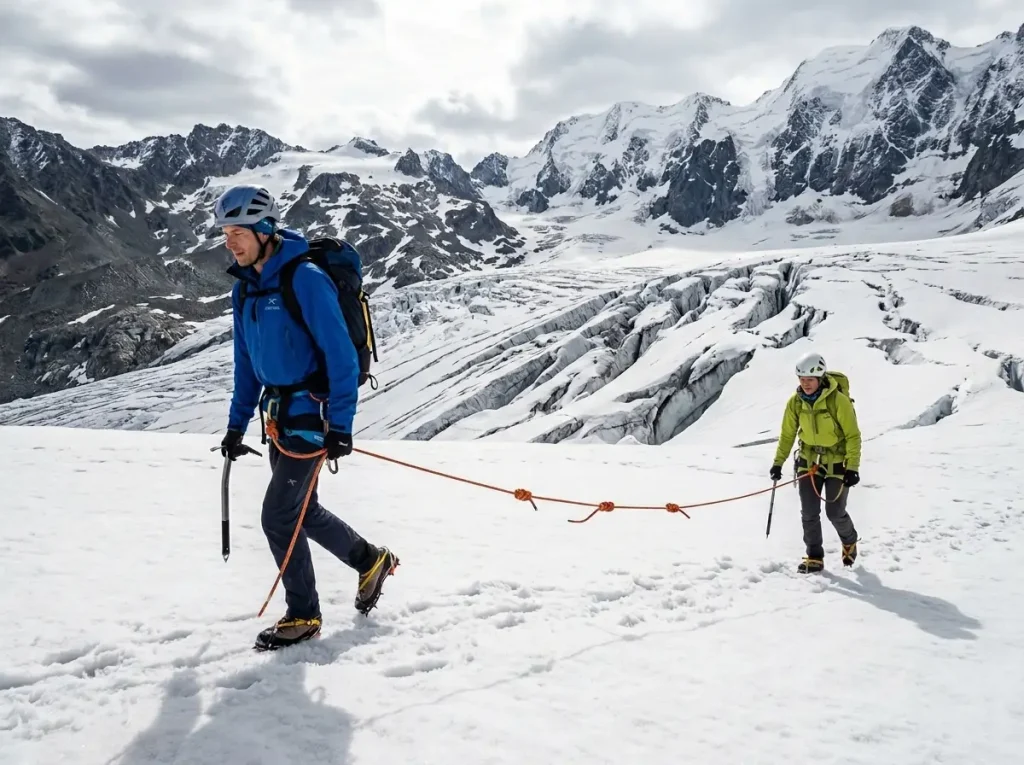
You have roped up. You feel safe. Here is the uncomfortable part: if you are six meters apart with no knots in the rope, you are not protected — you are just more committed to the same outcome as your partner. The gap between looking roped up and actually being protected is enormous, and it lives entirely in details that never make it onto a trailhead sign.
Rope Spacing and Brake Knots: The Setup That Actually Works
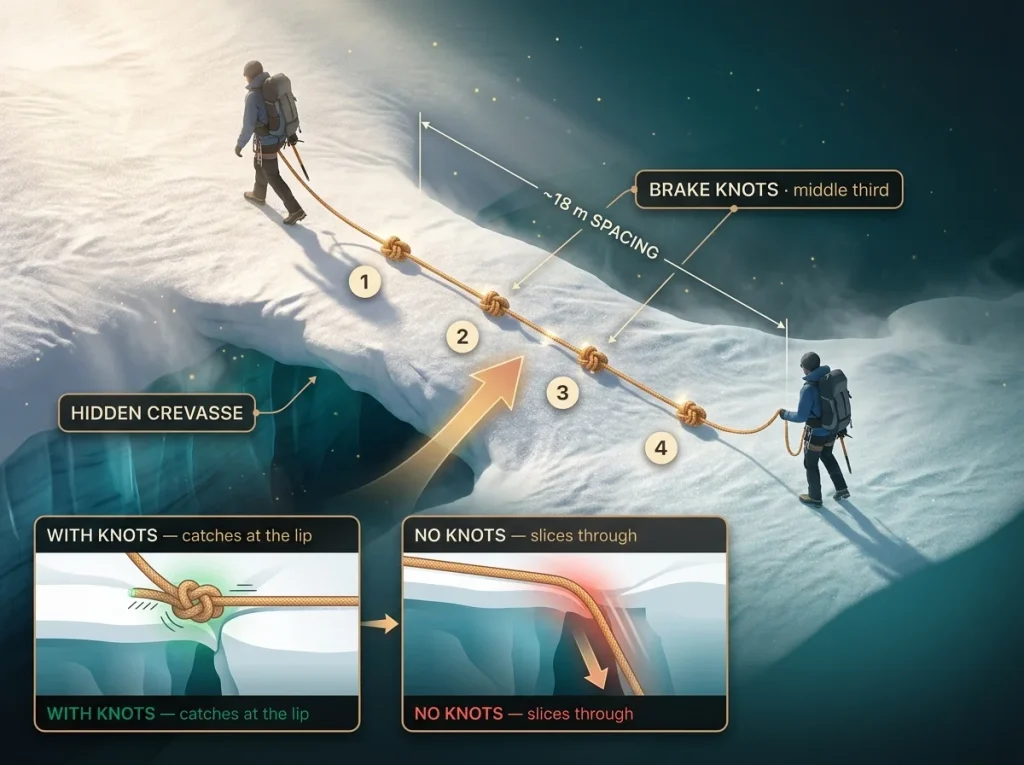
For a two-person team on a crevassed glacier, the working setup is about 18 meters of spacing with four to five brake knots — butterfly knots tied into the middle third of the rope. Those knots are the whole game. If your partner punches through a snow bridge, the knots jam against the lip and into the snow and give friction a chance to stop the fall before it rips you both in. Without them, a two-person arrest on a slick glacier is statistically a coin flip you do not want to be holding.
Petzl’s glacier travel protocol for two-person teams (detailed here) lays out the spacing and knot placement, and it is worth reading before your first glaciated objective rather than after.
When Being Roped Together Makes Things Worse
This is the part almost nobody covers, and it is the most important idea in the whole section. Roping together on steep snow without any protection between you — no placed gear, no snow anchor, no secure stance — does not make you safer. It creates false security and ties two people to one fall.
Will Gadd, who has spent a career in this terrain, puts it about as flatly as it gets: roping together like that just pulls more people off the mountain, not fewer. On ground where a slip is genuinely unlikely, the right call is often to unrope and move efficiently as individuals. On ground where a fall is likely, the rope only helps if it is backed by real protection that can actually stop the load.
This runs against every instinct a new alpinist has, and getting it wrong is how rope teams pull each other down. Thinking through those calls is its own skill, which is why it helps to treat alpine rope management as a strategic decision framework rather than a fixed rule.
Communication and Team Roles on the Glacier
Before anyone steps onto the ice, the whole team knows the same three things: the arrest position, the signal to stop, and the first move if someone goes in. Two-person glacier travel is a categorically higher-risk game than a three-person team, because the surviving climber is both the anchor and the rescuer with no backup. If it is only the two of you on a crevassed glacier, both of you need the full self-rescue sequence dialed cold. And get your coiling sorted on the approach — a kiwi coil for shortening up on the way to the ice, a tidy butterfly coil for the pack carry — so you are not fighting a tangle when the terrain changes.
The first time you rope up on a glacier, you will feel like a real mountaineer. Check the actual setup before that feeling fools you: knots in the middle third, full spacing, both people clear on the rescue. Pride is not protection — the rope only works if the details are right.
Skill 4: Crevasse Rescue Fundamentals
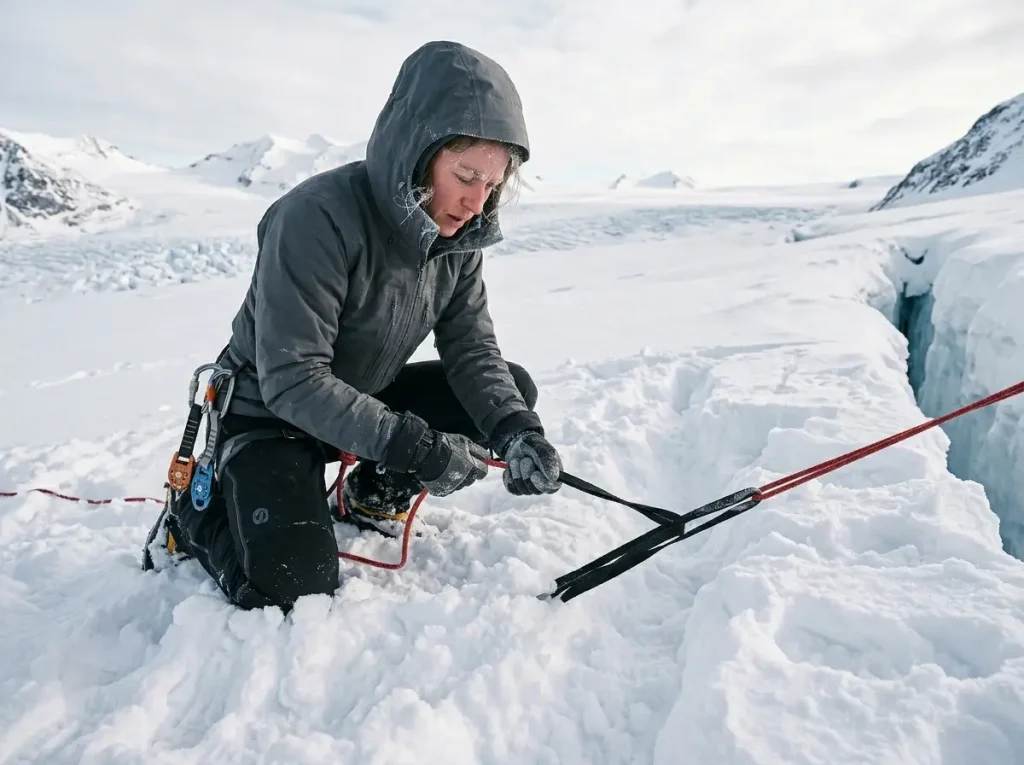
Crevasse rescue is the one skill where “we’ll figure it out if it happens” is the worst attitude in all of alpinism. Picture the real version: your partner is in a slot, maybe hurt, maybe hanging under an overhang, and you are alone on the surface having just caught the fall. Now you have to self-arrest, hold, build a bombproof anchor, rig a hauling system, and actually raise them — in the cold, with gloves on, while the clock runs.
None of that happens by instinct. It happens because you drilled it.
The First 30 Seconds After a Crevasse Fall
Stop the fall first — self-arrest, dig in, hold. Then call out and confirm your partner is conscious and can hear you. Then, and this is the part that feels wrong, you slow down.
A rushed, badly built anchor is worse than a slow, solid one, because if it fails you have turned one emergency into two. The first thirty seconds set the tone for everything that follows: get stable, get information, and do not let panic pick the next move for you.
Building an Anchor Before You Do Anything Else
Anchor first, rescue second — no exceptions. Before you attempt any hauling, you transfer the load to a real anchor: a T-trench deadman with an ice axe or a picket buried horizontal to the pull, or a solid snow setup you trust with a life. This is foundational enough that it deserves its own study; our walk-through on building a reliable snow anchor covers the trench geometry and the common ways people get it wrong.
Get the anchor right and the rest is mechanics. Get it wrong and the mechanics do not matter.
Z-Pulley Mechanics and Why You Must Practice This
The Z-pulley gives you a 3:1 mechanical advantage and lets one person haul another out of a slot. It needs two prusik loops, two pulleys or carabiners, and the know-how to pass a brake knot through the system mid-haul. Reading that sentence is not learning it.
The veterans at the UKC forums say it better than any manual: critical thinking and problem-solving beat memorizing rope systems, because the real scenario never looks like the drill. Practice the full sequence at least ten times on flat, non-threatening ground before you trust it on a glacier — and remember the climber in the slot can prusik up the rope to cut the load you are hauling, but only if they practiced that too.
Skill 5: Navigation and Route-Finding in Alpine Terrain
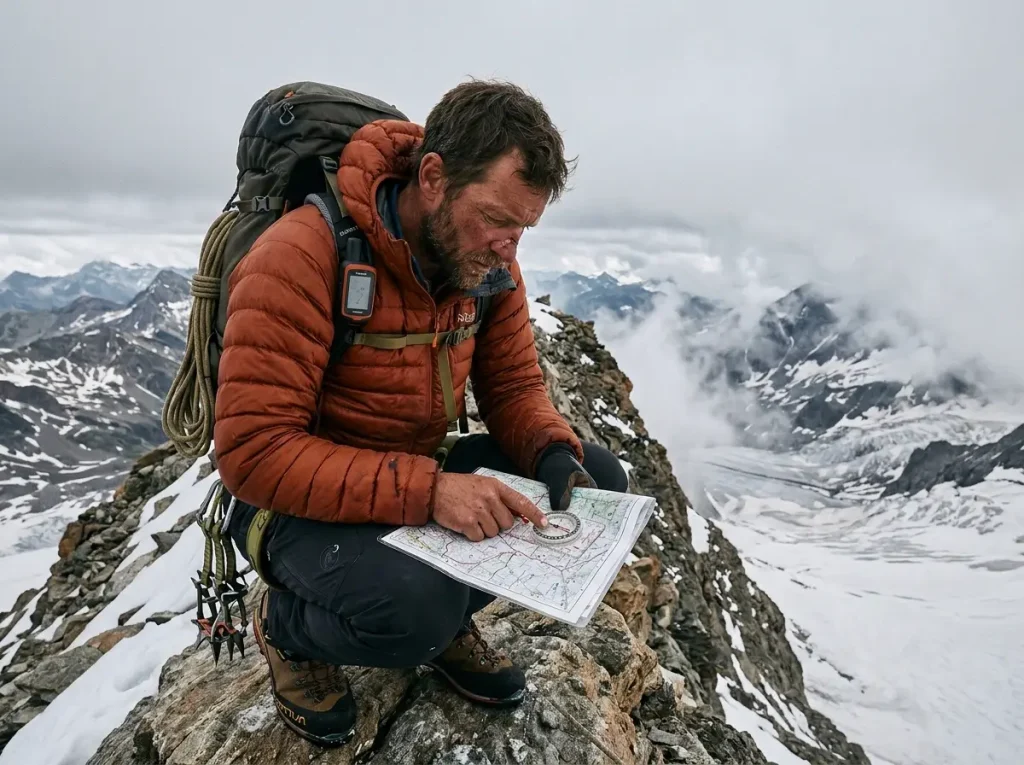
You climbed the right route. You tagged the summit. Now you have to find the way down through a whiteout, legs gone, in terrain that looks nothing like it did on the way up.
The descent is the part most people under-research, and the descent is where navigation failures turn into rescues. The route down is something you study before you leave the car — not something you sort out when you are already lost and cold.
Research the Descent Before You Leave the Car
Load the descent into your GPS as waypoints before the trip — not just the summit, but the key turns: the top of the couloir, the bench where the glacier trail splits, the spot where the obvious line cliffs out. Then print the topo. Phone screens die in the cold, crack in a fall, and go unreadable the moment your gloves are wet, while a paper topo in a chest pocket survives all of it. Redundancy here is not paranoia, it is the difference between an inconvenience and an epic.
Reading Terrain in Both Directions
The mountain you climb up is not the mountain you descend — the same ridge reads completely differently with the light moved and your brain fried. On the way up, deliberately clock landmarks for the way down: a distinct rock tower, a notch, the shape of a cornice. From the summit, take a few photos looking back down your descent line before you leave; that single habit has saved more route-finding than any gadget. Terrain recognition is a skill you build on purpose, not a thing that happens to you.
When the Map and the Mountain Disagree
In a true whiteout, no single tool is enough on its own. The system that works is redundant: a compass bearing, paced step counts, and the GPS cross-checking each other, because any one of them fails alone and they rarely fail together. And when the map says one thing and your gut says another, that disagreement is itself information — sometimes the honest answer is to stop, sit on it, or turn around. Often the cleanest move is recognizing the problem early, which is really about knowing when to bail before navigation confusion becomes a rescue.
Skill 6: Risk Assessment and Turnaround Discipline
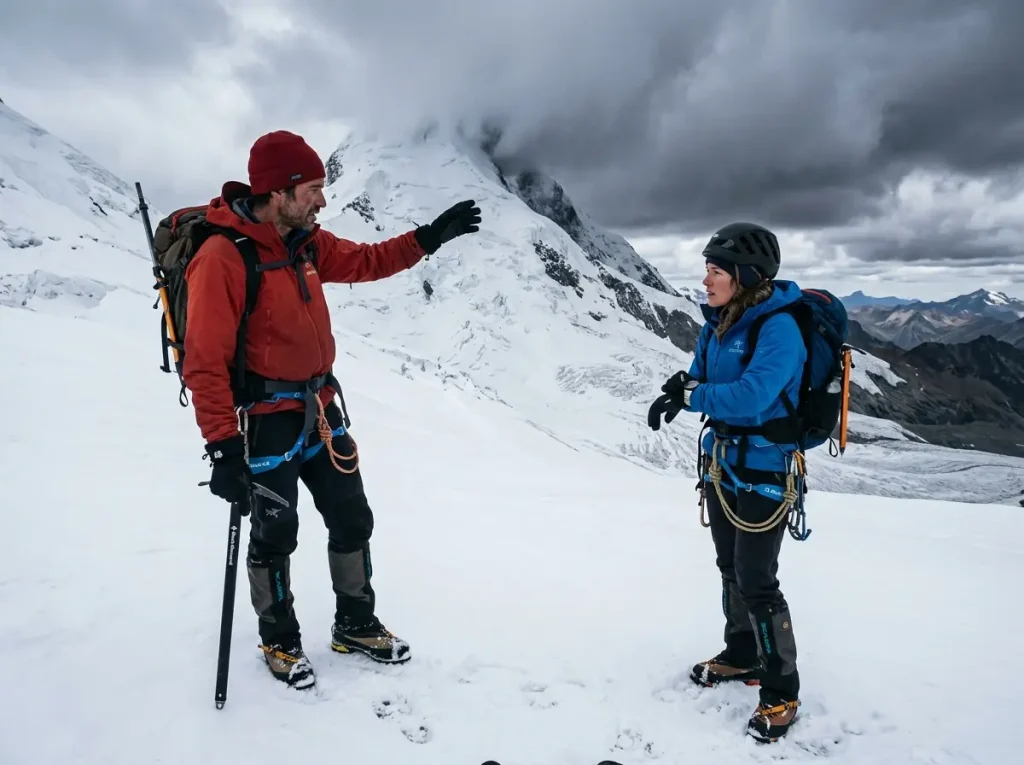
Nobody gets in trouble because they forgot how to self-arrest. They get in trouble because the summit was right there, the weather looked good enough, and the turnaround time they never actually committed to became negotiable in the moment. Summit fever is not a character flaw — it is a normal human response to effort and proximity.
You do not beat it with willpower at 100 meters below the top. You beat it with structure you set up before you ever left.
Why Moderate Terrain Is More Hazardous Than the Crux
Here is the paradox the accident data keeps confirming: the serious incidents often happen on well-traveled, moderate ground, not on the technical crux. The mechanism is cognitive. When terrain feels easy, your vigilance drops, and that drop compounds with the cumulative fatigue of a long day. Most accident chains start during the descent, hours in, when the hard climbing is behind you and your guard is down.
The “easy” traverse at hour eight is statistically the hazard, precisely because it does not feel like one. Knowing that — actually believing it while you are tired — is half the skill.
The Turnaround Time Rule (Set a Time, Not a Feeling)
Set a specific clock time before you leave: “we turn around at 11 a.m., wherever we are.” A time is harder to argue with than a condition, because a condition like “if the weather gets bad” leaves room for the optimistic read your tired brain wants to make. Build in a two-signal system, too — agree in advance on two triggers that automatically end the day, and commit that even one partner calling it is enough. The whole point is to move the decision out of the moment, where summit fever always wins, and into the parking lot, where you are still thinking clearly.
Reading Objective vs Subjective Hazards
Objective hazards — rockfall, seracs, incoming weather — you manage with research, route choice, and timing; they are out there whether you show up or not. Subjective hazards are harder, because they live inside the team: fatigue, ego, bad group dynamics, the quiet pressure not to be the one who calls it. Those you manage with honesty agreed on before the climb and a partner who will tell you the truth on the mountain. And if the decision comes too late anyway, you want to already know what happens when a turnaround decision comes too late, because an unplanned night out is survivable if you prepared for the possibility.
Will Gadd’s line is worth tattooing on your pack: the moderately fit but skilled climber succeeds far more often than the hyper-fit one with weaker skills. Most people invert it, train endless cardio, and show up technically under-prepared. Drill the skills first. The fitness is the easy part to add later.
Skill 7: Reading Alpine Snow and Terrain Conditions
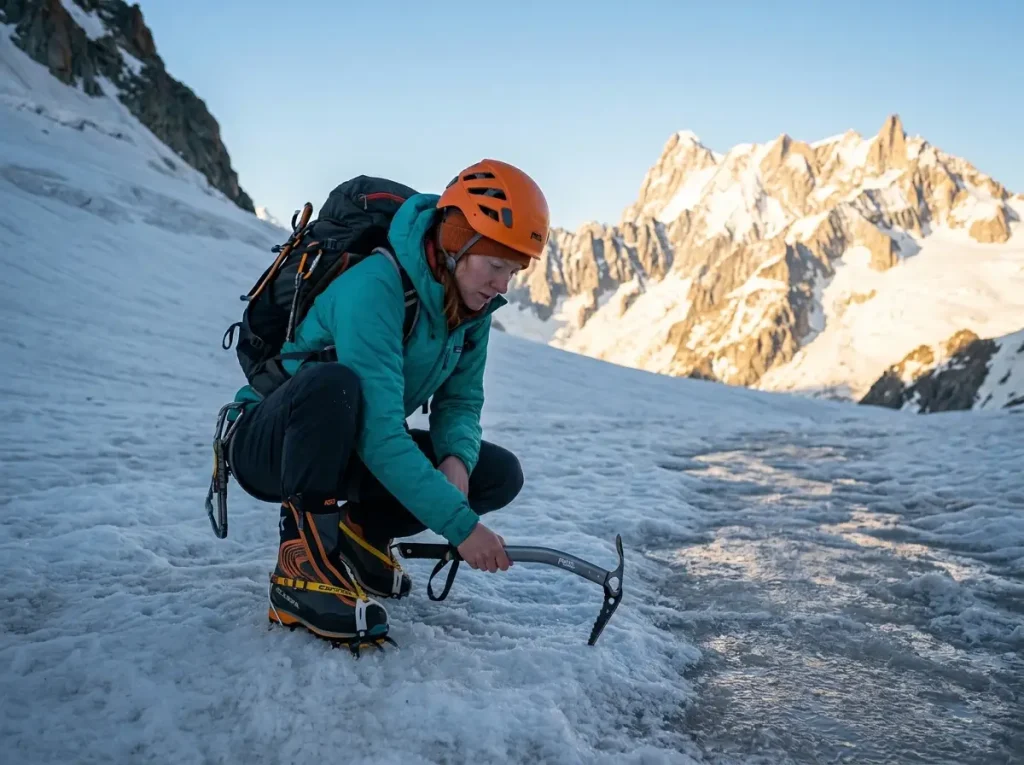
Snow is not snow. The firm surface that held your crampons cleanly at 6 a.m. can be a wet, sliding mess by noon, and the difference is not luck — it is the sun doing exactly what the sun always does. Learning to read what kind of snow you are standing on, and what the sun is doing to the slopes around you, is the skill that takes a few seasons to build but pays off the very first day someone tells you what to look for. This is the thing that separates an alpinist from a person who happens to own an ice axe.
Snow Types and What Each Means for Your Footing
Névé — consolidated, granular snow — is the good stuff: stable, great crampon purchase, the ideal surface to learn on. Wind slab is compacted by wind into a cohesive layer that can sit hollow over weaker snow and fracture and slide when you load it. Breakable crust is the ankle-wrecker that holds your weight for half a second and then collapses, draining your legs step after step. And wet or isothermal snow, late in the day after sun exposure, loses strength fast — which also signals rockfall coming off the terrain above.
Each one asks for different movement, and the American Alpine Club’s snow classification guidance (here) is a solid place to ground the distinctions. On firm névé, trust your points and move. On breakable crust, step high and stamp before you commit. On soft afternoon snow, sink-test each step and drift your line toward shadowed, firmer ground.
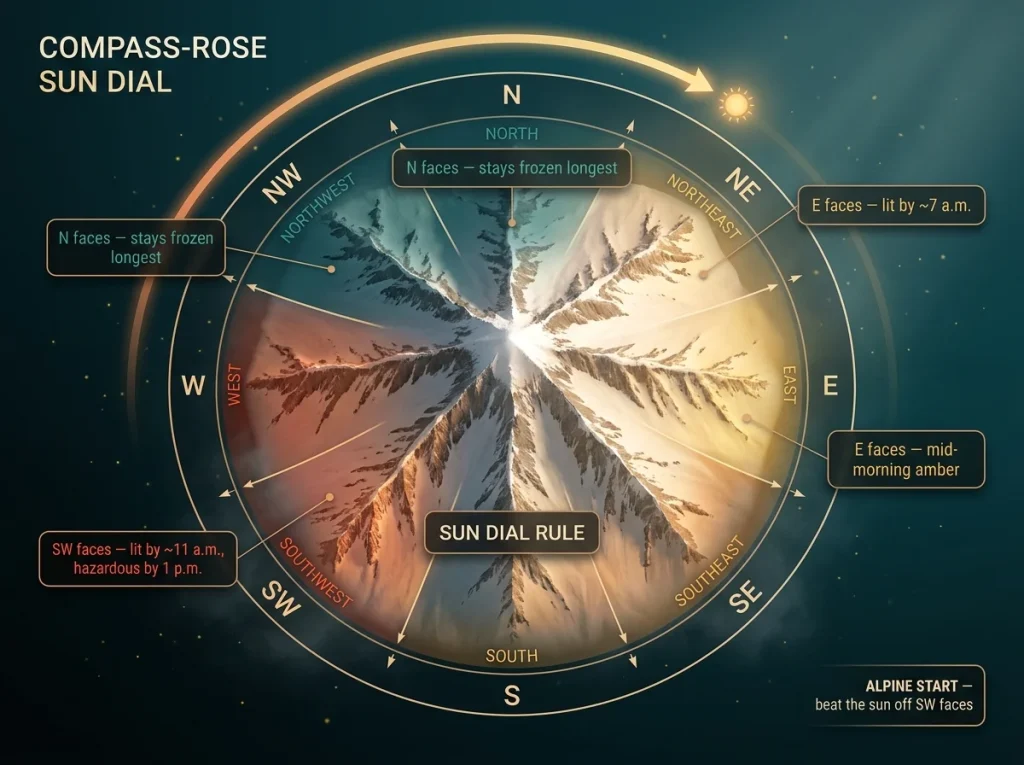
The Sun Dial Rule: Which Slopes Are Safe at What Time
A mountain works like a sun dial, and once you see it you cannot unsee it. A southwest-facing slope that is frozen solid and bomber at 6 a.m. is shedding snow, softening anchors, and throwing rockfall by 1 p.m. — same slope, same day, completely different objective. The whole reason for the alpine start, the 2-to-4 a.m. departure, is to be off the sun-exposed faces before the sun turns them against you.
Before a route, map which aspects catch sun at what hour and build your schedule around it: hit the east faces early, be done with the southwest faces before they cook, and plan your descent for ground that will still be frozen when you reach it. Get this wrong and a clean morning slope becomes an afternoon shooting gallery. This kind of terrain timing is also what makes moving fast and efficiently in alpine terrain so valuable — speed buys you margin against the clock.
Warning Signs You Feel Before You See Them
Some warnings come up through your boots before your eyes catch them. The hollow whumph underfoot is wind slab settling — a slab instability you feel as a drop. Shooting cracks that race out from your footstep mean the slab is fracturing. Roller balls running below a cliff band, and a sudden warm-up that softens everything, both say the snow’s strength is collapsing.
And the simplest read of all: if snow that was firm on the ascent is now wet and boot-deep on the descent, that is not just tiring — it is the slope telling you its strength-to-angle balance has shifted. Time to move, and time to take the message seriously.
Conclusion
Three things to carry off this page. First, the ice axe and crampons prevent accidents far more than they fix them — skill in movement is always your first line of defense, and self-arrest is only the backup. Second, moderate terrain on tired legs, usually on the descent, is the most statistically loaded moment of any alpine day; set the turnaround time before you start, not when you are 100 meters below the summit with the top in view. Third, rope systems only work when the details are right — 18 meters of spacing, brake knots in the middle third, a rescue sequence you have actually practiced cold, with gloves on.
Your next move is small and concrete: find a local alpine skills course, hire a guide for one day on glaciated terrain, or spend an afternoon on a safe practice slope drilling ice axe positions until they are automatic. Every objective gets safer the season after you build the skills — not the season after you build the fitness.
Frequently Asked Questions
01What is the most important skill for alpine climbing?
The most important alpine climbing skill is reliable footwork with your ice axe in the cane position, because it prevents the fall that self-arrest would otherwise have to save you from. Self-arrest is your backup system, not your first line of defense.
02How long does it take to learn alpine climbing skills?
Plan a realistic 6 to 12 month progression: rock technique and anchors first, then ice axe and crampon drills on safe slopes, then roped glacier travel with instruction, then a first objective below your technical limit. Skills before volume fitness, always.
03Do I need a guide to start alpine climbing?
For a first glaciated route, yes. One day with an AMGA-certified guide is worth two seasons of learning the hard way. For practice slopes and fundamentals a course works fine, and for technical objectives, climb with competent partners until you build the experience.
04Can I start alpine climbing after gym climbing?
Gym climbing builds the movement confidence and anchor basics you need, but alpine terrain adds ice axe work, crampon footwork, glacier navigation, and weather judgment a gym never teaches. Plan at least six months of outdoor rock and one alpine skills course first.
05Is alpine climbing the same as mountaineering?
Not exactly. Alpine climbing usually involves more technical rock, ice, or mixed pitches, while mountaineering often means snow slopes and ridge walking to a summit. The skills overlap heavily, but alpine climbing demands higher technical proficiency on steeper, roped terrain.
Safety Notice: Rock climbing and mountaineering are inherently high-risk
activities that can involve physical trauma or fatal incidents. The information on Rock Climbing Realms is for
educational and informational purposes only. Techniques and advice presented here are not a substitute
for professional, hands-on instruction. Conditions and risks vary by location. Always seek guidance
from a qualified instructor before attempting new techniques. By using this website, you agree that you
are solely responsible for your own safety. Any reliance you place on this information is strictly
at your own risk, and you assume all liability for your actions. Rock Climbing Realms and its authors
will not be held liable for any harm, damage, or loss sustained in connection with the use of this information.
Affiliate Disclosure: We are a participant in the Amazon Services LLC Associates Program, an
affiliate advertising program designed to provide a means for us to earn advertising fees by advertising and linking
to Amazon.com. As an Amazon Associate, we earn from qualifying purchases. We are also an official affiliate partner
of Black Diamond Equipment via the AvantLink network. If you click on a Black Diamond affiliate link and make a
purchase, we may earn a commission at no additional cost to you. We also participate in other affiliate programs.
Additional terms are found in the terms of service.