
In this article
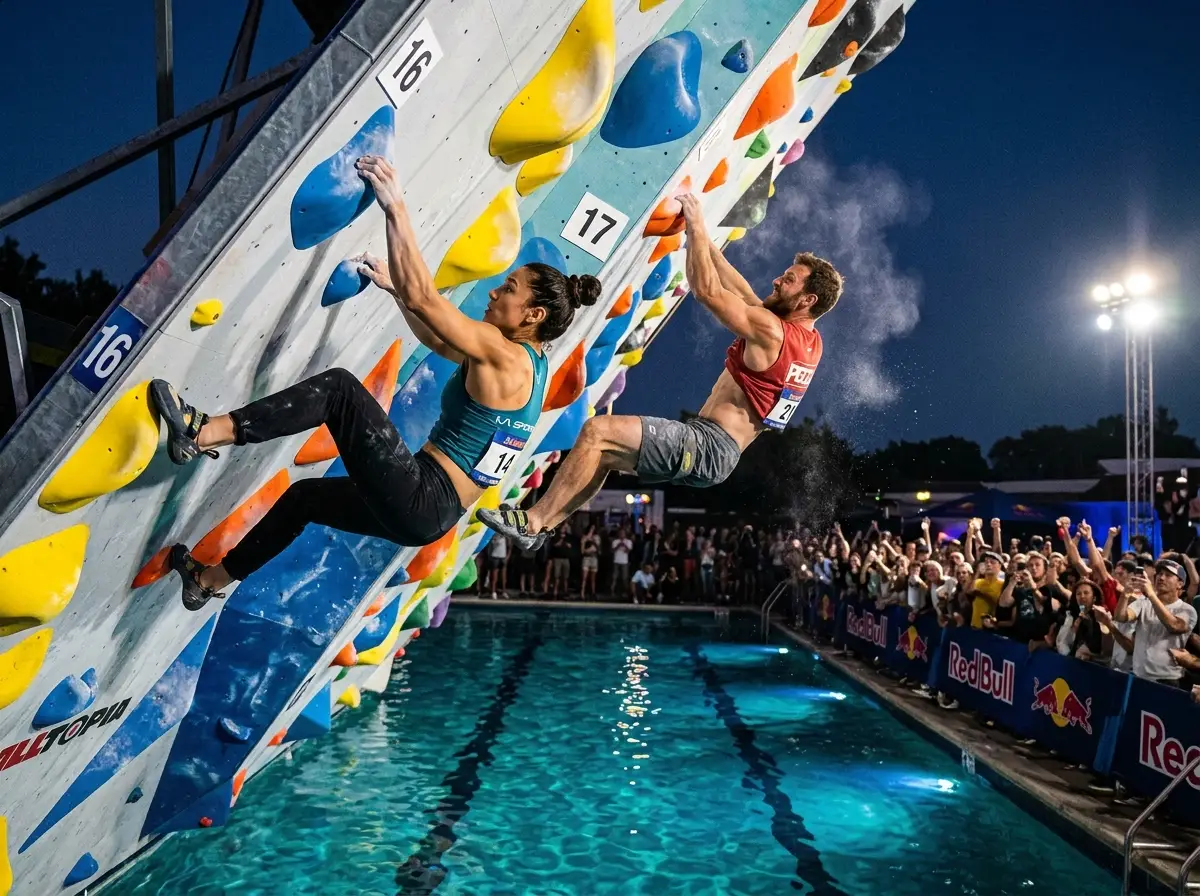
Two climbers chalk up side by side, fifty feet above a glowing turquoise pool. A horn sounds. They launch upward on identical overhanging routes — arms pulling, feet cutting, chalk raining down. One slips at the crux. The splash echoes across the venue. The other keeps climbing. That’s psicobloc in thirty seconds, and most people never get past the splash to understand what’s actually happening up on the wall.
I’ve followed these events since the early Park City days, and the format is wilder — and more tactical — than the highlight reels suggest. Here’s how psicobloc competitions work from qualifying rounds to the final bracket, what the rules actually are, and why the strategic chess match between climbers is the part nobody talks about.
Quick Answer: Psicobloc is a head-to-head knockout climbing competition where two athletes race up identical overhanging routes above a deep pool. The first climber to top out wins; if neither tops, the highest hold decides. No ropes, no harness — every fall ends in the water below. The format combines speed climbing’s intensity with the mental pressure of free soloing, played out across a bracket that forces the winner to complete four back-to-back climbs in the finals.
What Psicobloc Actually Means (And Why the Name Matters)
The Mallorca Origins of “Psycho Bouldering”
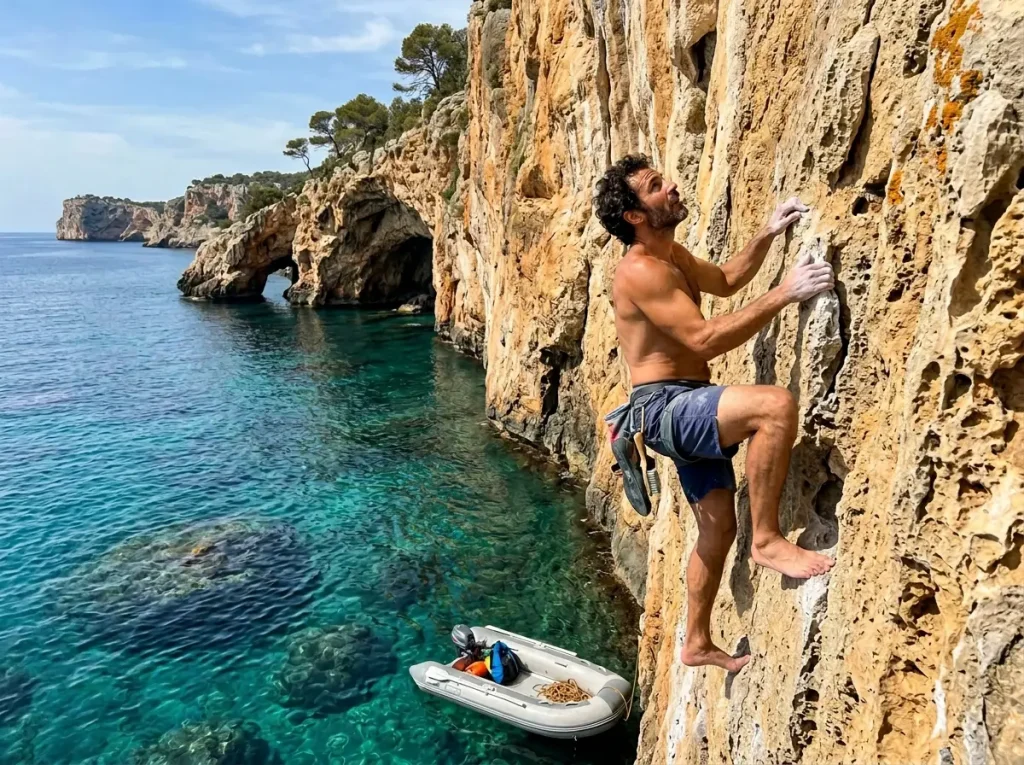
The word sounds made up. It basically is. In 1978, a Mallorcan climber named Miquel Riera got tired of aid climbing the same routes near Palma and dragged a few friends — Jaume Payeras, Eduardo Moreno, Pau Bover — to the sea cliffs at Porto Pi. They started free climbing the limestone directly above the Mediterranean with nothing but shoes and chalk. When the holds ran out, they fell into the sea.
Riera called it psicobloc — “psycho bouldering” in Catalan. The name stuck because it captured something no other climbing term did: the specific brand of madness required to free solo a cliff knowing your only protection is saltwater and good entry technique.
From Sea Cliffs to Chris Sharma’s Es Pontàs
For two decades, psicobloc stayed a niche Mallorcan thing. British climbers Tim Emmett, Neil Gresham, and Austrian Klem Loskot spread the word internationally during the late 1990s and early 2000s. But deep water soloing didn’t hit mainstream climbing consciousness until 2006, when Chris Sharma climbed the massive sea arch of Es Pontàs in Mallorca at 5.15a (9a+). That single ascent made DWS legitimate overnight — not a gimmick, but a discipline where the world’s hardest routes could exist. Mallorca became the epicenter, with routes like Alasha and Black Pearl pushing deep into the 5.14 range.
If you want the full story, check out our piece on Chris Sharma’s deep water soloing legacy.
How DWS Became a Competition Sport
The jump from sea cliffs to organized competition happened in 2011 when the Psicobloc Masters Series launched at Utah Olympic Park in Park City. The venue already had a deep pool built for ski jump training — someone looked at it and thought, “What if we bolted a climbing wall above that?” Walltopia built the wall, the format clicked, and the series ran through 2018.
In 2019, the competition rebranded as the Psicobloc Open Series and moved to Montreal. By 2024, it had gone fully international with stops in Marseille, Umag (Croatia), and Leonidio (Greece). Red Bull picked up the sponsorship and turned the production value up to eleven.
The Wall — Specs That Change How You Climb
Height, Overhang, and What They Mean for You
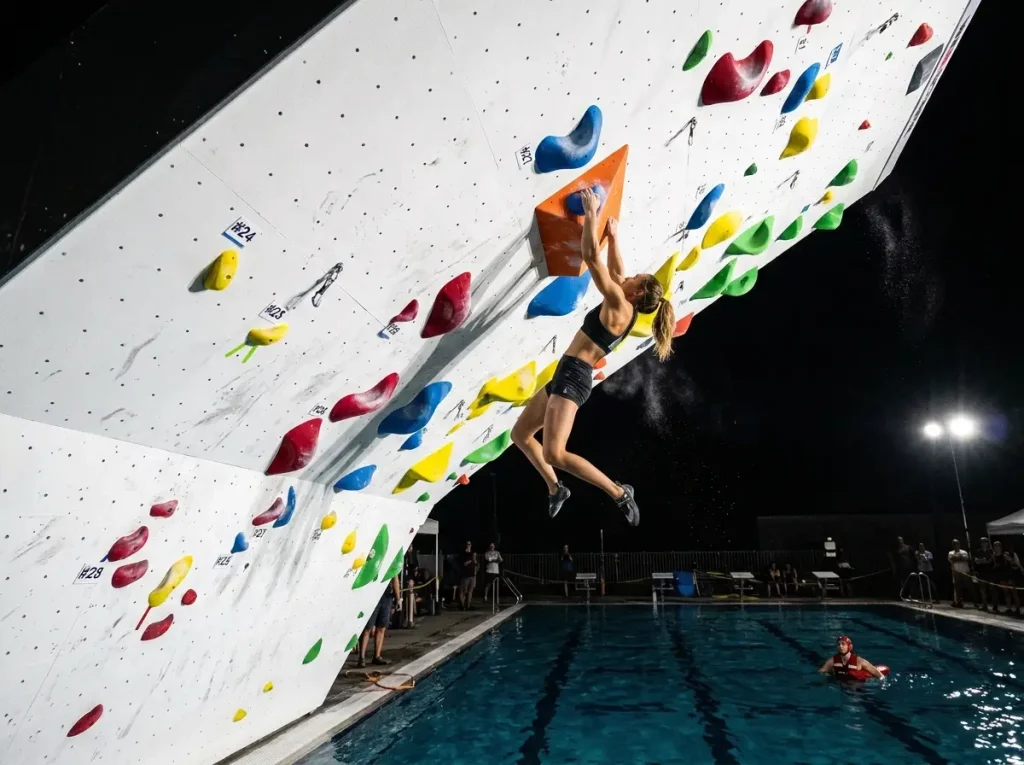
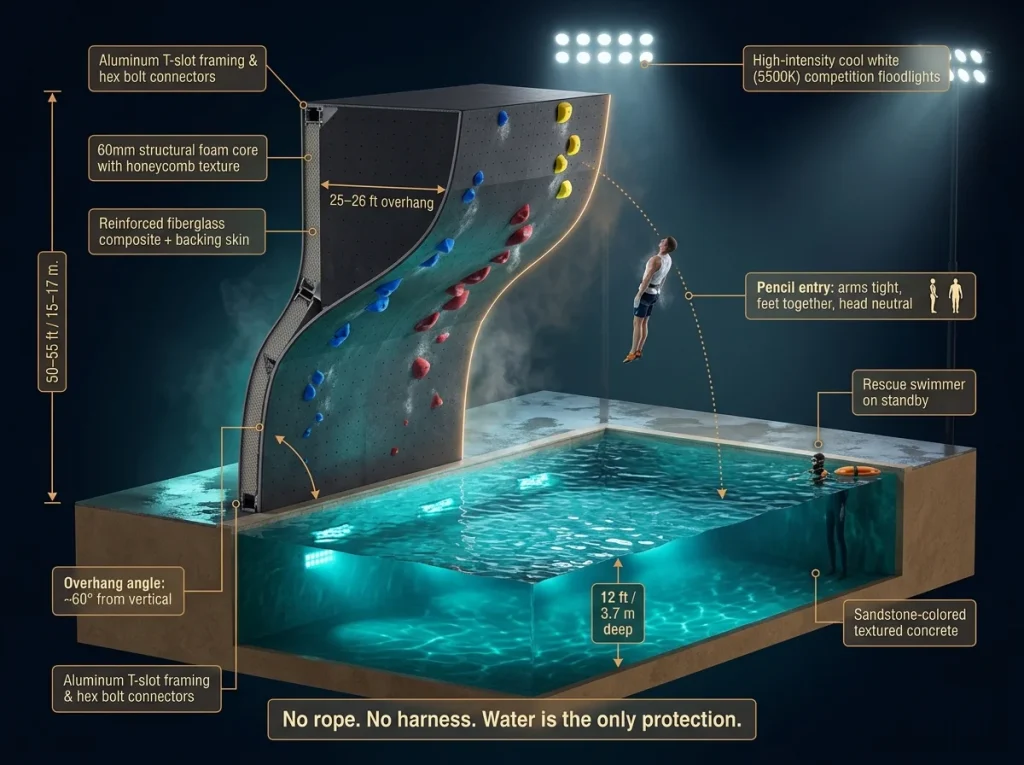
The competition wall stands roughly 50 to 55 feet tall (15-17 meters), manufactured by Walltopia — the same company that builds most commercial climbing gym walls worldwide. But height alone doesn’t tell the story. The wall overhangs approximately 25 to 26 feet, meaning the top of the route sits nearly as far out horizontally as it does vertically.
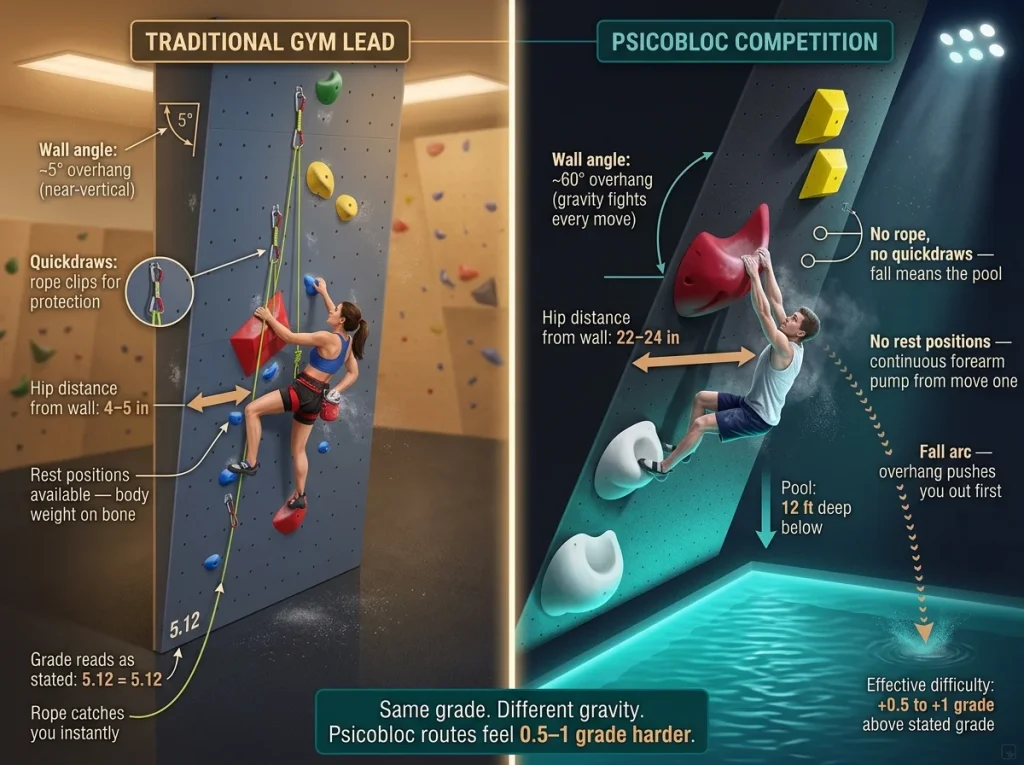
That geometry changes everything about how you climb. On a vertical wall, gravity pulls you straight down. On a 30-degree overhang, gravity pulls you off the wall entirely. Your forearms are fighting to keep you connected to the holds every second. There’s no resting. There’s no shaking out on a good stance. You either keep moving or you fall.
Pro tip: If you’ve climbed roofs or steep overhangs indoors, you know the pump comes fast. Now imagine sustaining that effort for a 50-foot route with someone racing you on the adjacent lane. That’s the physical reality of psicobloc. For overhang-specific technique, here’s how overhang positioning techniques translate to this format.
The Pool Below — Depth, Temperature, and Impact Physics
The competition pool sits roughly 12 feet (3.7 meters) deep — sufficient to absorb a 50-foot fall, but only if you enter correctly. Pencil entry is the technique: feet together, arms tight against your sides, head upright. That’s it. Deviate from that — go horizontal, go head-first, spread your arms — and a 50-foot fall into water stops being fun in a hurry.
According to AAC’s deep water soloing safety guidelines, impact injuries from uncontrolled entries range from severe bruising to fractured limbs and spinal injuries. Cold shock from sudden immersion is another factor — even in a competition pool, the temperature difference between your pumped muscles and the water hits your system hard.
A rescue swimmer treads water at the far end of the pool during every round. You don’t notice them until you need them.
Route Grades and What They Tell You
Competition routes run at 5.12+ for women and 5.13+ for men. Those are serious sport climbing grades. The routes aren’t watered down for spectacle — they’re set to challenge elite-level climbers while remaining climbable at speed.
Here’s what the grades don’t capture: a 5.12 on a 25-foot overhang climbs significantly harder than a vertical 5.12. The angle magnifies every weakness in your finger strength and core tension. Add the psychological weight of climbing with no rope, and the effective difficulty bumps up at least half a grade.
Head-to-Head Format Explained Round by Round
Two Routes, Two Climbers, One Winner
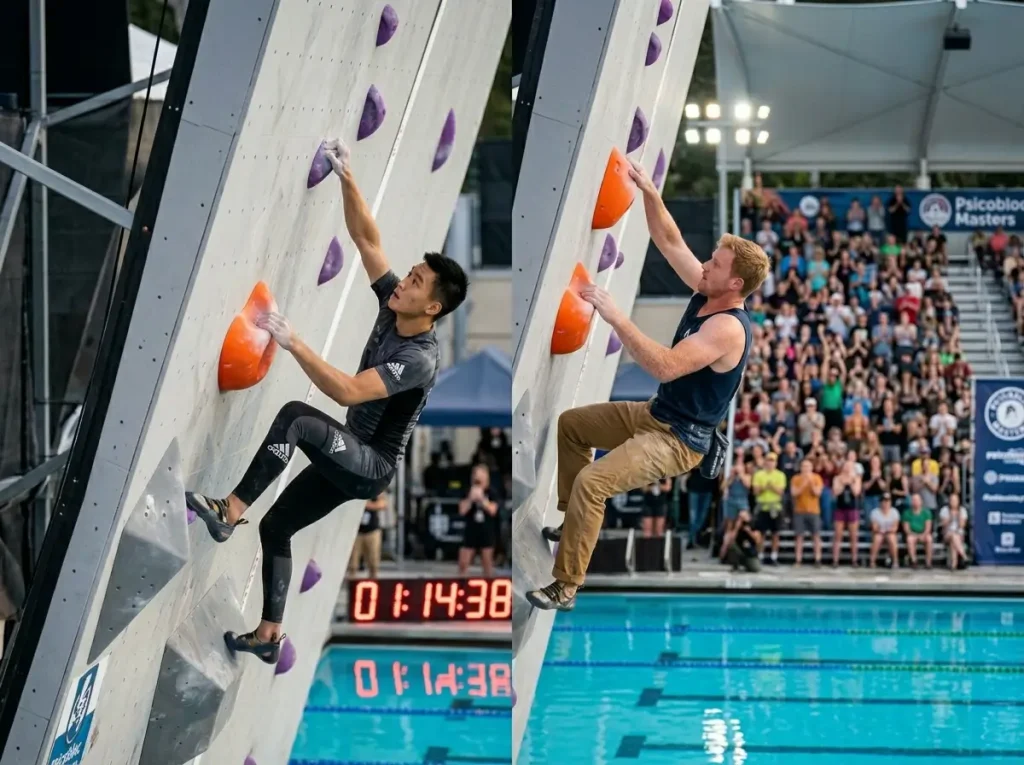
The format is beautifully simple. Two identical routes are set side by side on the competition wall. Two climbers start simultaneously at a signal. First to top out wins the match. If neither climber reaches the top, the one who reached the highest hold advances. If both fall at the same point — which happens more often than you’d think — the climber who held on longest at that hold takes it.
The Bracket — From Qualifying to Finals
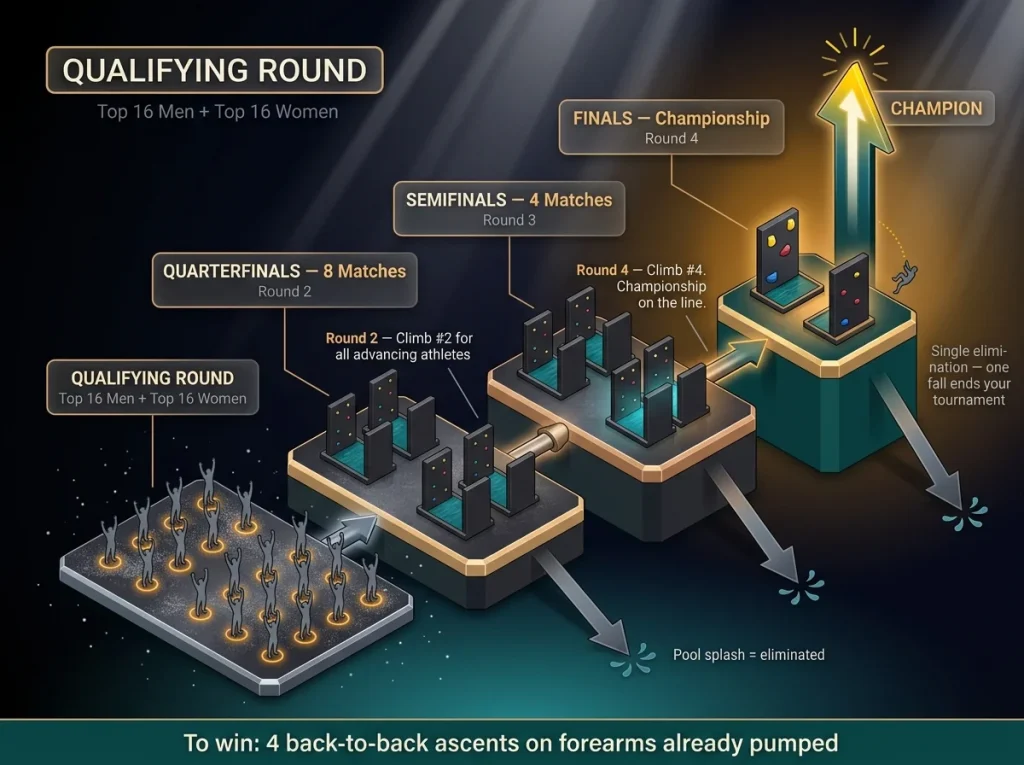
Open qualifying rounds narrow the field. The finals bracket takes the top 16 men and top 16 women into a single-elimination knockout. Lose once, and you’re done — no second chances, no redemption round.
That means the winner must complete the wall four times — quarterfinals, semifinals, and two final rounds — with only short rest between heats. By the fourth climb, forearm pump becomes the actual opponent. The person who manages their energy across the bracket often beats the person who climbed hardest in round one.
Think of it like a tennis tournament crossed with a track meet. The climbing competition scoring system for IFSC events works completely differently.
How Psicobloc Scoring Differs from IFSC Comps
In IFSC lead climbing, you get one attempt, climb alone, and your score is your highest hold. In IFSC speed climbing, you race a standardized route for the fastest time. Psicobloc borrows from both without being either.
The key difference: you can see your opponent. In lead, you climb in isolation — no idea how the other competitors performed until scores post. In psicobloc, the person next to you is right there in your peripheral vision. You hear them breathing. You see them hesitate. That dual pressure — climb fast AND don’t fall — creates something neither lead nor speed replicates alone.
No ropes, no quickdraws, no clipping. Every move carries the consequence of a 50-foot fall into the pool. Compare that to speed climbing techniques where a rope catches you instantly and the route never changes.
The Tactical Game Nobody Talks About
Pace Management Across Multiple Rounds
Here’s what the highlight reels cut: the winner didn’t just climb hard — they climbed smart over four rounds. Sprint the first route and your forearms are screaming by quarterfinals. Go too conservative and you lose to someone who just went all-out.
The best competitors treat qualifying like a controlled burn. They climb efficiently, hit the top with reserves left, and save the explosive efforts for semifinals and finals. Some climbers will even fall deliberately at a known high point in early rounds to conserve grip strength.
Pro tip: Watch the first ten holds of any head-to-head match. If one climber immediately accelerates, the other has a split-second decision: match that pace and risk blowing up, or stay steady and hope the sprinter falls first. That decision often determines the match.
Reading Your Opponent Mid-Climb
You’re not supposed to look sideways on a 50-foot overhang. Everyone does. Peripheral vision picks up the other climber’s movement speed, hesitation points, and movement cues. If they slow down, you know they’re pumped. If they suddenly accelerate, they found a rest or they’re going for broke.
The sounds matter too. Fast breathing means pump. The crisp snap of chalk hitting hands means they’re still in control. Silence means they’re locked in or about to fall — and you won’t know which until they do.
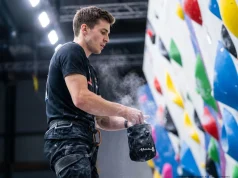
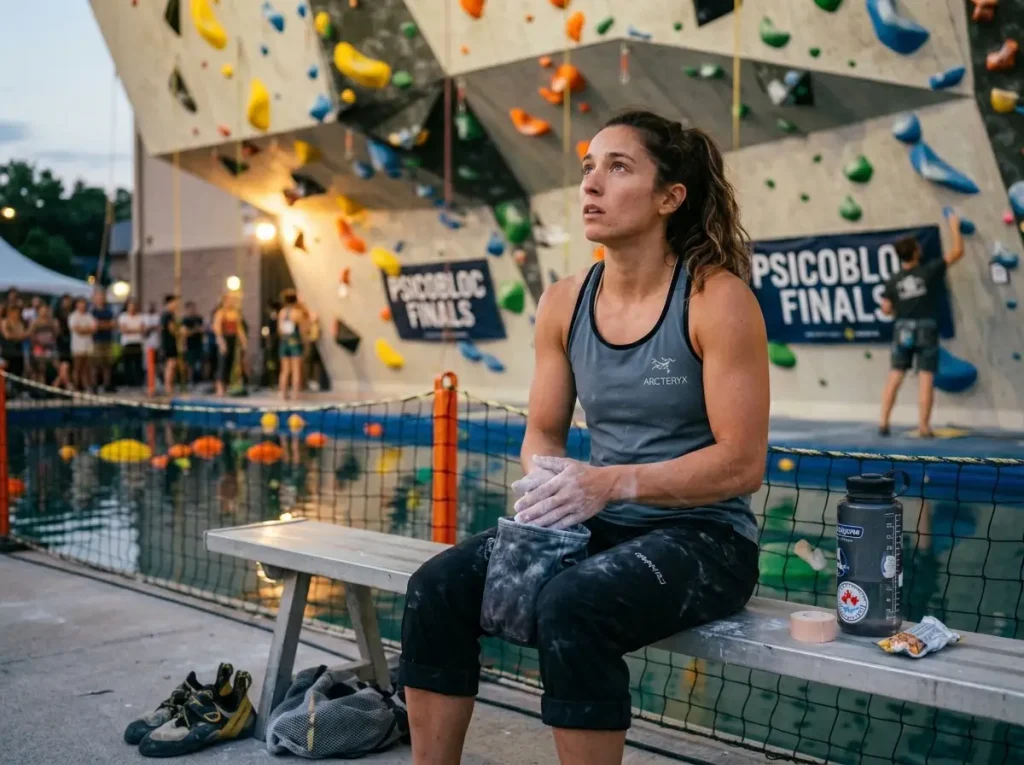
There’s a moment before every finals match that tells you everything. Both climbers sit at the wall base, chalking up, staring at the holds above them. The crowd goes quiet. In that silence, the mental game of climbing plays out in thirty seconds of eye movement and deep breathing.
When to Fall and When to Fight
Counterintuitive truth: sometimes the smartest move in psicobloc is letting go. In qualifying rounds, if you’ve already reached a height that guarantees advancement, burning your forearms for two more holds is a bad trade. You’re paying now for energy you’ll need later.
In finals, the math flips. Every hold matters because there’s no next round. The mental switch from “climb efficiently” to “beat that person to the top” is what separates competitors who make finals from those who win them.
Pro tip: The climbers who win consistently aren’t always the strongest in isolation. They’re the ones who still have forearm endurance left in round four — because they managed their effort across the entire bracket instead of emptying the tank early.
Route Setting for Spectacle and Speed
Designing Moves That Look Dramatic and Climb Fast
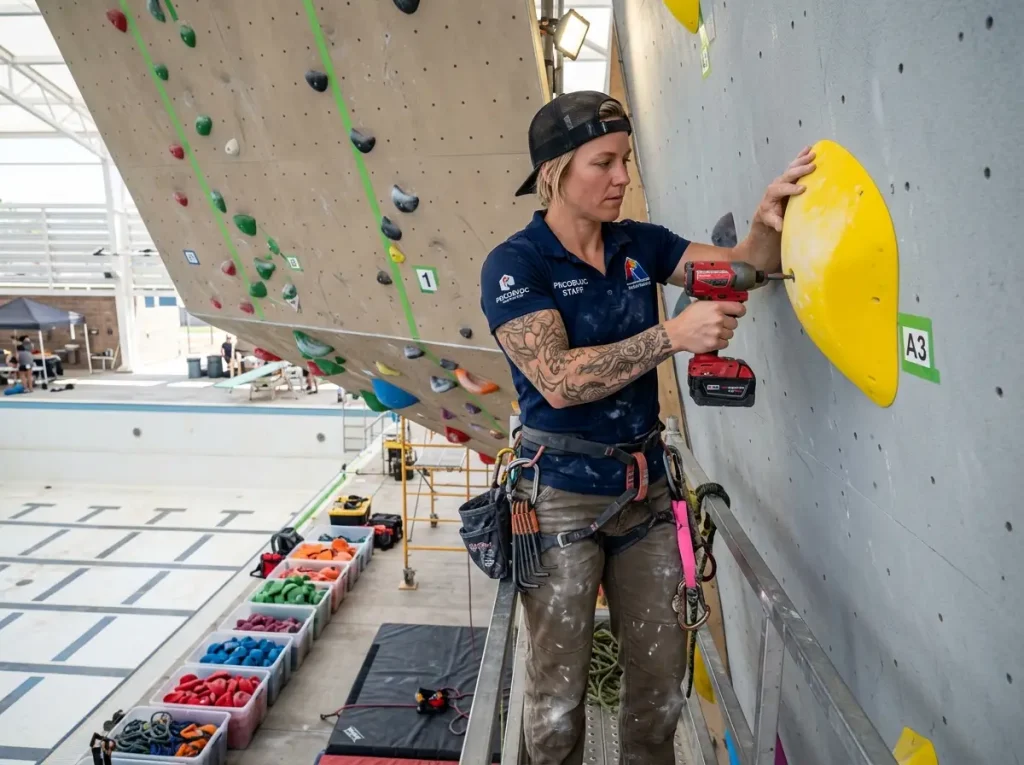
Psicobloc route setters face a unique challenge. The routes need to be hard enough to test elite climbers, fast enough to create exciting head-to-head races, and visual enough that a crowd of non-climbers can follow the action.
That means big lateral dynos over open air — the kind of move where a climber swings out into space before catching the next hold. Holds positioned to create dramatic positions where arms extend fully and feet cut loose. The overhang helps here: every fall goes cleanly away from the wall surface, which is both a safety feature and a spectacle feature.
The hardest part of the setter’s job: both routes must be identical. Hold for hold, angle for angle, difficulty for difficulty. Any asymmetry gives one lane an advantage, and competitors notice.
Why Psicobloc Routes Feel Different Than Gym Routes
If you’ve climbed competition-style gym routes, psicobloc still feels foreign. There are no resting positions — routes are designed for continuous upward movement. The absence of a rope removes the psychological safety net that lets you commit fully to hard moves on lead.
Then there’s the shoe problem. After falling into the pool in a previous round, your shoes are wet. Wet rubber on plastic holds changes friction entirely. Experienced competitors bring multiple pairs of shoes and swap between rounds, stuffing the wet pair with chalk to dry faster.
The Spectator Experience — More Festival Than Comp
Night Events, Music, and the Splash Zone
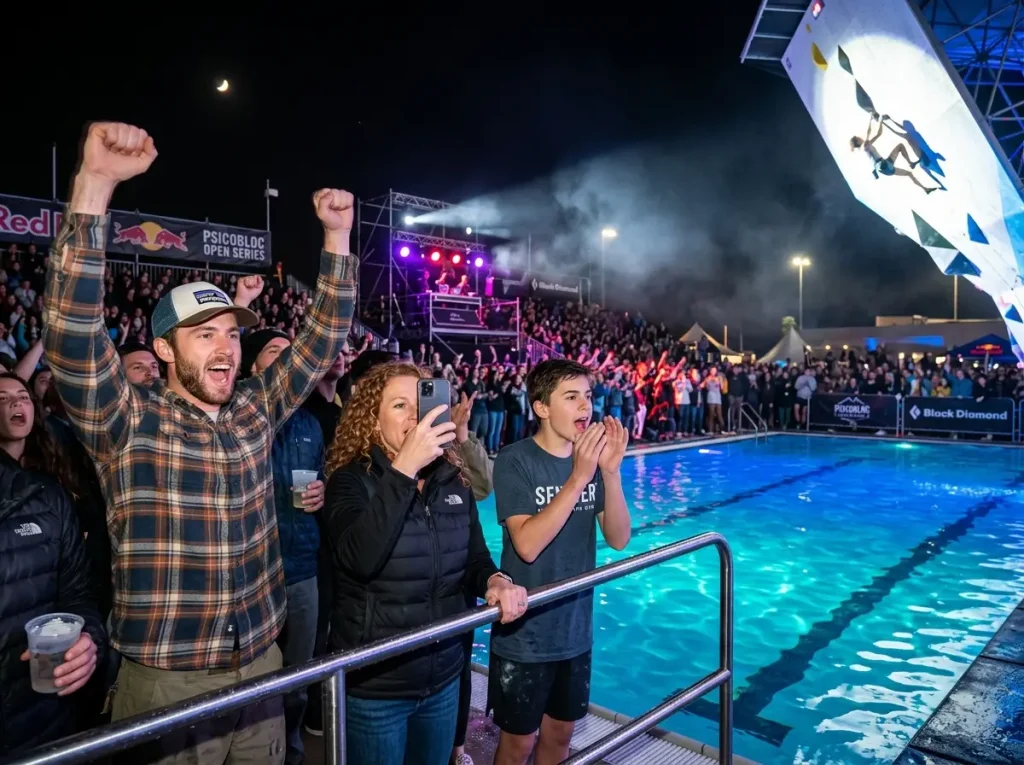
Forget the hushed gym atmosphere of an IFSC bouldering final. Psicobloc events — especially the Psicobloc Open Series stops — run at night under dramatic event lighting. The pool glows with underwater LED arrays cycling through blues and teals. DJs spin from elevated booths. The crowd is loud, close, and invested.
The front rows earn the name “splash zone” honestly. When a climber falls from 40 feet, the pool sends water across the railing and onto anyone standing too close. People bring ponchos. Some don’t and regret it. It’s part of the experience.
When a competitor stalls near the top, the crowd collectively holds its breath. When they fall, the gasp turns into a cheer as they surface. When someone tops out while their opponent is mid-fall, the noise hits differently — celebration and commiseration mixing at the pool edge.
Why Psicobloc Converts Non-Climbers Into Fans
Most competition climbing requires context to appreciate. In IFSC lead, understanding why a particular hold is significant needs climbing knowledge. In bouldering finals, the subtle difference between a flash and a second attempt only matters if you understand the scoring.
Psicobloc needs none of that. Two people race up a wall. First to the top wins. If they fall, they land in a pool. A five-year-old can follow the format, and the spectacle translates through a phone screen as easily as in person. It’s closer to a sprint than a chess match — and that accessibility is driving the format’s growth.
For more on climbing as spectator entertainment, check out our roundup of climbing competition documentaries that capture the atmosphere.
Where Psicobloc Competitions Happen Now
The Original — Utah Olympic Park
Park City, Utah hosted the Psicobloc Masters Series from 2011 through 2018. The venue was almost absurdly perfect: the ski jump training pool already existed, deep enough to safely absorb big falls. Walltopia built a 55-foot overhanging wall above it, and the competition had a ready-made home in a mountain town full of outdoor enthusiasts.
Those early Park City events established the format’s DNA — head-to-head racing, knockout brackets, the dramatic spectacle of falls into a floodlit pool. Everything that came after built on what they figured out in Utah.
Going Global — Montreal, Marseille, Umag, Leonidio
In 2019, the competition rebranded as the Psicobloc Open Series and expanded internationally. Montreal hosted the first events, then the series pushed into Europe with a 2024 season spanning Marseille (France), Umag (Croatia), and Leonidio (Greece).
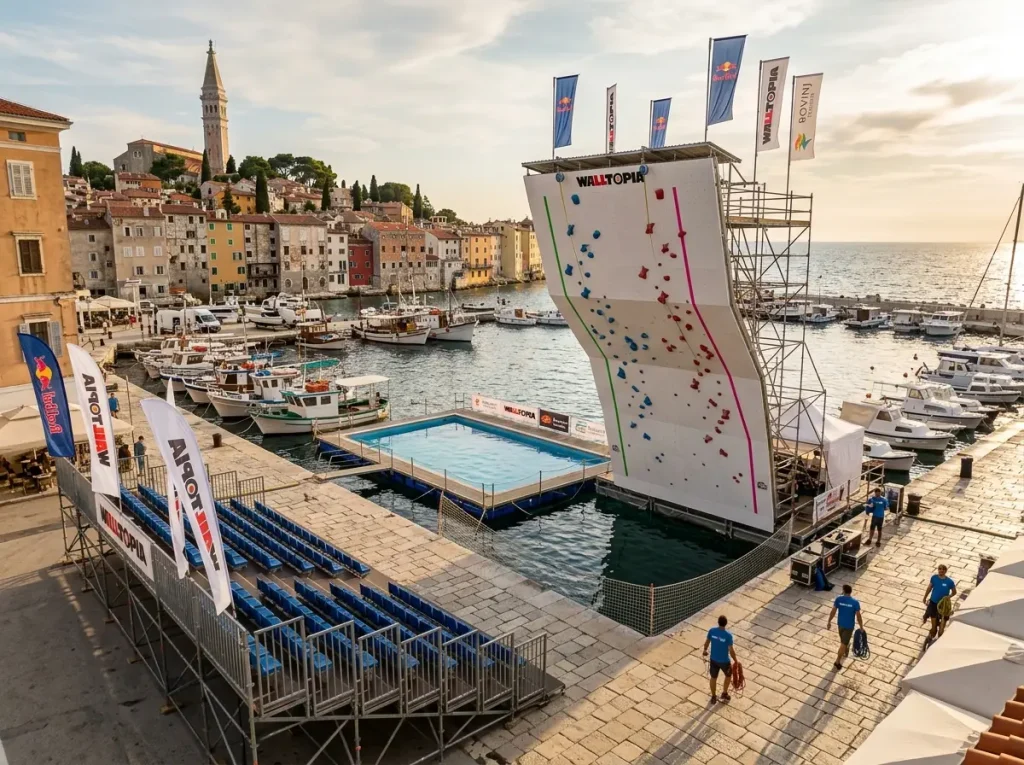
The format travels because the infrastructure is portable: a Walltopia wall, a sufficiently deep pool (floating pools work for harbor venues), and event production. The LA28 Olympic climbing format may not include psicobloc, but the competition’s growth suggests it’s building its own international circuit independent of the IFSC.
Can You Try It Yourself?
Some Psicobloc Open Series events include open amateur qualifying rounds where non-professionals can attempt the wall. The routes are the same — you’re just not expected to top them.
Outside of competitions, natural deep water soloing spots exist worldwide. Mallorca remains the gold standard, but spots like Summersville Lake in West Virginia and sections of Lake Powell offer DWS terrain in the US. The safety principles are the same: deep water, clean fall zone, buddy system, controlled entry.
If you’re considering your first time, start with our beginner’s guide to deep water soloing before you jump off anything.
Conclusion
Psicobloc packs the spectacle of extreme sports into a format simple enough for anyone to follow: two climbers, one wall, first to the top wins. But underneath the splashes and the crowd noise, there’s a tactical game playing out — pacing across four rounds, reading an opponent’s breathing and movement cues, knowing when to push and when to let go.
The format is growing because it solves competition climbing’s biggest problem: accessibility. You don’t need to understand grades or scoring systems to watch two people race up a wall and cheer when someone tops out or gasps when they fall. That’s why it’s expanding from Park City to three continents.
Find a Psicobloc Open Series event or pull up a full bracket replay online. Once you understand what the winner had to do to get through four consecutive climbs on pumped forearms, every splash and every top-out hits different.
Q1 What is the format of psicobloc competition?
Psicobloc uses a head-to-head knockout bracket where two climbers race identical overhanging routes above a pool simultaneously. The first to top out wins; if neither tops, the highest hold decides. Finals take the top 16 per gender through four elimination rounds.
Q2 How deep does the water need to be for deep water soloing?
Competition pools run approximately 12 feet (3.7m) deep for falls from 50+ feet. Natural DWS requires checking depth at your specific landing zone — tides, lake levels, and submerged hazards all affect safety. Controlled pencil entry (feet together, arms tight) is mandatory.
Q3 Is deep water soloing the same as psicobloc?
Deep water soloing (DWS) is the broad discipline of free soloing above water. Psicobloc specifically refers to the competitive format with artificial walls, knockout brackets, and head-to-head racing. The term originally named the activity itself — coined in Mallorca in 1978 — but now primarily describes the competition series.
Q4 What grade are psicobloc competition routes?
Competition routes grade at 5.12+ for women and 5.13+ for men. The severe overhang (25+ feet on a 50-foot wall) makes these grades feel harder than their vertical equivalents — your forearms fight gravity the entire way up with no resting positions.
Q5 Where can you watch psicobloc competitions?
The Psicobloc Open Series streams events through Red Bull’s platforms. Full competition replays and highlights are available on YouTube. The 2024 season covered Marseille, Umag, and Leonidio. Check the official Psicobloc Open Series site for upcoming event dates and livestream links.
Safety Notice: Rock climbing and mountaineering are inherently high-risk
activities that can involve physical trauma or fatal incidents. The information on Rock Climbing Realms is for
educational and informational purposes only. Techniques and advice presented here are not a substitute
for professional, hands-on instruction. Conditions and risks vary by location. Always seek guidance
from a qualified instructor before attempting new techniques. By using this website, you agree that you
are solely responsible for your own safety. Any reliance you place on this information is strictly
at your own risk, and you assume all liability for your actions. Rock Climbing Realms and its authors
will not be held liable for any harm, damage, or loss sustained in connection with the use of this information.
Affiliate Disclosure: We are a participant in the Amazon Services LLC Associates Program, an
affiliate advertising program designed to provide a means for us to earn advertising fees by advertising and linking
to Amazon.com. As an Amazon Associate, we earn from qualifying purchases. We are also an official affiliate partner
of Black Diamond Equipment via the AvantLink network. If you click on a Black Diamond affiliate link and make a
purchase, we may earn a commission at no additional cost to you. We also participate in other affiliate programs.
Additional terms are found in the terms of service.