
In this article
My oldest was five when she asked to try the climbing wall at the local gym. She scrambled up six feet, froze, and asked to come down. I lowered her, she ran to the bouldering cave, and spent the next hour climbing sideways on holds she could reach from the floor. That was the whole session. No summit. No ropes. No tears. She’s been climbing three times a week ever since.
The parents who lose their kids to climbing usually don’t realize it’s happening. They push for the top, correct technique too early, or skip straight to rope climbing before the kid is ready. Here’s how to introduce your child to rock climbing the way that actually sticks — starting with the right age, the right gear, and the right amount of zero pressure.
Quick Answer: Here’s how to introduce kids to rock climbing safely:
- Start at an indoor gym with bouldering, not roped climbing
- Let them play on the wall — no grade goals or summit pressure
- Use age-appropriate gear (full-body harness under 40 lbs)
- Progress to top-rope only when they ask for it
- Move outdoors with a guide or on easy, short routes first
When Kids Are Ready to Start Climbing
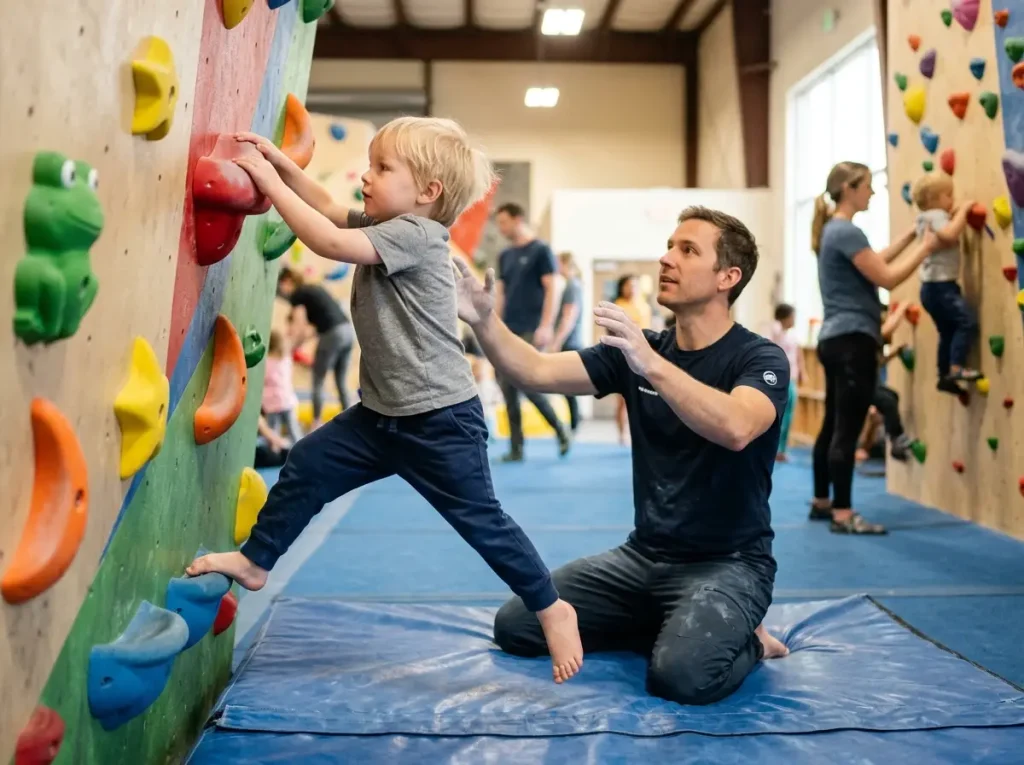
Kids can start climbing as early as age two or three — but what “climbing” means at that age is radically different from what it means at ten. Understanding the difference is the first step to not burning your kid out before they get started.
Ages 2–4: Movement Play
At this age, climbing is just structured scrambling. Kids this young don’t follow route-reading logic or understand safety systems. They grab holds that look fun, they climb three feet up, and they jump off. That’s perfect.
Most climbing gyms have dedicated toddler bouldering areas with oversized holds shaped like animals, stars, and mushrooms. The walls are short — rarely more than six feet — with thick crash pads below. Your job is to spot, not coach. Stand behind them with your arms loosely raised, and let them figure out the movement. Their hands and feet already know what to do.
Ages 5–7: Introducing Structure
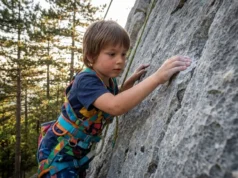
Five is the age most gyms allow kids to join structured programs. At this point, children can follow basic instructions, understand the concept of routes (follow the same-colored holds), and start learning safety commands like “take” and “lower me.”
This is also the age for introducing a full-body harness and top-rope climbing — but only if the kid shows interest. Some five-year-olds are ready to tie in. Others prefer bouldering for another year. Both are fine.
Ages 8+: Building Skills
By eight, most children have the coordination, attention span, and hip development to use a standard sit harness. They can start learning real technique: reading routes, flagging, matching, heel hooks. This is when climbing shifts from play to skill-building — but only if you let the progression happen naturally.
Pro tip: The single biggest mistake parents make is treating the climbing gym like soccer practice. Climbing is an individual sport. There’s no score, no team, and no clock. Kids who thrive in climbing are the ones whose parents let them set their own pace.
The Right Gear for Young Climbers
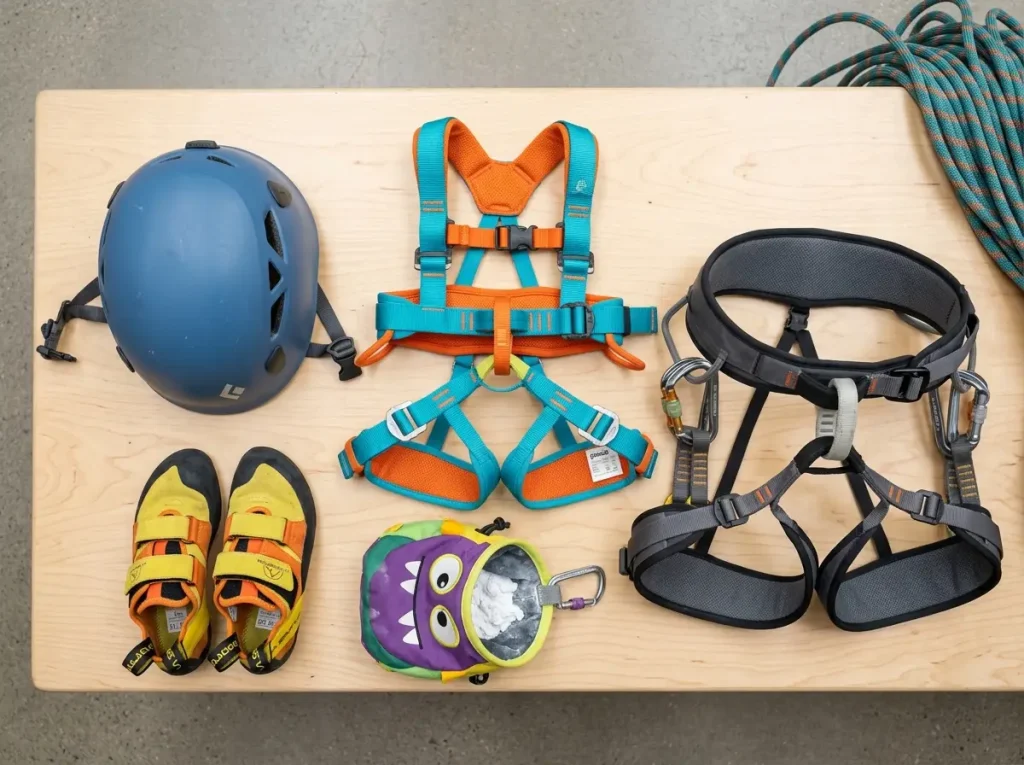
Kids’ gear isn’t just smaller adult gear. Children’s proportions are different — higher centers of gravity, narrower hips, smaller hands — and the equipment has to account for that.
Harness Selection by Weight
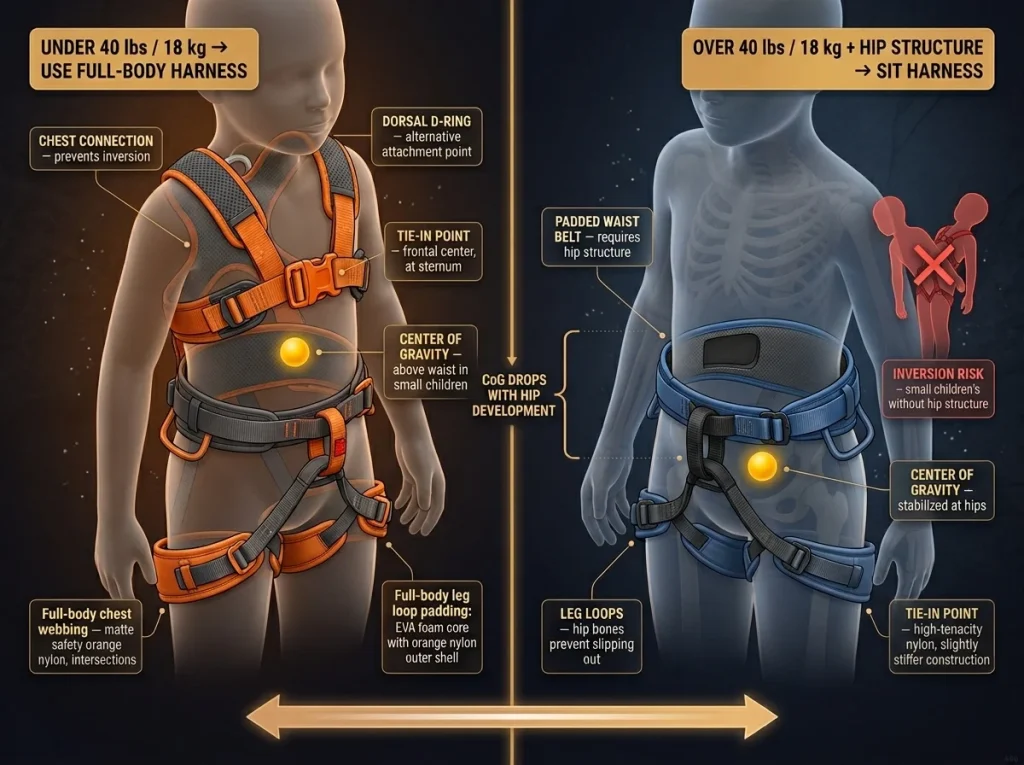
For children under 40–45 pounds, a full-body harness is the safe choice. Kids this small are top-heavy. In a regular sit harness, a fall or even just hanging on the rope can flip them upside down — their center of gravity sits above their waist, not at it. A full-body harness connects at the chest, making inversion almost impossible.
The Petzl Macchu and Edelrid Fraggle are the two most common kids’ full-body harnesses. Both meet UIAA and EN12277 standards with generous safety margins. The Macchu adjusts to fit kids from roughly 30 to 88 pounds. The Fraggle has similar range with a slightly different leg loop design.
Once your child develops noticeable hip structure — usually around age six to eight — they can transition to a youth sit harness. The transition point isn’t about age. It’s about whether they can hang in a sit harness without tipping backward. Test this at the gym before buying.
Shoes
Rental shoes work fine for the first few months. If your kid climbs more than twice a month, invest in their own pair. Kids’ climbing shoes come with velcro closures for easy on/off and softer rubber that’s less aggressive than adult shoes. The La Sportiva Gripit and Butora Brava are both solid choices that won’t fall apart after ten sessions.
Size them with about a half-thumb’s width of space at the toe. Kids’ feet grow fast, and shoes that are too tight will make them hate climbing. Too loose and they can’t feel the footholds. Check the fit every three months.
Helmet
Helmets are required for outdoor climbing, period. Most indoor gyms don’t require them, but some parents prefer them for young climbers on the lead wall. The Black Diamond Tracer and Petzl Boreo both come in kids’ sizes with easy adjustment dials.
Making the Gym Fun (Not a Training Ground)
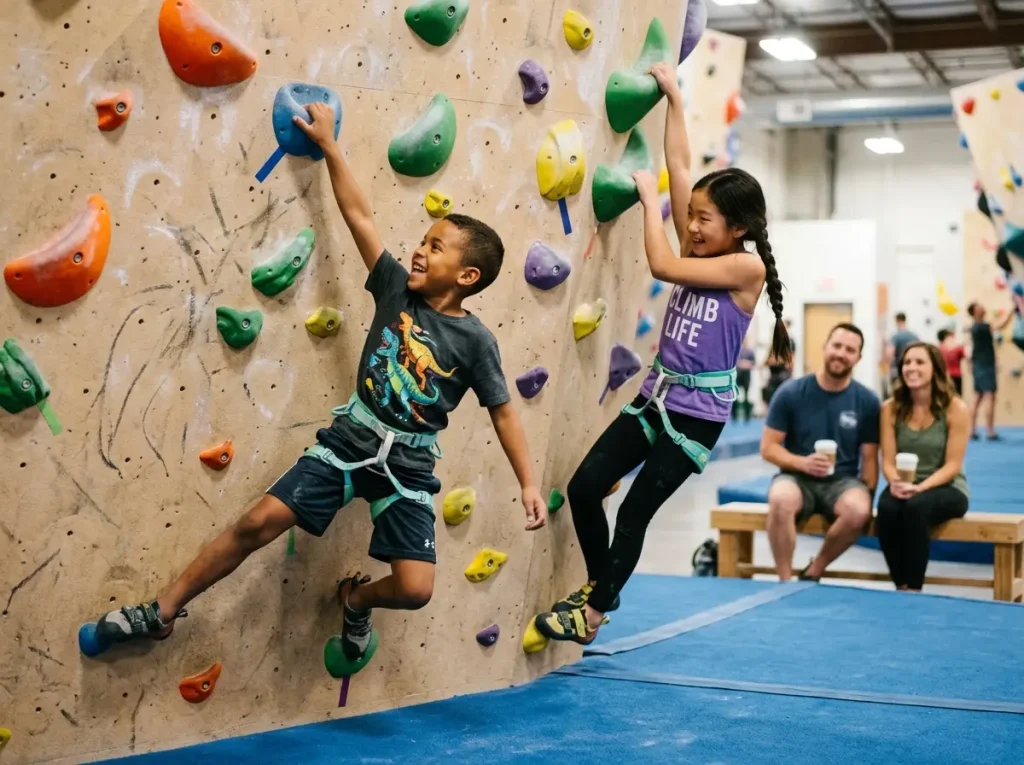
This is where most climbing parents get it wrong. They see the wall as a place to build skills. Their kid sees it as a playground. The kid is right.
Games Over Grades
Climbing games teach technique without the kid ever realizing they’re learning. Add-on (each climber adds one move to a sequence), color elimination (only use holds of one color), and traversing tag are all gym staples. These games build proprioception, grip strength, and movement reading — the same skills a coach would drill, except the kid is laughing instead of gritting their teeth.
If your child wants to just traverse back and forth on the bouldering wall for an hour, that’s a productive session. They’re building forearm endurance, balance, and spatial awareness. Don’t redirect them to the tall wall because you think they should be “progressing.”
Reading Pressure Signals
Kids communicate discomfort through behavior, not words. Watch for: sudden disinterest after a fall, asking to go home earlier than usual, reluctance to try routes they’ve done before, or the classic “my arms hurt” excuse on the drive to the gym.
These aren’t signs of laziness. They’re signs that the fun-to-stress ratio has tipped the wrong way. The fix is always the same: back off on the structure, go back to what they enjoyed, and wait. Climbing has to be something they choose, not something they endure.
The Role of the Parent at the Gym
Sit on the bench. Watch. Say “nice” when they do something cool. Do not coach their footwork, do not point out holds they’re missing, and do not compare their progress to other kids on the wall. If you want them to learn technique, enroll them in a youth program where an instructor — someone who isn’t their parent — teaches it.
The climbing parent’s job is transportation, encouragement, and snacks. Everything else is bonus.
Pro tip: The best metric for a kids’ climbing session isn’t how high they climbed or what grade they sent. It’s whether they ask to come back. If the answer is yes, you’re doing it right.
Belaying a Lightweight Climber
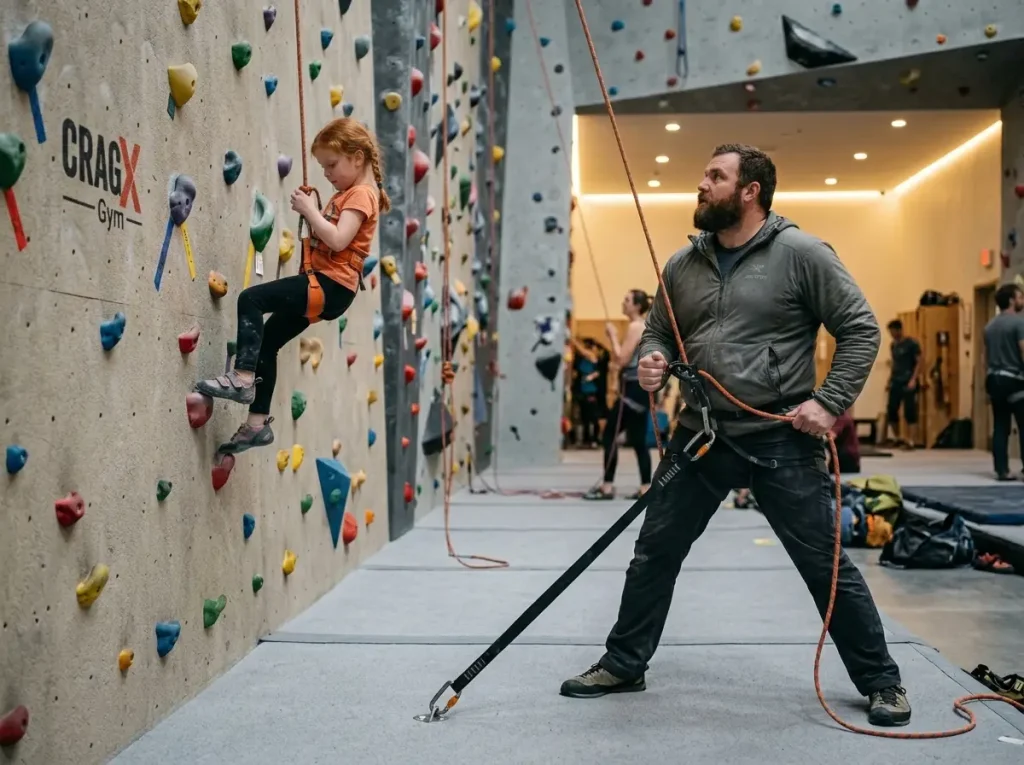
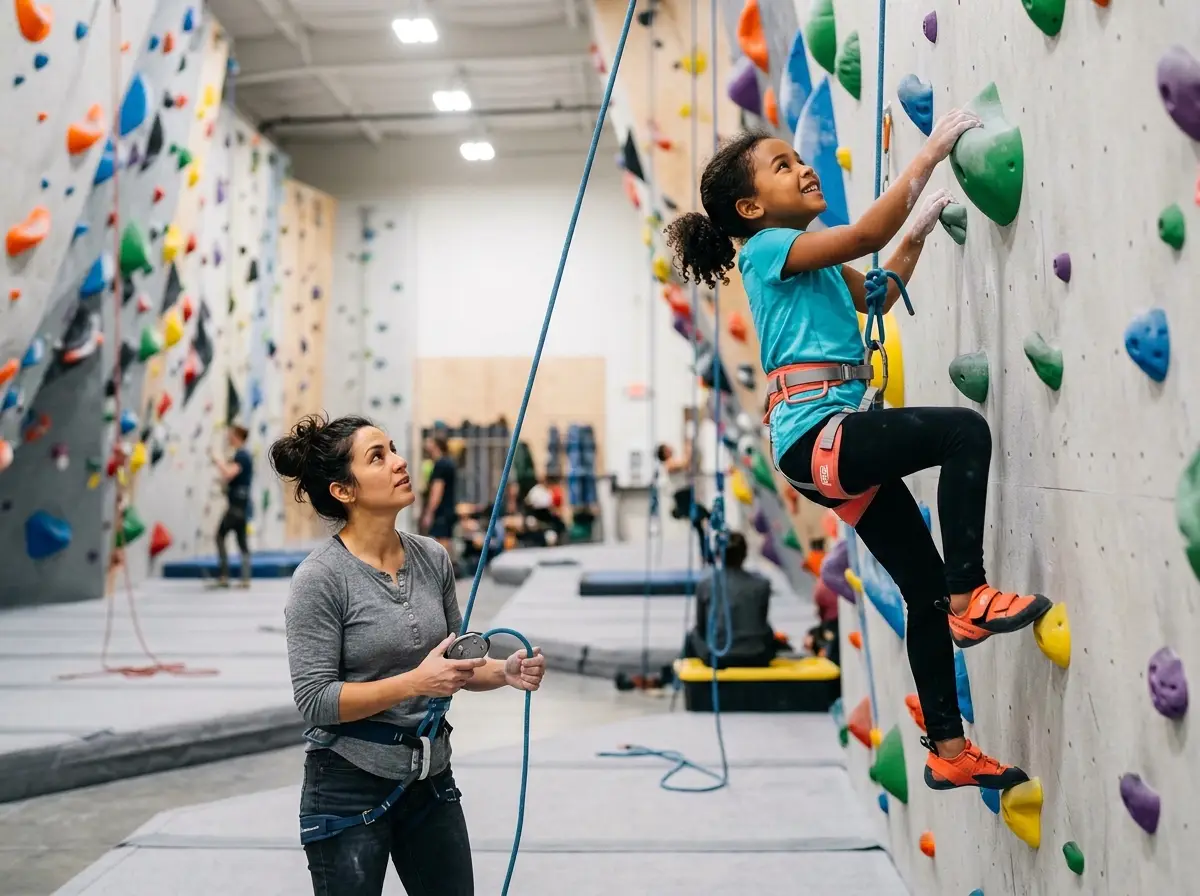
Here’s a problem that surprises every climbing parent: your kid weighs 50 pounds. You weigh 180. When they fall on top-rope, they don’t fall — you go up. And when they lower, the rope drags because there isn’t enough weight on the climber’s end to pull rope through the system smoothly.
The Weight Differential Problem
A standard belay setup assumes roughly similar weights between climber and belayer. When the belayer outweighs the climber by three or four times, the system behaves differently. On top-rope, the lightweight climber can struggle to lower smoothly because friction in the system exceeds their body weight. The rope just… stops.
On lead (if your child ever progresses to lead climbing), a significant fall generates so little force from a lightweight climber that the belayer barely feels it — which sounds safe, but it means the belayer doesn’t get the natural braking assist from being pulled into the wall. Attentive belay technique matters more, not less.
Solutions That Work
Ground anchoring: Many gyms have floor bolts or sandbag anchors near the base of routes. Clip a sling from the floor anchor to your harness belay loop. This prevents you from lifting off the ground during a catch and gives you a stable platform for smooth lowering.
Assisted-braking devices: A Petzl GriGri or similar assisted-braking device is strongly recommended when belaying kids. The camming mechanism locks regardless of rope speed, which matters when a 50-pound climber generates minimal friction through the system. A tube-style ATC works but requires more active attention.
Practice lowering: Before your kid leaves the ground on their first roped climb, practice the lower. Have them hang at waist height, sit back in their harness, and get comfortable with the sensation. Then lower them smoothly — two feet, pause, two feet more. Kids who trust the lowering process climb higher. Kids who don’t, freeze at the top.
Pro tip: If your child freezes mid-climb and won’t let go to be lowered, don’t shout instructions. Walk them through one thing: “Sit back like you’re sitting in a chair.” That single cue — sitting, not falling — works on kids under ten almost every time. It reframes the action from scary to familiar.
Moving from Gym to Outdoor Rock
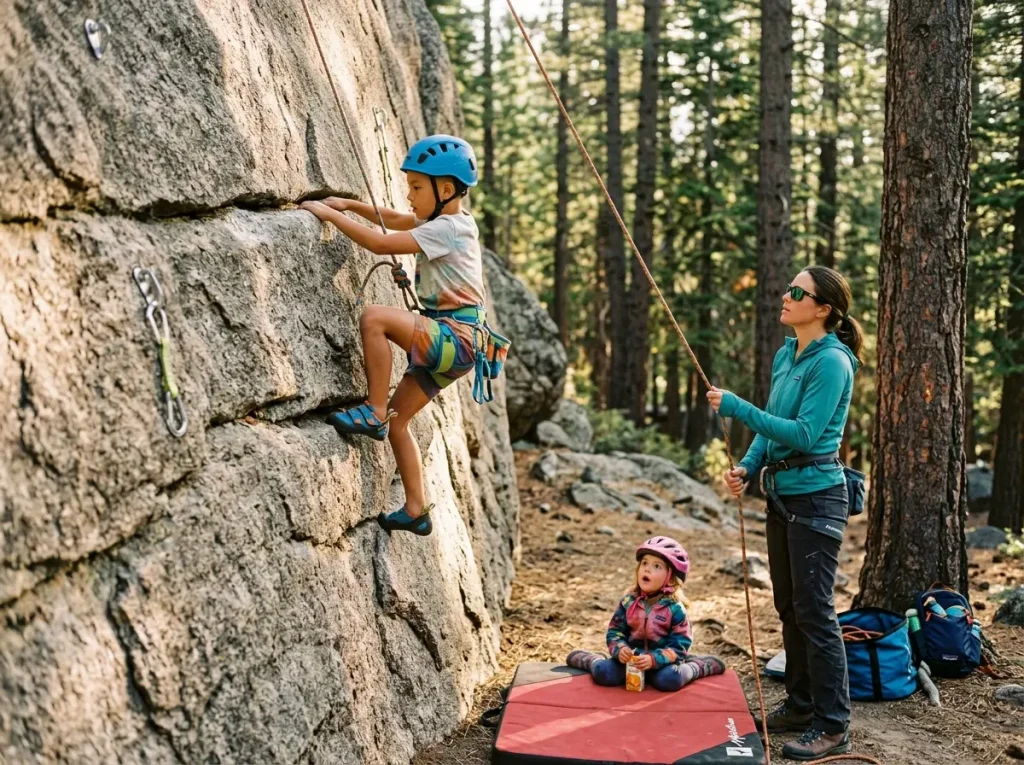
The gym-to-crag transition changes everything for kids. The holds aren’t color-coded. The heights are real. The rock is cold or hot or sharp. Some kids love it immediately. Others need several trips before the unfamiliarity fades.
When They’re Ready
There’s no grade threshold. A kid who boulders V2 in the gym might struggle on a 5.3 outdoor slab because outdoor climbing requires reading natural features — not following colored plastic. The readiness signals are behavioral: they’re comfortable on ropes, they communicate clearly with their belayer, and they express interest in trying “real rock.”
First Outdoor Session Rules
Choose a crag with routes rated 5.0 to 5.6 that are short — 25 to 40 feet. Bolted sport routes with closely spaced bolts are ideal. Set up a top-rope anchor if possible so the child never has to think about clipping.
Keep the first outdoor session to two hours maximum. The novelty, the sensory overload, and the sun wear kids down faster than you’d expect. Bring twice the snacks you think you need. End the day while they’re still having fun — the worst thing you can do is push until they’re tired and crying at the base.
If you’re not confident in your own outdoor setup skills, hire a guide for the first trip. A certified guide handles the systems so you can focus on your kid’s experience instead of worrying about anchors.
Outdoor-Specific Safety
Helmets are mandatory — on the climber, on the belayer, and on the spectator siblings sitting at the base, as recommended by the American Alpine Club’s safety guidelines. Rock falls from above, even small flakes, can cause head injuries. This is non-negotiable.
Teach kids the “falling zone” rule: never stand directly below a climber, never run under a route, and never throw rocks near the crag. These rules aren’t complicated, but they need to be established as habits before the first outdoor pitch.
Finding a Youth Climbing Program That Works
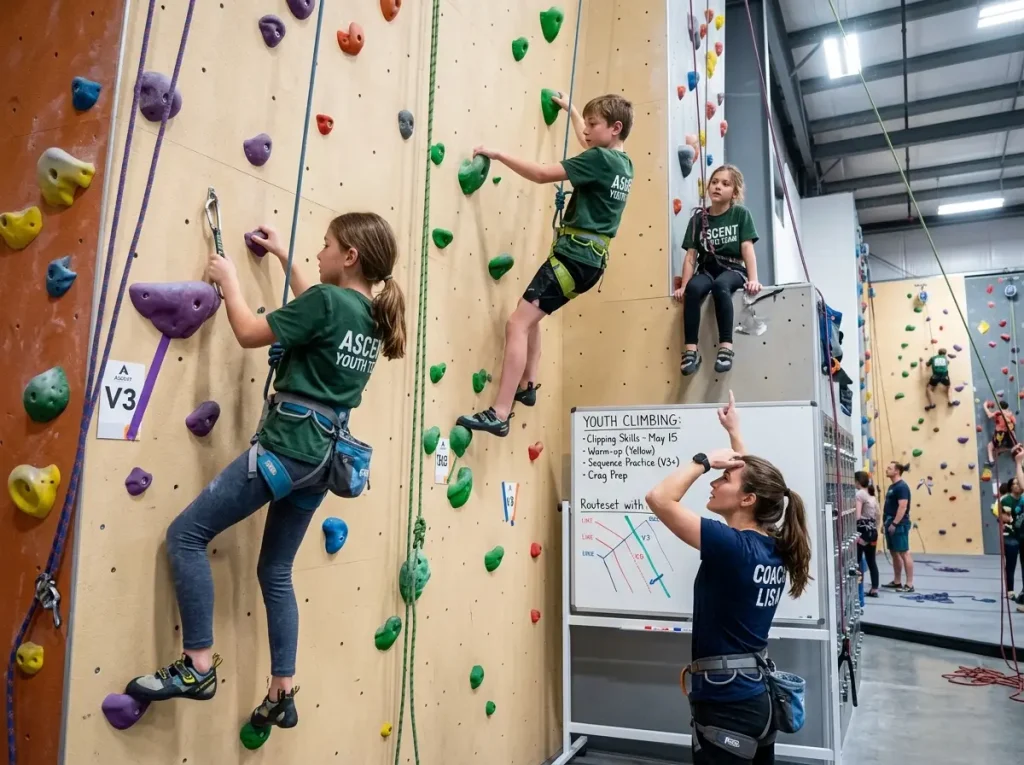
Youth climbing programs run the full spectrum from glorified daycare to legitimate skill development. Knowing what to look for saves you money and protects your kid’s relationship with the sport.
Green Flags
Look for programs with a low student-to-instructor ratio — no more than four kids per instructor for rope climbing, six for bouldering. Instructors should hold certification from an organization like the American Mountain Guides Association (AMGA) or have equivalent gym-specific training. Ask whether instructors have first aid and CPR certification — if the program can’t answer that question quickly, move on.
Good programs incorporate games and challenges alongside structured skill-building. The kids should be laughing at least as much as they’re concentrating. Watch a session before enrolling — the energy in the room tells you more than the marketing brochure.
Red Flags
Programs that emphasize competition grades over process are burning kids out. If the instructor is shouting “come on, you can do it!” at a scared kid clinging to the wall, that’s a red flag. If children are ranked against each other publicly, that’s a red flag. If the program requires more than two sessions per week for kids under ten, question whether the structure serves the child or the gym’s revenue.
High turnover in the instructor roster is another warning sign. Youth coaching is specialized work, and programs that can’t retain instructors are usually undervaluing the role.
Competitive Teams vs. Recreational Programs
Most gyms offer both. Recreational programs focus on fun, fitness, and progression at the child’s pace. Competitive teams train for competition circuits — USAC Youth Nationals, regional bouldering comps — with structured sessions three to five times per week.
Competitive climbing isn’t appropriate for most kids under ten. The physical demands on developing tendons and growth plates — especially the finger pulleys — can cause overuse injuries that don’t show up until their teens. Let your kid ask for competition, and let their body develop before you say yes.
Pro tip: Ask the gym if you can observe a full session before committing. Any program that won’t let a parent watch a class has something to hide. The best programs welcome parent observation because they’re proud of how they teach.
Conclusion
Kids who stick with climbing do so because it feels like play, not practice. The progression from bouldering cave to top-rope to outdoor rock should happen on their timeline, not yours.
Three things to get right from the start: use age-appropriate gear (full-body harness under 40 pounds, proper shoes that fit), keep the pressure at zero until they ask for more, and choose programs and environments where fun comes before grades.
Your next step is simple — find a local climbing gym with a kids’ area, let your child loose on the bouldering wall, and sit on the bench with your coffee. The wall does the teaching. You provide the ride home.
Q1 What age can a child start rock climbing?
Children can start climbing as early as age two or three on supervised bouldering walls with large holds and thick crash pads. Structured gym programs typically begin at age five, when kids can follow instructions and learn basic safety commands.
Q2 Is rock climbing safe for kids?
Yes — indoor climbing with proper supervision is one of the safer youth sports. Full-body harnesses prevent inversion for smaller children, and gyms maintain padded floors and inspected equipment. Outdoor climbing adds real hazards that require helmets and experienced adult oversight.
Q3 Should kids wear a full-body harness for climbing?
Children under 40–45 pounds should use a full-body harness because their high center of gravity can cause them to flip upside down in a standard sit harness. Once they develop hip structure — usually around ages six to eight — they can transition to a youth sit harness.
Q4 How do I find a good youth climbing program?
Look for a low student-to-instructor ratio (four kids per instructor for roped climbing), certified instructors, a mix of games and skill-building, and a program that welcomes parent observation. Avoid programs that emphasize competition grades for young children.
Q5 When should kids start climbing outdoors?
Move outdoors when your child is comfortable on gym ropes, communicates clearly with their belayer, and expresses interest in real rock. Start on short, well-bolted routes rated 5.0–5.6 and consider hiring a guide for the first outdoor session.
Safety Notice: Rock climbing and mountaineering are inherently high-risk
activities that can involve physical trauma or fatal incidents. The information on Rock Climbing Realms is for
educational and informational purposes only. Techniques and advice presented here are not a substitute
for professional, hands-on instruction. Conditions and risks vary by location. Always seek guidance
from a qualified instructor before attempting new techniques. By using this website, you agree that you
are solely responsible for your own safety. Any reliance you place on this information is strictly
at your own risk, and you assume all liability for your actions. Rock Climbing Realms and its authors
will not be held liable for any harm, damage, or loss sustained in connection with the use of this information.
Affiliate Disclosure: We are a participant in the Amazon Services LLC Associates Program, an
affiliate advertising program designed to provide a means for us to earn advertising fees by advertising and linking
to Amazon.com. As an Amazon Associate, we earn from qualifying purchases. We are also an official affiliate partner
of Black Diamond Equipment via the AvantLink network. If you click on a Black Diamond affiliate link and make a
purchase, we may earn a commission at no additional cost to you. We also participate in other affiliate programs.
Additional terms are found in the terms of service.