
In this article
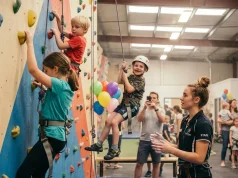
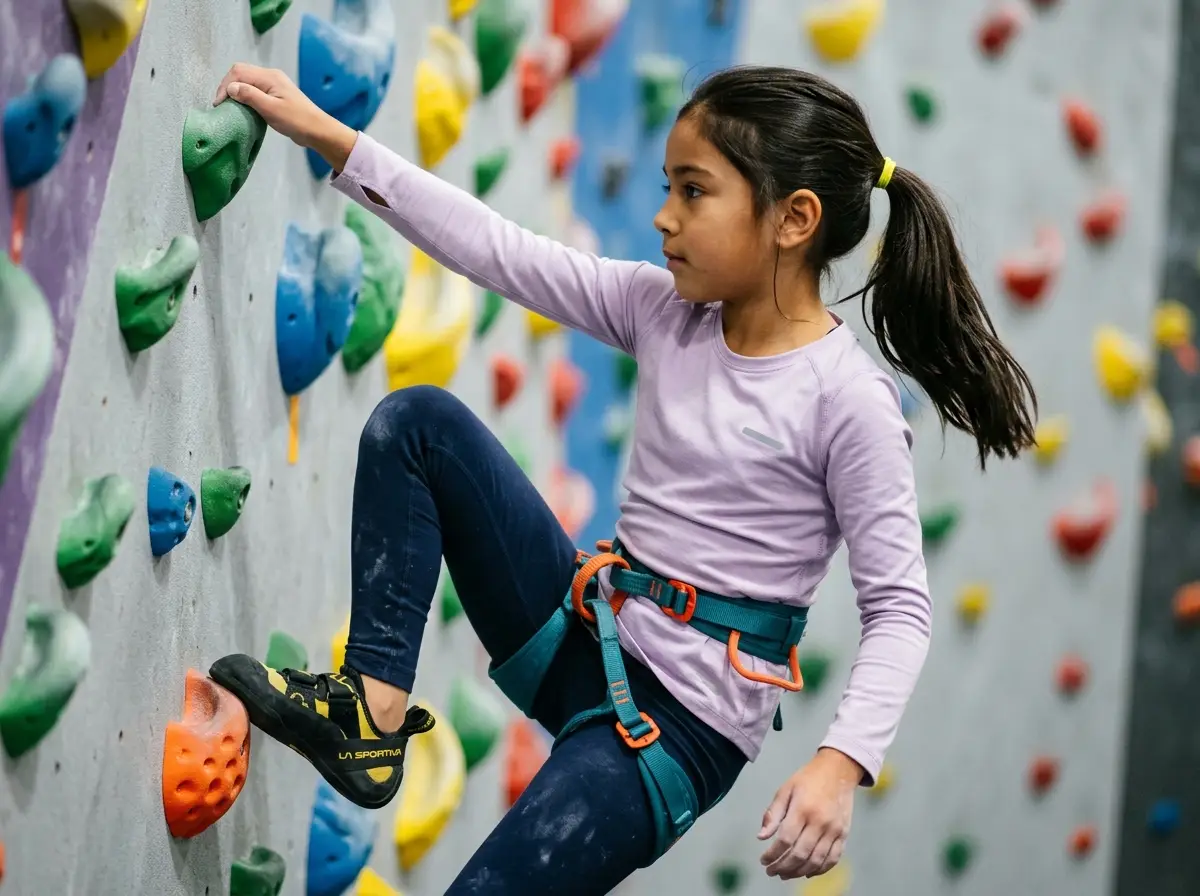
The nine-year-old froze two moves up the wall, fingers white-knuckling a jug she didn’t need to grip that hard, her feet scraping uselessly against the plastic while her coach watched from below. He didn’t reach for a handhold cue. He said one word: “Silent feet.” She paused, looked down, and placed her foot like she was setting a glass on a marble countertop. She moved again — and topped out. That’s a thirty-second clinic on beginner footwork, and it doesn’t look like coaching at all.
That moment is what structured play actually does. It fixes the problem without the kid knowing she was broken.
After years coaching youth climbers, here’s the honest truth: most kids don’t need harder problems. They need better feet. They need to stop barn-dooring off every slightly steep wall because they’ve never had to think about where their hips are. These twelve games exist to fix exactly those things — without the kids realizing they’re being fixed.
⚡ Quick Answer: The best indoor climbing games for kids teach footwork, center of gravity, and route-reading simultaneously — disguised as play. Games like Silent Feet, Add-On, and Wall Twister target specific biomechanical deficits far more efficiently than structured drills, because kids actually try hard at them. Run games on routes 1-2 grades below the child’s onsight level so the constraint — not the grade — is the challenge. Start with proprioception games as warm-up, progress to sequence-memory and endurance games as the session heats up.
| Game Skill Pillars & Minimum Age | ||
|---|---|---|
| Game | Primary Skill Pillar | Min. Age |
| 1. Add-On | Sequence Memory | 7+ |
| 2. Silent Feet | Proprioception | 4+ |
| 3. Shark Attack | Reactive Power | 5+ |
| 4. Lemon-Limes | Endurance / Eccentric Control | 9+ |
| 5. Blindfolded Bouldering | Proprioception | 8+ |
| 6. Wall Twister | CoG & Torque | 6+ |
| 7. Simon Says | Proprioception / Impulse Control | 5+ |
| 8. Eliminator | Sequence Memory | 8+ |
| 9. No-Hands Slab | CoG & Torque | 6+ |
| 10. 180 Traverse | CoG & Torque | 9+ |
| 11. The Rest Game | Endurance / Isometric Control | 5+ |
| 12. Traffic Jam / Pointer | Social / Adaptive | 7+ |
Why Climbing Games Are a Biomechanical Intervention (Not Just “Fun”)
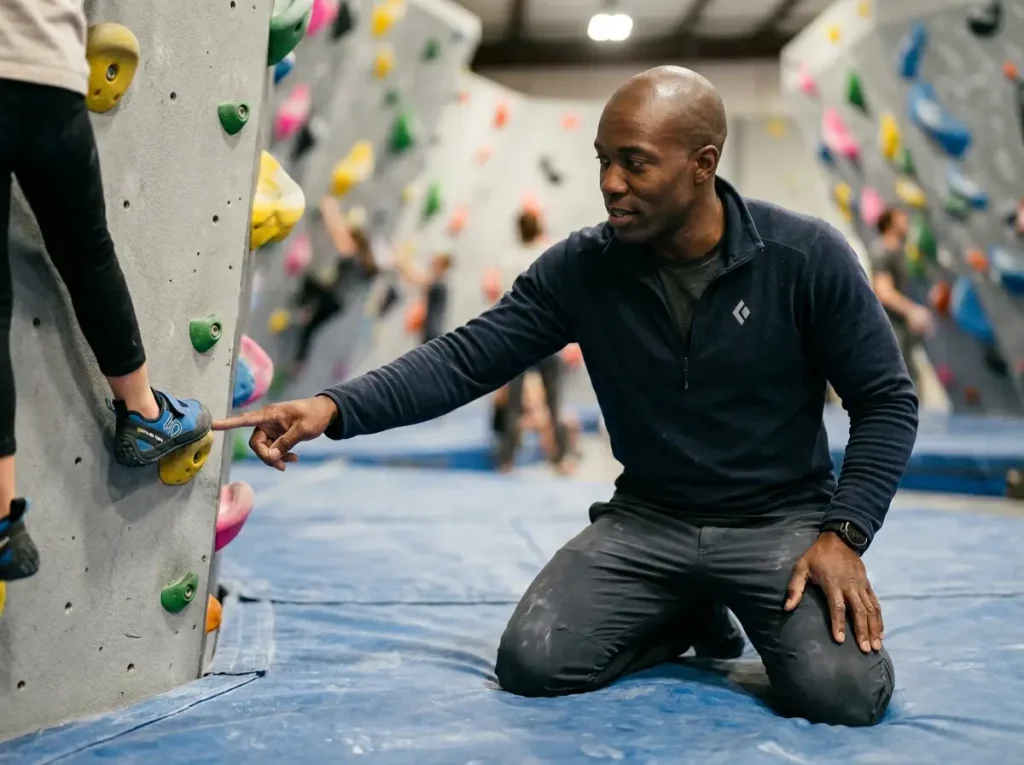
Kids are strong. That’s the problem. A nine-year-old can brute-force a V2 on pure arm pull, feet dangling, and walk away thinking they climbed it. They didn’t. They’re building technical debt — habits that work at low grades and collapse the moment terrain gets steep.
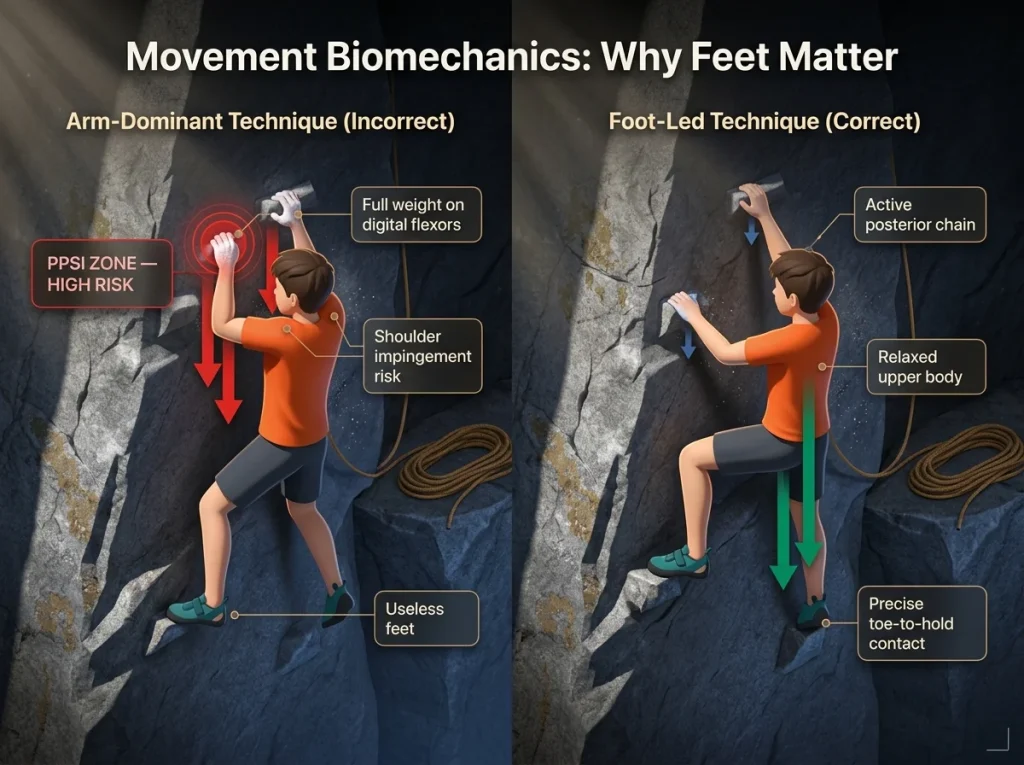
Prospective injury data in youth climbers under 16 shows that Primary Periphyseal Stress Injuries — PPSI — account for 45.3% of all injuries in climbers under 16. These aren’t fall injuries. They’re chronic overload injuries from compulsive crimping driven by arm-dominant technique. When kids pull instead of push, their digital flexors carry that load. Growth plates don’t tolerate it for long.
Games fix this. Silent Feet and No-Hands Slab force posterior chain engagement — load shifts from fingers to quads, forearm flexors to glutes. The child learns to trust their feet. Once you understand the biomechanical mechanics behind climbing injuries and why foot-led movement prevents them, game time stops feeling optional.
The neuroplasticity argument is just as strong. A child who explores footwork through Silent Feet’s feedback loop internalizes the correction faster than one who’s told “place your feet carefully” forty times. The game’s consequence is the teacher. You stop separating game time from technical training — they’re the same session.
I’ve run Silent Feet with groups ranging from five-year-olds to junior competitors. The kids who resist it most in the first ten minutes are usually the ones with the worst foot habits — they know, on some level, that the game is going to catch them.
Pillar 1 — Proprioception Games: Teaching Kids to Feel the Wall
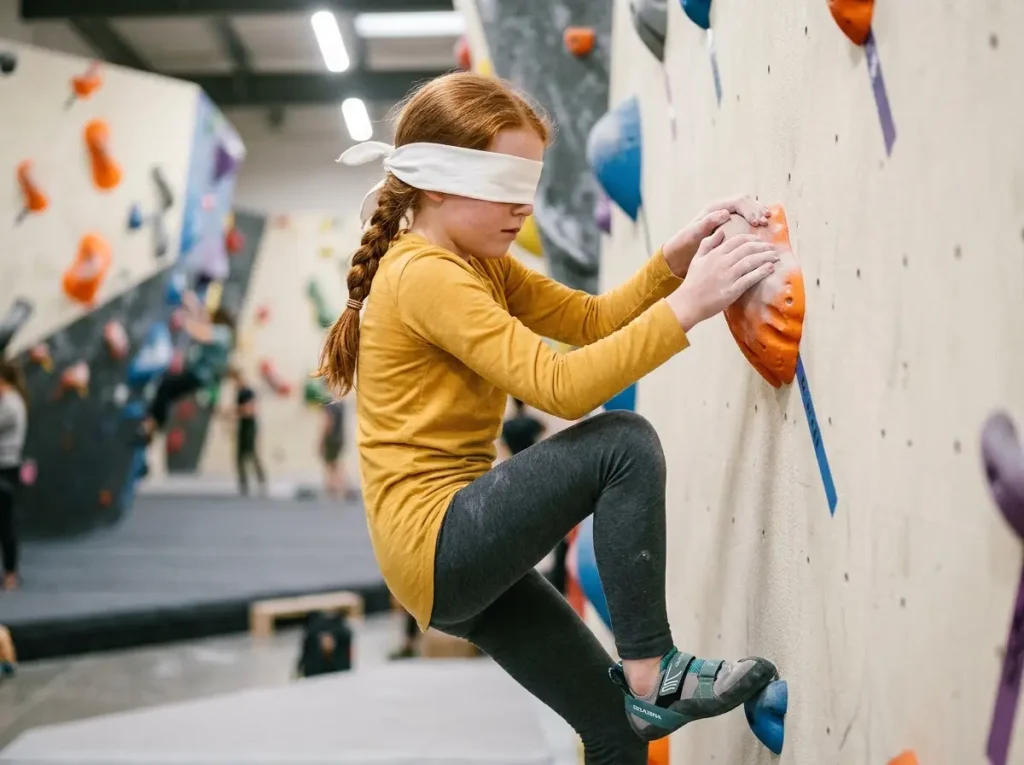
Proprioception is the internal sense of where your limbs are without looking at them. On a wall, that matters — your eyes track the next handhold while your feet need to find holds they can’t see. Most beginners compensate by tapping 2-4 times before weighting each foot, bleeding energy and introducing micro-slips. The role of climbing exercises in developing balance ability in children confirms proprioceptive development through climbing is real and measurable. Once you understand the physics of friction and foot-to-hold contact, the case for foot-training games makes itself.
Silent Feet — The “Look, Place, Weight” Protocol
One rule: every foot placement must be completely silent. Rubber strikes plastic, climber returns to start. The constraint forces a slowdown until precision catches up with ambition — look at the foothold, lock visual contact until it’s loaded, then commit weight. The sequence hardwires through consequence, not instruction.
Most beginners tap 2-4 times before weighting a foot. Silent Feet makes every tap an immediate failure event. Within twenty minutes, the tapping stops — not because the kid was lectured, but because it became expensive.
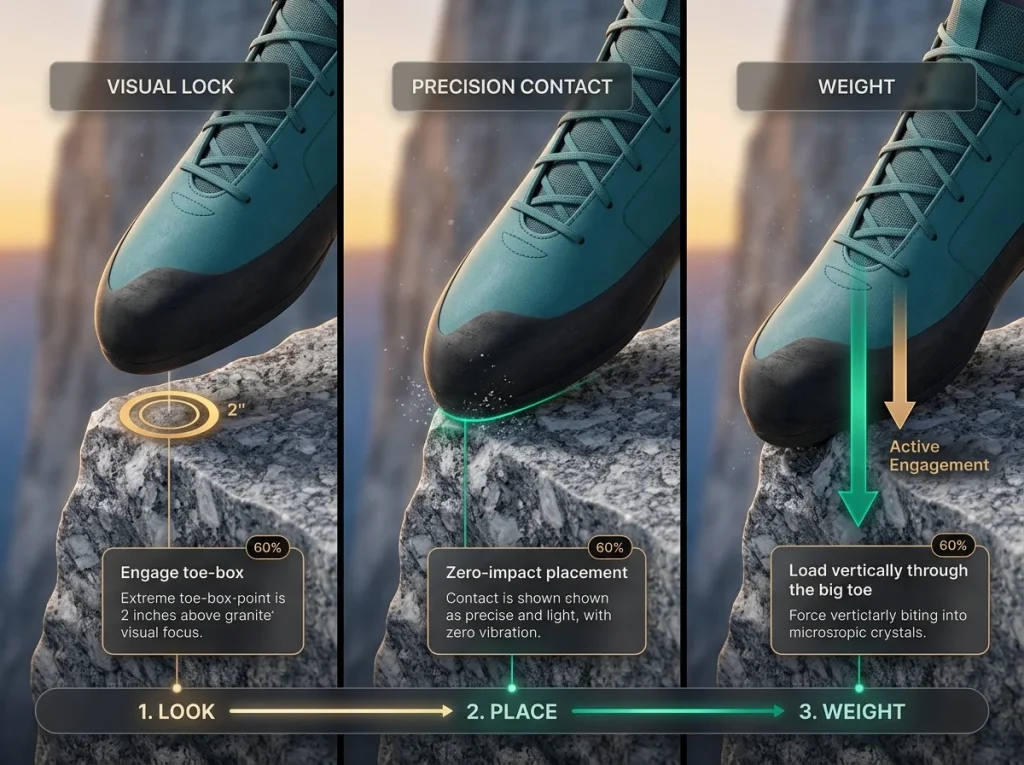
Pro tip: Run Silent Feet on a moderate traverse, not a hard route. The technical constraint should be the challenge, not the grade. If they’re struggling with the movement itself, you’ve chosen the wrong problem.
Blindfolded Bouldering — Haptic Feedback and Movement Imagination
The climber completes an easy route with eyes open first, then gets blindfolded. A ground navigator gives directions only — “right foot, six inches up, one inch left” — no physical contact. Without vision, the vestibular system works alone. The climber processes haptic feedback — hold shape, texture, friction — to find wall contact.
On real rock, chalk marks are unreliable. The ability to feel for the sweet spot transfers directly to outdoor performance. The navigator role teaches coaching language under physical load: “right foot” without a direction is useless. Sloppy cues produce sloppy movement.
Pro tip: 3-5 moves at max 1.5m height. Dedicated spotter plus navigator — blindfolded climbers lose spatial awareness faster than you expect.
Both of these proprioception games share the same underlying logic: remove one sense and the others sharpen. Once your kids have spent a session standing on feet they couldn’t see, their on-wall awareness in every subsequent session goes up a level. That’s the transfer you’re after.
Pillar 2 — Center of Gravity Games: Teaching Kids to Own Their Hips
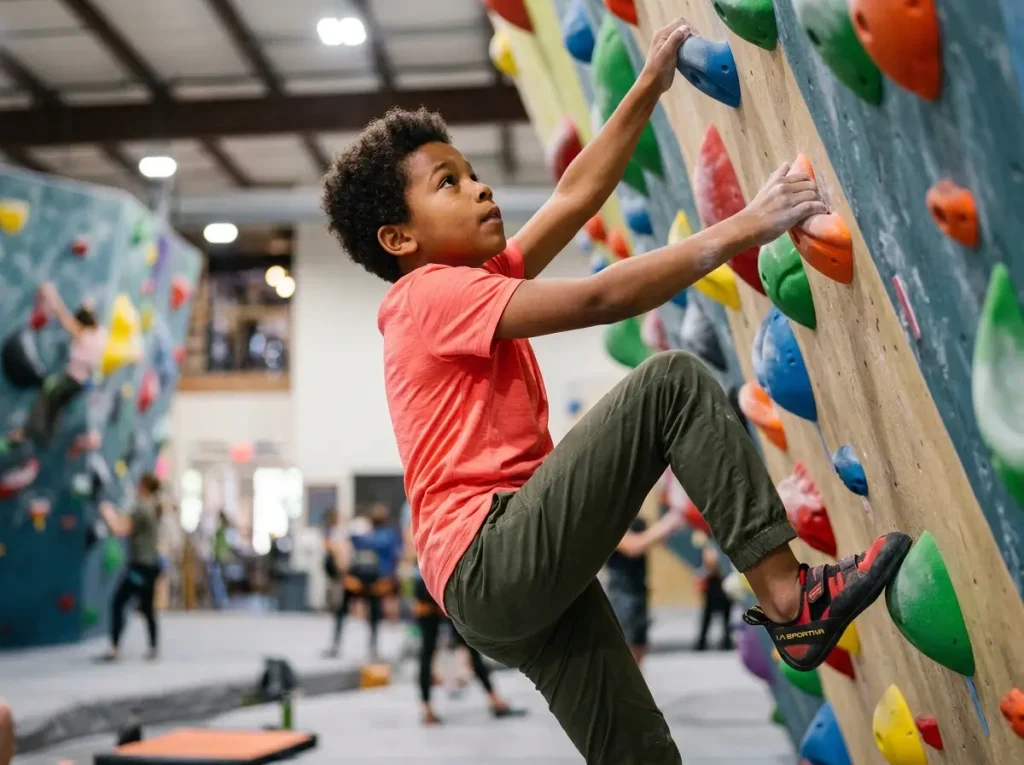
Tell a ten-year-old to “rotate their hips” during a move and nothing happens. Put them in a game where rotation is the only way to survive, and they figure it out in ten minutes. Biomechanical principles systematized for rock climbing technique confirms what coaches have observed for decades: rotational mechanics and active center of mass placement separate efficient climbers from arm-burners. When hips sit too far from the wall, the lever arm increases, friction at the feet drops, and they pop. The games below make correct hip position the path of least resistance.
Wall Twister — The Hip Mobility Diagnostic
A spinner calls a limb and a color. The climber moves that limb to a matching hold while staying on. Continue until fall. You’re watching a mobility diagnostic in action: consistent failure on high-step commands signals a hip range-of-motion problem, not strength, not fear. Get that data on day one.
Crossed-limb commands train something different: anti-barn-door stability. Moving a limb across the body while maintaining three points of contact forces torque management in real time. Teach the “Golden Triangle” — stable base between three contact points — before running this game. It’s the concept being tested.
Pro tip: Photograph stuck positions. That footage is the most useful coaching data you’ll collect all season.
Once you’ve identified the gaps, add hip mobility work to unlock high steps and heel hooks off the wall. Wall Twister tells you where the problem is.
180 Traverse — Hardwiring Rotational Mechanics
Every move requires a full 180° hip rotation: left hip to wall, then right, alternating continuously. Pivoting on toes only. Squaring up gets you sent back — enforce it.
Most kids climb frontal because that’s how humans walk stairs. Rotation is a learned override. The 180 Traverse makes it compulsory — there’s no way to cheat. Kids feel the mechanical benefit within five moves: a hip turned into the wall means less arm load, less pump. That feedback does more than any explanation.
The wall doesn’t care whether you know the theory. It only rewards correct positioning. After a few sessions of 180 Traverse, you’ll see kids rotating automatically on routes they’ve never played the game on. That’s the habit forming.
No-Hands Slab — The Physics of Friction Without Arms
Slab only. Hands behind back or holding tennis balls to prevent cheating. The climber tops the route on feet and balance alone. No-hands climbing is a brutally honest teacher: hips too far from the wall and your feet pop with nothing to save you. The “bum heavy” stance — weight perpendicular to the footholds — is the only thing that works. Run this on textured holds, not smooth volumes.
The first time a kid tops a slab with no hands, they always look down at their feet with genuine surprise. That moment — realizing their legs actually worked — is worth more than a month of verbal coaching on footwork.
Pillar 3 — Sequence Memory Games: Teaching Kids to Read the Wall Before They Leave the Ground
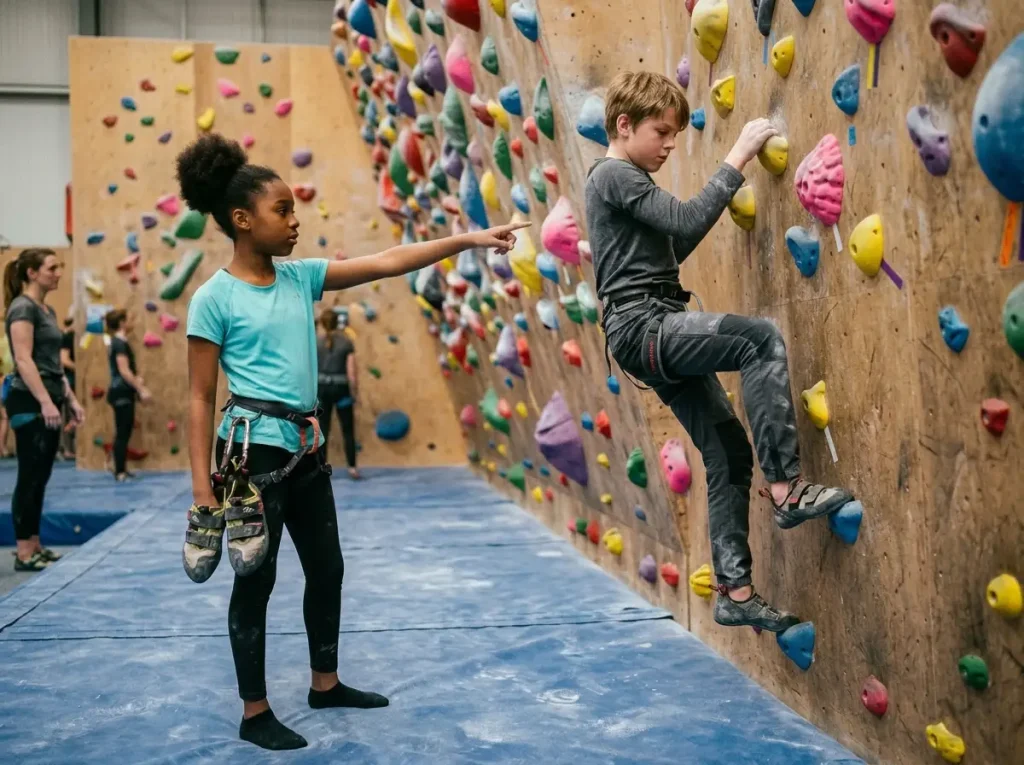
The mental side of climbing is undercoached. Motor planning and coarticulation research in climbing settings confirms the mechanism: anticipatory sequencing allows the brain to execute movements as a fluid plan rather than disconnected grabs. A climber who can’t form a motor plan before leaving the ground improvises their way up every route, burning energy on problems that should have been solved on the ground. The games below demand planning.
Add-On — Where Playing Becomes Training
Player 1 sets 1-3 moves on a dense bouldering wall. Player 2 replicates and adds. Each climber matches the full sequence before adding. Miss it or fall, eliminated. A “three lives” variant sustains engagement.
Add-On rewards technical creativity. A heel hook add-on is harder to replicate than a jug pull — coaches should reinforce technical adds over strength moves. The game introduces power endurance as sequences grow: later climbers feel cumulative pump without anyone calling it conditioning. That’s how to read a gym climbing route before leaving the ground applied under competitive pressure.
Pro tip: High hold density with significant color overlap forces genuine sequence memorization. If kids exploit color shortcuts, add a “no color calls” rule.
Eliminator — Discovering Advanced Technique Through Constraint
Group selects a hold-rich route. Each person climbs it, then eliminates one hold. Next person climbs without it, eliminates another. Continue until only essential holds remain.
Technique appears without being coached. As easy footholds disappear, flagging, backstepping, and smearing emerge — not because anyone instructed it, but because the game removed every other option. The question shifts from “which hold?” to “how do I orient my body to make this hold usable?” Let climbers choose which holds to eliminate: tactical thinking kicks in immediately.
Pointer — Building On-Sight Trust
A ground partner directs hold selection in real time using finger or laser. One instruction at a time — “right hand, blue crimp” — then wait. No pre-planned sequence, just immediate execution. Climbers who freeze on on-sight attempts have rarely practiced acting on partial information under commitment pressure. Pointer trains that without the fall consequences.
These three games progress from memorization (Add-On) to subtraction (Eliminator) to improvisation (Pointer) — a clean curriculum arc you can run across consecutive sessions as a group’s route-reading skill develops.
Pillar 4 — Endurance and Reactive Power Games: Building the Engine
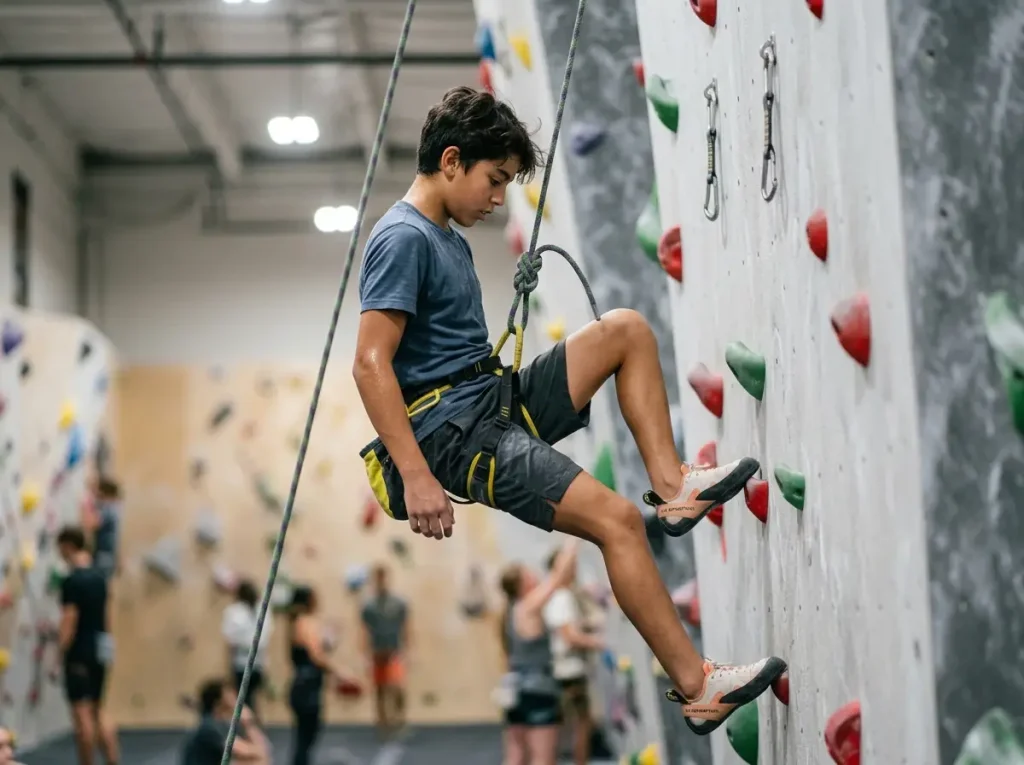
Lemon-Limes — The Eccentric Endurance Engine
Choose a route comfortably within the climber’s ability. Lemon phase: up one move, back to start holds without stepping off. Up two moves, back to start. Repeat to the top. Lime phase: inverse from the top. Down one move, back to top. Down two, back to top.
Down-climbing is metabolically and neurologically more demanding than upward movement. The muscles lengthen under tension — eccentric contractions — building real power endurance and joint stability in a way that campus boards and hangboards can’t replicate for kids this age. The repeated nature also targets lactic acid buffering: the glycolytic system gets trained without anyone announcing that conditioning is happening.
Lemon-Limes is not fun in the way Shark Attack is fun. The kids will tell you immediately. But the mechanical advantage is unambiguous, and the coach who runs it consistently will have climbers who don’t get pumped on sequences their peers fall off of. Frame it as the drill, not the game. Tell them the best climbers use it. Most of them will do it.
Pro tip: Name a rest position at the bottom — shake both arms for five seconds before each set. This teaches recovery tactics at the same time. One drill, two skills.
Shark Attack — Reactive Stability Under Stress
Everyone moves around the mat in a circle. “Shark Attack!” — the mats become water, and every climber must secure three points of contact on the wall before everyone else. Last one is eliminated. Variations: restrict to specific hold colors, or eliminate use of one limb.
This trains reactive power and vestibular processing under genuine stress. The sudden transition from horizontal movement to vertical stability requires the core and posterior chain to engage immediately. More importantly — and this is the part most coaches miss — it’s also a safety drill. It teaches children to identify the nearest secure hold and establish a stable position under irregular, unplanned conditions. That skill is genuinely useful on real rock.
Safety note: manage the fall zone aggressively during Shark Attack. Call “Freeze!” as a test command before using “Shark Attack!” for the first time — confirm the group understands stop-and-assess before the fast-movement scramble begins. Kids rushing simultaneously to the wall in different directions is the risk. Active supervision isn’t optional during this one. Check safe falling mechanics during high-energy bouldering drills before running this with a new group.
The Rest Game — Isometric Endurance and Three Points of Contact
Place items of clothing — hats, gloves, small toys — on various holds. The climber must put them on or collect them without stepping off the wall. This forces identification of a genuine rest position: jug for the hand, stable feet that allow a one-handed shake-out.
The Three Points of Contact rule becomes the survival mechanism, not a coaching directive. To put on a hat, three points must be solid enough to free the fourth limb for an extended period. That builds isometric endurance — the wall-time ability that separates climbers who can shake out and recover from climbers who get pumped and fall. Difficulty scales automatically: start items on jugs, progressively move them to harder holds as the group improves.
Pro tip: Use this as your cool-down game. Energy demands are lower than Shark Attack or Lemon-Limes, but the isometric and focus requirements stay high. Ends the session on a win.
The three games in this section don’t feel like a unified curriculum to the kids — Lemon-Limes feels like punishment, Shark Attack feels like chaos, the Rest Game feels like theater. But they’re hitting the same substrate: a body that knows how to manage effort across time. That’s the engine you’re building.
Pillar 5 — Social and Adaptive Games: Teaching Communication and Growth Mindset
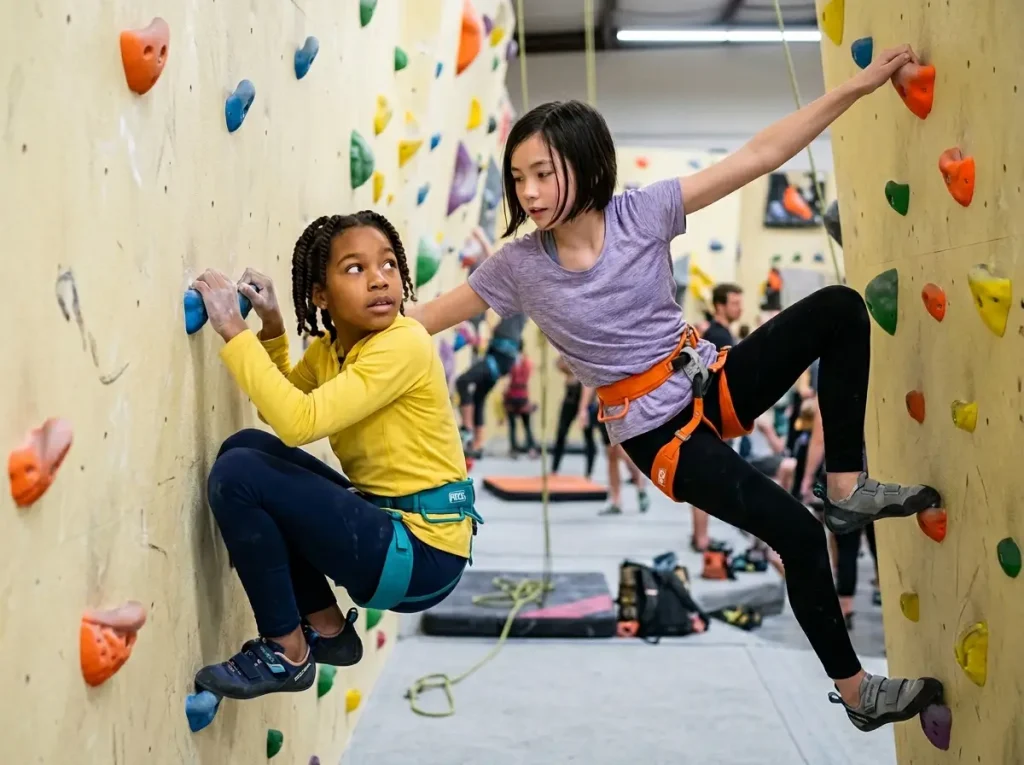
Simon Says on the Wall — Static Stability and Impulse Control
One person calls limb-and-color commands with or without the “Simon says” prefix. Move without the prefix and you’re eliminated. The climber holds each position until the next valid command. Holding under load is harder than moving through it — this is isometric core and hip stabilizer training without anyone calling it that. Use stuck positions as a diagnostic: high steps, wide-base stances, crossed arms are the mobility limits to address later.
The psychological piece matters too. Scrambling — moving before the next hold is identified — is one of the hardest beginner habits to break. Simon Says is the antidote. It enforces the pause, the assessment, the decision. Kids who go through a session of it start applying that same hesitation on their own.
Traffic Jam — Spatial Awareness at the Merge
Two groups navigate through each other on a traverse without touching the ground. One gets low, the other reaches over. Remove time pressure completely — racing produces collision risk. The goal is communication: who goes low, who goes high, who waits. Review gym climbing etiquette for shared wall environments before introducing this game — the fall zone and shared-wall concepts apply directly.
Coaching Language and Growth Mindset
Replace “I can’t” with “I haven’t yet” — every fall, every time. Celebrate funky attempts alongside clean sends. “Your foot popped on move three — what did your hip do right before?” pulls debrief toward analysis rather than emotion. The long-term goal is heuristic learning: athletes who read their own movement without being fed answers. What you say during Traffic Jam matters as much as the game itself.
Setting Up Your Game Session: Safety Protocols and Session Design
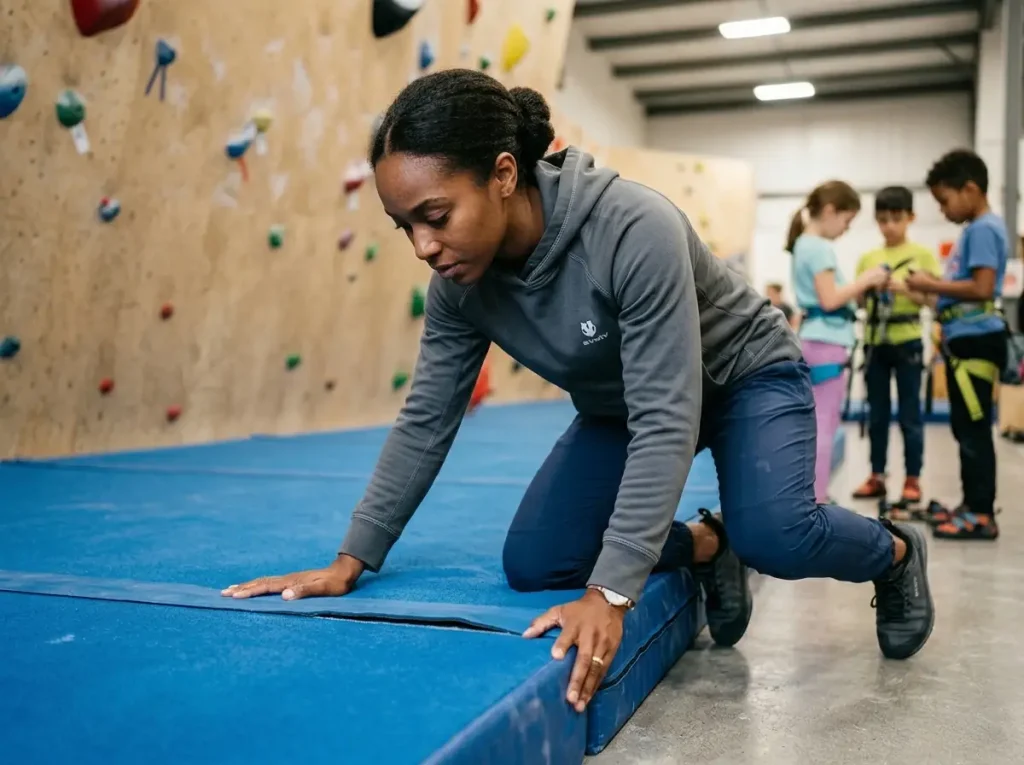
Warm-up with low-movement proprioception games first — Silent Feet, Simon Says, Rest Game. Cold posterior chains and un-warmed digital flexors are injury targets. Cold kids scrambling up a wall for Shark Attack is how sessions end early.
For any game with simultaneous wall access, establish a Fall Zone Clearance protocol before starting: no climber may be positioned directly below or beside another. Youth climbing safety guidelines and supervision standards set the baseline for supervised programs — know them before you design a session. Minimum supervision ratio for high-energy games: 1:6 coach-to-climber. Blindfolded climbing requires a dedicated spotter plus navigator — two adults for groups over four.
According to the Hospital for Special Surgery’s pediatric climbing research, youth climbers gain measurable improvements in upper body strength, problem-solving capacity, and spatial reasoning — all outcomes that structured game sessions accelerate by targeting those skills directly rather than through undifferentiated free climbing.
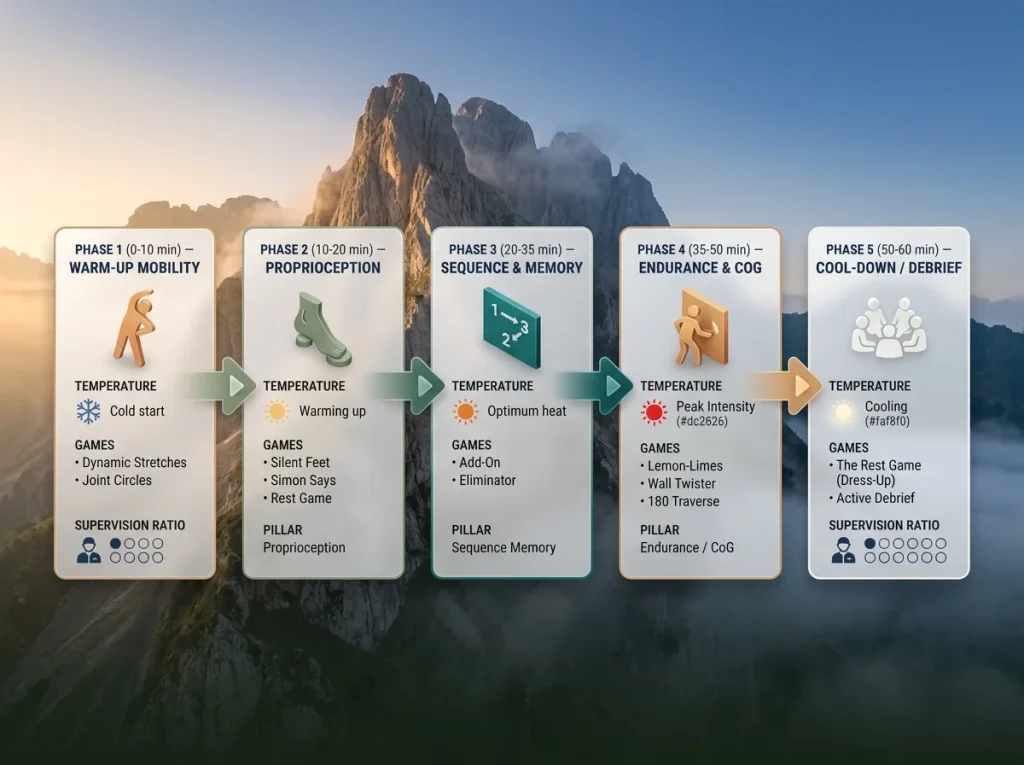
Session template (60 minutes):
- 10 min warm-up mobility
- 10 min proprioception game (Silent Feet, Simon Says)
- 15 min sequence/memory game (Add-On, Eliminator)
- 15 min endurance or CoG game (Lemon-Limes, Wall Twister)
- 10 min cool-down / debrief (Rest Game)
Run all games on routes 1-2 grades below each climber’s onsight level. The constraint is the challenge, not the grade. Before your first session, get age-appropriate harnesses and shoes for youth climbing sessions sorted — the games work on any bouldering wall, but gear that fits is non-negotiable.
Conclusion
Stop separating game time from technical training. Every game in this guide is a biomechanical drill. Silent Feet fixes footwork. Lemon-Limes builds eccentric endurance. Eliminator teaches route-reading through subtraction. The kids don’t know that. You do. That’s the entire point.
The physics operate identically whether a kid is doing a structured drill or playing Shark Attack. Torque, friction, and center of gravity management don’t care what you call the session. Design games that make correct physics the path of least resistance, and the technique follows.
Safety is architecture, not a lecture. Fall zone management, supervision ratios, warm-up sequencing — these aren’t add-ons to game sessions. They’re what allow the games to run cleanly in a group setting without someone leaving early with an injury.
Start with one game at your next session. Silent Feet is the lowest-friction entry point — no equipment, no setup, immediate feedback, works at every age. Watch where the rubber hits the hold. That’s where technique lives. Now go send something.
FAQ
What are the best indoor climbing games for kids just starting out?
Silent Feet and Simon Says are the two best entry points for true beginners — both run at low heights, require no equipment, and immediately address the two most common beginner errors: imprecise footwork and climbing or scrambling rather than deliberate movement. For groups, Shark Attack functions well as a warm-up game for any age and skill level.
How do I keep my 5-year-old interested in climbing?
The strongest engagement tools for kids under 6 are incentive-based games with tangible props — the Rest Game in its Dress-Up variant, where they collect small toys or clothing items, and Shark Attack. Both provide immediate visual feedback and feel like pure play. Avoid sequence-memory games like Add-On and Eliminator until age 7-8, when working memory is developed enough to track a growing sequence.
Are these climbing games safe for beginners?
Yes, when properly managed. Run all games on routes 1-2 grades below the climber’s onsight level, on bouldering walls within falling height (typically under 4.5m or 15ft), with crash mats covering the full fall zone. High-energy games like Shark Attack require active fall-zone supervision — never run them without a dedicated coach watching the approach zone. Risk management for groups is the skill that makes these games safe, not the games themselves.
What are some fun bouldering games for kids?
Add-On and Eliminator are the two best bouldering-specific games. Both scale automatically as the group improves, require no equipment setup, and produce genuine technical gains while staying competitive enough that kids want to play again. Wall Twister — using existing hold colors as the spinner — is another zero-equipment bouldering game that also serves as a hip mobility diagnostic.
At what age should kids start technical climbing training?
Games-based technical youth development can begin as early as 4-5 years old — the key is matching the game to the child’s motor development stage. Proprioception games like Silent Feet and the Rest Game work from age 4+. Sequence-memory games like Add-On work better from age 7+. Full rotation drills like 180 Traverse and endurance games like Lemon-Limes are best introduced at age 9-10, when the posterior chain is strong enough to benefit from eccentric loading without exposing growth plates to excess joint stress.
Safety Notice: Rock climbing and mountaineering are inherently high-risk
activities that can involve physical trauma or fatal incidents. The information on Rock Climbing Realms is for
educational and informational purposes only. Techniques and advice presented here are not a substitute
for professional, hands-on instruction. Conditions and risks vary by location. Always seek guidance
from a qualified instructor before attempting new techniques. By using this website, you agree that you
are solely responsible for your own safety. Any reliance you place on this information is strictly
at your own risk, and you assume all liability for your actions. Rock Climbing Realms and its authors
will not be held liable for any harm, damage, or loss sustained in connection with the use of this information.
Affiliate Disclosure: We are a participant in the Amazon Services LLC Associates Program, an
affiliate advertising program designed to provide a means for us to earn advertising fees by advertising and linking
to Amazon.com. As an Amazon Associate, we earn from qualifying purchases. We are also an official affiliate partner
of Black Diamond Equipment via the AvantLink network. If you click on a Black Diamond affiliate link and make a
purchase, we may earn a commission at no additional cost to you. We also participate in other affiliate programs.
Additional terms are found in the terms of service.