
In this article
The leader came off the wall at the third bolt and took the fall clean — but didn’t call out. Forty feet below, the belayer expected cursing, laughing, something. Instead: silence, then a low moan. The harness was holding him tight against the wall. Motionless. That’s the moment when everything you knew about calling for help either shows up or it doesn’t.
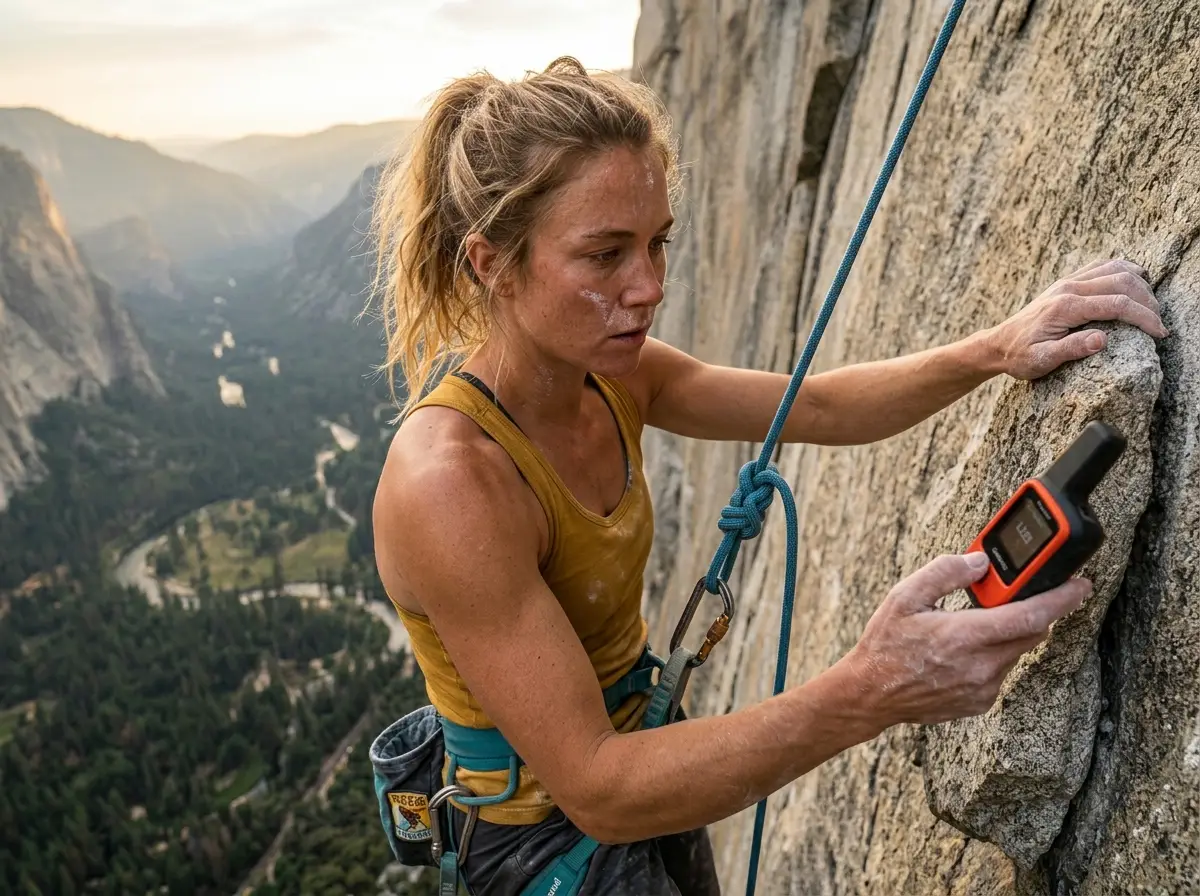
I’ve climbed for over two decades and watched that moment play out twice in the field. Both times the belayer hesitated — not out of indecision, but out of the old cultural pressure that says triggering a search and rescue response is failure. It isn’t. This guide replaces that stigma with a protocol: when to push the button, which device transmits from a north canyon wall, what happens inside the GEOS/IERCC dispatch center, and how to describe your position so a non-climbing dispatcher can act on it.
⚡ Quick Answer: Yes, you can — and should — call for rescue while climbing whenever a partner is motionless in a harness, unconscious, or has a suspected serious injury. Suspension trauma can become a fatality risk within 15–40 minutes. Use an Iridium-based device like the Garmin inReach Mini 2 for reliable signal in canyons and north-facing walls. Message your GPS coordinates first, followed by route name and a Mountain Project reference. On NPS land (Yosemite, Grand Tetons, Rainier), rescue is historically free.
The Biology of the Clock — Why “Wait and See” Is a Hazardous Strategy
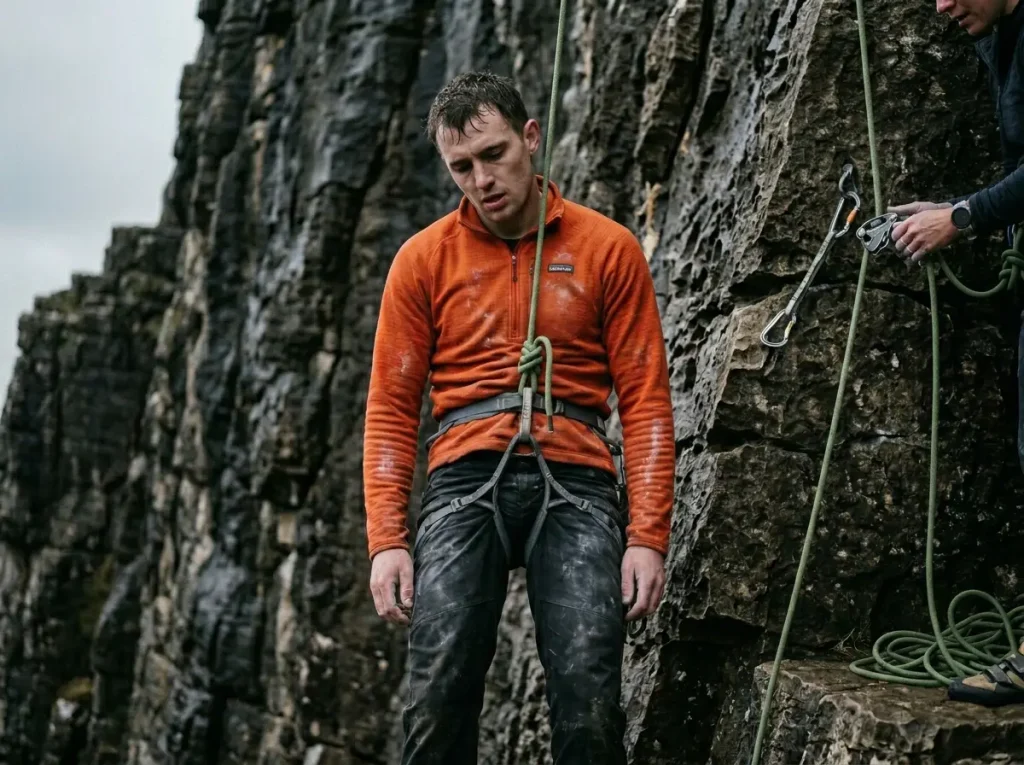
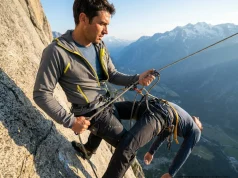
Your partner just took a hard fall and isn’t moving. The harness is doing its job — holding them against the wall. That’s where most people think the hazard is over. It isn’t. The harness just became the problem.
Harness leg loops act as low-pressure tourniquets on the femoral veins while the higher-pressure femoral arteries keep pumping blood into the legs. Blood flows in but can’t properly return. Up to 20% of total circulating blood volume can pool in the lower extremities within minutes. The heart starts struggling to fill. Then something counterintuitive happens — the Bezold-Jarisch Reflex fires, and the heart paradoxically slows down and dilates peripheral vessels instead of compensating. Total blood pressure collapse follows. The early warning signs — dizziness, nausea, tunnel vision — appear at 5–10 minutes. Loss of consciousness can happen within 5–15 minutes. The critical window runs 15–40 minutes, with venous pressure rising from a normal 25 mmHg to a catastrophic 90 mmHg.
There’s a clinical detail that the CDC suspension trauma and fall-arrest harness design study makes plain: a suspended climber who loses consciousness doesn’t fall sideways. They stay vertical. Blood doesn’t rush back to the brain. Cerebral perfusion keeps failing until it stops entirely. This is why OSHA-aligned industries — rope access, tower climbing — use a 9-minute rescue mandate as the operational benchmark for any suspended worker.
Nine minutes from hang to extracted. That’s the professional standard. Most climbing partners don’t even think about calling for help in that window because they’re still assessing the situation.
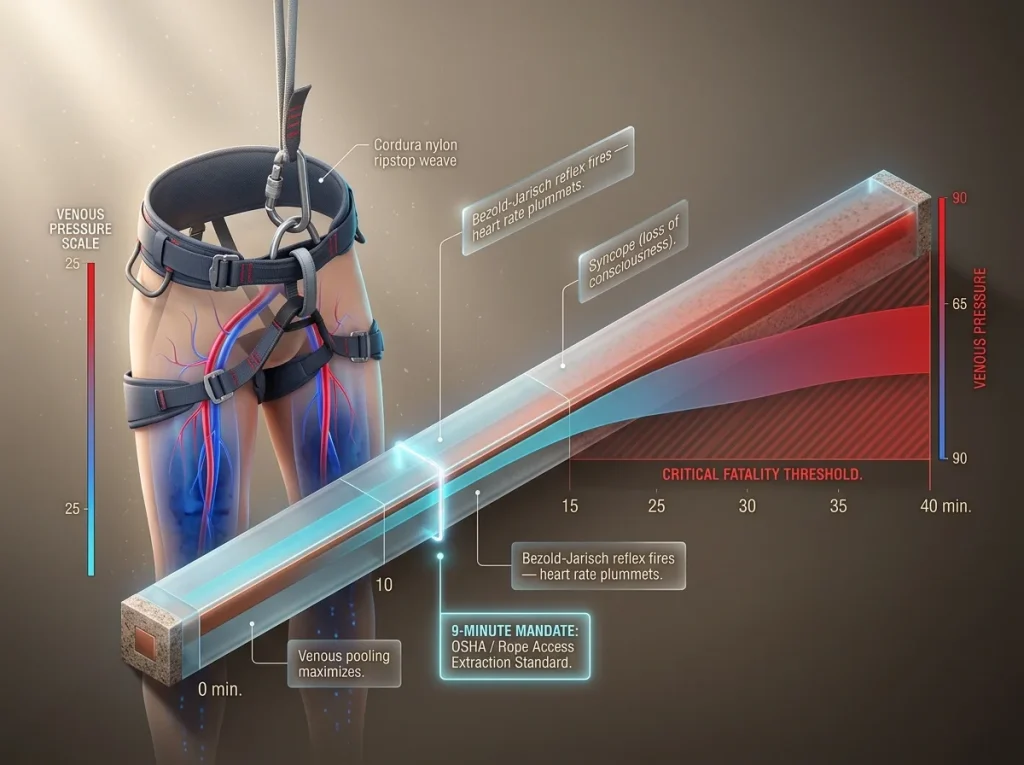
Pro tip: If your partner is conscious but dizzy after a fall and hanging in a harness, have them push their feet against any available feature immediately — even the toe of their shoe against the wall. Offloading femoral compression buys time while you organize the response. Don’t wait to see if they feel better.
The Hemodynamic Cascade Step by Step
Here’s the sequence, without the textbook language: blood moves into the legs faster than it can return. The heart empties. It tries to speed up — then the Bezold-Jarisch reflex kicks in and does the opposite of what you’d want, slowing the heart and widening vessels. Pressure drops. Consciousness goes. The partner who was talking to you five minutes ago stops responding and won’t fall horizontal to recover — because the harness keeps them vertical.
One field intervention that matters: if you have slings on your rack, you can improvise stirrups clipped from the belay loop down to a foot loop, letting your partner stand and shift weight off the femoral veins. It slows the cascade. It’s not a rescue — it’s time you’re buying while the rescue assembles.
Here’s the thing nobody warns you about: “rescue harm” from sudden repositioning. When a climber has been suspended for more than 15 minutes and is suddenly placed fully horizontal, the acid-laden blood trapped in the legs — heavy with lactic acid from anaerobic respiration — floods the heart. It can cause cardiac arrest at the moment of apparent safety. The Wilderness Medical Society guideline for this scenario: if the climber has been suspended more than 15 minutes, extract to a supported semi-recumbent position, not flat. Airway management takes priority over positioning only if they’re already unconscious. Know the difference before you need it. For the full field-level protocol on managing this on the ground, the suspension trauma field response protocol at Rock Climbing Realms covers the clinical decision framework in detail.
The Orbital Mechanics of Your SOS — Iridium vs. Globalstar in Vertical Terrain
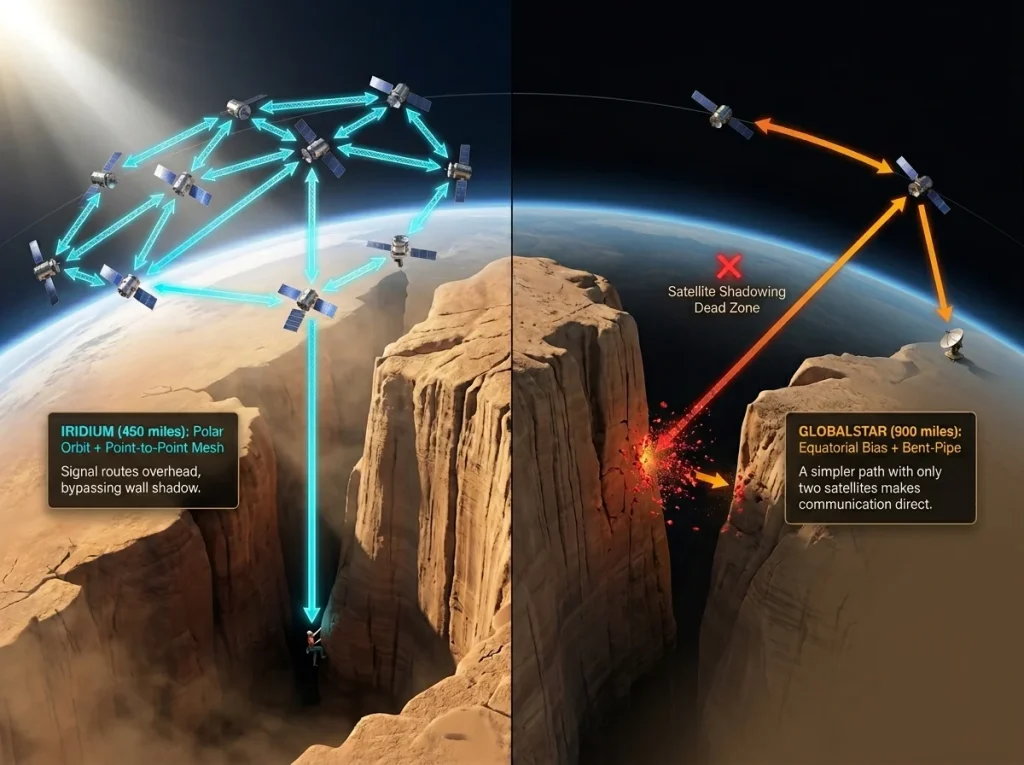
Two satellite architectures dominate the consumer rescue device market. They perform differently in the exact conditions where you’re most likely to need them. The difference isn’t marketing — it’s physics.
Iridium runs 66 satellites at roughly 450 miles altitude in polar orbit at 90° inclination. Satellites use inter-satellite links (ISLs) — the signal hops across the constellation until it finds one with a clear ground-station view. You don’t need to be over a ground station yourself. The message routes around the problem. Globalstar — which powers the SPOT Gen4 and iPhone 14/15 Satellite SOS — runs 24–32 satellites at about 900 miles, inclined at 52°. These satellites cannot talk to each other. They must simultaneously see both you and a terrestrial gateway to complete a transmission.
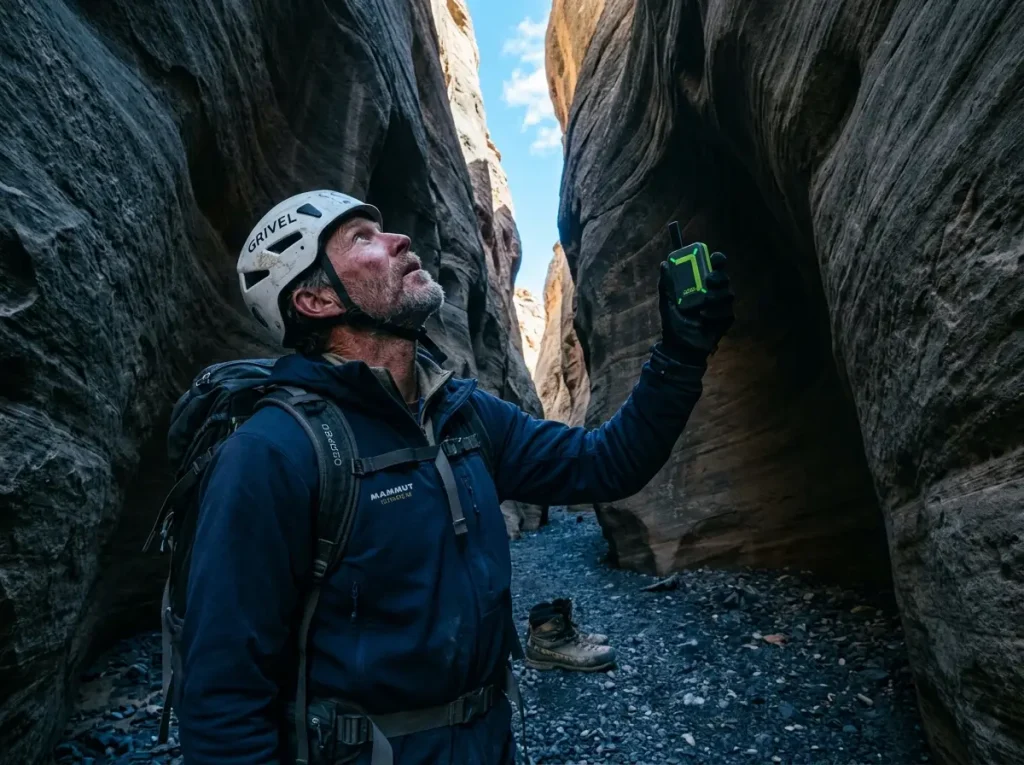
Satellite shadowing is what happens in vertical terrain when topographical features block signal. A north-facing 1,000-foot wall facing away from the temperate-zone orbits is a Globalstar dead zone. Those satellites appear low on the southern horizon — exactly where the wall blocks them. Iridium’s polar orbit sends satellites directly overhead, bypassing the shadow entirely. In narrow canyon slots where the visible sky might be a 5° slice open for a few minutes per hour, Iridium’s denser constellation gives statistically higher odds that a satellite passes through that window. For a broader look at integrating devices like these into your full safety system, advanced climbing safety systems beyond the basics covers the complete picture.
Pro tip: Don’t test your device in the parking lot before a canyon route. Turn it on, acquire satellite lock, and watch how signal bars behave as you move into shadow zones. The failure mode isn’t always “no signal” — it’s delayed lock that sends your SOS coordinates before the GPS has dialed in.
The Anti-Sell on PLBs vs. Two-Way Messengers
PLBs like the ACR ResQLink 400 transmit at 5 watts through the military COSPAS-SARSAT network. Raw signal power is unmatched — 5-year shelf life, no subscription, and the network has genuine global reach. The problem: one-way only. You press the button and go silent.
In a technical climbing scenario, the ability to communicate “leader is unconscious and hanging” versus “we’re stuck but walking out under our own power” changes the entire trajectory of the SAR response. Air medical evacuation versus a ground team. Helicopter versus a litter carry. That distinction comes from a single two-way message. The Garmin inReach Mini 2 — 3.5 oz, IPX7 waterproofing, 14-day battery at 10-minute tracking on Iridium — is the benchmark for standalone interface in cold-temperature environments. The Mountain Rescue Association equipment recommendations reflect this shift: professional SAR organizations now treat two-way messaging as standard for technical terrain.
Cold Truth on iPhones
iPhone 14/15 Satellite SOS runs on Globalstar. It works well in open terrain, and it’s better than nothing. But on a north face in Alaska or in a deep sandstone canyon, it has the same problem Globalstar always had: it needs to see a satellite that needs to see a ground station. When both conditions aren’t met simultaneously, the message doesn’t send. Carry an inReach if you’re going anywhere that doesn’t have a southern horizon.
The IERCC Dispatch Chain — What Actually Happens After You Push the Button
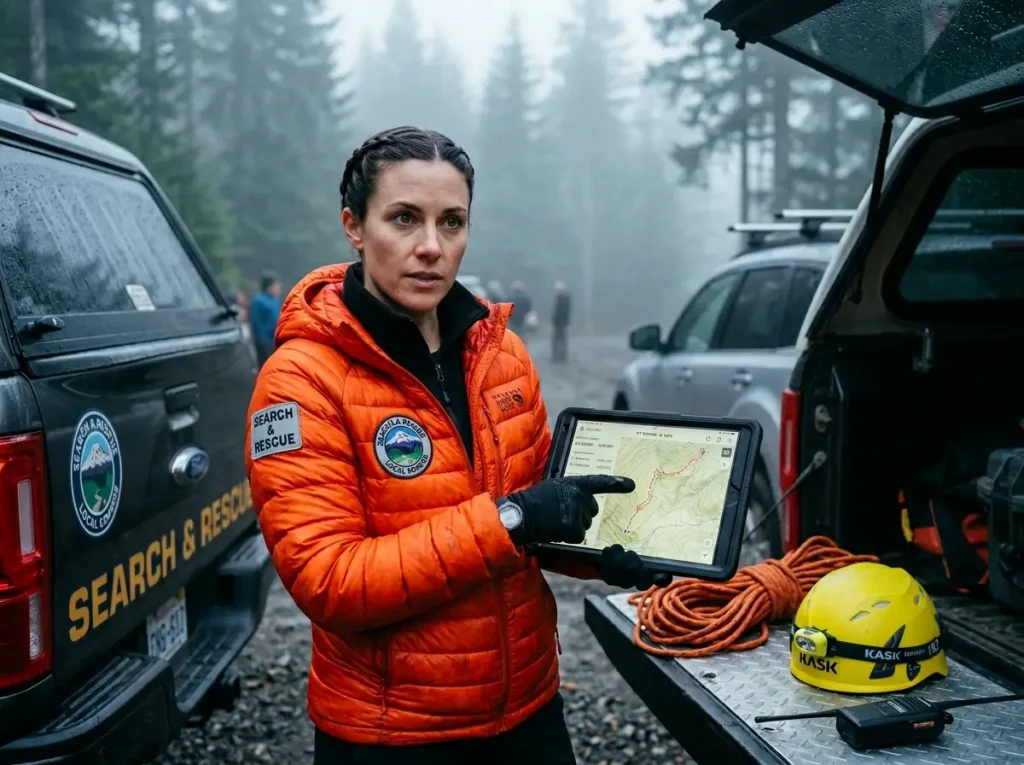
Most climbers picture pressing SOS as throwing their situation into a void and hoping for the best. The reality is more structured — and the structure matters, because how you communicate determines what shows up.
For Garmin inReach, the signal arrives at the International Emergency Response Coordination Center (IERCC), operated by GEOS in Montgomery, Texas. What they do in sequence: Stage 1 — GPS coordinates, battery life, and your pre-registered profile are pulled immediately. Stage 2 — dispatcher sends acknowledgment; if you respond, they triage: life-threatening injury? Technical extraction required? Stage 3 — they identify the jurisdiction. Jenny Lake Rangers for the Grand Tetons. YOSAR for Yosemite. Local sheriff for state lands. Stage 4 — they call your registered emergency contacts to verify your route plans, medical history, specific gear. (“Do they have a 70m or 60m rope?”) Stage 5 — in many cases, IERCC can bridge a direct text connection between you and the field SAR team leadership.
The Wilderness Medical Society’s climbing communication protocol documents the single most common failure in this chain: most SAR delays are communication failures, not equipment failures.
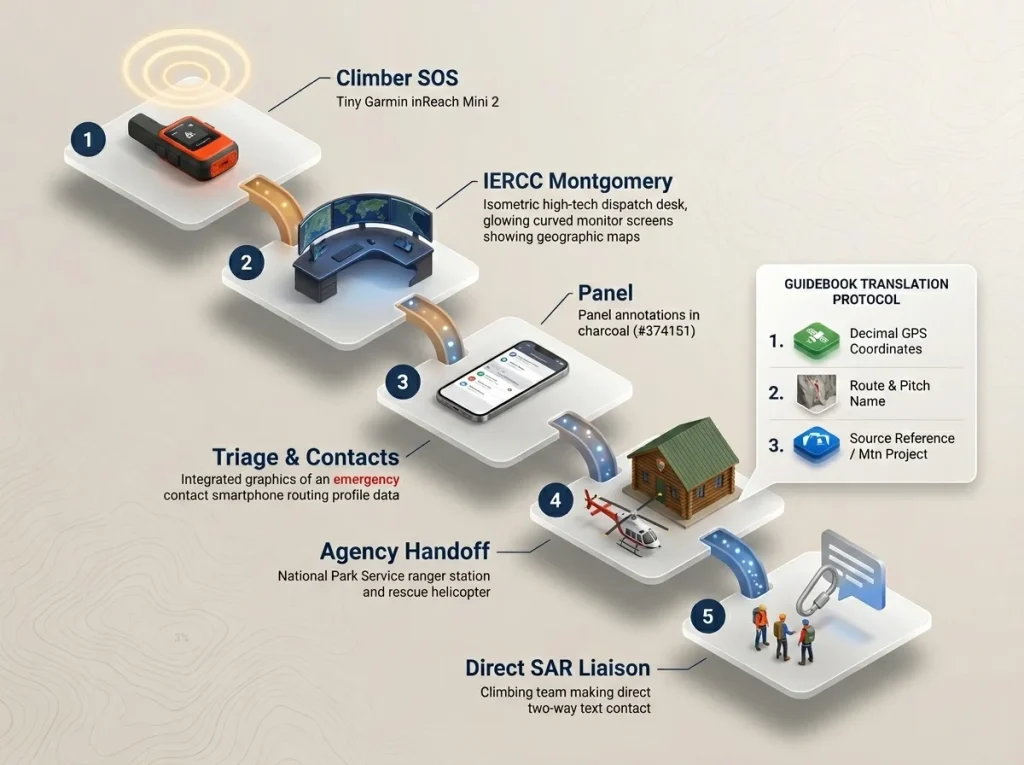
Pro tip: Before any serious climb, photograph the Mountain Project page for your specific route. If your phone runs out of power during the approach, a ground-level companion can relay the route description and pitch-by-pitch breakdown to IERCC. SAR teams now carry Mountain Project as a standard field tool. That single photograph can cut hours off coordination time.
The Guidebook Translation Protocol
Dispatchers in Montgomery, Texas, are not climbers. “Pitch 4” and “The Great Roof” are meaningless without context. The three-part message format that SAR teams can act on immediately:
- Decimal GPS coordinates — primary navigation data for helicopter pilots (e.g., 37.7341° N, 119.6367° W)
- Route name and specific feature — “Pitch 4, The Great Roof, The Nose, El Capitan, Yosemite NP”
- Source reference — “Location matches Mountain Project app description”
If battery is low and you’re on a technical section, priority is coordinates first, injury summary second, route name third. If you get only one message through, make it the coordinates. Pre-load your IERCC profile with your intended route and planned pitches before you leave the car — this one step removes significant lag from Stage 3. Connecting the pre-trip planning to the dispatch chain is exactly what the pre-trip risk assessment protocol at Rock Climbing Realms covers.
The Insurance and Cost Reality — Numbers Most Climbers Don’t Know
Financial fear is one of the most documented reasons climbers delay triggering SOS. That hesitation costs lives. Here’s the actual cost landscape, not the vague concern.
On NPS land — Yosemite, Grand Tetons, Rainier, Zion — rescue is historically free. The NPS is explicit: financial fear must never delay a call. The rationale isn’t charity; it’s policy built on the recognition that every minute of hesitation inside a suspension trauma window has measurable physiological consequences. On state or private land, SAR teams are often volunteers, but they can authorize private air medical assets. LifeMed, Guardian Flight — $10,000 to $25,000 per dispatch.
The No Surprises Act caps air ambulance billing for “medically necessary” transports near your deductible (around $3,250). It doesn’t cover technical extractions or pure search operations without medical transport. If injured and the helicopter provides any treatment en route, document it — that’s the billing protection trigger.
Insurance tiers that actually matter for climbing:
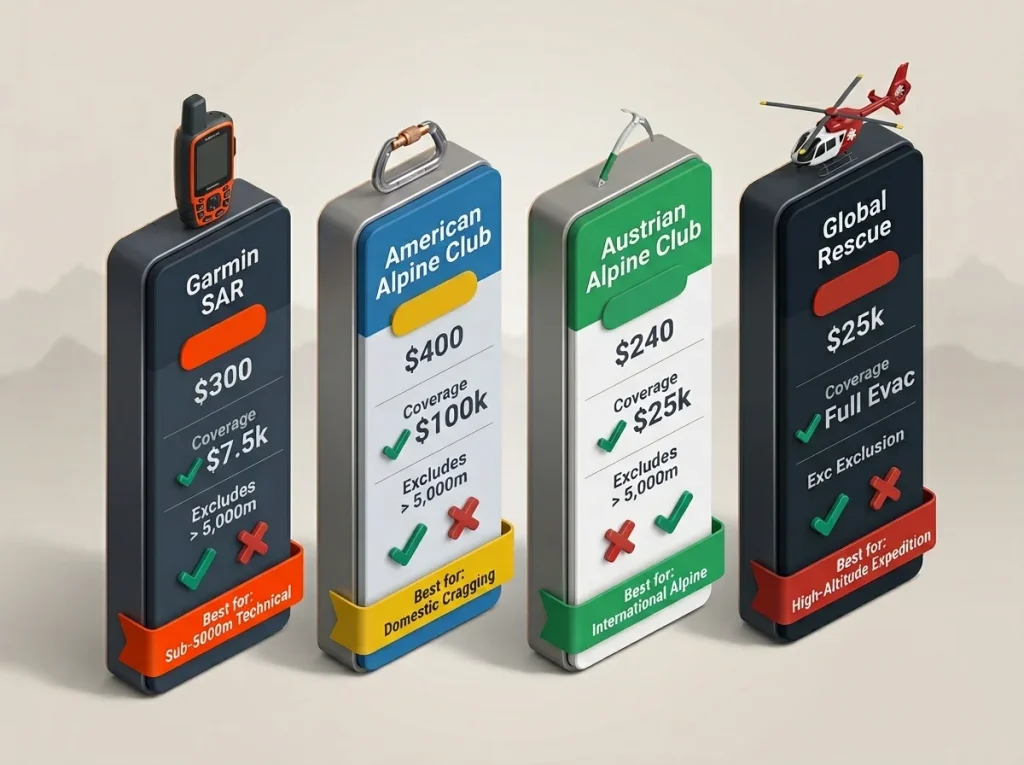
Garmin SAR Insurance at $39.95/year covers $100,000 but excludes technical climbing above 5km — read that exclusion before you buy it. AAC membership runs $65–$100/year with a $7,500 limit, which is serviceable for cragging but won’t cover a heli-evac from anything remote. The AAC membership rescue insurance coverage breakdown explains the tradeoffs before you need them. The Austrian Alpine Club runs roughly $90/year with a $25,000 limit — worth looking into for anyone who climbs internationally. Global Rescue at $330+/year covers full evacuation from anywhere, which is the right tier for alpine objectives and international climbs above 5km.
Standard travel insurance typically excludes “climbing with ropes and guides” — not assumed under “adventure sports.” Read the exclusions clause before you leave.
Jurisdiction Breakdown — Federal vs. State vs. Private
National Parks run a no-charge policy that is longstanding and deliberate: YOSAR, Jenny Lake Rangers, and NPS Rainier respond without billing climbers. The NPS philosophy is that the financial question should not register in the moment of crisis.
State lands managed by DNR, BLM, or state parks are highly variable. Some states authorize volunteer SAR only, which carries no cost. Others allow private air medical mobilization, which carries substantial fees. Before climbing any destination new to you, spend five minutes identifying the local SAR agency and whether private air assets are pre-authorized in your area. The pre-trip risk assessment protocol gives you the framework for that kind of pre-trip inventory.
Analog Fallback — When the Battery Is Flat and the Satellite Is Blocked
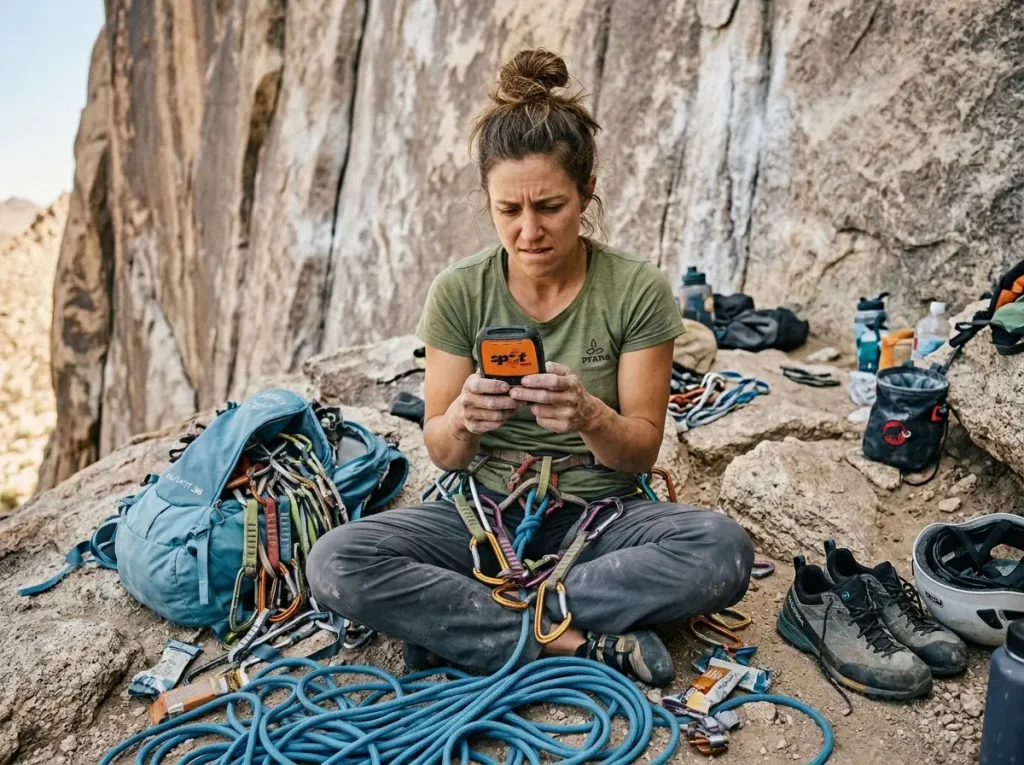
The Garmin is flat. The phone is flat. You’re on a ledge watching weather build. This is where the century-old mechanical toolkit still matters.
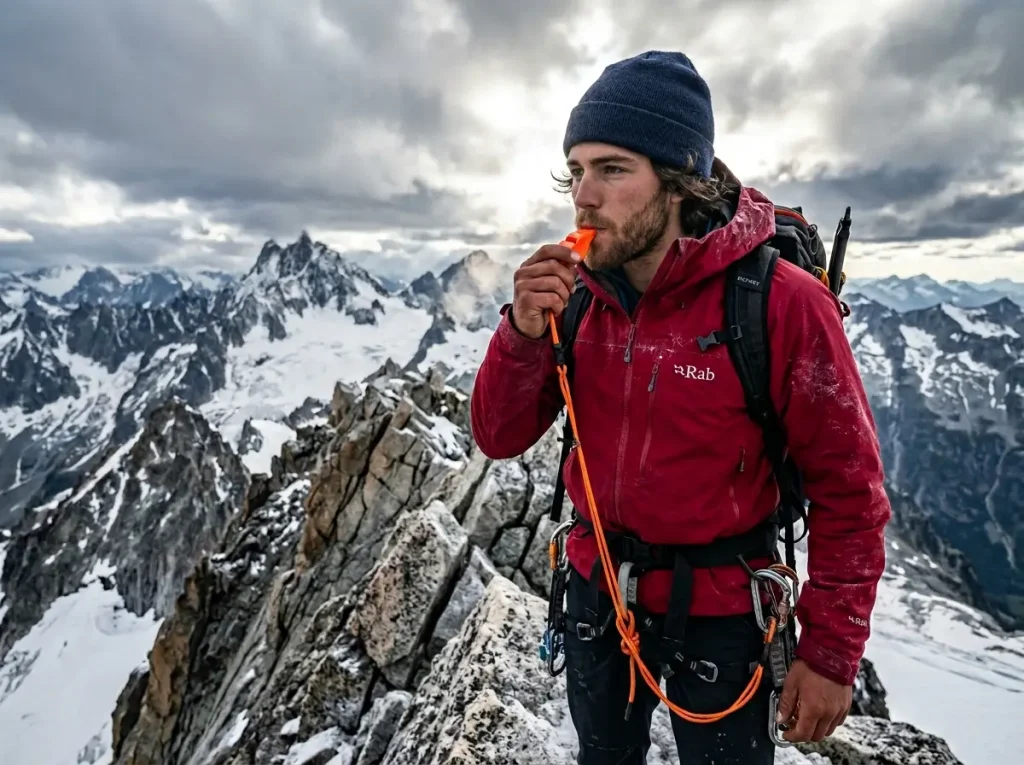
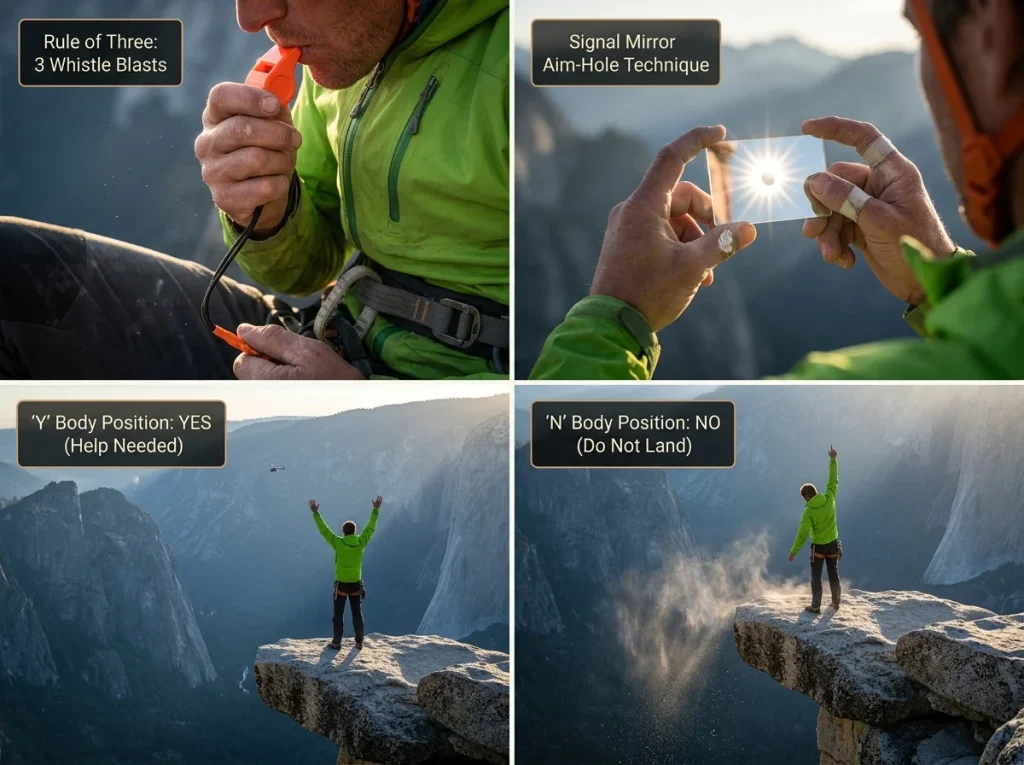
The Rule of Three is the North American standard: three signals — whistle blasts, mirror flashes, or smoke fires — followed by a one-minute pause, then repeat. In Europe, the Alpine Signal runs six signals per minute (every 10 seconds), followed by a one-minute pause. Know the difference if you’re climbing in the Alps — and know that a responding rescuer signals back at two per minute to confirm. According to Utah Emergency Management emergency wilderness signaling protocols, these acoustic standards are consistent across professional SAR training nationwide.
A Fox 40 pealess whistle generates 115 dB at one meter. The human voice in exposed terrain with wind: under 200 meters. A whistle properly aimed: 1–2 kilometers. The pealess design matters because a standard whistle with any moisture in the chamber goes silent — guaranteed in alpine or canyon conditions. On any multi-pitch route above a pitch or two, verbal commands fail anyway. The same three-blast signal doubles as your partner communication system on long routes. Understanding how multi-pitch communication systems integrate with distress protocols makes the whole emergency plan tighter.
For the complete visual demonstration of body signals and whistle technique under stress, this tutorial covers alpine emergency response procedure step by step:
Visual Signaling and Helicopter Protocols
A signal mirror in direct sunlight carries up to 10 miles. Overcast: useless. Know the conditions before relying on it. Any bright gear — orange bivy sack, lime harness — deployed on a visible ledge serves as passive signal from altitude.
Helicopter body signals: both arms raised in a Y-shape means “Yes, I need help.” One up, one down forms an N: “No help needed.” Crews read your signal from altitude before committing to an approach.
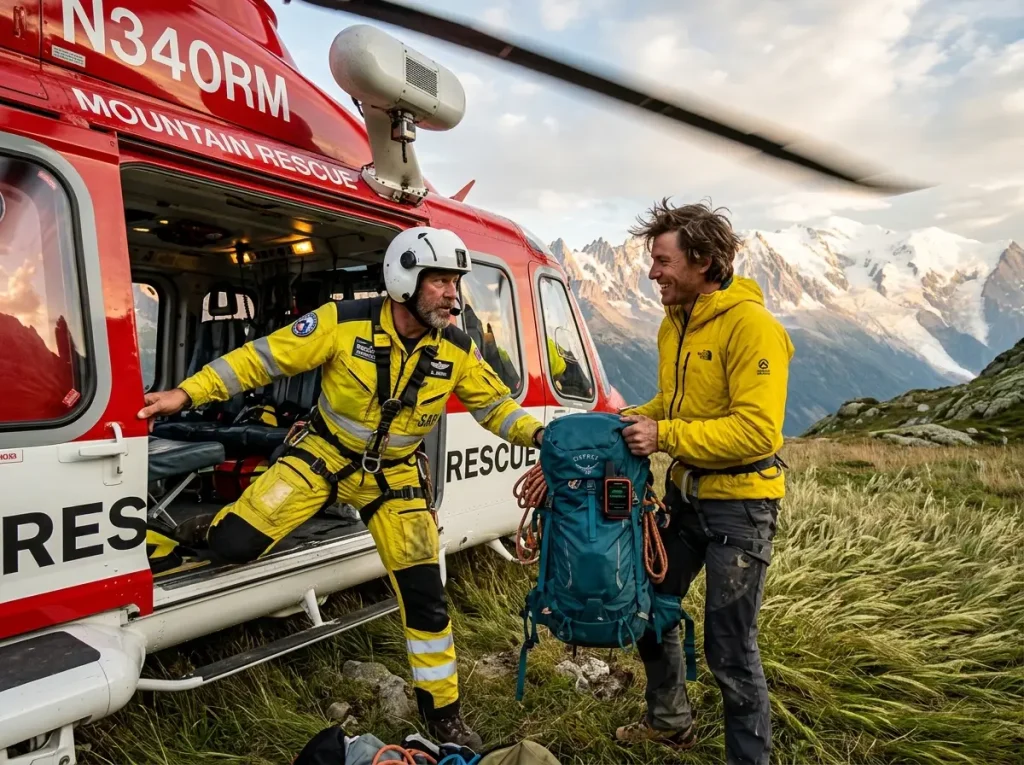
When a helicopter closes in: weight every loose item or stuff it in your pack. Never approach from the rear — the tail rotor operates at high speed and is nearly invisible. Wait for crew eye contact before moving. The CH-149 Cormorant generates downwash above 100 mph. A sleeping bag left unweighted on that ledge becomes a rotor strike hazard.
Pro tip: If you have any phone battery left, activate strobe mode on the rear flash. It’s visible several hundred meters in darkness and recognized by SAR teams as a distress signal on night operations. Zero cost, minimal battery draw. Use it.
The full analog kit weighs less than an ounce: Fox 40 pealess whistle clipped to your harness, small glass signal mirror in a hip belt pocket. Check the weight math — there is no gram-weenie argument for leaving either behind.
Real-World Failure Analysis — Mistakes That Compound Emergencies
Field data from NPS incident reports and documented community cases (Rokslide, Reddit) shows the same failure patterns cycling through rescues that should have been routine. Here’s where people go wrong.
The GPS lock problem. A documented Rokslide case: inReach coordinates were off by 6 km. The device hadn’t been turned on until the SOS was triggered, so it transmitted estimated position before acquiring a clean satellite lock. GPS accuracy degrades with cold starts. The fix is turning on the device at the trailhead, acquiring full lock before the approach, and letting it run in tracking mode throughout the climb. Some devices maintain a warm start for up to 24 hours after shutdown — check your device’s specs and plan accordingly.
The misuse problem. NPS data documents escalating frivolous SOS triggers — exhaustion, minor nausea, genuine discomfort. This taxes SAR resources, delays response to actual life-threatening situations, and in some jurisdictions introduces mountain rescue cost risk for the person who triggered. The clinical decision framework:
- Is anyone motionless and suspended in a harness? → SOS immediately. The 15-minute window isn’t a guideline.
- Is anyone unconscious or deteriorating? → SOS immediately.
- Can the injured climber be safely lowered to the ground? → Evaluate self-rescue first, initiate SOS simultaneously.
- Is this discomfort, exhaustion, or a non-critical injury? → Self-manage; use your messenger to update your emergency contact without triggering dispatch.
The Matterhorn case. A 5.9-grade climber attempted a 5.4 route on the Hörnli Ridge without the systems knowledge required — specifically executing an abseil without a backup. When rescue was needed, the terrain complicated extraction because the party had exceeded their technical ceiling. This is the Mountain Rescue Association incident documentation pattern that SAR professionals consistently report: the SOS trigger is rarely the mistake. Calling too late is the mistake. Calling without useful information is the mistake. Going on terrain that requires rescue to be part of the plan is the mistake — not the call itself. If you want to understand how this failure clusters with other preventable patterns, the most preventable climbing accident patterns lays out the human-factor taxonomy that drives most SAR events.
Pre-write a “status update” preset in your Garmin message library — something that tells your emergency contact you’re delayed but mobile, without triggering IERCC dispatch. It costs nothing. It saves you the cost of a SAR mobilization for a non-emergency situation.
FAQ
How long can you hang in a harness before it becomes life-threatening?
Serious physiological distress can begin within 5–10 minutes of motionless suspension. Loss of consciousness is possible inside 5–15 minutes. The critical window runs 15–40 minutes for healthy individuals under experimental conditions — pre-existing cardiovascular conditions or hard exertion immediately before the suspension accelerate all of it. Professional rope-access and tower-climbing standards now use a 9-minute extraction mandate as the SOP benchmark. That’s the number to internalize.
Does Garmin inReach work in deep canyons and on north-facing walls?
Better than any Globalstar-based device, yes. Iridium’s polar orbit and mesh networking give it statistical advantage in canyon and north-face environments by routing the signal overhead instead of toward a southern horizon. In narrow slot canyons, even inReach may require multiple transmission attempts — acquire satellite lock before the approach.
Is mountain rescue free in National Parks?
Within NPS boundaries — Yosemite, Grand Tetons, Rainier, Zion — there is historically no charge for SAR operations. The NPS rationale is explicit: financial fear must never delay a call for help. Outside NPS, on state or private land, private air medical assets may be authorized with fees from $10,000 to $25,000. The No Surprises Act provides limited protection for medically necessary air ambulance transports but does not cap technical extractions.
What’s the whistle signal for distress in North America?
The Rule of Three: three blasts followed by a one-minute pause, repeated. In Europe, the Alpine Signal is six signals per minute (every 10 seconds) followed by a one-minute pause. Carry a pealess whistle — Fox 40 or equivalent — clipped to your harness. Not in the pack top pocket. Not zipped in a jacket. On the harness, accessible if you’re injured or your hands are stuck in a crack.
How do I describe my position on a climb so SAR can find me?
Three-part protocol: decimal GPS coordinates first (primary helicopter navigation data), route name and specific pitch or feature second (Pitch 4, The Great Roof, The Nose, El Capitan, Yosemite NP), source reference third (Location matches Mountain Project app description). Pre-load your intended route into your IERCC or Garmin profile before departure. If battery is critical, send coordinates only — SAR can work from that alone.
Safety Notice: Rock climbing and mountaineering are inherently high-risk
activities that can involve physical trauma or fatal incidents. The information on Rock Climbing Realms is for
educational and informational purposes only. Techniques and advice presented here are not a substitute
for professional, hands-on instruction. Conditions and risks vary by location. Always seek guidance
from a qualified instructor before attempting new techniques. By using this website, you agree that you
are solely responsible for your own safety. Any reliance you place on this information is strictly
at your own risk, and you assume all liability for your actions. Rock Climbing Realms and its authors
will not be held liable for any harm, damage, or loss sustained in connection with the use of this information.
Affiliate Disclosure: We are a participant in the Amazon Services LLC Associates Program, an
affiliate advertising program designed to provide a means for us to earn advertising fees by advertising and linking
to Amazon.com. As an Amazon Associate, we earn from qualifying purchases. We are also an official affiliate partner
of Black Diamond Equipment via the AvantLink network. If you click on a Black Diamond affiliate link and make a
purchase, we may earn a commission at no additional cost to you. We also participate in other affiliate programs.
Additional terms are found in the terms of service.