
In this article
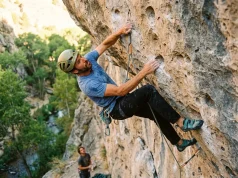
It’s 11 AM and your partner just onsighted Old Man’s Route — a supposed 5.2 that required two cam placements in a flared crack, a full-body stemming sequence around a polished quartzite bulge, and 20 minutes of mental negotiation above a ledge with a clear view of the valley 800 feet below. You’re not climbing 5.2. You’re climbing Seneca. And no amount of gym mileage prepared you for the fact that here, “easy” is a loaded word with a 60-year history baked into it.
After enough trips to the mid-atlantic quartzite trad destination that defines East Coast climbing, you learn to read the lies. This guide is not a welcome pamphlet. It is a technical blueprint for independent trad leaders who want to climb Seneca Rocks, WV without getting worked by grades that have been compressing since 1966. You’ll learn the geology behind the friction problem, the gear decisions that make standard racks fail, and the descent system that has left experienced climbers stranded on rappel when they skipped the backup.
| Climbing Area Specifications | |
|---|---|
| Feature | Specification |
| Rock Type | Tuscarora Quartzite (Metamorphic) |
| Grade Range | 5.2–5.14 YDS |
| Primary Style | Multi-pitch Traditional Climbing |
| South Peak Elevation | 2,092 ft (South Summit GPS-verified) |
| Approach | 1.3 miles / 700+ ft elevation gain |
| Regulatory Body | US Forest Service / Monongahela National Forest |
⚡ Quick Answer: Seneca Rocks grades run 1–2 full letter grades harder than equivalent gym or sport climbing grades — not because of one factor, but three stacked together: historical grade compression since 1966, polished Tuscarora quartzite that loses friction when wet, and complex route-finding on ledgy multi-pitch terrain. To climb here without getting sandbagged, apply the Two-Grade Rule on your first visit, carry offset nuts and Tri-cams instead of a standard double rack, and never skip the autoblock backup on the Traffic Jam rappel.
The Geology of the Sandbag — Why Seneca Grades Lie to You

The seneca sandbag is not a myth. It has a geological explanation that most trip reports skip entirely.
Seneca’s rock is Tuscarora Quartzite — a metamorphic formation nearly pure in silica, born 425 million years ago during the Silurian period and reoriented vertically by the Wills Mountain Anticline. That last geological event is why you see vertical fins rising from the Roy Gap valley floor. It’s also why the climbing feels nothing like granite or sandstone.
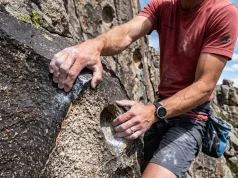
Granite relies on crystalline, mechanical interlocking between shoe rubber and rock crystal. Sandstone is porous — it grabs moisture and provides high friction even when damp. Quartzite does neither. It has low porosity and glass-like surface texture on polished sections. Water doesn’t absorb in; it sits on top, creating a lubricating layer that drops friction toward zero. The USGS research on friction of rocks documents exactly this phenomenon — polished quartzite surfaces behave differently than granite or sandstone when any moisture is present. That’s a material science issue, not a “slippery feeling.” Understanding how rock type determines protection strategy gives you the foundational context before you ever leave the trailhead.
The grade compression problem has a fixed historical moment. In 1966, George Livingstone established Madmen Only (5.10), marking a perceived physical ceiling for the era. Subsequent first ascensionists squeezed increasingly difficult routes into lower categories rather than pushing the scale. A Seneca 5.4 today regularly delivers technical route-finding, gear placements in flared quartzite cracks, and serious ledge exposure — features you’d expect on a 5.6 or 5.7 at any honest crag.
Local adage: “If you can climb a 5.10 at Seneca, you can climb a 5.10 anywhere.” That’s not a compliment. It’s a warning.
Your first lead here should be two full letter grades below your certified limit. Not one — two. Treat it like a new discipline.

Tuscarora Quartzite vs. Granite and Sandstone — A Friction Breakdown
On polished sections like Old Man’s P1, the lack of surface asperities means footwork shifts from smearing to precise edging. Rubber compounds engineered for granite will underperform here — you’re not getting mechanical grip from crystal interlock, you’re relying on surface contact tension that quartzite offers less of.
When skin is damp from sweat, similar micro-lubrication occurs. Porous rubber soles lose friction faster on quartzite than on any other common rock type. That’s the actual mechanism behind why a confident gym climber can feel completely out of control on terrain graded two letter grades below their limit. It doesn’t mean you’re weak. It means the physics are different here.
The 1966 Grade Ceiling and What It Means for Your Trip
John Stannard’s 1971 first ascent of Totem (5.11) technically broke the 5.10 ceiling — but it didn’t reset the existing grades. The compression ran backwards: the legacy of stiff ratings remained embedded in every classic route on the West Face. Post-Stannard routes are slightly less compressed, which is why targeting routes with “Old” in the name or first ascents from the 1950–1965 era gives you the most grade-honest experience on your first visit.
Pro tip: Skip the post-1970 testpieces on your first trip. Hit the classics — they’re hard enough, and they’ll tell you exactly where your quartzite calibration stands.
Flared Crack Mechanics — Why Your Cams Are Failing You

Standard cams fail at Seneca in ways that catch experienced leaders off guard. This isn’t a gear quality issue. It’s geometry.
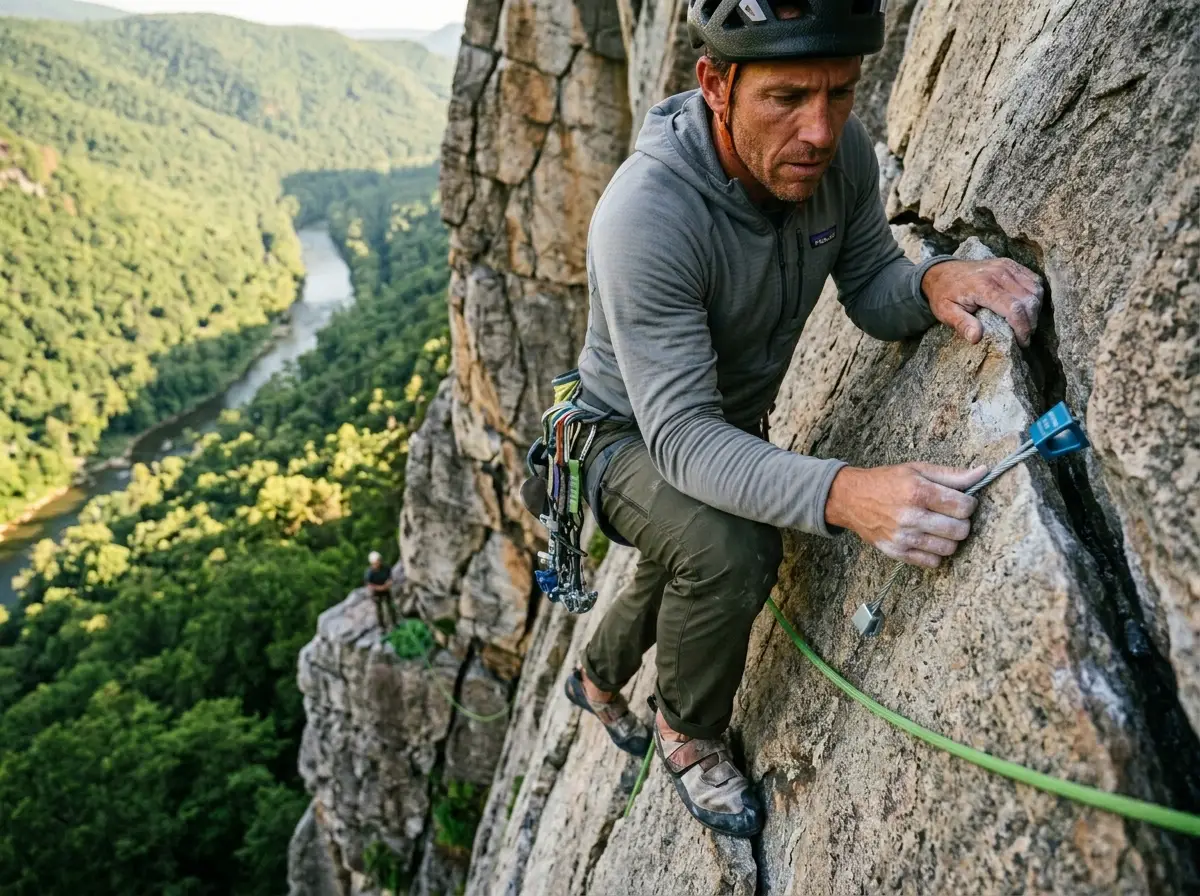
Quartzite’s metamorphic fracture pattern creates cracks that widen outward toward the face — flared geometry — instead of the parallel-sided splitters where SLCDs work optimally. For a cam to hold, its outward lobe force must exceed the downward pull. In a flared crack, the crack wall angle works against cam expansion. The lobes press against a surface that’s angling away from them. The result is “cam walking” — where rope vibration during a lead run causes the cam to migrate outward along the flare, increasing pullout risk before a fall even happens.
I placed a C3 in a horizontal crack on the West Face and watched it rotate 90 degrees as I moved above it. A Tri-cam in the same pocket didn’t move. That’s the quartzite difference, not a gear quality problem.
The fix is passive protection dominance. Offset nuts — DMM Offsets, Brassies — seat diagonally in non-parallel walls through a three-point contact geometry that standard symmetric nuts cannot replicate. And Tri-cams in active mode use a sharp fulcrum that bites into small rock irregularities rather than relying on smooth lobe expansion. A Pink (.5) or Red (1.0) Tri-cam routinely outperforms a C3 or C4 in Seneca horizontal pockets. Building your first trad rack the right way becomes even more important when you understand why passive protection matters at a place like Seneca.
SLCDs below 10kN rated placements in quartzite should be treated as directional aids, not primary anchors. A bombproof anchor at Seneca means three pieces minimum.

The Anti-Sell Gear Configuration for Seneca’s West Face
Forget the standard double rack of cams. Seneca’s irregular geometry rewards passive protection dominance over active protection density. Here’s what actually works on the South Peak West Face:
- Double set of standard nuts supplemented with DMM Offsets or Brassies
- Pink (.5) and Red (1.0) Tri-cams — non-negotiable for horizontal pockets, not optional upgrades
- Cams in sizes #0.5–2.0 (skip #3+ unless you’re targeting specific wide-crack routes, rare on the West Face)
- Mix of 60cm and 120cm slings — the 120cm alpine draws are essential for The Sidewalk traverse
- 10.0mm single rope or 8.0mm half ropes
Test every nut placement with a downward tug AND a lateral tap with the nut tool before committing. On polished quartzite, visual confirmation of a “good” nut is not sufficient. The irregular surface creates false security that disappears the moment you weight the piece.
Rope Selection — The Shevill Accident Case Study
In 2010, Ian Shevill fell approximately 10 feet above his last piece on La Bella Vista (5.10a). His brand-new 9.4mm rope severed when it snagged in a quartzite notch. The analysis points to a near Factor-2 scenario where a very short rope segment absorbed the full fall energy, exceeding the material’s limit.
Skinny ropes (≤9.5mm) have a lower sheath-to-core ratio. When caught against a sharp quartzite edge, the sheath wears through at forces below the rope’s rated impact force. The AAC accident analysis of high-force rope failure at Seneca Rocks is required reading before your first trip.
Use a 10.0mm–10.2mm single rope. The thicker sheath provides superior abrasion resistance against quartzite’s fine crystalline structure. Double rope technique — two 8.0mm–8.5mm half ropes — gives you independent routing that reduces drag on traverses and keeps a redundant strand free if one catches in a notch.
Pro tip: Carry a knife on your harness. Documented cases exist where cutting the rope was the only option for descent at Seneca when a rappel rope snagged in a crack.
Building a Seneca Rack — Gear Selection for Quartzite Trad

Seneca routes are “ledgey” — rock protrudes at irregular intervals, forcing the rope through angular changes that create extreme friction without proper sling management. This is not a strength issue. The force required to haul rope through multiple directional changes compounds with each unextended piece.
Long slings are mandatory. 60cm and 120cm slings keep the rope path linear through horizontal traverses. The 120cm alpine draws are specifically what saves you on The Sidewalk traverse section of the West Face. Understanding how alpine draws reduce rope drag on traverse-heavy terrain directly translates to what you’ll feel on a Seneca pitch.
The Sidewalk traverse will eat your rope velocity if you don’t extend every piece. I placed six pieces across 40 feet once without a single sling extension and nearly couldn’t clip the anchor. Don’t.
Check the Monongahela National Forest climbing regulations and anchor standards before your trip — the US Forest Service manages Seneca as part of the Monongahela National Forest and regulations change seasonally.
Trad Nuts 101 Applied to Quartzite — The Offset Advantage
Standard symmetric nuts assume parallel crack walls. Quartzite’s metamorphic fracture doesn’t give you parallel walls. Offset nuts seat diagonally — one side contacts the narrow crack dimension while the other contacts the wide side. The result is stable three-point contact even in tapered flares where a symmetric nut would walk.
On thin-crack sections of the West Face — especially routes in the 5.7–5.9 range — brass micronuts (Brassies) provide placements that aluminum nuts cannot. The anti-drag rope management question starts here: every piece that’s poorly placed or poorly extended adds to a compounding drag problem that gets worse the higher you climb.
Extending Slings — Rope Drag on Ledgy Ground
Each directional change in your rope path adds friction resistance. On a Seneca pitch with four directional changes of 20–30° each — typical for the ledgy West Face — unextended protection can lock your belay device.
Rule of thumb: if the rope path deviates visibly more than 15° at a piece, extend it with a 60cm sling. If the route traverses, use 120cm and clip one strand only (half ropes) or both (single rope, doubled draw).
Pro tip: Stand beneath each piece before clipping and preview the rope path looking up. That 10-second visualization saves 45 minutes of fighting drag on the pitch.
Logistics and the Stairmaster Approach — Arriving Ready to Climb

The “Stairmaster” approach — 1.3 miles, 700+ feet of elevation gain — qualifies as Class 1 on paper. What it actually is: sustained steep steps, fixed cables in the steeper sections, and the sustained cardiovascular load of carrying a full trad rack in summer heat.
The AAC identifies “creeping fatigue” — the accumulated mental and physical taxation of approach, rack management, and technical terrain — as a confirmed precursor to technical errors at anchor. Arrive at the base 20% fresher than you think you need to.
I carried a full double rack up the Stairmaster in August at noon. By the time I roped up, my forearms were pre-pumped from gripping the fixed cables. Cut your rack weight by 15% and carry approach water separately from your climbing pack. The approach and the climbing are two separate systems — treat them that way.
Above the observation deck, terrain transitions to Class 2/3 talus. The “Y” fork: left for Old Man’s area, right for Luncheon Ledge and upper West Face routes. Know your branch before you hit the fork. Above that, the Gunsight approach goes Class 4 — hands required, roping up recommended for beginners.
No cell service in Roy Gap. That’s not a heads-up — it’s a systems constraint. Emergency contact, navigation, and beta must be solved before entering the valley. Nearest major services: 3.5 hours to D.C. or Pittsburgh.
Stop at the Gendarme Climbing Shop in Seneca Rocks town. Every trip, without exception. They are the ground-truth source for current rappel anchor status, current rock conditions, and route-finding updates. When you’re operating in a no-cell environment at a multi-pitch crag, the Gendarme is your final safety check before committing to the wall.

The Approach Stage Breakdown — Class by Class
- Stage 1 (Discovery Center to Creek): Class 1. Cross the bridge, head toward Roy Gap Road. ~15–20 minutes.
- Stage 2 (The Stairmaster): Class 1 (steep). 700ft gain via switchbacks with fixed cables. ~45–75 min depending on pack weight.
- Stage 3 (Upper Talus Field): Class 2/3. Follow the “Y” junction. Left for Old Man’s area, right for Luncheon Ledge. Cairns present but can be disturbed.
- Stage 4 (Approach to Gunsight): Class 4. Hands required. A 20-foot unroped slip onto the talus carries real consequence regardless of your climbing grade.
Logistics Stack — What to Solve Before You Leave the Parking Lot
Download offline topographic maps (Gaia GPS or CalTopo) before entering the valley. Cloud-dependent apps are useless without cell service. Carry minimum 2L of water for approach plus climbing day — there are no water sources on the trail.
Check the official Seneca Rocks information and access guidelines from the Monongahela National Forest for current use restrictions before your trip. Restrictions change seasonally and without much public notice. The Gendarme shop also carries updated anchor information — worth the 5-minute detour to confirm the Traffic Jam rappel bolts have been recently replaced.
Descent Systems — Mastering the South Peak Rappel

The South Peak has virtually no walk-off descent. You will rappel. The Traffic Jam notch three-pitch rappel is the primary artery, and it’s where the consequences of skipped systems become irreversible.
19.4% of Seneca accidents involve inadequate rappel backups. That’s not a marginal statistic — it’s the second leading cause of incidents behind rope management errors. Read the most common rappelling accidents and how to prevent them before your first descent. The majority of rappel incidents at Seneca happen to experienced climbers who “made an exception.”
Two non-negotiables on every rappel, every time:
- Autoblock (third hand) friction hitch — not optional, not for “advanced climbers only”
- Closing the system — stopper knots in both rope ends before every rappel, without exception
On free-hanging sections of the Traffic Jam, there is zero warning before you rappel off the ends. There is no “I’ll remember this time.” Tie the knots.
Rope diameter matters here too. The Shevill accident — where a 9.4mm rope severed on a quartzite notch during a high-force snag — validates using a ≥10mm rope and inspecting the rope path carefully before weighting each station. The AAC accident analysis of rope severing at Seneca Rocks is the primary source for the “notch-catch” failure mechanism. Read it.

The Three-Pitch Traffic Jam Rappel Sequence
Station 1 (The Notch): Rappel 45 feet to the top of Neck Press. Vertical transition. Manage rope carefully around “cockscomb” quartzite features — rope snagging is most common here.
Station 2 (Neck Press): Rappel 65 feet to the second intermediate station. This station is frequently crowded on weekends. Plan to wait, or accept the risk of rushed transitions when other parties are present.
Station 3 (Final): 70-foot rappel to the ground. Total rope requirements for this multi-pitch rappel transition: a single 60m rope using the 3-stage method, or double 60m ropes for faster descent (note: double ropes increase rope jam probability on this descent).
A “fireman’s belay” from below — a partner holding the rope ends and pulling down sharply to stop a rappel — is the final backup on Station 3. If conditions allow, position a non-rappelling team member below before the last person descends.
Pro tip: Ask any guide service on the wall if you can ride their established rappel line on a busy weekend. Sharing an established line reduces rope jam risk and gives you a real-time model of the correct rope path through the notch.
ERNEST Anchor Building for Quartzite — 3-Piece Minimum
ERNEST: Equalized, Redundant, Non-extending, Solid, Efficient, Timely. This is the multi-directional anchor standard for Seneca’s multi-pitch transitions.
Because quartzite placements carry lower average confidence than granite equivalents, a 3-piece gear anchor is the baseline, not the maximum. Equalization in flared cracks requires careful load distribution — a master point on a cordelette or sliding X works better than a fixed two-bolt sport approach.
“Solid” at Seneca means: every anchor piece receives a downward tap (knock test) plus a high-force manual pull before you commit. Rock crystals can fracture around cam placements in heavily polished quartzite. Build anchors above ledges, not on them. A Factor-2 fall onto a ledge-level anchor applies full force to gear that may already be suboptimally seated.
For a deep-dive on descent mechanics and closed-system rappel protocols, this zero-error rappel guide covers the fundamentals that every Seneca leader should have locked in before leaving the ground.
Route Selection and the Mental Game — Climbing Smart Before Climbing Hard

Strength is not the problem at Seneca. Calibration is.
The Two-Grade Rule: on your first Seneca visit, select routes two full letter grades below your certified gym or known-honest outdoor limit. If you reliably onsight 5.10 at Red River Gorge without stress, your first Seneca target is 5.8. This is not humility — it’s how you get useful information about how the grades feel here without getting into trouble.
Know the sandbag suspects. Old Man’s Route (5.2–5.4) is one of the most-cited surprises for first-time Seneca visitors — the ledge-fall potential on pitch 1 is not a hypothetical. The seneca sandbag lives in routes that look trivial from below.
The “Walk of Shame” — retreating because a 5.7 felt like 5.9+ — is calibration data, not failure. A 5.12 gym climber attempting a Seneca 5.7 retreated at 30 feet because of a combination of polish anxiety, a cam that visibly walked in a flare while reaching for the next hold, and the slow realization that the ledge below was not a psychological abstraction. That’s a smart retreat. Use it.
Protection density recalibration is essential. At granite destinations, confident terrain gets gear every 15–20 feet. At Seneca, ledge-fall potential demands gear every 6–10 feet on terrain that feels secure. A cam that walks in a flare on “easy” terrain creates the same fall as no gear at all. More pieces, placed more frequently, with better assessment per piece.
For the mental side of technical climbing trip preparation at commitment-style crags, managing the mental game when a trad lead feels out of control addresses exactly the psychological recalibration this terrain demands.
Recommended First-Visit Route Sequence
Start with Old Man’s Route (5.2/5.4). It forces immediate calibration with quartzite friction, ledge exposure, and gear placement in flared cracks. If this feels easy, your grades are calibrating correctly and you can proceed up the sequence.
Progress to Skyline Traverse (5.4) or Pleasant Overhangs (5.7). Note: Pleasant Overhangs is where a 70m rope becomes specifically recommended for some single-rope descent variations — verify with the Gendarme before attempting. This is the kind of local beta that guidebooks don’t update fast enough to catch.
Do not skip the classics for “harder” routes on your first visit. Their reputation as approachable trad climbing objectives is exactly the trap.
Route-finding at Seneca is itself a skill. The quartzite fin architecture creates parallel lines that look viable from below but diverge significantly in difficulty. Match summit registry descriptions to your selected line before you leave the ground.
The Gendarme — Historical Context and What Its Absence Means
The Gendarme was a massive stone pillar integral to the Gunsight area. In 1987, it fell off the formation — not as metaphor, but as literal geological event. It fundamentally changed the physics and route-finding of the entire Gunsight area.
Pre-1987 topos that reference the Gendarme as a navigation landmark are now liabilities. Any printed guide or online resource using “Gendarme” as a reference point must be checked against post-1987 beta.
It’s also a reminder that Seneca is a living formation. Loose rock inspection before any pitch is professional practice, not paranoia. Rock that feels solid on a cold morning can behave differently as the quartzite warms and expands.
Conclusion
Three things separate climbers who get sandbagged from climbers who go home with clean sends:
Recalibrate before you rack up. Seneca grades lie by design — geological, historical, and psychological compression specific to this place. Two grades below your limit on your first visit, no exceptions.
Your standard rack is the wrong rack. Flared quartzite demands offset nuts, Tri-cams, and proper sling extension. A standard double-cam rack fails at Seneca in ways that will surprise experienced leaders.
The descent will put you at serious risk if you skip the backup. 19.4% of Seneca incidents involve inadequate rappel backups. Autoblock on every rappel. Stopper knots in both rope ends. Closed system, always.
Before your next trip, do one thing: pull the AAC accident analysis of rope severing at Seneca Rocks and read it with your partner. Understand what a Factor-2 scenario looks like in quartzite. Decide together what you’ll carry and how you’ll descend. That conversation is worth more than any additional pitch count.
Now go send something.
FAQ
How hard is climbing at Seneca Rocks compared to the gym?
Seneca grades run approximately 1–2 letter grades harder than equivalent gym or sport climbing grades. Grade compression from 1966, polished quartzite friction, and route-finding complexity stack together. A Seneca 5.7 routinely challenges climbers who confidently onsight 5.10 in a constructed setting. Budget two full grades of buffer on your first visit.
Do I need a guide for Seneca Rocks?
Not if you’re an experienced trad leader with solid ERNEST anchor building skills, route-finding experience, and a rack that includes offset nuts and Tri-cams. However, the descent system — the Traffic Jam three-pitch rappel — has specific technical requirements. If you haven’t confirmed current anchor conditions with the Gendarme shop and read current beta, consider a guide for your first descent. The rappel stations here have separated experienced climbers from the wall when they skipped the backup.
What gear do I need for Seneca that I might not already own?
Offset nuts (DMM Offsets or equivalent), Pink (.5) and Red (1.0) Tri-cams, 120cm slings, and a ≥10.0mm single rope or 8.0mm half ropes. Standard cam ranges (#0.5–2.0) carry over, but Tri-cams and offset nuts are Seneca-specific requirements, not optional upgrades.
Can you climb Seneca Rocks in the rain?
No. Quartzite does not absorb moisture like sandstone. Water creates a lubricating layer that eliminates surface friction on polished sections. Even light rain renders popular routes like Old Man’s functionally unclimbable. Wait a minimum of 24 hours after rain before attempting smooth-textured quartzite faces.
What is closing the system and why does it matter at Seneca?
Closing the system means tying stopper knots in both ends of your rappel rope before every rappel so that if you miscalculate rope length or hit a snag, you cannot rappel off the rope ends. At Seneca, the Traffic Jam descent has free-hanging sections where rope-end runout is a confirmed accident mechanism. There are no exceptions to this protocol on the South Peak descent. None.
Is mock-leading worth doing before your first Seneca trip?
Yes. If you haven’t climbed irregular crack systems outside of gym cracks, a day of mock-leading on Old Man’s lower pitches — with a toprope backup — is worth more than a confident onsight at a well-traveled sandstone crag. The quartzite feel, the gear assessment in flared pockets, the exposure management — these are skills that transfer in from real crack time, not from reading. Show up having done the reps.
Safety Notice: Rock climbing and mountaineering are inherently high-risk
activities that can involve physical trauma or fatal incidents. The information on Rock Climbing Realms is for
educational and informational purposes only. Techniques and advice presented here are not a substitute
for professional, hands-on instruction. Conditions and risks vary by location. Always seek guidance
from a qualified instructor before attempting new techniques. By using this website, you agree that you
are solely responsible for your own safety. Any reliance you place on this information is strictly
at your own risk, and you assume all liability for your actions. Rock Climbing Realms and its authors
will not be held liable for any harm, damage, or loss sustained in connection with the use of this information.
Affiliate Disclosure: We are a participant in the Amazon Services LLC Associates Program, an
affiliate advertising program designed to provide a means for us to earn advertising fees by advertising and linking
to Amazon.com. As an Amazon Associate, we earn from qualifying purchases. We are also an official affiliate partner
of Black Diamond Equipment via the AvantLink network. If you click on a Black Diamond affiliate link and make a
purchase, we may earn a commission at no additional cost to you. We also participate in other affiliate programs.
Additional terms are found in the terms of service.