
In this article
The altimeter read 5,800m and it was 1:47 AM. The headlamp beam caught nothing but darkness and falling snow, and the guide crouched at the tent door and said — quietly, so as not to wake the next team — “We still go.” Boots had been sleeping inside the bag all night. The inner liners came out warm. That single habit, drilled for two weeks before leaving Kathmandu, was the margin between a summit and a frostbitten abort.
That’s what this guide is about. Not the tourist version of Mera Peak. The real one — 6,476 meters, glacier travel, fixed lines on a 45-degree headwall, and a body working at 45% of its normal oxygen supply. You will leave here knowing exactly what can go wrong on every technical phase and how to stop it from happening.
⚡ Quick Answer: Mera Peak (6,476m) is Nepal’s highest trekking peak and a legitimate alpine expedition requiring 12-point crampons, ice axe technique, rope team travel, and — as of September 2025 — a government-licensed NMA guide by law. Take the Hinku Valley route, not Zatrwa La. Give Khare two rest days minimum. Set your 1:00 PM turnaround time before you leave High Camp and don’t negotiate it on summit day. Total cost runs $2,500–$5,000 plus personal gear.
MERA PEAK — QUICK REFERENCE
Altitude: 6,476m / 21,247 ft
Difficulty: Alpine PD / NMA Group B Trekking Peak
Duration: 17–18 days
Best Seasons: Spring (Mar–May) / Autumn (Sep–Nov)
Permit Fee 2026: $350 per foreign climber (Spring)
Minimum Team: 2 climbers + licensed NMA guide (mandatory)
What You’re Actually Signing Up For: The Reality of a “Trekking Peak”
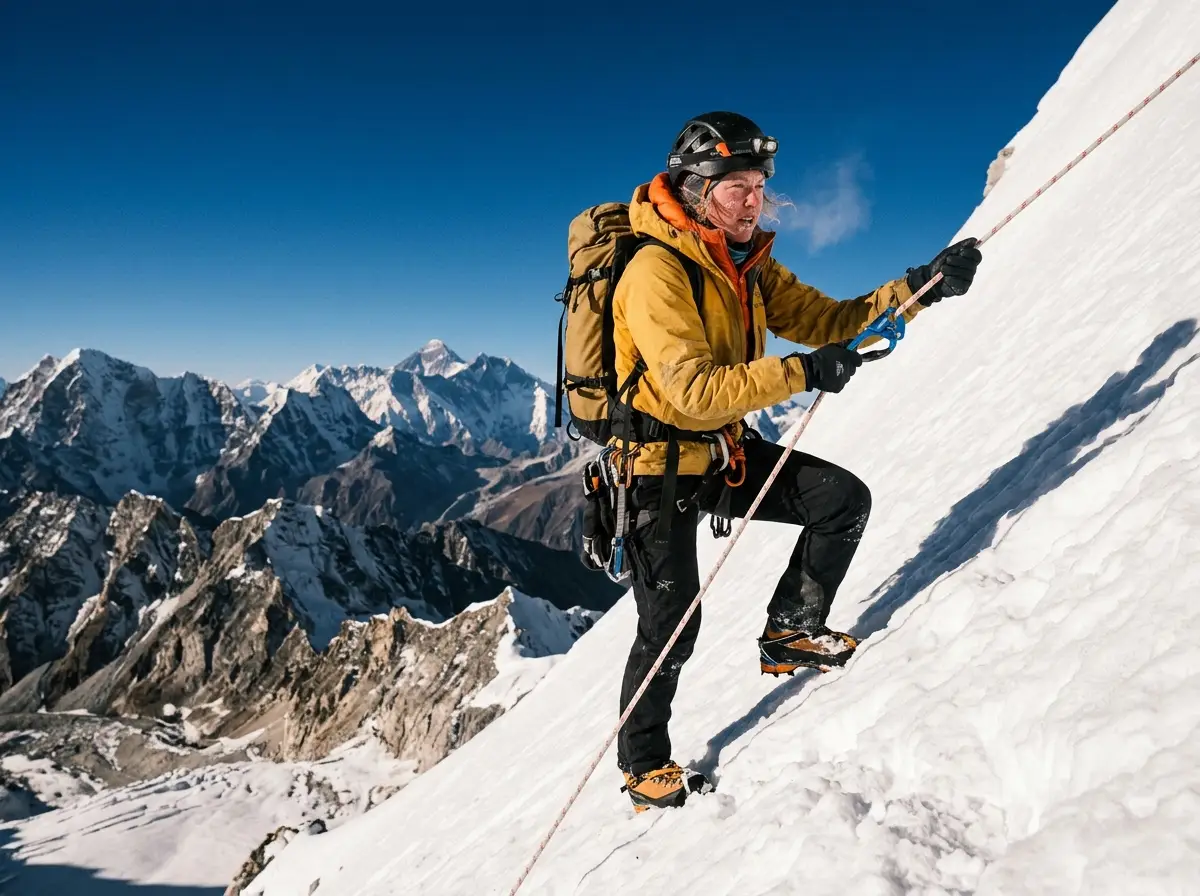
The “trekking peak” label is an NMA administrative category. It has nothing to do with technical difficulty. Mera Peak’s 6,476m summit puts it higher than anything in North America or Europe, and your body won’t care what the paperwork says.
The normal route grades Alpine PD — Peu Difficile. That sounds reassuring until you understand what PD requires: crampons, ice axe deployment, rope-team travel on crevassed glacier, and fixed-line ascent on the summit headwall. First ascent was May 20, 1953, by Col. Jimmy Roberts and Sen Tenzing — nine days before Everest. The mountain earned its reputation decades before anyone decided to call it a “trekking peak.”
At 6,476m, available oxygen drops to roughly 45% of sea level. Zone 2 aerobic effort — the kind you hold on a long trail run — feels anaerobic. Recovery between steps requires a deliberate step-breathe rhythm: one step, full exhale, one step. The Sherpas use this. Everyone else figures it out the hard way at Mera La. Altitude impairs decision-making. That’s why every safety system on this mountain has to be pre-decided, not negotiated at 6,200m when judgment is already compromised.
As of September 1, 2025, all foreign climbers must be accompanied by a government-licensed NMA guide for the entire expedition. Solo or independent approaches to Mera Peak are illegal. Minimum team size is two climbers.
The Three Mera Sub-Peaks (Which One You’re Actually Climbing)
Mera has three summits: Mera North (the highest technical point), Mera Central (the standard commercial target), and Mera South. Most guided packages go to Mera Central. Guides don’t always volunteer this distinction. Mera North requires additional rope work and is only appropriate for teams with prior glacier experience. Before you book, get it in writing which summit is included in your itinerary.
Pro tip: “Mera Summit” in an operator’s marketing almost always means Mera Central by default. Ask them to write Mera North or Mera Central explicitly in the contract — not just “Mera Peak.”
If you’re evaluating Mera alongside other NMA objectives, the Island Peak expedition guide covers a parallel Group B peak in the same region with a different technical character on the final headwall.
The 2026 Regulatory Landscape: Permits, Garbage Deposits, and the Licensed Guide Mandate
Spring 2026 permit fee: $350 per foreign climber, issued by the NMA. Autumn runs slightly lower. A refundable $500 garbage deposit per group is also mandatory — released only upon documented evidence that waste was removed from high camps. This is not optional and it is not a formality. Budget both.
Your guide must hold a government-issued license valid for the full duration. The minimum acceptable qualification is the NMA advanced course. An IFMGA/UIAGM-qualified mountain guide is the higher standard — Project Himalaya states this explicitly. When vetting operators, ask for the guide’s license number and verify it. The UIAA international safety standards for mountaineering equipment provide the global framework for evaluating equipment and guide certification quality. Budget 2–3 days of international schedule buffer for weather-related domestic cancellations at Lukla.
The Approach Decoded: Lukla to Khare and the Ramechhap Factor
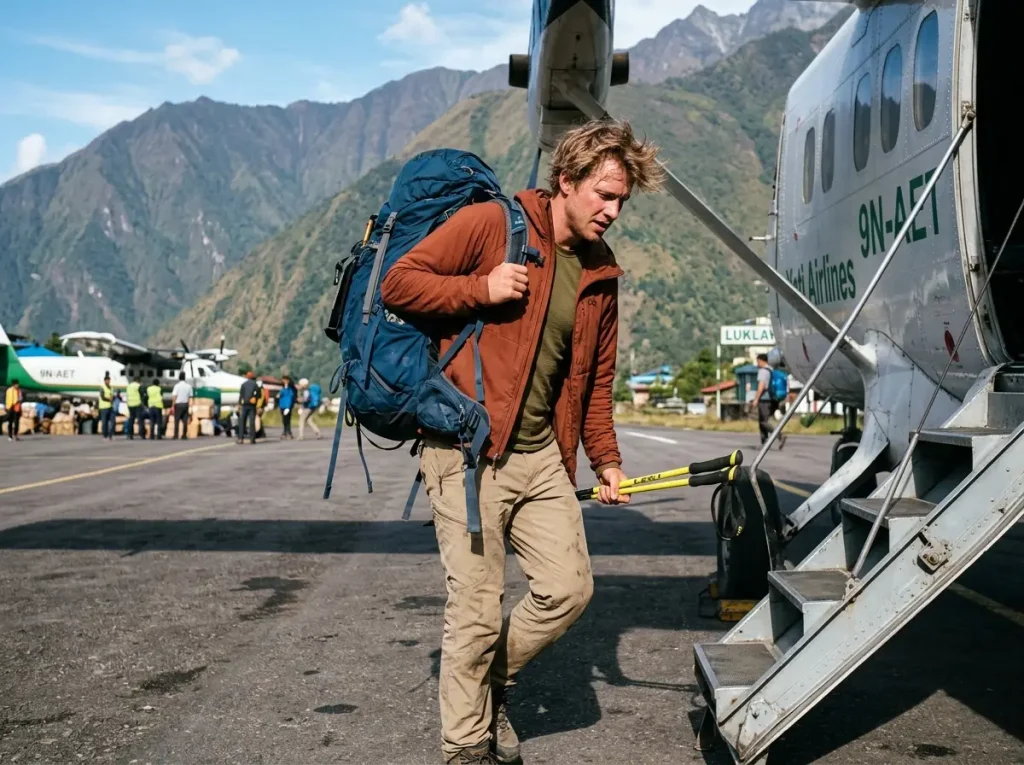
During peak seasons — mid-March to mid-May, and late September to late November — all Lukla flights divert from Kathmandu’s Tribhuvan International Airport to Manthali Airport in Ramechhap. The reason is straightforward: Lukla has a single STOL runway, and TIA’s bottleneck allows only two aircraft rotations from Kathmandu in the same morning window that allows five from Ramechhap. The 18–20 minute flight from Manthali beats the 35-minute leg from TIA, and lower runway altitude at 474m means fewer fog and crosswind cancellations.
What nobody writes about is what the Ramechhap transfer does to your body on Day 1. The operator departs Kathmandu at 1:00–2:00 AM. You spend 4–5 hours in a vehicle on the BP Highway — curved mountain road sections in the dark. Motion sickness is common. You arrive in Lukla sleep-deprived and potentially nauseous. This combination is a documented early-onset AMS accelerant. Recovery protocol on landing: 30 minutes minimum of slow hydration before starting the approach. The CDC altitude illness risk framework is unambiguous about sleep deprivation compounding acclimatization stress.
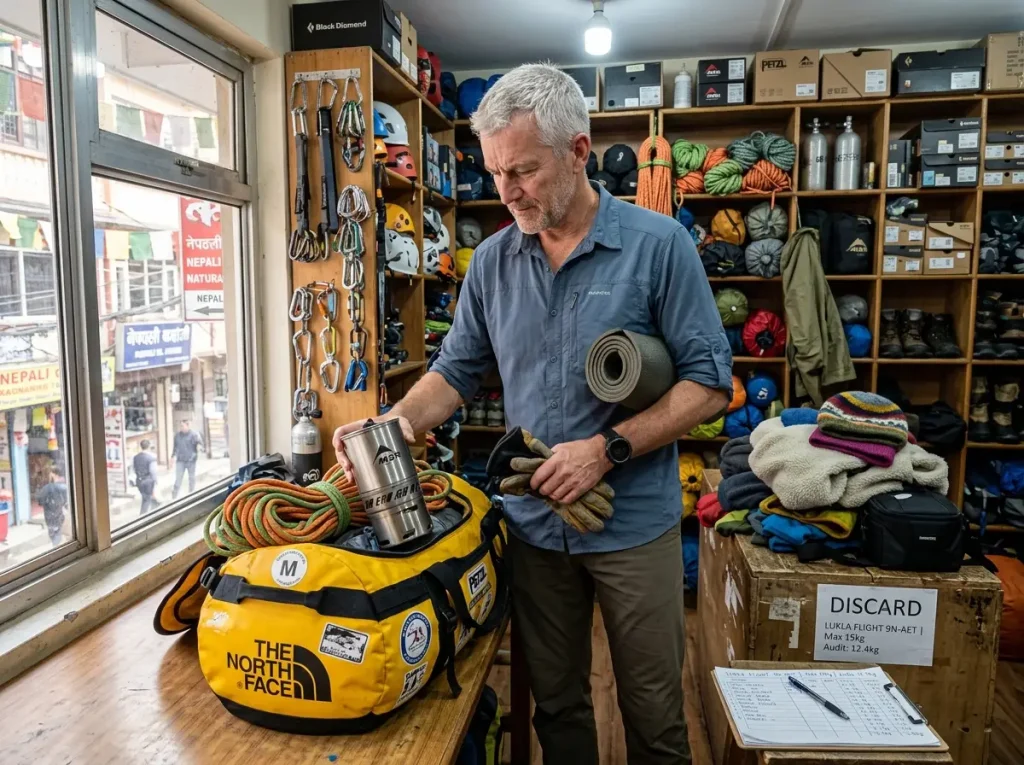
The DHC-6 Twin Otter and Dornier 228 operate at Lukla under VFR only. Hard baggage limit at Lukla: 15kg carry-on. This is a structural constraint — not a suggestion — and it shapes your entire gear list. Build the list backwards from 15kg.
Zatrwa La Pass vs. Hinku Valley: The Route That Determines Your Success
Two approach routes exist. The fast one — Zatrwa La — puts you at 4,600m on Day 2. The gradual one — Hinku Valley via Kothe — is the route veteran guides use when they want clients to summit.
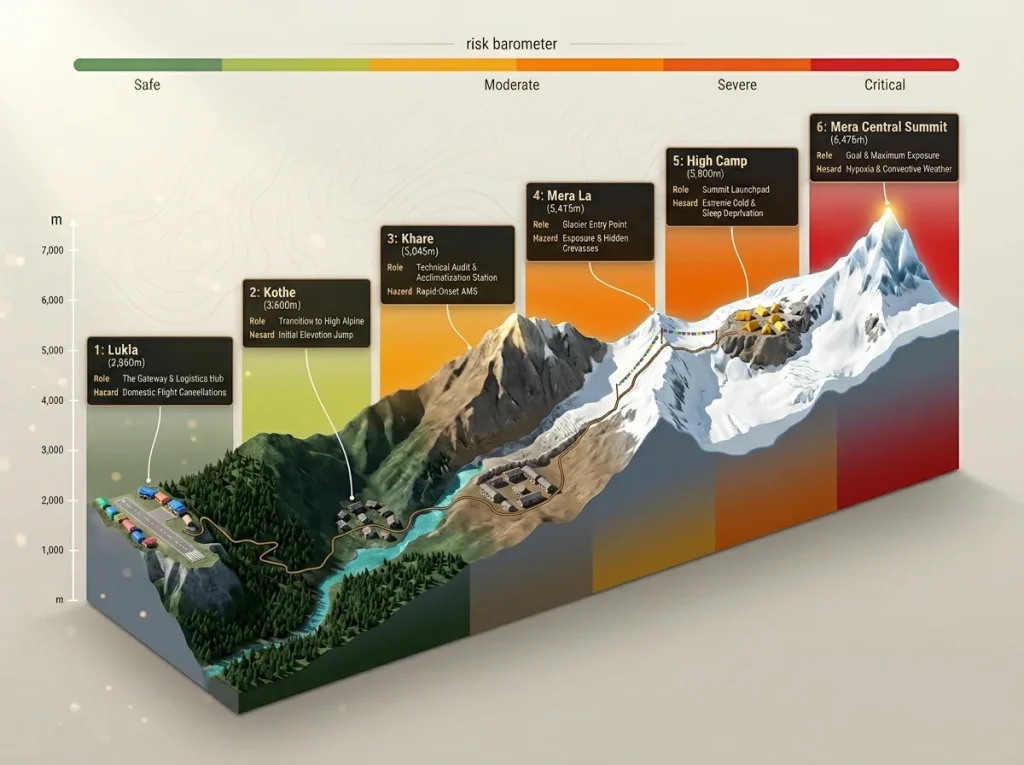
The Zatrwa La route saves two days on paper. In practice, field data from experienced expedition leaders shows it’s the primary cause of expedition failure on Mera. Climbers arrive at Khare already AMS-positive and fatigued. The two days “saved” are spent at Lukla waiting to recover. Take the Hinku Valley route. Kothe at 3,600m is the entry point — a transition from forest terrain to alpine that your body can actually process. Then Khare at 5,045m, Mera La at 5,415m, High Camp at 5,800m. Each elevation step lets your physiology catch up. For expedition planning and budget logistics, the Cho Oyu expedition guide breaks down high-altitude permit structures and operator vetting in comparable detail.
Khare: The Technical Audit Station
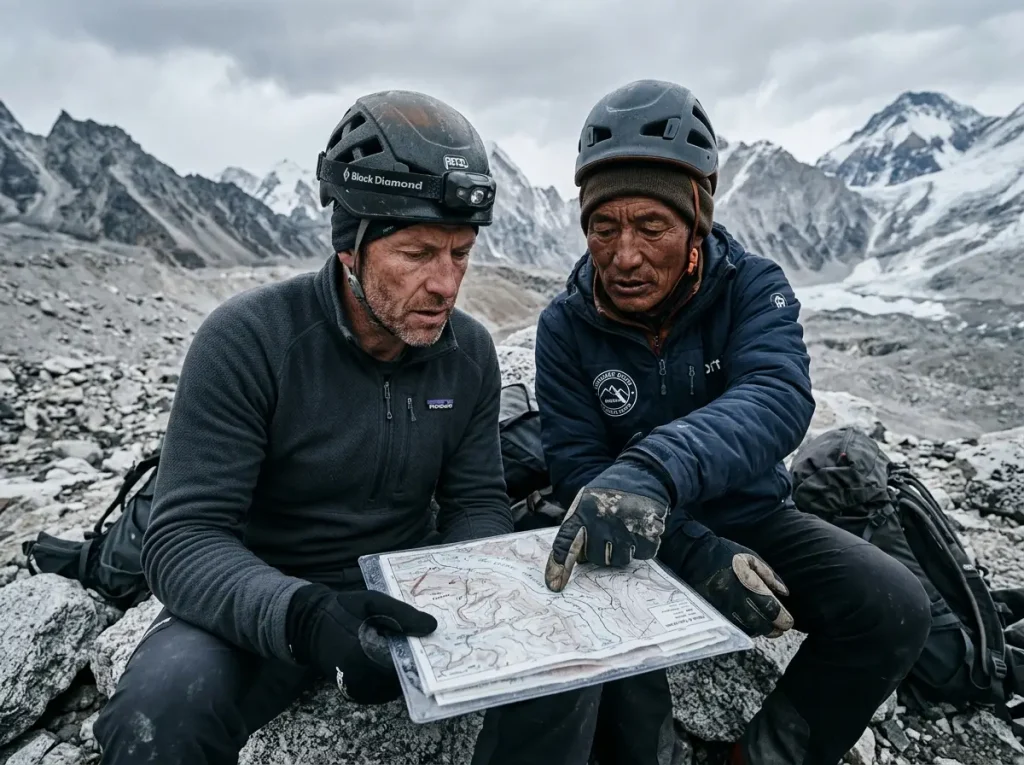
Khare is where expeditions either succeed or unravel. Veteran guides call it the gear-audit and acclimatization checkpoint. This is the last place to discover equipment problems before you’re on glacier.
At 5,045m, crampon-boot compatibility must be verified under real load. The muscular hit from crampon mass at this altitude is significant — “boots and crampons weigh more than your legs” is how guides describe the shock for first-time users. If your guide hasn’t inspected every climber’s crampon-boot system at Khare, ask for it. During a storm at 6,000m, a mismatched bail system becomes unrecoverable. Carry 7mm accessory cord specifically for crampon field repair — a broken heel-clip converts to a strap-on system with three meters of cord.
The Glacier Safety System: Crampons, Ice Axe, and Movement on the Headwall
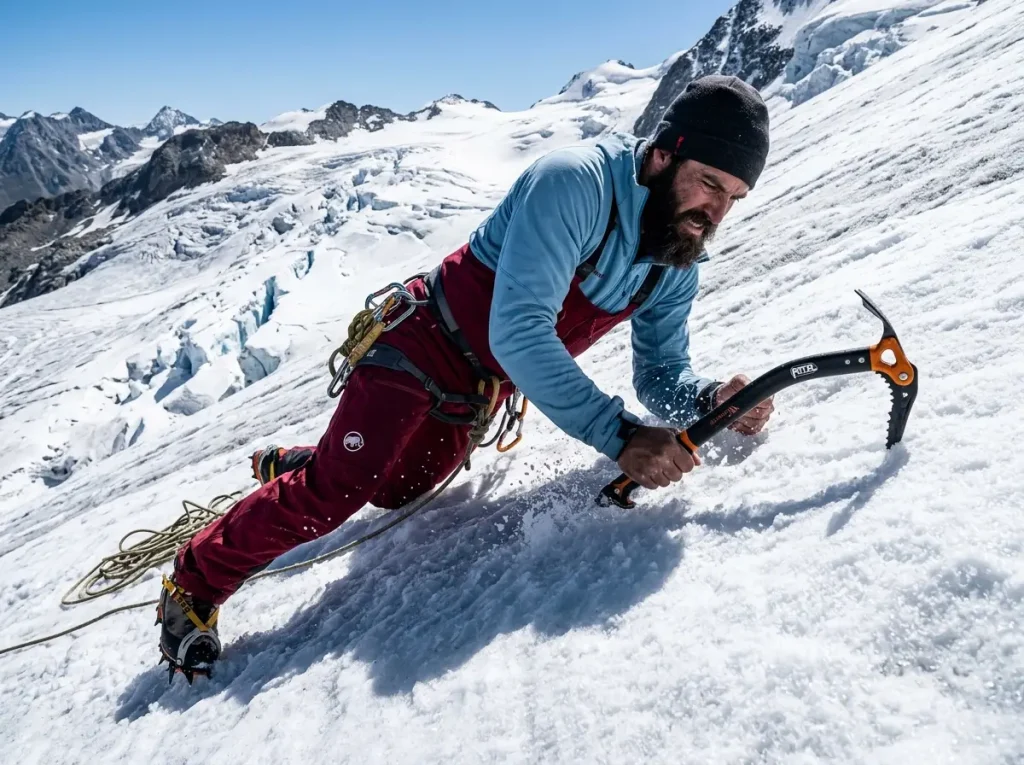
Glacier travel on Mera requires 12-point steel crampons with front points. Aluminum crampons and 10-point models won’t hold on the 45-degree summit headwall. Boot-crampon compatibility is a UIAA safety issue before it’s a comfort one: the bail system must match boot sole stiffness — B2 minimum, B3 strongly preferred for the headwall.
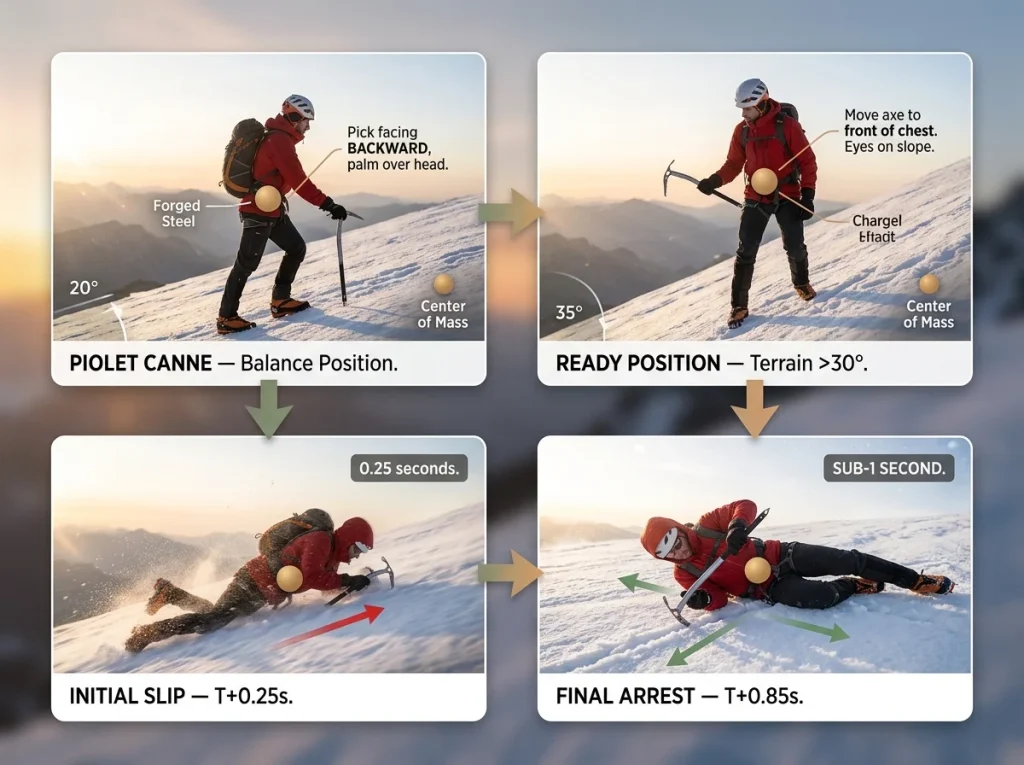
Here’s the physics most guides skip. On a 45-degree slope, a sliding climber accelerates at roughly 75% of free-fall speed — fast enough that after one second of sliding, the momentum is already close to what a 70kg person builds in a short fall. After three seconds, that momentum triples. At that point, self-arrest is functionally impossible for most humans. The piolet must be deployed within one second of the slip. Not two. One.
The ice axe starts in Piolet Canne position — tip in snow, used as a walking cane. On any steepening, it must rotate to arrest position in under one second. Practice this transition at sea level until it’s automatic. On the headwall, you don’t get time to think it through.
On 30-degree sections, use Pied à Plat — the French flat-footing technique — with all 12 crampon points engaged. It maximizes snow contact and reduces ankle loading over the multi-hour push that begins at 1:00 AM.
The Summit Headwall: What the 45-Degree Final Push Actually Demands
The final headwall to Mera Central rises at roughly 45 degrees for 150–200 vertical meters. Fixed lines are pre-placed by guides using snow pickets. Rock anchors can handle 20kN easily. Snow pickets in soft spring snow may fail at 4–6kN under dynamic load. Load distribution across multiple pickets is not optional. For a deeper understanding of building reliable snow protection, see the guide on building snow anchors that won’t rip out.
Ascent protocol: jumar on the fixed line. Self-belay on a personal tether at all times. Never unclip both protection points simultaneously. Summit push departs High Camp at 1:00–2:00 AM to reach the top by 8:00–9:00 AM before afternoon convective weather builds. Non-negotiable turnaround time: 1:00 PM, regardless of how close the summit looks.
Pro tip: Brief the entire team on the 1:00 PM turnaround before leaving High Camp — not on the headwall when someone is 200 meters from the top making emotional decisions. Most Mera accidents involve teams that were within reach of the summit at 1:30 PM.
Crevasse Travel: The Trenching Effect Nobody Explains
Between Mera La (5,415m) and High Camp (5,800m), the glacier is crevassed. Travel in rope teams of 3 minimum with 8–10m spacing between climbers. That spacing is the difference between a crevasse fall being self-arrested versus dragging the team.
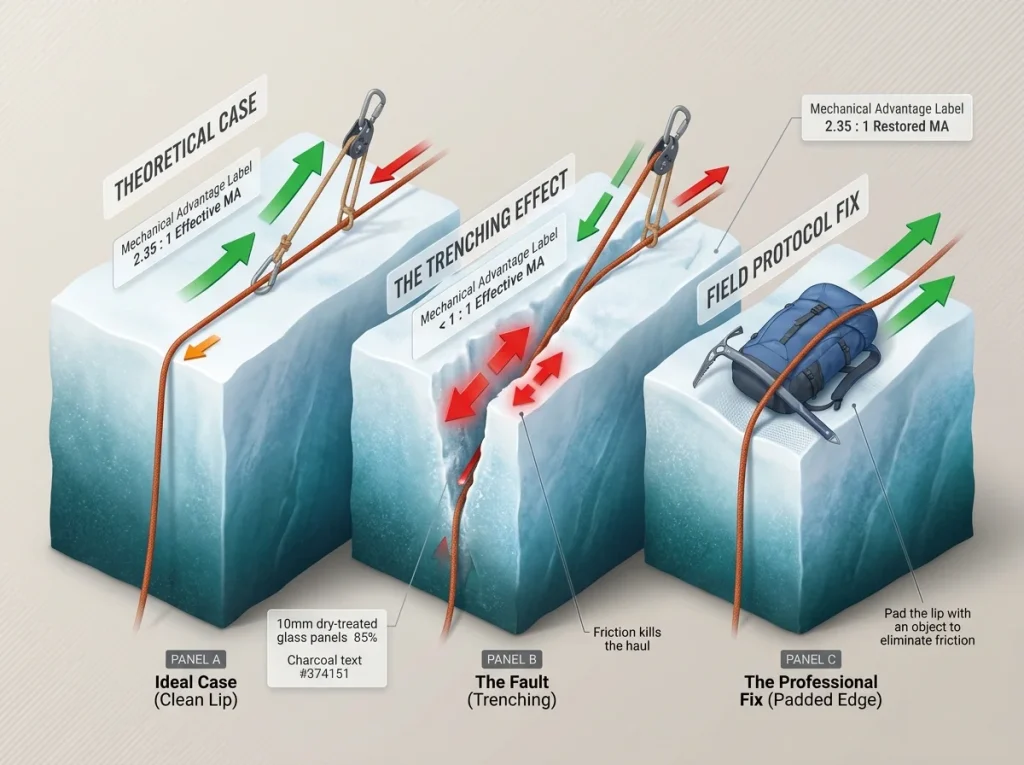
Here’s what no other guide explains about crevasse rescue: the trenching effect. When a teammate falls and the rescue rope loads against the snow lip, the rope cuts into the edge and friction shoots up fast. A Z-drag system gives you roughly 3:1 mechanical advantage in theory. With a good pulley like the Petzl Micro Traxion, that drops closer to 2.35:1 under ideal conditions. With rope trenching into a sharp snow lip, effective pull can fall below 1:1 — you physically cannot haul the person out using the standard setup. Fix: pad the snow lip immediately with a backpack, ice axe, or trekking pole across the edge before you start hauling. Do this first. Then run the system. The Petzl Micro Traxion must be oriented teeth-to-tail. Practice this at lower elevation before you need it.
The Biology of Altitude: Acclimatization, Diamox, and the HACE/HAPE Line
At 6,476m, your body is breathing faster than normal — hyperventilating — to pull more oxygen from thin air. That hyperventilation expels CO2, which makes your blood more alkaline. This is respiratory alkalosis. The paradox: alkaline blood suppresses the respiratory drive, causing periodic breathing and sleep disruptions above 5,000m. You stop breathing, wake up gasping, fall back asleep. Every night above base elevation.
This is what Acetazolamide (Diamox) counteracts, and most guides just say “take Diamox, 125mg twice daily” without explaining the mechanism. The biochemical mechanism of Acetazolamide for altitude is well-documented: it inhibits carbonic anhydrase in the kidneys, making the kidneys flush out bicarbonate. That shifts blood pH slightly toward acid — mimicking acclimatization and restoring the suppressed breathing drive. Acetazolamide also works at the carotid body, which blunts the “overshoot” ventilatory loop causing the periodic breathing cycles. This is the mechanism no competitor content explains.
On efficacy: for every 8 people who take Acetazolamide prophylactically, approximately 1 case of AMS is prevented that would otherwise occur. It’s a statistical advantage, not a guarantee. Standard dosage is 125mg twice daily. Clinical studies show no meaningful efficacy difference between 125mg twice daily and 375mg twice daily, but side effects — tingling in fingers and toes, taste changes with carbonated drinks — increase with dose.
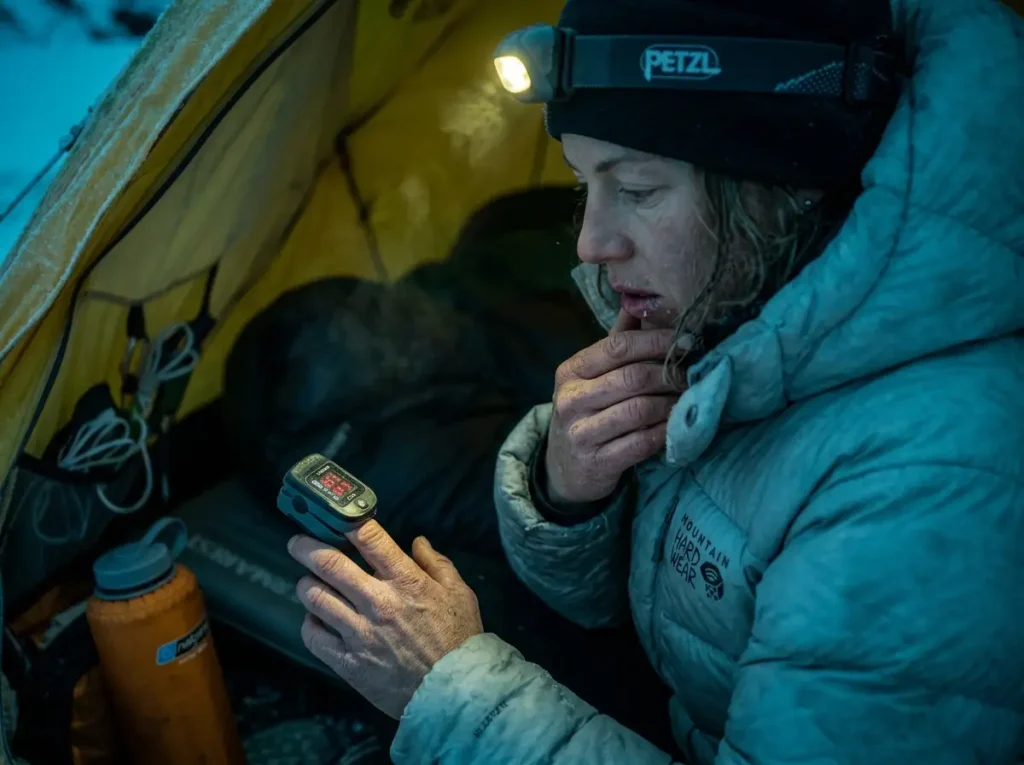
Carry a pulse oximeter. Track SpO2 trends over time, not single readings. A 5% overnight drop from your personal baseline warrants immediate guide consultation. Silent hypoxia progresses to HAPE or HACE before obvious symptoms appear in some climbers. For a full acclimatization framework, the altitude sickness acclimatization protocol covers the prevention schedule in detail.
Climb high, sleep low. The Hinku Valley route is built around this principle. Don’t shortcut it.
The Hydration Failure Point: Why Climbers Quit at 5,000m
Appetite suppression at altitude is aggressive. Most climbers stop eating and drinking at 5,000m+ because nothing tastes right and nothing sounds appealing. Summit success correlates directly with maintaining 4–5 liters of fluid intake daily — not because it feels like the right amount, but because you set alarms for it and drink on schedule.
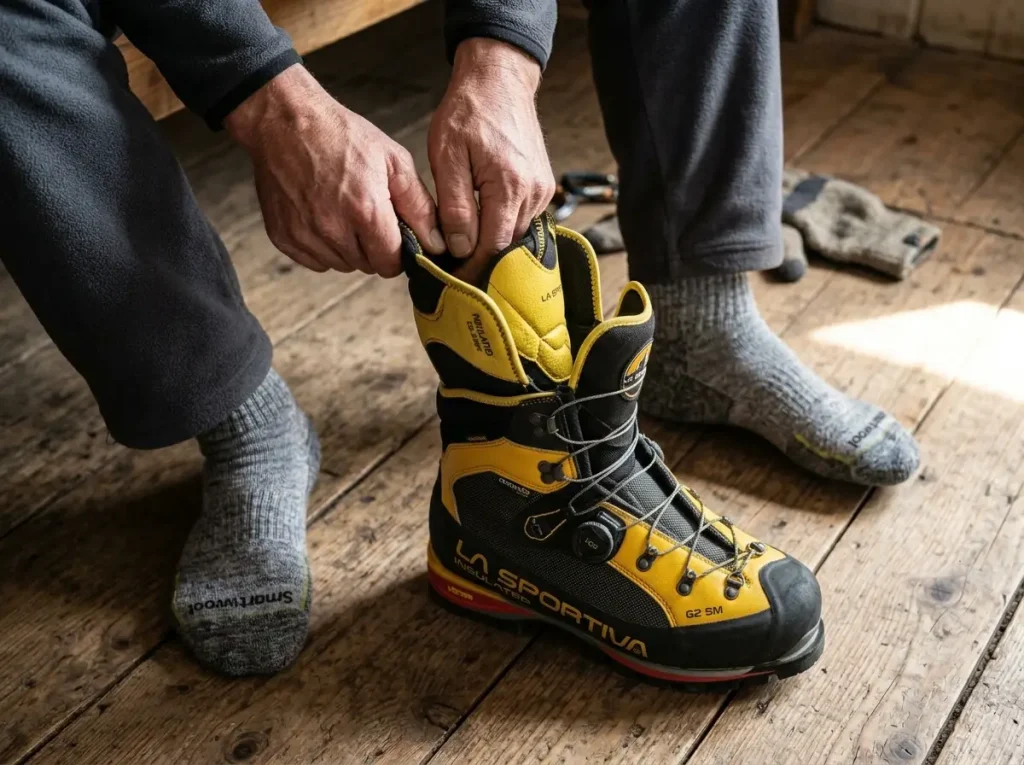
The Nalgene Cozie protocol: use an insulated bottle parka and store the Nalgene upside down in your sleeping bag at night. Ice forms at the top (the air pocket), so the lid-down position keeps water accessible until late in the night. At 2:00 AM at High Camp, if your inner boot liners have not been sleeping inside your bag, they will be frozen solid. Frozen liners at -20°C mean the summit attempt ends before it starts. This is a protocol failure, not a gear failure. Fix it before you leave Khare.
Recognizing AMS Before It Becomes HACE or HAPE
Use the AMS Lake Louise Score every morning at Khare and High Camp. Headache plus one other symptom — nausea, fatigue, dizziness, sleep disruption — equals mild AMS. Rest, hydrate, consider Acetazolamide. Do not ascend until symptom-free.
HAPE red flags: a dry cough that turns productive, pink frothy sputum, resting oxygen saturation dropping below 70% at altitude, crackling sounds on breathing. Response: immediate descent of minimum 500 vertical meters. Do not wait for dawn.
HACE red flags: ataxia (heel-to-toe walking test failure), altered consciousness. This requires helicopter evacuation — Ramechhap to Lukla costs $400–$600 per person shared, $1,500–$3,000 solo. Your insurance must explicitly state helicopter evacuation and death repatriation coverage. Standard travel insurance does not cover this.
The Gear System: What to Carry, What to Leave
High Camp reaches -20°C. The summit push can hit -25°C to -30°C with wind chill. Your total insulation system must be rated to -30°F (-34°C). That eliminates most 3-season down kits and everything chosen based on a gear shop’s “alpine” label.
Double mountaineering boots with removable inner liner are not optional — they are the thermal containment system. The liner stores inside the sleeping bag. Boots with construction that prevents clean liner removal create a critical failure on summit night. On specific models: the Mammut Nordwand 6000’s zipper construction has a documented higher failure rate in sub-zero temperatures compared to the YKK heat-sealed zipper on the Scarpa Phantom 6000. At -20°C, a zipper failure on a boot ends the summit attempt.
Crampon-boot compatibility: step-in bail models require a welt on both toe and heel. Frame crampons require full-shank stiffness (B2/B3 rated boots). Strap-on models accept most boots but introduce flex points that reduce front-point contact on steep terrain. Get this sorted at home, not at Khare.
The Lukla STOL baggage limit is 15kg hard. Build your gear list backwards from that constraint. The layering system that works at this elevation: merino or polypropylene base layer, active insulation mid-layer, Gore-Tex hardshell minimum. Belay parka with 800+ fill goose down for High Camp. Summit wind layer on top. See the detailed breakdown in the field-tested alpine layering system guide.
Pro tip: Alkaline batteries lose 30–50% capacity at -20°C. Lithium batteries maintain performance through the cold. Swap your headlamp batteries at Khare before the summit push. Carry a Black Diamond Storm 450 or equivalent rated IP67 — and carry a backup. A headlamp failure at 1:30 AM on the headwall with no backup is a full party abort.
The Technical Hardware Checklist (kN-Rated)
Fixed-line personal tether: minimum 20kN rated, UIAA 121 standard for connectors. Jumar/ascender must accept 11mm rope — test the mechanism in cold temperatures before departure, because lubricants solidify inside aluminum cam mechanisms at -20°C. At High Camp, apply dry lube to the cam before the summit push. Rope team minimum: 30m dry-treated glacier rope per pair. Wet ropes above 5,000m freeze into unusable rigidity. Dry treatment is not an upgrade — it’s field functionality.
The Psychological Gear Nobody Packs
Above 6,000m, the summit stops feeling reachable. It doesn’t look closer the longer you climb. Guides who have been there hundreds of times describe it as a “humbling” that hits every climber regardless of fitness or experience. The fix is consistent: the next glacial mound is the goal, not the summit. Set mini-goals and move through them.
Turnaround time is a psychological crisis, not just a logistical one. Brief the full team before departure from High Camp. Most Mera accidents trace to teams within 200 vertical meters of the summit at 1:30 PM. The mountain will be there next season.
The Expedition Logistics Blueprint: Costs, Operators, and the 2026 Permit Matrix
Total all-in cost range: $2,500–$5,000 for the full guided expedition — domestic flights, NMA permit at $350 spring, operator package, porters, food on mountain, and accommodation. Personal gear from scratch adds $1,500–$3,000 on top. Budget separately for helicopter evacuation insurance and 2–3 days of international flight buffer for weather delays. The expedition food planning and calorie calculator covers the on-mountain caloric math — at altitude, your calorie burn goes up significantly while your appetite goes down.
When vetting operators, four questions matter:
Does the guide hold a government-issued license AND a recognized international certification (IFMGA/UIAGM)? Does the package include a minimum of 2 rest days at Khare for acclimatization? Is helicopter evacuation insurance coordination handled by the operator or left to you? Are fixed lines pre-placed on the headwall by the operator’s team?
If any answer is unclear or evasive, that’s the answer.
Seasons: Spring vs. Autumn — What the Data Actually Shows
Spring (March–May): more crowded, better-established fixed lines, higher afternoon convective risk. Avalanche risk increases post-snowfall. Summit push temperatures: -20°C to -25°C. The 1:00 AM alpine start is engineered around afternoon convective cloud build-up that accelerates after 10:00 AM.
Autumn (September–November): less crowded, drier, harder glacier surface from post-monsoon snow consolidation — which actually improves 12-point crampon purchase on the summit headwall. Wind can be more consistent and stronger. For most serious climbers, autumn is the better technical season.
Winter (December–February): extremely cold, no commercial expeditions. Monsoon (June–August): categorically hazardous for glacier travel.
Insurance: What Your Policy Must Cover (Non-Negotiable)
Standard travel insurance does not cover Mera Peak. You need a high-altitude mountaineering policy with three explicit inclusions: helicopter evacuation issued by CAAN-licensed operators, repatriation coverage (check the policy language — many standard policies exclude it while implying they cover it), and medical treatment at altitude clinics. The Himalayan Rescue Association operates clinics at Pheriche — register there for mountain rescue coordination. Helicopter evacuation costs $400–$600 per person shared; solo evacuation runs $1,500–$3,000. The only rational response to that exposure is insurance.
Critical Failure Points: The Six Mistakes That End Summits
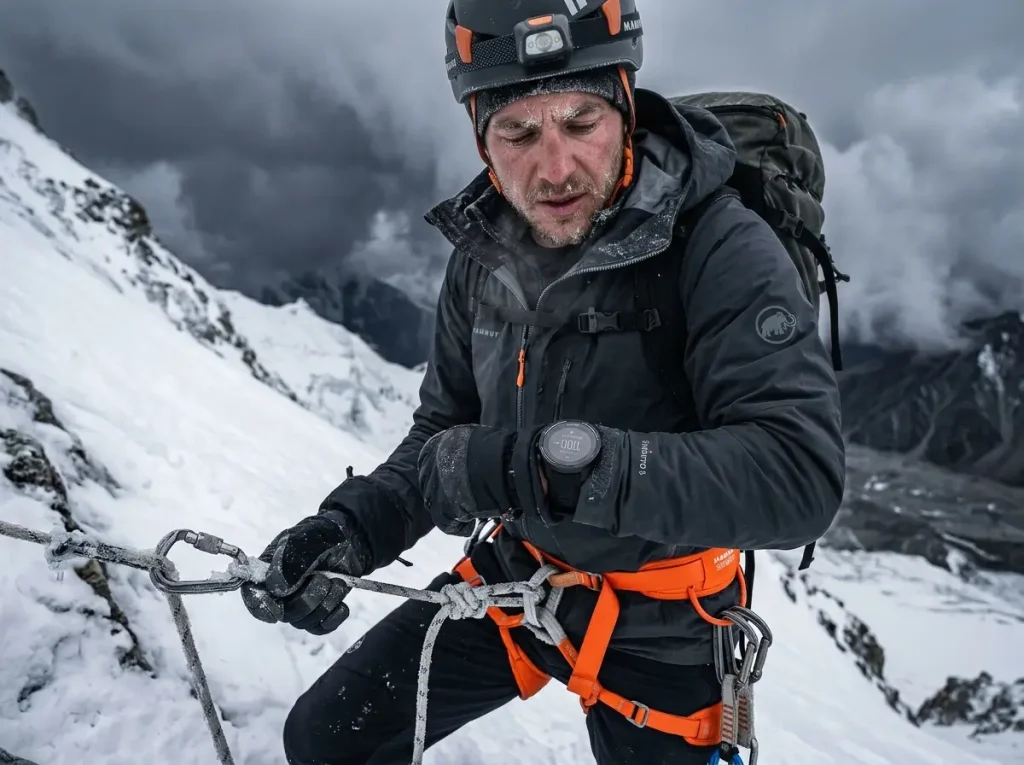
1. The Zatrwa La speed trap. Choosing the fast approach to save two days is the single most documented cause of expedition failure. Climbers arrive at Khare fatigued and AMS-positive. The time saved is spent at Lukla recovering.
2. The boot liner failure. Not storing inner liners in the sleeping bag. At 2:00 AM at High Camp (-20°C), frozen liners abort the summit before it starts. Protocol failure. Completely preventable.
3. Hydration collapse at 5,000m. Altitude-induced thirst suppression is predictable. Set mandatory fluid checkpoints every 90 minutes. Do not rely on thirst signals.
4. Crampon fit not tested under load. Many climbers arrive never having walked in crampons under a loaded pack. The muscular hit from crampon swing weight at 5,000m+ is significant. Specific conditioning is required before arrival.
5. Insurance gap. Discovering that your policy excludes helicopter evacuation or repatriation coverage after you’ve reached Khare. Read the policy before loading the pack. “Adventure coverage” and “mountaineering coverage” are not the same thing.
6. Turnaround time negotiation. The most common summit-day error. Two hundred meters from the top at 1:00 PM, the guide calls descent, and the climber pushes. This is how expeditions go wrong on what the NMA classifies as “trekking peaks.”
Field Repair Protocols: When Equipment Fails at 5,500m
Crampon bail arm breaks: 7mm accessory cord threaded through the bail arm converts a broken heel-clip crampon to a strap-on system. Carry 3 meters minimum. Frozen jumar cam: apply dry lube at High Camp before summit push. Liquid lubricants solidify inside aluminum cam mechanisms at -20°C. Headlamp failure: chemical light sticks (cyalume, 12-hour rated) are zero-maintenance backup and add negligible pack weight. At 1:00 AM on summit night, headlamp failure without a backup is a party-wide abort. For structured vertical medicine protocols, see the wilderness first aid for climbers in vertical terrain guide.
Conclusion
Three things end most Mera attempts:
The label lies. “Trekking peak” is an NMA administrative category. Mera Peak is a 6,476m alpine expedition requiring crampons, glacier travel, rope systems, and a licensed guide — by law, not preference.
The mountain is won by protocol, not heroics. The climbers who summit Mera are the ones who kept their boot liners warm, drank 4 liters at Khare, and turned around at 1:00 PM when the guide said so. Not the ones who pushed hardest.
Acclimatize like you mean it. Take the Hinku Valley route. Give Khare two rest days minimum. Carry the oximeter. The natural acclimatization window that one additional low-intensity rest day at 5,200–5,400m gives you outperforms any fitness preparation done at sea level. Go earn the summit on the mountain.
Now go send something.
FAQ
Is Mera Peak suitable for beginners with no prior mountaineering experience?
Mera is often called a beginner high-altitude peak, but that framing needs context. The normal route is Alpine PD-rated — glacier travel, crampon use, and fixed-line ascent are required skills. A beginner with no prior experience in these systems should complete a technical introductory mountaineering course (ice axe, crampon, self-arrest training) before attempting Mera. If you’ve done multi-day trekking above 4,000m and have taken a glacier travel course, Mera is a reasonable next progression step as a 6000m objective.
Do I need supplemental oxygen for Mera Peak?
No. Supplemental oxygen is not used on Mera and would be logistically impractical on the guided routes. At roughly 45% of sea-level oxygen availability, the summit push is manageable without supplemental O2 using proper acclimatization. Diamox (Acetazolamide) is commonly used as prophylaxis to support the body’s altitude adaptation — discuss the protocol with a travel medicine physician before departure.
How much does it cost to climb Mera Peak in 2026?
Expect a total all-in cost of $2,500–$5,000 for the guided expedition: domestic flights, NMA permit at $350 spring, operator package, porters, mountain food, and accommodation. Personal gear from scratch adds $1,500–$3,000. Budget an additional $400–$600 for helicopter evacuation insurance excess, and 2–3 days of international flight buffer for weather at Lukla.
What is the difference between Mera Peak and Island Peak?
Both are NMA Group B trekking peaks in the Khumbu region with different technical characters. Mera (6,476m) involves longer sustained glacier travel on the approach and a broader summit headwall. Island Peak (6,189m) has a more technical ice headwall on the final push — shorter route but steeper and more sustained. Mera is generally considered the better first high-altitude trekking peak objective; Island Peak is frequently paired with Mera for experienced teams doing a two-peak expedition.
When is the best time to climb Mera Peak?
Autumn (late September–November) is the preferred season for technical reasons: drier conditions, harder glacier surface, less crowding than spring. Spring vs. autumn trade-off: spring has better-established fixed lines and higher foot traffic, but carries greater afternoon convective risk and more summit-day congestion. The monsoon season (June–August) is categorically hazardous — do not attempt the glacier in monsoon conditions.
Safety Notice: Rock climbing and mountaineering are inherently high-risk
activities that can involve physical trauma or fatal incidents. The information on Rock Climbing Realms is for
educational and informational purposes only. Techniques and advice presented here are not a substitute
for professional, hands-on instruction. Conditions and risks vary by location. Always seek guidance
from a qualified instructor before attempting new techniques. By using this website, you agree that you
are solely responsible for your own safety. Any reliance you place on this information is strictly
at your own risk, and you assume all liability for your actions. Rock Climbing Realms and its authors
will not be held liable for any harm, damage, or loss sustained in connection with the use of this information.
Affiliate Disclosure: We are a participant in the Amazon Services LLC Associates Program, an
affiliate advertising program designed to provide a means for us to earn advertising fees by advertising and linking
to Amazon.com. As an Amazon Associate, we earn from qualifying purchases. We are also an official affiliate partner
of Black Diamond Equipment via the AvantLink network. If you click on a Black Diamond affiliate link and make a
purchase, we may earn a commission at no additional cost to you. We also participate in other affiliate programs.
Additional terms are found in the terms of service.