
In this article
The boulder hangs over you like a verdict. Your fingers are chalk-white and steady, but three feet to the left, the landing zone angles sharply over a root-strewn embankment—and your spotter is repositioning, muttering something about swing momentum. You have sent this grade in the gym a hundred times. You have never had to calculate whether the rock itself might be minutes from catastrophic failure under your grip.
This is the moment the gym never prepared you for.
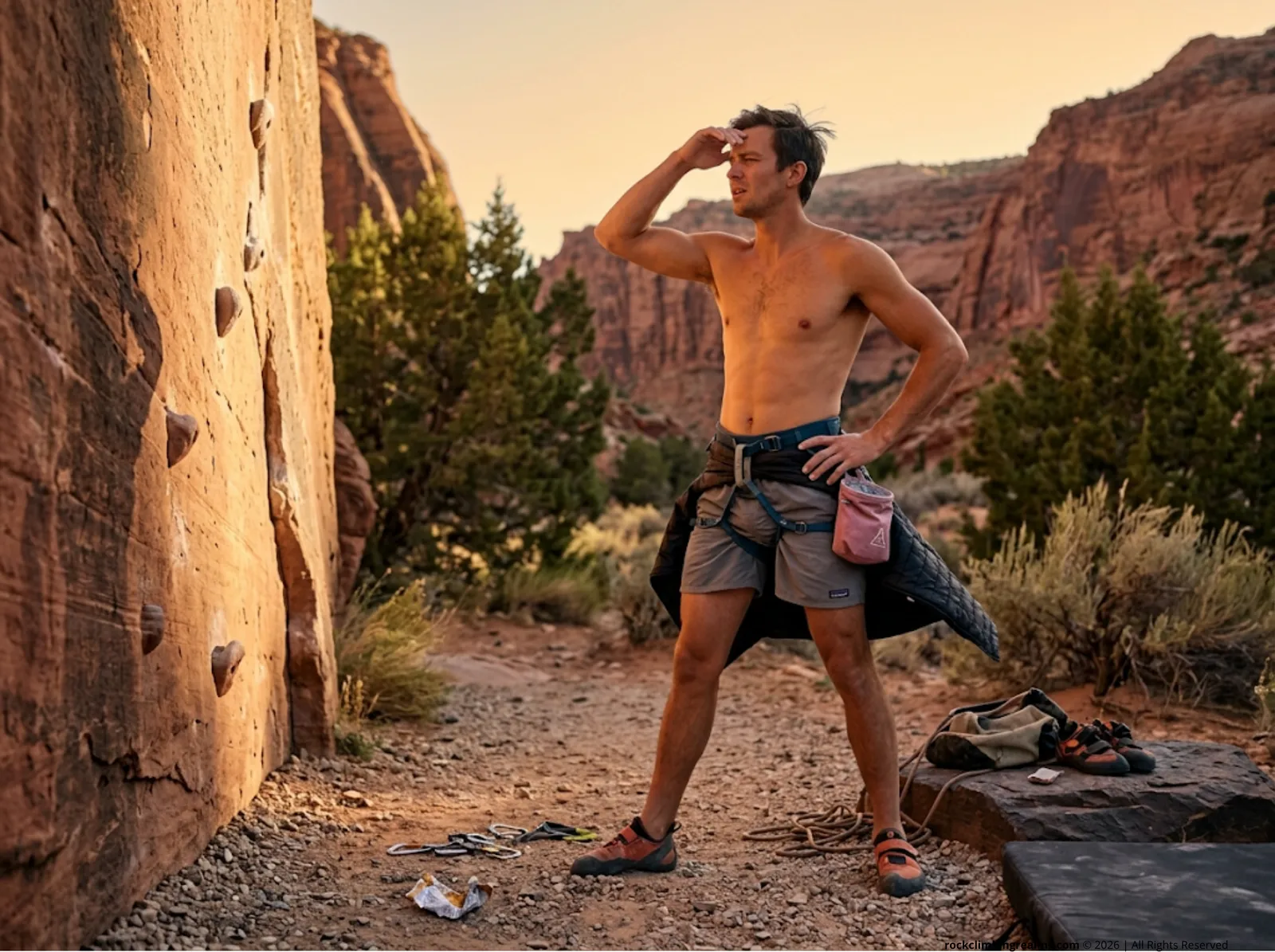
The controlled world of engineered holds and impact-absorbing flooring ends at the crag parking lot. Outdoors, the rock is porous, the physics are unforgiving, and the ethics are non-negotiable. A single session on saturated sandstone can destroy a problem that took decades to form. One uncontrolled fall can turn a boulder field into an ambulance route. After two decades of guiding and sending on sandstone across the West, I have seen good climbers ruin good rock in a single afternoon. This article is your technical protocol for bridging that gap—covering the geology of rock failure, the physics of falling, the biomechanics of spotting, the chemistry of chalk, and the stewardship standards that keep crags open.
Quick Answer: Outdoor bouldering demands five protocols you never had to think about indoors. Never climb on wet sandstone—wait 24 to 72 hours after rain depending on solar aspect and rock porosity. Deploy crash pads that extend 2 meters from the wall base with no gaps, and spotter hands in the “spoons” position. Use only high-purity magnesium carbonate chalk and brush every tick mark before you leave. Pack out everything, including human waste using WAG bags in high-traffic areas. These are not suggestions—they are the technical standards that keep crags open and climbers out of the hospital.
Understanding Rock Vulnerability: Why Sandstone Fails When Wet
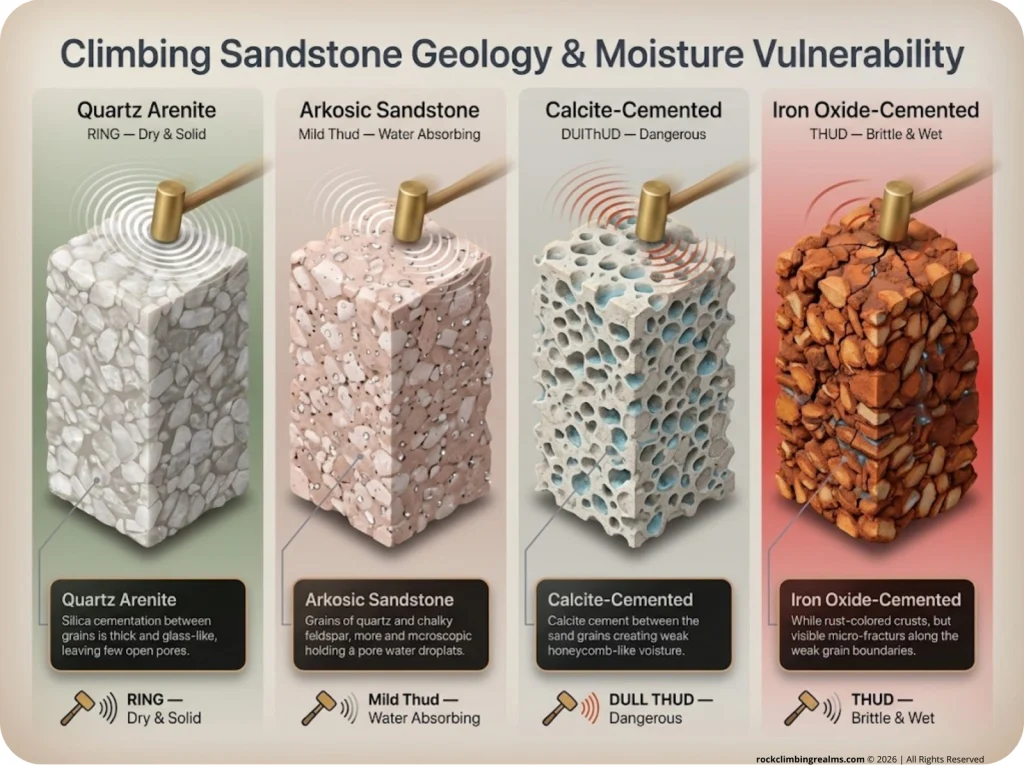
Sandstone is not the inert stone it looks like. It is a held-together stack of sand-sized mineral particles—quartz, feldspar, calcite, iron oxide—cemented by compounds that water rewrites. When moisture seeps into the pore structure, it weakens the molecular bonds holding those grains together. The result is a loss in hold strength that ranges from 15% to 75% depending on saturation level. A hold that supports your full body weight when dry can snap under the same load when damp. I have watched a huecos tank fracture mid-crux on stone that looked dry on the surface but was still carrying water in its internal matrix three days after the last rain.
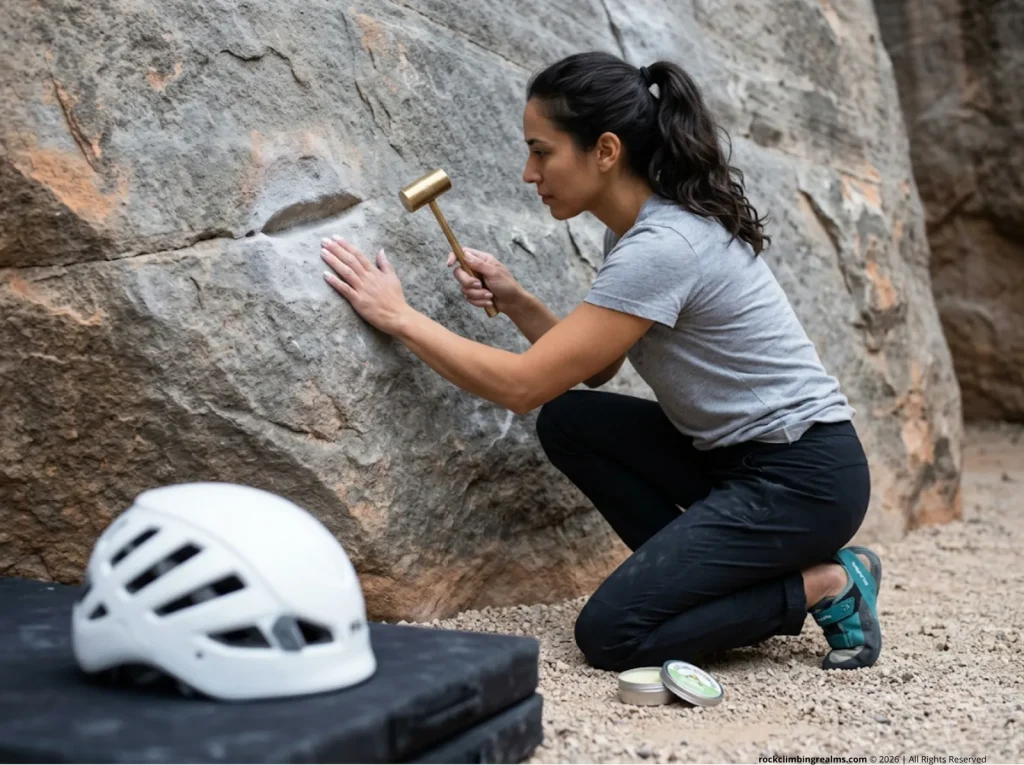
The sound test is the field tool that no one teaches you formally. Knock on a hold with your knuckles or a small brass mallet. Dry sandstone produces a clean, high-pitched ring. Saturated stone gives back a dull thud. Once you have heard the difference, you will never rely on visual surface inspection again. Many western sandstone areas—Nevada, Utah, the Colorado Plateau—show as much as 75% loss in structural integrity when fully saturated. Classic problems like The Pearl in Red Rock or Bring the Heatwole in Joe’s Valley have been measurably degraded by climbers who did not wait.
Not all sandstone is the same. Quartz Arenite is silica-cemented and holds up well under repeated use. Arkosic Sandstone has feldspar-dominant cementation and absorbs water faster, degrading more quickly. Calcite-Cemented sandstone—common in many sport climbing areas—dissolves and weakens significantly when saturated. Iron Oxide-Cemented stone has that distinctive red-orange color but is brittle and prone to fracturing along grain boundaries. These differences matter at the crag, and understanding the fundamental rock geology behind these failure modes is what separates climbers who protect stone from climbers who destroy it. A north-facing overhang in Quartz Arenite country might stay saturated for a week after a storm. The same formation facing south with wind exposure might be climbable in 24 hours.
Pro tip: Carry a small brass mallet and knock on the holds before every outdoor session. The ring versus thud test is the most reliable field diagnostic for sandstone saturation—more reliable than what the rock looks like or what the weather app says.
Environmental variables compound the drying question. Solar aspect is the dominant factor: south-facing walls in direct sun and wind dry fastest. North-facing or overhanging boulders can stay saturated for weeks even when conditions elsewhere are fine. Air movement matters enormously—wind strips the boundary layer of moisture from rock surfaces, while sheltered canyons with high humidity trap it. Temperature above 65°F accelerates drying; below that, chemistry slows to a crawl. A light afternoon shower might clear in 24 hours. Three days of steady rain in a canyon with no sun exposure might require a full week. Before your trip, check the weather history, not just the forecast.
The Physics of the Fall: Crash Pad Mechanics and Energy Dissipation
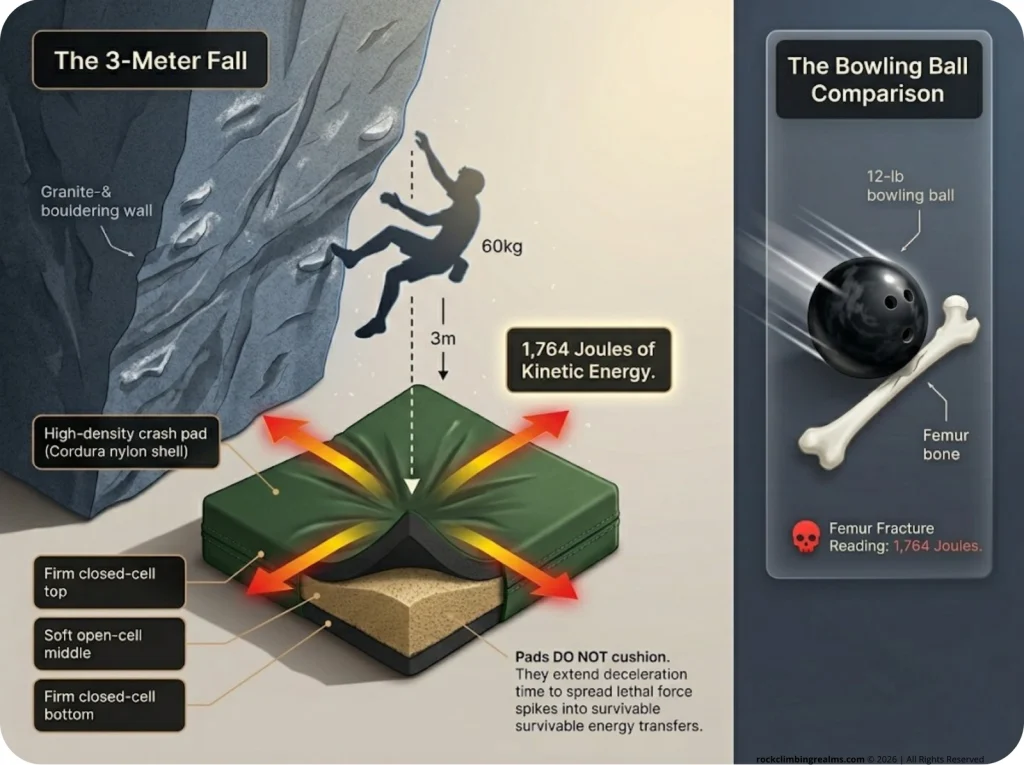
A falling climber is a physics problem with consequences. The energy generated by a fall depends on how heavy you are and how far you fall. A 60-kilogram climber falling from 3 meters generates a lot of force—enough that medical texts compare it to the impact severity of a 12-pound bowling ball traveling at highway speeds. The numbers are not abstractions—they are the difference between walking away and not.
The job of a crash pad is to extend the duration of impact. A pad does not cushion you. It lengthens the time over which your body decelerates, spreading a lethal spike in force into something survivable. UIAA Standard 161 is the governing safety standard for crash pads—it sets limits on how much force a pad can transmit to your body after a fall, and you can review the full technical specifications on the UIAA website. The Head Injury Criterion, known in the industry as HIC, measures the likelihood of traumatic brain injury from an impact. The critical threshold is 400. Pads tested above that threshold under controlled conditions are not compliant with UIAA 161.
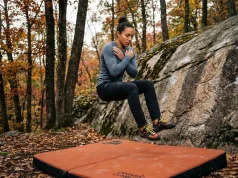
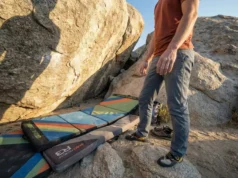
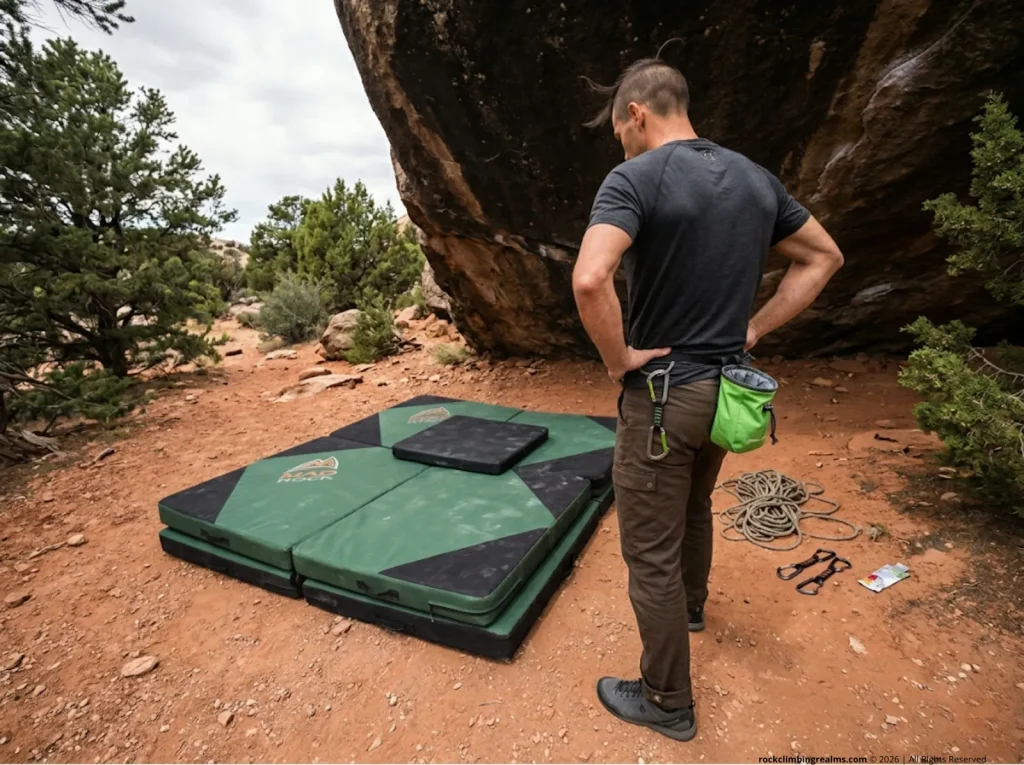
Pad placement is where most outdoor accidents happen. The rule is simple: for standard walls up to 3 meters, the pad must extend 2 meters from the base of the wall. For overhanging terrain, that extension needs to be 1.5 times the wall height to account for the outward centrifugal force of a falling body swinging away from the wall. On highball problems above 4 meters, a single pad is not enough—you need a layered “pad-fu” configuration that deflects the climber onto a broader protective surface. The most common injury mechanism outdoors is not the primary impact. It is the gap between pads where an ankle catches an edge, or a head drops between two pads. Slider pads and “blubbers”—narrow pads designed to span seams—are non-negotiable in any serious landing zone. Clean the pads too. Chalk buildup on the surface reduces friction at the exact moment you need grip most.
Before you buy your first dedicated outdoor pad, understand what you’re actually buying: the foam sandwich construction, compression set behavior, and reticulation properties of a pad determine how many seasons it will hold up and whether it will still meet UIAA standards after a summer in a damp garage.
Pro tip: Before your first move on a highball, practice your pad stack in a flat parking lot. Walking through the Tetris method—fitting pads together without gaps—takes 10 minutes. Doing it three feet off the ground with your spotter already in position is not the time to figure it out.
Spotting Biomechanics: Protecting the Cervical Spine Outdoors
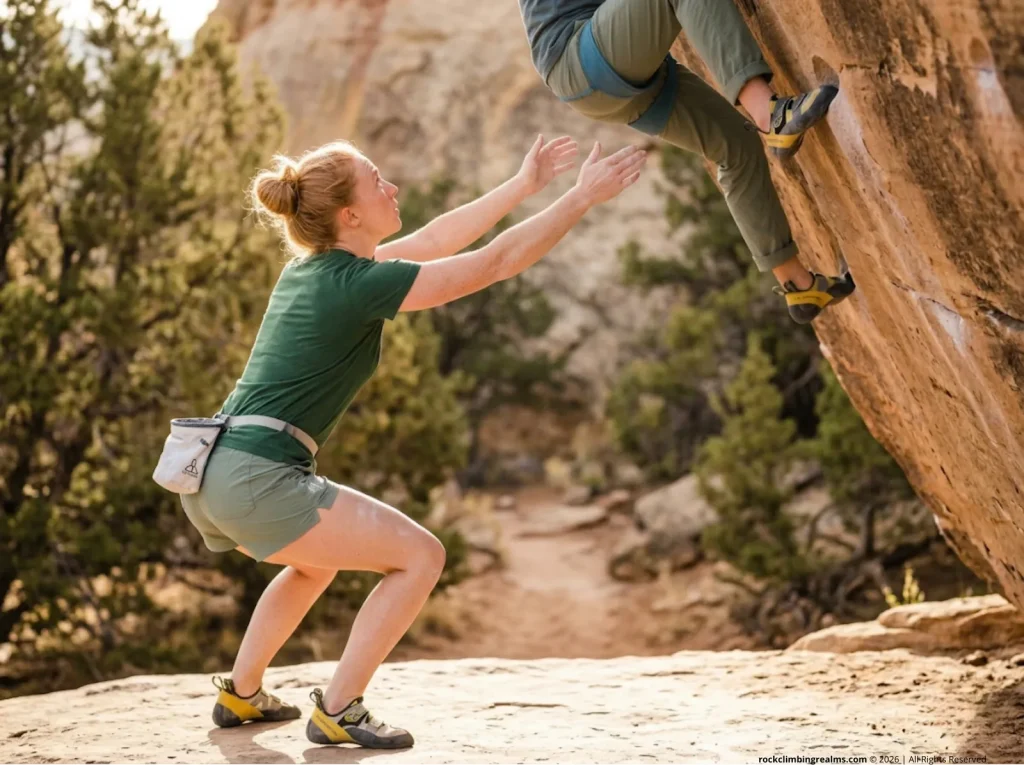
A spotter’s job is not to catch. It is to redirect. That distinction is the most important thing you will read in this article. A falling climber from 4 meters can generate forces equivalent to a small vehicle. No human body stops that safely. What a spotter does is nudge the falling body’s center of gravity—the hips—toward the pads and away from the embankment, the root ball, or the off-width crack that would turn a normal landing into a spinal injury.
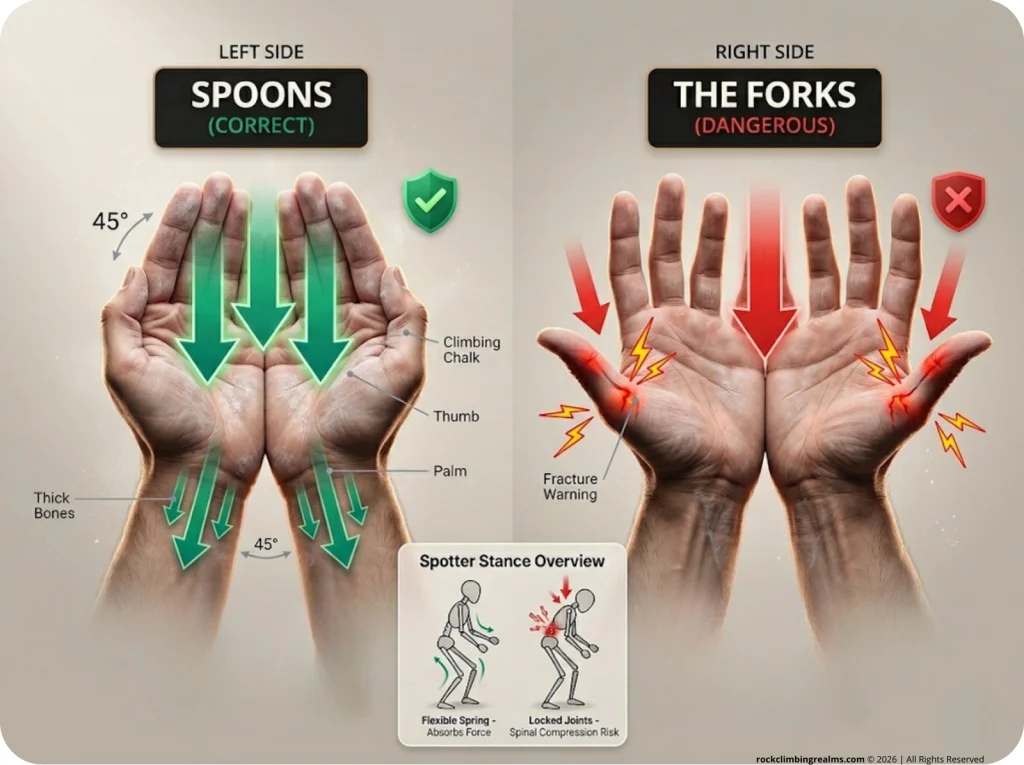
Hand position is the difference between a useful spot and a trip to the ER. Keep your fingers and thumbs together and tucked in. That is the “spoons” position. Spread fingers—”forks”—are extremely susceptible to fracture or dislocation when a 150-pound bodyslab lands on them at velocity. I have seen two spotter finger injuries at the same boulder in one season, both from people who did not keep their hands tucked. The spotter should also maintain a flexible stance with bent knees and bent elbows. Locked joints transfer the full force of the fall directly into the skeletal system, creating compression injury risk in the shoulders and spine. You are a spring, not a wall.
The fall zone is an imaginary 6-to-10-foot radius around the climber. On overhanging terrain, spotters need to position themselves further back from the base to account for swing momentum—the falling body does not drop straight down, it swings outward and then back. Before every ascent, climber and spotter need to agree on signals and the intended landing zone. A veteran boulder guide I know runs a simple pre-ascent ritual: he points at the landing, points at his hips, taps his head. The spotter nods. Only then does he pull. This takes five seconds and eliminates the most common communication failure in spotting.
The Chemistry of Chalk: Friction, Preservation, and Performance
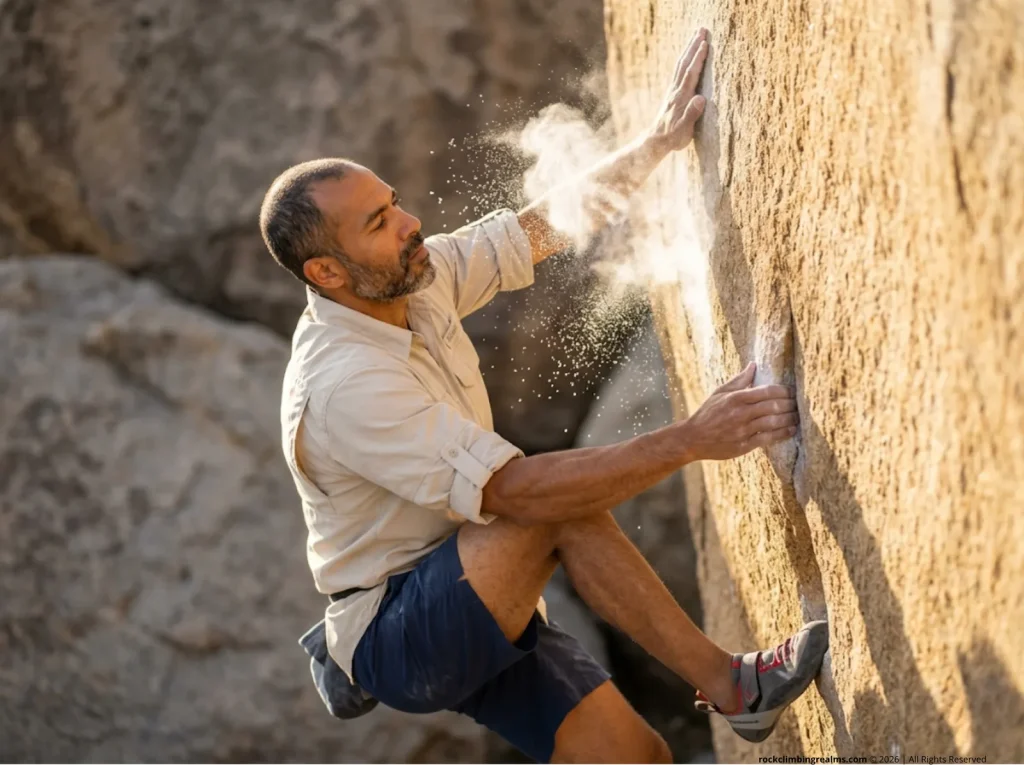
Climbing chalk is magnesium carbonate. Its job is to absorb moisture at the molecular level, keeping your hand surface dry so you can grip the rock. The problem is that not all chalk is pure magnesium carbonate. Cheap chalks often use calcium carbonate as a filler. Calcium carbonate absorbs water on its exterior surface and creates a slick, slimy film that makes your hands feel greasy right away. You chalk up and immediately lose grip. That is the filler talking, not the good stuff. High-purity chalk stays on your hands longer and provides that slightly tacky feel you want on technical stone. It also costs more, which is why cheap chalk is cheap.
Then there is rosin—also called POF, or pine rosin. Climbers used it historically, particularly in Fontainebleau, to enhance grip on glassy sandstone. It works. That is exactly the problem. Rosin bonds chemically with the rock surface and is functionally impossible to remove once it cures—it leaves a permanent sticky glaze that fills in the natural micro-texture of the stone, altering hold difficulty and destroying the rock’s structural surface. Unlike chalk, which you can brush away, rosin becomes part of the rock. Almost every major bouldering area now prohibits it explicitly, and violations can result in climbing bans. There is no outdoor situation where rosin is worth the damage.
Chalk ethics extends beyond what you put on your hands. Excess chalk left on the rock is visual pollution that alters the natural appearance of the stone. More than that, chalk that gets moist—from dew, humidity, or a rain event that was supposed to miss your area—forms a cement-like paste that creates permanent white scars on the rock surface. Brush every chalk mark and tick mark before you leave a problem. Use a soft nylon brush. Steel or brass brushes scratch and polish soft sandstone, accelerating the same erosion you are trying to prevent. The rule is simple: if you left a mark, you clean it.
Pro tip: Carry two brushes—one for the rock, one for your hands. Brush the hold after you send, not just before. Chalk that has been worked into the micro-texture of a sandstone pocket by repeated moves is far harder to remove than fresh dust.
Environmental Stewardship: The Seven LNT Principles Adapted for Bouldering
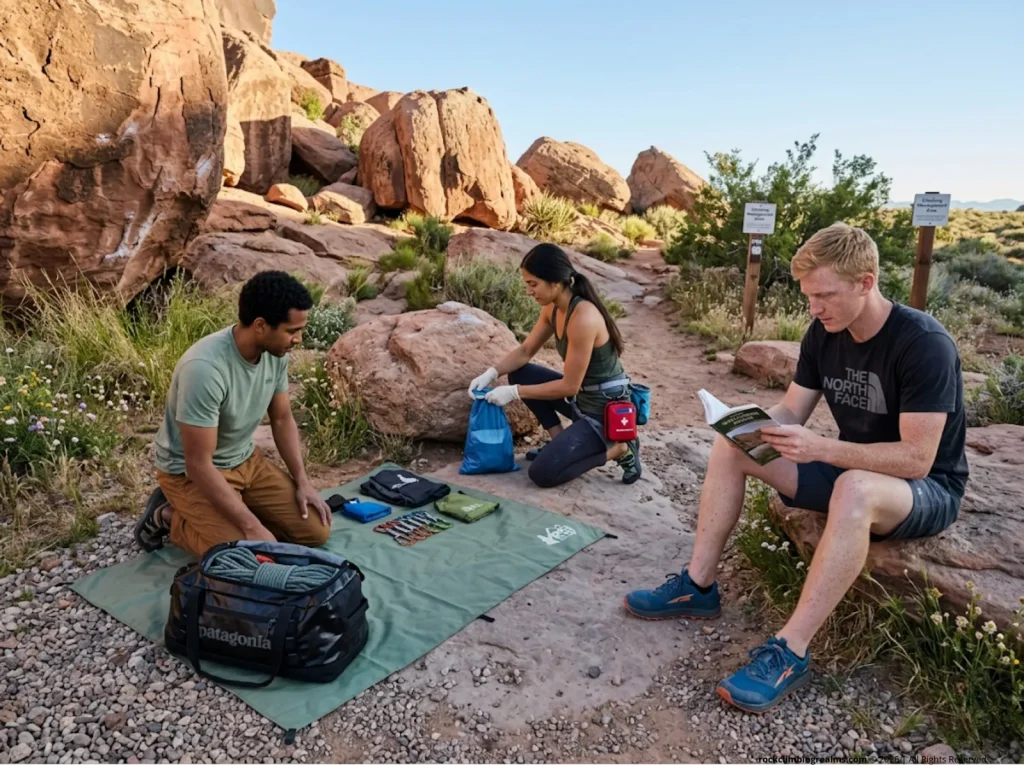
Climbing access is a social contract. Every boulder field you visit exists because climbers before you treated it with respect and because land managers decided the sport was worth accommodating. The data on crag closures is unambiguous: preventable environmental damage—trampled vegetation, human waste left in exposed areas, rosin-damaged stone, chalk-scarred rock—is a primary driver of access loss. The climbers who come after you are counting on the decisions you make today.
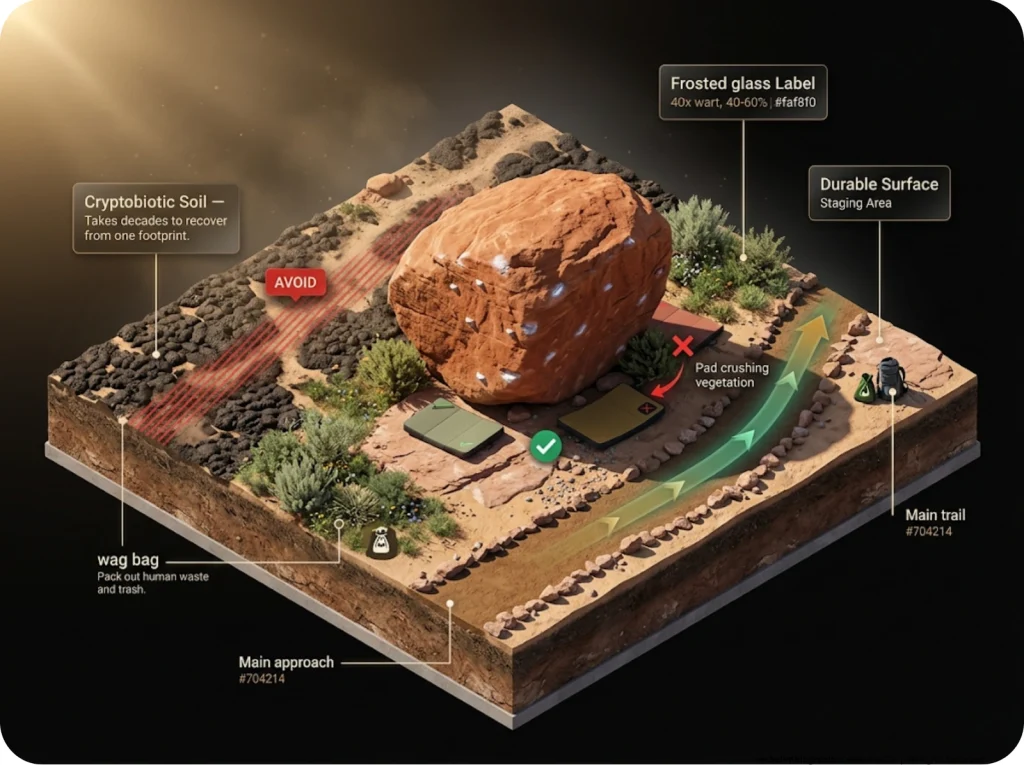
The foundation is planning. Before your trip, research local regulations, seasonal wildlife closures, and weather-dependent rock stability. Many crags have nesting raptor closures that are legally enforced with significant fines and ecological consequences—violations cause nesting birds to abandon young or waste critical energy. Cryptobiotic soil, the living biological crust found in areas like Indian Creek, takes decades to recover from a single footprint. Stay on durable surfaces—established social trails, rock, gravel—never on fragile biological soil crusts. Place your pads on rock or gravel, not on the vegetation you spent three minutes deciding was not worth worrying about. The Leave No Trace Seven Principles, developed by the National Park Service and applied across climbing contexts, provide the framework for minimizing impact on fragile crag ecosystems.
Pack out everything. Everything. Organic waste—apple cores, orange peels, food scraps—is included in that directive. What looks biodegradable in a canyon environment often is not, particularly in arid regions where decomposition is slow. Human waste in high-traffic areas requires a WAG bag—Waste Alleviation and Gelling system. These use a gelling agent to stabilize waste for sanitary transport. In many popular boulder fields, traditional catholes are insufficient or prohibited outright, and WAG bag failure is one of the most frequently cited causes of crag closures. Dog waste is part of this equation too. Canine feces degrade water quality and spread invasive plant seeds. Pack it out immediately, every time, regardless of how far you think you are from the parking lot.
If you encounter access threats—trail erosion, illegal bike trails cutting through the approach, new signage restricting climbing—know how to document and report them to the Access Fund or local land managers before the window to fix the problem closes.
Wildlife respect extends beyond closures. High noise levels—shouting, portable speakers, loud music—distress nesting raptors and interfere with the climber-spotter communication that keeps people out of the hospital. Portable speakers at a crag are not a gray area. They are a safety hazard and a breach of etiquette that will get you asked to leave by other climbers long before a ranger shows up.
Social Dynamics and the Technical Mentor Mindset
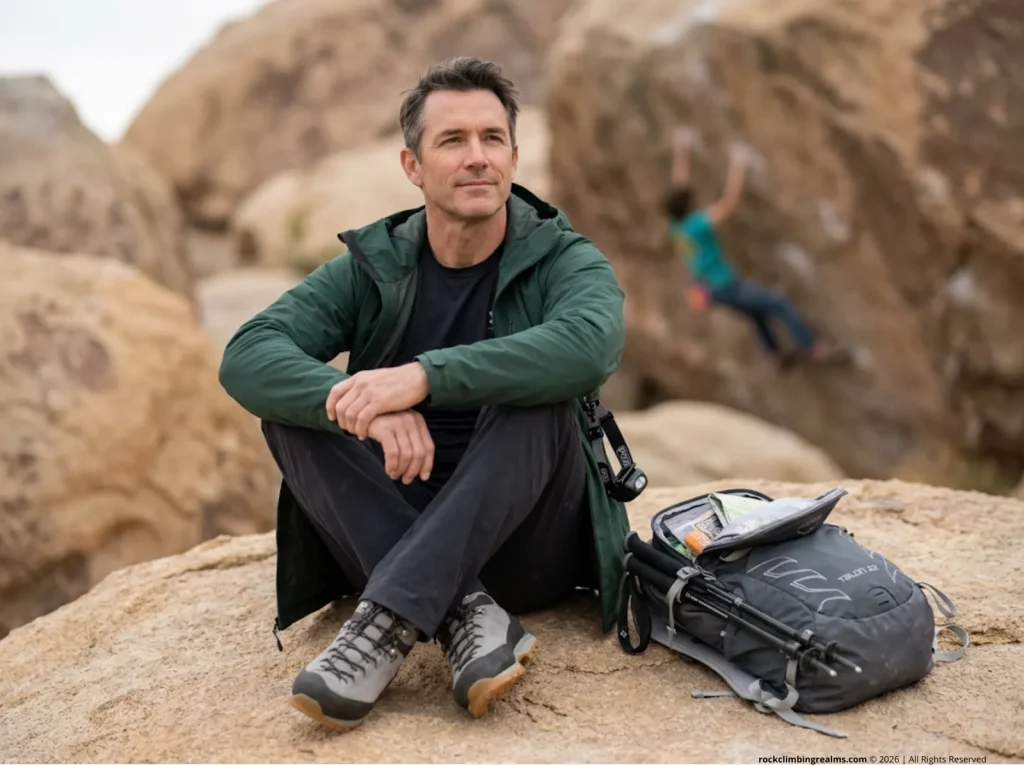
The gym-to-crag transition is not just physical. It is cultural. Indoors, music is normal, shouting is ambient, and beta spraying is essentially the social contract of a modern climbing gym. Outdoors, the tolerances are different and the consequences are collective. One person playing loud music in a canyon can get an entire crag closed during nesting season. One large group monopolizing a popular problem drives away the local climbers who have been protecting that area for years.
Beta etiquette is the first cultural wall you will hit. Unsolicited beta—giving sequence information to a climber who has not asked for it—is considered a breach of etiquette at most outdoor crags. Many climbers value the ground-up discovery process, working a problem through their own movement exploration rather than having the sequence handed to them. Before offering information, ask: “Do you want the beta?” Respect the climber’s autonomy in their problem-solving process. This is hardly unique to climbing culture—the same principle of not unsolicited advice applies in most skill-based communities. If a climber is deep in a sequence and you interrupt with well-intentioned beta, you may break their focus at the exact moment they need it most.
Group size matters structurally, not just socially. Groups larger than 10 to 15 people cause disproportionate vegetation damage and create a crowd atmosphere antithetical to why most people drive to a boulder field instead of staying at the gym. Manage noise. Yield to others on trails and at boulders. The climber who has been working a project for three hours has priority over your group photo op. These are not complicated rules. They are the basic physics of shared space.
Dogs at the crag are a privilege, not a right. Unsupervised dogs disturb wildlife, trample fragile plants, and create safety risks in the fall zone. If your dog barks excessively or shows aggression, you must be prepared to leave. Leash compliance, immediate waste removal, and behavioral control are not optional in any serious crag community. Eight rules for crag dog etiquette should be part of every outdoor climber’s pre-trip checklist.
Conclusion
Three things will determine whether you are a crag steward or a crag liability. First, you are not a customer of the climbing environment—you are a steward of it. Every decision, from waiting 48 hours after rain to brushing a chalk mark before you pull the car door, ripples forward to the next climber and the long-term health of the rock. Second, technical mastery is defined not just by the grade you send, but by the cleanliness of your exit and the integrity of the stone you left behind. The boulder field judges your ethics long after your skin has healed. Third, access is fragile. Rock is a living geologic canvas, the physics of a fall are unforgiving, and crag closures are routinely triggered by preventable impacts.
Good stewardship is not a personality choice—it is a practiced discipline. The Climber’s Pact and Beyond LNT frameworks give you the vocabulary and the checklist to make ethical decisions automatic, not deliberate.
Before your next outdoor session, build a personal pre-trip checklist. Consult the drying time matrix for your local sandstone type and weather history. Verify your pad carries a UIAA 161 compliance label. Brief your spotter on the hips-over-hands protocol and confirm the spoons position. Pack a WAG bag. Practice your pad-fu configuration in a flat parking lot before you get to the boulder. The landing zone you build is the only emergency system you have.
Now go send something.
FAQ
How long should I wait to climb on sandstone after rain?
Wait 24 to 72 hours minimum, but actual drying time depends on solar aspect, wind, humidity, and temperature. South-facing walls in direct sun and wind may be climbable in 24 hours. North-facing or overhanging boulders can stay saturated for a week or more. Always test with acoustic diagnostics—tap the hold. Dry stone rings. Wet stone thuds. If in doubt, wait another day.
Can I use my gym chalk outdoors?
Yes, but the type matters. Use high-purity magnesium carbonate chalk and avoid cheap chalks with calcium carbonate fillers that create a slippery film on your hands and the rock. Never use rosin, which is prohibited in almost all bouldering areas and causes irreversible glazing and hold polishing on sandstone.
How do I properly spot someone in bouldering?
Focus on the climber’s center of gravity—the hips—not their body. Keep your fingers and thumbs together in the spoons position to prevent fractures. Maintain a flexible stance with bent knees and elbows. Your job is trajectory redirection, nudging the falling climber toward the pads, not catching their full weight.
What is a WAG bag and why do I need one?
A WAG bag—Waste Alleviation and Gelling bag—is a gelling system that stabilizes human waste for sanitary transport out of the backcountry. In high-traffic bouldering areas where traditional catholes are insufficient or prohibited, WAG bags are mandatory. Improper waste management is one of the most common triggers of crag closures.
Is it okay to play music while bouldering outdoors?
No. Sound carries differently in natural environments and is amplified by canyon walls. Loud noise distresses nesting wildlife, including raptors during critical nesting periods, and creates safety hazards by interfering with climber-spotter communication. Portable speakers are a serious breach of crag etiquette and have contributed to access conflicts at multiple major bouldering areas.
Safety Notice: Rock climbing and mountaineering are inherently high-risk
activities that can involve physical trauma or fatal incidents. The information on Rock Climbing Realms is for
educational and informational purposes only. Techniques and advice presented here are not a substitute
for professional, hands-on instruction. Conditions and risks vary by location. Always seek guidance
from a qualified instructor before attempting new techniques. By using this website, you agree that you
are solely responsible for your own safety. Any reliance you place on this information is strictly
at your own risk, and you assume all liability for your actions. Rock Climbing Realms and its authors
will not be held liable for any harm, damage, or loss sustained in connection with the use of this information.
Affiliate Disclosure: We are a participant in the Amazon Services LLC Associates Program, an
affiliate advertising program designed to provide a means for us to earn advertising fees by advertising and linking
to Amazon.com. As an Amazon Associate, we earn from qualifying purchases. We are also an official affiliate partner
of Black Diamond Equipment via the AvantLink network. If you click on a Black Diamond affiliate link and make a
purchase, we may earn a commission at no additional cost to you. We also participate in other affiliate programs.
Additional terms are found in the terms of service.