
In this article
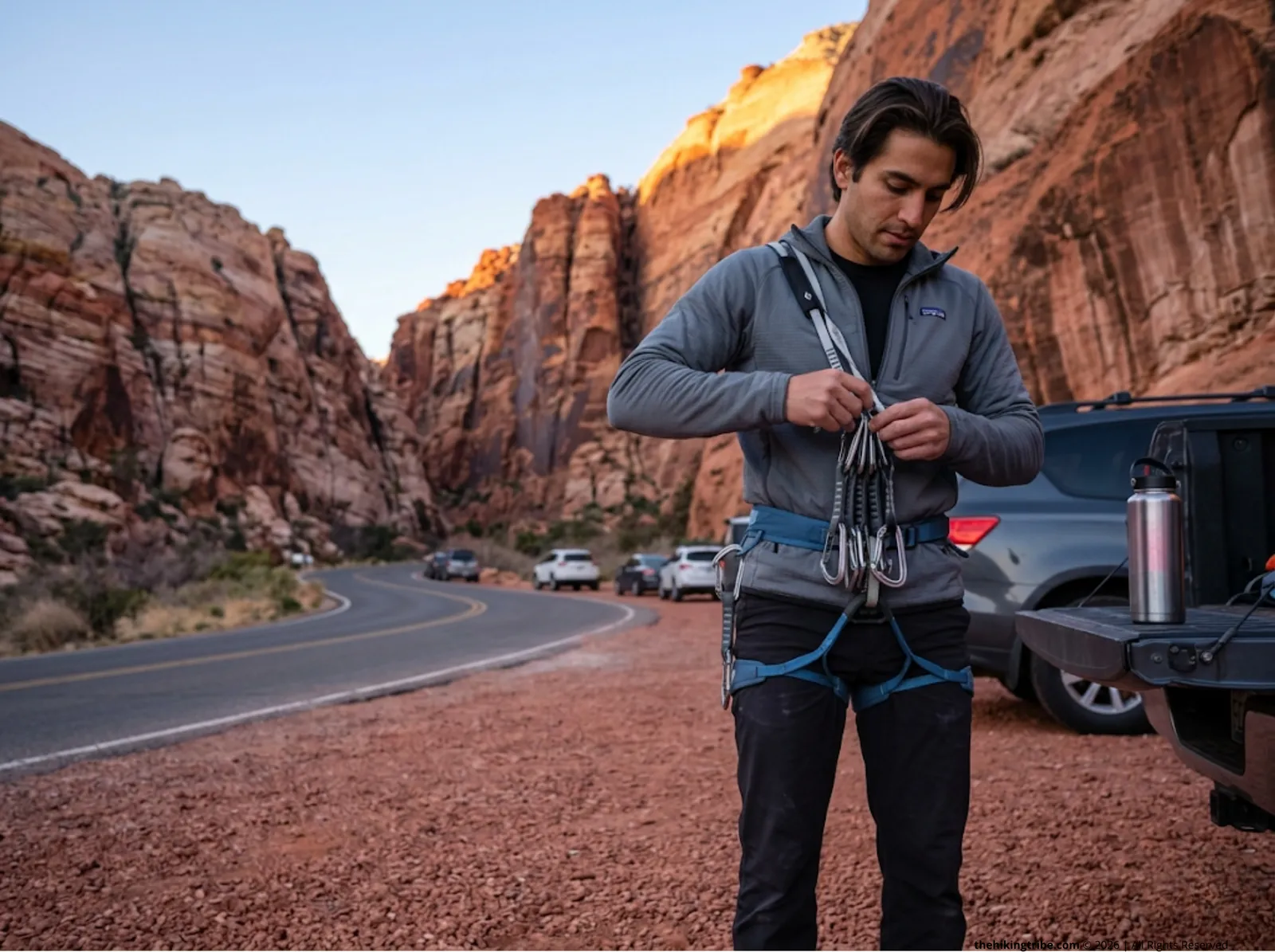
Chalk on your harness still fresh from the gym session you squeezed in before work. A conference call in 45 minutes. The Business Wall at Red Rock is 15 minutes away, and the friction is perfect — cool morning air, dry stone, not another team on the route.
That’s the promise of urban-adjacent climbing. That’s what this ranking is about.
Choosing where to live as a climber is the single biggest decision for your progression. Not your training plan. Not your shoe rubber. Where you sleep at night.
This guide ranks the best major US cities for urban-adjacent climbing using a data-backed Metropolitan Send-Index — evaluating each hub by geology, route density, commute time, seasonal windows, and technical requirements — so you can make an informed decision about where to live, work, and send.
Quick Answer: Las Vegas and Salt Lake City offer the highest climb-to-work efficiency in the US. Vegas gives you 2,887+ routes on Aztec Sandstone within 15 minutes of suburbia with 300+ climbable days per year. Salt Lake City puts you on world-class quartz monzonite cracks in Little Cottonwood Canyon after a 10-minute drive. The best city for you depends on your primary discipline: trad climbers lean Vegas or SLC, sport climbers look at Vegas or Chattanooga, and boulderers head to SLC.
The Science of Urban-Adjacent Climbing: What “Best” Actually Means
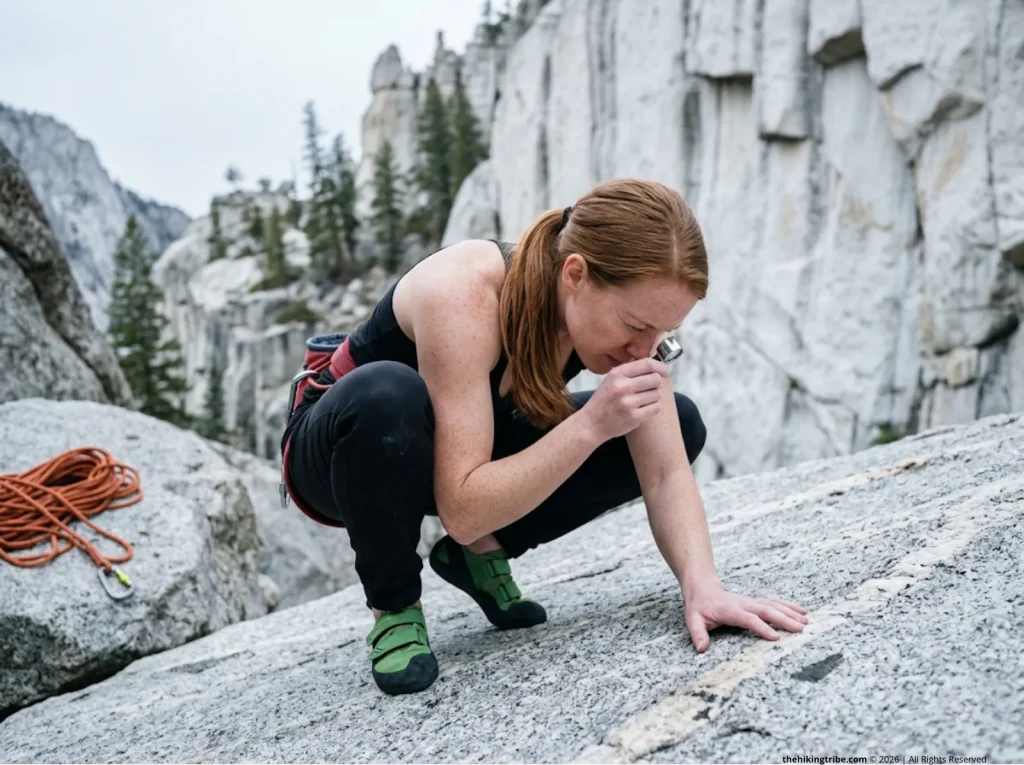
Every generic “best climbing cities” list ranks by vibe or Instagram aesthetics. That’s not how this works. What makes a city great for climbing comes down to rock type, friction, route density, and how fast you can get from your desk to the base of a cliff.
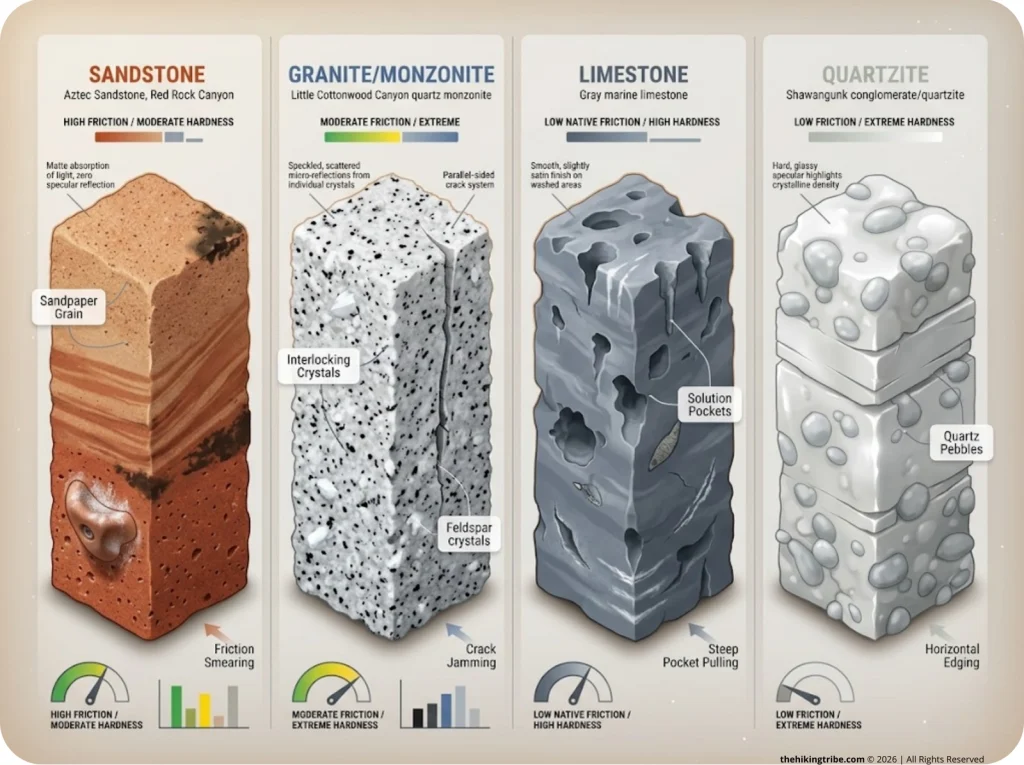
Rock Type and Friction: Why Geology Dictates Your Climbing Experience
Your fingers don’t grip rock — they grip the texture of it. Sandstone sticks better than any common climbing stone, thanks to its rough, grainy surface that catches skin and rubber like sandpaper. Quartzite is harder and chalk grips even better on it, but those razor edges demand precise footwork or you’ll skate right off.
Granite and monzonite sit in the middle — chalk helps, and the interlocking crystals hold up to decades of traffic without polishing out. Limestone has the least natural grip of the bunch, but makes up for it with tufas and water-eroded pockets you won’t find on any other stone.
Understanding how each rock type dictates grip, technique, and gear selection separates efficient projecting from fighting the rock every session. Chalk helps — it noticeably boosts grip on both sandstone and limestone — but the science behind why chalk behaves differently on granite versus sandstone is worth knowing before you pile it on too thick and create a slippery layer that actually reduces grip. The USGS research on rock friction confirms that at the low normal stresses characteristic of climbing, friction depends overwhelmingly on surface roughness and lithology — not the brand on your chalk bag.
The “Vertical Feet Per Minute of Commute” Metric Defined
How fast can you get from your front door to the base of a climb? A true city-climbing hub keeps that under 90 minutes. Beyond three hours, you’re not living near climbing — you’re making a destination trip.
Drive time alone doesn’t tell the story. A 15-minute drive plus a 45-minute scree scramble through Red Rock is less efficient than a 60-minute drive plus a 5-minute flat walk to LCC’s Secret Garden. Route density within a 30-minute radius determines whether you can run multi-year projects or you’re constantly driving to new crags.
Seasonality, Microclimates, and Year-Round Access Windows
Las Vegas has the widest seasonal window — desert sun and canyon shade allow climbing 300+ days per year with smart crag selection. SLC covers year-round by rotating between sunny winter crags and shaded summer canyons. Seattle is the most seasonally constrained hub here, with 150+ rainy days compressing reliable sending to June through September. Chattanooga works as a fall-through-spring destination, but summer humidity (75%+) kills sandstone friction. The Gunks run a compressed May–October prime season.

Las Vegas, NV — The Aztec Sandstone Benchmark
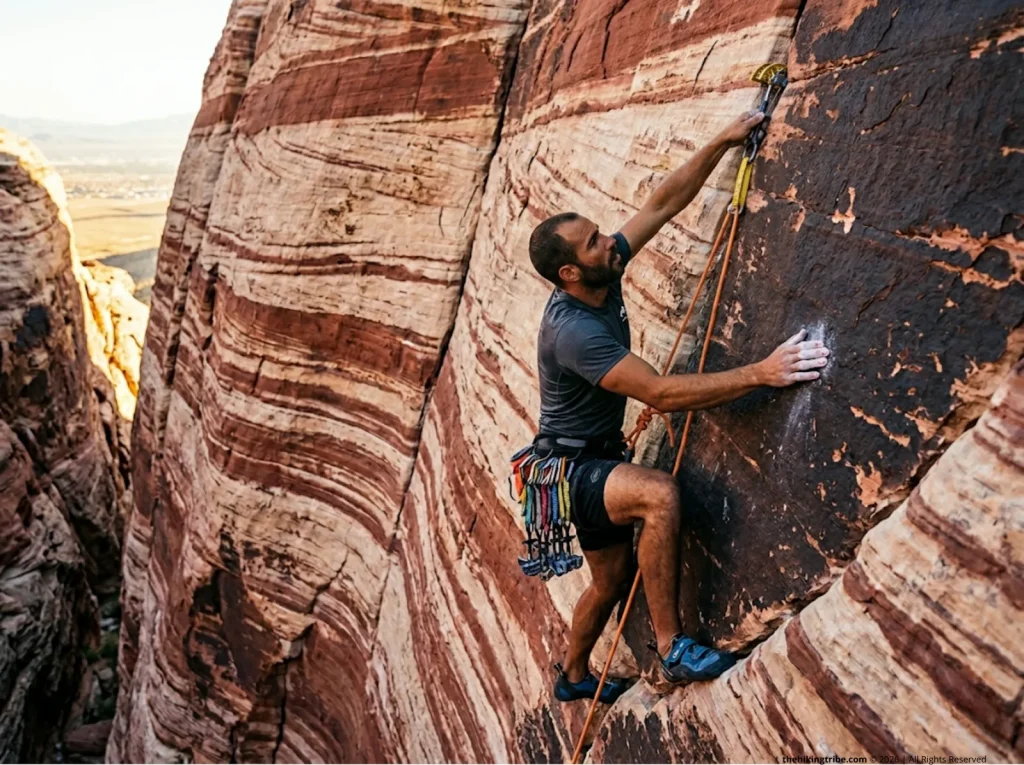
Fifteen minutes from the Summerlin suburbs, the 13-mile scenic loop at Red Rock Canyon opens onto 2,887+ routes spanning bouldering, single-pitch sport, and 15-pitch trad objectives. No other city-adjacent crag in the US matches that volume and variety.
Red Rock Canyon: Multi-Pitch Trad and the Keystone Thrust Fault
The defining feature is the Keystone Thrust Fault — a 65-million-year-old fracture where gray carbonate limestone was shoved over younger red sandstone, creating the vertical topography that makes Red Rock a multi-pitch destination. The BLM’s geological survey of Red Rock Canyon documents this thrust zone in detail, including how the fault angle creates the varied crack systems that make moderate multi-pitch trad so accessible here.
Moderate multi-pitch trad dominates (5.7–5.10), with hard sport in the Calico Hills pushing into the 5.13 range. Color tells you everything about hold integrity. Dark, desert-varnished patina surfaces are hard and trustworthy. White, unvarnished rock is more friable — it can break under your full weight.
Calico Hills Sport Climbing and Desert Bouldering
Calico Hills holds the highest concentration of steep sport routes in the Red Rock corridor, with bolted lines from 5.10 to 5.13. Bouldering at Kraft Mountain and Black Velvet covers V0–V13 with minimal approaches — the Aztec sandstone provides some of the most varied problems in the Southwest. Winter mornings are optimal; midday summer sessions are hazardous without shade.
Pro tip: Carry a gallon of water per person per hour for any Red Rock approach longer than 20 minutes when temps climb above 85°F. I’ve seen more epics caused by dehydration than by gear failure out there.
Desert Protocols: Wetness Rules, Permits, and Thermal Management
The Sandstone Wetness Protocol is absolute. Climbing within 48 hours of measurable rain causes irreversible hold damage and genuine safety hazards — this isn’t etiquette, it’s geology. The science behind the wet rock rule is straightforward: porous sandstone absorbs water and structurally fails under load when saturated. Break a hold on a classic because you couldn’t wait two days, and the local community will remember your name for the wrong reasons.
BLM timed entry reservations are required during peak season (October–April), and you’ll need a Scenic Drive pass secured in advance. The complete Red Rock Canyon planner’s guide with permits, routes, and safety protocols covers the logistics for first-timers. Satellite communicators are mandatory for multi-pitch objectives — 911 doesn’t reach most of the canyons.
Salt Lake City, UT — The Alpine-Granite Enclave
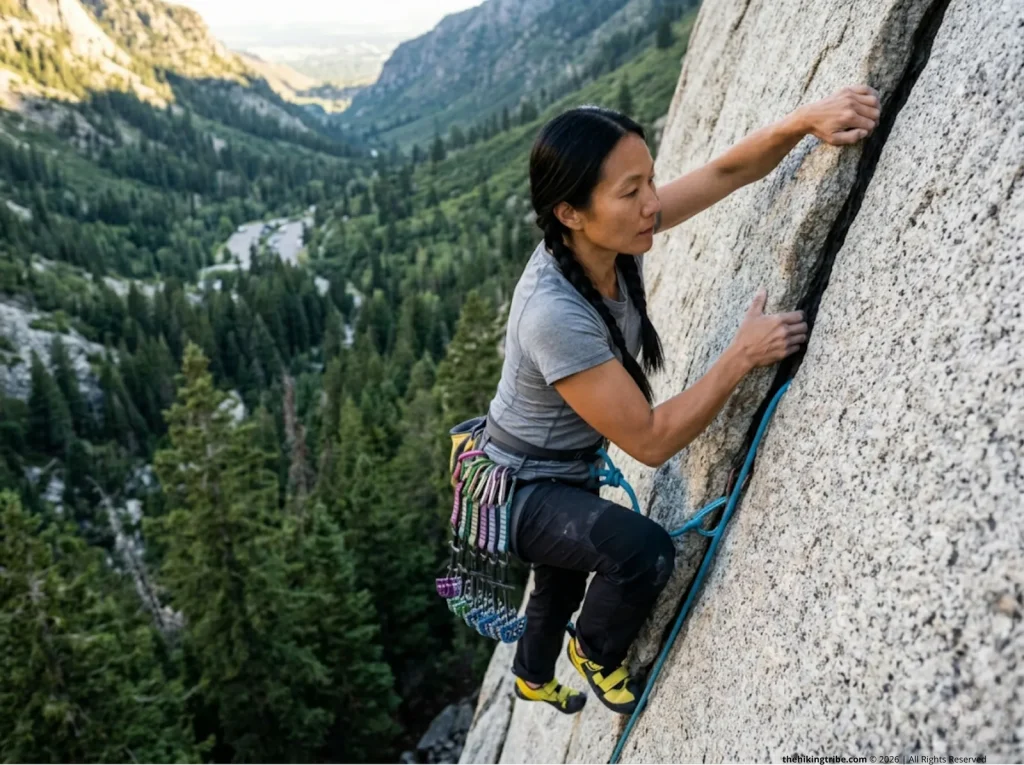
Ten minutes from the valley floor, Little Cottonwood Canyon delivers 2,238 routes on white quartz monzonite — similar to Yosemite granite but with a higher density of chickenheads, those protrusions of harder rock that give you positive holds where you’d expect blankness.
Little Cottonwood Canyon: Quartz Monzonite and Technical Trad
Cooling joints in the monzonite create parallel-sided cracks that run for hundreds of feet — the kind of splitters that make your rack feel perfectly sized and your technique transfer directly to Yosemite and Indian Creek. Crack widths range from finger locks to off-widths, with grades concentrated in the 5.8–5.11 range and approaches under 20 minutes.
The canyon’s glacial U-shape creates thermal pockets. North-facing walls stay cool through summer, south-facing walls catch morning sun for winter sessions. Understanding how rock geology determines climbing style and protection strategies matters here — the gear you place in monzonite behaves differently than in softer stone.
Bouldering Density and the “Climb-to-Work” Advantage
The Secret Garden boulders provide the highest density of V0–V13 problems with the shortest approach on this list — five minutes from parking. That 10-minute drive represents the shortest commute-to-crag ratio of any major US city. You can genuinely send on a lunch break.
Winter Congestion, Land Access, and the LDS Lease Factor
Winter parking is a nightmare. Combined ski traffic and climber demand means arriving before 7:00 AM on weekends or you’re walking from a mile out. Significant portions of LCC climbing sit on LDS Church-owned land via lease agreements — access is stable now but subject to policy shifts outside climber control. Temperature swings are aggressive, with 40°F differentials between canyon floor and upper crags.
Pro tip: Stay plugged into the Salt Lake Climbers Alliance. If LDS access terms change, they’ll be the first to know — and the first to organize a response.
Chattanooga, TN — The South’s Sandstone Mecca
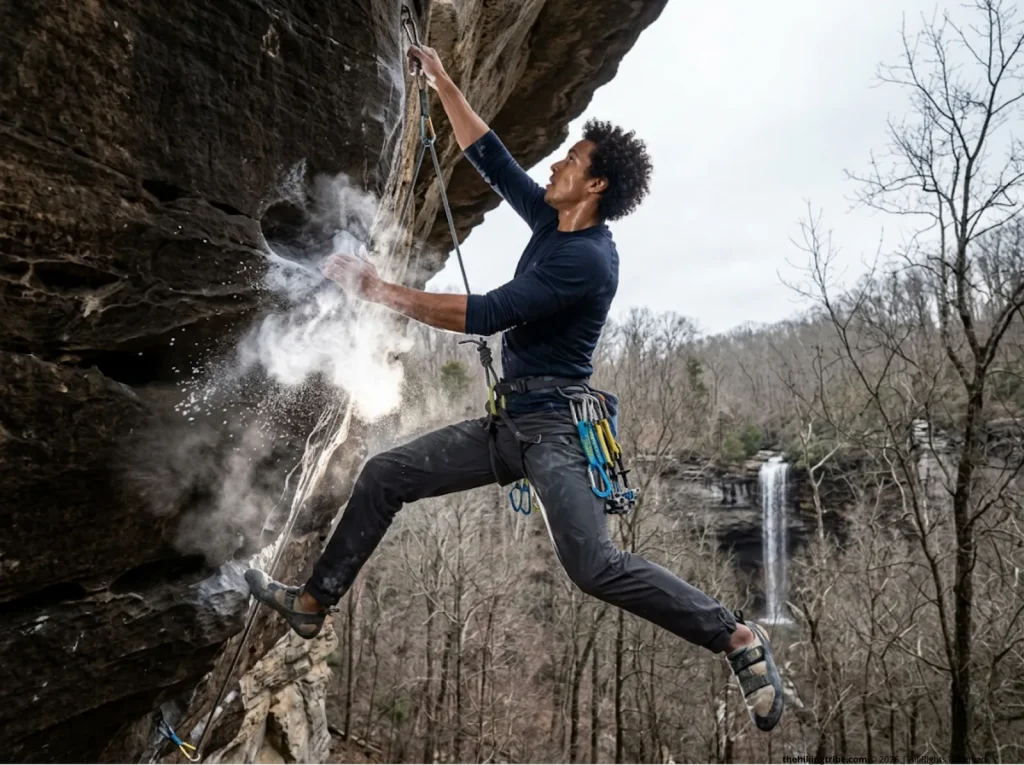
Six hundred-plus routes on Nutall Sandstone at T-Wall alone, with Denny Cove and Foster Falls within 45 minutes of downtown. The highest density of quality sandstone east of the Mississippi.
T-Wall and the Technical Face Climbing Standard
T-Wall’s south-facing wall functions as a winter heat sink — ambient temperatures run 15–20°F warmer at the crag than in downtown Chattanooga. The Nutall Sandstone is extremely hard with deep pockets and technical edges that build precise footwork and gear placement skills on vertical terrain.
Grades center on 5.9–5.10, with routes that demand full-brain engagement — precise gear on vertical faces that builds trad competence faster than clipping bolts on steep sport.
Denny Cove, Foster Falls, and the “Big Three” Sport Destinations
Denny Cove has become the Southeast’s benchmark for steep sport climbing — overhanging Nutall Sandstone routes from 5.10 to 5.14 that demand sustained power endurance. It’s the kind of crag that earns a spot on any list of North America’s top sport climbing destinations. Foster Falls complements that with technical face climbing on horizontal features. Castle Rock rounds out the Big Three with bouldering and moderate sport, covering every discipline within 30 minutes of downtown.
Hunting Season Closures and Southern Logistics
Tennessee hunting season (November–January) forces closures on multiple crag approaches — always check the SCC closure map before driving. AT&T provides the most consistent cell coverage in the rural corridors. Summer humidity averages above 75%, which drops friction enough that Chattanooga is fundamentally a fall-through-spring destination.
New York City Metro — The Gunks: Horizontal Mastery
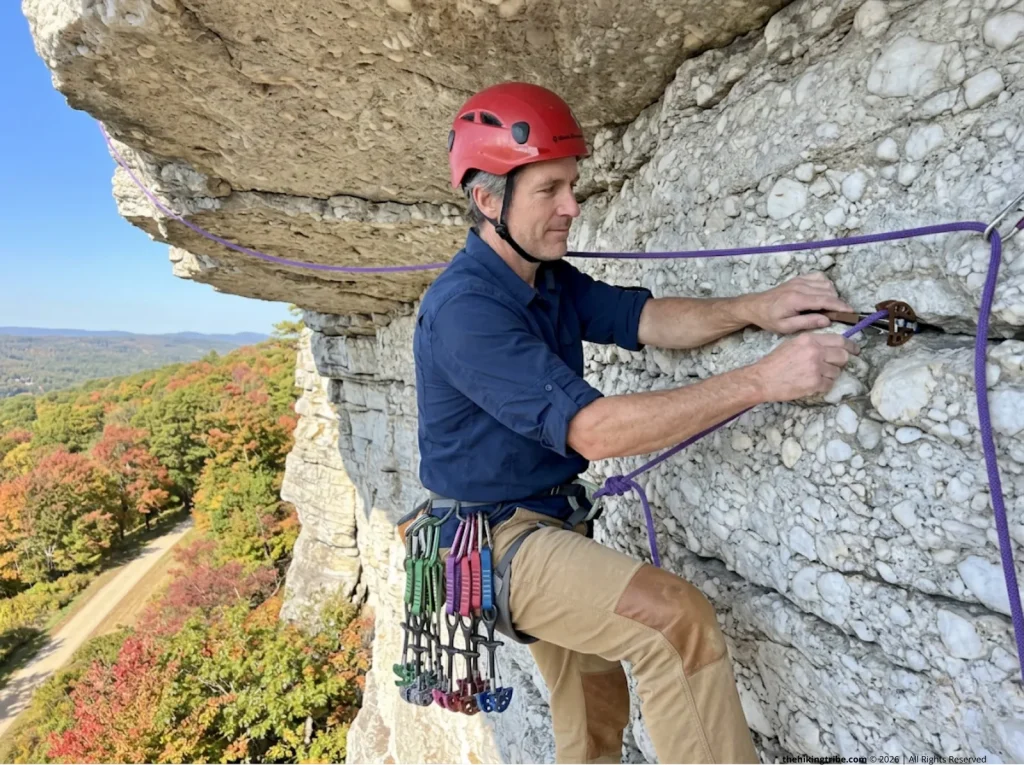
Ninety minutes from Manhattan. The longest commute on this list. But the Shawangunk Ridge’s quartz conglomerate and its horizontal crack systems provide a technical education that doesn’t exist anywhere else in US climbing.
Quartz Conglomerate and Horizontal Crack Systems
The rock is exceptionally hard and resistant to weathering, defined by horizontal bedding planes and massive roof systems. Route count sits at 1,352 — lower than Western hubs — but the concentration of 5.4–5.8 multi-pitch routes with real exposure gives you the highest density of moderate multi-pitch objectives in the country.
The comprehensive Gunks climbing guide covering guidebooks, pro services, and route beta is worth reading before your first trip, because the Gunks don’t climb like anything west of the Mississippi. Horizontal cracks dominate the protection game, and your standard vertical crack rack is functionally useless here.
The Trad Rack You Actually Need for the Gunks
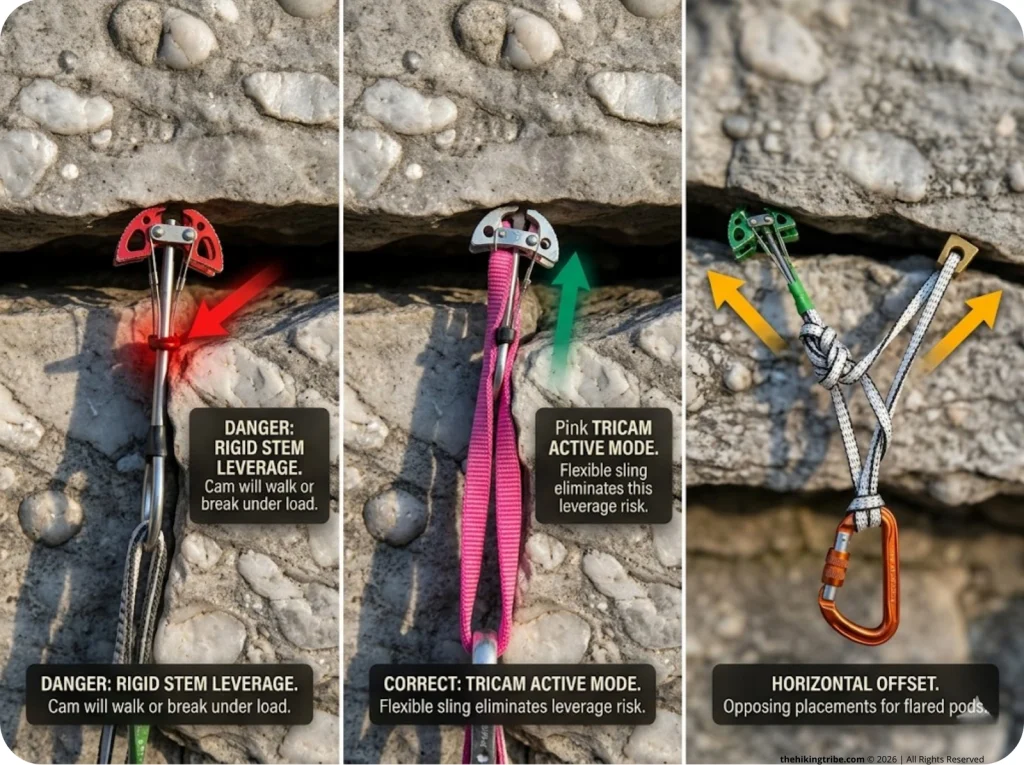
Load up on Tricams (Pink through Brown) for horizontal pods where standard SLCDs walk or refuse to seat. Flexible-stem cams are mandatory — rigid-stem units create leverage vectors that can fail under your full weight. The “horizontal offset” technique, placing two pieces in opposing directions within the same crack, is the defining protection strategy here. If you’re building your first trad rack, this progression guide walks through what to buy in what order — though the Gunks will make you add Tricams faster than any other crag in the country.
The grading will humble you. A Gunks 5.6 often involves sustained horizontal traversing with exposure that would get rated 5.8+ out West. Expect a full-grade adjustment.
GT Ledge Communication and Multi-Pitch Logistics
Wind and cliff geometry at the Trapps make verbal communication impossible on most multi-pitch routes. Set up rope tug signals or bring FRS radios before you start something like High Exposure. The GT Ledge creates bottlenecks on popular routes during peak season. That 90-minute commute is the longest on this list, but the carriage road approach (15–30 minutes, flat) is the easiest of any major crag in the country.
Seattle, WA — The Granite-Volcanic Proving Ground
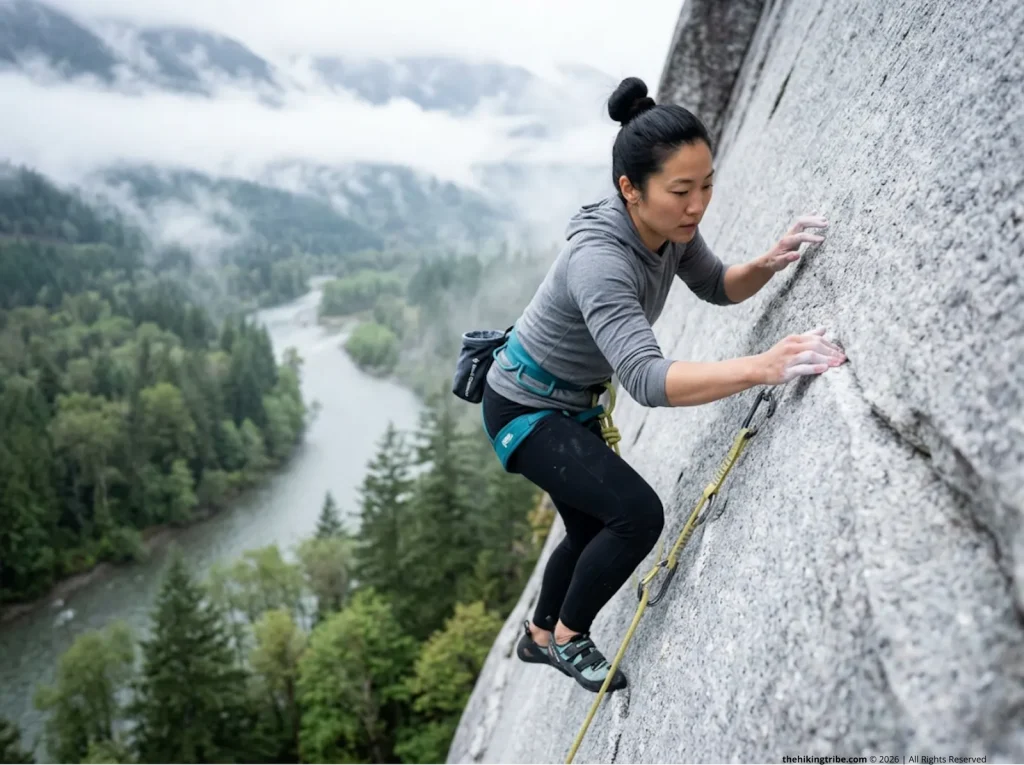
Seattle is the most seasonally constrained hub here, but two different rock types build well-rounded climbers. Index granite demands precision. Volcanic rock at the Exits builds power. Together, they cover more technical bases than any single stone type.
Index: Sandbagged Grades and Friction-Based Precision
Index granite is slick and fine-grained. It rewards perfect footwork and punishes dynamic, momentum-based climbing. Grades are notoriously sandbagged — a 5.9 at Index would rate 5.10+ at most other areas. Route count is around 400, the lowest on this list, but the concentration of quality 5.10–5.11 technical trad makes it a precision-training ground, not a volume destination.
Train vibrations from the adjacent BNSF rail line have caused rockfall on certain formations. Wear your helmet at the base.
The Exits and Volcanic Sport Climbing Volume
Exit 32 and 38 provide high-volume roadside sport climbing on volcanic rock — positive edges and overhanging terrain that build power endurance and complement Index’s precision demands. Drive time from Seattle is 45 minutes to the Exits and 60 to Index.
Rain, Humidity, and When You Can Actually Climb
Seattle’s maritime climate averages 150+ rainy days per year. Reliable sending windows compress to June through September. Granite friction drops measurably above 70% relative humidity, cutting effective grip on fine-grained Index stone. The complete guide to rock climbing in Washington State with routes, gyms, and alpine access covers seasonal strategy for the broader region.
Pro tip: Verizon provides the most consistent coverage at Index. A cellular booster in your car and a solid hotspot plan make mid-day meetings from the belay ledge realistic — at least during the dry months.
The Metropolitan Send-Index: Choosing Your Hub
Raw data doesn’t make decisions. Climbers do. Here’s how to match your priorities to the right hub.
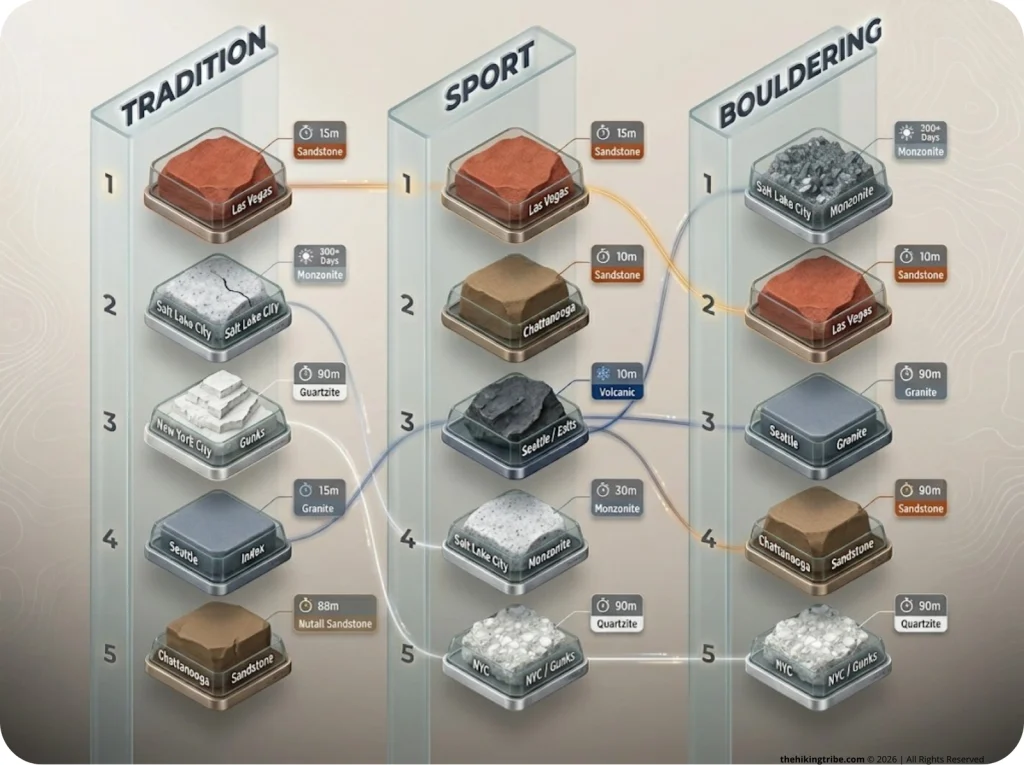
Ranking the Hubs by Discipline: Trad, Sport, and Bouldering
For trad, Las Vegas leads on multi-pitch volume and moderate grades, SLC follows on crack quality and density, and NYC ranks third for horizontal systems and exposure education that transfers to no other crag.
Sport climbers should look at Vegas first (Calico Hills steep sport), then Chattanooga (Denny Cove power endurance), then Seattle (Exits volcanic volume). Boulderers: SLC’s Secret Garden is the clear winner, followed by Vegas (Kraft Mountain variety) and Seattle (Index granite precision).
Career Logistics: Cost of Living vs. Climbing Density
Las Vegas and SLC hit the sweet spot of low cost of living, strong job markets, and world-class access. Chattanooga has the lowest cost of entry but a smaller professional job market — great for remote workers, limiting for anyone who needs to be in an office. NYC and Seattle command premium housing. The “climbing tax” — the housing premium you pay to live within 90 minutes of quality rock — ranges from near zero in SLC suburbs to $1,500+ per month for the Manhattan-to-Gunks commute.
The Multi-Hub Strategy for the Ambitious Professional
Remote workers can optimize by seasonal hub-hopping: Vegas in spring and fall, SLC in summer, Chattanooga in winter — maximizing friction conditions across different rock types. AMGA certification candidates benefit from Gunks exposure training combined with Western volume. No single city builds a complete guide’s toolkit.
Local climbing coalitions like the SCC, Salt Lake Climbers Alliance, and the Access Fund defend the crags we depend on — if you’re not sure how to help, start by learning how to report climbing access issues before a crag disappears.
Conclusion
Las Vegas and Salt Lake City provide the highest climb-to-work efficiency in the country. Geology dictates technique, and no single hub replicates the horizontal education of the Gunks, the precision demands of Index granite, or the power-endurance sandstone of Chattanooga. The Sandstone Wetness Protocol is non-negotiable — climbing wet sandstone destroys the resource and endangers the climber.
Map your next career moves against these hubs. Pick your primary discipline, calculate your commute-to-crag ratio, and choose the city that maximizes vertical feet per free hour.
Now go send something.
FAQ
What city has the best rock climbing in the US?
Las Vegas and Salt Lake City offer the highest climb-to-work efficiency — Vegas for its 2,887+ routes on Aztec Sandstone within 15 minutes of suburbia, and SLC for its 10-minute drive to world-class quartz monzonite cracks. The best city depends on your discipline.
Where can I live to climb every day?
Salt Lake City offers the most realistic daily climbing lifestyle, with a 10-minute commute to Little Cottonwood Canyon’s Secret Garden boulders. You can genuinely send on a lunch break. Las Vegas is close behind with 300+ climbable days per year.
Is rock climbing in Las Vegas better than Salt Lake City?
Vegas wins on route volume (2,887+ vs. 2,238) and seasonal window (300+ days vs. SLC’s weather-dependent rotation). SLC wins on commute efficiency (10 vs. 15 minutes) and bouldering density. Vegas is better for multi-pitch trad and sport; SLC is better for crack climbing and bouldering.
What are the best East Coast cities for climbers?
New York City (90 minutes to the Gunks) is the only major East Coast metro with world-class traditional climbing at city-adjacent distance. Chattanooga offers the highest density of sandstone sport and trad east of the Mississippi within a 15–45 minute radius.
How does rock type affect which city I should choose?
Rock type determines your technique, gear requirements, and seasonal window. Sandstone (Vegas, Chattanooga) offers the highest friction but demands strict wetness protocols. Granite and monzonite (SLC, Seattle) provide year-round crack systems but lower friction in humidity. Conglomerate (NYC or Gunks) builds unique horizontal protection skills found nowhere else.
Safety Notice: Rock climbing and mountaineering are inherently high-risk
activities that can involve physical trauma or fatal incidents. The information on Rock Climbing Realms is for
educational and informational purposes only. Techniques and advice presented here are not a substitute
for professional, hands-on instruction. Conditions and risks vary by location. Always seek guidance
from a qualified instructor before attempting new techniques. By using this website, you agree that you
are solely responsible for your own safety. Any reliance you place on this information is strictly
at your own risk, and you assume all liability for your actions. Rock Climbing Realms and its authors
will not be held liable for any harm, damage, or loss sustained in connection with the use of this information.
Affiliate Disclosure: We are a participant in the Amazon Services LLC Associates Program, an
affiliate advertising program designed to provide a means for us to earn advertising fees by advertising and linking
to Amazon.com. As an Amazon Associate, we earn from qualifying purchases. We are also an official affiliate partner
of Black Diamond Equipment via the AvantLink network. If you click on a Black Diamond affiliate link and make a
purchase, we may earn a commission at no additional cost to you. We also participate in other affiliate programs.
Additional terms are found in the terms of service.