
In this article
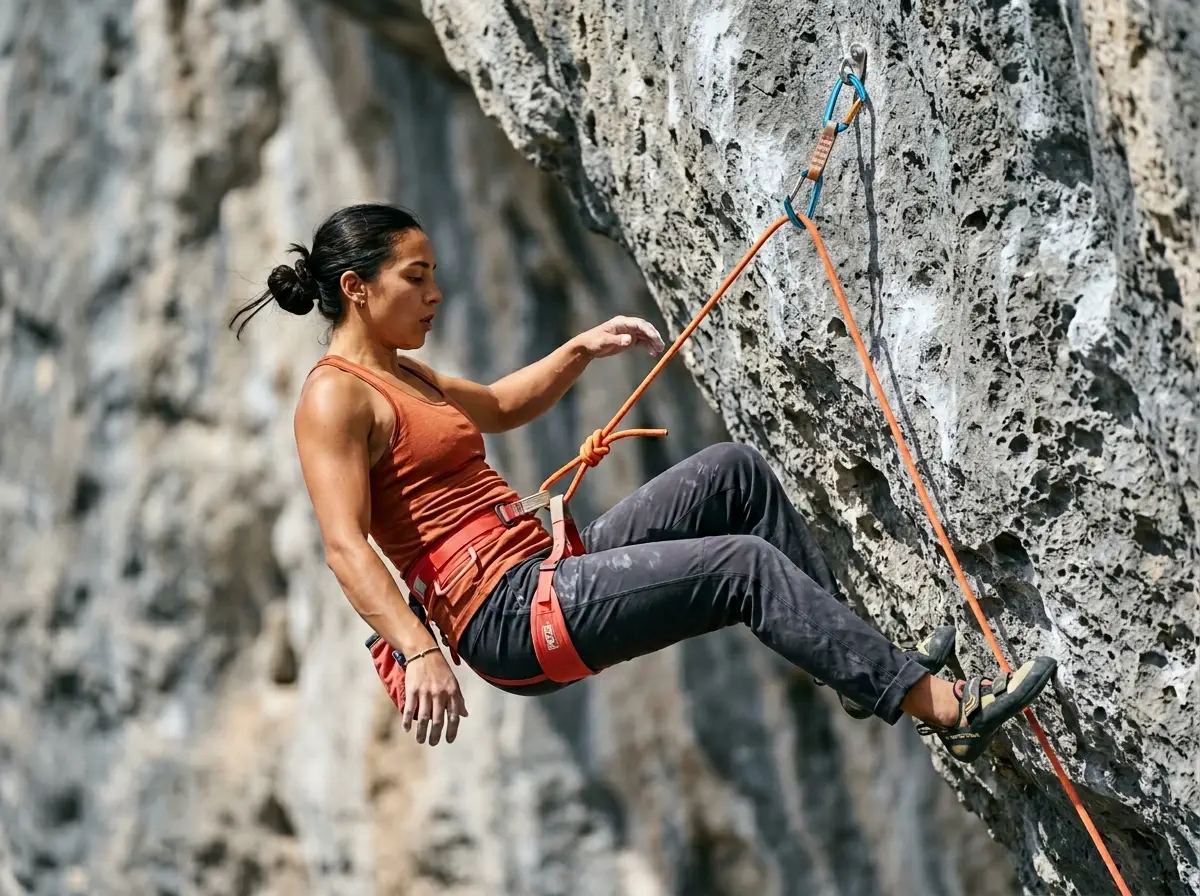
You’re fifteen feet above your last bolt, fingers scorching on a crimper, calves shaking. The next move is doable — you’ve done it in the gym a hundred times. But your brain screams no, and your feet cut loose before you’ve decided anything. You didn’t fall. You panicked. There’s a difference, and that difference is the gap between the climber you are and the climber you want to be.
I’ve been at that exact crossroads more times than I care to count — and I’ve watched climbers stronger than me stall out on routes they could physically do. The problem is never the arms. It’s the head. More specifically, it’s the absence of a systematic fall mastery protocol built on drills, not on wishful thinking or the kind of whipper therapy that just makes people hate falling more.
This guide breaks down the physics, the biomechanics, and the progressive drills that turn falling from a chaotic event into a skill you can train. By the end, you’ll know why fall factor matters more than fall height, why the soft catch is a two-person job, and how to work through a six-level progression that actually recalibrates your nervous system instead of traumatizing it.
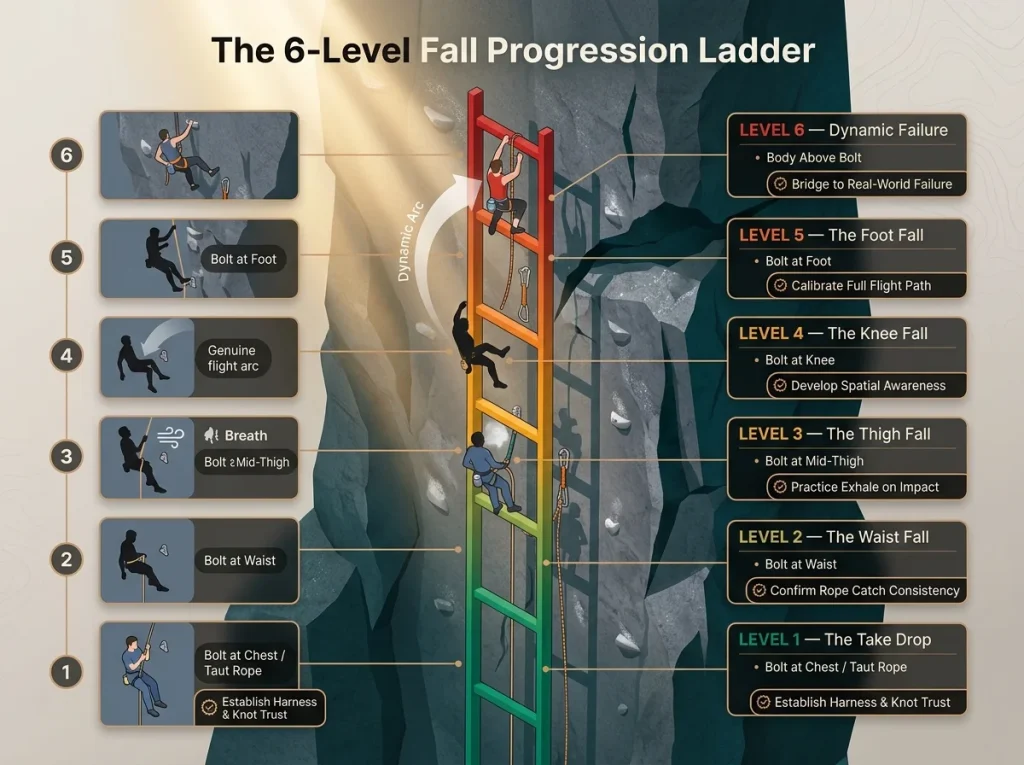
| The 6-Level Fall Progression Ladder | |||
|---|---|---|---|
| Level | Drill Name | Bolt Position | Objective |
| 1 | The “Take” Drop | Bolt at chest, rope taut | Trust harness & knot integrity |
| 2 | The Waist Fall | Bolt at waist | First minimal free-fall |
| 3 | The Thigh Fall | Bolt at mid-thigh | Practice exhale on impact |
| 4 | The Knee Fall | Bolt at knee | Spatial awareness training |
| 5 | The Foot Fall | Bolt at foot | Full commitment to flight path |
| 6 | Dynamic Failure | Body above bolt, mid-move | Bridge to real-world failure |
⚡ Quick Answer: To practice falling safely in sport climbing, work through the 6-Level Progression Ladder on overhanging terrain with a trusted partner — starting with a simple “take” (rope taut, bolt at chest) and building incrementally to dynamic failure above the bolt. Each level adds exactly one unit of commitment so your nervous system adapts through gradual exposure rather than trauma. Focus on three physical cues: keep the rope in front of your shins, exhale on impact, and never grab the quickdraw. Pair this with an active belayer who jumps into the fall to cut anchor forces by up to 32%.
Understanding Fall Physics Before You Leave the Ground
Here’s where most climbers get it wrong. They ask “how far will I fall?” when the question that actually matters is “what is my fall factor?”
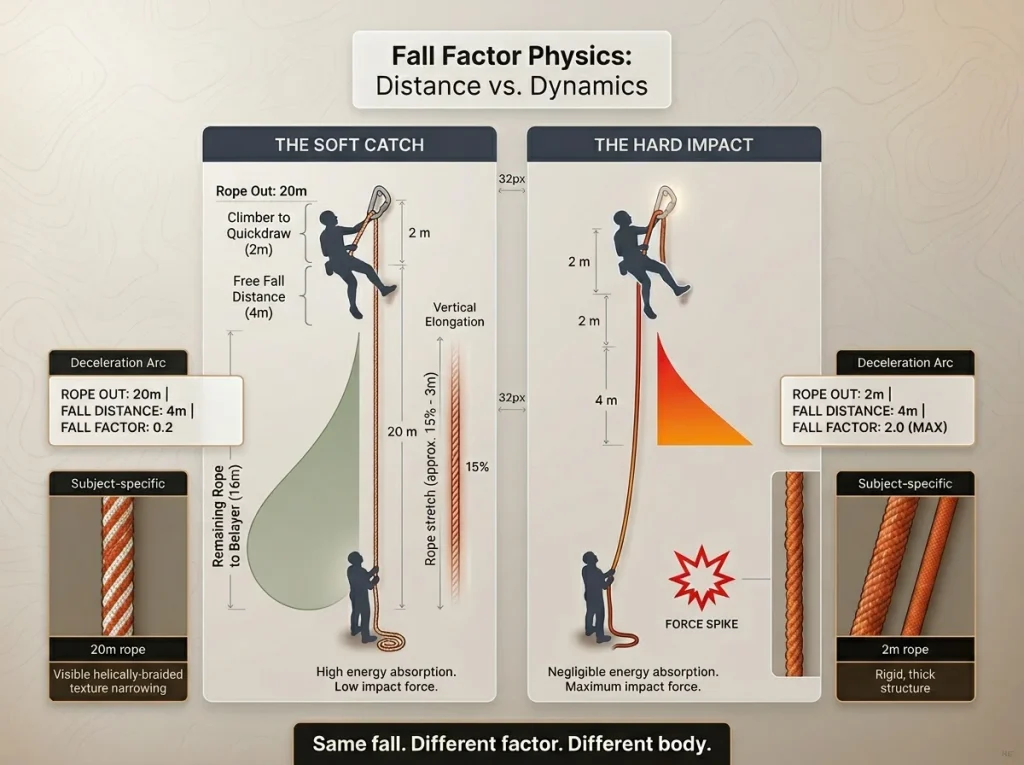
The fall factor is the ratio of fall length to rope length available to stretch. A 4-meter fall with 20 meters of rope out — fall factor 0.2 — is absorbed across a long column of nylon and the catch is soft. That same 4-meter fall with only 2 meters of rope out? Fall factor 2.0. Same body in the air, same distance dropping, but the impact force is dramatically higher because there’s almost no rope to absorb kinetic energy through elongation. Understanding UIAA safety standards for climbing gear helps you see how these numbers translate directly to what your body feels at the end of a fall.
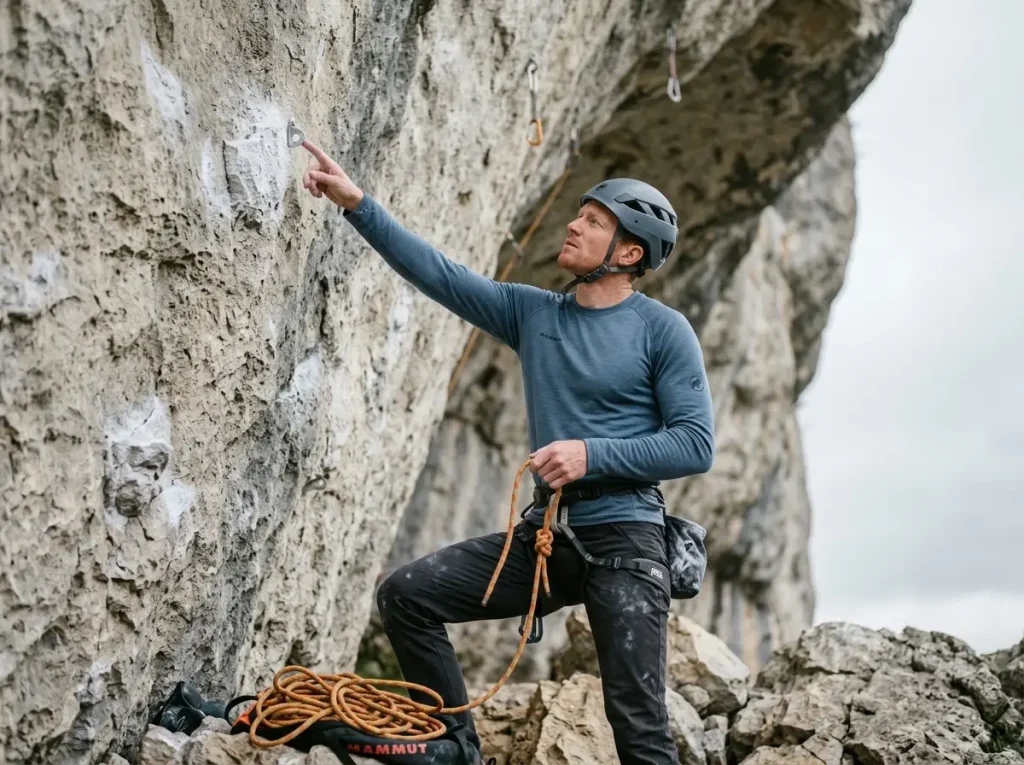
The second thing nobody teaches is the pulley effect: the top quickdraw bears roughly 1.6 to 1.7 times the force the climber feels, because it supports both sides of the rope. That’s why hardware ratings matter. Sport bolts are rated to a minimum of 25 kN against typical fall loads of 5 to 8 kN — you have a safety factor of 3 to 5 times. Under normal use, the hardware does not fail. The accident data consistently points to human error as the culprit.
Pro tip: Before the first clip, your fall factor is at its maximum. A ground fall in the first three meters of a route can approach factor 2. Stick-clip the first bolt of any powerful route — it’s not weakness, it’s physics.
The Fall Factor Formula: Stop Guessing, Start Calculating
The formula: fall distance divided by rope length available to stretch. A climber 3 meters above their last piece with 10 meters of rope out falls 6 meters total — fall factor 0.6. UIAA standard certification uses factor 1.77 with an 80 kg mass; a rope must survive five consecutive falls at this factor and keep impact force below 12 kN.
The worst moment on any route is the first bolt, not the top. A fall before clipping the first piece — with almost no rope deployed — can approach factor 2.0. Climbers who fixate on how high they are miss the point. The variable that determines catch severity is how much rope is out.
How Rope Drag Silently Increases Impact Force
In practice, rope drag breaks the energy absorption equation. Every carabiner and bend isolates sections of rope from stretching — on a route with noticeable drag and four or more pieces, the effective rope length can drop to 50% of what’s actually deployed, functionally doubling the fall factor without you noticing.
The fix is mechanical: use alpine draws to keep the rope path straight, extend quickdraws on routes with diagonal or horizontal bolt sequences. After placing protection, visually confirm the rope runs in roughly a straight line through your draws. If it’s S-curving, you’ve built a friction trap and your next fall is going to hurt more than it should. That awareness carries directly into the fall practice in the next section — clean rope management makes every drill more informative.
I started treating rope drag as a deliberate training variable, not just a minor annoyance. On a limestone sport route I was projecting, I shortened the draws and felt the difference in two falls back-to-back. Same height, same belayer — the second catch was noticeably softer. The physics are real and they’re immediate.
The 6-Level Fall Progression Ladder
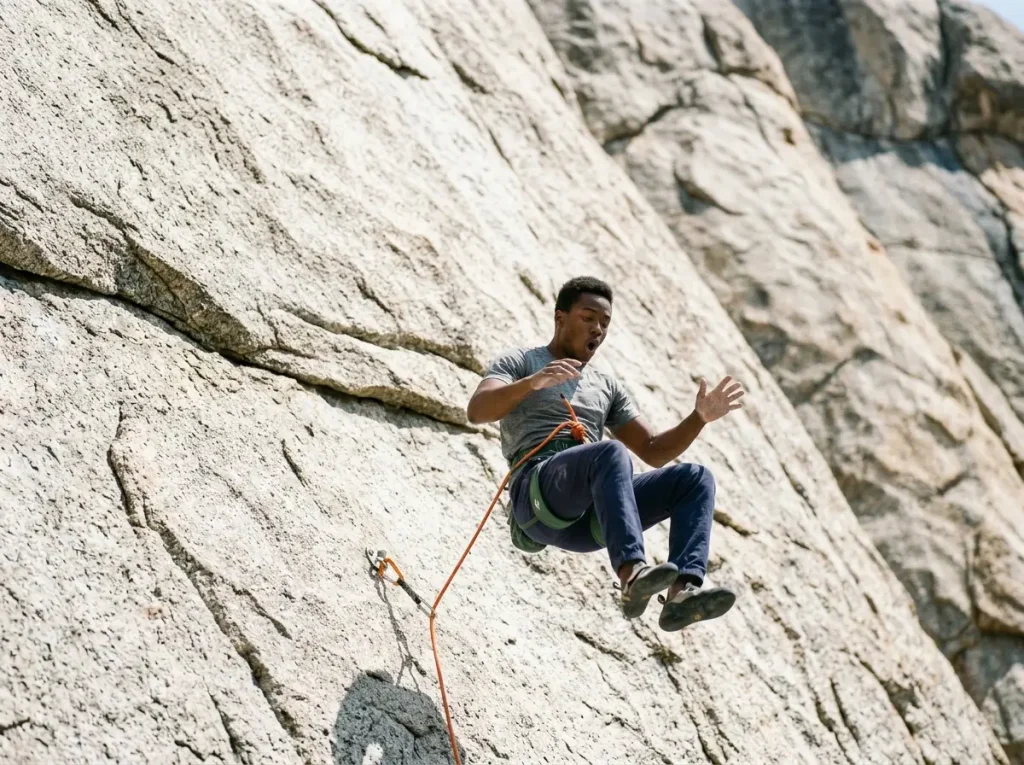
The nervous system does not respond to pep talks. It responds to data. And the only way to give it data about falling is to fall — incrementally, systematically, in conditions controlled enough to produce clean information rather than panic.
This fall mastery protocol works because each level adds exactly one increment of commitment. Your amygdala adapts to stressors through small, consistent doses. Pushing too far too fast doesn’t build somatic confidence — it builds trauma, which digs in the wrong grooves and makes you worse at falling, not better. Research on physiological responses to rock climbing stress confirms that incremental exposure protocols produce far better long-term fear extinction than overexposure does.
Level 1 — The “Take” Drop: Bolt at chest height with the rope already taut. Say “take” and let go. Zero free-fall. The entire point is establishing trust in your harness buckles and your tie-in knot. Sounds trivial. It isn’t. A lot of climbers have never consciously verified that trust through body experience — only through assumption.
Level 2 — The Waist Fall: Bolt at waist level. The rope goes taut almost instantly, but you get your first genuine micro-fall. The main discovery here is that the rope catches you without drama.
Level 3 — The Thigh Fall: Bolt at mid-thigh. This level first activates the startle reflex meaningfully. Practice exhaling on impact — this triggers the parasympathetic nervous system and begins building the reflexive response you’ll need on hard routes.
Level 4 — The Knee Fall: Spatial awareness training begins here. You have a genuine flight arc now. The drill is to look down during the fall, not up at the anchor. Climbers who stare upward misalign their spine for the wall contact.
Level 5 — The Foot Fall: Bolt at foot level. A real whipper. Calibrate your body for the full flight path, and build the somatic “library” your nervous system needs on actual routes.
Level 6 — Dynamic Failure: Body above the bolt, mid-move. The bridge between controlled drill practice and real-world redpoint failure. This is the most important drill for performance climbing and the one most people skip. It also transfers most directly to sending your project.
Run this protocol at the start of every season. Run it again after an injury, a bad fall, or a long layoff. The amygdala forgets, and the ladder brings it back. The mental training protocol for climbing performance walks through the four-week system that wraps around this physical drill sequence.
Flight Path Safety: The Three Non-Negotiable Rules
Before running any drill, lock these in.
Rule 1 — Rope in front of your shins, always. If the rope runs behind your leg at the fall moment, you flip upside down. Head injury and spinal trauma become real risks. Check rope position before leaving the ground and consciously re-check after any move where your leg crosses the rope — high steps, heel hooks, traversing clips.
Rule 2 — No aggressive push-off. A hard push away from the wall creates a pendulum. The rope arrests the outward arc and swings you back into the wall at higher velocity than if you’d just peeled. A small, controlled push to clear a feature is fine. A leg-press launch is not.
Rule 3 — Hands open, never grab the quickdraw. “Meat hook” injuries — fingers caught in gates or severed by carabiner edges — are documented accidents, not theoretical risks. When you feel yourself slipping, hands open, arms slightly extended.
Somatic Mastery: Body Language in the Air
Your body’s default response to a fall is the Valsalva maneuver: breath-hold combined with full muscular rigidity. A stiff body transmits impact force directly to bone. That’s the wrong output from the wrong reflex.
Exhale on impact is the technique. It activates the parasympathetic nervous system, reduces the magnitude of the startle reflex, and allows the body to distribute force over a longer time window as it “softens” into the harness. Practice this deliberately at Levels 3 through 6. Keep elbows and knees bent — they act as a biomechanical spring. On wall contact, absorb through progressive ankle-knee-hip flexion, not a rigid stick landing.
Pro tip: Build the exhale-on-impact reflex at home. Fall onto a mattress from table height and exhale deliberately at contact. Sounds too simple to matter. Do it twenty times. You’re building an autonomic motor pattern that will fire under stress on the wall when verbal reminders are useless.
Belay Device Mechanics: How Your Device Shapes the Catch
 grigri-technique-1024×765.webp” alt=”Sport climbing belayer demonstrating active catch technique with Petzl Grigri on limestone crag ” class=”wp-image-15638″/>
This part nobody explains in lead certification courses, and it’s the reason plenty of climbers had a bad experience with an assisted braking device after years on an ATC and couldn’t explain why.
Manual devices — ATC, Reverso — allow a small amount of rope slippage during a catch. That slippage is not a flaw; it’s device dynamics functioning as designed. It automatically softens the catch by extending the braking distance slightly.
Assisted braking devices — GriGri, Revo — lock the rope nearly instantaneously. Device dynamics equals zero. Every bit of catch softness now depends entirely on the belayer’s body movement. You can read how belay devices work — ATC, GriGri, and passive systems for the full mechanical breakdown. The practical takeaway: a GriGri user must be more physically active in the catch than an ATC user, not less.
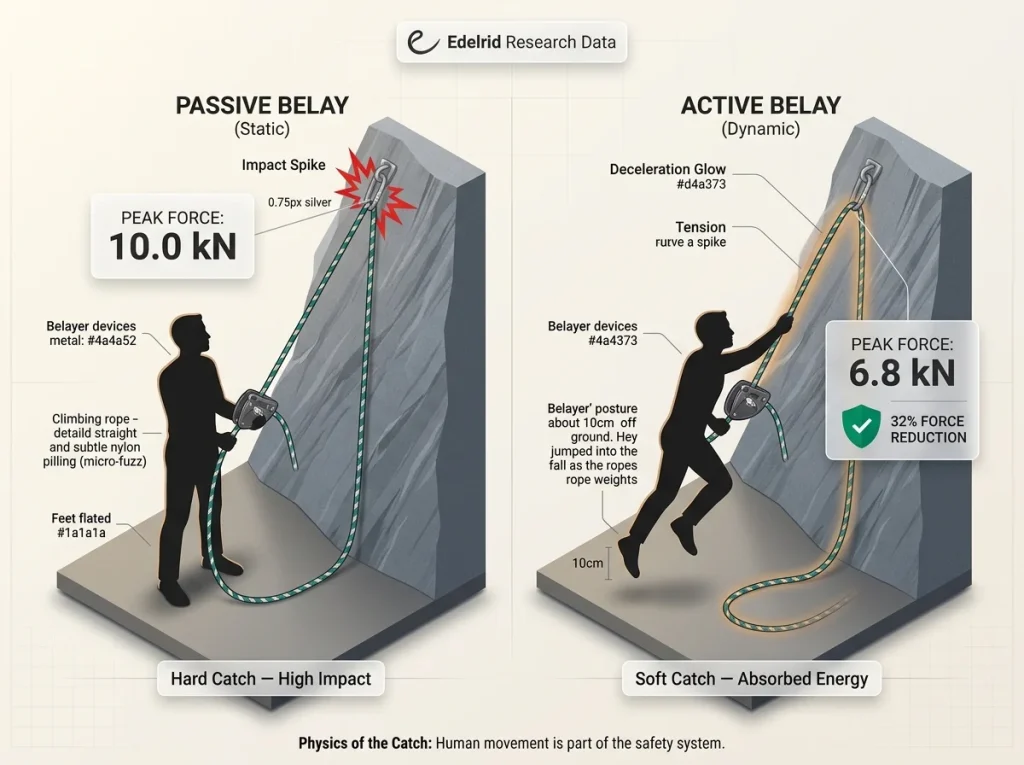
Edelrid’s controlled testing confirmed this with data: an 80 kg drop weight with an 80 kg passive belayer generated 10.0 kN at the top anchor. Active catch — belayer jumps into the fall — reduced that to 6.8 kN. A 32% force reduction. According to REI’s expert guide on lead climbing falls, the belayer’s body movement is one of the most undertrained variables in recreational lead climbing safety.
Pro tip: Train your belayer to respond to “Watch Me” with one specific action: shorten the slack slightly and pre-stage the jump. Not “take up all the slack.” Not “brace.” Pre-stage the jump. If they pull tight in response to “Watch Me,” they can yank you off the wall.
Active vs. Passive Belaying: The Physics of the Jump
Passive belay: the belayer braces stationary or leans back. Short braking distance. Sharp jolt. The entire fall force concentrates into a brief impulse.
Active belay: the belayer steps or jumps slightly toward the wall and upward as the rope loads. This adds 0.3 to 0.5 meters to the braking distance — enough to measurably reduce peak force. Timing is everything. The jump must trigger at the moment the rope begins to load, not before. An early jump does nothing; a late jump misses the window entirely.
Partner Weight Ratios and the Edelrid Ohm System
Weight disparity changes the whole equation. When the belayer weighs significantly less than the climber, the fall pulls them upward into the first bolt — the “rocket belayer effect.” Impact on the belayer’s face or head is a documented accident mechanism, not a hypothetical.
The Edelrid Ohm counters the rocket belayer effect by placing a friction-enhancing resistor at the first bolt. It effectively reduces the climber’s apparent weight by around 30 kg for the belayer. The successor model, the Edelrid Ohmega, adds three variable resistance settings and an internal lever that engages only during a fall, so rope handling for the leader stays smooth. The specific data point worth knowing: Ohm combined with an active belay produces lower anchor forces than active belay alone in a frictionless system — the added friction creates a more predictable deceleration curve. This matters because understanding the catch is what makes the fall drills above actually work in the field.
Managing the Mental Barrier: The Warrior’s Way Protocol
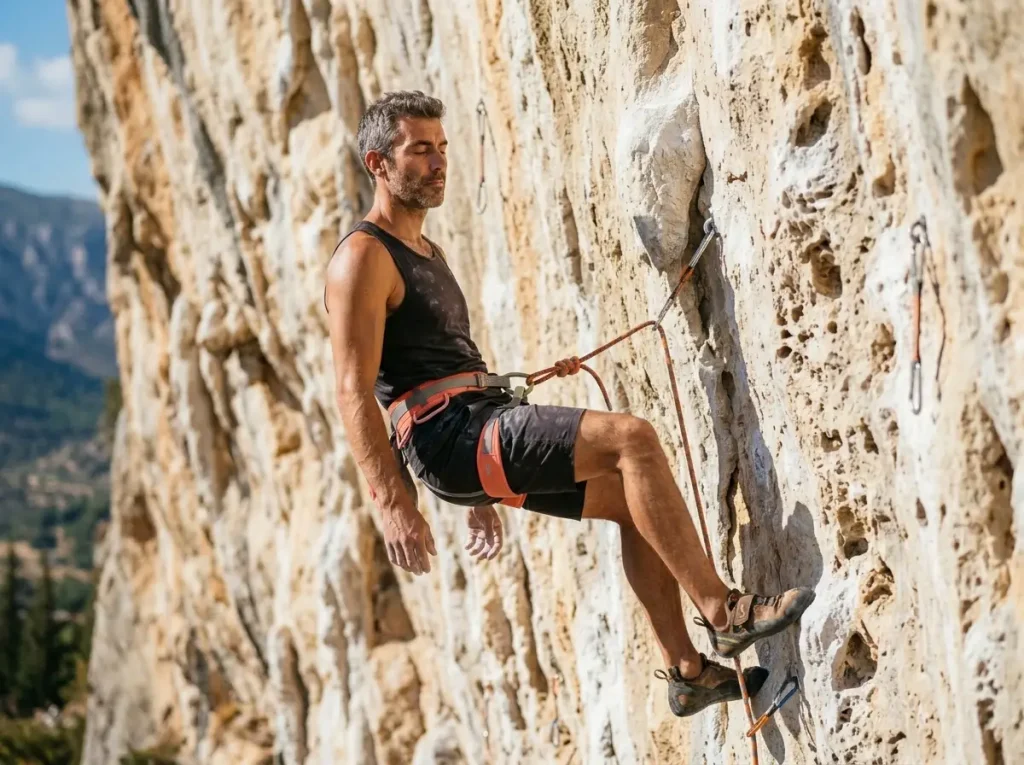
Fear of falling is not a character flaw. It is a baseline amygdala response to a genuine threat. The question isn’t how to eliminate it — that’s the wrong target. The question is how to manage it as a trainable variable.
Arno Ilgner’s Warrior’s Way mental training system treats fear as a motivation problem rather than a psychological defect. The internal locus of control shifts from “I hope nothing goes wrong” to “I have the data to assess this risk — now I decide.” That’s not bravado. That’s how expert practitioners in every high-stakes discipline actually think.
The framework has two distinct phases. In the Stop Phase — at a rest or a bolt — you assess the terrain. Is it overhanging with clean air below? Is your belayer ready? Is the rope in front of your legs? Is this a yes-fall zone or a no-fall zone? All decisions happen here. Once you leave the rest — the Move Phase — thinking stops. Commitment is total. A fall in the Move Phase is not failure; it’s the expected output of full commitment on a route at your limit.
Contrast this with whipper therapy. Taking massive falls before the nervous system is ready does not build trust — it builds trauma. Managing climbing anxiety with the graded exposure system walks through why incremental exposure works where overexposure fails.
The Stop/Move Decision Framework
At every rest, run the quick checklist. Is the terrain overhanging? Is there clear air below? Is your belayer ready? Is the rope in front of your legs? All four yes — proceed. Any one no — fix it or down-climb.
“Watch Me” is a signal, not a prayer. It tells your belayer to shorten slack and pre-stage the jump. Use it selectively. Overuse it and your belayer stops treating it as actionable information. The harder skill is distinguishing “I don’t want to fall” (emotional) from “this fall is genuinely hazardous” (technical). On a clean overhang with a ready belayer and bolt at knee height, falling is not objectively hazardous. Your hesitation is emotional. Name it that. Then commit.
Breathing Protocols and Somatic Resets
Box breathing at rest stances before a crux — four counts in, four hold, four out, four hold — directly activates the parasympathetic nervous system before you enter a move sequence where that system is fighting to stay online. It’s not a soft-skills accessory. It’s physiology.
“Exhale on intent” is the companion drill: exhale deliberately before committing to the crux move. It reduces the probability of the Valsalva response and keeps your core relaxed for the flight. Neuroplasticity research confirms that repeated successful falls literally rewire the amygdala’s threat classification over four to eight weeks of consistent practice. The ladder is not a one-session fix.
Pro tip: Keep a fear log. After every session, rate your subjective fear on a 1 to 10 scale for each drill level. A declining trend across weeks is measurable proof the protocol is working. Reading that evidence before a session is itself calming. You’re not guessing — you’re tracking a training variable.
Real-World Failure Analysis: When Falls Go Wrong
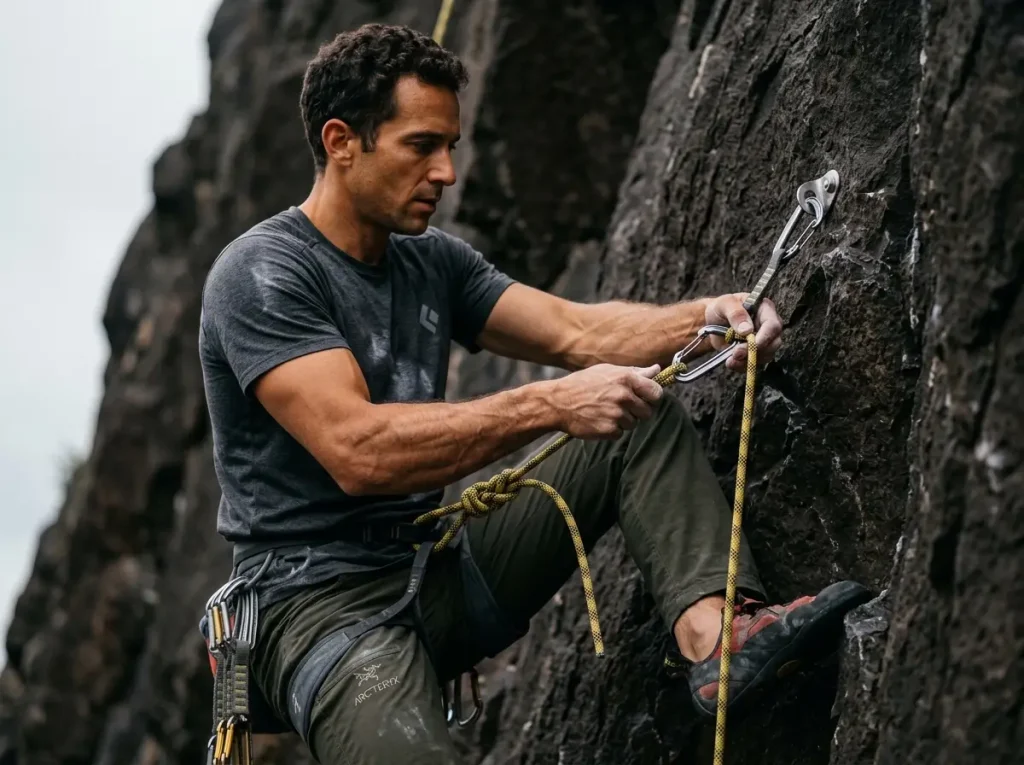
The falls that hurt people in sport climbing are rarely the ones they were prepared for. They’re the small procedural failures that combine with inattention.
The Clipping Fall is the highest-consequence routine event in sport climbing. When you pull a loop of slack to clip and then fall, you effectively double the fall height relative to falling with the rope at your waist. If the bolt is half a meter below your waist when you pull slack, you’re adding that extra slack to the fall distance. The fix: clip bolts at the waist for maximum efficiency from a stable position with your feet set and the bolt at waist level. If you can’t get stable, don’t pull slack. Down-climb one move and reset.
Back-clipping and Z-clipping create fall scenarios far worse than anything the route itself presents. Standard lead certification catches both — but field habits drift over time. Periodically recheck yours.
The Watch Me Backfire. A belayer who pulls slack tight in response to “Watch Me” can yank you off the wall or create a jarring hard catch. This is a training failure, not a gear failure. Belayer error prevention backed by AAC data makes clear that human factors — not hardware — are the dominant failure mode in sport climbing accidents.
Ledge Awareness. The majority of serious sport climbing injuries happen on vertical or slabby terrain where the climber swings into a feature during the fall. Read the route from the ground before tying in. Map the yes-fall zones and the no-fall sections explicitly — not in a general sense, but specifically. “From the third bolt to the fourth bolt, the terrain is slabby and I need to down-climb before falling if I’m flagging left.”
The route-reading habit took me embarrassingly long to develop. I used to rack up, tie in, and go. Now I spend three minutes at the base just watching the rope path in my head for each fall zone. It’s changed how I climb completely — the near-panics come much less often when you’ve already accepted what a fall at each section looks like before it happens.
The Clipping Fall Trap and Rope Position Discipline
When your body is above the bolt and you reach high to pull slack, the effective fall distance increases by the length of slack in your hand plus the distance from your waist to the bolt. Combined, this can be several meters more than it appears from the ground.
The discipline rule is simple: if you cannot clip from a stable position with your feet set, you do not pull slack. You down-climb. This isn’t timid — it’s the technique that elite lead climbers actually use. The Quadriga effect is worth knowing here too. Your finger flexors share a common muscle belly, so when fatigue builds, grip strength drops across all fingers simultaneously rather than gracefully degrading. Elite climbers recognize this cross-finger fatigue signal as the time to fall intentionally from a controlled position — before flailing starts. A controlled fall from exhaustion beats an uncontrolled peel.
Sharp Edges and Gear Longevity
No rope is immune to a crystalline edge under high-factor fall conditions. On routes over granite or limestone with visible sharp arêtes, the rope path through your draws must redirect the line away from edge contact.
More insidious is chemical contamination. Acid — from car batteries, cleaning agents, unknown liquids at the crag — can invisibly compromise a rope’s polyamide core. The sheath looks fine. The core fails under a load it should handle easily. After any fall involving potential sharp-edge contact, run the full rope through your hands. Feel for flat spots, stiffness changes, sheath damage. The climbing rope inspection, care, and retirement guide covers the full protocol — backed by UIAA documentation on climbing rope safety and failure modes.
Conclusion
Three things worth carrying out of this article.
First: fall factor, not fall height. The variable that determines how hard a catch hits is the ratio of fall distance to effective rope length — not the absolute meters. Minimize rope drag, maximize effective rope length, and stop measuring risk by how high you are.
Second: the soft catch is a dual skill. Your belayer’s body movement is a physical component of your safety system. An active catch cuts anchor forces by over 30%. Training your partner is part of training yourself.
Third: incremental exposure rewires fear. Taking six controlled falls at the right progression levels builds the somatic library your nervous system needs to stay calm on hard routes. Whipper therapy is not the protocol. The ladder is.
Next session, run Level 1 through Level 3 of the progression ladder with a trusted partner before you tie in on anything at your limit. You don’t need to be fearless to send your project. You need enough falls in the bank that your nervous system trusts the system. Now go send something.
FAQ
How do you practice falling in lead climbing?
Start with the 6-Level Progression Ladder on overhanging terrain: Level 1 is a simple take with the rope taut and the bolt at your chest, progressing incrementally to Level 6 where you fall dynamically above the bolt mid-move. Each level adds one increment of commitment — the amygdala requires small, consistent stress doses to build genuine somatic trust. Always practice with an experienced partner who understands active belaying. Revisit the ladder at the start of every climbing season.
How do I stop being afraid of falling while climbing?
Fear of falling is a hardwired survival response — the goal is management, not elimination. Use Arno Ilgner’s Stop or Move framework: at rest stances, assess the terrain and categorize it as a yes-fall or no-fall zone, then commit fully once you leave the rest. Pair this with a fear log that tracks your subjective fear rating across weeks of consistent drill practice. A measurable, declining trend over four to eight weeks is how you know the amygdala desensitization is working.
How far is a safe fall in lead climbing?
The question is not how far — it’s what is the fall factor? A 6-meter fall with 20 meters of rope out produces factor 0.3. A 2-meter fall with 1 meter of rope out produces factor 2.0. The second fall is far more violent despite being shorter. A genuinely safe fall combines overhanging or vertical terrain clear of ledges, an active belayer, properly extended quickdraws, and rope kept in front of the climber’s legs at the moment of release.
Is falling in sport climbing safe?
With proper systems in place, yes — but proper systems is carrying significant weight in that sentence. Modern dynamic ropes stretch up to 40% under test conditions, sport bolts are rated to 25 kN minimum against typical fall loads of 5 to 8 kN, and the hardware safety margins run 3 to 5 times under normal use. Gear failure under normal sport climbing conditions is statistically negligible. The accident data consistently shows human error — rope behind the leg, clipping falls with excess slack, belayer inattention — not equipment failure as the culprit.
What is the difference between an active catch and a passive catch in belaying?
A passive catch happens when the belayer braces stationary or leans back, creating a short braking distance and a sharp jolt. An active catch means the belayer steps or jumps slightly toward the wall as the rope loads, extending the braking distance and reducing peak anchor forces by up to 32% according to Edelrid’s controlled testing. If your partner uses a GriGri, active catches are even more critical — assisted braking devices lock instantaneously and eliminate the passive rope-slip buffer that manual devices like the ATC provide automatically.
Safety Notice: Rock climbing and mountaineering are inherently high-risk
activities that can involve physical trauma or fatal incidents. The information on Rock Climbing Realms is for
educational and informational purposes only. Techniques and advice presented here are not a substitute
for professional, hands-on instruction. Conditions and risks vary by location. Always seek guidance
from a qualified instructor before attempting new techniques. By using this website, you agree that you
are solely responsible for your own safety. Any reliance you place on this information is strictly
at your own risk, and you assume all liability for your actions. Rock Climbing Realms and its authors
will not be held liable for any harm, damage, or loss sustained in connection with the use of this information.
Affiliate Disclosure: We are a participant in the Amazon Services LLC Associates Program, an
affiliate advertising program designed to provide a means for us to earn advertising fees by advertising and linking
to Amazon.com. As an Amazon Associate, we earn from qualifying purchases. We are also an official affiliate partner
of Black Diamond Equipment via the AvantLink network. If you click on a Black Diamond affiliate link and make a
purchase, we may earn a commission at no additional cost to you. We also participate in other affiliate programs.
Additional terms are found in the terms of service.