
In this article
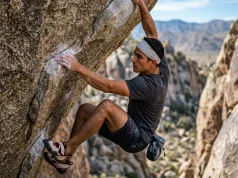
You’re three moves into the crux of a V6 you’ve attempted forty times. Fingers hold. Foot smears. And then—the same twitch, the same hitch, the same fall. Same exact spot. Every single burn.
That’s not a motivation problem. That’s a systems error. And you’ve been trying to fix it by doing more of what isn’t working.
After years watching climbers spin their wheels on the same grades, the pattern is unmistakable. Most plateaus aren’t about effort. They’re about diagnosing the wrong variable and training it harder. This guide gives you the diagnostic framework to figure out whether your ceiling is a hardware failure (finger strength, critical force, recovery deficit) or a software failure (movement economy, neural recruitment, tactical inefficiency)—and a specific fix for each.
⚡ Quick Answer: A climbing plateau means your current stimulus no longer drives adaptation. First, test your finger strength on a 20mm edge as a percentage of body weight. If you’re below the grade benchmark, you have a physiological gap—train max recruitment and critical force. If you’re above it, movement economy or tactics are the bottleneck—stop hangboarding and start deliberate practice. Most climbers diagnose the wrong problem and train the wrong system for months.
Diagnosing the Plateau — Hardware vs. Software

Here’s where everyone gets it wrong: they assume the plateau is about weakness. It’s usually not.
The most useful framework treats a climber as a system with two failure modes. Hardware failures live in the muscles, tendons, and metabolic capacity. Software failures live in movement patterns, neural recruitment efficiency, and tactical decision-making. Training the wrong one is how climbers spend six months on a hangboard when what they needed was a spray wall. Check the data-backed climbing assessment framework before you commit to a training block—it gives you the actual test to run.
Dave MacLeod makes this distinction sharper than anyone: most climbers “train” when they should be “performing.” Training thrashes the body. Performing means showing up fully rested, projecting a specific problem, and measuring adaptation. If you’re climbing five days a week at moderate intensity and going home pumped, you’re training. If your project hasn’t moved in six weeks, you’re digging a hole.
The binary success trap is another pattern worth naming early. Climbers count only sends. A session where you complete four of six moves on a V6 is measurable progress—even without the send. Count moves, not sends. That’s where the data lives.
The MVC Benchmark — How Strong Is Strong Enough?
MVC (Maximum Voluntary Contraction) is the gold-standard diagnostic for climbing-specific finger strength. You measure it on a 20mm edge, in a half-crimp position, as a percentage of your body weight. Not during a session. Rested, three trials, 7-second max hangs.
The grade correlation breaks down like this: V4 climbers typically sit around 80–90% body weight on a 20mm edge. V6 demands 100–110%. V10 athletes test at 140–160%. If you’re stuck at V4 with 120% body weight on that edge, your fingers aren’t the problem. You have a software bug. If you’re at 80%, you have a hardware gap—and no amount of footwork drilling will close it.
The correct finger strength testing protocol matters here. Too many climbers test themselves during a session or use full-crimp, which generates higher numbers but trains an injury pattern. Half-crimp is what you actually climb in. That’s the position you test.
Pro tip: If you test full crimp, you’re benchmarking the position most likely to blow your A2 pulley. Half-crimp transfers better to actual climbing holds and keeps your tendons intact long enough to use the data.
The Software Failure — Movement Economy and Geometric Entropy
Geometric entropy sounds academic. In practice, you can feel it. It’s the climber who barnstorms through a sequence—explosive, chaotic, burning through reserves—versus the one who floats the same problem with half the effort. Same grade. Completely different motor cost.
Research on 3D center-of-mass tracking shows the difference is measurable: force-centric climbers use roughly twice the mean power output compared to agility-centric climbers making the same moves. “Silent feet” and “soft gripping” aren’t coaching clichés. They’re entropy-reduction strategies—ways of cutting metabolic waste out of every move.
The barn-door effect is a real physics problem. When your center of mass falls outside the support polygon, rotational torque pulls you off the wall. Flagging and drop-knees aren’t stylistic choices—they’re the counter-balance that keeps you in contact with the problem.
The Tactical Failure — Route Reading and Pacing
Lattice Training has the data on this: intermediate climbers consistently underperform their strength benchmarks because of poor tactical pacing. They climb every move at 90% effort when only two or three moves actually require it. The rest are supposed to be rests.
The G-Tox protocol is something most climbers have never heard of. On a rest hold, lower your arm below your waist. It accelerates forearm blood return compared to the instinctive “arm up” recovery posture. The body finds that position intuitively on steep terrain, but most people default to shaking out with their arm raised. It’s slower.
The 10-4 rule for projecting: ten attempts maximum per session, four minutes of full rest between burns. Beyond that, fatigue masks the patterns you’re trying to learn. It’s just noise.
The Physics of Friction — Why Your Feet Are Lying to You

I spent a year trying to trust my feet on slab. The problem wasn’t trust. I was smearing on my arch instead of the ball of my foot. Friction geometry, not psychology.
Friction is not a fixed property of rubber. It’s a dynamic relationship between the rubber compound and the surface. On slab, standing directly over your feet—directing your weight into the rock rather than away from it—is what maximizes grip. Every inch your hips lean back reduces the force pressing your foot into the stone, and effective grip drops with it. “Trusting your feet” is a physics instruction, not a confidence exercise.
For a deeper look at how this plays out on real terrain, the breakdown of edging vs. smearing physics on real terrain gets into the specifics of foot placement mechanics that apply directly to slab footwork.
The peer-reviewed biomechanical principles of sport climbing confirm the center-of-mass and normal force relationships—the physics here are unambiguous and consistent across climbing disciplines.
Static vs. Dynamic Friction — The Slip Threshold
Static friction is always higher than dynamic friction. The moment a foothold slides, the friction coefficient drops—and once it drops, you can’t recover by “trying harder.” This is why slipping accelerates. That micro-slip becomes a full slip becomes a fall.
The practical implication: place the foot, pause, load. Don’t bounce-launch off a foothold. Dynamic loading crosses the slip threshold before the rubber has time to deform and grip. Cold rubber makes this worse. Stiff rubber offers less deformation, less surface contact, less grip. Warm your shoes up with gentle friction before you commit to precise footwork on slabs.
Here’s the piece most coaching content never covers: viscoelastic creep. Under a static load, Vibram XS Edge and similar compounds continue to deform slightly over one to two seconds, increasing actual surface contact with the rock’s micro-texture. Holding a position statically for a moment literally increases friction. The shoe is still working after you stop moving. This is why pausing on a foothold multiplies grip in a way that moving through it doesn’t.
Pro tip: On granite, the crystal porosity increases surface contact for static friction. On limestone pockets, the hold shape matters more than rubber behavior. Learn your rock type. It changes everything about how you load your feet.
Lever Systems — How Body Position Creates Force Multipliers
Most human joints operate as third-class levers—effort between fulcrum and load. They trade force for speed and range of motion. This is why pulling is inherently inefficient. Every time you try to muscle through a move with upper-body strength, you’re fighting the worst mechanical position available to you.
Second-class levers flip that equation. Standing on your toes uses this—it amplifies force. High-stepping is less taxing than pulling a lock-off because you’ve accessed better mechanics. The “brute force” error is attempting to overcome a third-class lever disadvantage with more effort instead of repositioning your center of mass.
Moving your center of mass closer to the wall reduces the moment arm—the perpendicular distance from your joint to the force line. A two-inch shift in hip position can reduce finger load by 15–20%. The coaching cue “stay close to the wall” isn’t about style. It’s mechanics. Torque minimization is the actual goal.

Finger Strength and Critical Force — The Grade Ceiling

The first time I tested my critical force on an actual force plate was a correction I didn’t expect. I’d been hanging at what felt like maximum effort for three-minute intervals. My CF came back at 38% of MVC. I was trying to climb 5.12.
Critical Force (CF) is the maximum isometric intensity you can sustain without complete fatigue. For intermediate climbers, that typically sits at 40–45% of MVC-7. Improving CF beyond 45% is a prerequisite for 5.12+ and 5.13—not just a nice addition. For sport routes, CF is a more predictive metric than max strength because most routes demand sustained sub-maximal output across multiple cruxes, not a single all-out effort.
The physiology of rock climbing peer-reviewed study pins down the CF benchmarks and the metaboreflex mechanism. Elite climbers show an attenuated blood pressure response to isometric exercise—they tolerate and clear metabolites faster than intermediates, which is why they can recover on rest holds that an intermediate can’t use at all.
When forearm muscles accumulate lactate, the sympathetic nervous system triggers a metaboreflex—heart rate and blood pressure spike, fine motor control degrades, and the pump compounds. Improving CF delays metaboreflex onset. That’s what you’re actually training when you do ARC work. Not endurance for its own sake—you’re pushing back the threshold where your hands stop doing what you tell them.
The connection between CF mechanics and what you feel on a route—what’s actually happening when you pump off a route—makes the physiology concrete. Worth reading alongside this section.
Max Hangs vs. Recruitment Hangs — Choosing the Right Tool
Max hangs: 7–10 seconds at 90–100% MVC, five sets, three to five minutes full rest. Purpose: increase tendon stiffness and max force output. The right tool when you’re below the grade benchmark.
Recruitment hangs: 5–7 seconds at above 90% MVC, six to eight sets, three-plus minutes rest. Purpose: improve neural access to motor units—not strength, but the ability to recruit fast-twitch fibers earlier and sustain their output. The right tool when you’re at or above the benchmark.
The error most V4–V6 climbers make is defaulting to 4×4s (power endurance circuits) when what they actually need is max recruitment work. 4×4s train the ability to be repeatedly weak. Recruitment hangs train the nervous system to access what’s already there. They’re fundamentally different stimuli.
Half-crimp transfers better to actual climbing holds. Full crimp generates slightly higher force numbers on a test and significantly increases A2 pulley injury risk. For safe hangboard loading protocols for building tendon base, the tendon adaptation timeline matters: tendons adapt three to five times slower than muscles. Strength gains consistently outrun tendon capacity as a climber approaches their threshold. That gap is where injuries happen.
Pro tip: If you can’t complete a full set at 90% MVC with complete rest between sets, you’re not doing recruitment hangs. You’re doing exhaustion drills with a fancy name.
The Critical Force Protocol — Raising the Ceiling
ARC training (Aerobic Restoration and Capillarization): 20–40 minutes of continuous low-intensity climbing or hanging at 30–40% MVC. The goal is increased capillary density in forearm flexors, which improves metabolite clearance—the physiological mechanism behind CF improvement. It’s boring. It works.
The periodization sequence that produces measurable results: three to four weeks of ARC base, followed by three to four weeks of recruitment hangs, followed by a two-week project phase. This is the standard block for CF improvement with Lattice Training athletes.
Eric Hörst’s warning about “copy-cat training” belongs here: doing what an elite climber does at the elite climber’s volume destroys intermediate climbers. An Adam Ondra training block involves volume and intensity an intermediate body cannot process. It creates a deeper NFO hole, not adaptation.
Anthropometric Benchmarks — When Weight Is the Variable
Intermediate climbers run BMI 21–24. Elite climbers run 18–21. The operative metric is strength-to-weight ratio, not absolute strength. A 100kg climber at 150% body-weight finger strength has the same relative output as a 60kg climber at 150% body weight. Physiologically equivalent. The number that matters is the ratio.
Pull-up benchmarks follow the same pattern: intermediates at V4–V5 hit 100–120% bodyweight; elite V10+ athletes reach 150–180%. Max hang time on a 25mm edge separates the populations cleanly: intermediates hold 15–25 seconds; elites hold 40 seconds or more.
The body-weight obsession trap is worth naming directly. Aggressive caloric restriction suppresses the testosterone/cortisol balance that governs recovery capacity. Climbing lighter and climbing recovered are mutually exclusive if the deficit is too aggressive. You can’t cut weight and build tendon capacity simultaneously. Pick one.
Recovery Science — When the Problem Is the Training Plan Itself

I bought a Whoop in January. By February, it had told me more about why I wasn’t sending than two years of training journal entries combined.
The plateau often arrives not from under-training but from the training load exceeding the body’s adaptation capacity. This is Non-Functional Overreaching (NFO), and it’s one of the most misdiagnosed plateau causes in climbing because it feels like a motivation problem. You feel “ready.” Your HRV and hormones say otherwise.
The testosterone/cortisol ratio is the clinical marker: a 30%+ decrease indicates insufficient recovery. In research camp settings, climbers at peak fatigue showed a 42% ratio drop coinciding with measurable handgrip strength decline—per peer-reviewed research on overreaching markers in climbing athletes. That’s not a bad week. That’s a hormonal system in a catabolic state.
HRV (Heart Rate Variability) is the accessible proxy. Higher RMSSD and SD1 values indicate parasympathetic dominance—recovery state. HRV suppression after high-intensity sessions lasts 24–48 hours. The uncoupling effect is the part that catches climbers off guard: objective markers are often out of sync with subjective feel. You feel ready. Your endocrine system is still catabolic. Training in that state doesn’t produce adaptation—it digs the hole deeper.
The sleep-cortisol loop compounds it: elevated cortisol from overreaching degrades sleep quality, which raises cortisol further. The plateau reinforces itself. For how supercompensation actually works on rest days, the distinction between a recovery day that works and one that doesn’t is the difference between breaking a plateau and deepening it.

Using HRV to Detect Training Readiness
The measurement protocol matters: take HRV immediately upon waking, lying still, for two minutes. Morning HRV reflects cumulative recovery from the previous day or days—not your current subjective state. Any device using RMSSD (Whoop, Garmin HRV Status, Polar) gives you usable data. Consistency within one device matters more than cross-device comparison.
The decision tree is simple: green zone HRV approves high-intensity work. Yellow zone means technique or volume day. Red zone means active recovery or full rest. Training on a red HRV day produces negative adaptation—it accelerates NFO rather than building fitness.
Pro tip: Track for four weeks before you interpret anything. HRV has enormous individual baseline variance. You’re looking for deviations from your normal, not a universal number. The benchmark is you.
The Deload Week — Mandatory, Not Optional
Dave MacLeod’s 50% rest rule on bouldering trips: half the days must be actual rest days for high-intensity performance. Not “easier” days. Full rest.
A technical deload maintains climbing frequency (three days a week) but drops intensity to 60–70% of max and eliminates all limit bouldering and max hangs. A full deload goes five to seven days with no climbing, active recovery only—no isometric forearm stress.
Supercompensation doesn’t happen immediately after rest. Peak performance typically arrives five to ten days post-rest, not the day after a deload. Signs that a deload is overdue: performance declining despite no change in training, sleep disruption, persistent soreness in finger flexors, and the specific emotional flatness about climbing that feels different from normal project frustration. Frequency recommendation: one technical deload every four to five weeks of high-intensity training; one full deload every twelve to sixteen weeks.
The Movement Rewrite — Breaking Neural Grooves

The V5 setter threshold is real. At most gyms, V5 is where the setter stops setting for technique and starts setting for creativity. Climbers who plateau at V4 are the ones who haven’t built the movement vocabulary for creative problem-solving. They’re not weak. They’re running familiar programs on unfamiliar hardware.
Neural adaptation to a given movement pattern creates grooves—efficient pathways that execute familiar sequences with minimal cognitive load. The plateau trap is when those grooves become rigid. The climber stops adapting to novel sequences and starts imposing known patterns on unfamiliar problems instead of reading what the move demands.
Stimulus variability breaks the groove: deliberately training on problems with unfamiliar hold types, angles, and sequences forces new neural recruitment. Spray walls do this better than set routes. Set routes reinforce known patterns. A plateau climber needs more spray wall, less route climbing. For a window into how this plays out at the highest level, how Adam Ondra approaches movement variability and neural adaptation shows what deliberate variability looks like when taken to its logical end.
Perception-action coupling (Lattice Training’s framing) is the skill of matching body movement to hold shape without beta, in real time. This is the opposite of memorizing sequences, which creates grade-specific performance that doesn’t transfer. You can flash every V5 in your home gym and fall off the first V5 at a new crag. That’s the symptom.
Deliberate Practice on Sub-Grade Problems
Deliberate practice is fundamentally different from volume training. It requires conscious, effortful attention to execution quality on every single rep. Not grinding through attempts—watching your feet, feeling your grip pressure, noticing where weight loads on each placement.
The protocol: spend the first 30 minutes of each session on problems two to three grades below your max. Execute with perfect footwork, zero over-gripping, and deliberate pauses on each foot placement. Count moves, not sends. A session where you improve execution on 20 specific moves is more valuable than 20 failed attempts on a limit problem.
The no-beta drill: solve problems without watching other people or having the sequence explained. Builds real-time movement reading versus pattern matching. If you can’t tell me where your weight was on every foothold during a climb, you were on autopilot. Autopilot doesn’t improve.
Dynamic Movement Integration — The Dyno as Diagnostic
Most intermediate climbers avoid dynamics—dynos, deadpoints. This avoidance concentrates all training load on static, controlled positions and starves the nervous system of force-time curve training. The range of movement patterns narrows. The plateau deepens.
Dyno mechanics: match hands at the apex of the leg back-swing, not at the top of the leg drive. Hannah Morris’s paddle-dyno cue gets this right—the legs create momentum, the arms redirect it. Timing is everything. Most climbers fire their arms too early and cut the power transfer short.
MacLeod’s insight on the fear of losing grade applies directly here: climbers avoid learning dynamic movement because they fear falling on problems they can currently static. This keeps the tool set narrow. A climber solving everything statically is accumulating a massive movement debt. Deadpoints bridge static and full-dynamic movement—the training step between controlled pulling and committed dynos. Start there.
Integration drill: two sessions per week on problems only solvable dynamically. Start at V2–V3. Build the vocabulary at low stakes. How to structure a periodization block that includes dynamic movement work gives you the structure to add this alongside strength and endurance without overcrowding your training week.
The Anti-Sell Gear Audit — What Your Plateau Actually Needs

I bought a hangboard when I needed a spray wall. Classic hardware-solution-to-a-software-problem mistake. The board collected dust for six months while I got stuck at V5s I should have been solving by moving differently.
Gear should be prescribed to the diagnosed failure mode. A hangboard for a technique-limited climber is wasted money and a potential injury. A spray wall for a climber with a genuine hardware gap won’t fix the deficit. Buying gear before diagnosing the problem is just retail therapy.
For hardware failures: Beastmaker 1000 or 2000 (larger holds, more variety), or the Trango RPTC for space-efficient mounting. Select based on diagnosed weakness—open-hand, half-crimp, or pinch—not on what’s popular.
For software failures: a spray wall or home woody. This is the investment that breaks movement grooves. The Kilter Board reinforces modern compression and coordination movement—optimal for software failures. The Moonboard specializes in crimp-intensive power—optimal for hardware gaps. Choose based on the diagnosis, not the Instagram algorithm.
For recovery-limited climbers: the prescription isn’t gear. It’s a structured deload calendar and an HRV tracking tool. Whoop or Garmin. Not a new hangboard.
Anti-sell callout worth knowing: the Edelrid Ohm (360g, V-groove friction system) can create “short-rope” risk on overhanging terrain—it adds friction even when slack is needed for a soft catch. If your partner is lighter than you by more than 10kg, the Ohmega (190g) is a safer default for dynamic sport routes. The DAV recommends friction enhancement above that weight disparity threshold. Know which device fits your actual situation.
For how to set process goals instead of grade goals, the framing shift from “what grade can I buy my way to” to “what process change breaks this plateau” is the mental model that makes gear audits honest.
Conclusion
Three things, straight up.
First: diagnose before you train. Measure your finger strength relative to your grade. If you exceed the benchmark, movement is the problem—stop hangboarding and start deliberate practice. If you don’t, physiology is the gap—run recruitment hangs and ARC work. Training the wrong system wastes months.
Second: recovery is training. HRV and testosterone/cortisol ratio data are the earliest warning system for the NFO spiral that turns a temporary plateau into a permanent one. Subjective feel lies. Your blood doesn’t.
Third: movement variability breaks plateaus. Spray walls, dynos, and deliberate sub-grade practice rewrite neural grooves. No amount of strength training fixes a software problem.
Next session, before you touch your project: pick a 20mm edge, hang half-crimp for 7 seconds at max effort, and record the percentage of your body weight. Look at the grade table. That number tells you more about your plateau than two years of gut-feeling training decisions.
FAQ
How do I know if I’m plateauing or just having bad sessions?
A plateau is six or more weeks without measurable improvement in any benchmark—not isolated bad days. Track your MVC-7 finger strength, count moves completed on project problems, and monitor perceived exertion on sub-max climbs. If all three are stagnant for six-plus weeks, you have a plateau, not a bad week.
Why am I stuck at V4 even though I train three times a week?
Frequency without specificity is the most common V4 plateau driver. Three sessions of varied gym climbing typically doesn’t deliver the targeted stimulus needed to cross the V4–V5 technical threshold—max recruitment, critical force work, or deliberate movement practice. Audit whether your sessions include any of the specific interventions in this guide.
How long does a climbing plateau last if I address the root cause?
With accurate diagnosis and a corrected training stimulus, physiological plateaus typically break in six to ten weeks. Movement skill plateaus can break faster—two to four weeks with deliberate practice—but may take longer if the motor patterns are deeply ingrained. Without addressing the root cause, plateaus persist indefinitely.
What are the best finger strength exercises for breaking through a grade plateau?
The answer depends entirely on your MVC benchmark relative to your grade. Below benchmark: recruitment hangs and max hangs on a 20mm edge at 90%+ MVC, five to six sets, fully rested. Above benchmark: stop finger training and increase deliberate movement practice on sub-grade problems.
Can over-training cause a climbing plateau?
Yes—NFO is one of the most misdiagnosed plateau causes. A 30%+ drop in the testosterone or cortisol ratio is clinical evidence. If your HRV is suppressed, sleep is disrupted, and motivation is flat, adding more training will deepen the plateau. The prescription is a full deload week, not a new training plan.
Safety Notice: Rock climbing and mountaineering are inherently high-risk
activities that can involve physical trauma or fatal incidents. The information on Rock Climbing Realms is for
educational and informational purposes only. Techniques and advice presented here are not a substitute
for professional, hands-on instruction. Conditions and risks vary by location. Always seek guidance
from a qualified instructor before attempting new techniques. By using this website, you agree that you
are solely responsible for your own safety. Any reliance you place on this information is strictly
at your own risk, and you assume all liability for your actions. Rock Climbing Realms and its authors
will not be held liable for any harm, damage, or loss sustained in connection with the use of this information.
Affiliate Disclosure: We are a participant in the Amazon Services LLC Associates Program, an
affiliate advertising program designed to provide a means for us to earn advertising fees by advertising and linking
to Amazon.com. As an Amazon Associate, we earn from qualifying purchases. We are also an official affiliate partner
of Black Diamond Equipment via the AvantLink network. If you click on a Black Diamond affiliate link and make a
purchase, we may earn a commission at no additional cost to you. We also participate in other affiliate programs.
Additional terms are found in the terms of service.