
In this article
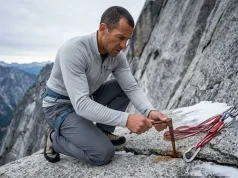
You’re standing at the top of the cliff. Wind, sun, probably a little exposed. You’ve clipped both bolts, you’ve threaded the cordelette, and now you’re looking down at your work. It looks right. But the hollow-stomach question is already forming: does this thing actually hold?
I’ve been in that exact spot more times than I can count — as a climber, then as someone teaching others to build anchors. Most beginners make the same mistakes. Not because they’re careless. Because every guide they’ve read taught them the steps without teaching them the physics. They learned what to do. Nobody explained why it works — or why it stops working.
This article changes that. By the end, you’ll understand anchor geometry, soft good selection, and the SERENE-ERNEST framework at a level that makes every decision at the top of a route deliberate instead of hopeful.
⚡ Quick Answer: For a standard two-bolt sport anchor, use 20–25 feet of 7mm nylon cordelette tied into a BHK (Big Honking Knot) with two locking carabiners placed opposite and opposed. Keep your master point angle under 60° — above 120°, each bolt is carrying 100% of the load with zero sharing. Apply the Snip Test (mentally cut each component — does the system survive?). If not, rebuild before loading it.
| Climbing Anchor Methods Comparison | |||
|---|---|---|---|
| Method | Redundancy | Best Use Case | Difficulty |
| Two-Quickdraw | Low | Day climbing, emergency setup | Beginner |
| Cordelette / BHK | High | Standard sport anchor, guided settings | Intermediate |
| The Quad | High | Fixed top-rope station, high volume | Intermediate |
| Sliding-X | Medium | Close bolts, quick equalization needed | Intermediate |
| Tensionless Wrap | High (conditionally) | Tree anchors, dry rough bark only | Expert |
The Physics Behind a Bombproof Anchor

Here’s the mistake every beginner makes: they hear “60-degree rule” and treat it like a hard stop — anything under 60° is safe, anything over is sketchy. That’s wrong. The 60° figure is a minimum acceptable threshold, not a target.
Force multiplication in a two-bolt anchor is not linear. At 0° (anchor legs running parallel), each bolt takes 50% of the load — maximum efficiency. At 60°, each leg bears 58%. At 90°, both legs are carrying 71% of your body weight. Still manageable for modern bolts. But at 120°, each leg is carrying 100% of the load. No sharing is happening. You have two bolts, and each one is holding all of you.
According to the Physics of climbing anchors — University of Alaska Fairbanks, this relationship is a function of the cosine of half the angle — which explains why the curve accelerates sharply after 90°. At 150°, force multiplication reaches 193%. At 175°, it exceeds 1,100%. Those numbers aren’t hypothetical. They describe what happens to your anchor hardware when your bolts are far apart and your sling is running wide.
You can check the UIAA-certified minimum breaking strengths for each component to understand why bolt ratings exist where they do — and how quickly a wide angle eats into those margins.
Pro tip: If your master point is above the cliff edge and you can’t fit two fists between the point and the lip, your angle is getting wide. Step back, look at the geometry, and adjust before you clip.
The 60-Degree Rule Is Not the Whole Story
The force-per-leg table nobody shows you:
| Angle of Loading Table | |
|---|---|
| Angle | Load per Leg |
| 0° | 50% |
| 45° | 54% |
| 60° | 58% |
| 90° | 71% |
| 120° | 100% |
| 150° | 193% |
| 175° | 1,146% |
The practical takeaway: aim for 30°–45° when bolts are close together. 60° is acceptable. Once you’re past 90°, start asking why. On wider bolt placements, use a longer cordelette or a quad with more extension to keep that master point correctly positioned. The table above is the single piece of information most beginner guides leave out — and it’s the one that actually explains why anchor geometry matters.

The American Triangle — Why It’s Still Wrecking Anchors
The American Triangle (sometimes called the closed-loop triangle or ADT) is still showing up at crags. I see it at sport venues, I’ve seen guides build it without recognizing it. It happens when you run a loop of cord through both bolt hangers and clip both ends to a single carabiner — creating a closed-loop triangle geometry.
The problem isn’t just angle. This setup creates inward horizontal forces on both bolts, in addition to the vertical load from the climber. At 90°, each bolt is taking 1.3 times the climber’s weight. Push that triangle to 120°, and each bolt absorbs twice the load. On soft sandstone, that’s a failure waiting to happen.
The version beginners build most often: they thread a sling through both bolt hangers and clip both ends to the belay rope. Closed loop. No equalization. Every newton going into the anchor is splitting wrong.
One edge case worth knowing: when bolts are at different heights, the triangle’s angle shifts asymmetrically. More force concentrates on the lower bolt. It’s not a 50/50 problem — it’s a specific failure point. Know which bolt is taking the hit.

How Master Point Position Changes Everything
Walk to the base of the climb. Look straight up. That spot directly above the route’s start — that’s where your master point needs to hang. Not to the left. Not to the right. Directly above the line.
A diagonal master point creates unequal tension on the two anchor legs. One side is taking more load than the other. The cordelette isn’t doing the job it’s supposed to do. In a fixed top-rope setting with 50 laps a day on it, that asymmetric loading adds up and accelerates wear on the heavier-loaded leg. Walk down, look up, and check the line before you trust it.
Soft Good Selection — The Material Science Guides Don’t Teach

Most beginner articles list gear. They say “use a cordelette or slings.” They don’t tell you which material the cordelette should be made of, or why it matters in a top-rope setting specifically.
The short version: 7mm nylon wins for top-rope anchors. Here’s why.
Nylon (Polyamide) can stretch up to 30% before failure. That stretch is not a weakness — it’s a shock absorber. In a short top-rope fall, the cordelette stays loaded under tension. That elasticity bleeds off peak forces before they hit the bolts. Nylon also melts at 245°C. A climbing rope running across a nylon master point under lowering loads is not going to heat the sling to a failure point.
Dyneema, by contrast, stretches only 3–5%. It’s nearly static. Any slack in the system becomes a sharp shock load on the anchor. Worse, Dyneema’s melting point is 145°C — 100 degrees lower than nylon. A rope running repeatedly across a Dyneema sling under friction can damage it. DMM and Black Diamond testing shows that knots in Dyneema reduce its breaking strength by over 50%. The Double Fisherman’s can slip under cyclical top-rope loading.
For choosing between dynamic and static rope for your anchor extension, see the complete climbing rope guide — understanding the full rope stack matters here.
I watched a guided group destroy the sheathing on a $280 performance rope in a single season. They were top-roping. A thicker, cheaper rope built for workload — not for sending — would have lasted three times as long. That’s the anti-sell on high-performance ropes for top-rope use: a 10.0–10.5mm workhorse beats a 9.2mm race rope in this setting every time.
Check the UIAA Standard 123 for fixed anchor hardware classifications for the full specs on what “rated” actually means here.
Why Nylon Wins for Top-Rope Anchors
In a top-rope set, the cordelette stays continuously under tension for hours. Every time a climber reaches the top and weights the anchor, then lowers, then another climber goes up — the cordelette is cycling. Shock loading from even short falls still hits the system with force. Nylon, at 245°C melting point, absorbs friction heat with room to spare. Its Figure-8 on bight and BHK stay stable under this repeated cycling. Dyneema’s slickness means knots can migrate over time. This is not theoretical — guides who’ve run the same anchor for a full season of instruction see it.
Pro tip: Inspect nylon cordelettes for UV degradation every season. Whitish or chalky appearance in the sheath means it’s due for retirement. Nylon degrades from ultraviolet exposure whether you use it or not. Date-stamp your gear with a paint pen on purchase.
The Dyneema Anti-Sell for High-Volume Sites
Dyneema is the right material for alpine draws where every gram matters and loads are single-use dynamics. It’s the wrong material for a standard top-rope anchor that 12 people will weight and unweight across a Saturday session.
High-use top-rope settings also accelerate something called Black Rope Syndrome — your rope turns black and gritty from aluminum oxide particles embedding in the sheath. The combination of soft aluminum hardware and low-friction Dyneema speeds this up. Fine material particles grind into the rope’s core over time. If your rope looks like it’s been dipped in graphite after a season at a popular crag, this is the mechanism.
Leave the Dyneema draws for projecting. If you’re rigging an anchor that stays up all day for a guide session, sewn nylon slings or a 7mm nylon cordelette are the professional choice.
Cordelette Length and Configuration
For a standard two-bolt sport anchor, 20–25 feet of 7mm nylon builds a proper BHK. If you’re rigging a traverse anchor, extending over an edge, or dealing with widely spaced bolts, bring 30 feet. The extra cord costs you nothing and saves you a full rebuild on awkward terrain.
The BHK creates two independent master point loops — one for the belay rope, one for a backup or PAS clip-in. It’s significantly more stable under cyclical load than a single overhand knot. The bowline loosens under repeated weighting and unweighting. The BHK doesn’t. Mark the midpoint of your cordelette before you first use it. A permanent marker dot saves frantic searching on a sloped ledge when you need to find center fast.
Building the Anchor Step-by-Step — The SERENE-ERNEST Standard

Before anything else: your PAS goes on. Clip your Personal Anchor System to both bolts independently before you touch the cordelette. Before you uncoil rope. Before you take off your pack. Your anchor is the only thing between you and a ground fall while you’re building the anchor. Treat it like the first step because it is.
The professional framework for evaluating any anchor is SERENE-ERNEST: Solid, Equalized, Redundant, Efficient, No Extension, Escapable. AMGA SPI guides add a second acronym — ERNEST (Efficient, Redundant, No Extension, Equals, Solid, Timely) — as an operational variant for institutional use. Either way, the core test is the same.
Apply the Snip Test as you build. Mentally cut each component of the anchor. Does the system survive? If cutting any single piece causes total failure, the anchor isn’t truly redundant. Rebuild it. This is the SERENE-ERNEST framework applied to trad gear placements explained in full, but the mental model works for sport anchors too.
Carabiner orientation: two lockers, gates on opposite sides, gate openings facing down. This is opposite and opposed. The reason: gate flutter is a real failure mode. When a carabiner’s spine strikes rock during loading, inertia causes the gate to oscillate open momentarily. A locked gate open under load drops breaking strength from ~24 kN to 7–9 kN. Two opposite-and-opposed carabiners eliminate simultaneous gate flutter as a system-failure point.
The AMGA Single Pitch Instructor certification protocol mandates locking carabiners at the master point for exactly this reason. If you’re running a top-managed site — meaning you’re the anchor while others climb — this isn’t optional.
Building the Quad or BHK from a Cordelette
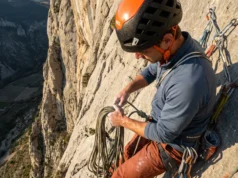
Double the cordelette into a bight. Pull the bight through both bolt hangers. Pull both doubled strands together and tie a Figure-8 on the doubled loop — that’s your BHK. The result is two independent master point loops. One for the belay rope, one for backup.
Check: the master point should hang approximately at chest height from the lip when you’re clipped in, angled back from the edge. If it’s sitting lower than your waist, you’re perched over the edge while managing it. Adjust the cordelette length or your position.
One technical note on the “shelf” setup some climbers use: clipping the strands above the master point knot is not genuine backup redundancy if the cordelette is Dyneema with an overhand knot. Under shock load, that configuration can fail. The BHK on nylon is the standard for a reason.
Carabiner Placement and the Opposite-and-Opposed Rule
Lock one carabiner with gate opening left and facing down; the second with gate opening right and facing down. Gate-side inward toward the cliff reduces spine abrasion on rock.
For steel carabiners at high-volume institutional anchors: aluminum is fine for sport climbing where loads are intermittent. But a top-rope station running 50 laps a day is a different environment. The sandpaper effect of a dirty rope over aluminum builds groove depth fast. Grooves over 1mm become sharp edges that cut rope sheath in dynamic falls. Steel resists this. At ~100g versus ~35g for aluminum, the weight penalty is real. When you’re not carrying the hardware to the top of the pitch, it doesn’t matter.
Hardware Durability and the Anti-Sell on Carabiners

I started switching to steel lockers at the master point after watching grooves form on my aluminum ones in two seasons of regular guiding. The weight penalty is real. So is the rope savings, and so is the reduced sheath damage across a full client roster.
Aluminum carabiners are soft. A climbing rope running over aluminum under lowering loads creates metal oxide dust — that’s the black residue on your rope. Fine aluminum particles embed in the sheath, increasing friction and cutting serviceable life. This is Black Rope Syndrome, and it’s the direct consequence of aluminum hardware at a high-volume master point.
Groove depth greater than 1mm on a carabiner creates a sharp edge. That edge can sever rope sheath in a dynamic fall. The UIAA safety standards for connectors and fixed anchors set the minimum at 20 kN major axis, 7 kN gate open — but that’s a floor, not a comfort zone. You can pass UIAA ratings and still be accelerating rope wear through poor carabiner selection.
The documented consequence: real-world anchor failure chains caused by hardware degradation show that the failure often isn’t a single dramatic break — it’s accumulated wear across a dozen sessions producing invisible damage in the rope system.
Aluminum vs. Steel — The High-Volume Decision Matrix
Weekend cragging on your own gear, occasionally top-roping: aluminum is perfectly adequate. It’s light, reasonably priced, and the wear rate is manageable.
Guided or institutional use — 20+ laps per day, multiple clients, rope running the same path all day — steel is the correct call. Petzl AM’D steel lockers at the master point are a professional standard specifically because of this economics calculation. Cost per year of use is lower. Rope replacement costs drop. One piece of hardware that costs more and lasts longer beats cycling through cheaper alternatives that shorten your rope’s life.

Bolt Assessment Before You Clip
Check visible corrosion, hanger deformation, and the rock around the bolt. Spin-test stainless bolts: if the hanger rotates freely, the bolt has likely failed internally — Stress Corrosion Cracking (SCC) can eat a bolt from the inside without visible surface rust.
The UIAA 123 SCC classification exists because stainless steel bolts at coastal and tropical crags fail under body weight from salt and humidity-induced cracking. If you’re climbing at a coastal crag — Thailand’s limestone, Kalymnos’s south-facing walls — check whether bolts are SCC-rated. Titanium is increasingly replacing stainless at these locations, but even titanium isn’t immune to installation failures. Spin-test regardless.
Pro tip: If a bolt looks questionable, don’t use it alone. Clip both bolts of the station and back them up to a third point if one’s available. Redundancy at the bolt level costs nothing.
Retire Gear Before It Fails
Nylon cordelettes: 10 years maximum, immediately after any severe loading or fall. Carabiners: retire at groove depth over 1mm, after any hard deck fall, or after chemical exposure. Slings and webbing: UIAA recommends 10-year maximum shelf life unloaded, 3-year active use.
The problem with visual-only inspection: internal UV degradation in nylon polymers is invisible until failure. Paint-pen the purchase date on every piece when you buy it. Date it, track it, retire it. Gear that looks fine from the outside can be significantly weaker after two seasons of UV exposure — and you won’t see it until it matters.
Real-World Edge Cases — What Happens When Nothing Is Perfect

Every guide photographs perfectly aligned bolts at a clean granite face. Your crag will have staggered bolts, oxidized hangers, sloping ledges with no flat ground, and edges that want to eat your sling. That’s normal. Learn to build for it.
Staggered bolts: clip the higher bolt first to your PAS, then adjust cordelette leg lengths unequally — longer leg to the lower bolt — so the master point hangs directly above the route below. A Sliding-X is an alternative: it self-equalizes dynamically, but always add overhand stopknots to limit extension to 6–8 inches if a bolt pulls. Without those stopknots, you’ve traded one problem for another.
Tree anchors: the tensionless wrap method is theoretically the strongest anchor you can build — the friction of the wraps is what holds the load. Smooth or wet bark dramatically reduces friction. A cord that looks wrapped solidly can slide down a lichen-covered trunk under load. Minimum tree diameter: 5 inches, per National Park Service anchor regulations at Joshua Tree. Know the park regs before you rig.
For choosing the right personal anchor system for top-managed scenarios, a PAS beats a daisy chain specifically because daisy chains shock-load when clipped to adjacent pockets. On awkward terrain with staggered bolts, your tether geometry matters.
A documented case from Devil’s Lake: a nylon sling extended over a sharp limestone edge appeared redundant — two strands — but a 2mm fin cut through the master point knot in a single session. The fix is 11mm static rope for edge exposure, or foam padding at the contact point. Edge protection isn’t optional when your sling is running over rock.
The horn anchor case is worth knowing: a climber tug-tested a large rock horn, built on it, it passed — until the climber traversed and the direction of pull changed. The cord walked off the horn. Direction of pull is not a one-time assessment. Reassess as climbers move across the wall.

Pro tip: Mark the midpoint of your cordelette before you leave home. A permanent marker dot means you can find center fast, even fumbling on a sloping ledge with wind and a client below.
Building on Staggered Bolts
The adjustment is straightforward once you’ve done it: pull more cord through the lower bolt hanger so that leg is longer, pull less through the higher hanger, and bring both to the same master point location directly above the route. Check that the master point angle stays under 60° despite the asymmetry.
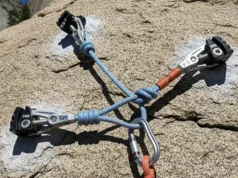
A Sliding-X with stopknots is the faster alternative. Clip both bolts, let the X equalize, tie stopknots on each side of the X so the extension is limited. It’s faster to build than a cordelette BHK, but requires you to nail those stopknots before loading it. Miss the stopknots and you’ve built a self-extending system — which means a bolt failure sends a shock load through whatever is left.
Tree Anchors — The Friction Problem
Minimum two full wraps around a tree with at least 5 inches of trunk diameter, solid root structure, no disease. After wrapping, the cordelette runs back toward the climb with a closing knot. Do not leave a simple wrap clipped with a carabiner — that creates a load path over the bark edge and eliminates the friction advantage of the tensionless method.
Shenandoah prohibits tree anchors on Little Stony Man. Joshua Tree requires trees of at least 5-inch diameter. These aren’t guidelines — they’re regulations that affect access. Carry a 1m tan or gray sling as standard kit. Color-matching slings at sites like Arches where NPS requires hardware to match the rock keeps the crag open. It costs nothing to carry.
Edge Protection for Extending Past Ledges
A cordelette extended over a sharp lip without protection can abrade through at the master point knot in one session. The solution: pad the edge with closed-cell foam, route the rope around the rock feature rather than over it, or use 11mm static rope with superior abrasion resistance where webbing would fail.
Professional guide practice: build the BHK back from the edge on a 30-meter static rope, using the rope’s length to position the master point precisely at the lip. This minimizes abrasion by removing the knot from the edge contact point entirely. I’ve seen slings cut through in a single rapping session. The edge was a 2mm limestone fin. It looked fine from above. It was half severed from below.
Anchor Cleaning and Transitioning — The Skills Nobody Teaches at the Start

Most beginner guides end when the anchor is built. That’s half the system. The back half — getting the climber down, retrieving gear, leaving the station clean — is where most mistakes happen with newer climbers.
For cleaning a sport anchor safely from the top of the route, the Bight Method is the professional standard. Here’s the sequence: tie a backup clove hitch to the anchor while still connected, pull a bight of rope from below through both rings, clip the bight to your belay loop with a locking carabiner, untie your original figure-8 from your harness, pull through the rope, call off belay. Threading the rope directly through rings creates metal wear on the rings and leaves metal contamination in your rope sheath. The bight method avoids both.
The first time I cleaned an anchor properly on lead, I realized how many steps I’d been skipping for a year. It felt weird. After five more times, it was automatic. That’s how most anchor skills work — uncomfortable first, eventually invisible.
The Mountaineers’ step-by-step guide to setting top rope anchors covers the full sequence visually for beginners who need to see the rope path before they trust it.
Pro tip: Always tie stopper knots in both rope ends before rappelling. The leading cause of rappel incidents is rappelling off the end of the rope. A stopper knot takes eight seconds to tie. There is no excuse for skipping it.
The Bight Method for Cleaning Fixed Rings
Step 1: Tie a backup clove hitch to the anchor before disconnecting your original tie-in. Step 2: Pull a bight of rope from below through both fixed rings. Step 3: Clip the bight to your belay loop with a locking carabiner. Step 4: Untie your original figure-8. Step 5: Pull through the rope and call off belay.
Threading the rope directly through fixed rings wears the rings and deposits metal oxide in your rope sheath. The bight method is cleaner mechanically and safer for everyone below.
Rappelling vs. Being Lowered — Choosing the Right Exit
Lowering: faster, simpler, requires an attentive belayer. The right call for beginner top-rope instruction. When the rope is clipped at the master point and your belayer is competent, this is the clean exit.
Rappelling becomes necessary when the descent route doesn’t match the climb, the rope is too short to lower from, or you need to retrieve the anchor from above. When rappelling: stopper knots in both ends, autoblock backup on your brake strand, device weighted before unclipping from the anchor. Not in that order — in every order, every time.
Leaving No Trace — Ethics of Fixed Hardware
Arches NP: replacement anchors must color-match the rock surface. Rocky Mountain NP: bolting is prohibited in Wilderness zones — removable protection, or nothing. Shenandoah: fixed anchors are prohibited if removable pro works. Joshua Tree: new or replacement bolts require a permit.
These are not suggestions. They’re the rules that determine whether climbing access at these crags exists in 20 years. Remove old slings from bolt stations — they’re not gifts to the next party, they’re sun-rotted webbing waiting to fail. Leave the station cleaner than you found it.
Conclusion
Three things from this, because three things you’ll actually remember:
Angle is everything. Keep your master point angle under 60°. The force curve above that threshold doesn’t climb — it accelerates. At 120°, your two-bolt anchor becomes a one-bolt anchor. This isn’t a rounding error; it’s a failure mode.
Material matters more than brand. Nylon for top-rope anchors. Steel for institutional high-volume master points. Dyneema is a different tool for a different job. Matching material properties to the actual use case is what separates a guide’s anchor from a gym climber’s first outdoor setup.
Build for the worst case, not the textbook case. Staggered bolts, wet bark, sharp edges, diagonal pull — these are normal at real crags. The Snip Test on every anchor until you run it in your head without thinking about it: that’s the goal.
Next time you’re at a real crag, run three questions on every anchor you encounter before you trust it: What’s my angle? What’s my material? Does it survive the Snip Test? Run those questions on someone else’s setup too. You’ll see problems most guides never address.
FAQ
What is the best material for a top rope anchor?
7mm nylon cordelette or a pre-sewn nylon quad is the professional recommendation for most top-rope anchor settings. Nylon’s 30% elongation absorbs shock loads that would hit the bolts directly with a stiffer material. Its 245°C melting point gives critical safety margin against rope-on-sling friction under lowering loads. Dyneema is superior for alpine draws where weight is critical, but its 145°C melting point and near-zero elongation make it a poor choice for high-volume top-rope use.
How long should a cordelette be for a top rope anchor?
For a standard two-bolt sport anchor, 20–25 feet of 7mm nylon is the working standard. If you’re rigging a traverse anchor, extending over an edge, or working with widely spaced bolts, bring 25–30 feet. Measure your cordelette before your first use and mark the midpoint with a permanent marker. Finding center in a hurry on a sloping ledge is harder than it sounds.
Is it safe to top rope off two quickdraws?
Two quickdraws on two solid sport bolts is an acceptable emergency setup, but it lacks the redundancy of a properly rigged cordelette or quad. The critical gap: two quickdraws create a shared clip point on the carabiner spine, not a dedicated master point loop. This means if either carabiner fails, both quickdraws come down together. For any guided or instructional setting, a cordelette BHK or pre-sewn quad is the correct build.
How do you equalize three anchor points?
Use a cordelette with three legs brought to a single master point. Tie each leg off individually at the appropriate length, bring all three loop bights together, and secure with an overhand or figure-8 on the bundle. Alternatively, run a sliding-X across two of the three points and add a direct clip to the third — then connect all three to a master point carabiner. The key rule: redundancy cannot be sacrificed for simplicity. Three-point equalization requires all three legs to remain load-bearing even if one fails.
What does the AMGA Snip Test mean for my anchor?
The Snip Test is the AMGA SPI’s mental redundancy check. Mentally cut each component in sequence — if cutting any single piece causes total system failure, the anchor isn’t truly redundant. A proper SERENE-compliant anchor passes: if either bolt fails, the other holds. If either carabiner fails, the other holds. If the master point knot fails, the second loop holds. If your anchor doesn’t pass the Snip Test, rebuild it before loading it.
Safety Notice: Rock climbing and mountaineering are inherently high-risk
activities that can involve physical trauma or fatal incidents. The information on Rock Climbing Realms is for
educational and informational purposes only. Techniques and advice presented here are not a substitute
for professional, hands-on instruction. Conditions and risks vary by location. Always seek guidance
from a qualified instructor before attempting new techniques. By using this website, you agree that you
are solely responsible for your own safety. Any reliance you place on this information is strictly
at your own risk, and you assume all liability for your actions. Rock Climbing Realms and its authors
will not be held liable for any harm, damage, or loss sustained in connection with the use of this information.
Affiliate Disclosure: We are a participant in the Amazon Services LLC Associates Program, an
affiliate advertising program designed to provide a means for us to earn advertising fees by advertising and linking
to Amazon.com. As an Amazon Associate, we earn from qualifying purchases. We are also an official affiliate partner
of Black Diamond Equipment via the AvantLink network. If you click on a Black Diamond affiliate link and make a
purchase, we may earn a commission at no additional cost to you. We also participate in other affiliate programs.
Additional terms are found in the terms of service.