
In this article
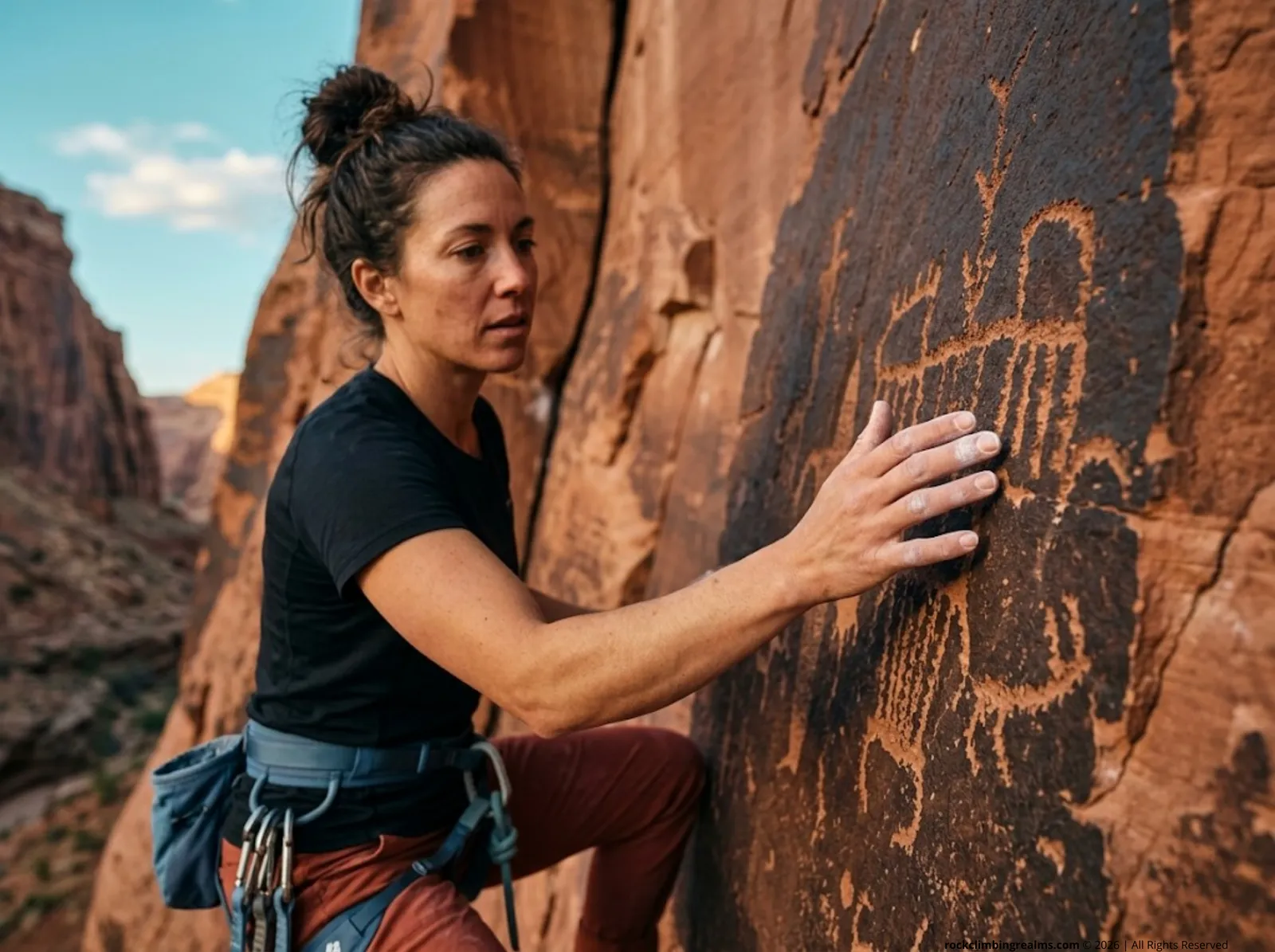
Halfway up a desert sandstone pitch outside Moab, I chalked up on what looked like a blank, dark slab. Then the late-afternoon light shifted. Shadows appeared inside tiny carved depressions — peck marks from a hammerstone, hundreds of years old. I had just smeared magnesium carbonate across a Fremont petroglyph. No amount of brushing would undo it.
After years of climbing in the Southwest — Indian Creek, Bears Ears, Castle Valley — I’ve learned that the most critical outdoor climbing skill isn’t anchor building or crack technique. It’s reading the rock before you touch it.
This guide provides the forensic, legal, and ethical framework every outdoor climber needs to identify, protect, and report cultural heritage sites at the crag. Not as a lecture from a regulator — as a technical skill, taught climber-to-climber.
⚡ Quick Answer: Climbing chalk (magnesium carbonate) permanently damages ancient rock art by destroying the microbial biofilms that form rock varnish, filling petroglyph peck marks with white powder that erases shadow-based visibility, and creating irreversible hydromagnesite bonds when mixed with water. Under ARPA (Archaeological Resources Protection Act), damaging cultural resources on federal land carries fines up to $250,000 and five years in prison. The fix isn’t to stop climbing — it’s to develop the forensic skill of identifying sites before you chalk up.
The Chemistry of Chalk on Ancient Rock — Why It’s Permanent
How Rock Varnish Forms — And Why It Can’t Be Replaced
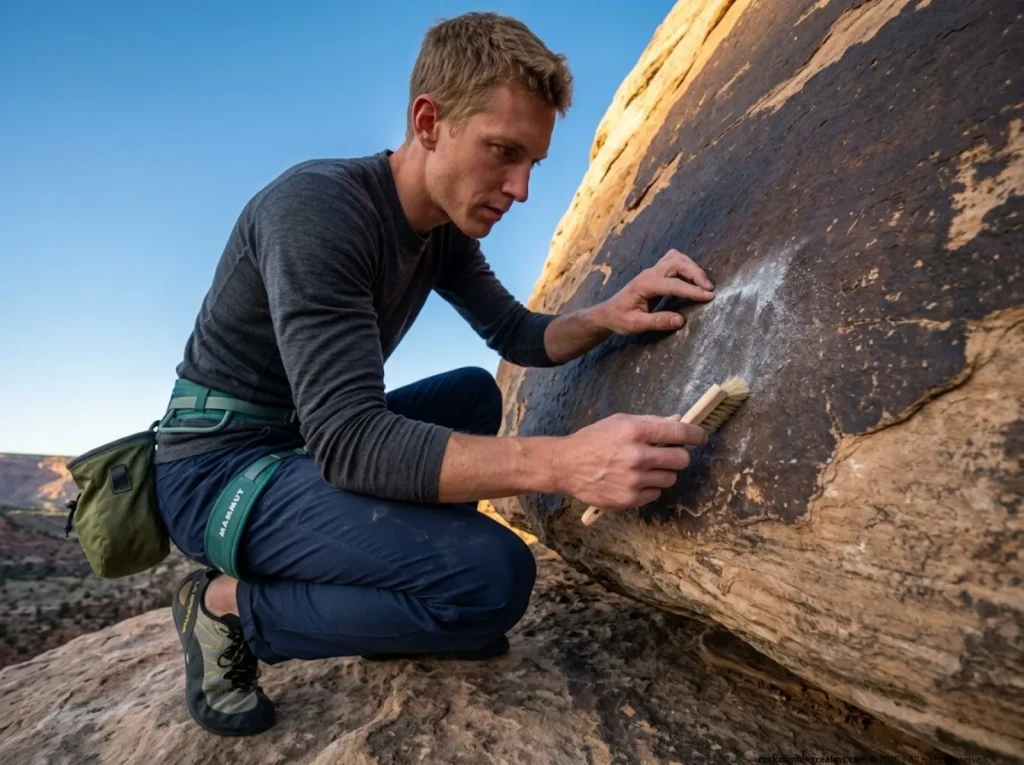
Every desert climber has seen it — that dark, almost glossy coating on sandstone that makes the rock look like it’s been dipped in chocolate. That’s rock varnish, a microscopically thin layer of manganese and iron oxides mixed with clay minerals. It forms over thousands of years in arid environments, growing at a rate measured in micrometers per millennium.
Ancient artists used this varnish as their canvas. They pecked through the dark, oxidized surface with hammerstones to reveal the lighter rock beneath, creating petroglyphs that have outlasted entire civilizations. The varnish also stores paleoenvironmental data — wet/dry climate cycles locked inside its layers like rings in a tree trunk.
Here’s the problem: when climbing chalk contacts that surface, the damage is permanent on any human timescale. The varnish can’t heal itself fast enough. A single chalk smear will outlast you, your gear, and most of the buildings standing right now.
Pro tip: If a rock surface is noticeably darker than the surrounding area, treat it as a high-probability zone for cultural resources. Dark varnish is the first visual warning sign that ancient heritage may be present.
Dry Chalk vs. Liquid Chalk — Two Different Threats to Rock Art
Standard dry chalk works as a desiccant. It strips moisture from the microbial biofilms that are the biological foundation of rock varnish — those organisms are what keep the varnish growing and self-repairing. Eliminate them, and the rock’s “healing” process stops permanently.
And the performance argument doesn’t hold up either. Chalk improves friction on sandstone by roughly 19%, but on polished or non-porous surfaces it actually creates a slippery granular layer that reduces your grip. Excess chalk doesn’t help you climb harder. It just hurts the rock.
Liquid chalk is worse. The ethanol in liquid chalk acts as a carrier solvent, pulling magnesium carbonate particles deeper into the porous matrix of sandstone. The rosin (POF) content can permanently polish the surface into a glassy state — a critical threat to pictograph panels where painted mineral pigments sit in the top few microns of the rock.
Here’s the data point that should keep you awake at night: invisible chalk concentrations have been detected on 65% of sampling points even where no white traces are visible. You can’t see the damage, but it’s there.
The Hydromagnesite Trap — Why Water Makes It Worse
This is the mistake I see most often, and it’s the one that does the most permanent harm.
When chalk dust gets wet — from rain, a water bottle spray, or a well-intentioned cleanup attempt — it forms a hydromagnesite shell. That’s a hard, crusty residue that chemically bonds to the rock surface. Permanently.
So the climber who sprays water on chalk smears near rock art, thinking they’re helping? They just created an irreversible white glaze. The chemical and physical threats that destroy rock art have been extensively documented by the Arkansas Archeological Survey, and hydromagnesite bonding is among the most destructive.
If you accidentally chalk a sensitive area, the protocol is simple: stop. Walk away. Report to a professional conservator. Do not try to clean it yourself. If you need guidance on chalk management in non-sensitive areas, learn how to properly clean chalk from rock without causing further harm. But near cultural sites, hands off.
Professional restoration of chalk-damaged panels runs $10,000 to $15,000. The portable infrared cameras used in conservation work cost $50,000 to $100,000. That’s the cleanup bill when someone tries to “help.”
The Forensic Climber’s Field ID Guide — Spotting What You Can’t Unsee
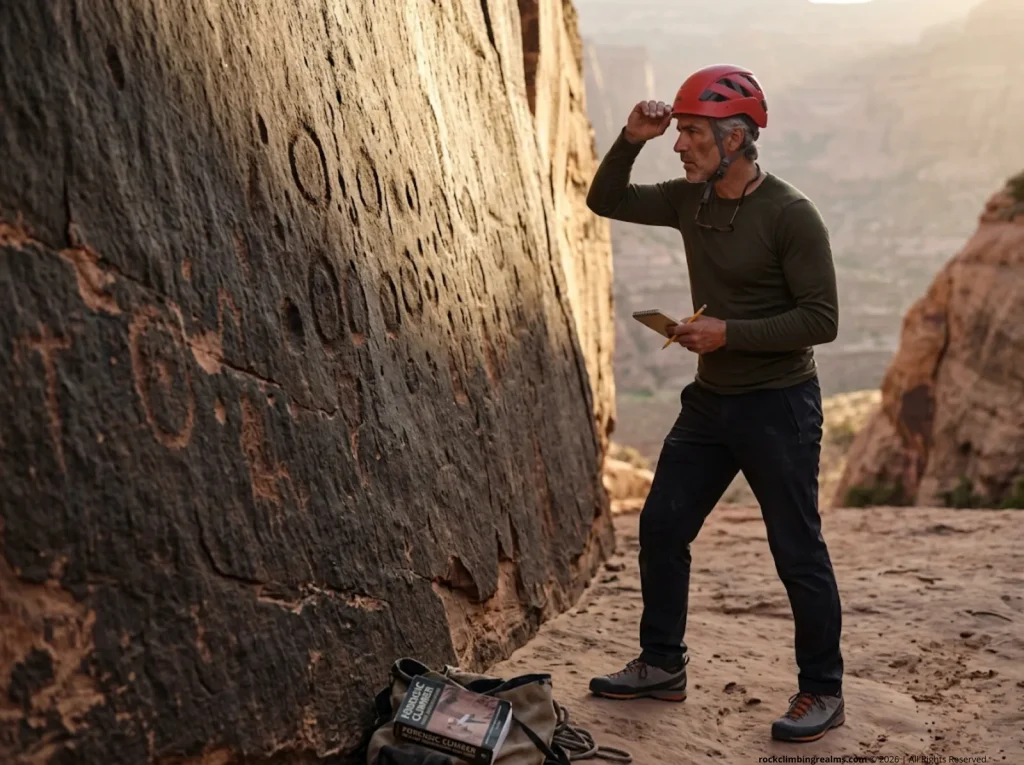
Petroglyphs vs. Pictographs — The Visual Identification Matrix
Two categories. Know the difference.
Petroglyphs are carved. Ancient artists pecked into dark-varnished rock with hammerstones, leaving small indentations — peck marks — where the lighter base rock shows through. Look for patterns in the contrast between dark varnish and light exposed stone.
Pictographs are painted. Mineral pigments — ochre, iron oxides — applied directly to rock surfaces, usually in sheltered alcoves where weather can’t reach them. The pigment binders (animal fats and plant oils) degrade under UV and are extremely sensitive to chalk absorption.
Both forms can be over 12,000 years old. Both are irreplaceable. And both are easy to miss if you don’t know what you’re looking for.
Pro tip: The Mirror Test — if you see something that looks man-made, check the surrounding rock. Natural geological features repeat across strata. Human-made marks don’t. If the pattern breaks the geology, stop and look closer.
One more thing: fake-o-glyphs — modern carvings meant to look old — are surprisingly common near campgrounds and popular areas. You can distinguish them from authentic petroglyphs by checking for varnish re-growth inside the carved lines. Real petroglyphs that are centuries old will show partial re-varnishing in the grooves. Fresh carvings won’t.
The Shadow Play Technique — Reading Rock at Different Sun Angles
This is the single most valuable field identification skill in this entire article.
Faint petroglyphs are often invisible at noon. The peck marks are so shallow that direct overhead light eliminates the shadows that make them visible. But visit the same wall at golden hour — when the sun hits the surface at a low angle — and suddenly shadows fill every carved depression, and images that were invisible an hour ago jump off the rock.
Researchers using hyperspectral imaging have found ancient handprints on surfaces that appear completely blank to the naked eye. So the wall you’ve been chalking and climbing for years? It might not be “blank” at all.
This is what I call the invisible art trap — assuming a wall has no cultural value because nothing is visible to you, right now, at this sun angle. That assumption is the single most common mistake climbers make at heritage sites.
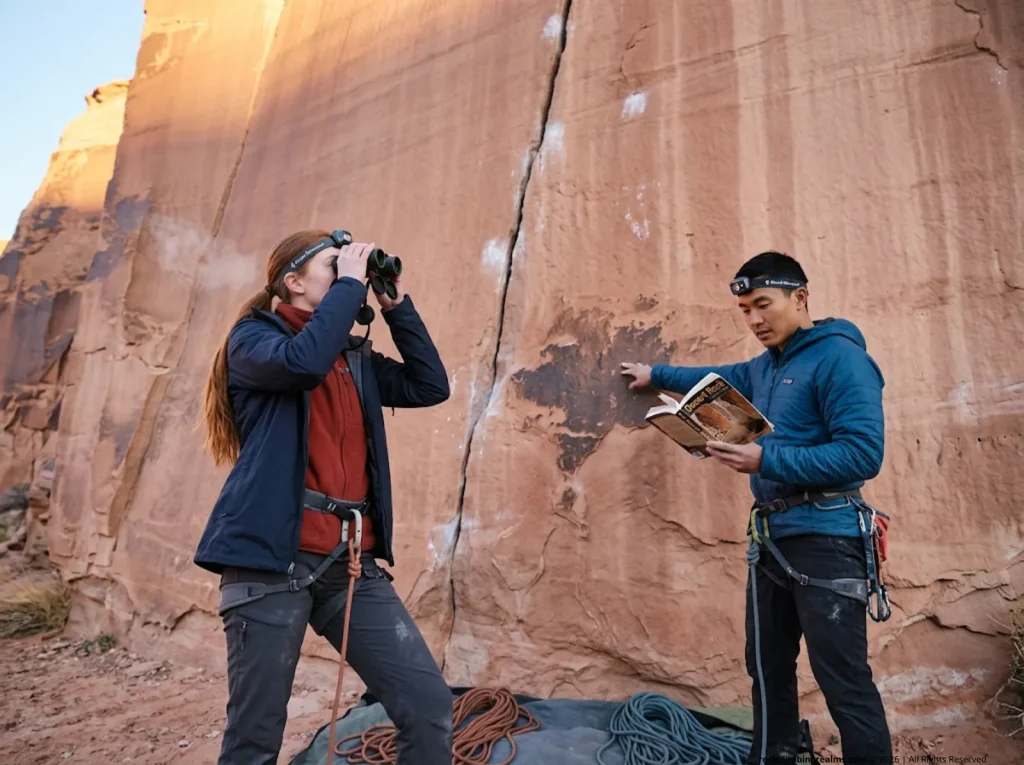
Before you chalk up for a high-ball or new lead, run the 360-Degree Scan: step back and visually sweep the entire rock face for manganese varnish patterns, color anomalies, and repeated geometric shapes. It takes sixty seconds. It could save a site that’s survived 10,000 years.
The “Sunshine Wall” Lesson — When Misidentification Has Real Consequences
In 2022, a climber named Richard Gilbert bolted through a panel of Fremont petroglyphs near Moab. He mistook the ancient carvings for modern graffiti because they were near a campground.
The Access Fund issued a rare public condemnation: “We unequivocally condemn the recent actions… that compromised the integrity of petroglyphs, sacred Indigenous cultural artifacts.”
This case study distills the core problem. In the gym, every wall is a blank slate. The routesetters put the holds there yesterday, and the wall itself is just plywood and paint. But the gym-to-crag transition doesn’t come with an archaeology lesson. Nobody teaches you to read rock surfaces for cultural significance before you start drilling.
That education gap — between indoor climbing and outdoor archaeological sensitivity — remains the single biggest failure in the climbing community. If you want a broader framework for respecting the rock, start with the science-backed ethics of climbing in desert environments.
The Legal Framework — What ARPA Means for Every Climber
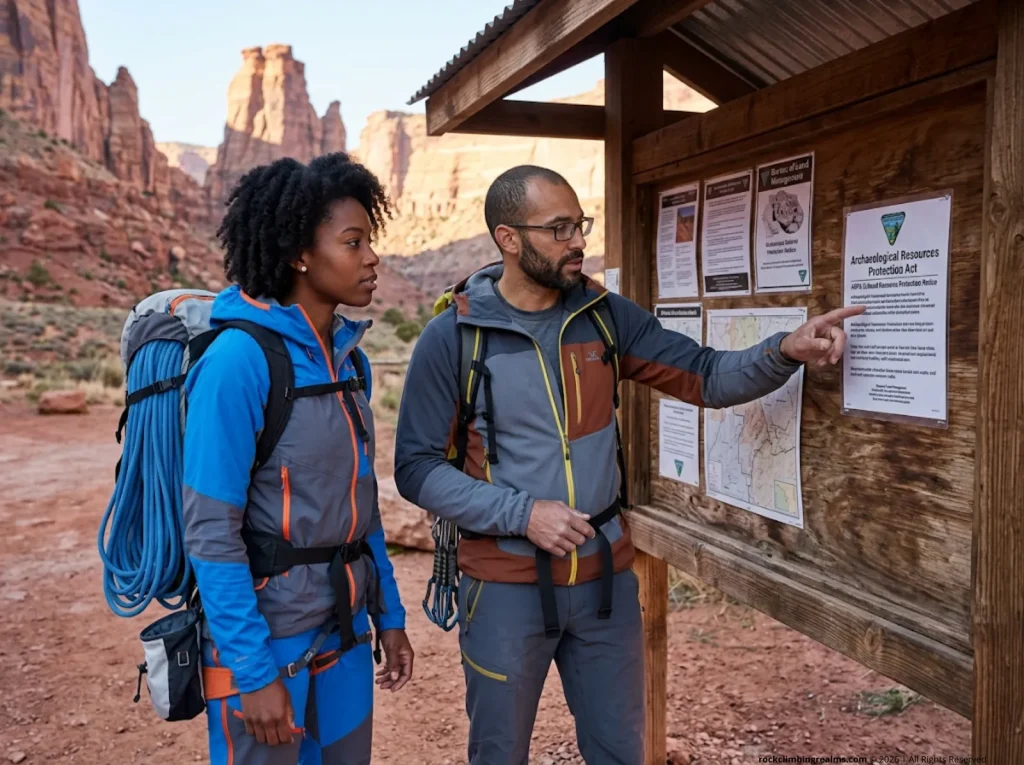
ARPA in Plain English — Fines, Prison, and Gear Seizure
The Archaeological Resources Protection Act of 1979 protects all archaeological resources over 100 years old on federal and Indian lands. “Damage” under ARPA covers a wider range of activities than most climbers realize: bolting through panels, scrubbing rock art with brushes, obscuring images with chalk, even removing small artifacts from the ground near a site.
The penalty tiers are steep. Damage valued under $500 is a misdemeanor. Over $500, it’s a felony — and first-time offenders face up to $250,000 in fines and five years in prison. You can review the full text and legal background of the Archaeological Resources Protection Act through the National Park Service.
Here’s the detail most climbers miss: ARPA allows for the forfeiture of climbing gear and vehicles used in the commission of a violation. Your rack, your ropes, your truck — all subject to seizure.
And this isn’t theoretical. The Bureau of Land Management has increased enforcement and now offers rewards up to $4,000 for information on cultural site vandalism. In Wyoming alone, approximately 25% of the 1,100 documented Indigenous rock art sites have been vandalized or defaced.
The PARC Act and Its Conditions — Fixed Anchors Are Conditional
The PARC Act (Protect America’s Rock Climbing Act) codified that fixed anchors are appropriate in Wilderness — but that approval came with conditions attached. The climbing community’s right to use permanent hardware depends on demonstrated ability to act as responsible land stewards.
In areas of high cultural density — Indian Creek, Moab, Bears Ears National Monument — the move is to prioritize removable protection over bolts. A cam leaves no trace. A bolt is a permanent wound in the rock face, and in a culturally sensitive zone, that wound can become a federal case.
If you want the backstory on how close the climbing community came to losing fixed anchor access entirely, read about the ongoing fight over fixed anchor policy in American wilderness.
Pro tip: When climbing in the desert Southwest, default to trad gear whenever the route allows it. Cams and nuts leave no permanent mark. In areas where fixed anchors already exist, inspect them for proximity to varnished panels — and report anything suspicious to the managing agency.
The Sacred Ground — Indigenous Perspectives Every Climber Must Hear
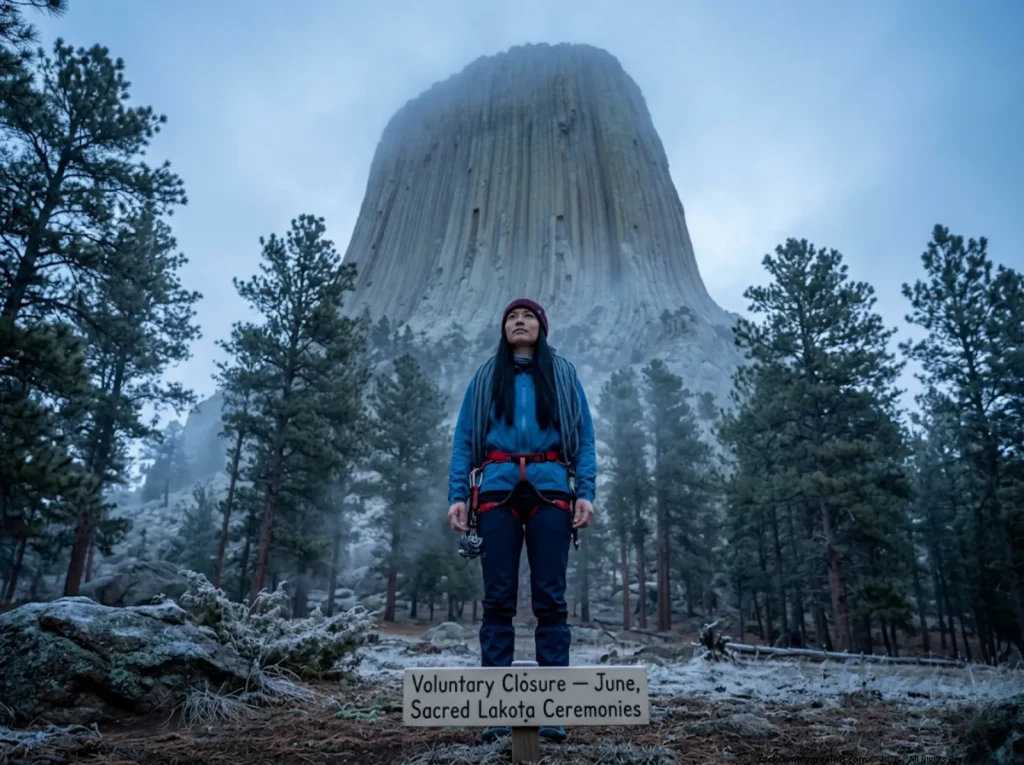
“You’re Climbing One of Our Grandfathers” — The Spiritual Framework
This isn’t about compliance. It’s about understanding.
Waylon Black Crow Sr., Oglala Lakota, on Devils Tower: “Those rocks represent grandfathers. So when people climb Devils Tower it’s like they’re climbing one of our grandfathers and it’s disrespectful.”
Chris Peters, Pohlik-lah tribal member: “Sacred sites are not sacred because Native people believe they are. They are sacred in and of themselves. Even if every one of us disappears, they will still be sacred.”
These aren’t abstract philosophical positions. They are perspectives shaped by thousands of years of relationship with the land — a form of expertise that most climbing publications never acknowledge.
Traditional Ecological Knowledge (TEK) and Land Management
Traditional Ecological Knowledge represents millennia of systematic environmental observation. It is not folklore. It is not superstition. It’s a rigorous, long-form dataset that often captures ecological dynamics too subtle for modern short-term studies.
Tribal Historic Preservation Officers emphasize that cultural sites are not museums. They are not relics. They are active, living spiritual places where physical intrusion — whether from a bolt, a chalk smear, or a camera flash — carries weight and consequence.
When a fixed anchor appears on a sacred site, it is not perceived as a climbing convenience. It is received as a permanent physical scar on a living ancestor. That distinction matters for how the climbing community engages with access restrictions going forward.
Voluntary Closures and the Ethics of Compliance
Devils Tower has a voluntary climbing closure every June to honor Lakota ceremonies. Voluntary. Not mandatory.
But here’s the strategic reality: when climbers treat voluntary closures as optional, they signal to regulators that mandatory restrictions are necessary. Every climber who ignores a voluntary closure builds the case for a permanent ban.
Voluntary compliance is the single strongest argument against future mandatory climbing access restrictions. If you care about keeping crags open, understanding the real threats to climbing access and how to fight them is non-negotiable.
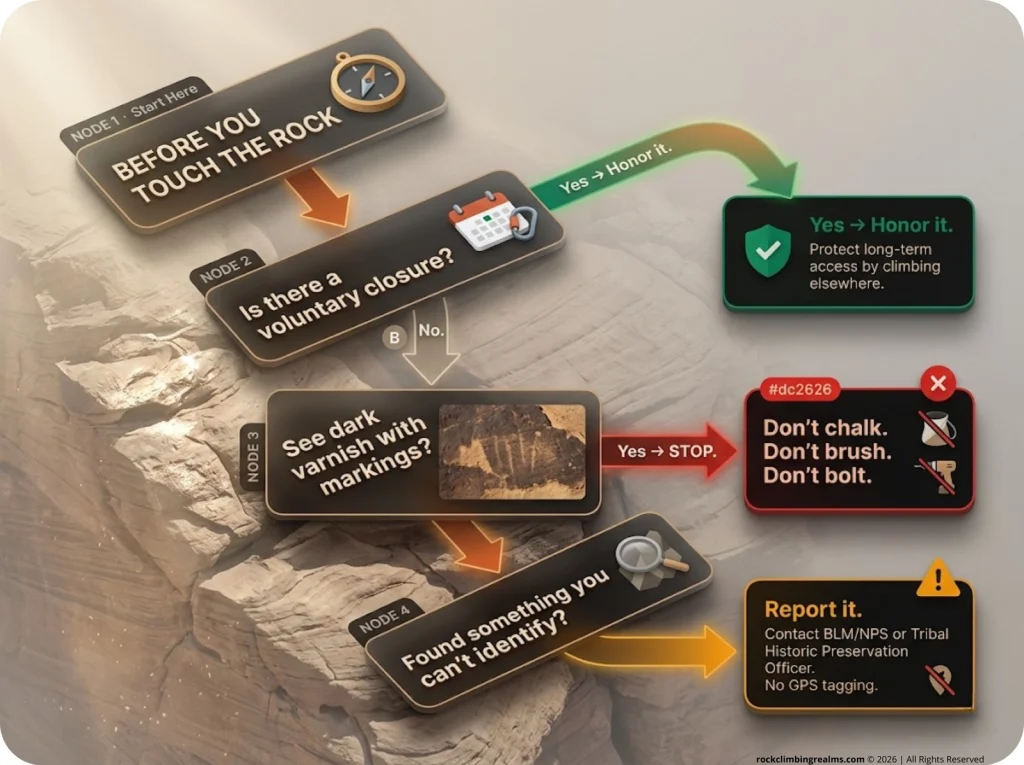
The Digital Beta Problem — When GPS Tags Expose Sacred Sites
Mountain Project and the Accountability Gap
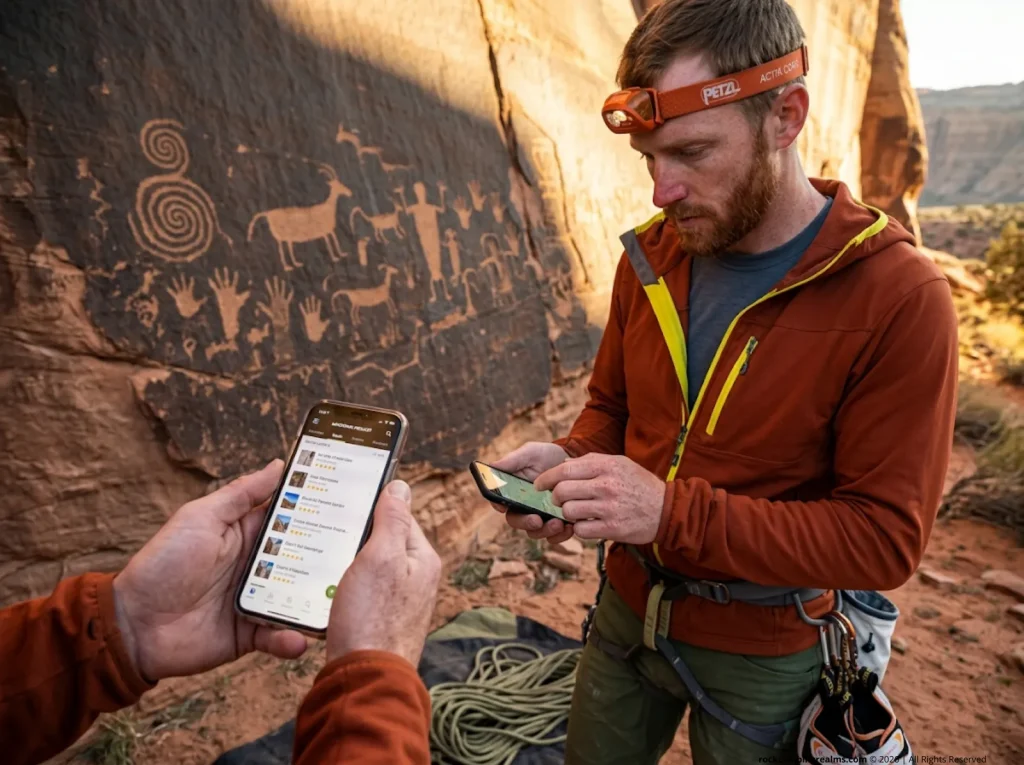
Climbers routinely GPS-tag routes with exact coordinates on Mountain Project — and there are zero accountability standards for identifying routes that pass through or near cultural sites.
Think about what a typical route description looks like: “Great sandstone. Dark varnish. Excellent friction.” That might be describing a petroglyph panel without the poster having any idea. Once a site like that gets geotagged with coordinates and a four-star rating, traffic increases exponentially. A crag that saw two parties a week suddenly draws twenty. And every one of those climbers brings chalk.
This is digital beta in its most destructive form — not deliberate exposure, but careless sharing of location data for sensitive areas without understanding the consequences. Some established climbing areas — certain sections of Indian Creek, for example — have deliberately un-published route information to protect adjacent cultural resources.
The climbing community needs a standard: if a new route passes within visual range of heritage sites, coordinates should be withheld from public databases. This isn’t gatekeeping. It’s stewardship. The distinction is critical.
The Ethics of Sharing — Balancing Beta and Protection
Before posting any new outdoor route, scan your photos for cultural features — peck marks, painted figures, geometric shapes on dark varnish. If you see anything suspicious, omit the GPS coordinates. Contact a local Tribal Historic Preservation Officer instead.
If you find yourself needing to report a discovery — or flag a route that shouldn’t be published — learn how to report climbing access issues through proper channels. The process exists, and using it correctly protects both the site and your access.
Pro tip: Before uploading any climbing photos to social media or route databases, zoom in on the background rock. Faded pictographs and shallow petroglyphs are often invisible at climbing distance but clearly visible in a high-resolution photo. If you spot something after the fact, contact the managing agency — don’t just delete the photo and forget about it.
The Stewardship Protocol — Your Pre-Climb Heritage Checklist
Before You Leave the Car — Research and Reconnaissance
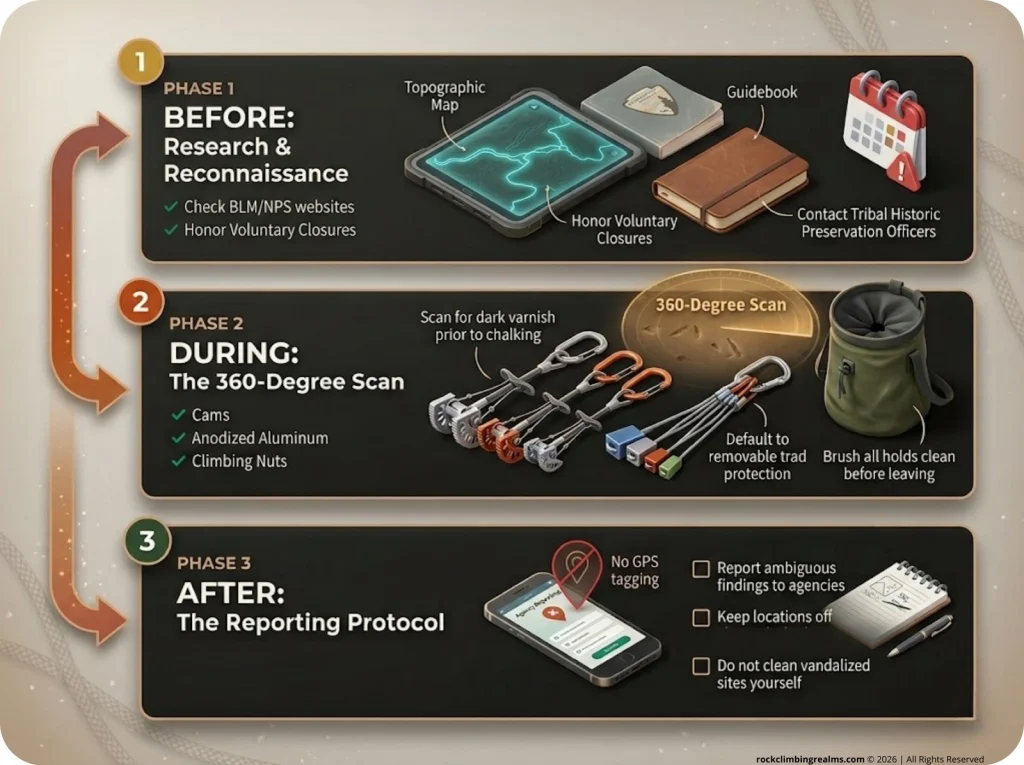
Check BLM and NPS websites for active cultural resource advisories in your climbing area. Contact the local managing agency (NPS, BLM, USFS) for site-specific guidance — many cultural zones are not marked with signage and don’t show up on standard climbing apps.
Review volunteer closure calendars. If you’re climbing in the Southwest — Bears Ears, Indian Creek, Moab — assume cultural density is high and plan your route selection accordingly.
At the Crag — The 360-Degree Scan and Removable-First Protocol
Run the 360-Degree Scan before chalking up. Step back from the wall and sweep for dark varnish patterns, geometric shapes, color anomalies, and anything that breaks the natural geological grain of the strata.
In high-cultural-density areas, default to removable protection — cams and nuts over bolts. Brush chalk off holds after every session. Think of it as the climbing equivalent of flushing the toilet — basic courtesy to the next climber and the rock.
If you must use tick marks, keep them tiny. Use colored chalk that approximates the rock’s natural varnish. And brush everything off before you leave. No exceptions.
After You Find Something — The Report Protocol
If you spot something that looks like a cultural artifact while climbing, stop. Do not touch it, photograph it with flash, or tag it on social media with coordinates.
Report to the managing agency — BLM, NPS, or USFS — with a general location description. If the site is on or near tribal land, contact the relevant Tribal Historic Preservation Officer. If the site appears recently vandalized, document what you see (chalk smears, bolt holes, brush marks) and report to the BLM’s reward program for cultural site vandalism tips. Tips are worth up to $4,000.
Building this practice into your routine is part of a larger commitment. If you haven’t already, read the practical field guide to the Climber’s Pact — it’s the foundation of everything we’re talking about here.
Conclusion
Three things to remember.
Chalk damage is permanent. A hydromagnesite bond lasts longer than you will. The No-Water Rule is as non-negotiable as tying a backup knot.
Identification is a climbing skill. The 360-Degree Scan, the Mirror Test, and the shadow play technique belong in your toolkit alongside anchor building and crack jamming. Learn to read the rock before you touch it.
Voluntary compliance is leverage. Every climber who honors a voluntary closure on a sacred site protects long-term access for the entire community. Every climber who ignores one builds the case for a permanent ban.
Next time you’re at a desert crag, spend ten minutes scanning the rock before you chalk up. The things you’ll learn to see will change the way you look at every wall — indoor or out.
Now go send something.
FAQ
Is it illegal to climb on petroglyphs?
Yes — under ARPA (Archaeological Resources Protection Act), damaging archaeological resources over 100 years old on federal or Indian land is a federal offense. Penalties include fines up to $250,000 and five years in prison. Even unintentional chalk contact can constitute alteration under the statute.
How can you tell if a rock has cultural value?
Look for peck marks (small indentations from hammerstones) on dark varnished surfaces, painted figures in sheltered alcoves, and geometric shapes that don’t repeat in the natural strata. Use low-angle light to reveal faint petroglyphs invisible at midday.
Does chalk damage rock art?
Yes — permanently. Magnesium carbonate destroys the microbial biofilms that form rock varnish, fills petroglyph peck marks with white powder, and alters surface pH. When mixed with water, it forms a hydromagnesite shell that cannot be removed without professional intervention costing $10,000 or more.
What should I do if I find a petroglyph while climbing?
Stop climbing that section immediately. Do not touch, photograph with flash, try to clean, or tag the location on social media. Report to the managing federal agency (BLM, NPS, or USFS) with a general location description and contact the relevant Tribal Historic Preservation Officer.
Which climbing areas are closed for cultural reasons?
Notable examples include the voluntary June closure at Devils Tower (Lakota ceremonies), seasonal closures in Bears Ears National Monument, and specific panel protections at sites across the Colorado Plateau. Check BLM and NPS websites for current advisories before any desert climbing trip.
Safety Notice: Rock climbing and mountaineering are inherently high-risk
activities that can involve physical trauma or fatal incidents. The information on Rock Climbing Realms is for
educational and informational purposes only. Techniques and advice presented here are not a substitute
for professional, hands-on instruction. Conditions and risks vary by location. Always seek guidance
from a qualified instructor before attempting new techniques. By using this website, you agree that you
are solely responsible for your own safety. Any reliance you place on this information is strictly
at your own risk, and you assume all liability for your actions. Rock Climbing Realms and its authors
will not be held liable for any harm, damage, or loss sustained in connection with the use of this information.
Affiliate Disclosure: We are a participant in the Amazon Services LLC Associates Program, an
affiliate advertising program designed to provide a means for us to earn advertising fees by advertising and linking
to Amazon.com. As an Amazon Associate, we earn from qualifying purchases. We are also an official affiliate partner
of Black Diamond Equipment via the AvantLink network. If you click on a Black Diamond affiliate link and make a
purchase, we may earn a commission at no additional cost to you. We also participate in other affiliate programs.
Additional terms are found in the terms of service.