
In this article
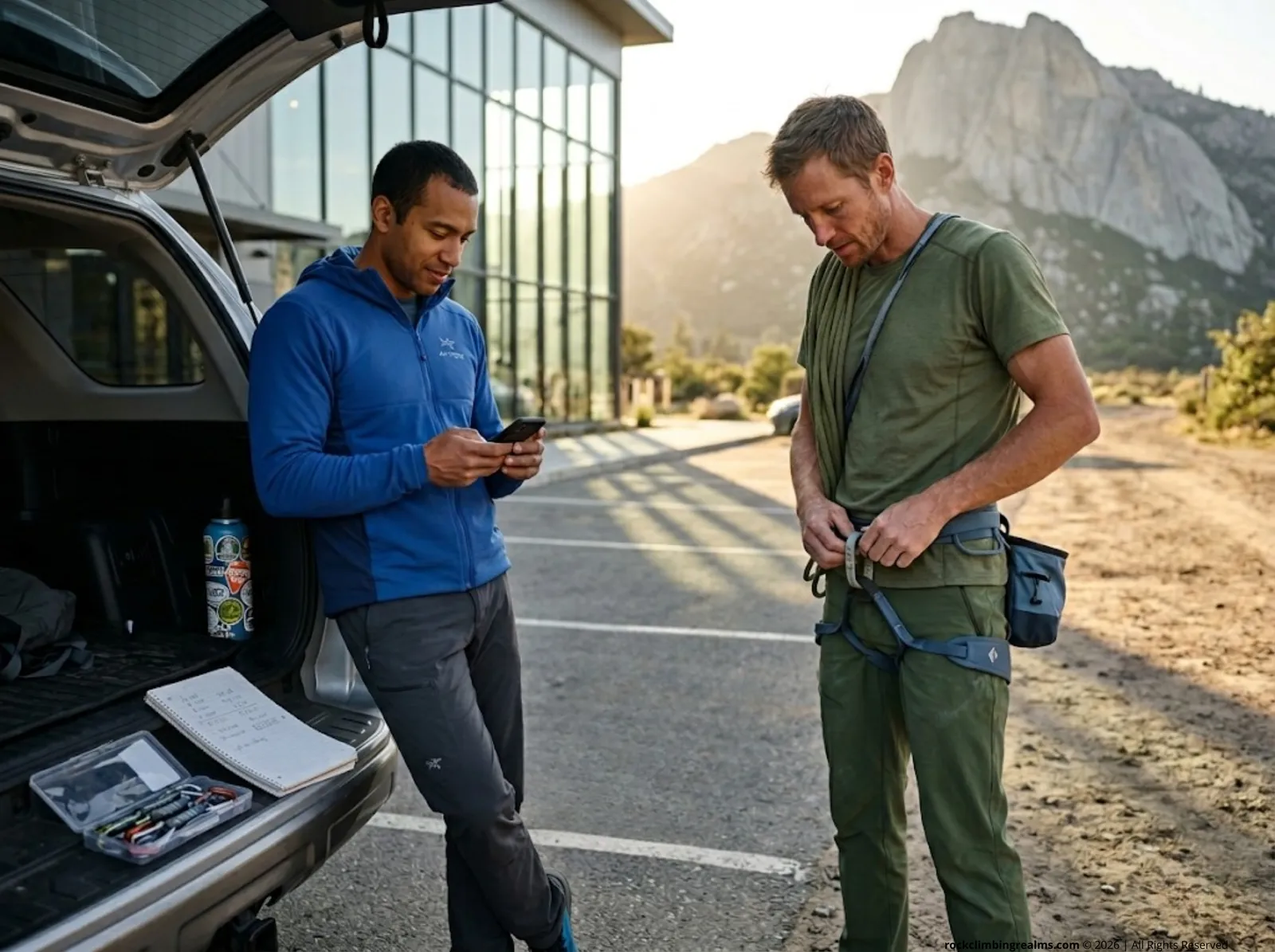
I’m sitting in the parking lot of a $120-a-month climbing gym, staring at an AAC membership renewal on my phone, doing the math on an old receipt. Two hundred bucks a year for rescue insurance I hope I never use — or three more months of autobelay sessions on plastic holds. The rational choice isn’t obvious, and nobody in the locker room is talking about it.
Then I open ExpertVoice. A full set of Black Diamond Camalot C4s drops from $650 to $487. A 70m Mammut rope goes from $280 to $210. In one purchase cycle, that $100 club membership saves me $370. The napkin math speaks for itself.
After a decade of holding both a climbing gym membership and an AAC Partner card — tracking every dollar through both systems — I built a decision framework that most “gym vs. outdoor” articles never touch. This guide breaks down the total cost of ownership for climbing memberships, from the monthly dues at your local gym to the tiered club structure that provides insurance, gear discounts, and access advocacy. By the end, you’ll know exactly where your money returns the most value for your specific objectives.
⚡ Quick Answer: A climbing gym ($80-$130/month) is your best investment for year-round training density and partner finding. A climbing club like the American Alpine Club ($100/year at Partner level) provides rescue insurance, 25-60% pro deals via ExpertVoice, and land access advocacy. Most serious outdoor climbers need both — the gym builds the engine, the club provides the safety net and gear savings that offset its own cost in a single purchase.
The Economics of Indoor Climbing — Where Your $100/Month Actually Goes
Monthly Dues vs. Actual Training Value
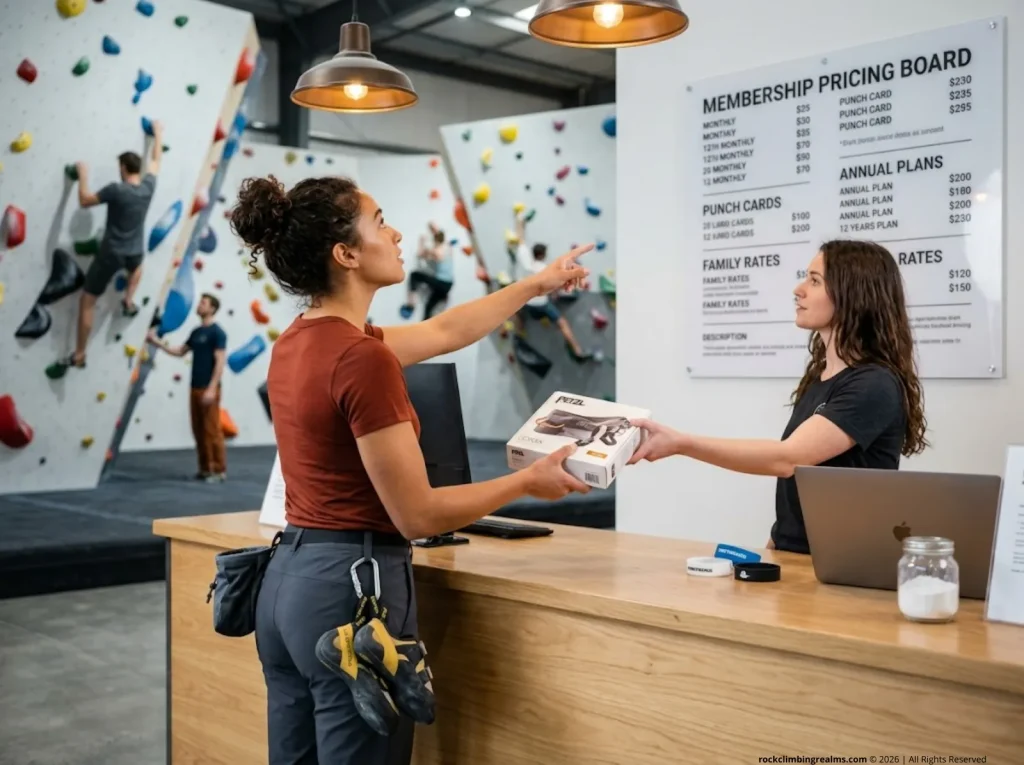
The typical high-tier U.S. climbing gym membership runs $80 to $130 per month — that’s $960 to $1,560 annually. This positions indoor climbing as a premium fitness product, competing with CrossFit and boutique studios rather than your neighborhood Planet Fitness.
The numbers behind that price tag are staggering. The global climbing gym market hit $3.32 billion in 2024 and is projected to reach $7.6 billion by 2034. North America accounts for 37.1% of that revenue, according to U.S. Bureau of Economic Analysis outdoor recreation data. Bouldering-specific facilities generated $1.37 billion alone, growing at roughly 20% year-on-year — fueled by the fact that you only need shoes and chalk to walk in the door.
Here’s what those numbers mean for you: in 2024, 44% of new U.S. gyms were expansion builds by existing corporations, not indie startups. Ninety percent of new facilities open in cities that already have climbing infrastructure. The industry is “deepening,” not spreading — which means your gym is increasingly competing on extras like saunas, yoga, and hybrid fitness models rather than wall quality alone.
Pro tip: When gym-shopping, ask about routesetting frequency. A gym that resets walls every two to three weeks delivers dramatically more movement variety than one that resets monthly. That’s your real training ROI — not the steam room.
If you’re weighing whether the climbing gym membership is worth it, consider what it actually buys: climate control, independence from weather and daylight, and access to standardized training tools like hangboards and system walls. Whether that justifies $100+ a month depends entirely on how you use it.
When you’re ready to evaluate your options, understanding the hidden factors that separate a great gym from an expensive mistake can save you hundreds in wasted contracts.
The Three Pillars of Gym ROI
The physical return on a gym breaks down into three pillars.
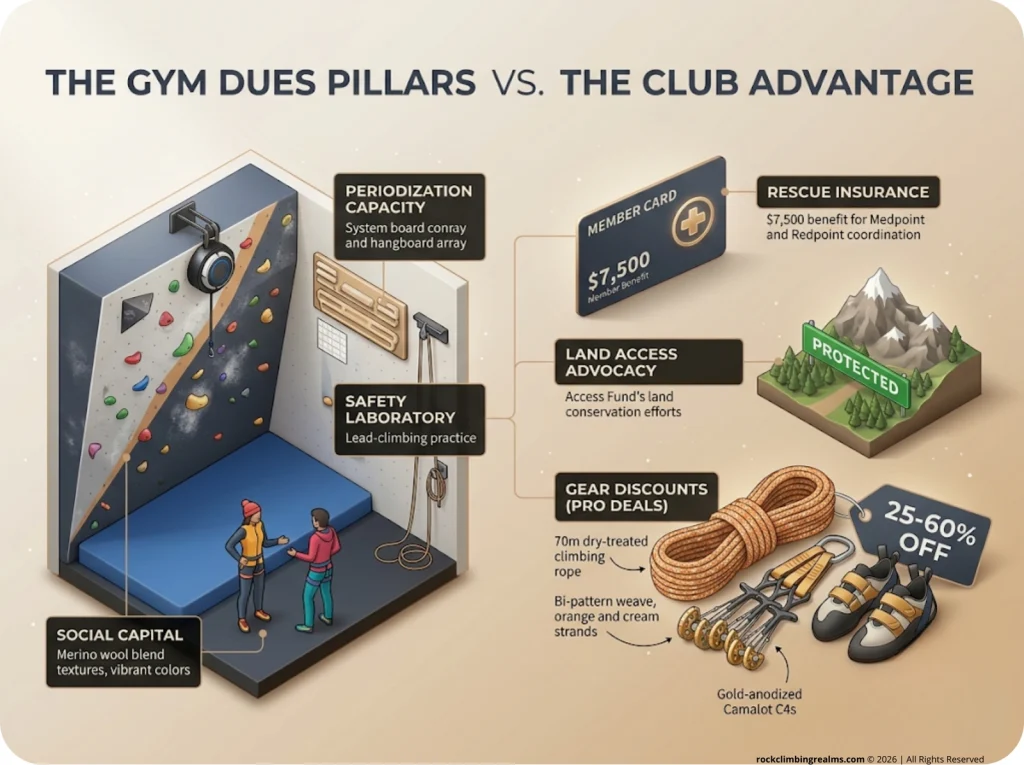
First, periodization capacity. Gyms allow structured training protocols — 4x4s for power endurance, max hangs on standardized hangboards, limit bouldering sessions — that natural crags simply can’t replicate consistently. You can train with precision regardless of season.
Second, safety training. Controlled environments let you practice lead falls and belay mechanics under staff supervision, reducing the consequence cost of early-stage errors. This is your practice laboratory.
Third, social capital. Gyms are the primary clearinghouse for partner finding, which is essential for transitioning into lead climbing, trad climbing, and multi-pitch. Without a partner, your gym membership is just an expensive bouldering pass.
When the Gym Becomes a Trap
Indoor grades are deliberately “soft” compared to outdoor ratings. This is a commercial consideration by gym operators to encourage progression and retention among casual participants. A gym 5.11 often feels like a crag 5.9 or 5.10a.
The gym graduate — someone proficient at indoor V5 or 5.11 — often discovers that outdoor competency is an entirely different skill set: reading natural rock without chalk marks, placing protection on run-outs, cleaning anchors, managing real exposure. Gym climbing builds the engine — strength, power, movement patterns. Outdoor climbing builds the driver — decision-making, technique, risk assessment. One without the other is a half-system.
The Climbing Club Advantage — Insurance, Advocacy, and the Safety Net You Don’t Have
AAC Membership Tiers — What $45 to $250 Actually Covers
While gyms provide the physical wall, organizations like the American Alpine Club, The Mountaineers, and the Access Fund provide the legal, educational, and insurance infrastructure that makes outdoor climbing viable. In a sport where a single rescue can cost $10,000 to $50,000, these organizations represent a massive ROI for anyone venturing beyond padded floors.
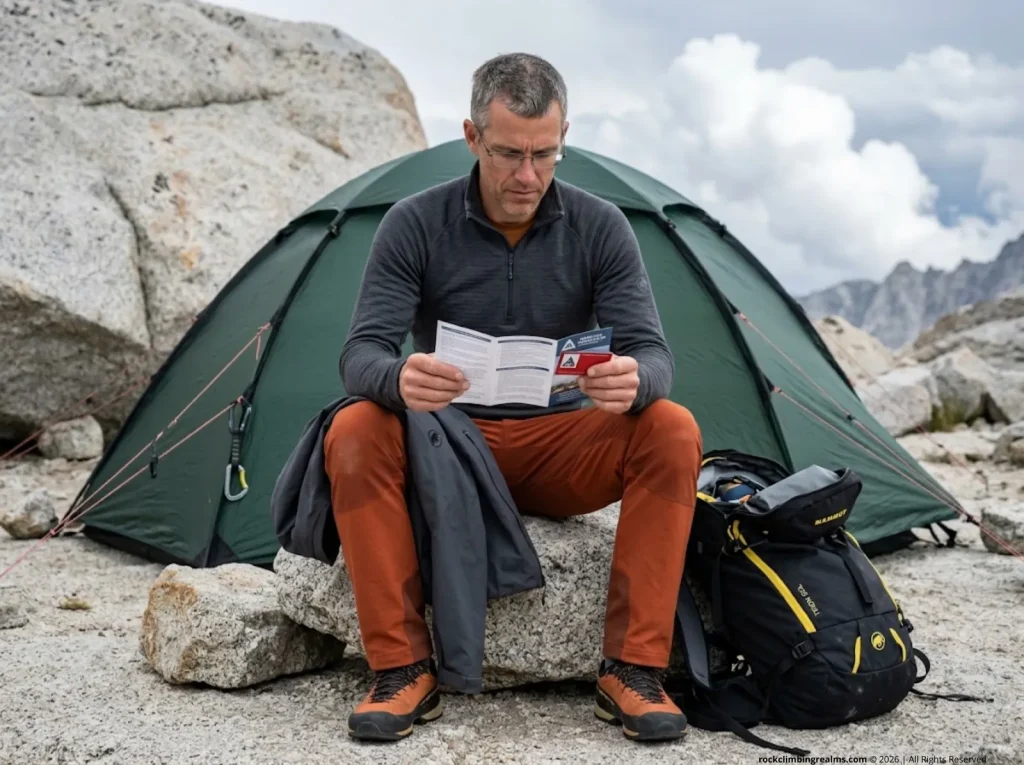
The AAC operates a tiered structure. The Supporter level ($45/year) covers gear discounts, library access, and advocacy support — solid for students and indoor-only climbers. The Partner level ($100/year) is the industry standard for recreational outdoor climbers: it includes $7,500 domestic rescue via Redpoint Travel Protection, $5,000 medical expense per incident, and full ExpertVoice pro deal access. The Leader level ($250/year) targets alpine climbing and international objectives with a $300,000 evacuation benefit covering repatriation to a home hospital.
The AAC reported $7.91 million in revenue and $10.7 million in total assets in 2024. This is a well-funded organization with real financial muscle, not a volunteer side project.
For a deeper look at how the numbers break down across tiers, I wrote a full analysis of the real financial ROI of an AAC membership.
The Rescue Insurance Math Nobody Explains
Standard health insurance policies often carry “hazardous activity” exclusions that can deny claims related to mountaineering or technical rock climbing. That detail alone makes club membership a hedge worth having.
The AAC’s $5,000 medical expense benefit is the piece most people overlook. Unlike the rescue benefit, which requires coordination with Redpoint, the medical reimbursement applies for emergency stabilization away from home regardless of whether a formal rescue occurred. This is an essential safety net for road-tripping climbers facing out-of-network ER fees.
Critical exclusions worth knowing: the policy doesn’t cover pre-existing conditions treated within 45 days of travel, or injuries resulting from intoxicants. Rescue services are also excluded above the Arctic Circle unless a “polar upgrade” is purchased.
Pro tip: Keep your AAC member card in your wallet AND a photo of your policy number on your phone. SAR teams and hospital admissions will ask for it, and you won’t have cell service at the trailhead.
The Access Fund — Protecting the Crags You Climb On
The Access Fund represents the advocacy arm of the community. Since its founding, the AF has protected over 40 million acres of public climbing land, according to Access Fund’s land protection record. That’s not a footnote — it’s the entire reason some of your favorite crags still exist.
The AF was a key force behind the PARC Act (Protect America’s Rock Climbing Act), which seeks to codify the legality of fixed anchors in wilderness areas. Without it, existing federal policy could ban all fixed protection on public wilderness land — effectively erasing every sport climbing route in those zones.
Joint memberships combining the AAC and Access Fund simplify the cost and bundle rescue insurance with land access protection. If a crag closes due to liability or mismanagement, the value of all your gear and training drops to zero. The AF is the organization actively preventing that scenario.
The ExpertVoice ROI — How a $100 Membership Pays for Itself
The Mathematics of Outfitting a Rack
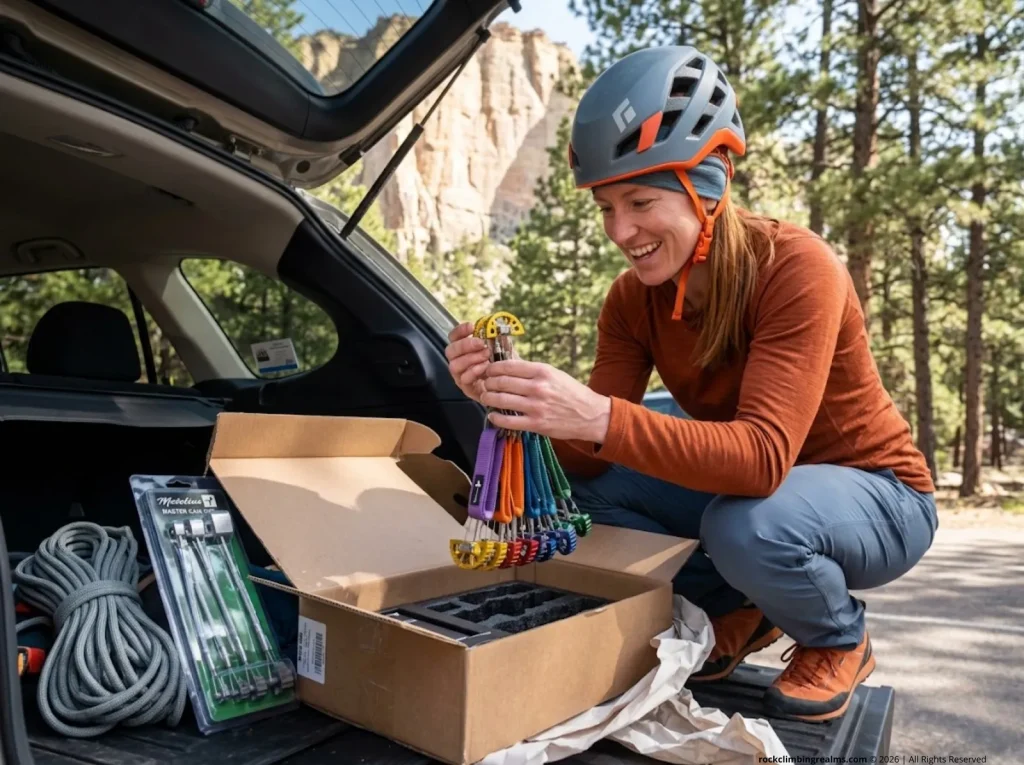
This is where the financial justification gets hard to argue with. A standard trad starter rack — cams, nuts, quickdraws, rope, shoes — exceeds $2,000 at retail. Through ExpertVoice discounts at the AAC Partner level, savings reach $370 or more on a single purchase cycle. That’s a 370% direct ROI of membership on a $100 investment.
The breakdown is specific: a BD Camalot C4 set drops from $650 to $487.50. A 70m dynamic rope from $280 to $210. Twelve quickdraws from $240 to $180. A pair of performance shoes from $190 to $142.50. For climbers pursuing high-altitude objectives where gear costs exceed $5,000 — tents, down suits, expedition boots — annual savings surpass $1,500. ExpertVoice provides access to over 300 brands including Black Diamond, Petzl, La Sportiva, and Mammut.
Pro tip: Stack your ExpertVoice purchases. Place one large order at the start of your season instead of buying gear piecemeal throughout the year — you’ll hit free shipping thresholds faster and avoid impulse buys on items you don’t need.
If you’re building your first rack, understanding what actually belongs in a first trad rack will help you prioritize those savings on gear that matters.
The Guidebook Library — A Hidden Membership Perk
One of the most underrated hidden perks of the AAC is the world’s largest mountaineering library. Members can borrow guidebooks for almost any crag globally, paying only return shipping. With modern guidebooks running $40 to $60 each, a climber visiting three new areas annually saves $120 to $180, further amortizing the cost of membership.
This benefit is almost never mentioned in competitor content. If you’re a road-tripper who hits new crags every season, the library alone shaves a significant chunk off your travel budget.
The Gym-to-Crag Transition — The Skill Gap That Gets Climbers Hurt
Indoor vs. Outdoor — The Reality Check
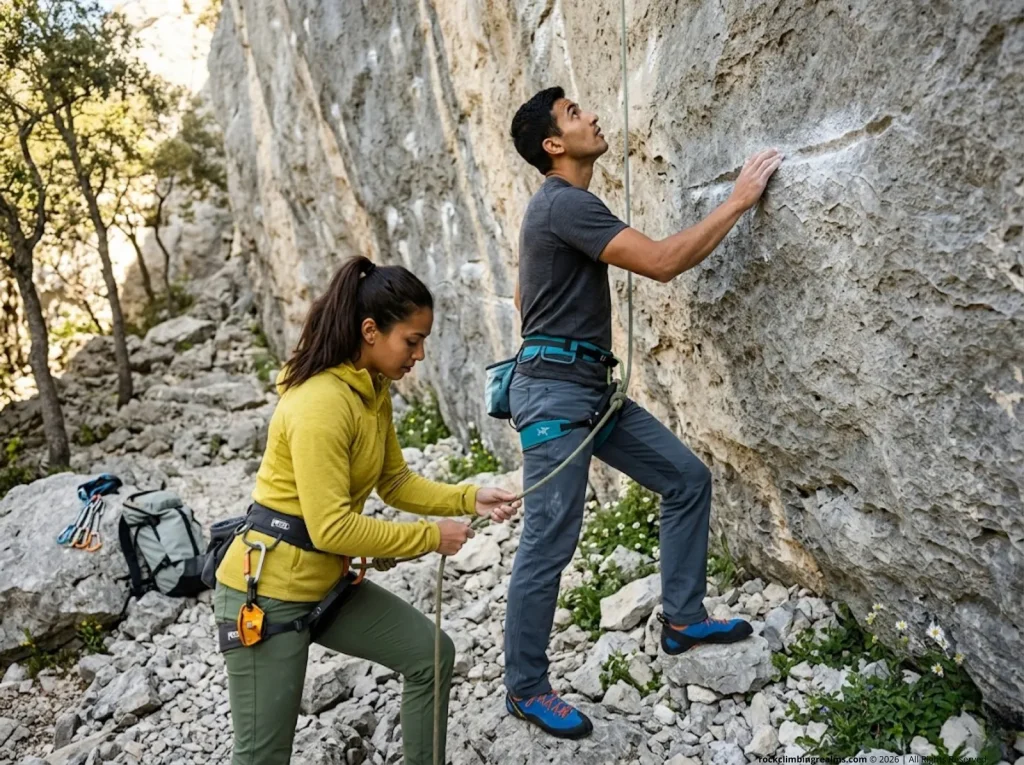
The gym-to-crag transition is where confidence can become a liability. Here’s what changes when you step off the padded floor:
- Route reading: Indoor holds are color-coded and obvious. Outdoor features are subtle, hidden, and un-chalked — you’re reading rock, not plastic.
- Protection: Indoor draws are pre-hung at 3-5 foot spacing. Outdoors, you bring your own draws, and 8-15 foot run-outs are common.
- Anchors: Indoors, you lower off fixed rings. Outdoors, you must clean anchors and often rappel.
- Environment: Indoors, the floor is flat and padded. Outdoors, it’s talus, rockfall, weather, and real exposure.
Is climbing outdoors harder than indoors? The physical difficulty is comparable at the same grade, but outdoor climbing adds an entirely different layer of complexity. Grades feel one to two numbers harder outside because route reading, protection management, and mental load eat into your capacity.
Why Clubs Fill the Mentorship Gap
The Mountaineers provides structured, volunteer-led courses refined over decades. For an $85 annual fee, a member accesses a Basic Alpine course covering knot mastery, crevasse rescue, and technical movement — all taught by experienced practitioners following The Mountaineers’ member benefits and course offerings.
The AAC publishes Accidents in North American Climbing — the single most important educational resource for accident prevention, providing data-driven analysis of real failures. The AMGA SPI (Single Pitch Instructor) standards emphasize that “speed is safety” but never at the expense of redundancy. These professional standards are taught through institutional education, not YouTube videos.
“Climbing folklore” — techniques passed through casual advice at the crag — is one of the most hazardous costs in this sport. Clubs provide the definitive source of truth.
Pro tip: Your first five outdoor sport leads should be mentored by someone who has done the gym-to-crag transition themselves. The cost of a guided day ($300-$500) is insignificant compared to a helicopter evacuation.
For the full step-by-step process, I put together the complete gym-to-crag transition checklist with gear lists and technique primers.
The Hybrid Climber Strategy — Both Gym and Club, Zero Wasted Dollars
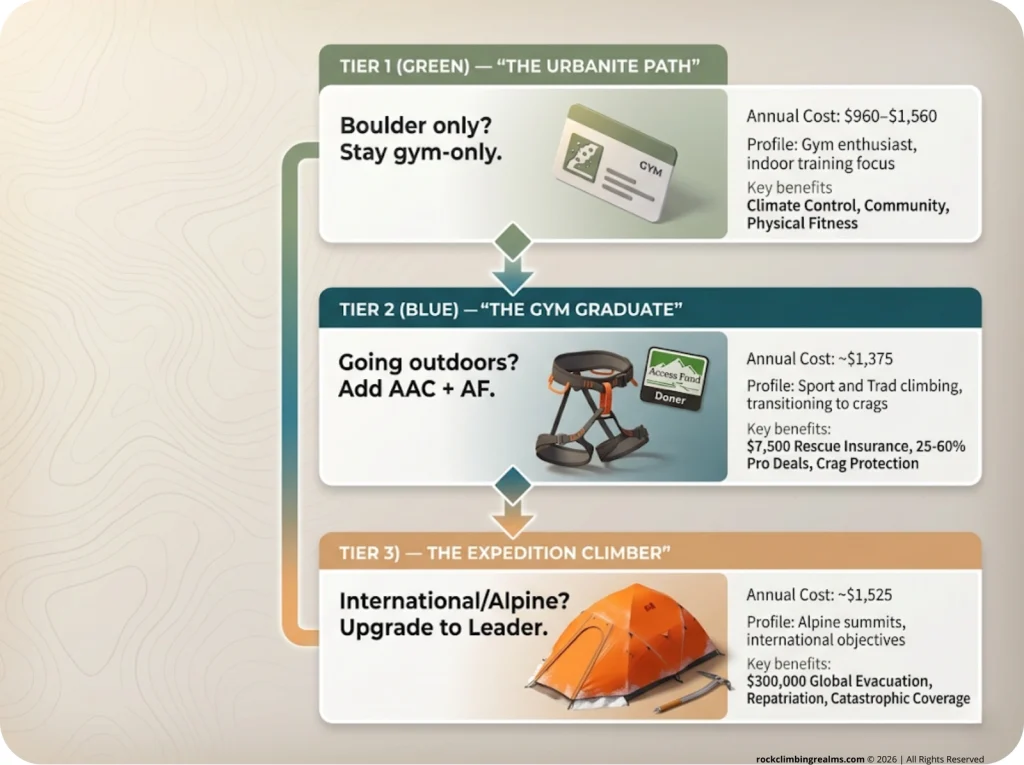
The most effective climbers in 2025 don’t choose gym or club. They run a hybrid climber model that maximizes the ROI of both systems. Here’s how the tiers break down.
Tier 1 — The Gym-Only Path (The Beginner/Urbanite)
Annual cost: $960-$1,560 (gym only). ROI focus: physical fitness, weight loss, social networking. Best for the urbanite climber who primarily boulders indoors with no immediate plans to venture outside. The gym-as-third-space value is high — it replaces a traditional fitness membership. But this path carries zero rescue insurance, zero gear discounts, and zero advocacy contribution. If you never leave the gym, it works. If you do, you’re exposed.
Tier 2 — The Core Outdoor Path (The Gym Graduate)
Annual cost: ~$1,200 (gym) + $175 (AAC Partner + AF joint membership) = $1,375/year. ROI focus: gear savings, rescue insurance, and access advocacy. This is the sweet spot for the gym graduate transitioning to sport climbing and trad. The $370+ in ExpertVoice savings effectively covers club dues for three years in a single purchase.
At this stage, building your network matters just as much as building your rack. Knowing how to find reliable climbing partners beyond the gym is the difference between progression and stagnation.
Tier 3 — The Alpine/International Path (The Expedition Climber)
Annual cost: ~$1,200 (gym) + $325 (AAC Leader + AF joint membership) = $1,525/year. ROI focus: catastrophic insurance and global rescue insurance. Best for climbers targeting high-altitude peaks or international expeditions. The $300,000 evacuation benefit is an essential hedge against a life-altering financial loss. At this level, the membership isn’t a nice-to-have — it’s a professional-grade risk management tool.
The Advocacy ROI — Why Your Dues Protect Everyone’s Access
The PARC Act and Fixed Anchor Protection
The PARC Act seeks to codify the legality of fixed anchors — bolts, pitons, chains — in wilderness areas. Without this legislation, existing federal policy could ban all fixed protection on public wilderness land. This is not theoretical. It’s an active policy debate that the Access Fund has been at the center of for years.
If fixed anchors are banned, every sport climbing route in a wilderness area effectively ceases to exist. Every route you’ve ever climbed, every anchor you’ve ever clipped — gone. This is the access advocacy argument reduced to its most concrete form.
For a deeper look at what’s at stake, I covered the active threats to climbing access and how to fight them in a separate piece.
Diversity, Demographics, and Growing Political Power
The 2024 Outdoor Participation Trends Report recorded 175.8 million participants in outdoor recreation — a record. Increasing participation from women, people of color, and LGBTQ+ individuals is broadening the political base for conservation advocacy.
As the participant base grows more diverse, the collective lobbying power of organizations like the Access Fund increases, making them more effective at securing federal funding for trail maintenance and land access protection. The tension between dirtbag culture and urban professionalism is real, but advocacy organizations bridge both communities by focusing on the one thing everyone shares: access to rock.
Conclusion
Three things are true about the climbing gym vs climbing club decision.
A gym builds the engine. A club provides the safety net. One without the other is a half-system. The gym gives you training density, partner finding, and climate control. The club gives you rescue insurance, gear discounts, and the advocacy that keeps crags open.
The math favors both. A single gear purchase through ExpertVoice can offset three years of club dues. The $7,500 rescue benefit alone justifies the $100 annual membership if you climb outdoors even once per year.
Your dues protect more than yourself. Every dollar to the Access Fund protects the crags everyone climbs on. Every AAC membership supports accident research that makes the entire sport safer.
Pull up your gear receipts from the last twelve months. Calculate what you’d have saved at 25% off. Compare that to the $100 AAC Partner membership. The napkin math will do the talking.
Now go send something.
FAQ
Is a climbing gym membership worth it if I only boulder?
Yes — if you climb three or more times per week, a monthly membership ($80-$130) is cheaper than day passes and provides consistent access to varied routesetting. However, bouldering-only climbers get less value from club memberships unless they plan to transition outdoors.
How do I transition from gym to outdoor climbing safely?
Take a guided course or join a club-organized trip for your first outdoor leads. The skill gap between indoor vs outdoor climbing is significant — route reading, protection placement, anchor cleaning, and environmental awareness are not taught in gyms.
What are the benefits of joining the American Alpine Club?
The AAC’s Partner tier ($100/year) includes $7,500 rescue insurance, $5,000 medical expense coverage, access to ExpertVoice gear discounts (25-60% off), the world’s largest mountaineering library, and support for climbing access advocacy.
Is climbing outdoors harder than indoors?
The physical difficulty is comparable at the same grade, but outdoor climbing adds complexity — un-chalked holds, inconsistent protection spacing, anchor management, weather, and real exposure. Grades feel one to two levels harder outdoors because of these added demands.
Can I get gear discounts without joining a climbing club?
ExpertVoice pro deals (25-60% off) are exclusively available through organizational memberships like the AAC or Access Fund. Some brands offer athlete sponsorship programs, but the entry barrier is much higher. For most climbers, a $100 club membership is the fastest path to professional-grade gear pricing.
Safety Notice: Rock climbing and mountaineering are inherently high-risk
activities that can involve physical trauma or fatal incidents. The information on Rock Climbing Realms is for
educational and informational purposes only. Techniques and advice presented here are not a substitute
for professional, hands-on instruction. Conditions and risks vary by location. Always seek guidance
from a qualified instructor before attempting new techniques. By using this website, you agree that you
are solely responsible for your own safety. Any reliance you place on this information is strictly
at your own risk, and you assume all liability for your actions. Rock Climbing Realms and its authors
will not be held liable for any harm, damage, or loss sustained in connection with the use of this information.
Affiliate Disclosure: We are a participant in the Amazon Services LLC Associates Program, an
affiliate advertising program designed to provide a means for us to earn advertising fees by advertising and linking
to Amazon.com. As an Amazon Associate, we earn from qualifying purchases. We are also an official affiliate partner
of Black Diamond Equipment via the AvantLink network. If you click on a Black Diamond affiliate link and make a
purchase, we may earn a commission at no additional cost to you. We also participate in other affiliate programs.
Additional terms are found in the terms of service.