
In this article
You’re 80 meters down the East Ledges, dusk eating the last daylight, and your rappel device grinds to a stop against the joining knot. Your partner is already at the anchor below. The rope won’t pull. You tied two lines together for this bail, and now you have to get past that knot mid-descent, hanging free, alone, with nothing but a Prusik hitch and a sling between you and the deck.
What you do in the next 90 seconds decides whether you walk away or become another line in the AAC accident report.
After a decade of multi-pitch trad and more bail rappels than I’d like to admit, I’ve watched this essential rappel skill separate climbers who stay calm from those who freeze. The difference isn’t talent. It’s rehearsal.
Here’s the complete knot-pass system: the critical error that causes accidents, five tested methods ranked by terrain and gear, and the training drills that build muscle memory before your life depends on it.
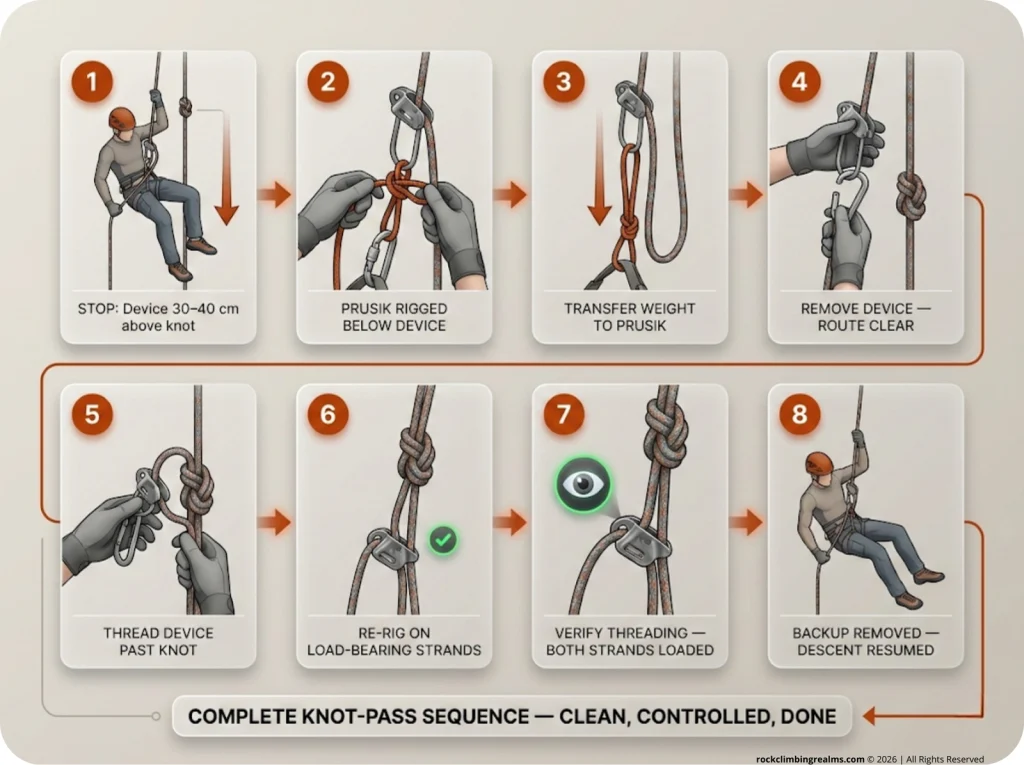
⚡ Quick Answer: Stop 30–40 cm above the joining knot. Clip a Prusik or PAS tether to the rope above the knot and weight it fully. Remove your rappel device from above the knot, re-rig it on the rope below the knot on both load-bearing strands (never on a tail), then transfer weight back to the device and resume descent. Keep all rope tails at 30 cm maximum. Clipping the tail instead of the strand has caused documented fatalities.
When and Why You’ll Face a Knot Mid-Rappel
Joined Ropes on Multi-Pitch Bail
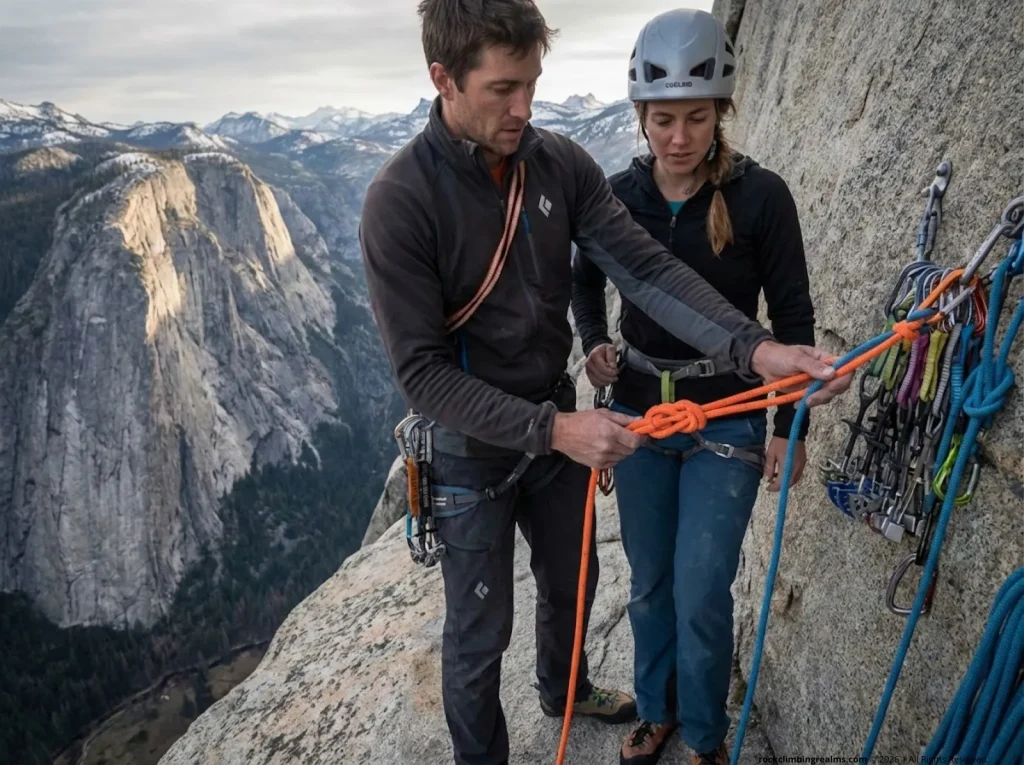
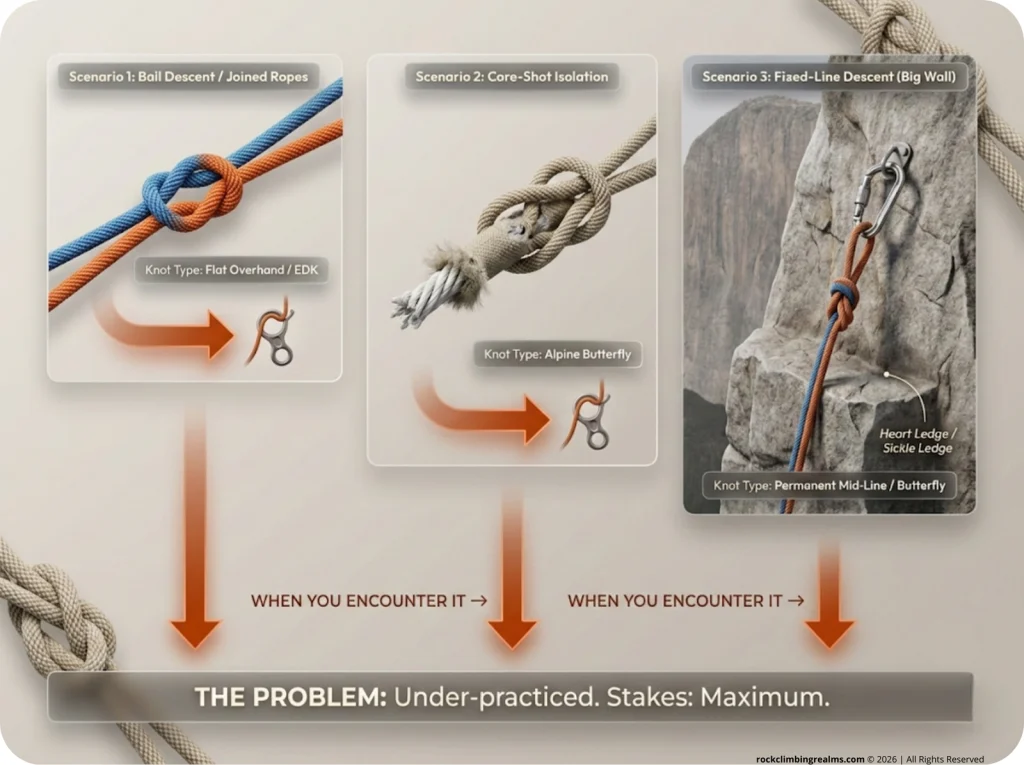
Most climbers first encounter a mid-line knot when an afternoon storm forces a retreat off a multi-pitch route. You tie two 60-meter ropes together with a Flemish bend, the rewoven figure-8 that’s more secure than a flat overhand for single strand rappel setups, and now that joining knot sits right in the middle of your rappel line. Your device can’t slide past it. You have to move it manually.
The UIAA recommends the flat overhand bend with 30 cm tails for same-diameter double rope rappel descents, and a double fisherman for dissimilar diameters. But on a joined ropes single-strand descent, the Flemish bend resists inversion under load better than either. Whichever knot you choose, it blocks the device and demands a knot pass.
Pro tip: Tie a butterfly knot just above the knot connecting your ropes before you start rapping. It gives you a ready-made clip-in point at the knot site and saves fumbling later when it matters.
If you’re building your multi-pitch rappel systems skills, this technique is one you can’t afford to skip.
Core-Shot Isolation and Fixed-Line Descents
An alpine butterfly loop also isolates a damaged section of rope, a core-shot you found mid-route, creating a rope damage isolation point your device can’t pass. On big walls, fixed ropes on El Cap Heart Ledge or Sickle Ledge may carry permanent mid-line knots. Canyoneering single-strand lines and professional rope access systems routinely have them.
The problem isn’t frequency. Trad climbers face this less often than rescue pros. The problem is that when it happens, you’re under-practiced and the stakes are maximum.
The Fatal Mistake Nobody Explains
What Tail-Clipping Actually Does to the System
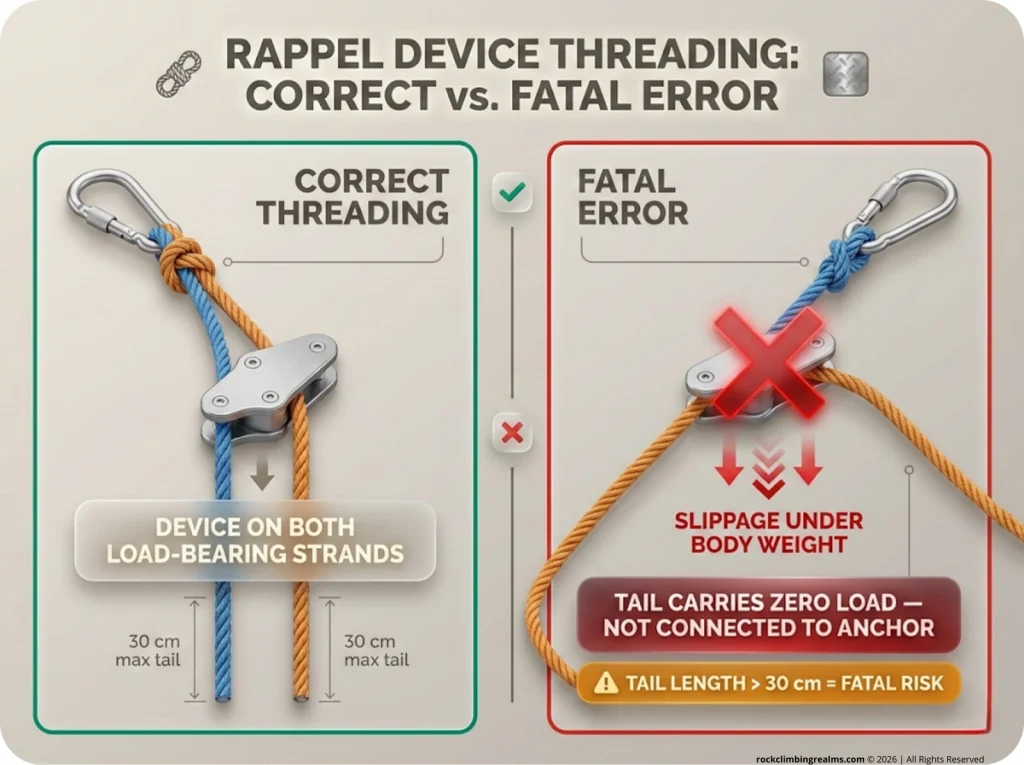
Here’s the error that kills: when the rope tails on a joining knot are too long, more than 30 cm, the rappel device can thread onto a tail instead of the load-bearing strand. A tail carries zero load. It’s not connected to the anchor above. Under body weight, it slips straight through the device. You fall.
The American Alpine Club’s 2025 rappel fatality analysis documented 15 rappel incidents involving 23 climbers and five fatalities in a single season. Knot-pass and device-detachment errors are a documented subset of those numbers. This isn’t theoretical. People die from this.
The 30 cm Rule and How to Enforce It
Both the UIAA and experienced guides like John Godino at Alpinesavvy specify the same limit: short rope tails, maximum 30 cm, forearm length. Measure tails against your forearm. If the tail runs longer than wrist to elbow, trim it or re-tie. Dress it and stress it, then verify visually: both strands of the load-bearing rope run through the device. Not through a tail.
Partner check: both climbers confirm the device is threaded on both strands. This simple habit catches the tail-clipping error before it turns fatal.
Building pre-climb partner checks into your routine makes tail verification automatic, not optional.
The Core Knot-Pass Sequence Step by Step
Stop, Rig Backup, Transfer Weight
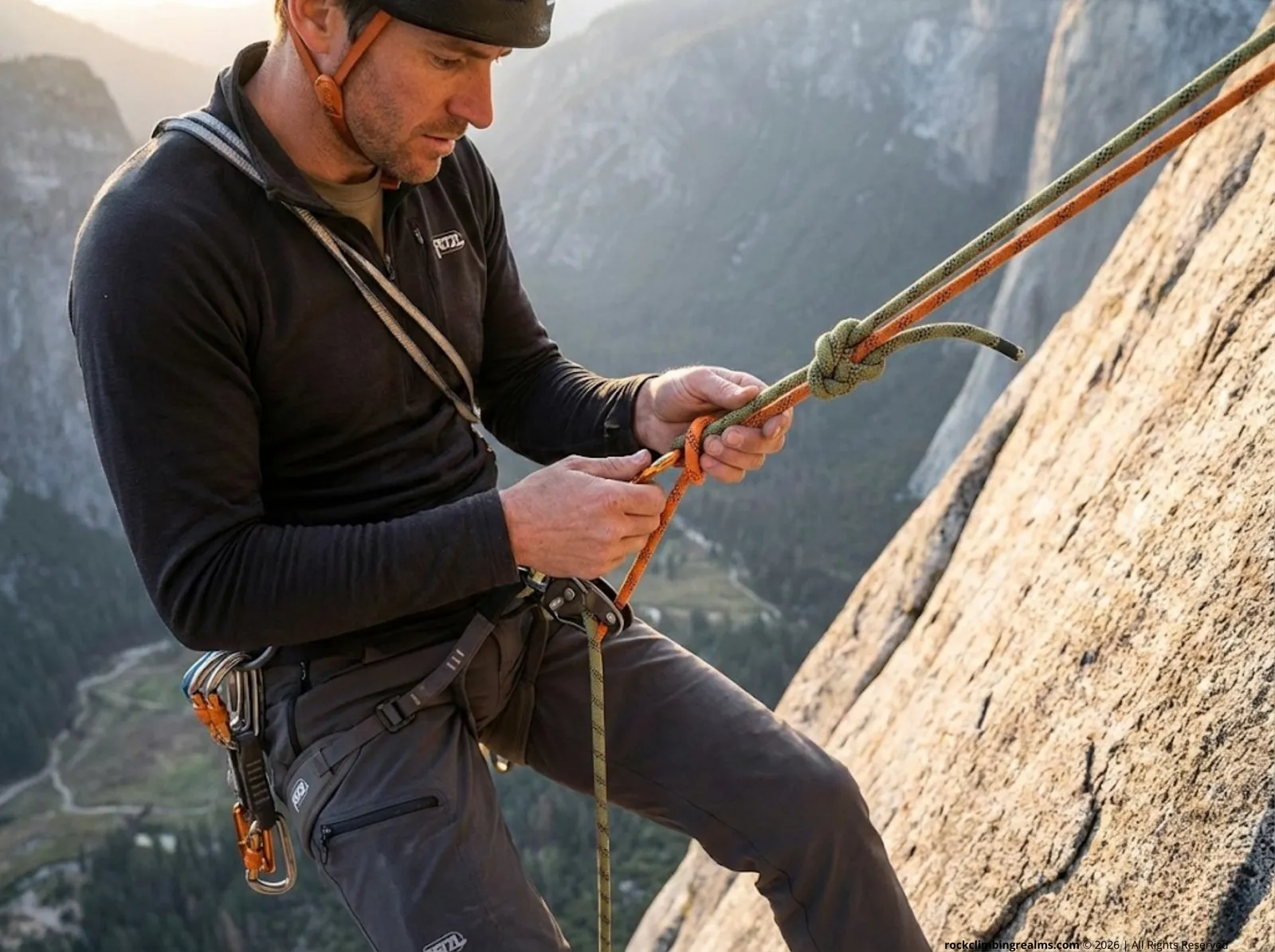
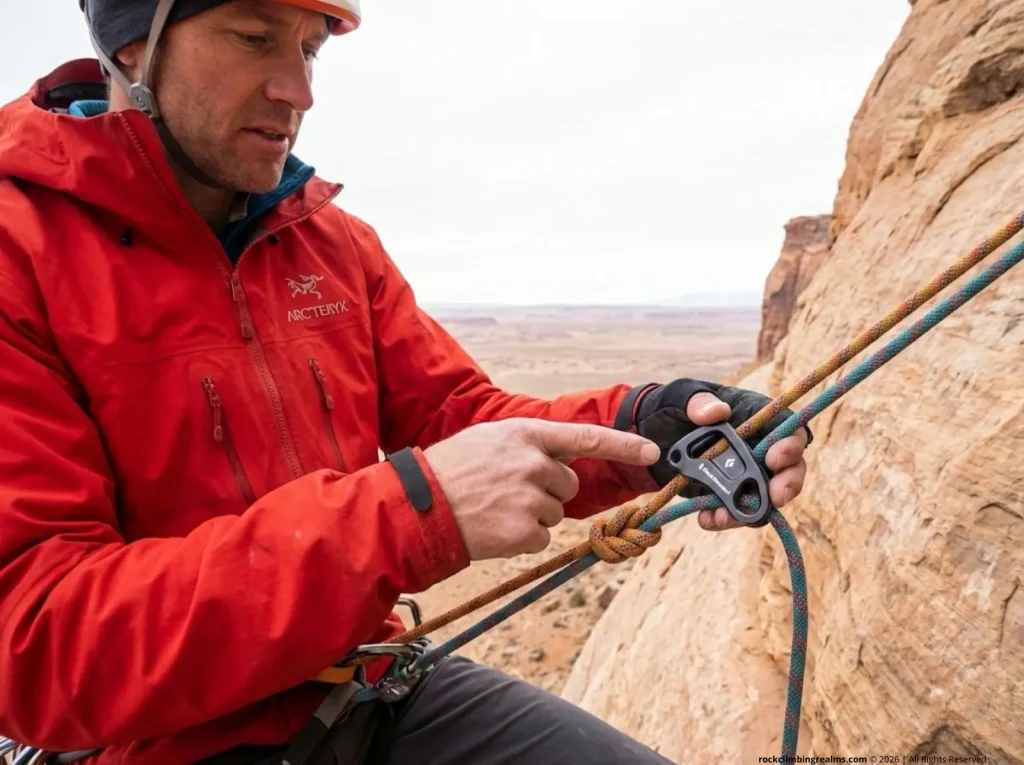
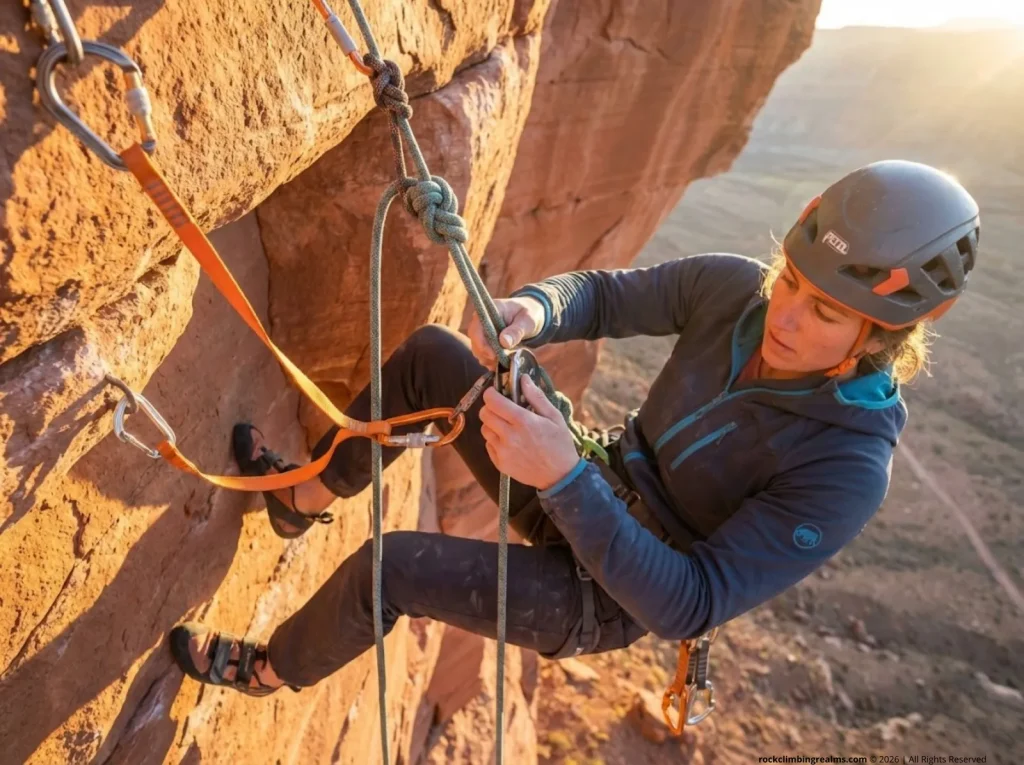
Stop 30–40 cm above the knot. Close enough to reach it, far enough that your device doesn’t jam into it. Now clip your pre-rigged tether, a personal anchor system (PAS) or sling through your belay loop, to the rope above the knot. If you tied a butterfly knot earlier, clip to that. If not, rig your Prusik hitch above the knot using 6–7 mm accessory cord with three wraps.
Transfer weight to the backup. Sit back. Let the Prusik or tether take your entire body weight. Test it with a hard bounce. If it holds, you’re secure. If it slips or the robust knot shifts, something is wrong. Fix it before touching anything else.
Pro tip: Always bounce-test the Prusik before you unclip a single thing. One hard sit. If it holds, proceed. If it doesn’t, you just learned something critical in a controlled moment instead of mid-fall.
Remove Device, Re-Rig Below Knot
With weight fully on the backup, remove the rappel device from the rope above the knot. Thread it onto the bottom rope below the knot, on BOTH load-bearing strands, not on a tail. Before unweighting the backup, verify: device on the correct strands, locking carabiner closed, device oriented properly.
For extra redundancy, tie a backup knot, a figure-8 on a bight, below the joining knot and clip it to your harness. It’s a safety net during the transition. If your device somehow fails during re-rig, that catastrophe knot catches you.
If the fundamentals of a closed-system rappel setup aren’t second nature yet, master those before attempting a knot pass.
Unweight Backup and Resume Descent
Slowly shift weight from the backup onto the newly-rigged device. Once the device is loaded and controlling your descent, remove the friction hitch from the rope, unclip the tether, and resume rappelling. Clean, controlled, done.
One last thing: after the pass, manage the rope pull from below. That joining knot needs to clear every edge, flake, and constriction on the way down. A knot stuck 100 meters above you is a different kind of bad day.
Five Methods Ranked by Terrain and Gear Weight
The Butterfly-Tether Method (Minimalist)
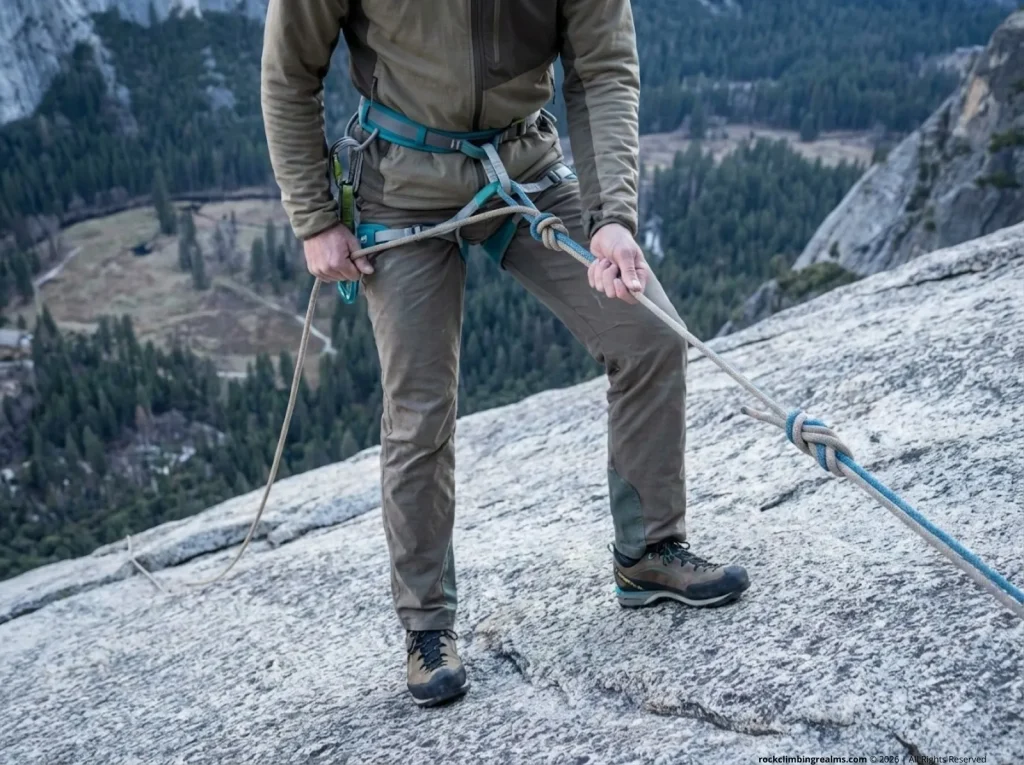
This is the lightest setup. Tie an alpine butterfly loop in the rope just above the joining knot before you start rappelling. When you reach it, clip your PAS or a single sling to the butterfly with a locking carabiner, weight it, and pass as normal.
Gear required: one personal anchor system and one locker. John Godino developed this approach for El Cap bail scenarios and it works well on planned single strand rappel descents where you control the setup. The limitation: you need to tie the butterfly before descending. It’s not available on someone else’s rope.
If you haven’t chosen between a PAS versus daisy chain for anchor tethers yet, the PAS wins here because it’s rated for load-bearing and the daisy is not.
The Prusik-and-Tether Method (Standard)
The textbook approach taught by most guiding organizations. Rig a Prusik hitch with 6–7 mm cord above the device, clip a tether to the harness, transfer weight to the backup, pass the knot, and resume. Works everywhere: slab, vertical, free-hang. Requires a Prusik cord, a PAS or sling, and two locking carabiners. Takes a practiced climber about two to three minutes.
The Batman Downclimb (Terrain-Specific)
On low-angle slab or ledgy terrain, skip the friction hitch. Simply batman down the rope, hand-over-hand descent past the knot with your feet flat on rock supporting your weight. Zero extra gear. About 30 seconds.
The catch: this only works when your feet can take your body weight. On steep overhanging rock or a free-hanging rappel, batman is extremely dangerous. If your feet aren’t on something solid, you need a Prusik above device. No exceptions.
Advanced and Rescue Methods
The two-device method rigs a second rope device below the knot before removing the first, offering maximum redundancy but doubling gear weight. Mechanical rope grab devices like the Petzl ID, CMC CLUTCH, or MPD lock automatically and speed the transition, but they’re expensive and heavy. The mule-overhand tie-off on an extended rappel device gives you hands-free time during re-rig, which is valuable on complex free-hang passes.
These methods are standard in professional rope access and rescue. For most climbing scenarios, the Prusik-and-tether standard covers everything.
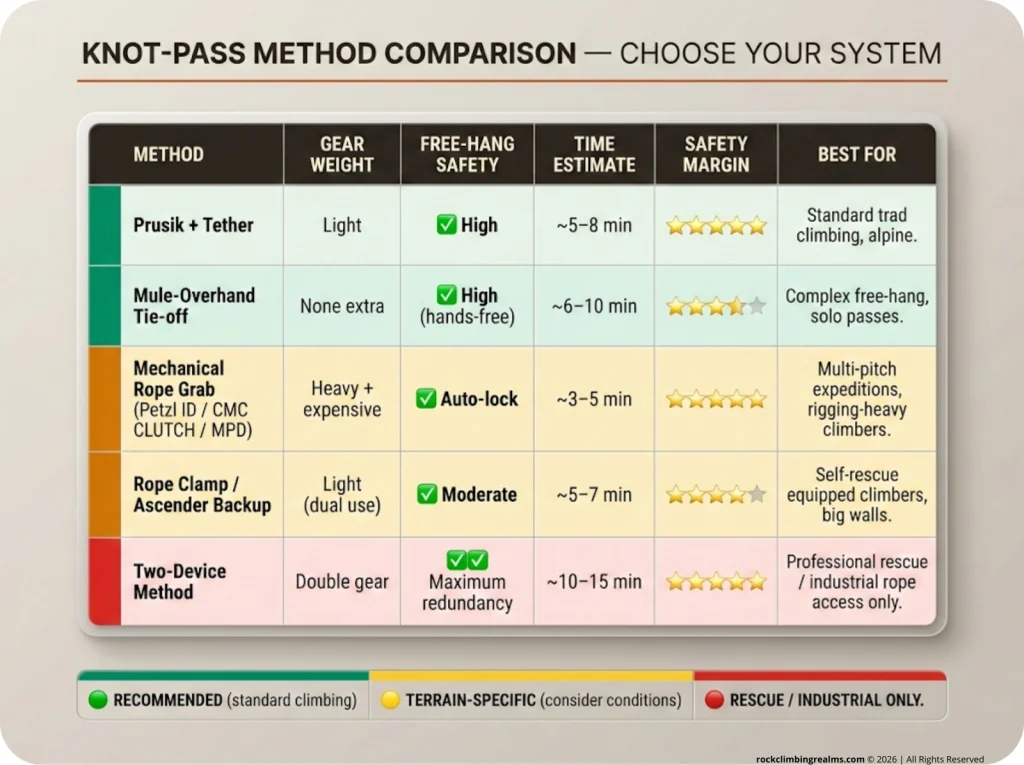
Pro tip: If you carry a rope clamp or ascender for self-rescue anyway, it doubles as your backup device for the knot-pass. One piece of gear, two critical skills.
Common Mistakes and How Each One Gets You
Skipping the Backup Entirely
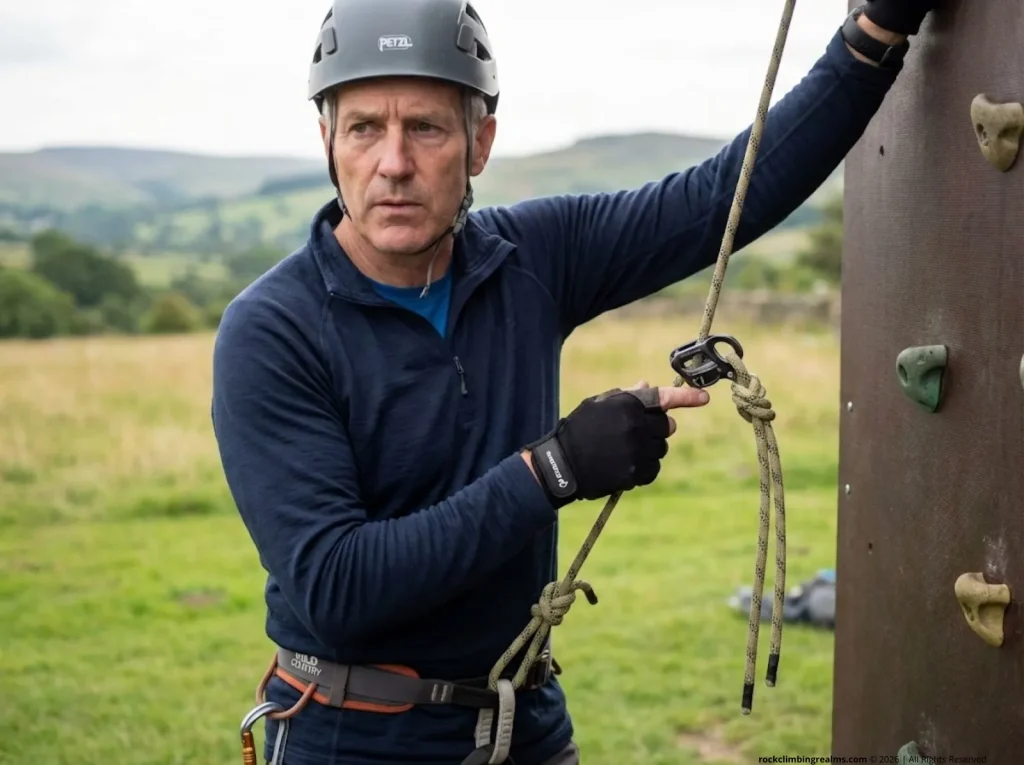
Removing the device without establishing a friction hitch or tether first means zero connection to the rope during the re-rig. Even two seconds of unprotected hang time is enough to lose grip and fall. The fix is absolute: always establish backup FIRST, bounce-test it, THEN remove the device. No shortcut exists for this step.
If your self-rescue rope ascension techniques are rusty, the Prusik skills you build for knot-passing serve double duty as emergency ascension tools.
Device Jams Into the Knot
Stopping too close, less than 20 cm above the knot, causes the device to wedge against it under load. A jammed device is brutally hard to remove while hanging on it and creates exactly the panicked, unplanned scenario where people make fatal errors. The fix: stop 30–40 cm above the knot, not at it. Measure a forearm’s distance.
Free-Hang Pass Without Friction Hitch
Attempting the batman downclimb on overhanging or free-hanging terrain is a way to die. Without foot-to-rock friction, your arms alone can’t hold your body weight during the transition. If your feet can’t take your weight, you MUST use a friction hitch above device. There is no fast-and-light way around physics.
How to Practice Before You Need It
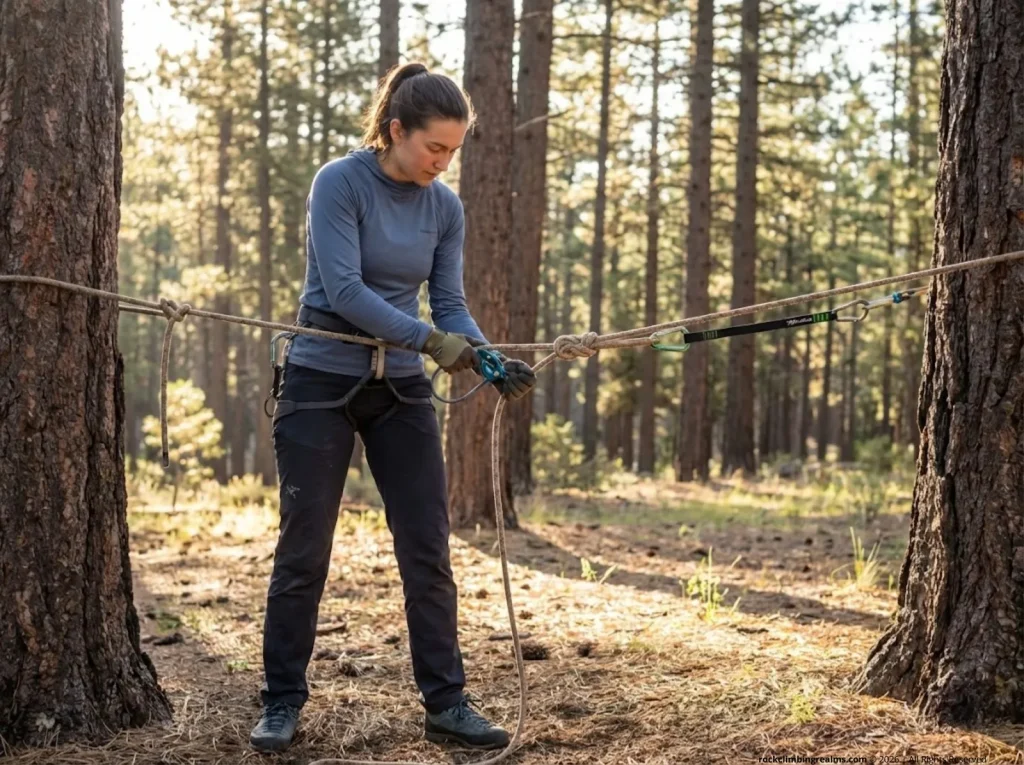
Floor-Level Drill (Week 1–2)
String a rope between two trees or ground-level anchors at waist height. Tie a joining knot with a butterfly knot at the midpoint. Run the full knot-pass sequence: clip backup, transfer weight, remove device, re-rig the device below the knot, unweight backup. Repeat until it takes under three minutes with zero hesitation.
The goal is your hands, teaching them to thread the device on the correct strands, test the Prusik, and verify everything by feel. On the ground, mistakes are free.
Start by mastering the Prusik and butterfly knots on flat ground before you add any vertical component.
Staircase or Low Wall Drill (Week 3–4)
Move to a staircase or short wall, two to three meters, where you can weight the system with your feet still close to the ground. Add the psychological element of actually hanging on the Prusik under body weight. Practice with a belayer or fireman’s belay for safety during the learning phase. Target: full sequence in under two minutes, smooth transitions, no fumbling.
Vertical Near-Ground Drill (Before Real Application)
Full vertical setup, three to five meters off the deck, with a crash pad or belayer below. This is your final checkpoint. The pass must be smooth, confident, and completed without verbal coaching. Breathe between steps. Talk yourself through the checklist out loud. Never rush the verification step.
I don’t let anyone on my rope team attempt a real knot pass until they’ve done it clean on the training wall three times in a row. That’s the standard.
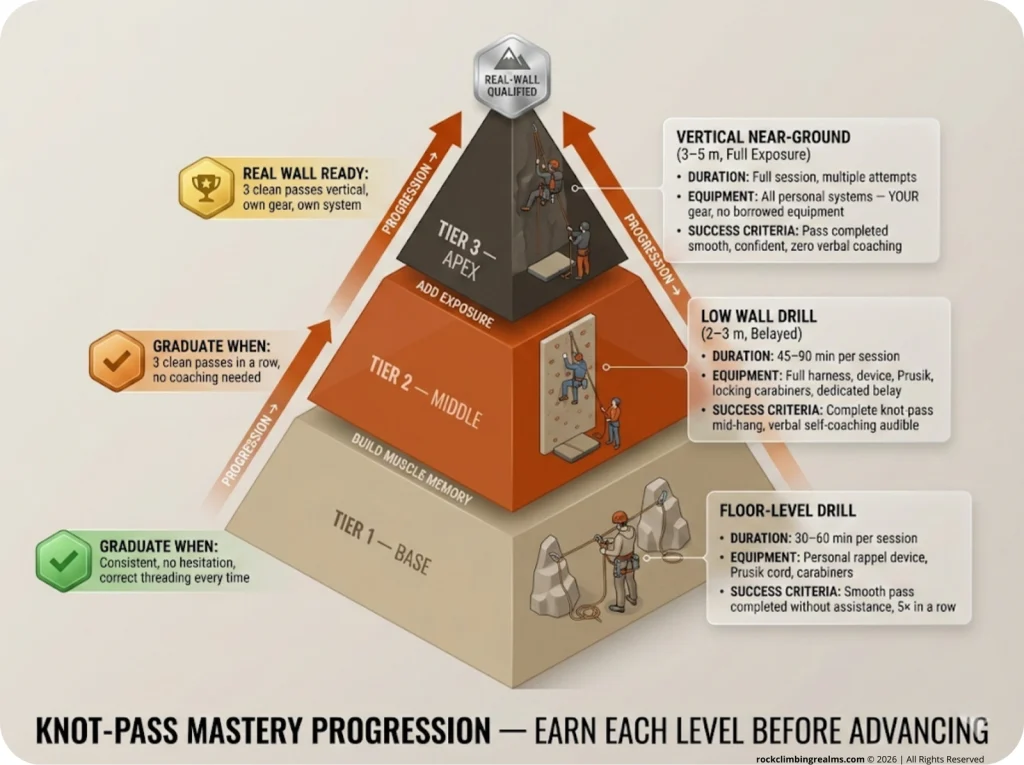
Pro tip: Rehearse knot passes with your actual gear, not borrowed stuff. Your fingers need to know how YOUR carabiners gate, how YOUR Prusik cord grips, and how YOUR device threads. Borrowed gear on a real wall is a recipe for fumbling.
Conclusion
Three things keep you alive when your device hits a mid-line knot on rappel. First, the 30 cm tail rule. Measure against your forearm, enforce it every single time, and verify that both strands run through the device before you weight anything. Second, match your method to your terrain. The Prusik-and-tether standard works on slab, vertical, and free-hang alike. Third, progressive practice. Floor, staircase, low wall. Wire this sequence into muscle memory before your life depends on it.
Set up a ground-level drill this weekend. Two trees, one rope, one joining knot. Run the sequence ten times until your hands know it without your brain getting in the way.
The next time you’re 80 meters up with a knot staring back at you, the only thing between you and the deck is how many times you’ve rehearsed this on the ground.
FAQ
Can you rappel past a knot in the rope?
No. Your rappel device physically cannot pass a knot mid-line. You must stop above the knot, transfer your weight to a backup system like a Prusik hitch or PAS tether, remove the device, re-rig it below the knot, and resume descent. There is no continuous-flow method.
What is the best knot to join two ropes for rappelling?
For double rope rappel, the flat overhand bend with 30 cm tails is the UIAA-recommended standard. For single strand rappel on joined ropes, the Flemish bend (rewoven figure-8) is preferred because it resists inversion under asymmetric loading.
Is it safe to pass a knot on a free-hanging rappel?
Yes, but only with a friction hitch rigged above the knot as your backup. The batman downclimb method is NOT safe on free-hang terrain because it requires positive footing on slab or ledge. If you are hanging free, a Prusik above device is mandatory.
How do you back up a rappel with a Prusik?
Wrap 6–7 mm accessory cord (three wraps) around the rappel rope above your device to create a Prusik hitch. Clip it to your harness belay loop with a locking carabiner. Under load, the Prusik grips the rope and holds your weight. When unweighted, it slides freely for normal rappelling.
How long should rope tails be on a joining knot for rappelling?
Maximum 30 cm, forearm length. Longer tails create a fatal hazard where your device threads onto the tail instead of the load-bearing strand, resulting in a fall with zero protection. Measure against your forearm and re-tie if needed.
Safety Notice: Rock climbing and mountaineering are inherently high-risk
activities that can involve physical trauma or fatal incidents. The information on Rock Climbing Realms is for
educational and informational purposes only. Techniques and advice presented here are not a substitute
for professional, hands-on instruction. Conditions and risks vary by location. Always seek guidance
from a qualified instructor before attempting new techniques. By using this website, you agree that you
are solely responsible for your own safety. Any reliance you place on this information is strictly
at your own risk, and you assume all liability for your actions. Rock Climbing Realms and its authors
will not be held liable for any harm, damage, or loss sustained in connection with the use of this information.
Affiliate Disclosure: We are a participant in the Amazon Services LLC Associates Program, an
affiliate advertising program designed to provide a means for us to earn advertising fees by advertising and linking
to Amazon.com. As an Amazon Associate, we earn from qualifying purchases. We are also an official affiliate partner
of Black Diamond Equipment via the AvantLink network. If you click on a Black Diamond affiliate link and make a
purchase, we may earn a commission at no additional cost to you. We also participate in other affiliate programs.
Additional terms are found in the terms of service.