
In this article
You’re halfway through the approach to Intersection Rock, rack jingling on your harness, and a ranger steps out from behind a boulder. “Got your permit?” Your stomach drops. You picture the five-hour drive from LA, the gear you packed, the friends waiting at the base. All of it wasted because of some form you didn’t know existed.
Here’s the good news: you almost certainly don’t need one.
After years of climbing at Joshua Tree National Park and watching people stress about this exact question, I can tell you the permit system is both simpler and more complicated than most climbers think. Simple because recreational climbing requires zero permits. Complicated because the moment you pull out a drill, lead a paid client, or camp in the backcountry, the rules change fast. What follows is the full breakdown of who needs what, what your entrance fee covers, and how the park’s evolving climbing management plan could change access in the coming years.
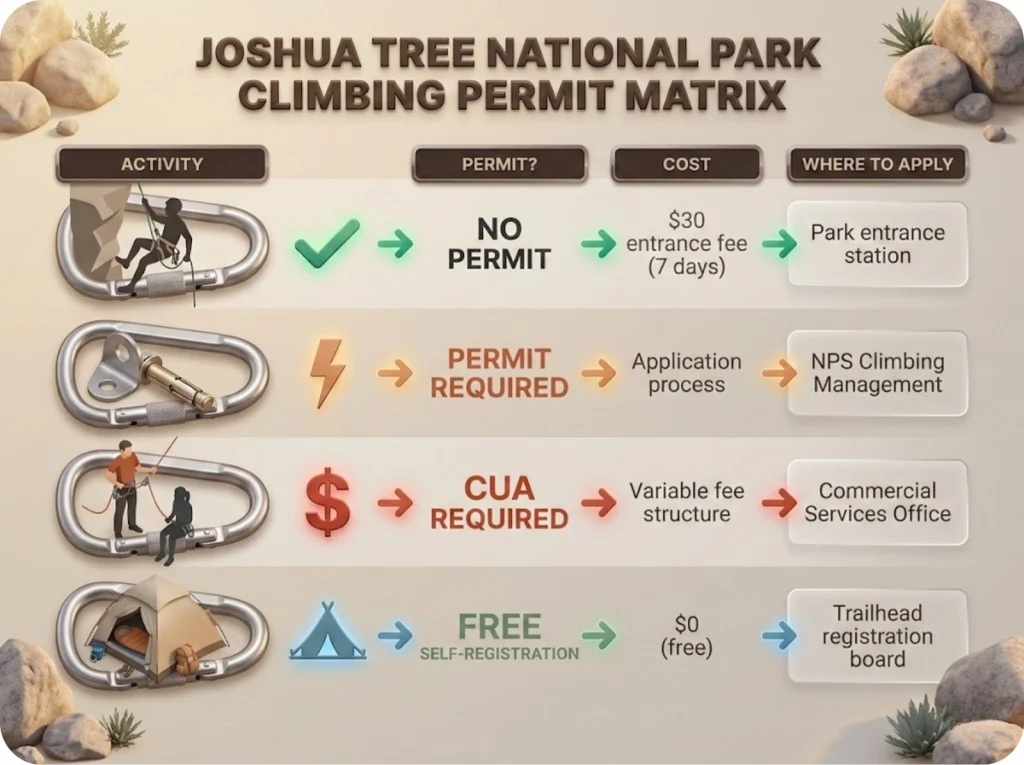
⚡ Quick Answer: Recreational climbers at Joshua Tree don’t need a climbing permit. You pay the standard National Park Service entrance fee ($30/vehicle for 7 days) and you’re free to trad climb, sport climb, boulder, or top-rope anywhere that isn’t posted as closed. A bolting permit is required for any fixed anchor work since February 2022. Commercial guides need a Commercial Use Authorization (CUA). Backcountry overnight camping requires free self-registration at trailhead boards.
The “No Permit” Reality for Recreational Climbers
What Your Entrance Fee Actually Covers
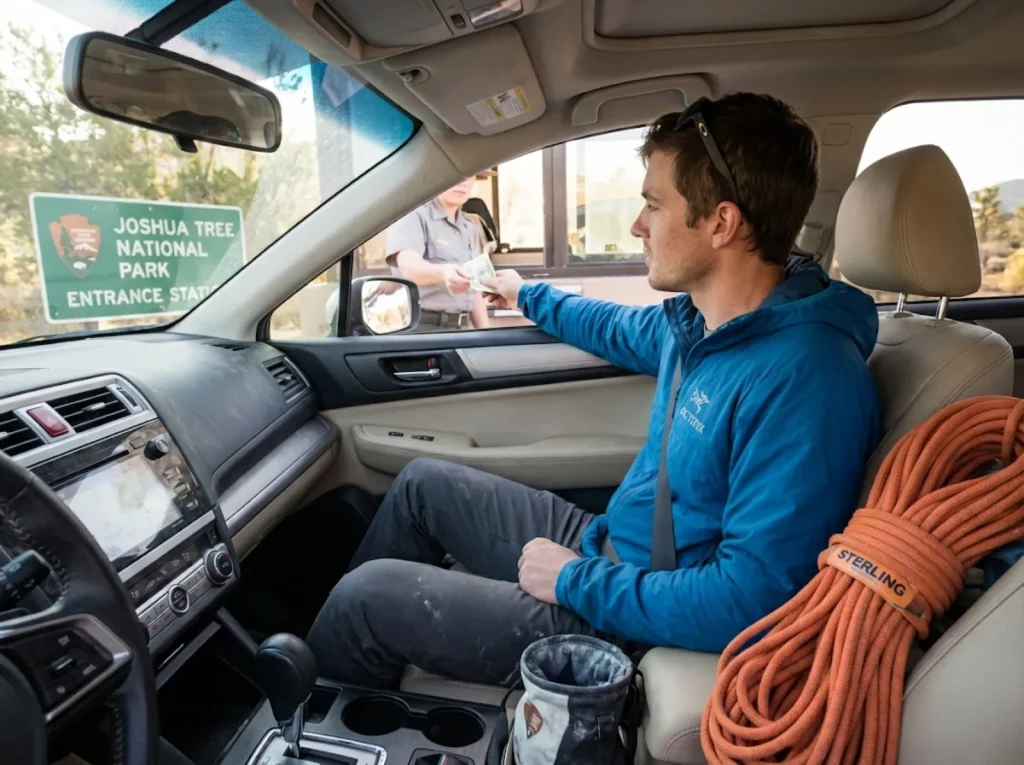
There is no such thing as a “climbing permit” for recreational climbing at Joshua Tree. You pay the entrance fee and you’re in. Trad, sport, bouldering, top-rope — all covered under general park access. That’s it.
The Private Vehicle Pass runs $30 for 7 days and covers everyone in the car. Motorcycles cost $25. If you’re walking or cycling in, it’s $15 per person for anyone 16 and older. The America the Beautiful Pass at $80 per year covers Joshua Tree National Park plus every other federal recreation site — it pays for itself after three visits.
A park-specific annual pass at $55 makes sense if you’re hitting JTree twice per season. And if you’re a U.S. citizen 62 or older, the Senior Lifetime Pass at $80 one-time is the best deal in outdoor recreation.
There’s no reservation system for day-use climbing. You show up, pay, and climb. You can check current fee details on the NPS Joshua Tree fee schedule. If you’re planning beyond just the day’s routes, our full Joshua Tree climbing guide covers area-by-area breakdowns for different ability levels.
Pro tip: The America the Beautiful Pass covers two adults at any federal site in the country. If you split it with a climbing partner, that’s $40 each for a full year of access to every national park, forest, and BLM area. Do the math before you pay the daily fee at the gate.
The Camping Bottleneck Nobody Warns You About
The real access barrier at Joshua Tree isn’t paperwork. It’s finding somewhere to sleep. The park has roughly 500 campsites serving millions of annual visitors. During peak climbing season — October through May — reservable campgrounds fill six months in advance on recreation.gov.
Hidden Valley at $25 per night sits closest to the best crack climbs and face climbs, but it’s first-come, first-served. Get there before noon on Thursday for a weekend spot, or don’t bother. Black Rock and Cottonwood ($35/night) have flush toilets and water. Indian Cove and Jumbo Rocks run $30-$35 with pit toilets and zero water.
That last part matters more than you’d think. There is no potable water in the park’s interior climbing areas. Plan for at least one gallon per person per day. I’ve watched strong climbers bonk on 5.8 slabs at 2 PM because they treated water like whiskey and rationed it. Bring double what you think you need.
You can read more about NPS campground reservations and backcountry permits on the park website, and our guide to finding free and cheap camping near climbing areas covers overflow options when every campsite shows “full.”
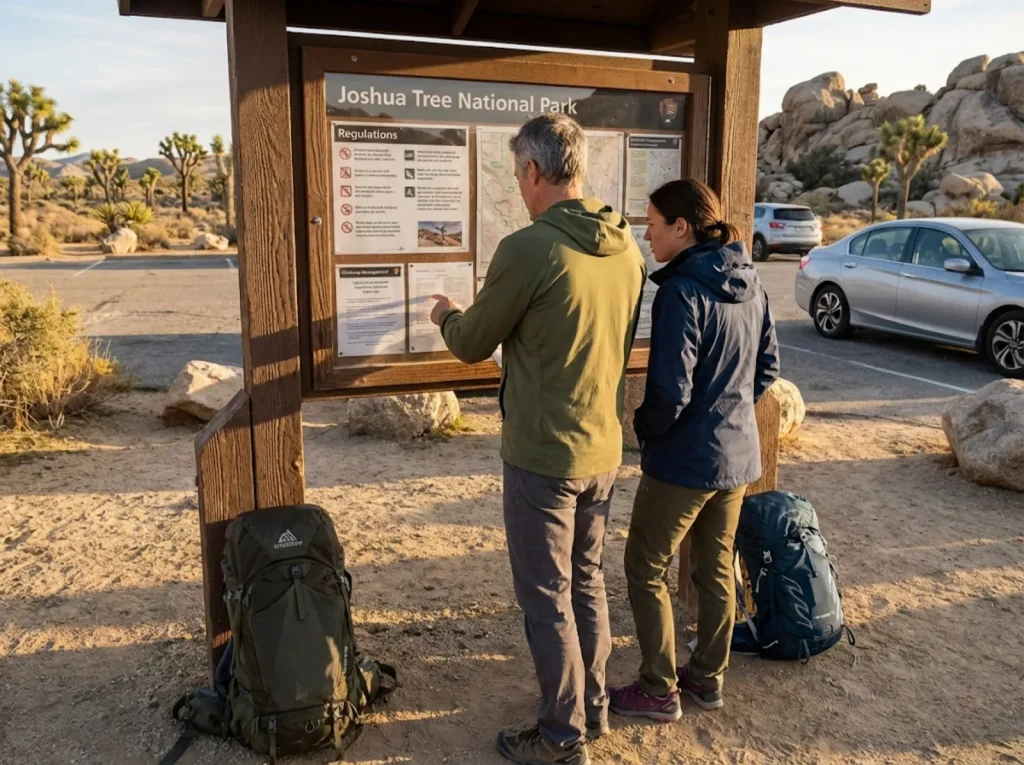
Backcountry overnight stays require a free self-registration permit at backcountry boards near trailheads. You must camp at least one mile from any road and 500 feet from any trail. It’s free, it takes two minutes, and rangers do check.
The Bolting Permit You Can’t Ignore (2022 Rule Change)
What Changed on February 4, 2022
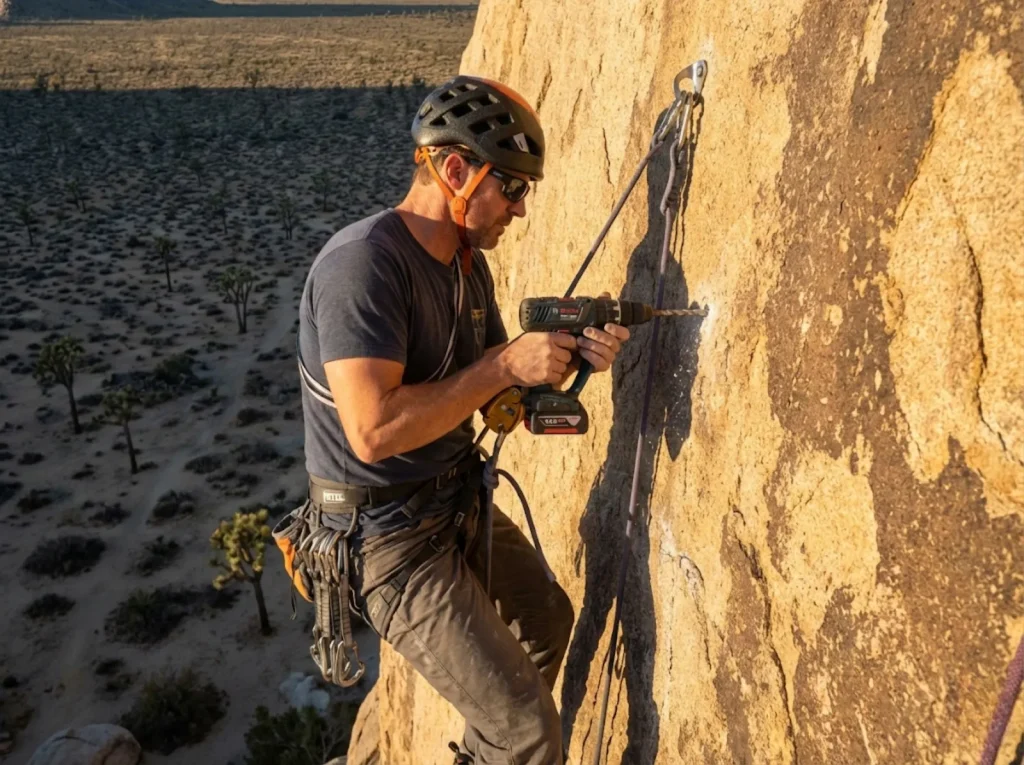
This is where the joshua tree permit system climbing rules get serious. As of February 4, 2022, every fixed anchor action — placement, removal, and replacement — requires an NPS permit. No exceptions. This applies park-wide, in both wilderness areas and non-wilderness areas.
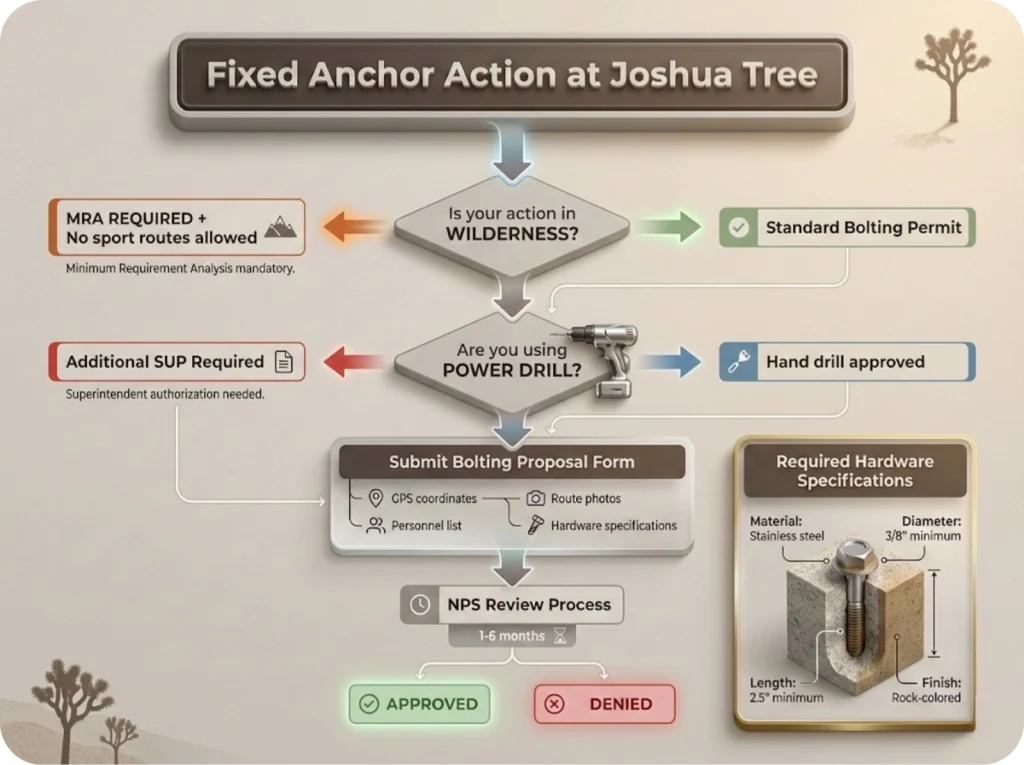
A “fixed anchor” means any climbing hardware left in place. Bolts, pitons, slings, webbing on rappel stations. If you leave it, you need a permit for it. The rule applies regardless of tools — hand drills and power drills both require the bolting permit. Power drills additionally require a special use permit authorized by the Superintendent.
Before 2022, replacing existing hardware was handled informally. Now, even swapping out a 40-year-old rusted quarter-inch bolt on a classic route requires formal approval. The park’s climbing ranger, Bernadette Regan, handles bolting inquiries and permit processing. You can find the full policy at the NPS Joshua Tree bolting policy page.
The Application Process and Hardware Standards
Applicants submit either a Bolting Proposal Form for new routes or a Rebolting Proposal Form for replacements, both sent to the Division of Emergency Services. You can download the official NPS bolting proposal form directly.
The data requirements are specific: route name, formation name, UTM coordinates, exact number of bolts requested, photos of existing hardware, a list of all vehicles and personnel, and designation of an on-site leader. Hardware standards are strict — stainless steel bolts, neutral or rock-colored hangers, minimum 3/8-inch diameter at 2.5 inches length.
Application processing time varies widely. Some applications move in a month. Others, especially those triggering NEPA compliance review, can stretch to six months. Plan accordingly.
Pro tip: If you’re rebolting existing classics, reach out to the Joshua Tree Climbing Stewards before submitting your application. They’ve built working relationships with the park’s climbing management team and can help you avoid common application mistakes that delay processing.
The Wilderness Problem
Here’s the tension at the heart of JTree’s bolting debate. Between 85 and 90 percent of the park is designated wilderness. Section 4(c) of the Wilderness Act prohibits “permanent improvements” and “structures or installations.” Bolts technically qualify.
Groups like Wilderness Watch argue that all climbing bolts are illegal installations and should be removed. The Access Fund and NPS counter that climbing is a “legitimate and appropriate” wilderness use and that “occasional placement” doesn’t violate the Act. The park uses a Minimum Requirements Analysis for every bolt application in wilderness — anchors are only approved when no removable climbing protection like trad gear, cams, or nuts can protect the route, and only if it’s not a bolt-intensive sport route.
This effectively blocks new sport route development in wilderness areas while allowing trad-style first ascents with minimal fixed protection. If you want to understand how these regulatory battles play out nationally, how climbing access threats shape the routes we climb puts the Joshua Tree situation in broader context.
Guiding for Profit? The CUA Permit Breakdown
Fees, Tiers, and the Application Gauntlet
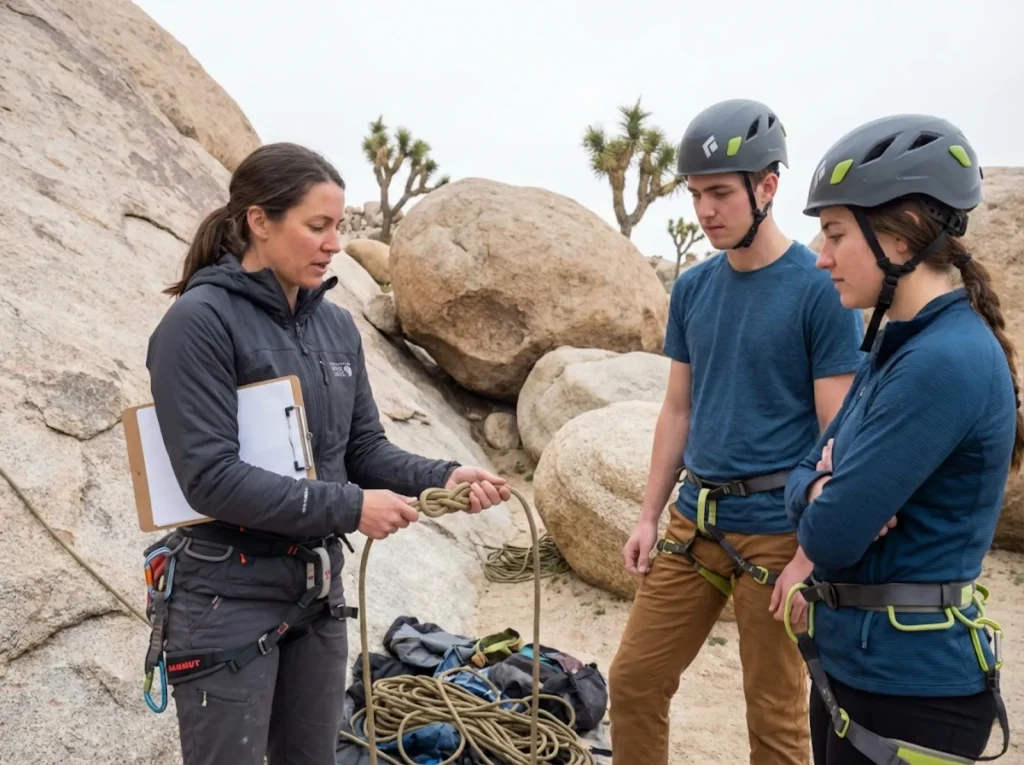
Anyone charging a fee for activities inside Joshua Tree — guided climbs, photography workshops, outdoor education — needs a Commercial Use Authorization. No exceptions.
The application fee is $350 for the first activity and $250 for each additional activity. Non-refundable. As of December 1, 2024, the National Park Service standardized CUA management fees based on gross receipts: under $250K pays 3%, $250K–$500K pays 4%, and over $500K pays 5% annually. Every guide must carry a park-issued Guide Card at $15 per person and hold certifications from AMGA, PCGI, or PCIA.
The CUA is valid for one calendar year, January 1 through December 31. The Permit Office operates Monday through Friday, 8:00 AM to 2:00 PM PST. Full details are on the NPS Joshua Tree CUA application page.
Here’s the math nobody does until it’s too late. At 3% of $80K gross from JTree commercial guiding, you’re paying $2,400 in market price management fees plus the $350 application. Add Guide Cards for three guides ($45), and your regulatory overhead alone is $2,795 before you’ve bought a single piece of insurance. If you’re curious about what proper credentials look like from a client’s perspective, what to look for when hiring a climbing guide covers the certification alphabet soup.
Pro tip: The CUA calendar year (Jan 1 – Dec 31) doesn’t prorate. If you apply in October, you still pay the full annual management fee percentage. Time your application to start January if possible — you get 12 months of authorized operation instead of three.
Insurance, Reporting, and the Paper Trail
CUA holders must carry minimum $500,000 general liability insurance and indemnify the federal government. If you’re transporting clients in vehicles, the minimums jump: $1M for up to 6 passengers, $1.5M for 7-15, $3M for 16-25, and $5M for 26 or more.
Every guide needs current First Aid/CPR and Leave No Trace certifications. Food service requires a Food Handlers Card. Monthly Activity Reports (Form 10-660A) track total clients served, trips made, and length of stay. The Annual Financial Report (Form 10-660) is due January 31 with full gross receipts disclosure. Submit it late and you risk permit revocation.
The reporting burden catches small operations off guard. Running a one-person guiding business with a CUA means you’re not just guiding — you’re running a compliance department of one.
Closures, Group Limits, and the Rules That’ll Get You Fined
Areas You Cannot Climb (Permanent and Seasonal)
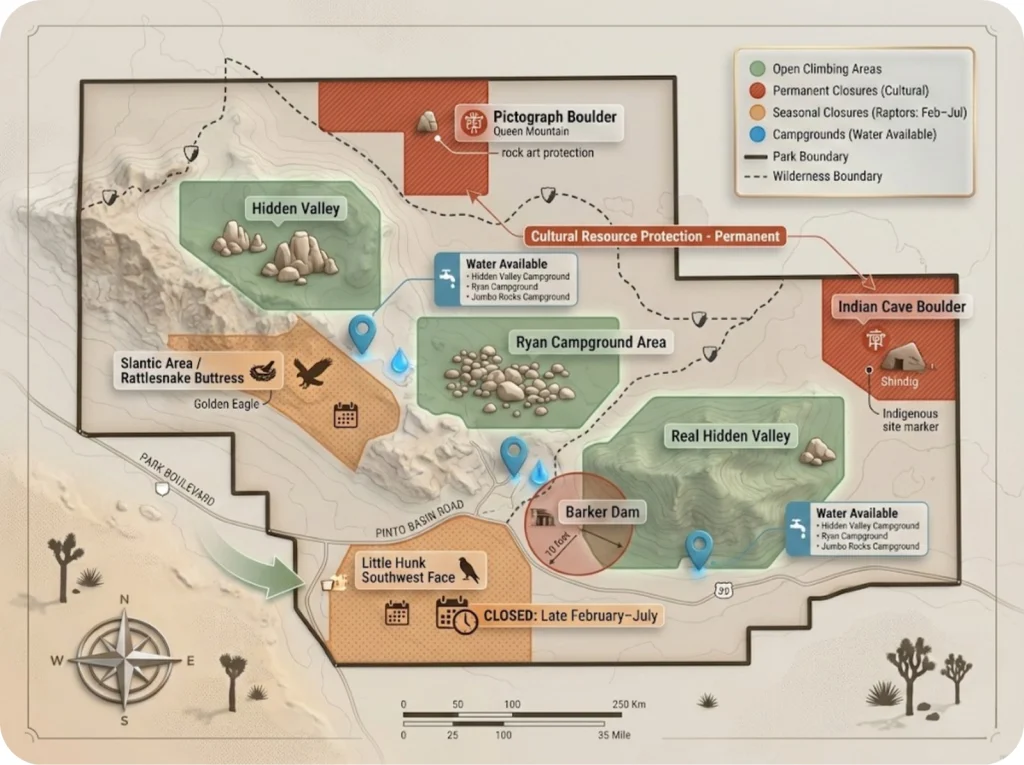
Pictograph Boulder on Queen Mountain and Indian Cave Boulder at Shindig are permanently closed to bouldering and climbing to protect Indigenous rock art from the Chemehuevi, Serrano, Cahuilla, and Mojave peoples. Barker Dam has a 10-foot entry closure around the entire structure. The Hemingway Parking Area (opposite side) sits on private land — no climbing, period.
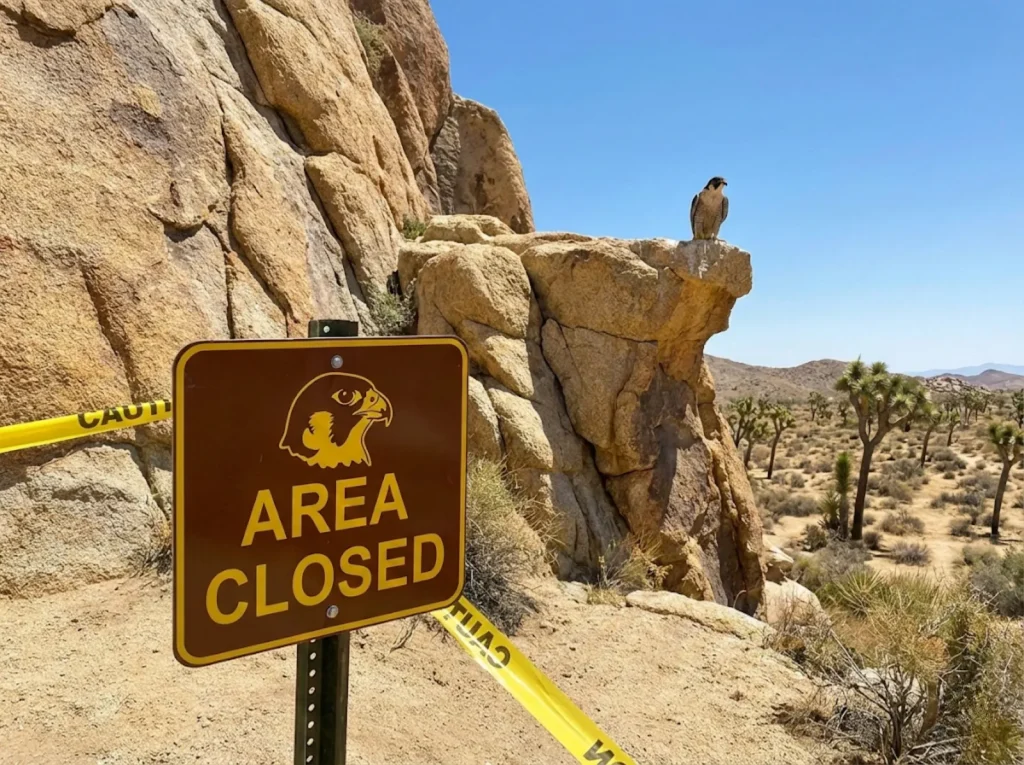
Seasonal raptor closures hit between late February and July. The Slantic Area around Rattlesnake Buttress and Little Hunk’s Southwest Face close to protect nesting Golden Eagles and Peregrine Falcons. The NPS Joshua Tree climbing closures page has current status, but signage at the crag isn’t always up to date. Check online before you hike in. If you want to understand why these closures exist and the biology behind them, the science behind raptor nesting closures for climbers breaks it down.
Desert ecosystems are fragile in ways that aren’t always visible. The cryptobiotic soil crusts that cover much of the ground between formations take decades to recover from a single footprint. Understanding how cryptobiotic soil affects climbing areas will change how you walk between boulders.
Group Size Limits and the Joshua Tree Conservation Act
General group size restrictions cap at 12 people for both day and overnight use. Sensitive areas like Quail Springs near Trashcan Rock and Feudal Wall in Indian Cove may have lower limits for commercial groups.
The Western Joshua Tree Conservation Act, enacted in 2023 with a management plan finalized August 2025, designated the western Joshua tree as a candidate threatened species. While the park is federal land, the state’s protection reinforces existing rules: no hammocks, slacklines, or ropes on Joshua trees. The conservation plan undergoes biannual review starting in 2026, meaning regulations could shift.
I’ve seen groups of 15 or more stacked at Trashcan Rock on a Saturday, completely unaware they’re over the legal limit. Rangers do cite for this. It’s not a suggestion. For a deeper understanding of minimum-impact practices, our complete guide to Leave No Trace climbing ethics covers the full framework.
The Climbing Management Plan and What’s Coming Next
What the CMP Will Address
Joshua Tree is actively developing a Climbing Management Plan — the first regulatory framework to address bouldering, highlining, slacklining, and social trail management alongside traditional and sport rock climbing. The plan is delayed by the complexity of tribal consultation with four recognized Indigenous nations and environmental impact studies under NEPA.
Key issues under review include the formalization of social trails to climbing formations (some are being mulched over while others become official paths), bolting quotas by area, and revised commercial group sizing. The plan will likely establish clearer guidelines for sport climbing in non-wilderness areas while tightening restrictions in wilderness. Current status is available on the NPS Climbing Management Plan for Joshua Tree page, and how the Access Fund fights for climbing access explains the advocacy side.
What this means for you: the rules you climb under in 2026 may look different by 2028. Bookmark the CMP page.
The Old School vs. New School Ethics Divide
Joshua Tree’s climbing culture is rooted in a traditional ethic. Hand-drilled bolts on lead, run-out routes on slabs where a fall can mean a 30-foot slide, minimal protection. The old school ethics position is straightforward — if you can’t do it clean with trad gear, you shouldn’t be doing it. This view treats rap-bolting and sport-style development as incompatible with JTree’s identity.
The new school ethics counter is equally direct. Modern safety standards matter. Rap-bolting with power drills creates evenly spaced climbing protection that opens routes to more potential climbers. The tension produces bolt-chopping wars — newly placed hardware removed by community members who view it as a violation of the local ethic.
The CMP will attempt to mediate this divide by designating zones appropriate for different development styles. Until then, route developers should expect community scrutiny alongside the permit process. If you’re planning a bouldering-focused trip and want to sidestep this debate entirely, our Joshua Tree bouldering guide covers the best problems on JTree’s quartz monzogranite.
Pro tip: The term climbers use for the loose grit on less-trafficked JTree slabs is “ball bearings underfoot.” The dark coating on the rock that provides the best friction is “desert varnish” or “patina.” Using the right language signals to locals and rangers that you know what you’re doing.
Conclusion
Three things to carry out of this article.
First, if you’re a recreational climber, breathe. You don’t need a climbing permit. Pay your entrance fee, bring enough water, and climb. The real barrier is camping logistics, not paperwork.
Second, if you’re touching fixed anchors — placing, replacing, or removing bolts — you need a bolting permit as of February 2022. The process requires GPS data, photos, and NPS review, and it can take months. Start early.
Third, if you’re guiding for money, the CUA system is a year-long administrative commitment with real financial weight. The fees, insurance minimums, and reporting deadlines will eat your time if you’re not prepared.
Bookmark the NPS climbing closures page and the Climbing Management Plan updates. The regulatory situation at Joshua Tree National Park is actively shifting, and the climbers who stay informed are the ones who keep climbing without interruption.
FAQ
Do I need a permit to boulder at Joshua Tree?
No. Bouldering falls under general recreational climbing access. You only need the standard park entrance fee — $30 per vehicle for 7 days. Certain boulders like Pictograph Boulder and Indian Cave Boulder are permanently closed due to cultural site protections, so check the closures list before your trip.
Can I use a power drill to replace bolts at Joshua Tree?
Only with both a Bolting Proposal permit and a separate special use permit authorized by the Superintendent. Hand drills still require the bolting permit but skip the SUP layer. As of 2022, all bolt work — placement, replacement, or removal — requires formal NPS approval regardless of tools used.
How much does it cost to get a commercial guiding permit for Joshua Tree?
The initial application is $350 (non-refundable) plus $15 per Guide Card. On top of that, you pay a management fee of 3-5% of your gross receipts from park-based operations annually. You also need AMGA, PCGI, or PCIA certification and minimum $500,000 in general liability insurance.
What happens if I climb in a closed area at Joshua Tree?
You risk a federal violation citation under the Superintendent’s Compendium. Fines for violating wildlife closures or entering closed cultural sites can reach several hundred dollars. Repeated violations can result in being banned from the park. Rangers actively patrol popular climbing areas during raptor nesting season.
Is there a reservation system for day climbing at Joshua Tree?
No. Unlike some national parks that have implemented timed entry reservations, Joshua Tree currently has open day-use access. You show up, pay the entrance fee, and climb. The park has discussed timed entry systems for peak season, but none are in effect as of early 2026.
Safety Notice: Rock climbing and mountaineering are inherently high-risk
activities that can involve physical trauma or fatal incidents. The information on Rock Climbing Realms is for
educational and informational purposes only. Techniques and advice presented here are not a substitute
for professional, hands-on instruction. Conditions and risks vary by location. Always seek guidance
from a qualified instructor before attempting new techniques. By using this website, you agree that you
are solely responsible for your own safety. Any reliance you place on this information is strictly
at your own risk, and you assume all liability for your actions. Rock Climbing Realms and its authors
will not be held liable for any harm, damage, or loss sustained in connection with the use of this information.
Affiliate Disclosure: We are a participant in the Amazon Services LLC Associates Program, an
affiliate advertising program designed to provide a means for us to earn advertising fees by advertising and linking
to Amazon.com. As an Amazon Associate, we earn from qualifying purchases. We are also an official affiliate partner
of Black Diamond Equipment via the AvantLink network. If you click on a Black Diamond affiliate link and make a
purchase, we may earn a commission at no additional cost to you. We also participate in other affiliate programs.
Additional terms are found in the terms of service.