
In this article
The limestone edge crumbles under your left foot. Flakes rattle 400 meters into the Val Gardena below, and your partner’s voice gets swallowed by the wind two pitches above. The topo says “IV+, follow the obvious crack system.” Nothing is obvious. Your hands are cold, your ropes are tangled around a roof, and nobody mentioned the thunderstorm building behind Sassolungo.
That was my first day on Dolomite rock. I’ve been back seven times since, and I still learn something painful every trip. The Dolomites will humble you — not because the climbing is impossibly hard, but because everything works differently here. The grades feel stiff. The protection is bizarre. The weather turns violent with zero warning. And the descents? The descents are where people actually get hurt.
This is the honest beta I wish someone had handed me before that first route on the Sella Towers. No recycled travel-blog nonsense. Just the stuff that keeps you climbing and gets you back to the rifugio in one piece.
⚡ Quick Answer: The best time to climb in the Dolomites is September for stable weather, though June through October all work. You’ll need UIAA grade IV or higher on outdoor trad to enjoy the classics. Budget €1,500–€3,000 for a week including an IFMGA certified guide at €370–€660/day and rifugio stays at €55–€95 half-board. Bring 60m half ropes, offset nuts, and enough slings for the natural rock threads called clessidre that make Dolomite climbing unique.
Why Dolomite Limestone Changes Everything You Know About Climbing
The Rock Itself — Friction, Threads, and Clessidre
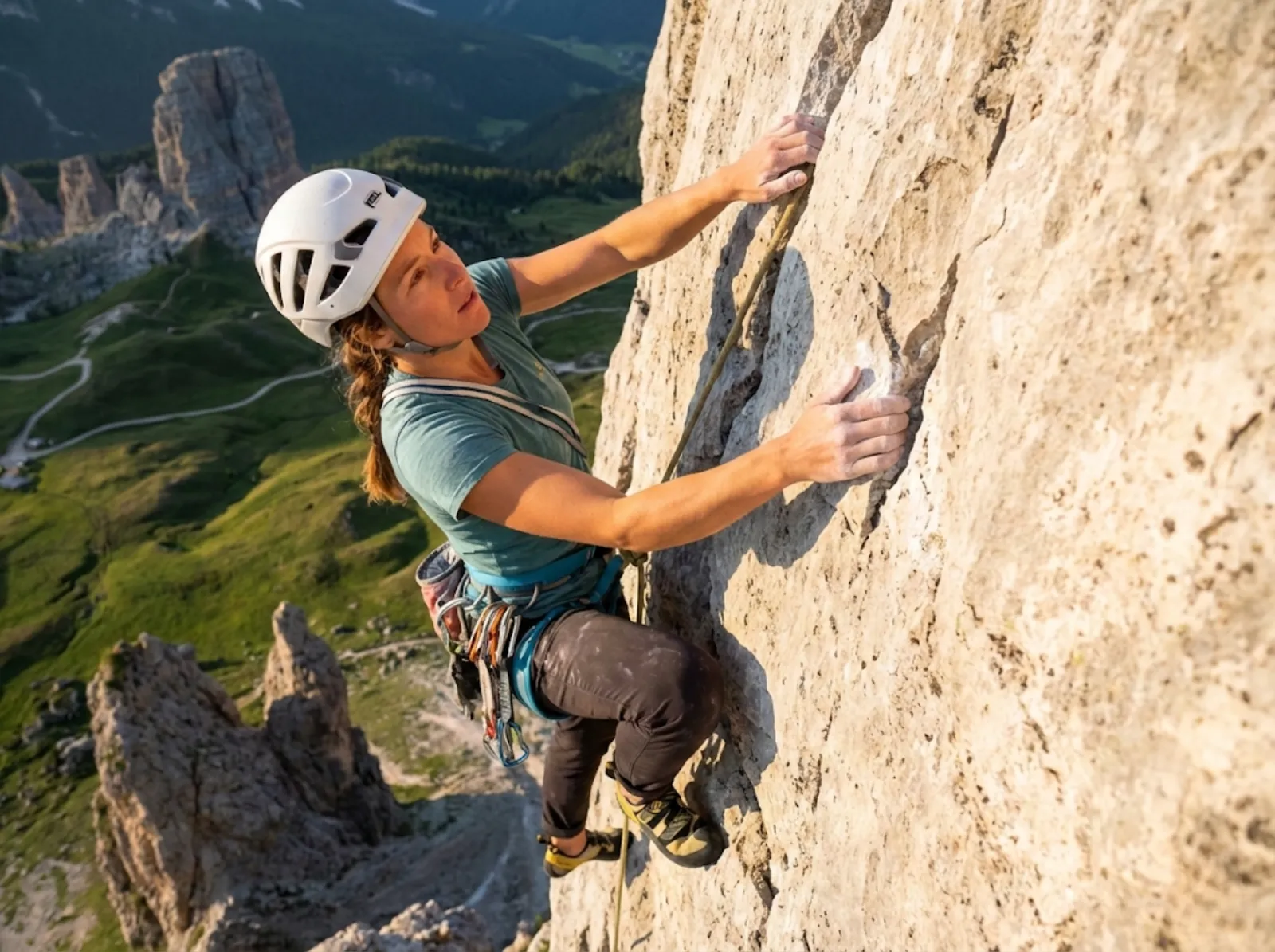
Dolomite isn’t regular limestone. It’s a magnesium-rich carbonate rock formed from ancient coral reefs — harder than typical limestone, with high friction even when damp. But the features are different from what you trained on at the gym: irregular pockets and sloping holds instead of uniform edges.
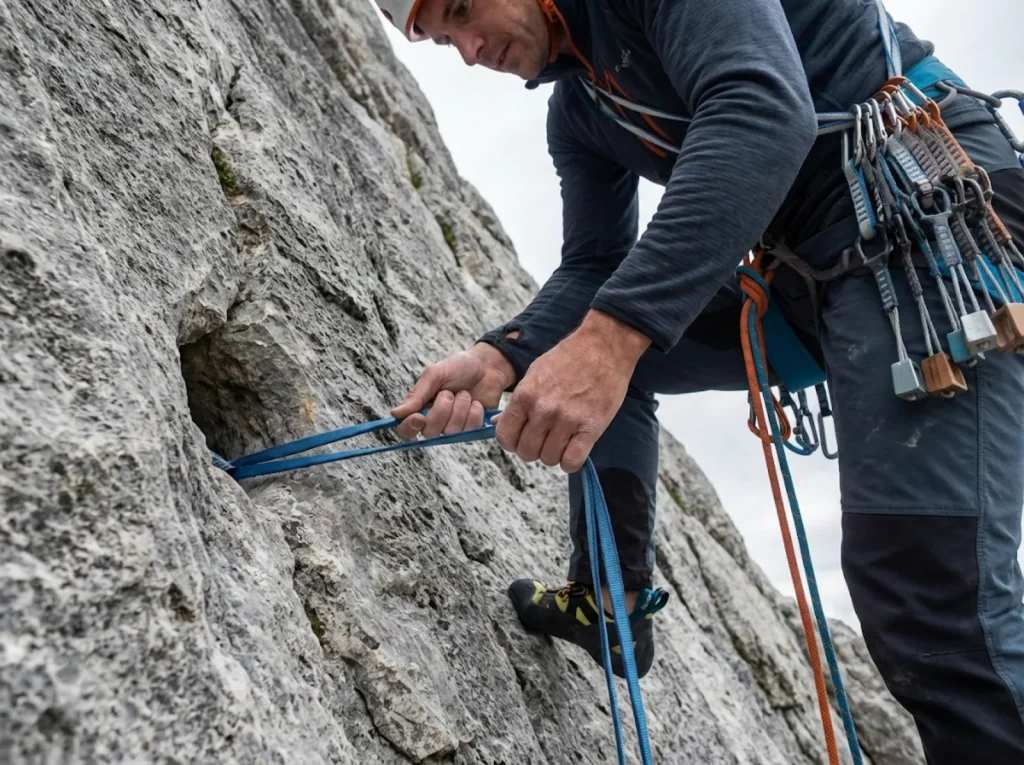
The real difference is protection. Forget splitter cracks and obvious cam placements. The Dolomites run on clessidre — natural holes bored through the rock that you thread with slings for bomber anchors. I’ve clipped clessidre that felt more solid than any bolt I’ve ever trusted. Loop a 120cm or 240cm sling through, clip a carabiner, and you have protection that has been holding climbers for a century.
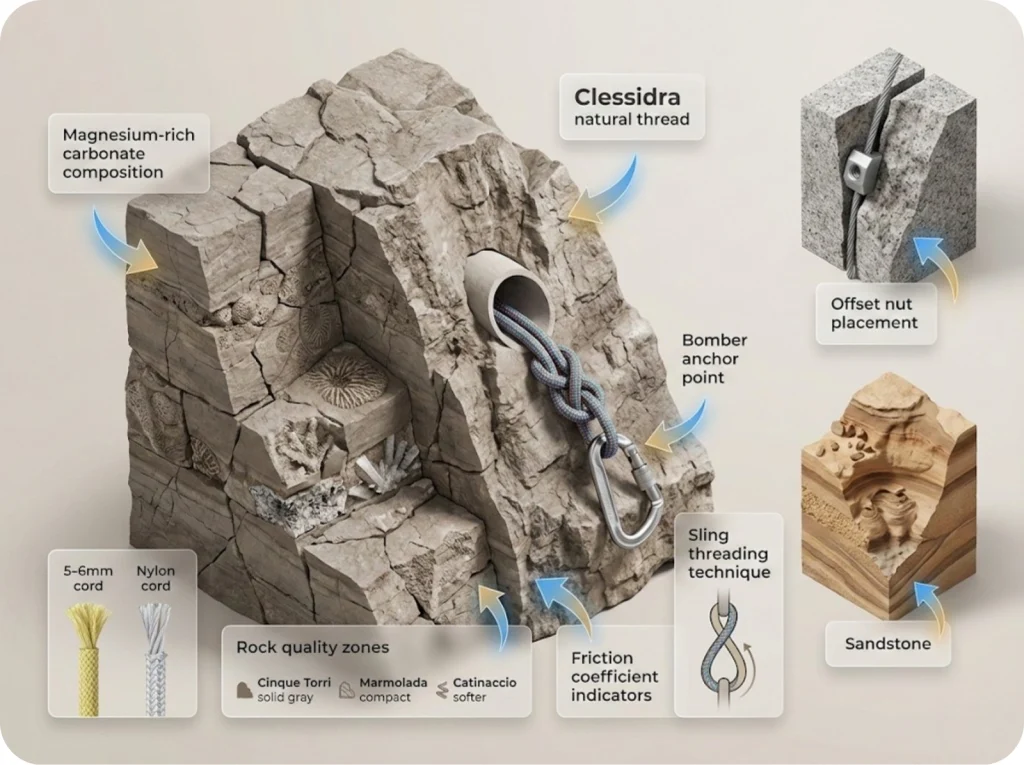
Rock quality shifts dramatically across massifs. Cinque Torri gives you solid grey limestone with clean features. The Marmolada south face is compact but can weep water. Catinaccio? Softer, chossier — watch every foothold. If you want to understand how rock geology changes your protection strategy, it pays to study before you pack.
Pro tip: Bring 5–6mm Kevlar cord for supplementary threads. It handles the sharp limestone edges better than nylon, and a few meters weighs almost nothing on your harness.
Old-School Grades — Why UIAA V Feels Like 5.10
The UIAA grading system uses Roman numerals based on the 1920s Welzenbach Scale. Most Dolomite topos do not use French grades at all. Here’s the conversion that matters: UIAA III = 5.4, UIAA IV = 5.6, UIAA V = 5.8, UIAA VI = 5.10, UIAA VII = 5.12.
But those numbers lie. A UIAA V on the Via Comici-Dimai hits harder than a gym 5.8 because the grade includes route-finding, runout between gear, and the mental weight of committing to a 500-meter wall with questionable retreat options. If you can’t comfortably cruise 5.9 outdoors on trad, you will struggle on UIAA IV in the Dolomites.
There’s also the split between “plaisir” (bolted multi-pitch) routes and classic alpine routes. Plaisir routes have fixed bolts every 3–4 meters. Classics might have a rusty piton every 15. Know which one you’re getting on before you leave the car.
The Bolt-vs-Piton Tension
On classics like the Spigolo Dibona, adding bolts is considered vandalism against mountaineering history. Guide associations systematically replace 50-year-old rusted pitons at belay stations with stainless steel bolts for safety — but the route lines remain traditional.
Understanding the difference between “equipped” (bolted) and “classic” (traditional) routes is critical for safety planning. Always check route descriptions before committing.
Three Hubs, Three Personalities — Where to Base Your Trip
Cortina d’Ampezzo — Tre Cime, Tofana, and the Big Walls
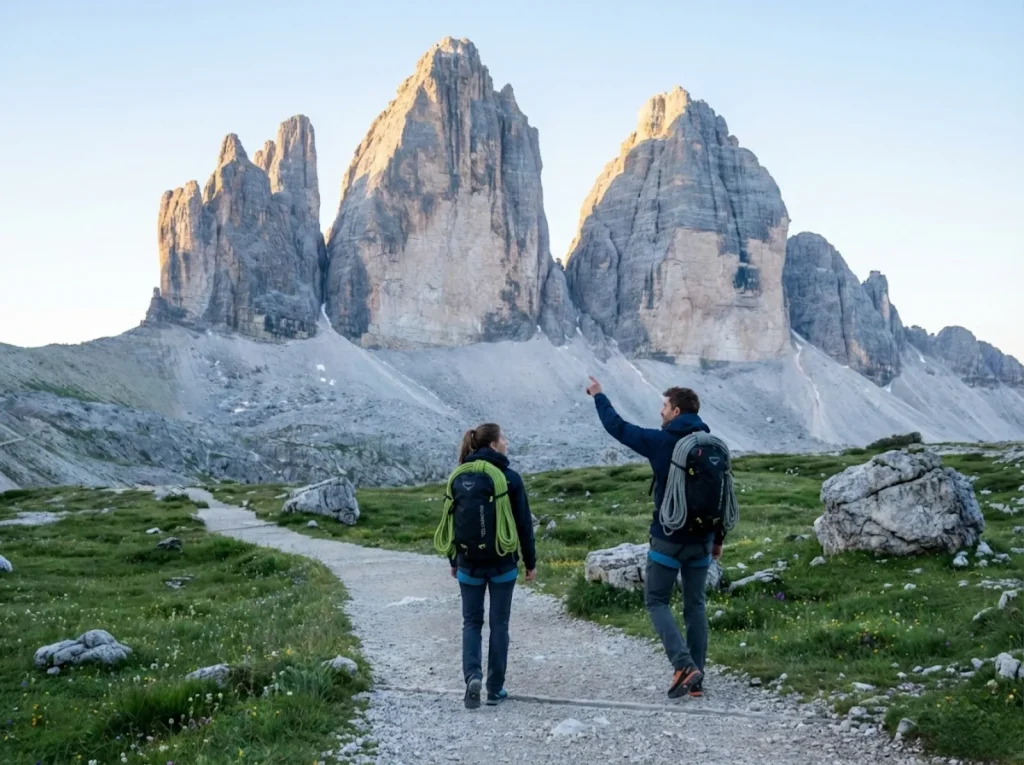
Cortina d’Ampezzo is base camp for the iconic walls: Tre Cime di Lavaredo, Tofana di Rozes, and the endless routes fanning across the Cristallo d’Ampezzo massif. The Spigolo Dibona (IV+, 430m, 12 pitches) and the Via Comici-Dimai (VI/A0, 500m, 16+ pitches) live here. So does the Spigolo Giallo on Cima Piccola — the Yellow Edge that glows at sunset.
Cinque Torri sits 15 minutes by lift above Cortina and works like an outdoor climbing gym. Short approaches, routes from III to VII, and you’re back drinking espresso by lunch. It’s the best warm-up climbing area in the Dolomites, and I’ve burned happy rest days there when the high peaks were socked in.
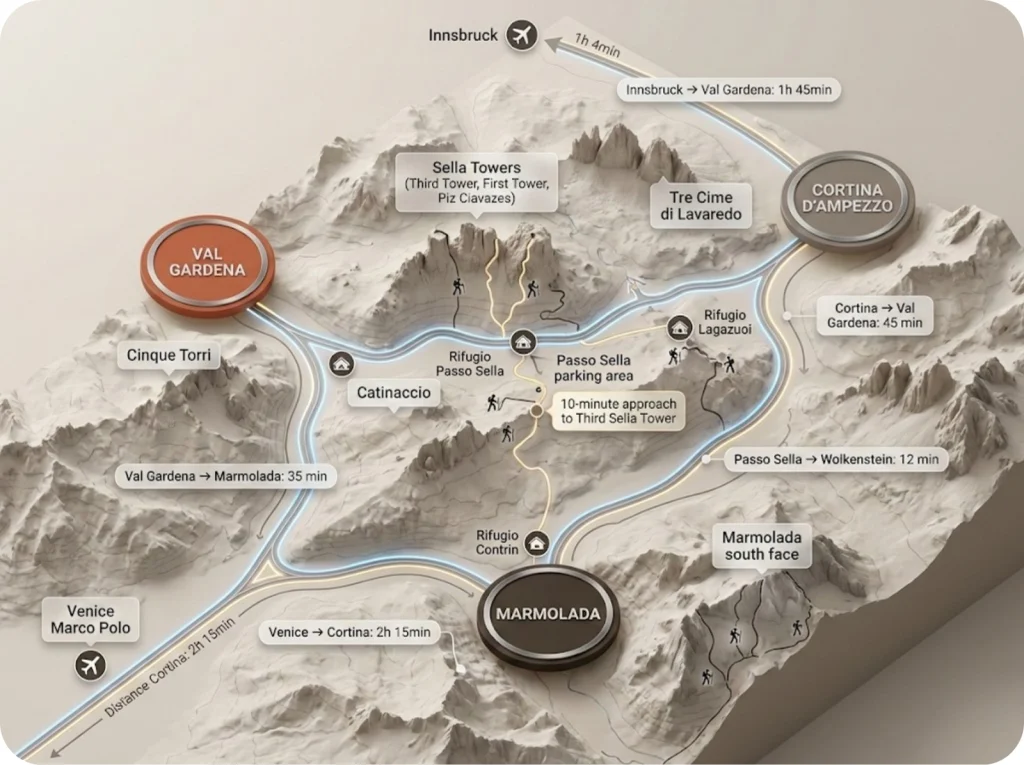
Getting here: fly into Venice Marco Polo and catch the ATVO bus to Cortina (roughly 2 hours), or fly into Innsbruck and drive south over the Brenner Pass.
Val Gardena — Sella Towers and the 10-Minute Approach
Val Gardena might be the most efficient multi-pitch climbing destination on Earth. Park at Passo Sella, walk 10 minutes, climb 8 pitches on the Third Sella Tower (V-, 290m), and drive 12 minutes back to Wolkenstein for dinner. The ratio of climbing time to approach time is unbeatable.
The Sella Towers are where I tell first-timers to start. The Third Tower Normal Route is a perfect introduction to Dolomite alpine rock climbing: exposed enough to demand respect, well-protected enough to build confidence. From there, step up to Piz Ciavazes Schubert (VI-, 250m) or the First Sella Tower Delenda Carthago (6b, 180m) if you want bolted sport climbing on big walls.
If you’re new to vertical terrain, reviewing multi-pitch systems and safety fundamentals before your trip is time well spent.
Marmolada — The Queen and Her 900-Meter South Face
Marmolada (3,343m) is the highest peak in the Dolomites and the line between multi-pitch climbing and serious mountaineering. The south face — locals call it the Silver Wall — drops 900 meters of sheer limestone hosting routes like the legendary Fish Route (Attraverso il Pesce). If you’re chasing it, you need alpine routes experience beyond typical cragging: longer approaches, glacier remnants, altitude effects, and full self-rescue skills.
The Brenta Dolomites near Madonna di Campiglio offer a different flavor — hut-to-hut itineraries that combine via ferrata with multi-pitch climbing on circuits linking Rifugio Graffer and Rifugio Tuckett.
Building the Right Rack for Dolomite Limestone
Protection That Actually Works in Limestone Pockets
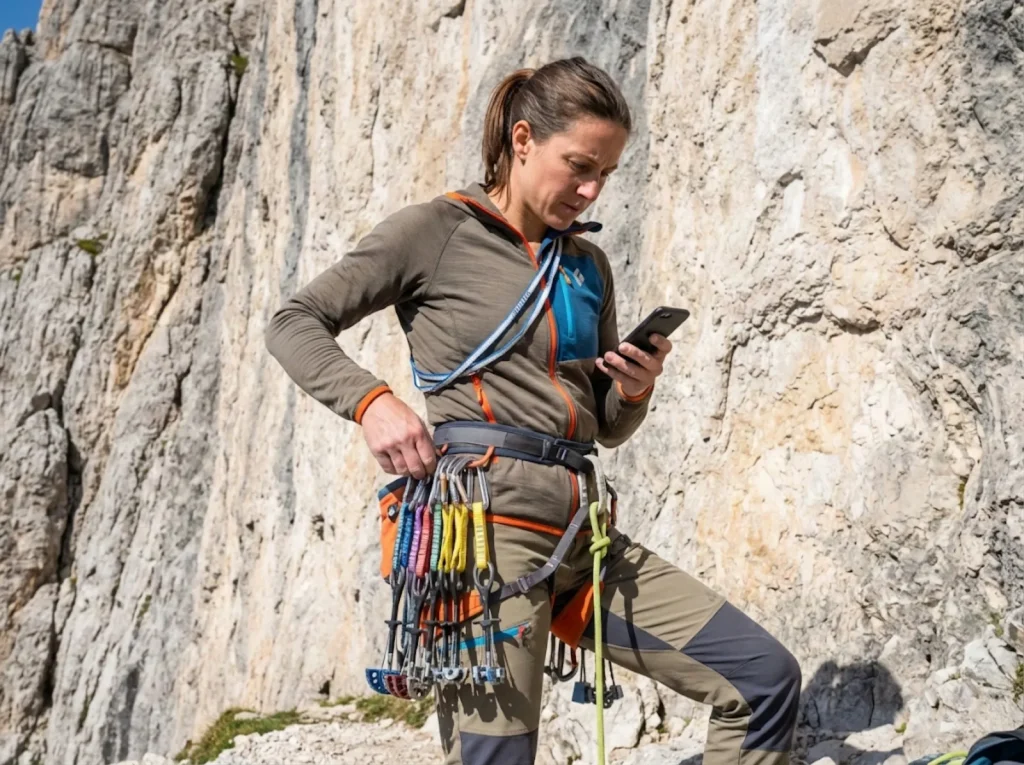
Forget your gym rack. Dolomite rock eats standard gear strategies for breakfast. Offset nuts outperform symmetric ones in the irregular pods and limestone pockets — the asymmetric shape matches natural features that straight-sided gear just slides out of.
Micro-cams work in thin seams, but you won’t need much larger than a #2 unless you’re on specific routes like Don Quixote. The real workhorse is slings: 120cm and 240cm Dyneema loops for threading clessidre, backed by a few meters of 5–6mm Kevlar cord for tighter threads. Most belays are equipped with two stainless steel rings at the sostas (belay stations), but bringing cordelette for backup on older routes is non-negotiable.
If you’re building your first trad rack, know that a Dolomites-specific setup leans heavier on slings and lighter on large cams than a typical granite rack.
Pro tip: Rack your slings in alternating lengths over your head and one shoulder, not clipped to your harness. It keeps weight centered and prevents the “gear tornado” that happens when you try to find a 240 buried under six quickdraws.
Ropes, Draws, and the Onion System
60m half ropes are the standard here. Full stop. They give you 60m rappels on descent (critical — more on that later) and reduce rope drag on the wandering trad lines that wrap around roofs and chimneys. A single 70m rope limits you to 35m rappels and will leave you stranded on half the descents.
Alpine draws are mandatory. If you use standard quickdraws on every piece, you’ll be fighting rope drag by pitch four and unable to pull rope through by pitch six. Extending every piece with alpine draws and rope drag management technique turns a miserable battle into a smooth lead.
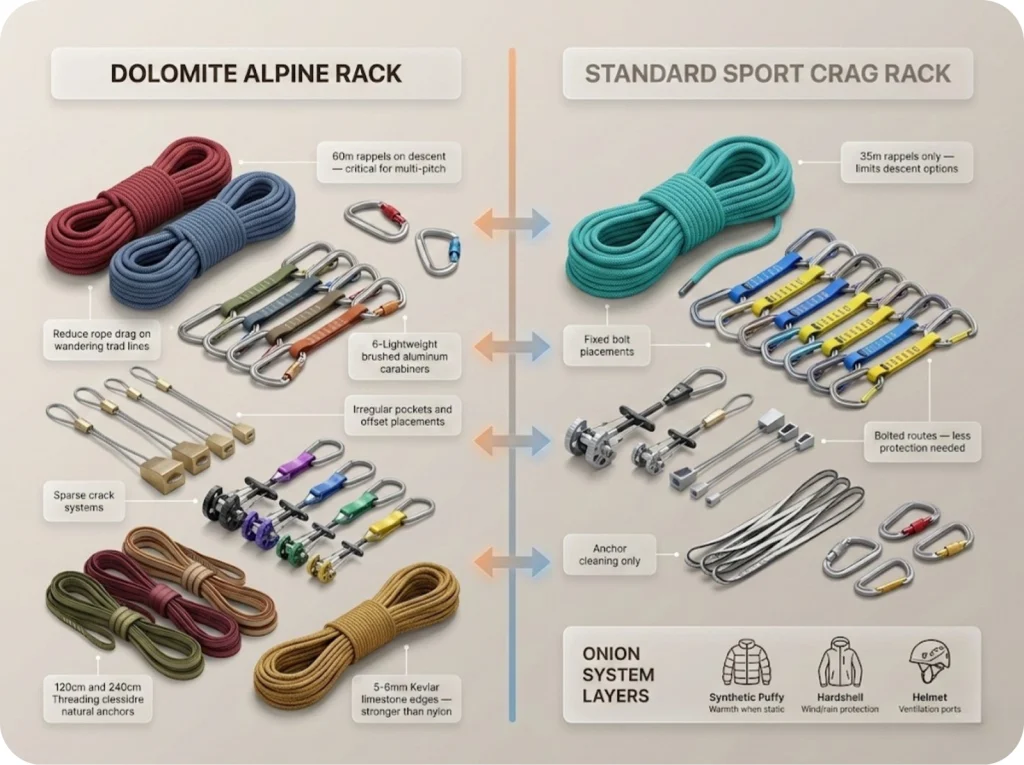
Pack layers even in July. The “Onion System” isn’t optional: a synthetic puffy over your base layer for belaying in shade on north faces, a lightweight hardshell for afternoon weather, and a climbing helmet at all times.
The Dolomite Start — Weather, Season, and Storm Retreats
The Diurnal Clock That Runs Your Day
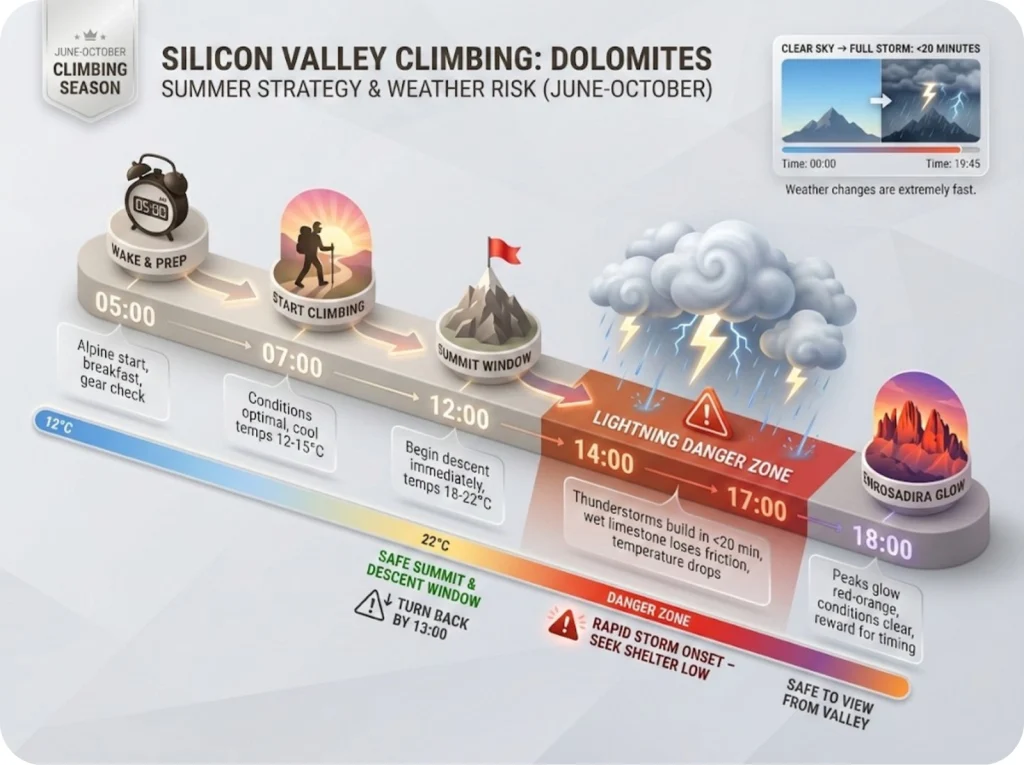
The best climbing season in the Dolomites runs June through October, but every single day follows the same brutal clock. You wake at 05:00. You climb from 07:00 to noon. You summit and start descending by 12:00. And you are off the wall by 14:00. Period.
This isn’t arbitrary. Between 14:00 and 17:00 during July and August, thunderstorms build with frightening speed. I have watched clear blue sky turn into a full electrical storm in under 20 minutes. Being on an exposed ridge during that window is life-threatening — lightning plus sudden temperature drops plus wet limestone that loses all friction.
By 18:00, conditions usually clear. That’s when the Enrosadira happens — the magnesium in the Dolomite rock catches the sunset light and the peaks glow red and orange. It’s the reward for getting off the wall on time.
Month-by-Month Breakdown
June brings wildflowers at peak bloom and routes opening at lower elevations, but high passes above 2,500m may still hold snow. Carry microspikes for approaches to places like Passo Gardena.
July and August are peak season: longest days, best access to high routes, highest route crowding on classics. They’re also peak thunderstorm months. North faces get popular because they stay shaded and cool.
September is the golden month. Low precipitation, clear air, minimal storm risk. Temperatures drop but the climbing is mint. This is when the veterans come.
October works for lower routes. Larch trees turn gold, the crowds vanish, but days are short and mornings start below freezing. Most rifugios close the first week of October.
Plan B — Valley Crags and Lake Garda
When weather shuts down the high mountains, drive south to Arco near Lake Garda for sheltered sport climbing at lower altitude. Guides from services like FreeDolomites build Plan B options into trip itineraries for exactly these days. Bolted single-pitch crags near the Falzarego Towers also work as lower-commitment alternatives.
Rifugi, Guides, and the Economics of a Dolomites Trip
How the Rifugio System Works
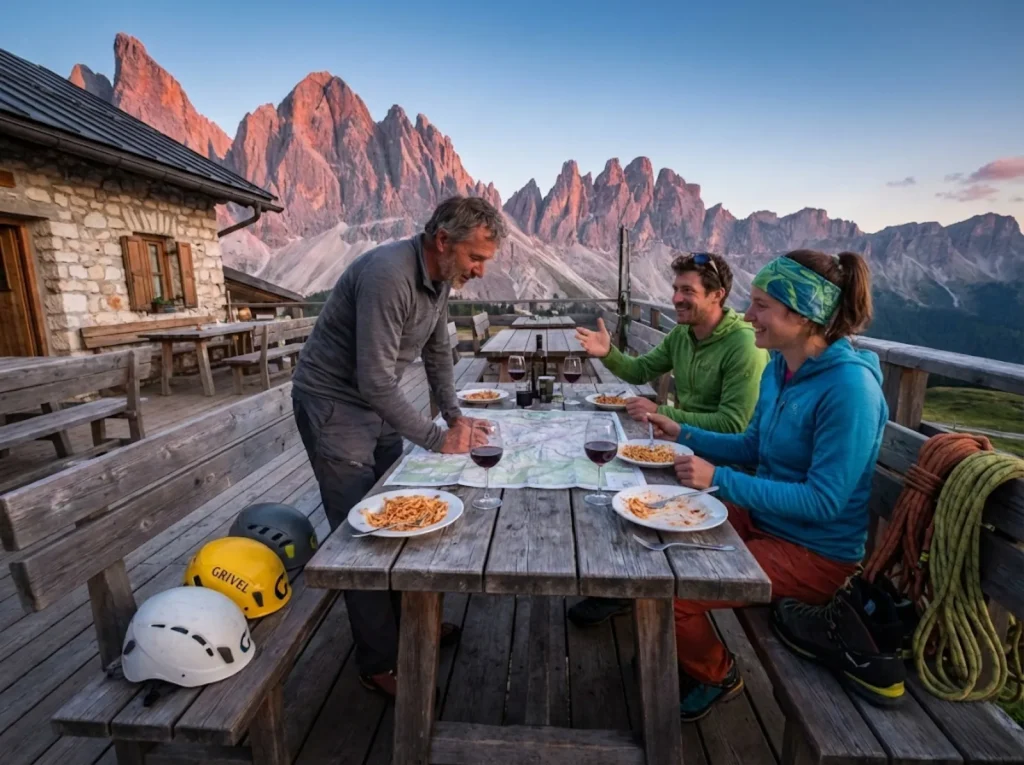
Mountain huts in the Dolomites are managed by CAI (Club Alpino Italiano) and run more like mountain hotels than backcountry shelters. Dormitory beds cost €30–42 per night for non-members. Half-board (dinner plus breakfast) runs €75–€95 and is worth every cent — you’ll eat pasta, polenta, and drink wine at 2,400 meters with the peaks turning pink outside the window.
CAI or reciprocal Alpine club members get 30–40% discounts. Membership pays for itself in two nights. Showers cost €5–10 for 3–5 minutes (coin-operated), and bottled water runs about €5 for 1.5 liters. Book private rooms 6+ months ahead for popular huts like Rifugio Firenze or Fonda Savio Hut.
Pro tip: Check cable car closing times every morning. They usually shut at 16:30–17:00. Missing the Cinque Torri or Lagazuoi lift turns a 15-minute ride into a 2-hour knee-destroying descent on loose scree.
Guide Costs and What IFMGA Certification Actually Means
An IFMGA certified (UIAGM) mountain guide charges €370–€420 per day for standard multi-pitch on moderate routes. Demanding routes — 10+ pitches, complicated descents — push that to €500–€660 per day for one client, €700–€800 total for a pair.
The certification matters. UIAGM is the international gold standard, validated across rock, ice, ski mountaineering, and rescue. The IFMGA maintains a public directory of certified guides through its member associations. Always verify your guide’s credentials before committing money.
Top services worth contacting: Guide Dolomiti with Enrico Maioni for Cortina-based expertise, OnTop Mountaineering for their deep route database, FreeDolomites for narrative-driven guiding with Fabrizio, and Catores Alpine School in Val Gardena. For a broader network, International Alpine Guides operates across the region.
Insurance and Rescue — The €90-Per-Minute Reality
Aiut Alpin Dolomites runs helicopter rescue in the region, and it costs roughly €90 per minute of flight time. A “routine” rescue can exceed €14,000. Let that number sit for a second.
Get travel insurance that explicitly covers alpine rescue evacuation before you leave home. CAI membership includes basic rescue coverage. Austrian or German ADAC insurance also covers evacuations in northern Italy. Dial 112 for emergencies, and download offline maps before your trip — cell coverage at rifugios is spotty at best.
Descents, Mistakes, and the Things Nobody Warns You About
Why Descents Are the Real Crux
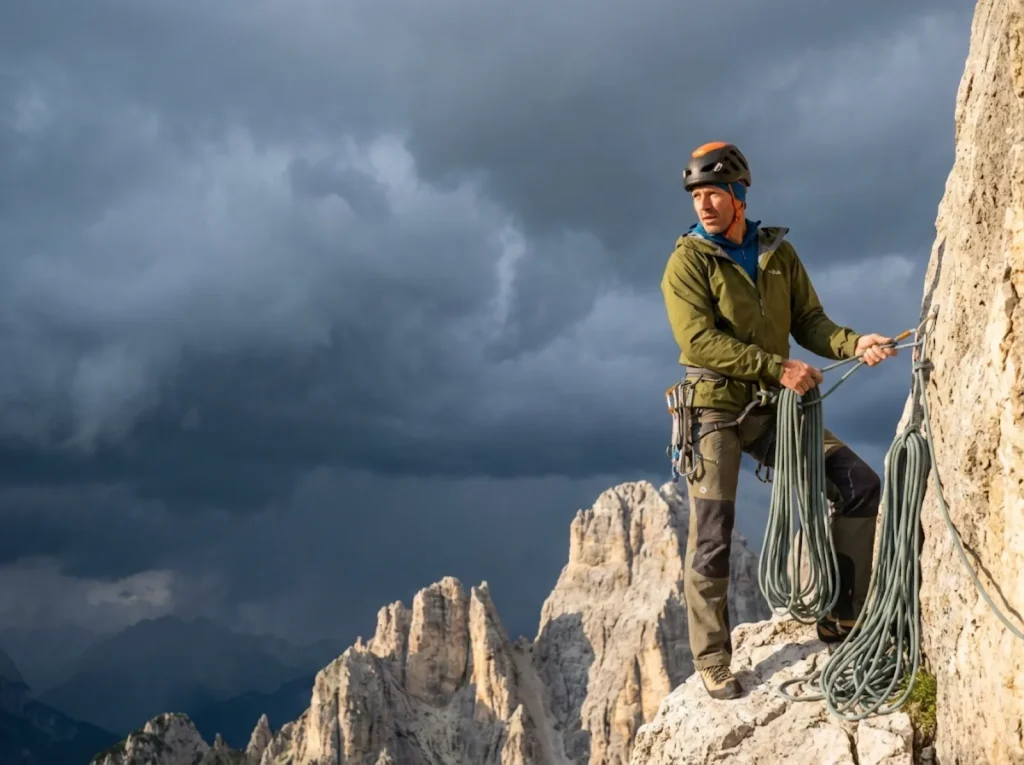
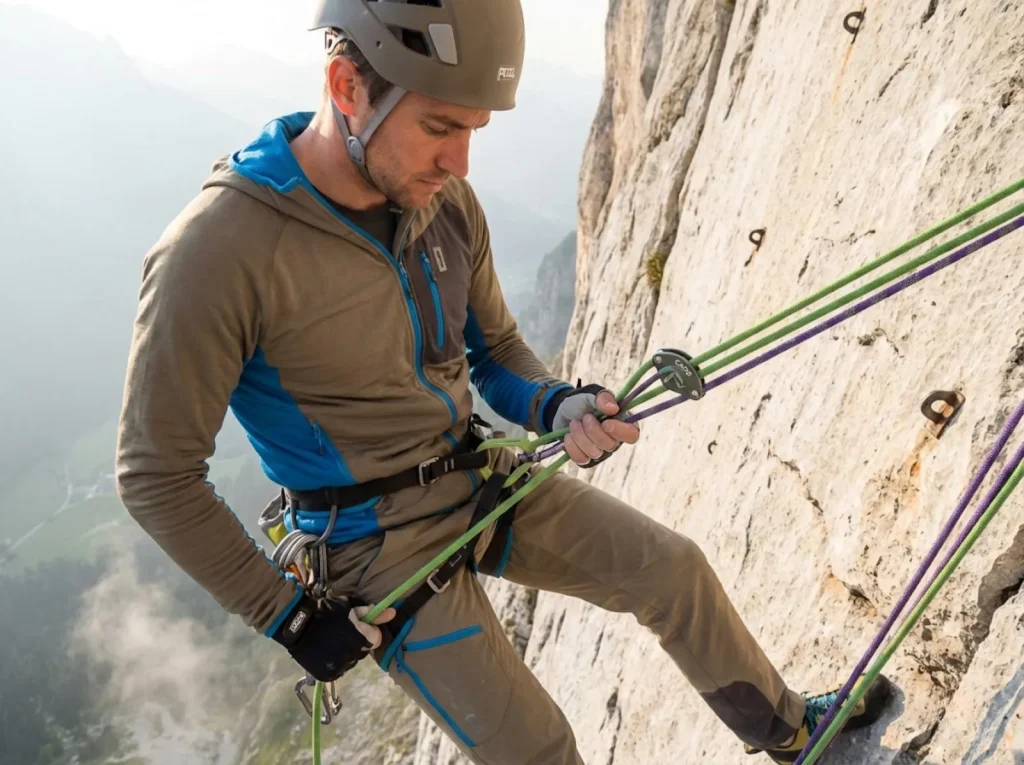
Here’s what nobody tells you: getting down from a Dolomite route is often harder than climbing it. Descents involve unmarked scrambling on loose rock, multiple rappel stations connected by narrow ledge systems, and navigation decisions that aren’t covered by the two-line description in your topo.
The descent from the Dibona Arete on Tre Cime involves traversing ledge systems invisible from above. The walk-off from Sassolungo Normal Route is a labyrinth of cairns through broken terrain. Every route has a descent story worthy of its own article.
This is why 60m half ropes are non-negotiable. They enable full 60m rappels at every station. A single rope limits you to 30m, and you will run out of anchor options mid-descent. Before your trip, brush up on closed-system rappel protocols — the margin for error on a Dolomite rappel is exactly zero.
Pro tip: Carry the specific rappel descent beta for every route you plan to climb. “Descent: 1 hour” in a topo tells you nothing. Get the exact station count, direction changes, and scramble sections from guidebooks, local guides, or online databases before you commit.
The Four Mistakes That Wreck Dolomites Trips
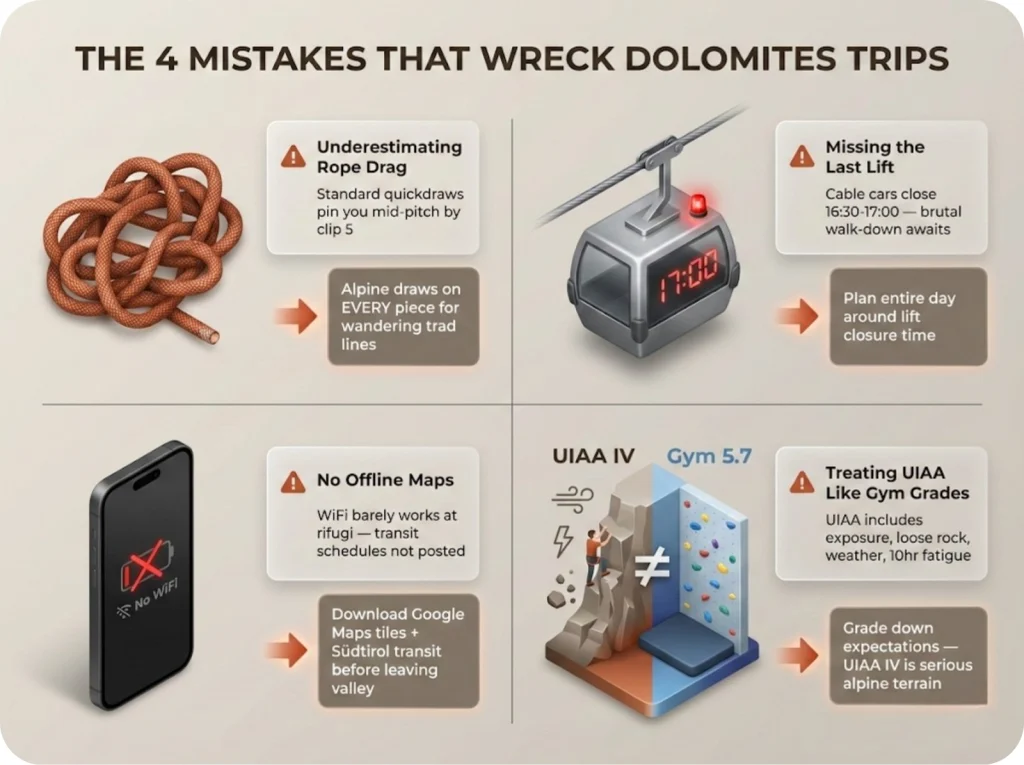
Underestimating rope drag. Wandering trad lines around roofs and chimneys demand alpine draws on every single piece. Standard quickdraws will pin you mid-pitch by the fifth clip.
Missing the last lift. Cable cars close at 16:30–17:00. Plan your day around that number or accept a brutal walk-down on knees that are already destroyed from 10 pitches of Dolomite climbing.
No offline maps. WiFi barely works at most rifugi. Download your Google Maps tiles and transit schedules before you leave the valley. The Cortina Express Bus and local Südtirol transit run on fixed schedules that aren’t posted anywhere useful.
Treating UIAA grades like gym grades. Every season, someone gets benighted because they assumed UIAA IV would feel like gym 5.7. It won’t. The numbers include exposure, loose rock, weather, and the accumulated fatigue of 10 hours of vertical movement.
Leave No Trace in the Dolomites
High-traffic areas around the Tre Cime base are waste hotspots. Pack out all solid waste. Use grey or tan chalk to match the limestone — white chalk streaks on famous routes are an eyesore and an ethics violation. Remove sun-bleached slings from rappel stations and replace with earth-toned cord. Respect seasonal raptor nesting closures posted at trailheads and follow Leave No Trace ethics for climbers as a baseline, not a ceiling.
Conclusion
The Dolomites reward preparation, not athletic ego. Match your routes to your outdoor trad grade, not your gym PR. The Dolomite Start isn’t optional — be off the wall by 14:00 or accept the consequences of exposed-ridge lightning. And budget honestly: a “cheap” Dolomites trip doesn’t exist, but a well-planned one is worth every euro.
Build your tick list around one hub for your first trip. Spend 4–5 days in Val Gardena: warm up on Cinque Torri, step up to the Third Sella Tower, and finish with something committing on Piz Ciavazes. Get the movement right on limestone before chasing the big names on Tre Cime. Then go send something.
FAQ
Do I need a guide to climb in the Dolomites?
Not on bolted plaisir routes if you have solid multi-pitch trad experience and can read UIAA grades comfortably. For classic alpine routes on Tre Cime, Marmolada, or anything above UIAA V, hiring an IFMGA certified guide is strongly recommended — they handle route-finding, rappel descent beta, and real-time weather decision-making that can save your life.
What is the best time of year to climb in the Dolomites?
September. Low precipitation, clear skies, minimal thunderstorm risk. July and August offer the longest days but the highest afternoon storm frequency. June works for lower-altitude routes, but high passes above 2,500m may still hold snow.
What climbing grade do I need for the Dolomites?
You should comfortably lead UIAA IV (roughly 5.6 YDS) on outdoor trad to enjoy the easiest classics. UIAA grades in the Dolomites run stiff compared to French grades — if you can’t cruise 5.9 trad outdoors, expect to struggle on routes graded UIAA V.
How much does a week of climbing in the Dolomites cost?
Budget €1,500–€3,000 per person for 5–7 days. Breakdown: IFMGA guide (€370–660/day for 3–4 guided climbing days), rifugio half-board (€75–95/night for 4–5 nights), gear rental (€50–100), transport from Venice Marco Polo (€100–200). CAI membership saves 30–40% on hut costs and is worth getting before your trip.
Can I rent climbing gear in the Dolomites?
Via ferrata sets, crampons, and climbing helmets are widely available at rental shops in Cortina and Selva for €9–29/day. However, climbing shoes, harnesses, and trad protection (cams, nuts) should be brought from home. Local rental shops focus on ferrata Dolomites and hiking equipment, not rock climbing racks.
Safety Notice: Rock climbing and mountaineering are inherently high-risk
activities that can involve physical trauma or fatal incidents. The information on Rock Climbing Realms is for
educational and informational purposes only. Techniques and advice presented here are not a substitute
for professional, hands-on instruction. Conditions and risks vary by location. Always seek guidance
from a qualified instructor before attempting new techniques. By using this website, you agree that you
are solely responsible for your own safety. Any reliance you place on this information is strictly
at your own risk, and you assume all liability for your actions. Rock Climbing Realms and its authors
will not be held liable for any harm, damage, or loss sustained in connection with the use of this information.
Affiliate Disclosure: We are a participant in the Amazon Services LLC Associates Program, an
affiliate advertising program designed to provide a means for us to earn advertising fees by advertising and linking
to Amazon.com. As an Amazon Associate, we earn from qualifying purchases. We are also an official affiliate partner
of Black Diamond Equipment via the AvantLink network. If you click on a Black Diamond affiliate link and make a
purchase, we may earn a commission at no additional cost to you. We also participate in other affiliate programs.
Additional terms are found in the terms of service.