
In this article
The first time my partner whipped off the fourth bolt, I didn’t just feel the jerk in my arms—I felt my feet leave the ground. Before I knew it, I was airborne, rocketing toward the wall with nothing between my face and the quickdraw but three feet of panic.
After years of belaying partners who outweighed me by 60+ pounds, I’ve tested every solution on the market—sandbags, ground anchors, the Edelrid Ohm, and now the Ohmega. Some work. Some create new problems. This guide breaks down what actually happens when a light belayer catches a heavy climber, compares every solution available, and shows you exactly when to use each one—so you can catch big falls without becoming a human projectile.
⚡ Quick Answer: If your climber weighs more than 1.5 times your body weight, you need intervention—either an Edelrid Ohm/Ohmega at the first bolt, sandbag ballast, or refined soft catch technique. Ground anchors work for top-rope but create dangerous hard catches on lead. The 10kg (22 lb) difference is where you should start paying attention.
Why Weight Difference Creates Real Danger
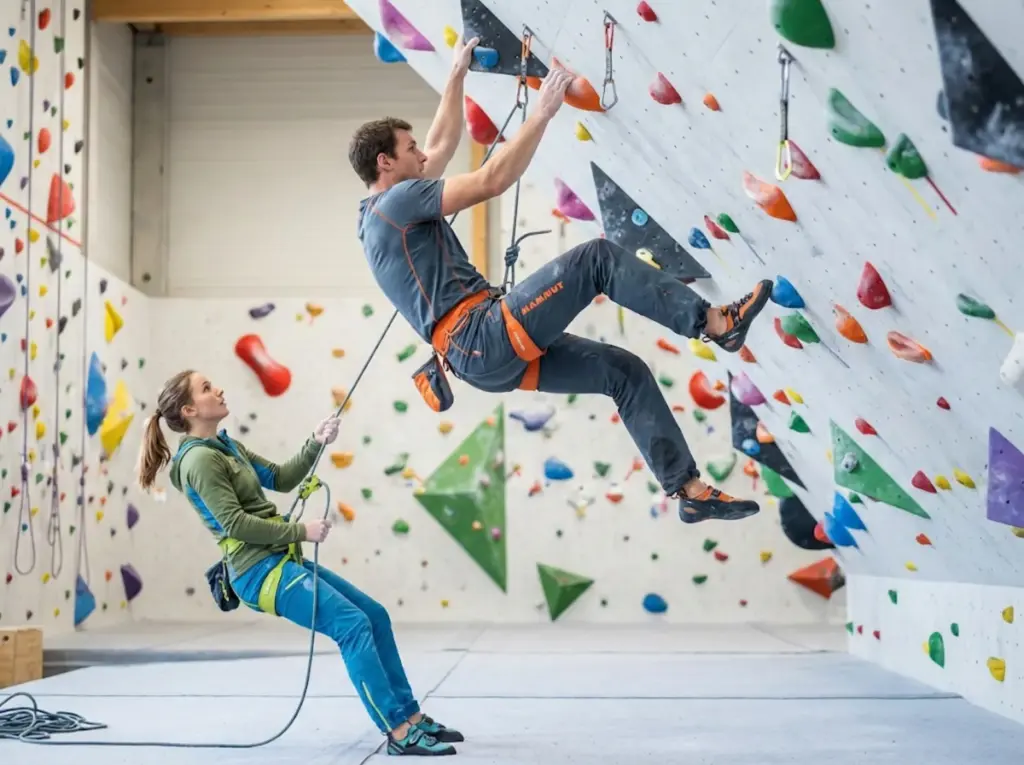
When a heavy climber falls, the rope tension doesn’t just tug at your harness—it tries to yank you off your feet and into the wall. This isn’t about grip strength or technique alone. It’s physics working against you.
The “Flying Belayer” Problem
The German Alpine Club (DAV) calls it “getting launched.” When your partner whips, the rope tension pulls you upward and inward toward the first bolt. If you weigh significantly less than your climber, you accelerate toward the wall at dangerous speeds.
The 10kg rule is your first warning sign. According to the DAV Indoor Climbing Safety Guidelines, if the weight difference exceeds 10kg (about 22 lbs), active countermeasures become necessary. Beyond that threshold, you’re not just getting pulled—you’re getting launched.
The real dangers are collision with the wall, the first bolt, or even the falling climber. And here’s what most people miss: indoor gyms are more dangerous than outdoor crags for this exact scenario. Straight bolt lines on gym walls create almost zero friction in the system. Outdoor routes with wandering paths and rock features add parasitic friction that slows the pull. In the gym, you get the full force.
Pro tip: Stand close to the wall so the pull is vertical. If you stand too far back, you’ll get dragged across the floor before flying up—and that’s worse.
The 1.5x Rule Every Belayer Must Know
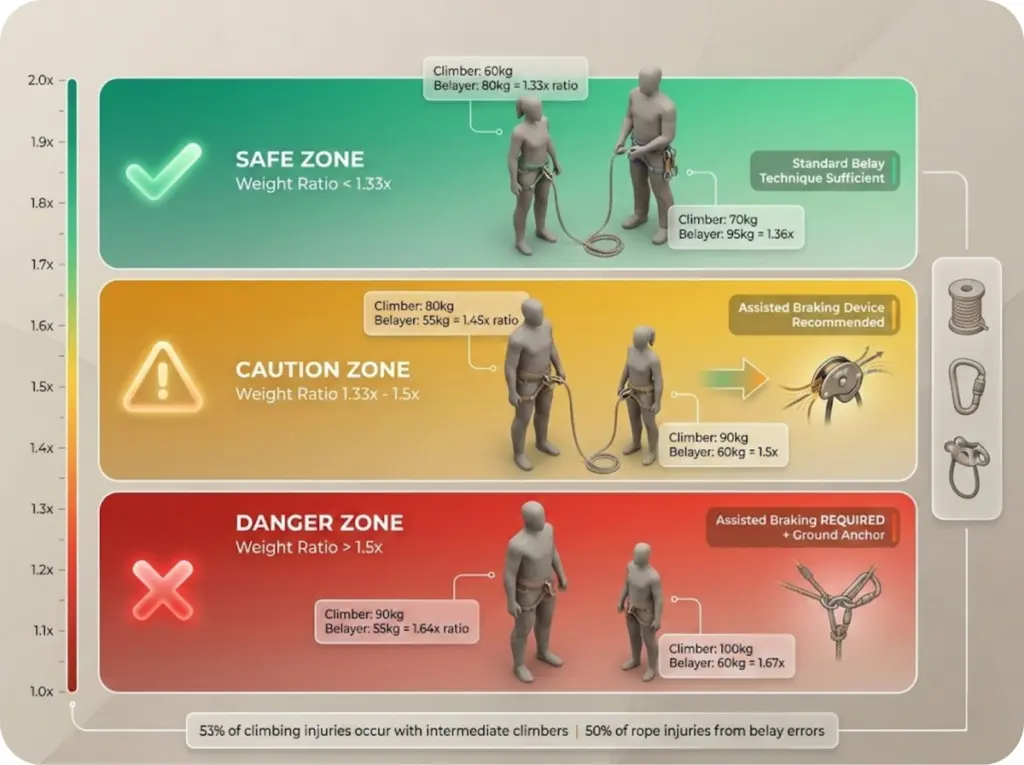
The DAV sets an absolute limit: the climber must NOT weigh more than 1.5 times the belayer’s weight. For a 130lb belayer, that caps the climber at 195lbs. Exceed this ratio without specialized equipment, and you cannot reliably hold a fall.
The 1.33x ratio is your comfort zone—where standard belay devices work adequately. Between 1.33x and 1.5x, you need countermeasures. Beyond 1.5x, you’re gambling with both bodies.
Here’s what that looks like in practice:
- 120lb belayer → 180lb climber = 1.5x ratio (absolute limit)
- 130lb belayer → 173lb climber = 1.33x ratio (comfort zone)
- 100lb belayer → 200lb climber = 2.0x ratio (dangerous without intervention)
When Gyms Are More Dangerous Than Crags
Straight gym routes mean minimal parasitic friction. The rope runs nearly parallel to the wall through the quickdraws, so almost the full force of the fall transmits directly to you.
Outside, wandering routes create friction through rock features, carabiners at angles, and rope drag. A light belayer may handle the same partner better on a meandering outdoor sport route than on a straight gym line.
Gym-specific risks compound the problem: smooth walls offer nothing to brace against, and hard rubber floors mean nowhere safe to go if someone decks. Understanding the physics of friction devices for light belayers helps explain why these tools matter more indoors than out.
The Ground Anchor Trap (And Why It Can Hurt Your Climber)
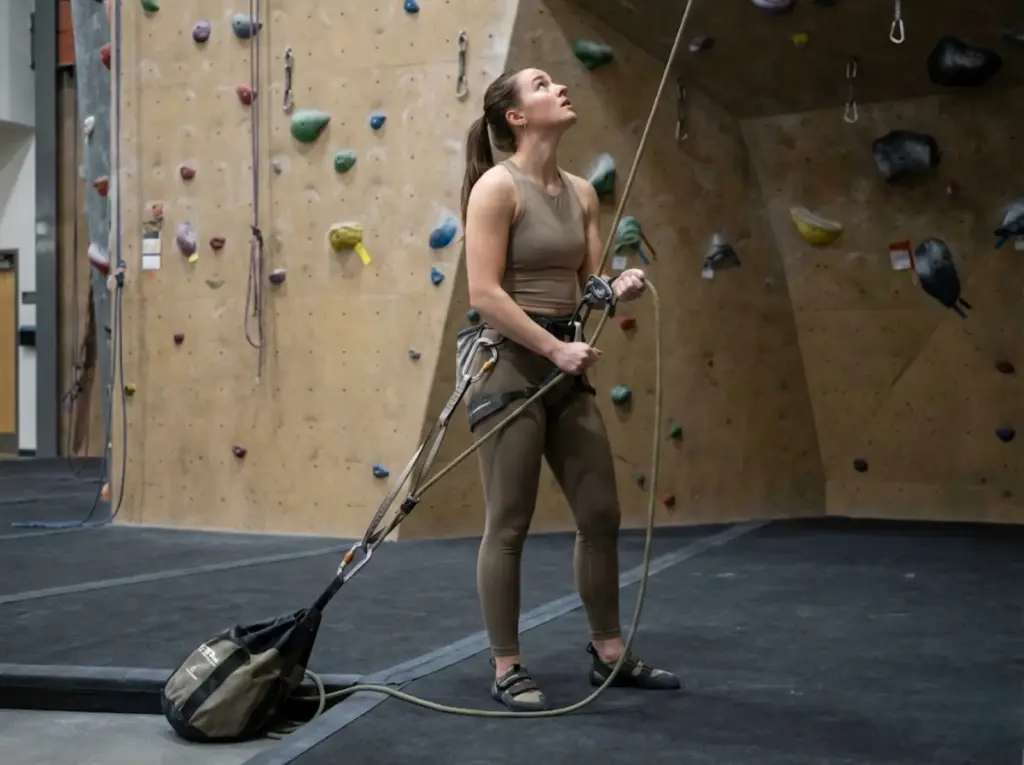
Here’s where well-meaning advice goes wrong. “Just anchor yourself to the floor” sounds logical—until you understand what it does to your climber.
How Ground Anchors Create Hard Catches
Fixing yourself to the floor removes the system’s primary shock absorber: your body movement. When you’re free to move, your upward acceleration during a catch extends the deceleration time. That’s a soft catch—lower peak forces, gentler on the climber’s body and the gear.
Anchor yourself, and all that leftover energy goes somewhere else. It goes into your climber’s ankles, their spine, and the bottom bolt. High peak impact forces from hard catches can cause ankle fractures for the climber and put excessive outward force on that critical first piece of protection.
One certified lead instructor put it bluntly: “If you anchor the belayer, you’re going to get a really hard catch and a lot of force on the bottom bolt… not good.”
Pro tip: Ground anchors should be reserved for top-rope belaying. For lead climbing, use friction devices that allow some controlled belayer movement.
When Ground Anchors Are Actually Appropriate
Ground anchors have their place—just not for lead climbing with significant weight difference.
Top-rope belaying is different. The fall factor is low (the climber is always above the anchor point with minimal slack), so dynamic absorption matters less. Many gyms require anchoring for top-rope regardless of weight ratio. Check your gym policy.
The rule is simple: top-rope with anchor, lead climbing without. If you must manage a big weight gap on lead, friction devices or ballast are your answers—not bolting yourself to the floor.
The Edelrid Ohm vs. Ohmega—A Direct Comparison
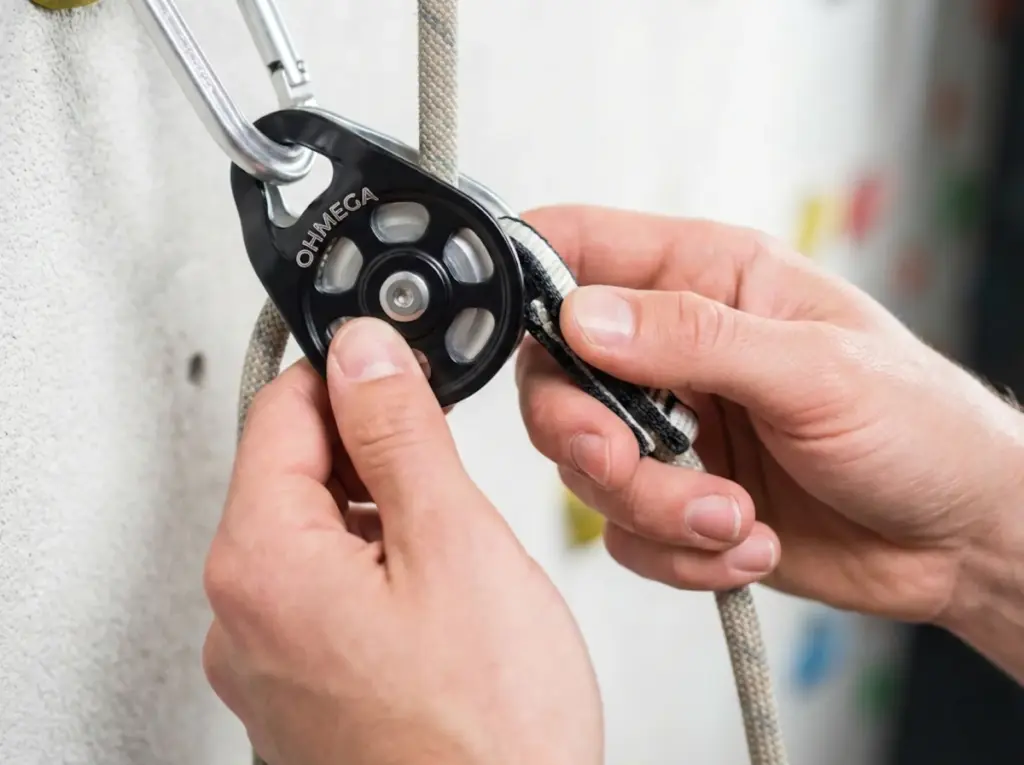
The market responded to the weight differential problem with purpose-built gear. Two devices dominate: the original Edelrid Ohm and its successor, the Ohmega.
How the Ohm Works
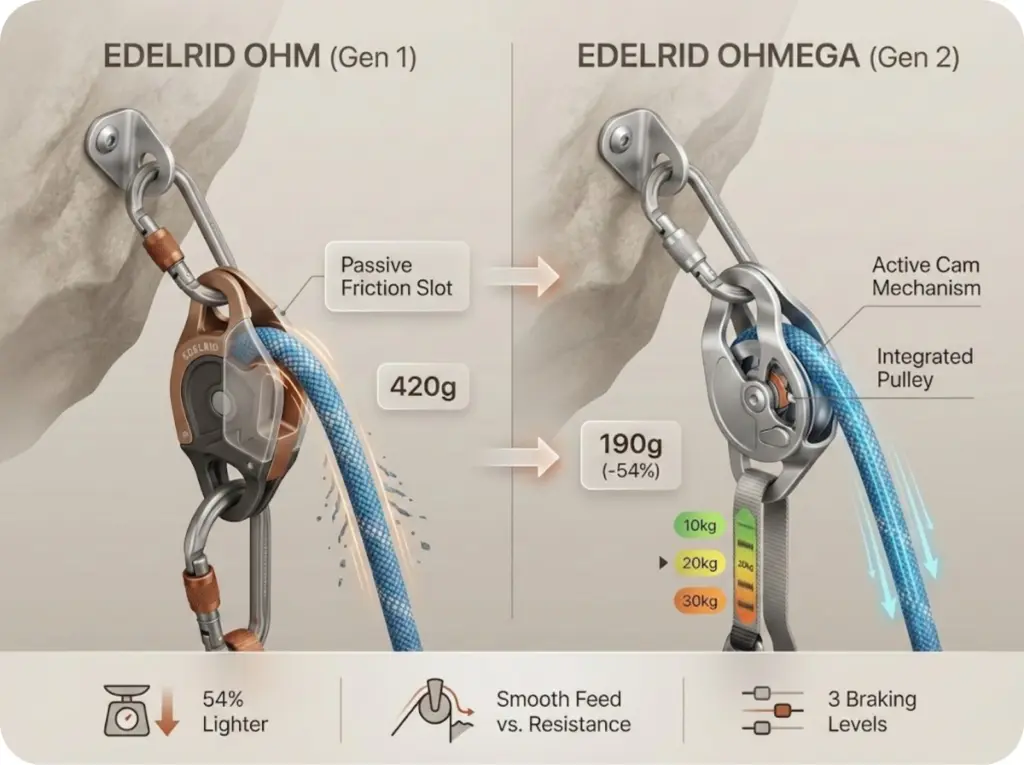
The Ohm is an assisted-braking resistor you install at the first bolt. It uses a passive V-shaped braking channel—no moving parts, no springs, just geometry.
When your climber falls, the rope pulls into that channel and friction spikes. Edelrid says it effectively adds about 25kg (55lbs) to the belayer. You don’t get launched; the system stabilizes. But unlike a ground anchor, the rope still slips through the device, preserving the dynamic catch.
Key specs:
- Minimum belayer weight: 40kg (88lbs)
- Rope compatibility: 8.9mm – 11.0mm
- Weight: 405g—nicknamed the “mini brick” for a reason
The Ohm prevents the launch without creating a hard catch. It works with your belay device, not instead of it. Understanding UIAA safety standards for belay devices provides context for how this engineering approach meets industry safety requirements.
The Ohmega Upgrade—What’s Different
The Ohmega represents the second generation. Instead of a passive slot, it uses an active spring-loaded camming mechanism—similar to a GriGri, but designed to allow controlled slippage rather than full lock.
The key innovation is adjustability. An integrated HMPE sling lets you select between three braking levels: 10kg, 20kg, or 30kg of added resistance. Different partner, different setting.
At 190g, the Ohmega is more than 50% lighter than the Ohm. And the integrated pulley solves the original’s biggest complaint—rope drag during clipping. The Ohm feels like pulling rope through a cheese grater when you’re reaching for a clip. The Ohmega feeds smooth.
Community feedback suggests caution with the 30kg setting. Some users report it creates catches too hard—mimicking a static belay. The 10kg or 20kg settings handle most weight gaps without over-braking.
Which One Should You Buy?
Choose the Ohm if: You want simplicity, don’t mind the weight, and your weight gap is consistent. Set it and forget it.
Choose the Ohmega if: You climb with multiple partners of varying weights, value smooth rope feel while clipping, or hike to crags where every gram matters.
Both cost approximately $130 USD. Both work. The Ohmega just offers more tuning options.
| Edelrid Ohm vs Edelrid Ohmega Comparison | ||
|---|---|---|
| Feature | Edelrid Ohm | Edelrid Ohmega |
| Mechanism | Passive Friction | Active Cam |
| Weight | 405g | 190g |
| Resistance | Fixed (~25kg) | 10/20/30kg |
| Clipping Drag | High | Low (Pulley) |
| Price | ~$130 | ~$130 |
Sandbags—The Low-Tech Solution That Still Works
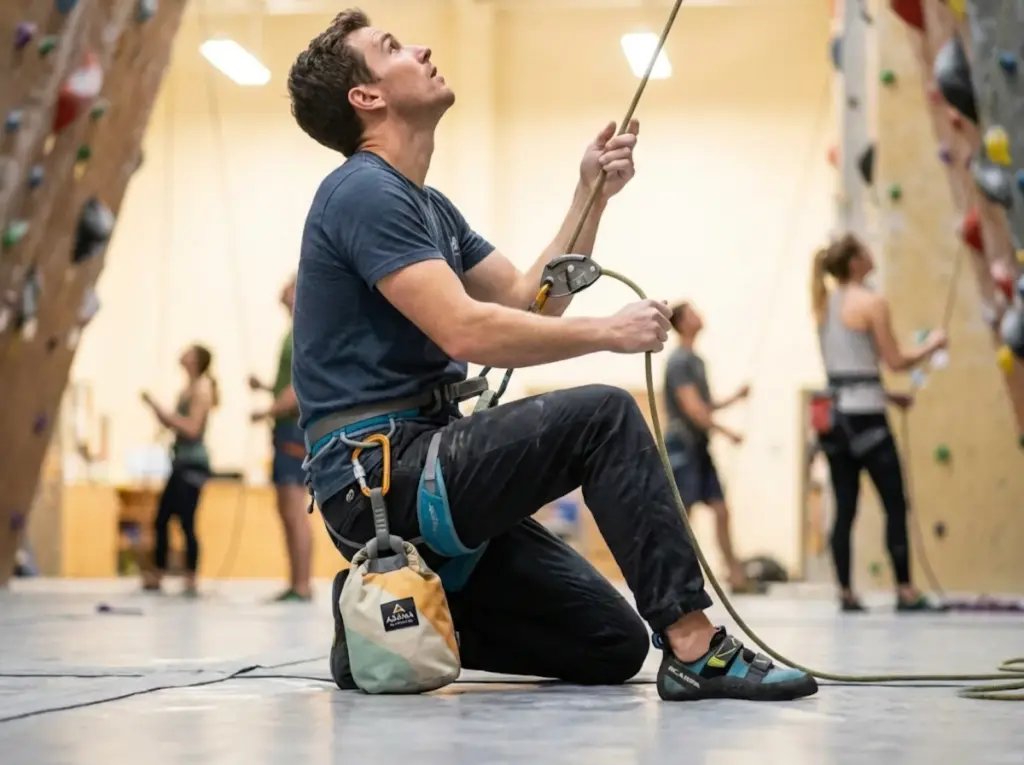
Before friction devices existed, gyms solved weight differential the old-fashioned way: adding mass. Sandbags clipped to your harness remain a valid solution—with trade-offs.
How Much Weight Do You Actually Need?
The goal is bringing your weight ratio below 1.33x, or at minimum below the 1.5x danger threshold.
For a 100lb belayer with a 200lb climber, that’s a 2.0x ratio—well into dangerous territory. Adding 50lbs of ballast drops it to 1.33x. Most gyms provide 40-50lb bags as standard, which handles typical gaps.
The math is straightforward: add enough weight to close the gap, but you don’t need to fully equalize. Getting below 1.33x is the target.
The Mobility Trade-Off
Here’s what nobody mentions in the product description: sandbags severely restrict your movement. You can’t dodge falling gear. You can’t move quickly to pay out slack for a dynamic clip. You’re tethered.
They’re also a tripping hazard—for you and everyone walking by the wall.
Sandbags work well for projecting—repeated falls on the same route where you’re stationary and focused. They’re less useful for onsighting or moving between routes frequently.
The best setup often combines moderate ballast with good communication. Choosing the right belay device for your system complements your ballast choice—assisted-braking devices like the GriGri add another layer of security.
The Soft Catch Technique for Light Belayers
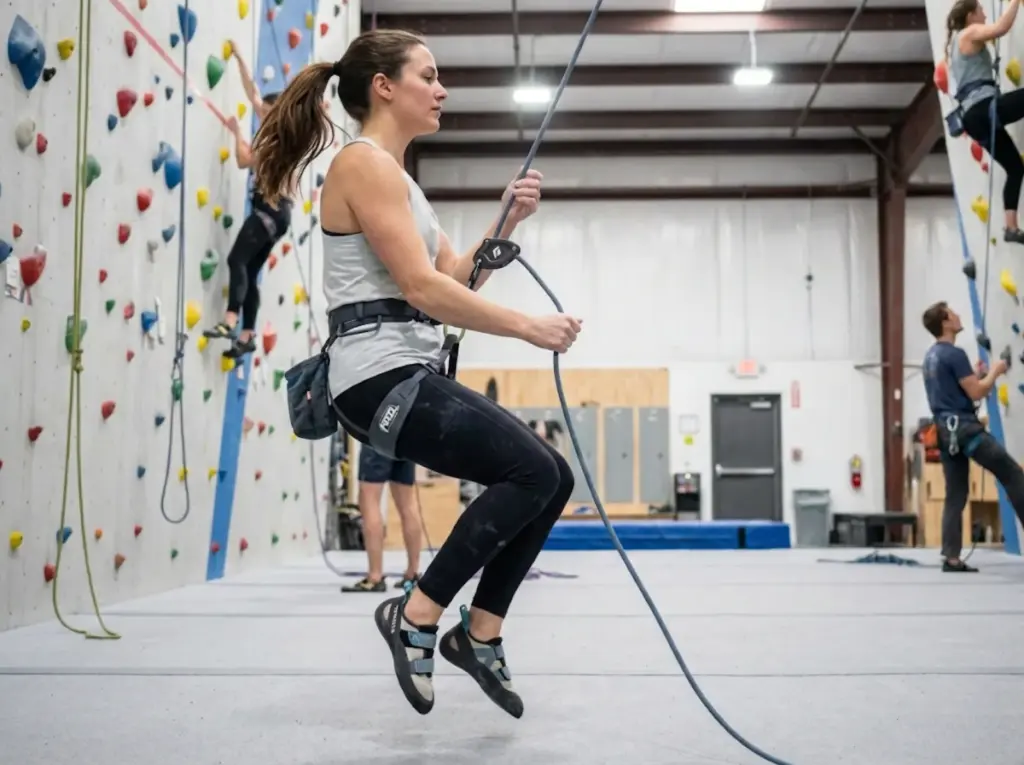
Gear helps, but technique matters more. A trained light belayer can catch a heavy partner safely—the physics actually work in your favor if you control them.
Stance and Positioning
Stand close to the wall—no more than arm’s length from the first bolt. This ensures the pull is vertical, not diagonal. A diagonal pull drags you across the ground before lifting you, which scrapes knees and removes control.
Position one foot forward in a braced stance. Your rear leg absorbs the initial jerk. Keep your brake hand locked, but don’t fight the upward movement—control it.
Eyes stay UP. Watch your climber, not your slack pile. Anticipating the fall matters more than reacting to it.
Controlled Flight vs. Uncontrolled Launch
Here’s the counterintuitive truth: a soft catch actually benefits from your upward movement. When you rise with the rope, you extend the deceleration time for your climber. Lower peak forces, gentler landing.
The difference between controlled flight and uncontrolled launch is intention. Use your non-brake hand to block against the wall as you rise—this prevents your face from meeting the first draw. Think “jump with the rope” rather than “fight the rope.”
A 100lb belayer can catch a 175lb climber safely with proper technique. One experienced belayer reported being lifted “about a foot below the first bolt” during falls—but the ATC held fine, and the stiff-arm block against the wall kept her safe.
Pro tip: During your first sessions with a heavier partner, take practice falls at low heights. Build the muscle memory before committing to hard sends.
The fundamentals here connect directly to passing your lead climbing certification—weight management is part of every serious belay test.
What the Injury Data Actually Shows
Theory is useful. Data is better. Here’s what actually happens when weight differential goes wrong.
The Intermediate Trap
A prospective analysis of indoor climbing injuries across 515,337 gym visits revealed something surprising: beginners only accounted for 17% of accidents. The majority—53%—happened to intermediate climbers who climb roughly once per week.
Beginners are cautious. They follow rules. Intermediates get complacent. They have basic skills but lack the advanced judgment to manage complex scenarios like significant weight differences.
The same study found that 50% of all rope climbing injuries were directly attributable to belay errors. Not gear failure. Not bad protection. Human error in managing the system.
Injury rate overall is low—0.02 per 1,000 hours of climbing. But when injuries happen, they’re severe: fractures, strains, Grade 2-3 on the UIAA scale requiring medical intervention.
Common Injuries in Weight Mismatch Situations
For belayers: Collision trauma dominates. When you launch uncontrolled, you hit the wall—knees, hands, sometimes head. Friction burns from the rope and “tight grip” strains from trying to arrest a heavy fall without mechanical assistance are common.
For climbers: The hard catch problem. When the catch is too static, all that energy goes into ankles. Wall collisions during arrested falls cause contusions and worse.
Medical research explicitly links injury severity to lack of dynamic energy absorption. The fix is systems-based: use devices that add friction while preserving dynamics, not devices that lock everything solid.
Conclusion
Three truths about heavy climber, light belayer partnerships:
The 1.5x rule is your hard limit. Exceed it without equipment and you’re gambling with both bodies. Know your ratio before you tie in.
Ground anchors solve one problem but create another. They prevent the flying belayer, but they deliver hard catches that can injure your climber. Use friction devices for lead, anchors for top-rope only.
The Ohm and Ohmega aren’t magic—they work WITH good technique, not instead of it. Master your stance, your positioning, and your controlled flight before relying on any device.
Next time you rope up with your partner, run the numbers. Know your ratio. If it crosses 1.33x, have a plan. The gear exists. The techniques work. Use them.
FAQ
What is the maximum weight difference for lead climbing?
The DAV recommends a maximum ratio of 1.5:1 (climber to belayer). If the difference exceeds 10kg (~22 lbs), you should use countermeasures like the Edelrid Ohm, sandbags, or specific soft-catch technique.
Does the Edelrid Ohm really work?
Yes. The Ohm effectively adds about 25kg of resistance to the system, preventing the belayer from being launched while still allowing a dynamic catch. It requires a minimum belayer weight of 40kg to function correctly.
Is it safe to anchor a lead belayer to the ground?
Not for lead climbing. Ground anchoring creates hard catches that can injure the climber’s ankles and overload the bottom bolt. Friction devices (Ohm, Ohmega) or controlled ballast are safer for lead.
How heavy should a climbing sandbag be?
Heavy enough to bring your weight ratio below 1.33x. For a 100lb belayer with a 200lb climber, 50lbs of ballast drops the ratio from 2.0x to 1.33x. Most gyms provide 40-50lb bags.
Can a light person safely belay a heavy person on lead?
Yes, with preparation. Use friction devices (Ohm or Ohmega), practice soft-catch technique, position close to the wall, and communicate clearly with your partner. The physics work—you just have to manage them.
Safety Notice: Rock climbing and mountaineering are inherently high-risk
activities that can involve physical trauma or fatal incidents. The information on Rock Climbing Realms is for
educational and informational purposes only. Techniques and advice presented here are not a substitute
for professional, hands-on instruction. Conditions and risks vary by location. Always seek guidance
from a qualified instructor before attempting new techniques. By using this website, you agree that you
are solely responsible for your own safety. Any reliance you place on this information is strictly
at your own risk, and you assume all liability for your actions. Rock Climbing Realms and its authors
will not be held liable for any harm, damage, or loss sustained in connection with the use of this information.
Affiliate Disclosure: We are a participant in the Amazon Services LLC Associates Program, an
affiliate advertising program designed to provide a means for us to earn advertising fees by advertising and linking
to Amazon.com. As an Amazon Associate, we earn from qualifying purchases. We are also an official affiliate partner
of Black Diamond Equipment via the AvantLink network. If you click on a Black Diamond affiliate link and make a
purchase, we may earn a commission at no additional cost to you. We also participate in other affiliate programs.
Additional terms are found in the terms of service.