
In this article
You’re standing at the base of your first via ferrata, staring at a steel cable bolted to a limestone cliff, holding a Y-shaped contraption with two carabiners that you just rented from the hut ten minutes ago. The guy at the counter showed you the girth hitch in about eight seconds and said “clip both, move one at a time.” That’s the entire briefing most people get — and it’s not enough.
I’ve watched climbers clip in wrong, skip anchor transitions, and haul themselves up iron ladders with both carabiners swinging free. Most of them had no idea what the energy absorber on their back actually does, or that their lanyard is a one-use system if they fall. Here’s the setup knowledge that rental desks and trail brochures don’t cover.
Quick Answer: A via ferrata setup requires a climbing harness (any standard seat harness works), a certified via ferrata lanyard with an energy absorber meeting EN 958, and a helmet. The lanyard attaches to your harness belay loop with a girth hitch. At every anchor point, move one carabiner at a time so you’re always connected to the cable. The energy absorber is a one-time-use system — if it deploys in a fall, you stop and replace it before continuing.
What a Via Ferrata Lanyard Actually Is
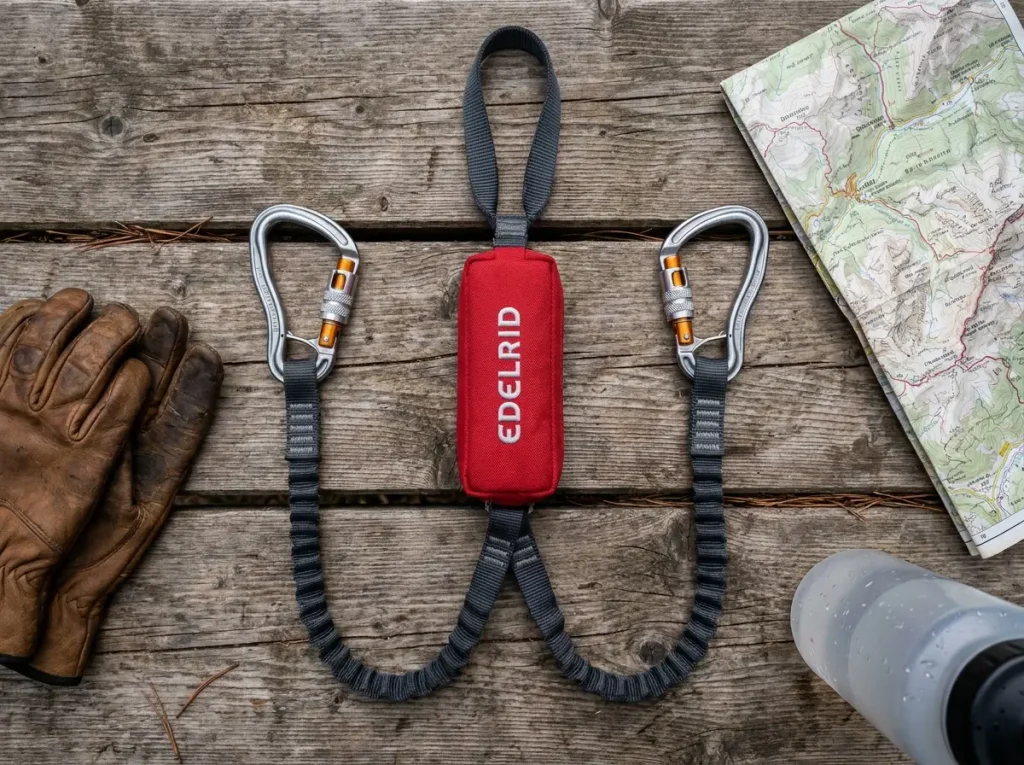
A via ferrata lanyard — also called a via ferrata set or klettersteig set — is a purpose-built safety system designed for one specific job: keeping you alive if you fall while clipped to a steel cable. It looks simple — two elastic arms with carabiners on the ends, connected to a pouch. But every component is engineered around a physics problem that most people never think about.
The Three Components
The lanyard has three parts that work as a system. The attachment loop at the top girth-hitches to your harness belay loop. The energy absorber sits in the middle — a sewn pouch containing accordion-folded webbing stitched together in a pattern designed to tear progressively under load. And two elastic arms extend from the absorber, each ending in an auto-locking carabiner with a keylock nose that won’t snag on the steel cable.
The elastic arms are important for a reason most guides skip: they keep the lanyard short and tidy when you’re not falling. A long, floppy lanyard increases your fall distance if you peel off the route. The elasticity retracts the arms against your harness so the carabiners stay within easy reach without dangling below your waist.
Why You Can’t Substitute Regular Climbing Gear
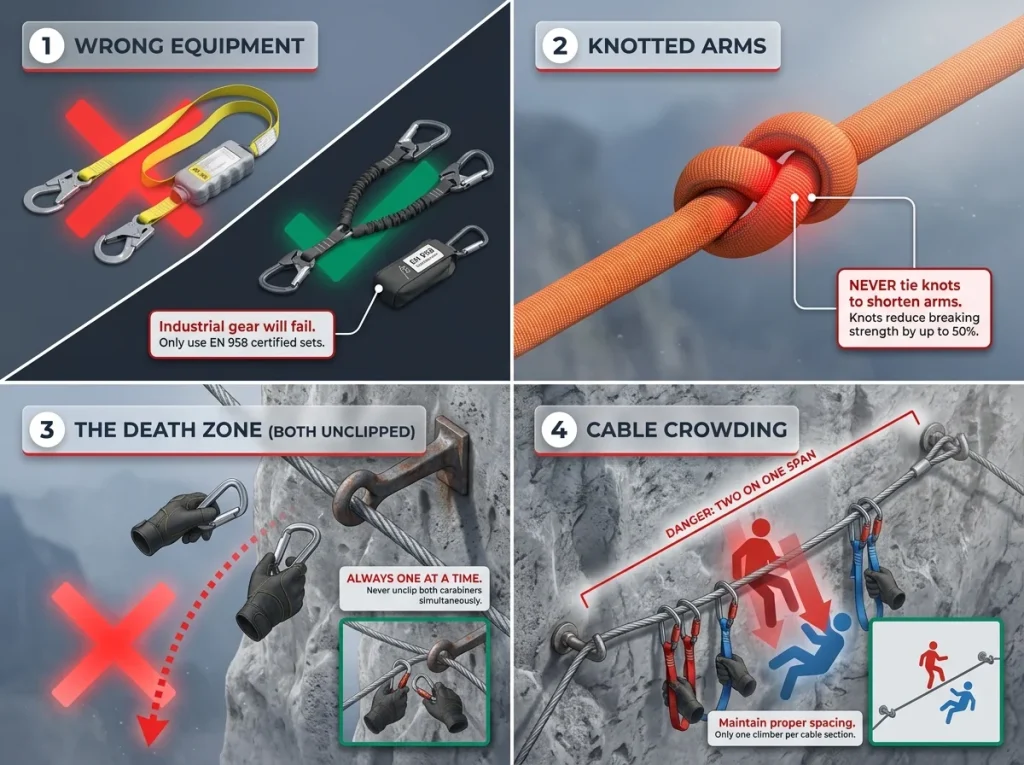
This is where people get hurt. A quickdraw, a sling, or a length of climbing rope clipped to your harness looks like it does the same job — it connects you to the cable. But regular climbing gear has no energy absorption system. On a via ferrata, fall factors can exceed 2.0 because the cable anchor spacing creates long potential falls on a short attachment. Without an energy absorber, the impact force on your harness — and your spine — can exceed 12 kN. That’s enough to cause serious spinal injury or rip the cable anchor from the rock.
The energy absorber keeps impact force under 6 kN by progressively tearing through its stitched folds, extending the braking distance up to 2.2 meters and spreading the deceleration over time. This is why the EN 958 standard exists specifically for via ferrata lanyards — no other piece of climbing gear is certified for this loading scenario.
Pro tip: If someone offers to lend you a homemade via ferrata setup — two slings girth-hitched together, or a daisy chain clipped to the cable — politely decline. The math doesn’t work. A 5-meter fall on a 1-meter sling with no energy absorption generates forces that slings aren’t designed to handle. Rent the real thing from the hut. It’s ten euros.
Choosing the Right Harness for Via Ferrata
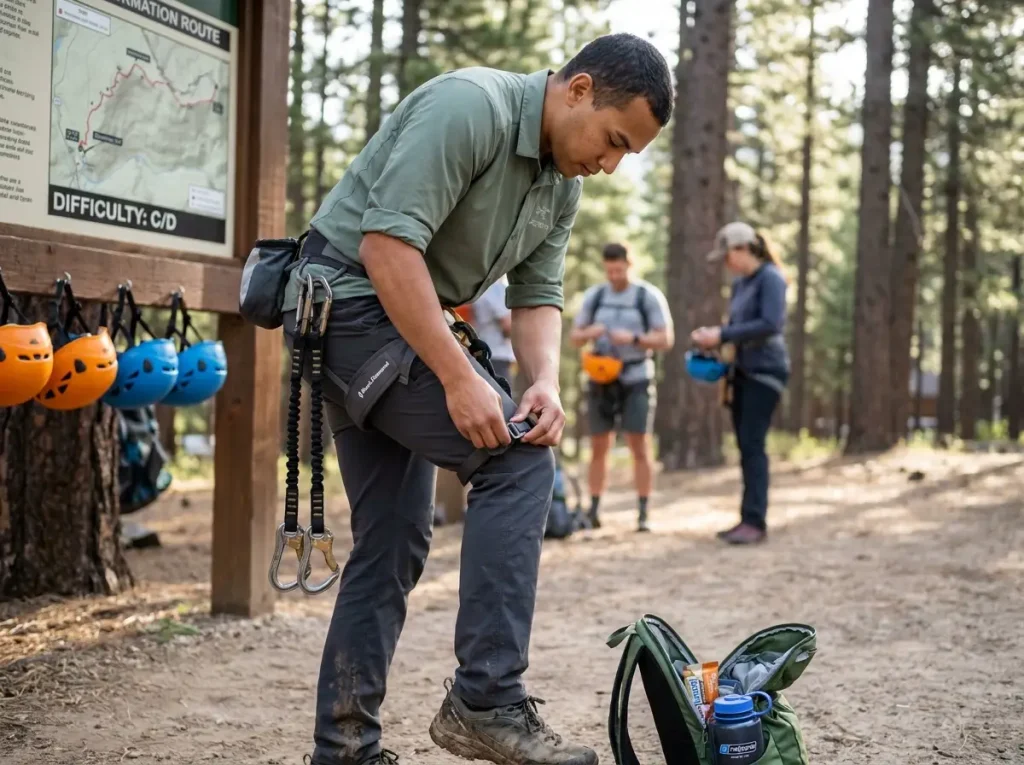
The good news: you don’t need a special harness. Any standard climbing seat harness with a belay loop works for via ferrata. If you already own a harness for sport climbing, trad, or gym climbing, it’s the same one you’ll use on the iron way.
What Actually Matters in a Via Ferrata Harness
Comfort matters more than features here. Via ferrata routes can take 2–5 hours, and unlike rock climbing where you’re actively moving most of the time, via ferrata involves a lot of standing on iron rungs while you fumble with carabiners at anchor transitions. That means your harness is loaded in a standing position for extended periods, and leg loops that dig into your thighs will make the last hour miserable.
Look for adjustable leg loops — your thighs swell as you climb, and fixed-size loops that felt fine at the trailhead will cut off circulation by the crux. Generous padding on the waist belt matters because you’ll rest your weight against it every time you lean back to admire the view (which is the whole point). Gear loops are nice but not critical — most via ferrata routes don’t require a trad rack. A couple of loops for a water bottle carabiner and a glove clip are plenty.
When a Full-Body Harness Makes Sense
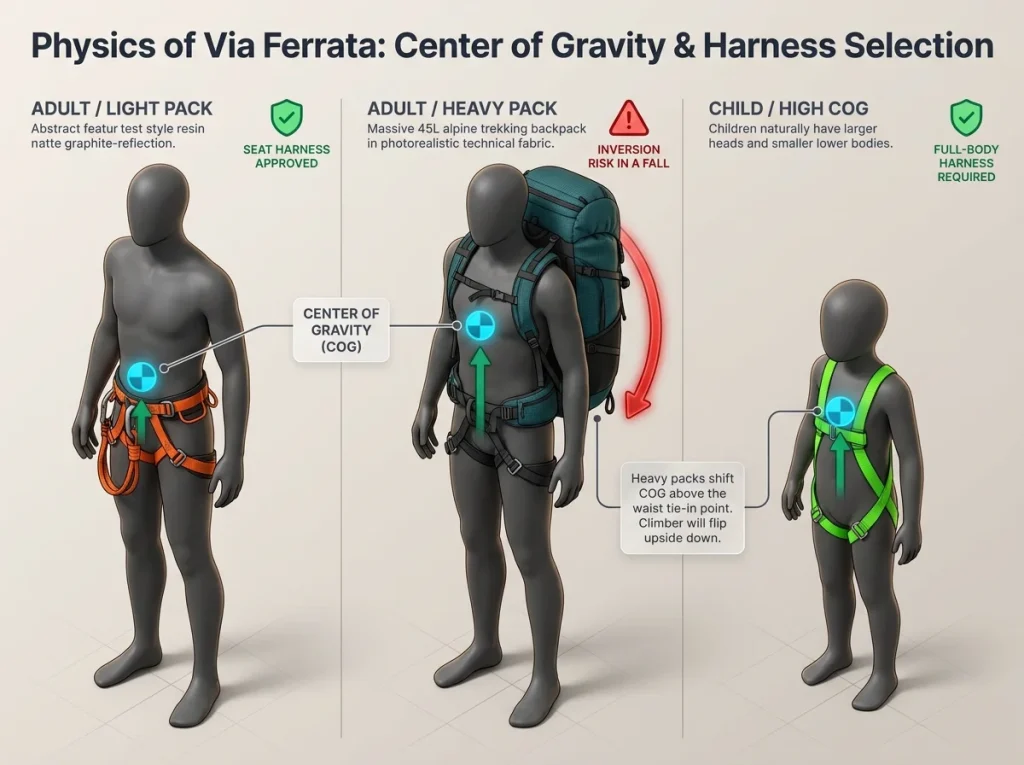
For adults carrying heavy packs — camera gear, extra layers for an alpine traverse — consider a full-body harness or a chest harness paired with your seat harness. A heavy pack shifts your center of gravity above your waist, and in a fall, a seat harness alone can flip you upside down. That’s not survivable if you’re unconscious. For children under 40 kg, a full-body harness is non-negotiable — kids’ center of gravity is higher than adults’, and they’ll invert in a fall with a seat harness every time.
How the Energy Absorber Saves Your Life
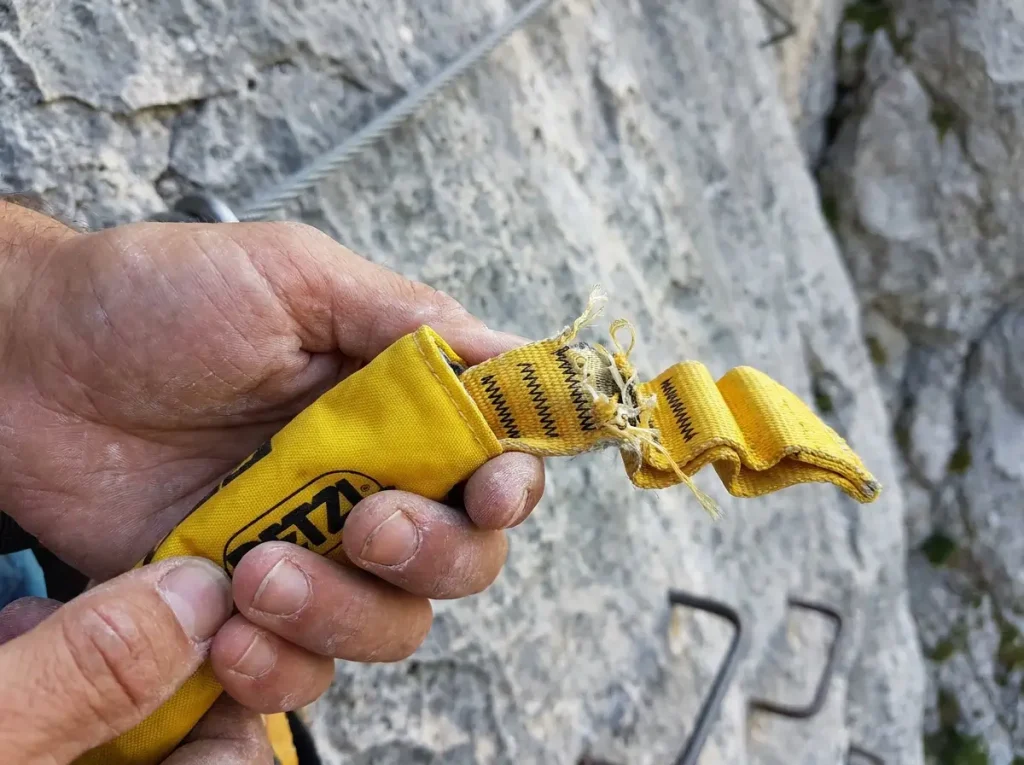
The energy absorber is the component that separates via ferrata gear from everything else in your climbing kit. Understanding how it works changes how you treat it — because it’s a one-shot system, and most people don’t realize that until it matters.
The Progressive Tearing Mechanism
Inside the sealed pouch, a length of webbing is folded in an accordion pattern and stitched together with thread designed to tear at a controlled force. When you fall and the lanyard goes tight, the stitching begins to rip — not all at once, but fold by fold. Each fold that tears adds length to the lanyard, extending the braking distance and keeping the deceleration forces on your harness below 6 kN.
The total braking distance is up to 2.2 meters under the current EN 958:2017 standard. That means if you fall 4 meters above an anchor point, you’ll actually travel 4 + 2.2 = 6.2 meters before you stop. This is why via ferrata routes need significant exposure below the cable — there has to be space for the absorber to do its job.
One Fall, One Absorber
Here’s the part that catches people off guard: once the energy absorber has deployed — meaning the stitching has torn — the lanyard is finished. You cannot re-fold it, re-stitch it, or use it again. The torn stitching will not hold a second fall.
If your absorber deploys mid-route, you need to stop climbing. Clip into the cable with a backup sling if you have one, assess whether you can safely retreat, and do not continue upward on a spent lanyard. This is why some experienced via ferrata climbers carry a lightweight backup sling — not as a substitute for the lanyard, but as a static attachment to hold position while they figure out next steps.
Pro tip: Before you start any route, open the energy absorber pouch and look inside. Make sure the webbing is neatly folded, the stitching is intact, and there are no signs of previous deployment. If you’re renting gear, this takes ten seconds and tells you whether the last person took a fall that nobody reported. If even one fold looks torn, hand it back and ask for a different set.
How to Inspect After Minor Incidents
Not every jolt is a full deployment. If you slip a few inches and catch yourself on a rung with the lanyard barely loading, the absorber probably didn’t tear. Check the pouch: is it still sealed and compact? Is the same amount of webbing visible at the opening as before? If everything looks the same, you’re good. If the pouch looks longer, looser, or you can see torn threads at the opening, treat it as deployed.
Clipping Technique at Anchor Points
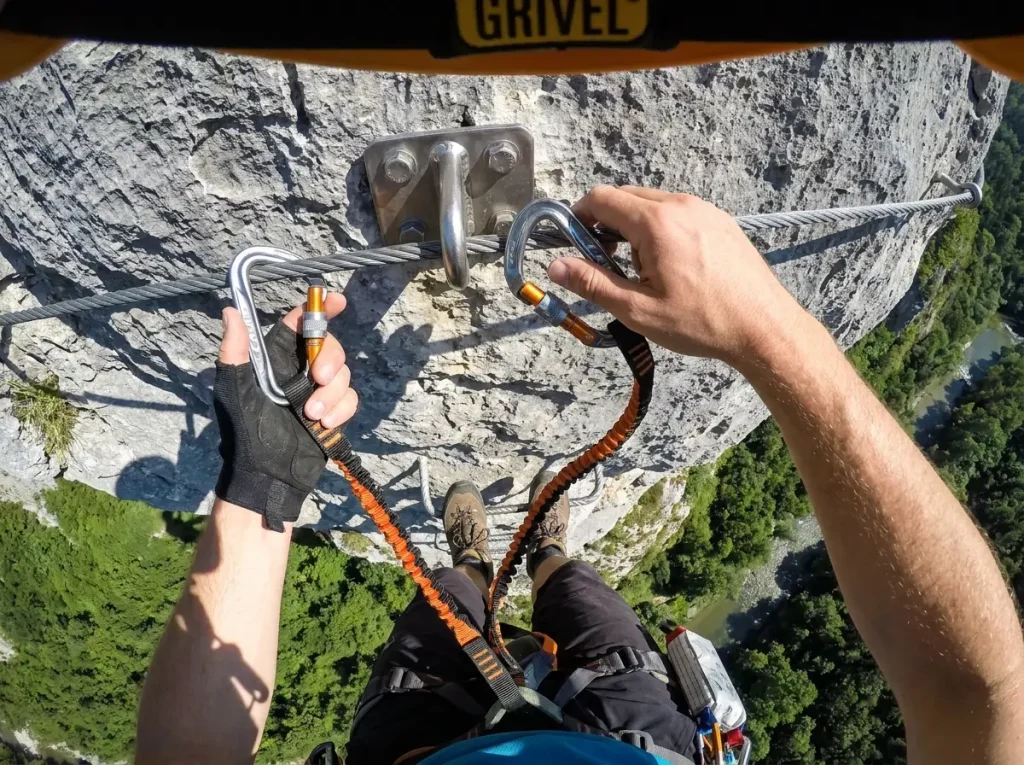
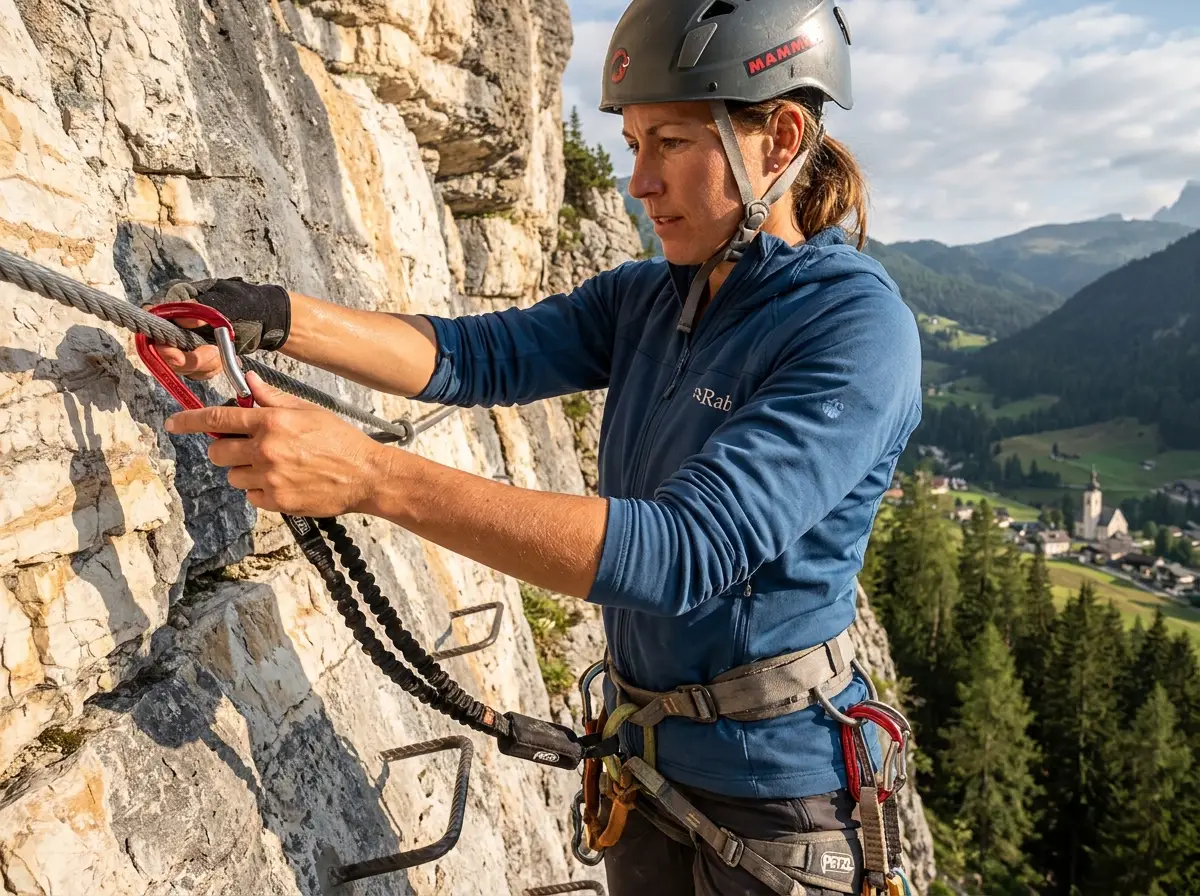
The via ferrata cable isn’t one continuous line. It’s bolted to the rock at regular intervals through anchor brackets — metal plates with eyelets that the cable passes through. At every bracket, you need to move your carabiners past the bracket to the next section of cable. This transition is the most hazardous moment on any via ferrata.
The One-at-a-Time Rule
Both of your carabiners should be clipped to the cable at all times while you’re climbing. When you reach an anchor bracket, move one carabiner past the bracket to the next cable section. Then move the second carabiner to join it. At no point should both carabiners be off the cable simultaneously. This is the single most important safety rule on any via ferrata, and it’s the rule that gets broken most often.
The sequence looks like this: reach the bracket, unclip your right-hand carabiner, reach past the bracket, clip it to the cable on the other side, then unclip your left-hand carabiner and clip it past the bracket too. You’re always attached by at least one arm.
Why People Skip It
Anchor transitions take time. On a busy via ferrata with people stacked behind you, there’s social pressure to move fast. Beginners especially feel this pressure and start unclipping both carabiners at once to save a few seconds. Don’t. The two seconds you save are not worth the exposure of being completely unattached to the cable. If you slip during that moment, nothing stops you.
Handling Crowd Pressure
If someone behind you is pushing to pass at an anchor point, let them wait. There’s no safe way to pass another climber at a bracket — the cable section between anchors is one-person-at-a-time. Wave them past at a resting ledge or a wider section where you can step aside. Never rush an anchor transition because someone behind you is impatient. The same risk-management principles apply here as anywhere else in climbing: your safety is not negotiable.
Pro tip: Develop a rhythm for transitions — right hand first, clip, left hand second, clip, done. Always the same order. When you’re pumped and tired at the crux and your brain stops thinking clearly, the muscle memory from fifty previous transitions takes over. Consistent order eliminates the chance of accidentally unclipping both.
Common Mistakes and Safety Rules
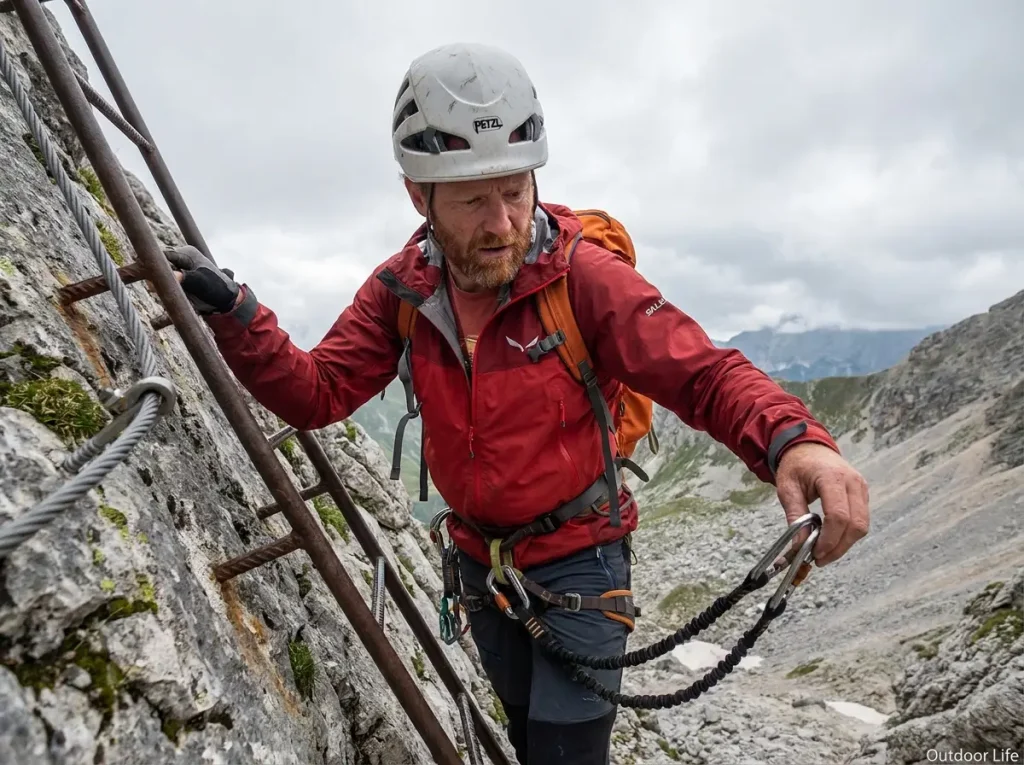
Most via ferrata incidents aren’t caused by gear failure — they’re caused by humans misusing good gear. After watching dozens of first-timers and a few experienced climbers make the same errors, the pattern is predictable.
Using Construction Lanyards Instead of Via Ferrata Sets
Online retailers sell cheap Y-lanyards marketed for “climbing” that are actually fall-arrest equipment designed for construction scaffolding. These lanyards look similar to via ferrata sets but are not certified to EN 958. The energy absorbers on construction lanyards are designed for vertical falls from a fixed point — not the dynamic, angled loading of a via ferrata cable. Check the certification label. If it says EN 355 (industrial fall arrest) instead of EN 958 (via ferrata), don’t use it on rock.
Tying Knots in the Lanyard
Some climbers tie knots in their lanyard arms to shorten them or create an improvised adjustment. This is explicitly prohibited by EN 958 and voids the certification. Knots create stress concentrations in the webbing that can cause the arm to fail at a fraction of its rated strength. If your lanyard arms feel too long, you have the wrong size — not a problem that knots fix.
Ignoring the Weight Range
EN 958 certifies each via ferrata set for a specific weight range — typically 40 kg to 120 kg including equipment. Below 40 kg, you might not generate enough force to activate the energy absorber, meaning you’d hit the end of your fall with a sharp jerk instead of a controlled deceleration. Above 120 kg, the absorber may not provide enough braking distance. Check your total weight — harness, pack, water, helmet — and make sure you’re within range.
Spacing on the Cable
Only one person should be on a cable section between two anchor brackets at any time. If two people are clipped to the same section and the upper person falls, their falling mass can generate enough force to rip the bracket — taking both climbers with it. Keep a full cable section of distance between you and the next person.
Y-Shape vs V-Shape Lanyards and Why It Matters
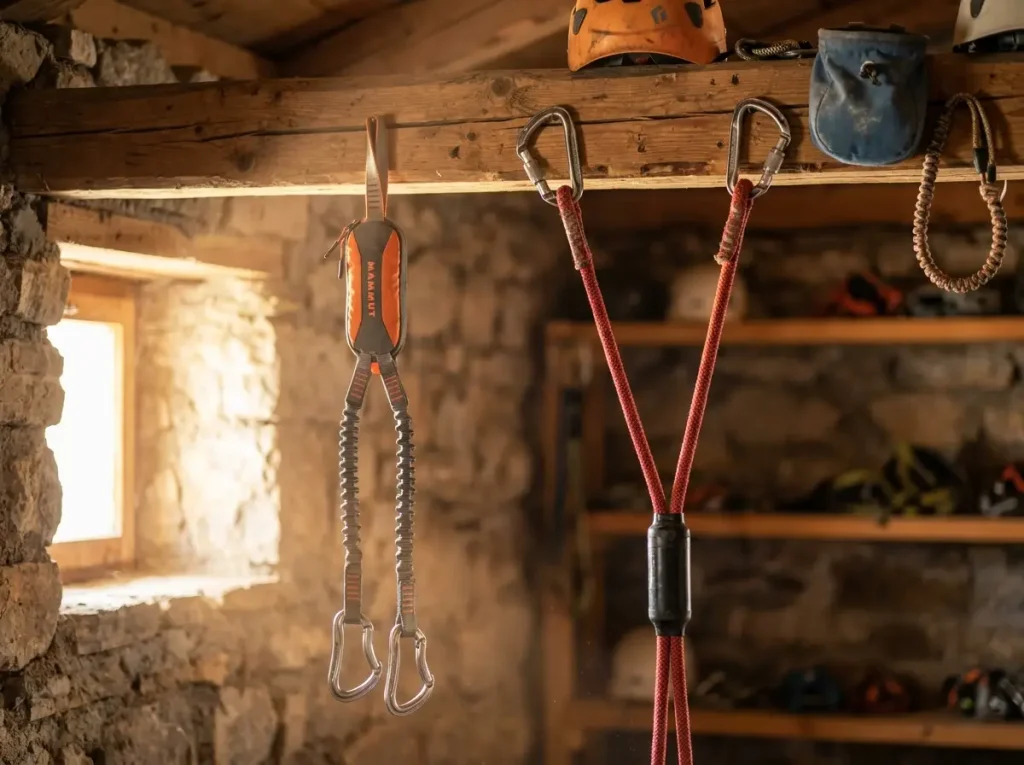
If you’re renting or buying used gear, you may encounter two different lanyard designs. Understanding the difference could prevent a critical clipping error.
Modern Y-Configuration (Current Standard)
On a Y-lanyard, both arms extend downward from a single energy absorber at the top. The attachment loop goes to your harness, the absorber sits below it, and the two arms branch out from the bottom of the absorber. This is the only design currently approved by the UIAA, and for good reason: both arms can be clipped to the cable simultaneously, and the absorber will function correctly regardless of which arm takes the load.
This design is simpler and nearly foolproof. Clip both arms, move one at a time, and the absorber is always in the system no matter which carabiner catches you.
Older V-Configuration (Phased Out)
The V-lanyard reverses the geometry. The energy absorber sits at the junction where the two arms meet, with the arms extending upward to the carabiners in a V shape. The critical difference: on a V-lanyard, you must only clip one arm at a time. If both arms are clipped to the cable and you fall, the load bypasses the energy absorber entirely — the force transfers directly through both arms to the cable without any shock absorption.
This limitation made V-lanyards inherently more error-prone. A moment of inattention — clipping both arms because it feels safer — turns the energy absorber into dead weight. The UIAA stopped approving V-configuration lanyards for this reason.
How to Identify What You Have
Look at where the energy absorber pouch sits. If it’s at the top (between the attachment loop and the arms), you have a Y-lanyard — clip both arms freely. If the absorber is at the junction where the arms meet (at the bottom of a V shape), you have an older V-lanyard — clip only one arm at a time and know that you’ll be momentarily unprotected during every transition.
If you’re renting from a reputable outfitter, you’ll almost certainly get a Y-lanyard. But mountain huts in remote areas sometimes have older stock. Knowing what to look for takes five seconds and could save your life.
Pro tip: If you encounter a V-lanyard in a rental fleet, hand it back and ask for a Y-configuration set. If they don’t have one, understand that your anchor transitions will leave you completely unattached for a moment each time — you’re unclipping the one active arm, moving it past the bracket, and re-clipping, with zero backup during the move. On exposed terrain, that’s a risk worth avoiding with a quick gear swap.
Conclusion
Via ferrata gear is simpler than a trad rack, but the consequences of getting the setup wrong are just as serious. Know the three components of your lanyard — attachment loop, energy absorber, elastic arms — and understand that the absorber is a one-shot system. Clip both carabiners to the cable, move one at a time at every bracket, and never rush a transition because someone behind you is impatient.
The biggest gap in most via ferrata briefings is the physics: why regular slings fail, how the energy absorber actually works, and what to do if it deploys mid-route. Now you know. Gear up, check the absorber pouch before you start, and keep your systems dialed — the iron way rewards preparation.
Q1 Can you use a regular climbing harness for via ferrata?
Yes. Any standard seat harness with a belay loop works for via ferrata. You don’t need a special harness — the critical piece is the via ferrata lanyard with its certified energy absorber, not the harness itself.
Q2 How do you attach a via ferrata lanyard to a harness?
Thread the attachment loop of the lanyard through both tie-in points on your harness using a girth hitch, then pull the lanyard through the loop to cinch it tight. The energy absorber should rest against your lower back or hip.
Q3 What is the difference between a Y-lanyard and a V-lanyard?
A Y-lanyard has the energy absorber at the top with both arms below — clip both arms freely. A V-lanyard has the absorber at the arm junction — only clip one arm at a time or the absorber won’t work. Y-lanyards are the current standard.
Q4 How long does a via ferrata lanyard last?
A via ferrata lanyard lasts up to 10 years from manufacture date if unused, or 3–5 years with regular use. Replace it immediately if the energy absorber has deployed in a fall, regardless of age.
Q5 Do you need gloves for via ferrata?
Gloves aren’t mandatory but are highly recommended. Steel cables are rough on bare hands, and iron rungs can have sharp edges. Lightweight leather climbing gloves or cycling gloves work well and prevent blisters on longer routes.
Safety Notice: Rock climbing and mountaineering are inherently high-risk
activities that can involve physical trauma or fatal incidents. The information on Rock Climbing Realms is for
educational and informational purposes only. Techniques and advice presented here are not a substitute
for professional, hands-on instruction. Conditions and risks vary by location. Always seek guidance
from a qualified instructor before attempting new techniques. By using this website, you agree that you
are solely responsible for your own safety. Any reliance you place on this information is strictly
at your own risk, and you assume all liability for your actions. Rock Climbing Realms and its authors
will not be held liable for any harm, damage, or loss sustained in connection with the use of this information.
Affiliate Disclosure: We are a participant in the Amazon Services LLC Associates Program, an
affiliate advertising program designed to provide a means for us to earn advertising fees by advertising and linking
to Amazon.com. As an Amazon Associate, we earn from qualifying purchases. We are also an official affiliate partner
of Black Diamond Equipment via the AvantLink network. If you click on a Black Diamond affiliate link and make a
purchase, we may earn a commission at no additional cost to you. We also participate in other affiliate programs.
Additional terms are found in the terms of service.