

In this article
You’re standing at the base, racking up, and your fingers run across a sling that feels a little off. Stiffer than you remember. The color looks washed. You clip it anyway because you’ve trusted this thing for three years and it hasn’t let you down yet. That moment — when your gut says maybe but your wallet says not yet — is exactly where most climbers get gear retirement wrong.
I’ve retired soft goods that looked brand new and climbed on others that looked rough but still had life in them. The difference is knowing what actually matters versus what just looks scary. Here’s how to read your gear honestly and know when it’s time to let go.
Quick Answer: Most climbing soft goods — harnesses, slings, ropes, webbing, and cord — should be retired after 1–10 years depending on use frequency, with a hard 10-year maximum even if unused. Inspect for fraying, stiffness, discoloration, and core damage before every climb. The real skill is learning what dying soft goods feel like in your hands, not just what they look like.
What Counts as Soft Goods in Climbing
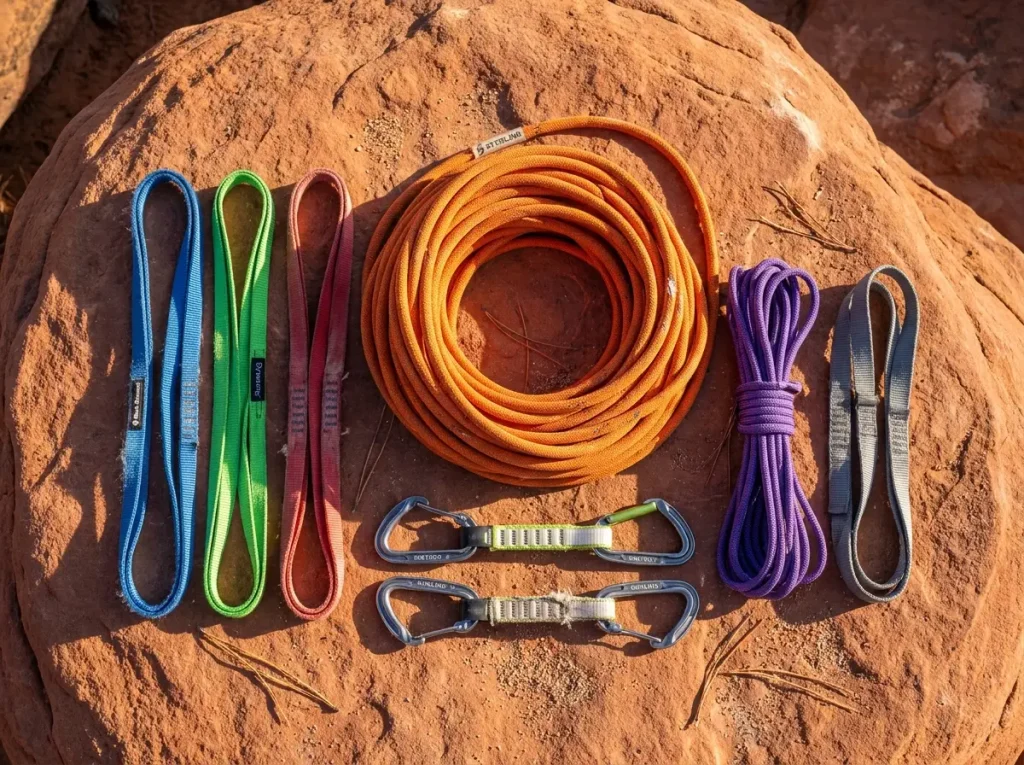
If it’s made of textile fibers and you’re trusting your life to it, it’s a soft good. That’s the simple version. The category covers everything woven, stitched, or braided that sits between you and the ground: climbing ropes, harnesses, sewn slings, runners, quickdraw dogbones, cordelettes, personal anchor systems, and loose webbing or cord you tie yourself.
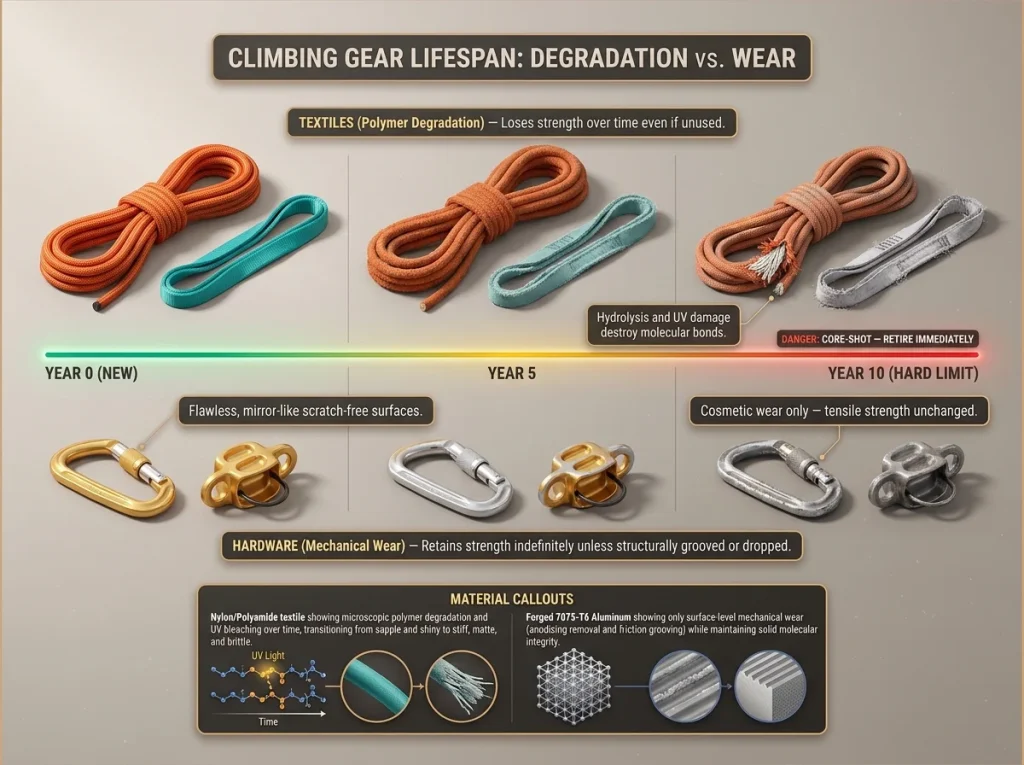
The reason soft goods get their own retirement rules — separate from hardware like carabiners and belay devices — is material degradation. Metals corrode and wear mechanically, but they don’t lose molecular strength just sitting in your closet. Nylon and Dyneema do. The polymer chains in textile fibers break down from UV radiation, heat, moisture, chemical exposure, and plain old time. A carabiner from 2010 that passes a visual inspection is probably fine. A sling from 2010 is not.
The Gear Most Climbers Forget
Everyone thinks about their rope and harness. The pieces that get overlooked are the small ones: the dogbones on your quickdraws, the cam slings on your trad rack, and the personal anchor system you clip into at every belay station. These see just as much wear as your rope — sometimes more, because they’re repeatedly loaded over edges and exposed to grit — but most climbers never give them a second look until something feels wrong.
Your belay loop is another silent timer. It’s the single most loaded piece of soft good on your person, handling every catch, every lower, every hang. Most harnesses have wear indicators built into the belay loop — a contrasting color thread that shows through when the outer layer wears thin. If you can see it, you’re done.
Why Soft Goods Are Different From Hardware
A well-maintained carabiner can serve for decades because aluminum doesn’t lose tensile strength with age alone. Soft goods are the opposite. Even a sling stored in perfect conditions — dark, dry, room temperature — will lose strength over time as the polymer chains degrade through a process called hydrolysis. Nylon absorbs moisture from the air, and that moisture slowly breaks the molecular bonds that give the fiber its strength. This is why every manufacturer puts a hard expiration date on soft goods regardless of use.
Manufacturer Timelines and the UIAA Standard
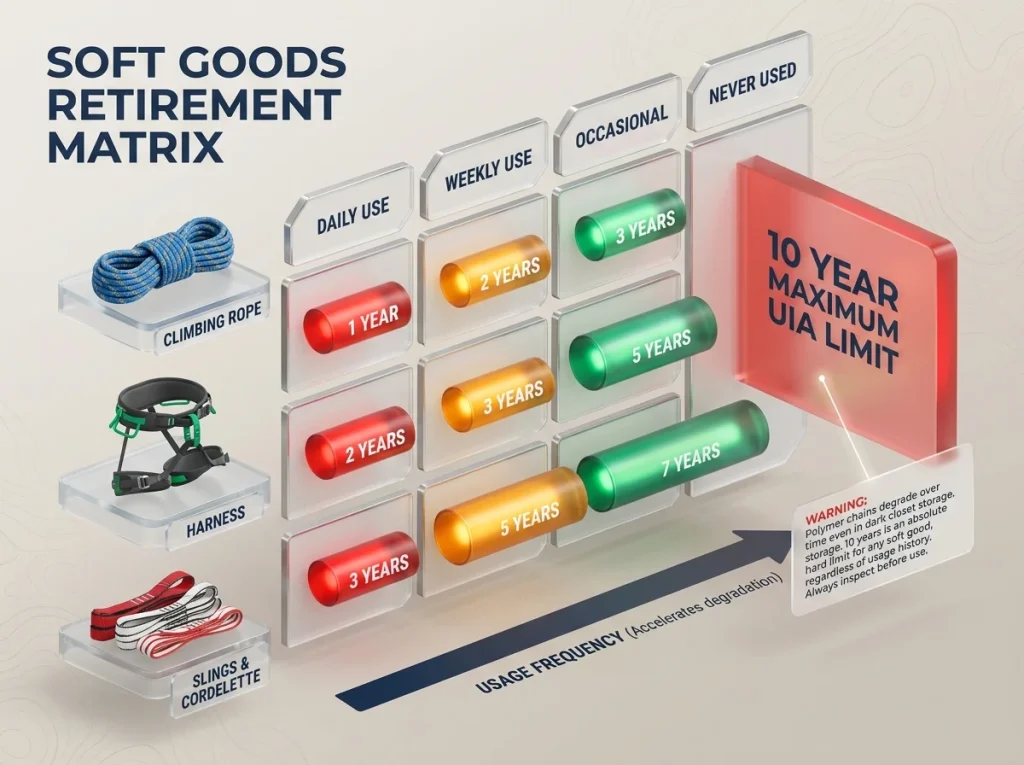
Every reputable climbing gear manufacturer publishes retirement guidelines for their soft goods, and they all land in roughly the same range. The UIAA (International Climbing and Mountaineering Federation) sets the framework that manufacturers follow, and the numbers break down by use frequency:
Climbing Ropes:
- Daily use: retire within 1 year
- Weekly use: 1–2 years
- Monthly use: up to 5 years
- Rare use (a few times per year): up to 7 years
- Never used: 10 years maximum from manufacture date
Harnesses:
- Daily professional use: 1 year
- Regular recreational use (weekly): 1–3 years
- Occasional use: up to 5 years
- Maximum regardless of use: 7–10 years (varies by manufacturer)
Slings, Webbing, and Cord:
- Regular use: 3–5 years
- Moderate use with no major falls: up to 5 years
- Maximum regardless of use: 10 years
The Date That Actually Matters
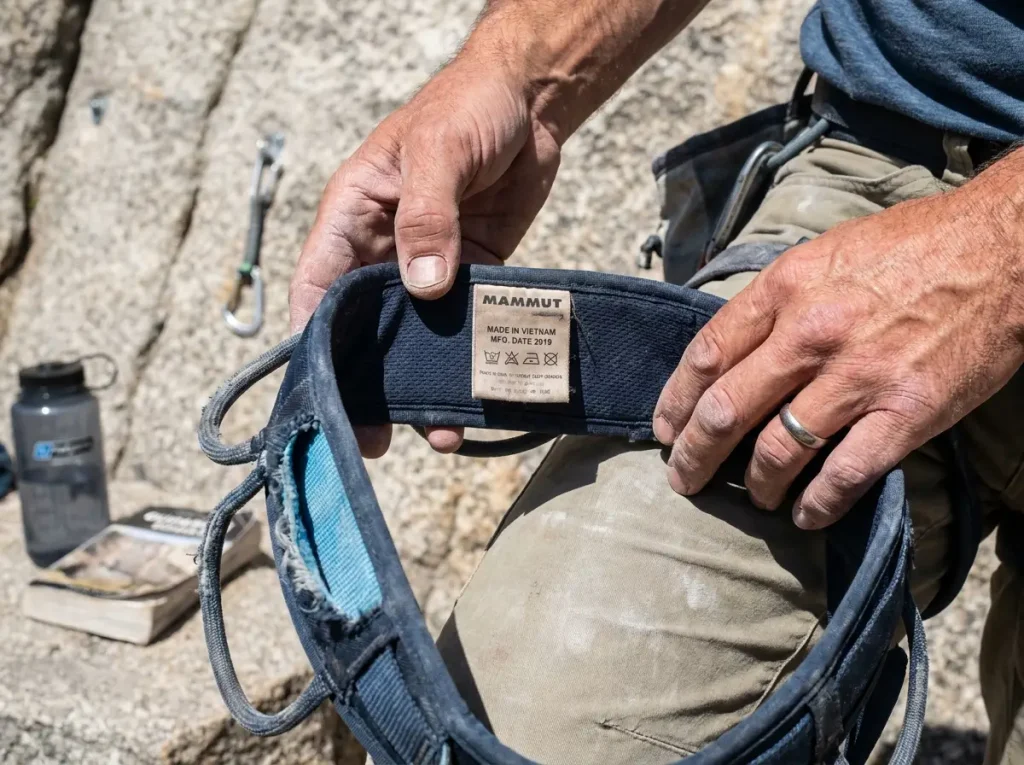
The clock starts on the manufacture date, not the day you bought it. That sling that sat on a shop shelf for two years before you picked it up? It’s already two years into its lifespan. Check the tag or label sewn into the product — every UIAA-certified piece of gear is required to show its manufacture date. If you can’t find the date or the label is worn off, that alone is a reason to retire the piece.
Why Manufacturers Are Conservative
These timelines are deliberately cautious. A sling rated for 22 kN when new doesn’t suddenly break at 10 kN after five years of moderate use. But manufacturers can’t predict how you stored your gear, what chemicals it contacted, or how many micro-abrasions it accumulated over edges you didn’t notice. The published timelines account for worst-case scenarios because there’s no practical way to test a specific piece of gear in the field without destroying it. When a manufacturer says “retire after seven years,” they’re saying: we can’t guarantee it beyond this point, and we’re not willing to bet your life on it.
Pro tip: Keep a simple gear log — even just a note in your phone — with purchase dates and rough use frequency for your harness, rope, and slings. When you can’t remember if you bought that sling two years ago or four, the log answers the question before your gut has to.
How to Inspect Each Type of Soft Good
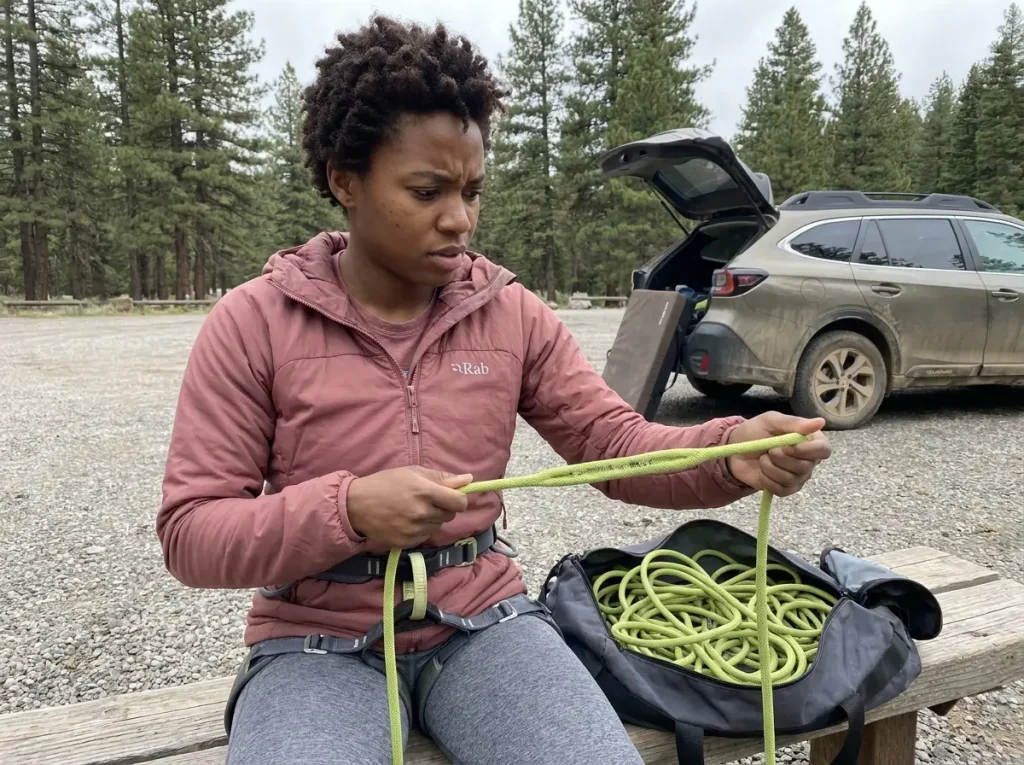
Knowing the manufacturer timelines gets you halfway there. The other half is hands-on inspection — the kind you do before every climbing day, not once a season. Each type of soft good has its own failure signatures, and catching them early is the difference between retiring gear on your terms and having gear retire itself mid-pitch.
Ropes
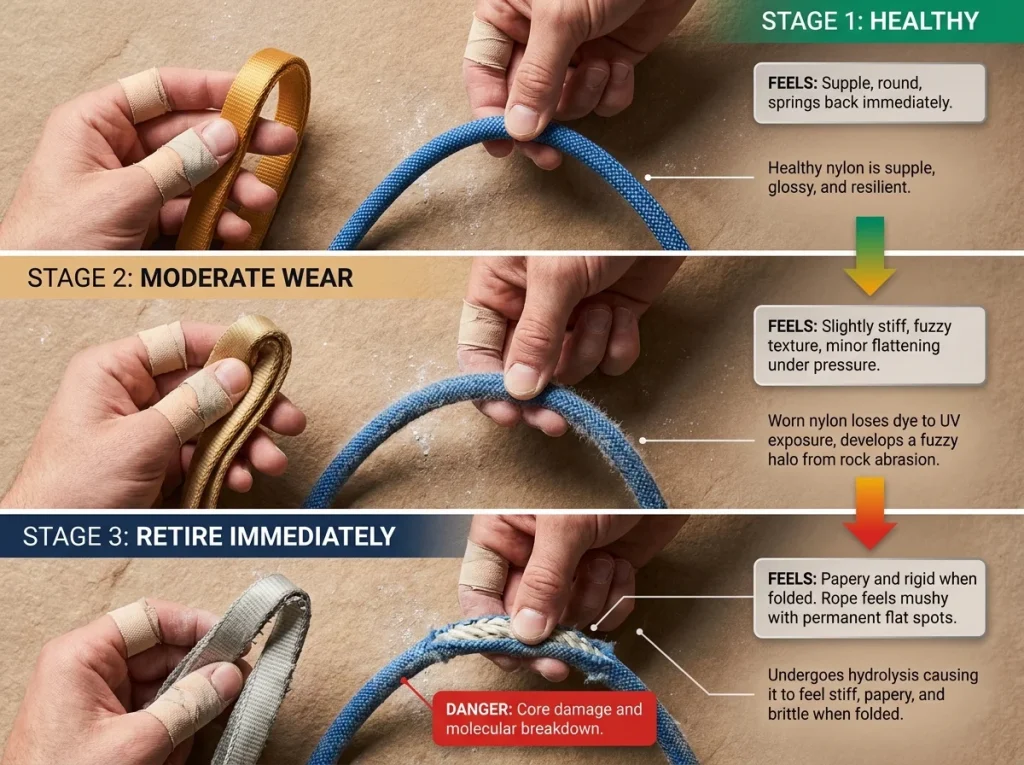
Run every inch of your rope through both hands before you climb. You’re feeling for flat spots — sections where the sheath has compressed and the rope feels thinner or stiffer than the surrounding length. A flat spot means the core has shifted or been damaged internally. Also feel for soft spots where the rope feels mushy and unsupported, like the core fibers have been broken and the sheath is holding everything together alone.
Look for core shots — any place where you can see the white inner core through the outer sheath. Even a small core shot is a retire-immediately situation. Check for excessive fuzz, which signals sheath wear, and discoloration from UV exposure or chemical contact. Understanding how your rope behaves when healthy makes it easier to spot when something changes.
Harnesses
Focus on the structural webbing — the waist belt and leg loops — not the padding or gear loops. Padding wear is cosmetic. Webbing wear can fail. Run your fingers along every inch of the load-bearing webbing, checking for fraying, abrasion that’s worn through the outer fibers, or discoloration. Pay special attention to the belay loop: it takes more repeated loading than any other component. If your harness has a wear indicator — a contrasting thread woven into the belay loop — and you can see it, replace the harness immediately.
Check all buckles for proper function. Bent or stiff buckles that don’t slide smoothly can slip under load. Inspect the tie-in points where your rope threads through — these see enormous friction during falls and lowers.
Slings, Runners, and Dogbones
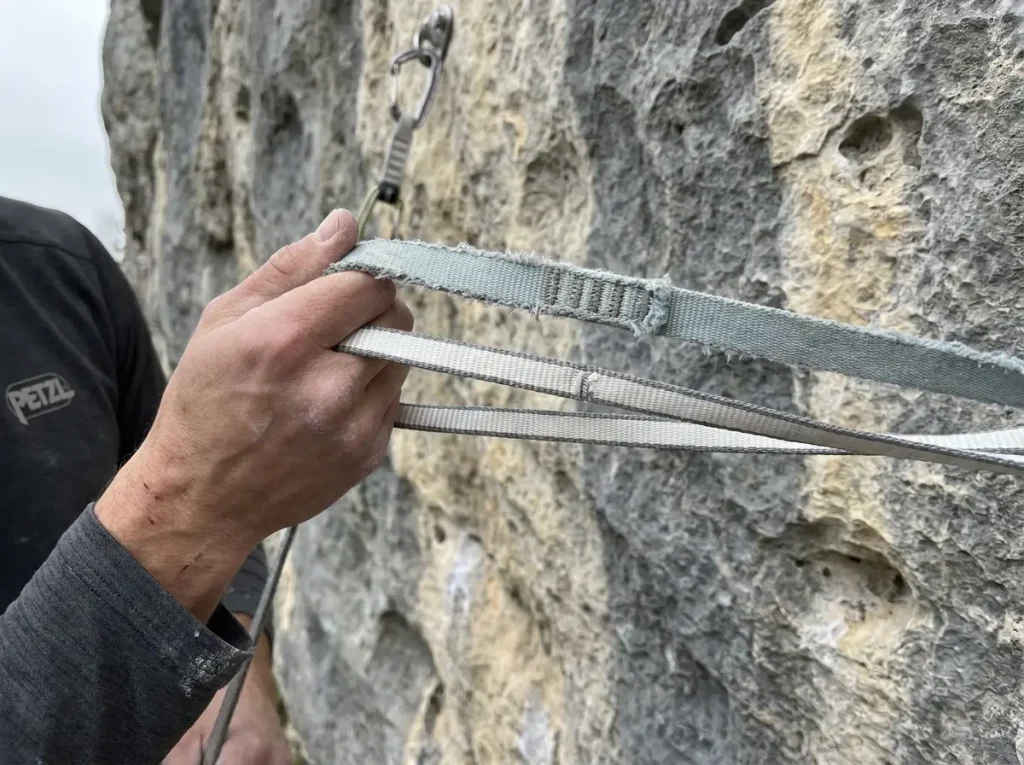
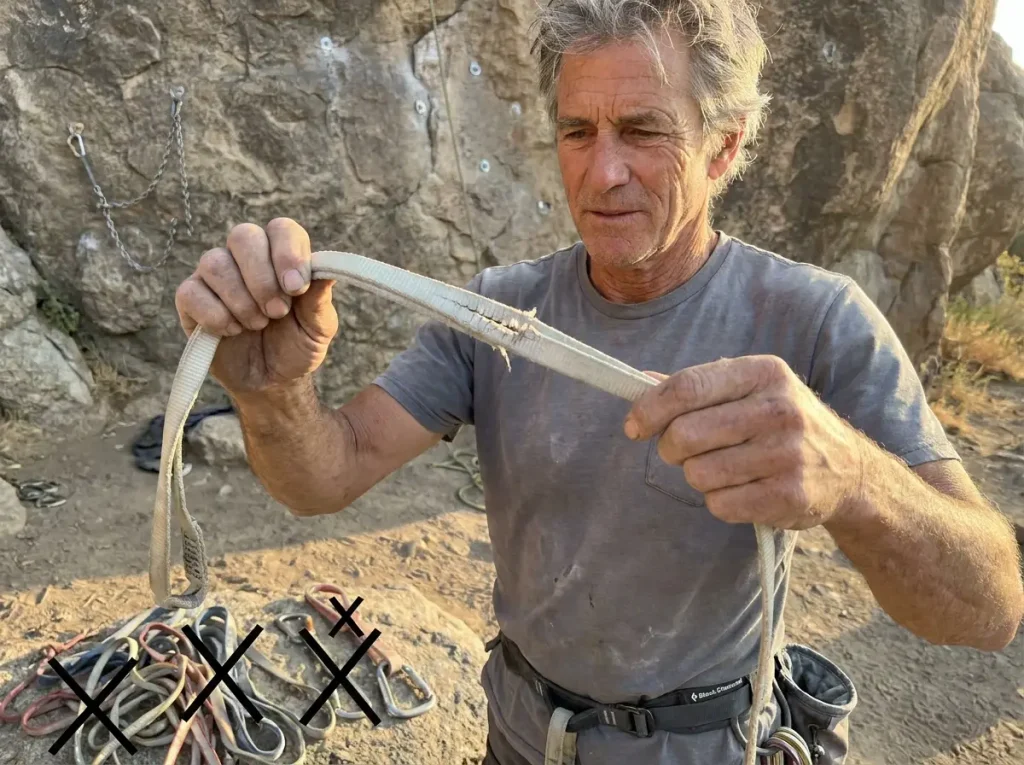
Inspect the full length of each sling for cuts, fraying, and burn marks from rope friction. Pay extra attention to the bar tack stitching at the sewn ends — this is where the sling’s rated strength lives. If the stitching is abraded, frayed, or partially torn, the sling is done. Check for stiffness by folding the sling in half — healthy nylon flexes smoothly; degraded nylon resists the bend and feels papery.
Quickdraw dogbones deserve the same inspection as standalone slings. They sit on your rack for hundreds of pitches, getting loaded over edges, dragged through cracks, and baked in the sun. Many climbers replace their carabiners but forget that the dogbone between them is the actual weak link.
Pro tip: When inspecting slings, flip them inside out at the bar tacks. Damage often hides on the inside face where the sling sits against rock edges — the outside can look fine while the inside is shredded.
Nylon vs Dyneema — How Material Changes the Retirement Math
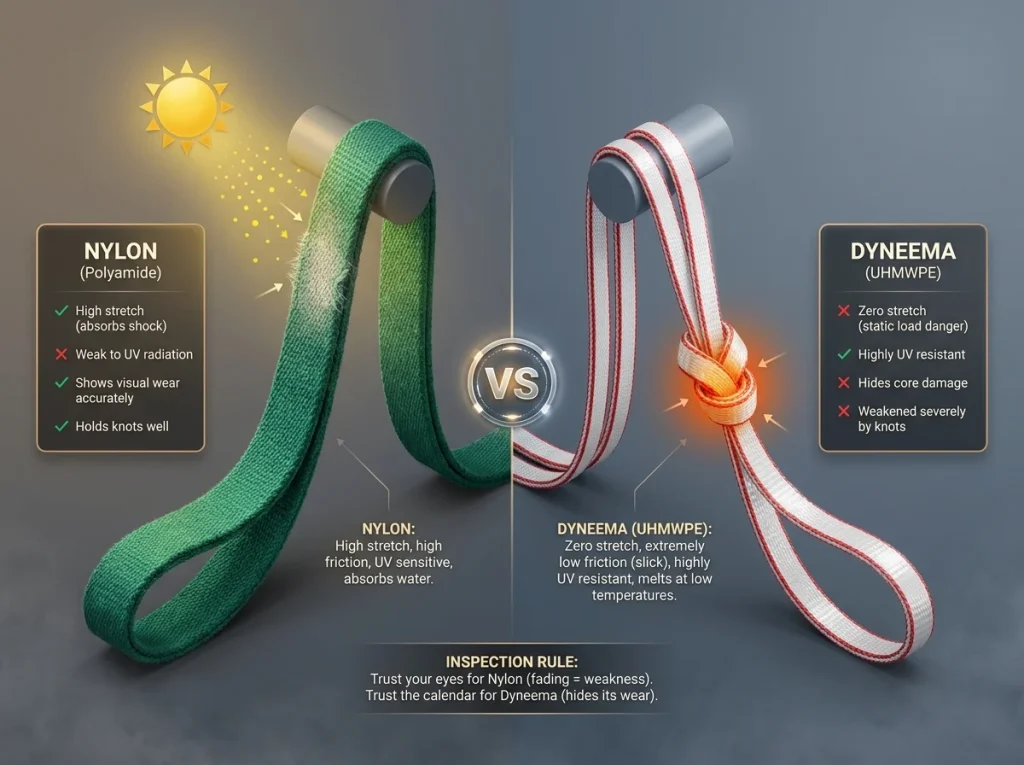
Not all soft goods age the same way, and the material your sling is made from changes what you’re looking for and how urgently you need to act. Nylon (polyamide) and Dyneema (ultra-high-molecular-weight polyethylene, also sold as Spectra or Dynex) are the two main materials, and they degrade through completely different mechanisms.
How Nylon Ages
Nylon is the workhorse of climbing soft goods. It’s strong, it stretches under load (which absorbs energy in a fall), and it’s relatively inexpensive. But nylon is vulnerable to UV radiation — sunlight breaks down the polymer chains and weakens the fiber over time. Black Diamond’s QC Lab testing found that nylon webbing loses roughly 16% of its strength in the first 10 weeks of UV exposure, with slower degradation after that initial drop.
Nylon also absorbs moisture — up to 10% of its weight in humid conditions — and that moisture accelerates a chemical process called hydrolysis that slowly breaks the fiber down from the inside. This is why storage matters: a nylon sling stored damp in a hot trunk degrades faster than one stored dry in a dark closet.
The good news: nylon shows its age visually. Fading, stiffness, and fuzziness are reliable indicators of UV damage. When a nylon sling looks old, it probably is old.
How Dyneema Ages
Dyneema is a different animal. It’s significantly stronger per unit weight than nylon, and it’s nearly immune to UV degradation — the molecular structure of polyethylene doesn’t absorb ultraviolet light the way nylon does. Dyneema slings can sit in the sun for years and retain most of their strength.
The catch: Dyneema is sensitive to heat and repeated flexing. Tying knots in Dyneema weakens it significantly — the tight bend radius damages fibers in a way that nylon handles much better. And Dyneema doesn’t stretch, which means it absorbs impact forces less gracefully than nylon. Over time, repeated loading and unloading fatigues the fibers, especially at crease points.
Black Diamond’s old-vs-new testing showed that a heavily used Dyneema sling lost over half its rated strength — from above 22 kN to just 10.5 kN. The sling still looked decent. That’s the problem with Dyneema: it doesn’t always show its age the way nylon does.
What This Means for Your Rack
If your nylon slings look faded and feel stiff, trust what you’re seeing — they’re telling you the truth. If your Dyneema slings look fine but you’ve been climbing on them hard for three or four years, trust the calendar instead. Dyneema hides its wear better, which makes time-based retirement more important than visual inspection alone.
Pro tip: For anchor building where slings sit over edges and take repeated loads, nylon is often the better choice despite being heavier. It shows wear honestly, stretches to absorb shock, and handles edge loading better than Dyneema. Save Dyneema for alpine draws and situations where weight savings matter most.
The Feel Test — What Dying Soft Goods Actually Feel Like
This is the part nobody writes about, and it’s the part that matters most once you’ve been climbing long enough. Visual inspection catches obvious damage — cuts, core shots, massive fading. But experienced climbers develop a tactile sense for gear condition that goes beyond what your eyes can see. Call it the feel test.
What Healthy Soft Goods Feel Like
A healthy nylon sling is supple. It drapes over your hand, folds easily, and has a slight silky texture. A healthy rope coils smoothly without memory kinks, and when you pinch it, it has uniform resistance all the way around — no mushy spots, no hard spots. Healthy webbing bends without resistance when you fold it in half. These are the baselines. You need to know them so you can recognize when something changes.
What Degraded Soft Goods Feel Like
A nylon sling that’s dying feels papery. It’s lost its flexibility and resists folding — when you bend it sharply, it holds the crease instead of springing back. In severe cases, you can hear it crackle slightly, like bending a piece of cardstock. That sound is polymer chains snapping at the fold point.
A rope that’s past its life feels dead in your hands. It doesn’t have that springy lively quality anymore. When you pinch and roll it between your fingers, you’ll find sections that feel flat or uneven — internal damage that the sheath is masking. Old ropes also develop persistent kinks that won’t flake out, a sign that the core has deformed permanently.
Old webbing on quickdraw dogbones develops a glazed, almost shiny surface from repeated loading. This glazing is a sign of fiber compression and heat buildup from friction. The dogbone will feel stiffer through the middle section where it contacts the rock, even if the ends near the carabiners still feel normal.
When Feel Overrides the Calendar
Here’s the thing: a sling can be two years old and feel terrible if it’s been abused — dragged over sharp edges, left in a hot car all summer, caught in a factor-two fall. And a sling can be five years old and feel perfectly healthy if it’s been well stored and lightly used. The manufacturer timeline is the outer boundary, but the feel test can tell you to retire something sooner. When your hands say this isn’t right, listen to them. Your fingers have been handling this stuff for hundreds of pitches — they know what right feels like.
When Fixed Gear at the Crag Looks Sketchy
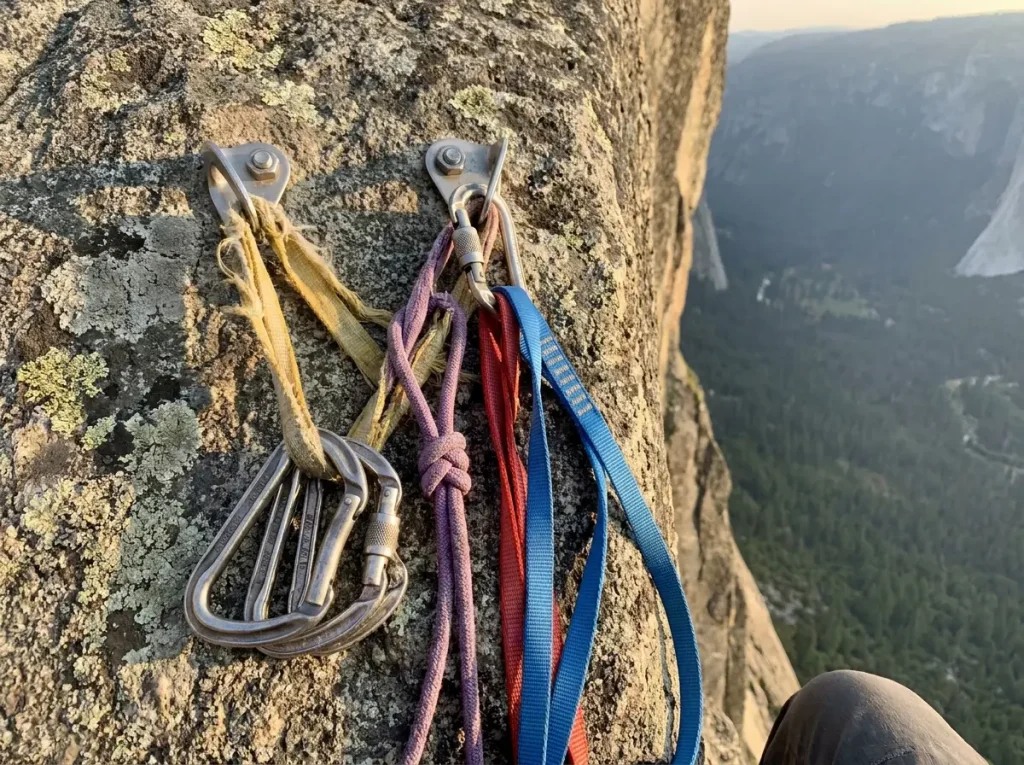
Your personal soft goods are one thing — you know their history, when you bought them, how hard you’ve climbed on them. Fixed gear at the crag is a completely different calculation. Those sun-bleached slings at the rappel station, the faded cord connecting the anchors, the bail biner with a grooved gate — somebody put those there, and you have no idea when or what they’ve been through since.
How to Read Fixed Soft Goods
Start with color. Severe fading is the most reliable visual indicator of UV damage on fixed slings. A nylon sling that’s faded from bright blue to pale grey has been cooking in the sun for years. That color loss correlates directly with strength loss — the same UV radiation that bleaches the dye also breaks down the nylon fibers. If the sling has faded to the point where you can’t tell what color it originally was, treat it as compromised.
Feel the webbing. Fixed slings that have been exposed to weather cycles — freezing, thawing, rain, baking sun — often feel brittle and stiff. They’ve gone through hundreds of moisture absorption and evaporation cycles that accelerate hydrolysis. A healthy sling should fold easily in your hand. A fixed sling that resists folding has likely lost significant strength.
Check the knots. Fixed cord tied with a double fisherman’s or overhand knot concentrates stress at the bend points. If the cord at the knot looks discolored, compressed, or frayed compared to the free-hanging sections, the knot area is weaker than the rest — and the rest is already suspect.
The Backup Rule
The safest approach to fixed soft goods is simple: always add your own. Clip into the existing anchor setup, but equalize through your own sling or cordelette rather than trusting the fixed webbing as your sole attachment. Carry a couple of extra slings specifically for backing up sketchy anchors — a 120cm nylon sling weighs almost nothing and can save your life if that sun-bleached bail sling lets go during a rappel.
If you’re the last one down and you’ve added good gear to a sketchy anchor station, consider leaving your sling in place. It costs you fifteen dollars and protects the next climber who shows up. This is part of the stewardship ethic that keeps crags safe for everyone.
Pro tip: Carry a permanent marker in your chalk bag. When you encounter fixed soft goods that are clearly past their lifespan — faded white, stiff, frayed — mark them with a large X after adding your backup. It signals to the next party that someone assessed this gear and found it wanting. Don’t cut them unless you’re replacing them entirely — other climbers may not have backup gear.
Conclusion
Retiring soft goods comes down to three things: know the manufacturer timelines and treat them as hard limits, not suggestions. Inspect with your hands, not just your eyes — the feel test catches degradation that visual checks miss, especially on Dyneema. And never trust fixed gear at the crag without backing it up with your own.
The cost of a new sling is fifteen dollars. The cost of a new harness is a hundred. The cost of trusting gear past its lifespan is a conversation nobody wants to have. Check your soft goods, log your purchase dates, and build the habit of honest assessment. Your hands already know what healthy gear feels like — start listening to them.
Q1 How long do climbing slings last?
Climbing slings last 3–5 years with regular use, or up to 10 years if stored properly and rarely used. Nylon slings show age through fading and stiffness, while Dyneema slings hide wear — retire Dyneema by calendar if visual inspection doesn’t reveal issues.
Q2 How often should you replace a climbing harness?
Replace a climbing harness every 1–3 years with regular use, or after 7 years maximum even if unused. Check the belay loop wear indicator and inspect tie-in points and buckle webbing before every session for fraying or abrasion.
Q3 Can you use an old climbing rope?
An old climbing rope can be used if it passes a thorough inspection — no flat spots, soft spots, core shots, or excessive stiffness. But any rope over 10 years old from its manufacture date should be retired regardless of condition or storage quality.
Q4 Does climbing webbing expire?
Yes. All textile climbing gear has a finite lifespan due to polymer degradation from UV, moisture, and time. Manufacturers recommend retiring webbing and cord after 10 years maximum, with active-use lifespan closer to 3–5 years depending on frequency and conditions.
Q5 Should you trust old fixed slings at a climbing anchor?
Never trust old fixed slings as your sole attachment point. Always back them up with your own sling or cordelette. Severely faded, stiff, or frayed fixed webbing has likely lost significant strength and should be supplemented or replaced entirely.
Safety Notice: Rock climbing and mountaineering are inherently high-risk
activities that can involve physical trauma or fatal incidents. The information on Rock Climbing Realms is for
educational and informational purposes only. Techniques and advice presented here are not a substitute
for professional, hands-on instruction. Conditions and risks vary by location. Always seek guidance
from a qualified instructor before attempting new techniques. By using this website, you agree that you
are solely responsible for your own safety. Any reliance you place on this information is strictly
at your own risk, and you assume all liability for your actions. Rock Climbing Realms and its authors
will not be held liable for any harm, damage, or loss sustained in connection with the use of this information.
Affiliate Disclosure: We are a participant in the Amazon Services LLC Associates Program, an
affiliate advertising program designed to provide a means for us to earn advertising fees by advertising and linking
to Amazon.com. As an Amazon Associate, we earn from qualifying purchases. We are also an official affiliate partner
of Black Diamond Equipment via the AvantLink network. If you click on a Black Diamond affiliate link and make a
purchase, we may earn a commission at no additional cost to you. We also participate in other affiliate programs.
Additional terms are found in the terms of service.